Introduction
Hemorrhage remains the major cause of preventable death in trauma, accounting for an estimated 35% of civilian prehospital trauma deaths and 40% of deaths in the first 24 hours post-injury.Reference Kauvar, Leferin and Wade1 In the military environment, more than 90% of potentially survivable combat deaths are due to exsanguinating hemorrhage.Reference Eastridge, Mabry and Seguin2 In the civilian environment, intentional mass-trauma events continue to increase throughout the world.
Early control of life-threatening hemorrhage prior to shock onset is increasingly recognized as a time-critical intervention in the management of trauma patients. Tourniquets (TQs) have been demonstrated to save lives in these circumstances.Reference Kragh, Littrel and Jones3-Reference King6 As a consequence, both military and civilian trauma systems now emphasize the early, judicious use of TQs for exsanguinating extremity hemorrhage.
In the United States, national programs have been developed to train lay-providers to manage bleeding prior to the arrival of definitive medical care.Reference Elkbuli, Dowd and Casin7,Reference Lei, Swartz and Harvin8 These programs have emphasized the use of commercial, military-approved TQs for hemorrhage control. However, the size of current military TQs, designed to be carried in large first aid pouches, may preclude every day carry (EDC) by trained civilian lay-providers. In the absence of commercial TQs, lay-providers would be forced to fashion improvised TQs, which are less effective in controlling exsanguinating extremity hemorrhage than their commercial counterparts.Reference Loftus, Pynn and Parker9-Reference Stiles, Cook and Sztajnkrycer11
Several novel commercial TQ designs have been developed that are smaller than conventional military TQs, and therefore may be more amenable to EDC. These designs might improve lay-provider capability when responding to events, including high-threat incidents. However, in contrast to current military TQ designs, less is known about the efficacy of these designs in effectively controlling extremity hemorrhage. The purpose of the current study was to compare the efficacy of three novel commercial TQs to a military-approved TQ in an in-vivo model of arterial occlusion and generated force.
Methods
Study Population and Setting
Four specific TQs were evaluated: the Generation 7 Combat Application Tourniquet (CAT7; control; CAT Resources, Rock Hill, South Carolina USA); Stretch Wrap and Tuck Tourniquet (SWAT-T; H and H Medical, Williamsburg, Virginia USA); Generation 2 Rapid Application Tourniquet System (RATS; RATS Medical, Salt Lake City, Utah USA); and Tourni-Key (TK; CitizenAid, Wolverhampton, United Kingdom). The study was reviewed and approved by the Mayo Clinic Institutional Review Board (Rochester, Minnesota USA).
Study Design
Study 1: Lower Extremity Distal Flow Cessation Study—An un-blinded study of TQ application efficacy and time to successful application was conducted. Study participants consisted of nine Emergency Medicine residents from a single program. Each participant performed a single application attempt with each TQ design, resulting in four trials per participant and a total of 36 independent observations. All were provided 30 minutes opportunity to review and become familiar with the four TQ designs prior to the application attempt.
A single male volunteer, 178 cm, 88.2 kg, left thigh circumference 50.5 cm, was utilized to evaluate lower extremity distal flow cessation. Location for TQ application was marked on the mid-left thigh.
Starting position for each of the four TQ was defined as follows:
1. CAT7: Constricting band loosely placed around extremity at marked application point;
2. SWAT-T: Elastic band held against extremity at marked application point;
3. RATS: Elastic band loosely placed around extremity at marked application point; and
4. TK: Men’s necktie wrapped around limb at marked application point, first knot applied; anti-pinch card not utilized.
New CAT7 TQs and men’s neckties were used for each application in order to avoid stretch effects on the material.
Prior to starting each application evolution, the left leg was elevated slightly above the bed to ensure consistent application and arterial visualization. The TQ was maximally tightened and time recorded. Once tightened, presence or absence or popliteal artery blood flow distal to the TQ was determined using a Zonare ZS3 ultrasound (Mindray Medical USA Corp; Mahwah, New Jersey USA).
Study 2: Upper Extremity Generated Force Study—An un-blinded study of TQ application using the previously described four TQs was conducted. A single male volunteer, 178 cm, 88.2 kg, left upper arm circumference 34.5 cm mid-biceps, was utilized to evaluate force generated by each TQ. Location for TQ application was marked on the left upper arm at the mid-bicep level.
Successful TQ application was determined by loss of left radial pulse. Generated force was measured with a capacitive-based force sensor (SingleTact; Pressure Profile Systems, Inc., Glasgow, Scotland, United Kingdom). A single pre-calibrated circular sensor (0.35 in thickness, 15mm in diameter, 450N max force) was placed between the skin and the TQ at a standardized location on the lateral aspect of the arm centered under the TQ. Force was measured at 40Hz while the TQ was tightened to full application. The steady state maximal generated force was maintained for 30 seconds. A single steady state measurement was recorded for each TQ.
Outcome Measures
The primary outcome measures for Study 1 were time to TQ application from standard starting position and sonographic assessment of cessation of flow through the popliteal artery. The primary outcome measure for Study 2 was steady-state generated force.
Data Collection
For Study 1, de-identified participant data were entered into a Microsoft Excel Database (Microsoft Excel for Mac 2011, v14.4.3; Microsoft Corporation, Redmond, Washington USA). For Study 2, output from the circular pressure sensor system was collected every second, and an average steady-state generated force calculated.
Statistical Analyses
Times were compared using either one-way ANOVA or paired two-tailed t-tests. Success rates were analyzed using Kruskall-Wallace or two-tailed Fisher Exact Tests. All tests were two-sided and P values <.05 were considered statistically significant. Bonferroni correction was applied for multiple comparisons.
Results
Study 1: Lower Extremity Distal Flow Cessation Study
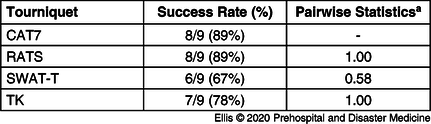
Tourniquet success rates for complete cessation of arterial flow are shown in Table 1. Overall, no difference in success rate existed between the three novel TQs and the control CAT7 (H 0.89; P = .83). Pairwise comparisons likewise failed to demonstrate any significant difference in success rates.
Successful Tourniquet Application Rates for Popliteal Artery Flow Cessation

Note: The presence or absence of popliteal artery complete occlusion following tourniquet placement, as determined by Zonare ZS3 ultrasound assessment, was recorded. Success rate assessment for each of the four individual tourniquet models consisted of nine independent observations.
Abbreviations: CAT7, Generation 7 Combat Application Tourniquet; RATS, Generation 2 Rapid Application Tourniquet System; SWAT-T, Stretch Wrap and Tuck Tourniquet; TK, Tourni-Key.
a Kruskall-Wallace comparison H = 0.98; P = .82.
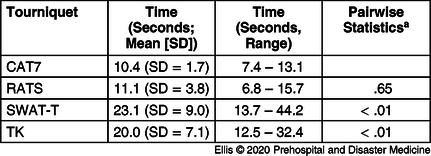
Times for TQ application are provided in Table 2. A significant difference was noted between the three novel TQs and the control CAT7 (F 9.71; P <.01). Significant time differences existed between the SWAT-T (P <.01) and the TK (P <.01) compared with the CAT7, while no significant time difference was observed between the RATS and the CAT7 (P = .65). The mean time for TQ application with all four systems was less than 30 seconds.
Time for Tourniquet Application

Note: Time in seconds for lower extremity tourniquet placement was recorded. Time assessment for each of the four individual tourniquet models consisted of nine independent observations.
Abbreviations: CAT7, Generation 7 Combat Application Tourniquet; RATS, Generation 2 Rapid Application Tourniquet System; SWAT-T, Stretch Wrap and Tuck Tourniquet; TK, Tourni-Key.
a One-way ANOVA F = 9.71; P <.01.
Study 2: Upper Extremity Force Study
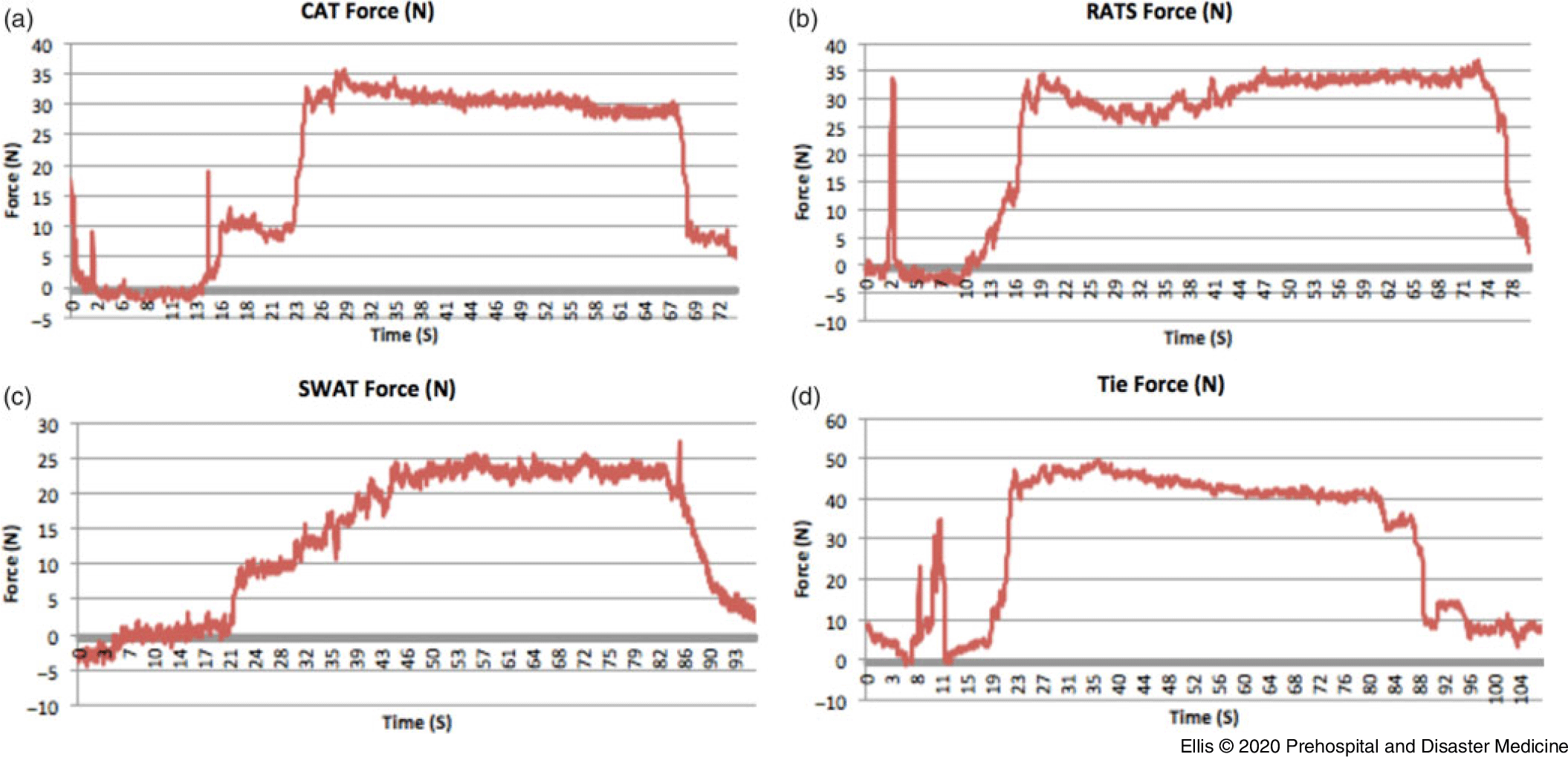
Steady state maximal forces were similar between the four tourniquets (Figure 1; A-D). The force of the CAT7 was midway between the three novel TQs.
Steady-State Maximal Generated Force Measurements for Upper Extremity Tourniquet Applications.

Discussion
Tourniquets save lives.Reference Eastridge, Mabry and Seguin2-Reference Beekley, Sebesta and Blackbourne4,Reference Goodwin, Moore, Pasley, Tronsco, Levy and Coolsby12 Hemorrhagic shock remains the major cause of preventable death in trauma, accounting for 91% of potentially survivable deaths in combat.Reference Eastridge, Mabry and Seguin2 Analysis of potentially survivable combat deaths revealed that 12%-25% of deaths were amenable to TQ use.Reference Eastridge, Mabry and Seguin2,Reference Holcomb, McMullin and Pearse13 Wide-spread use of TQs is credited with a 6.7-fold decrease in extremity exsanguination death.Reference Kragh, Littrel and Jones3
Early hemorrhage control, prior to the onset of shock, is critical. Prehospital TQ application was associated with 89% survival, compared with 78% survival when delayed to the hospital environment.Reference Eastridge, Mabry and Seguin2 Tourniquet application prior to the onset of shock was associated with 96% survival, compared with only four percent survival after the onset of shock.Reference Eastridge, Mabry and Seguin2 It has been estimated that earlier use of TQs would have resulted in a 57% decrease in mortality.Reference Beekley, Sebesta and Blackbourne4
Recent mass-shooting incidents and terrorist events have raised awareness regarding the need for both TQ training and access in the civilian population.Reference King6,Reference Lei, Swartz and Harvin8,Reference King, Larenrzakis and Ramly14,Reference Ramly, Runyan and King15 After the Boston Marathon bombing (2013; Boston, Massachusetts USA), it was noted that 66/153 injured presenting to the hospital in the first 24 hours had extremity trauma.Reference King, Larenrzakis and Ramly14 Despite the military experience, extremity hemorrhage was either left untreated in the prehospital environment or treated with improvised TQs.
Many assumptions concerning bystander involvement during disasters have recently been questioned.Reference Ross, Redman and Mapp16-Reference Cocking19 In Boston, rather than flee or panic, bystander aid was noted to be critical during the initial mass-casualty response, including hemorrhage control.Reference Kellermann and Peleg20 Similar findings have been noted during other mass-violence events. However, these spontaneous responders were ill-equipped to control hemorrhage, resorting to improvised TQs for hemorrhage control. While improvised TQs have been recommended during exigent circumstances, prior studies have noted a 75%-83% failure rate.Reference Kragh, Walters and Baer10,Reference Stiles, Cook and Sztajnkrycer11
The solution to this dilemma is to ensure that spontaneous responders are both trained in hemorrhage control and have immediate access to commercial TQs.Reference Dhillon, Dodd and Hotz21 The most commonly used commercial TQs were developed for military use, and are large and bulky, making them unsuited for civilian EDC. Results of the current study suggest that, compared with a military windlass TQ, the three novel TQ designs are equally effective. No statistically significant difference in success rate for arterial flow occlusion distal to TQ application was noted (Table 1). Although statistically significant differences in time to TQ placement were noted for the SWAT-T and TK compared with the CAT7, the mean application time for all TQ designs was less than 30 seconds (Table 2). As such, it is doubtful that these differences are clinically significant. The force generated by the control CAT7 was midway between that generated by the other TQ designs (Figure 1). Based upon these results, any of the studied designs would appear suitable for civilian EDC.
One intriguing finding was the efficacy of the TK. The TK is a unique design that essentially creates a hybrid improvised/commercial TQ, combining an improvised constricting band (eg, tie or scarf) with a commercial windlass apparatus. Despite being an improvised TQ, the TK had a lower extremity success rate of 78%, a lower extremity mean application time of 20.0 (SD = 7.1) seconds, and the highest generated force rate of any TQ design studied (41.9 [SD = 1.3] N; Figure 1). These findings suggest that with specific training, some improvised TQ designs may be more effective than previously described.Reference Kragh, Walters and Baer10,Reference Stiles, Cook and Sztajnkrycer11 More study is required to optimize improvised TQ design for exigent circumstances.
Limitations
The current study suffers from several limitations, including an un-blinded methodology. The study design included TQ application by multiple participants, thereby limiting operator bias and improving study validity. However, all participants were highly trained emergency medical professionals familiar with the concept and design of TQs, and therefore presumably more facile with application than lay-providers. Prior studies have suggested that non-medical personnel have significant difficulty with the correct application of commercial TQs, particularly without training.Reference Zwislewski, Nanassy and Meyer22-Reference Dennis, Bajani and Schlanser25 Even after receiving stress inoculation training, non-medical providers had a failure rate of 79%, with 62% placed incorrectly.Reference Tsur, Binyamin, Koren, Ohayon, Thompson and Glassberg26 Every day carry without effective training will not adequately improve community resilience and the ability of spontaneous responders to effectively act during a catastrophic event.
A final limitation of the study is that it provides indirect proof of efficacy. In contrast to actual or simulated hemorrhage models, the participants did not have the direct feedback of overt hemorrhage control and cessation of bleeding, which may have impacted time to successful application. Cessation of arterial flow distal to the lower extremity TQ application site was confirmed by real-time ultrasonography. Generated force was documented in the upper extremity after establishing loss of a palpable radial pulse without ultrasound documentation. However, it was anticipated that the force required for upper extremity distal arterial flow cessation would be less than that already demonstrated by ultrasound in the lower extremity model.
Conclusions
All three novel TQ designs appeared to be comparable to the current CAT7 windlass TQ in terms of cessation of distal blood flow and time to successful application. These three novel designs all have a smaller footprint than the CAT, making them more amenable to EDC. Regardless of the selected design, emphasis should be placed on training and equipping spontaneous responders in order to build community resilience in the face of isolated severe trauma and larger scale mass-violence events.
Conflicts of interest
none