Introduction
The developmental origins hypothesis proposes that the roots of some adult diseases can be found in adverse developmental circumstances, such as low birth weight (LBW; Barker, Reference Barker2004). Prematurity is known to predispose infants to many significant adverse outcomes, including general health, and, more specifically, neurological, and cognitive difficulties. Preterm (<37 weeks' gestation) birth and LBW (<2500 g) are common occurrences and a leading cause of disability and infant mortality (Msall & Tremont, Reference Msall and Tremont2002; Stephens & Vohr, Reference Stephens and Vohr2009; Roberts et al. Reference Roberts, Anderson, De Luca and Doyle2010). Medical and neuropsychological profiles of these infants have been well described in the literature (Johnson, Reference Johnson2007), and, increasingly, attention is turning towards psychiatric outcomes in this vulnerable population.
Although many preterm infants survive without major disability, a substantial percentage suffers a greater burden of morbidity than their term-born peers, and consequently utilise health services to a greater degree (Petrou et al. Reference Petrou, Henderson, Bracewell, Hockley, Wolke and Marlow2006; Fanaroff et al. Reference Fanaroff, Stoll, Wright, Carlo, Ehrenkranz, Stark, Bauer, Donovan, Korones, Laptook, Lemons, Oh, Papile, Shankaran, Stevenson, Tyson and Poole2007; Wilson-Costello, Reference Wilson-Costello2007). Unsurprisingly, mortality and morbidity are strongly related to size and maturity at birth. Preterm birth is classified according to gestational age, with categories including preterm, very preterm (VP; <32 weeks' gestational age), and extremely preterm (EP; <28 weeks' gestational age). Infant birth weight is also divided into similar categories, including LBW, very low birth weight (VLBW; <1500 g) and extremely low birth weight (ELBW; <1000 g). In relation to neuropsychological deficits, a ‘gestational-age gradient’ has been widely observed, with the rate and severity of impairment increasing with decreasing gestational age (Johnson, Reference Johnson2007). Further, the survival of the smallest and youngest infants has steadily risen across developed countries over recent decades (Costeloe et al. Reference Costeloe, Hennessy, Gibson, Marlow and Wilkinson2000; Doyle & Victorian Infant Collaborative Study Group, Reference Doyle2004; Doyle et al. Reference Doyle, Roberts and Anderson2010).
In the general population, psychiatric disorders such as anxiety, depression and psychosis often emerge in the adolescent to young adult period, though this may be preceded by childhood emotional and behavioural disturbances (Brady & Kendall, Reference Brady and Kendall1992; Kaufman & Charney, Reference Kaufman and Charney2000; Costello et al. Reference Costello, Mustillo, Erkanli, Keeler and Angold2003; Essau, Reference Essau2003, Reference Essau2008; Ford et al. Reference Ford, Goodman and Meltzer2003; Rutter et al. Reference Rutter, Kim-Cohen and Maughan2006; Boeing et al. Reference Boeing, Murray, Pelosi, McCabe, Blackwood and Wrate2007; Zahn-Waxler et al. Reference Zahn-Waxler, Shirtcliff and Marceau2008). In studies where Diagnostic and Statistical Manual of Mental Disorders (DSM) criteria have been employed, an increased prevalence of attention deficit hyperactivity disorder (ADHD) has been found in those born preterm, with one meta-analysis finding that preterm children face a risk ratio of 2.64 [95% confidence interval (CI) 1.85–3.78] compared with controls (Bhutta et al. Reference Bhutta, Cleves, Casey, Cradock and Anand2002). Preterm birth is also associated with later social, externalising and behavioural problems (Botting et al. Reference Botting, Powls, Cooke and Marlow1997; Bhutta et al. Reference Bhutta, Cleves, Casey, Cradock and Anand2002; Anderson & Doyle, Reference Anderson and Doyle2003; Foulder-Hughes & Cooke, Reference Foulder-Hughes and Cooke2003; Gray et al. Reference Gray, Indurkhya and McCormick2004; Delobel-Ayoub et al. Reference Delobel-Ayoub, Kaminski, Marret, Burguet, Marchand, N'Guyen, Matis, Thiriez, Fresson, Arnaud, Poher and Larroque2006), but these studies can be limited by small sample sizes, particularly with respect to subgroups with lower survival rates (i.e. individuals born ELBW/EP), and a reliance on the use of non-diagnostic questionnaires to assess psychopathological symptoms.
Population-wide record keeping in Scandinavian countries permits the linking of registers to produce large-scale studies. These have been a fruitful source of information regarding outcomes related to prematurity, and suggest that psychiatric sequelae are prominent in young adulthood. Lindström et al. followed up a sample of over half a million people born in Sweden in the 1970s (Lindström et al. Reference Lindström, Lindblad and Hjern2009). In young adulthood, these authors found a stepwise increase in psychiatric hospital admissions as gestational age reduced, after adjusting for socio-economic confounders [hazard ratios: 1.68 for VP (gestational age <32 weeks); 1.21 for moderately preterm (gestational age 33–36 weeks); 1.08 for early term group (gestational age 37–38 weeks)]. In addition, the effect of preterm birth was greater in households with low socio-economic status, suggesting an interaction between biological and social vulnerabilities. Hospitalization for anorexia nervosa has also been reported to be higher in girls born very preterm, with risk further increased for individuals born small for gestational age (SGA; birth weight<two standard deviations below the mean for gestational age) (Cnattingius et al. Reference Cnattingius, Hultman, Dahl and Sparén1999). Birth weight may exert a non-specific effect on psychiatric outcome, with the likelihood of diagnoses from in-patient and out-patient services of schizophrenia, affective disorder, neurotic disorders and substance-use disorders negatively related to birth weight (Abel et al. Reference Abel, Wicks, Susser, Dalman, Pedersen, Mortensen and Webb2010). Differences have also been noted between preterm and term-born young adults with respect to out-patient interventions for psychiatric conditions. Formerly preterm individuals are more likely to be prescribed psychopharmacological treatments for psychosis, depression and anxiety (Crump et al. Reference Crump, Winkleby, Sundquist and Sundquist2010), and susceptibility to stress in young men appears to increase as birth weight decreases (Nilsson et al. Reference Nilsson, Nyberg and Östergren2001).
Although data from register studies are informative, alternative sources of diagnostic information should also be pursued. For instance, the nature of the registers is such that latent, or hitherto undiagnosed, conditions are unable to be recorded. Consequently, disorders that are not sufficiently severe to warrant hospitalization or pharmacological intervention, but are still clinically relevant, may not be included in estimates of prevalence. Indeed, mental illnesses including depression and anxiety often go undiagnosed and untreated, with disabling consequences (WHO World Mental Health Survey Consortium, 2004). In addition, such registers are only available in a very limited number of countries. The individuals included in register studies published to date tend to be born in the 1970s, and to have received vastly different neonatal care compared with more recent cohorts of preterm individuals, which may affect the degree of vulnerability experienced by survivors of preterm birth.
Non-diagnostic assessments of behavioural and emotional problems are widely used in prematurity research and permit a more fine-grained view of the severity of these difficulties. Most studies assessing preterm children for attentional dysfunction find a higher prevalence of the disturbance in preterm samples (Bhutta et al. Reference Bhutta, Cleves, Casey, Cradock and Anand2002). Unsurprisingly, when analysis is restricted to VP and/or VLBW children, attention problems remain much more prevalent than amongst controls (Aarnoudse-Moens et al. Reference Aarnoudse-Moens, Weisglas-Kuperus, van Goudoever and Oosterlaan2009). The literature is less consistent with respect to emotional functioning, however, with evidence of both poorer outcomes in preterm groups than controls (Anderson & Doyle, Reference Anderson and Doyle2003; Hack et al. Reference Hack, Youngstrom, Cartar, Schluchter, Taylor, Flannery, Klein and Borawski2005; Farooqi et al. Reference Farooqi, Hägglöf, Sedin, Gothefors and Serenius2007; Bohnert & Breslau, Reference Bohnert and Breslau2008; Samara et al. Reference Samara, Marlow and Wolke2008) and of similar outcomes for preterm groups and controls (Hille et al. Reference Hille, den Ouden, Saigal, Wolke, Lambert, Whitaker, Pinto-Martin, Hoult, Meyer, Feldman, Verloove-Vanhorick and Paneth2001, Reference Hille, Dorrepaal, Perenboom, Gravenhorst, Brand and Verloove-Vanhorick2008; Cooke, Reference Cooke2004; Herva et al. Reference Herva, Pouta, Hakko, Läksy, Joukamaa and Veijola2008). In a recent meta-analysis, parental reports of internalising and externalising problems did not differ between VP/VLBW and control children, with small combined effect sizes (Aarnoudse-Moens et al. Reference Aarnoudse-Moens, Weisglas-Kuperus, van Goudoever and Oosterlaan2009). However, there was high heterogeneity across studies with respect to parental impressions of internalising difficulties (Aarnoudse-Moens et al. Reference Aarnoudse-Moens, Weisglas-Kuperus, van Goudoever and Oosterlaan2009). In adolescence, however, those born preterm may have different perceptions of their emotional functioning to their parents (Brown et al. Reference Brown, Kilbride, Turnbull and Lemanek2003; Saigal et al. Reference Saigal, Pinelli, Hoult, Kim and Boyle2003). A number of studies employing psychopathology questionnaires have also reported significantly more preterm/LBW individuals within the clinical or borderline ranges on these measures in childhood (Samara et al. Reference Samara, Marlow and Wolke2008; Delobel-Ayoub et al. Reference Delobel-Ayoub, Arnaud, White-Koning, Casper, Pierrat, Garel, Burguet, Roze, Matis, Picaud, Kaminski and Larroque2009) and adolescence (Gardner et al. Reference Gardner, Johnson, Yudkin, Bowler, Hockley, Mutch and Wariyar2004; Dahl et al. Reference Dahl, Kaaresen, Tunby, Handegard, Kvernmo and Ronning2006). Some research suggests a disproportionate risk for adolescent ELBW boys (Grunau et al. Reference Grunau, Whitfield and Fay2004c). These screening measures act as a proxy for psychiatric dysfunction or distress, but are unable to provide information about the prevalence rates of clinically diagnosable disorders. The consistency between these data and findings from studies using clinical criteria remains unclear.
In light of this, the present article aimed to use meta-analytic techniques to synthesise findings of clinically diagnosable psychiatric disorders in preterm or LBW individuals born in more recent times. In contrast to the meta-analysis by Aarnoudse-Moens et al. (Reference Aarnoudse-Moens, Weisglas-Kuperus, van Goudoever and Oosterlaan2009), which used parent and teacher questionnaire ratings to examine mean rates of internalising and externalising symptoms, we will focus on the rates of clinical diagnosis of mental illness. This requires analysis of studies that assessed for a range of psychiatric conditions in late school-age, adolescent and young adult samples. The primary aim of this paper was to examine the prevalence of any psychiatric diagnosis in those born preterm or LBW (meta-analysis 1). A second, auxiliary, aim was to investigate the prevalence of anxiety and depressive disorders in preterm/LBW individuals during the high-risk period from late school-age to early adulthood (meta-analysis 2). We did not examine rates of ADHD, since reports of increased rates of ADHD in preterm individuals have been widely replicated both at the diagnostic and dimensional levels (Breslau et al. Reference Breslau, Brown, Del Dotto, Kumar, Ezhuthachan, Andreski and Hufnagle1996; Foulder-Hughes & Cooke, Reference Foulder-Hughes and Cooke2003; Samara et al. Reference Samara, Marlow and Wolke2008), and demonstrated by past meta-analysis (Bhutta et al. Reference Bhutta, Cleves, Casey, Cradock and Anand2002). The prevalence of emotional disorders in preterm individuals, on the other hand, is much less well understood.
Method
Study selection
For both analyses, relevant research findings published in peer-reviewed journals were found using the PubMed and PsycINFO electronic databases. Studies were found using the following search terms in various combinations: ‘preterm’, ‘low birthweight’, ‘psychiatr*’, ‘DSM’ and ‘ICD’. Searches were limited to include articles published between 1995 and 2010 in peer-reviewed English-language journals. The articles found by this broad search were then screened by title and, where necessary, by abstract. In addition, reference lists of accepted published articles were reviewed in order to identify further relevant research.
Specific inclusion criteria were as follows: (1) publication either in print or online between 1995 and November 2010; (2) a case-control design, with inclusion of a group of children, adolescents or young adults born preterm/LBW and a control group of term-born individuals; (3) use of a diagnostic instrument to assess a range of psychiatric disorders meeting DSM 4th edition (DSM-IV; APA, 2000), DSM 3rd edition – revised (DSM-III-R; APA, 1987) or International Classification of Diseases, 10th revision (ICD-10; WHO, 2007) criteria; (4) participant ages between 10 and 25 years, i.e. from late primary-school age to young adult period; (5) did not report on the same cohort as in other publications; and (6) publication in a peer-reviewed, English-language journal. Studies were included if they reported the prevalence of DSM diagnoses in prematurely born and term-born individuals and if they specified the number of participants in each group. No minimum sample size was imposed, as studies of formerly preterm individuals, particularly those of lowest gestational age or birth weight, often comprise only relatively small numbers of participants.
Statistical analyses
Meta-analysis was conducted using Review Manager (RevMan) software v. 5.0 (The Cochrane Collaboration, Denmark). Fixed-effects Mantel–Haenszel meta-analysis was performed, with results presented as odds ratios (ORs) and 95% CIs. The contribution of individual studies is weighted by the inverse variance method. The I 2 statistic was used to measure heterogeneity across study findings. The I 2 statistic indicates the percentage of variation in effect size attributable to heterogeneity between studies, and is classified as mild (25%), moderate (50%) or high (75%) (Higgins et al. Reference Higgins, Thompson, Deeks and Altman2003).
With respect to meta-analysis 2, some studies (Botting et al. Reference Botting, Powls, Cooke and Marlow1997; Elgen et al. Reference Elgen, Sommerfelt and Markestad2002; Indredavik et al. Reference Indredavik, Vik, Heyerdahl, Kulseng, Fayers and Brubakk2004) reported the number of anxiety and depressive diagnoses but did not indicate the number of individuals who received co-morbid anxiety and/or depressive diagnoses. It was assumed for the purpose of meta-analysis that these represented individual cases.
Results
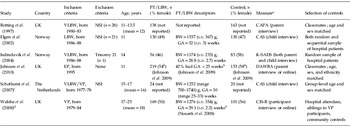
The literature search yielded 719 articles in the broad search; of these, only six studies produced categorical diagnostic data that passed the inclusion and exclusion criteria (Botting et al. Reference Botting, Powls, Cooke and Marlow1997; Elgen et al. Reference Elgen, Sommerfelt and Markestad2002; Indredavik et al. Reference Indredavik, Vik, Heyerdahl, Kulseng, Fayers and Brubakk2004; Schothorst et al. Reference Schothorst, Swaab-Barneveld and van Engeland2007; Walshe et al. Reference Walshe, Rifkin, Rooney, Healy, Nosarti, Wyatt, Stahl, Murray and Allin2008; Johnson et al. Reference Johnson, Hollis, Kochhar, Hennessy, Wolke and Marlow2010). Where cohorts were followed longitudinally and diagnostic data were available at multiple time points (Schothorst et al. Reference Schothorst, Swaab-Barneveld and van Engeland2007), data were included from the latest time point, so as to avoid the need for a repeated-measures analysis. In addition, one study reported findings from a VLBW/VP group and a term-born SGA group (Indredavik et al. Reference Indredavik, Vik, Heyerdahl, Kulseng, Fayers and Brubakk2004); data from the SGA group were excluded from analysis as they were not preterm. Relevant data from each study are displayed in Table 1. As can be seen in Table 1, there is variability in the tools employed for diagnostic criteria for psychiatric disorders, and in the birth characteristics of the participants. The studies were all conducted in the UK or other European countries.
Methodological features of studies included in meta-analyses 1 and 2

PT, Preterm (<37 weeks' gestation); LBW, low birth weight (<2500 g); VLBW, very low birth weight (<1500 g); NSI, neurosensory impairment; CAPA, Child and Adolescent Psychiatric Assessment; BW, birth weight; s.d., standard deviation; GA, gestational age; CAS, Child Assessment Schedule; K-SADS, Schedule for Affective Disorders and Schizophrenia in Children; EP, extremely preterm (<26 weeks); DAWBA, Development and Well Being Assessment; VP, very preterm (<32 weeks); CIS-R, Clinical Interview Schedule-Revised; DSM-III-R, Diagnostic and Statistical Manual of Mental Disorders, Third Edition Revised; ADHD, attention deficit hyperactivity disorder; ICD, International Classification of Diseases.
a Diagnoses assessed: CAPA: DSM-III-R ADHD, depression, generalized anxiety, conduct, and oppositional disorders; CAS: DSM-III-R depression, anxiety disorders (including separation anxiety, phobia), enuresis, encopresis, ADHD, conduct, and oppositional disorders; CIS-R: ICD-10 mixed anxiety and depressive disorder, depressive episodes, anxiety disorders (including agoraphobia, generalized anxiety disorder, panic disorder, social phobia, obsessive-compulsive disorder); DAWBA: DSM-IV ADHD, anxiety disorders (including separation anxiety, specific phobia, post-traumatic stress disorder, and generalized anxiety disorder), childhood emotional disorder not otherwise specified, major depression, autism spectrum disorders, tic disorder, conduct, and oppositional disorders; K-SADS: DSM-IV anxiety disorders (including separation anxiety, generalized anxiety, social phobia, specific phobia), depressive disorder, ADHD, conduct disorder, Asperger's disorder, adjustment disorder, elimination disorder, post-traumatic stress disorder, stuttering, tic disorder. No findings of bipolar, psychotic, or eating disorders.
b Estimate only; data not specifically reported in included articles and available only from other articles (as cited) reporting on the same birth cohort.
c Not included in meta-analysis 2.
d Not included in meta-analysis 1.
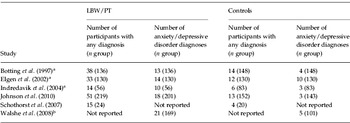
Dichotomous data (i.e. number of participants with and without any psychiatric diagnosis for meta-analysis 1, and number of participants with anxiety or depressive disorders for meta-analysis 2) from the studies are presented in Table 2.
Number of individuals receiving any psychiatric diagnosis and number of anxiety or depressive disorder diagnoses made in included studies

LBW, Low birth weight; PT, preterm.
a The presence of co-morbid anxiety and depressive disorders was not clear; the number of diagnoses was treated as separate cases for analysis.
b Only anxiety and depressive disorders were found in this study.
The six combined studies yielded 734 individuals in the preterm/LBW groups and 634 individuals in the control groups.
Meta-analysis 1: studies using DSM/ICD diagnostic instruments
The five combined studies in meta-analysis 1 yielded 565 individuals in the preterm/LBW groups and 533 individuals in the control groups. Fig. 1 displays relevant data from the studies included with any psychiatric diagnosis, and their weight in the analysis according to total sample size (i.e. controls and cases combined). The rates of any psychiatric diagnosis were statistically significantly higher in the preterm/LBW groups in each study, and overall.
Fixed-effects meta-analysis comparing prevalence of any psychiatric diagnosis in preterm (PT) and low birth weight (LBW) and control individuals. M-H, Mantel–Haenszel; CI, confidence interval.

The test for overall effect of group on diagnosis frequency was significant (z=7.42, p<0.00001), and the overall OR for any psychiatric diagnosis was 3.66 (95% CI 2.57–5.21), indicating higher risk for the preterm/LBW group. The I 2 test revealed negligible heterogeneity between the various studies' findings (I 2=0%). Publication bias was assessed using visual inspection of funnel plots (see Appendix), which did not appear suggestive of bias.
Meta-analysis 2: studies reporting clinically diagnosable anxiety and depression
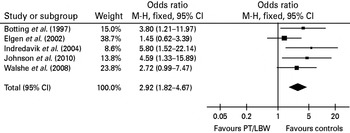
The five combined studies in meta-analysis 2 yielded 692 individuals in the preterm/LBW groups and 605 individuals in the control groups. Fig. 2 displays relevant data from the studies included and their weight in the analysis according to total sample size.
Fixed-effects meta-analysis comparing prevalence of anxiety and depressive disorder diagnoses in preterm (PT) and low birth weight (LBW) and control individuals. M-H, Mantel–Haenszel; CI, confidence interval.

The I 2 test in relation to these data also indicated negligible heterogeneity across study findings (I 2=8%). The test for overall effect of group on the number of anxiety and depression diagnoses reported was significant (z=4.46, p<0.00001), and the overall OR was 2.92 (95% CI 1.82–4.67), indicating higher risk for the preterm/LBW individuals. Publication bias was again assessed using visual inspection of funnel plots (see Appendix). As noted previously, some studies reported the number of anxiety and depressive diagnoses (Botting et al. Reference Botting, Powls, Cooke and Marlow1997; Elgen et al. Reference Elgen, Sommerfelt and Markestad2002; Indredavik et al. Reference Indredavik, Vik, Heyerdahl, Kulseng, Fayers and Brubakk2004), but not whether these disorders each affected different individuals (i.e. no co-morbidity). The present analysis was therefore also performed with the assumption that, in these studies, those with anxiety also had depressive diagnoses in both the preterm/LBW and control groups. The results of this analysis differed only marginally from the original results (OR 2.96, 95% CI 1.70–5.16).
Discussion
This article integrated the published findings of clinically diagnosable psychiatric disorder in cohorts of children, adolescents and young adults born preterm or with LBW. Meta-analysis 1 revealed that preterm/LBW individuals were about 3.5 times more likely to receive a diagnosis of a psychiatric condition in late childhood, adolescence and young adulthood than were their normal birth weight (NBW) peers. Although the included studies were somewhat diverse in sample characteristics such as birth weight, age and birth era, as well as in the instruments used to identify psychiatric disorders, the findings were consistent across studies. Furthermore, the results of meta-analysis 2 indicated that, across the same age range, preterm/LBW individuals were almost three times more likely to receive a diagnosis of an anxiety or depressive disorder than their NBW peers.
The results of the two meta-analyses extend those of larger-scale register-based studies of older individuals born in earlier decades (Lindström et al. Reference Lindström, Lindblad and Hjern2009; Crump et al. Reference Crump, Winkleby, Sundquist and Sundquist2010) by including measures capable of detecting as-yet undiagnosed disorder in younger age groups in a broader geographical region. Those born preterm/LBW were indeed more vulnerable to psychiatric morbidity in general than their NBW peers, and the combined risk of such diagnosis was greater than the risk of hospitalization reported in Swedish data (Lindström et al. Reference Lindström, Lindblad and Hjern2009). Importantly, although some discrepancies exist amongst questionnaire-based studies with regard to elevated levels of internalising difficulties (Hille et al. Reference Hille, den Ouden, Saigal, Wolke, Lambert, Whitaker, Pinto-Martin, Hoult, Meyer, Feldman, Verloove-Vanhorick and Paneth2001; Anderson & Doyle, Reference Anderson and Doyle2003; Cooke, Reference Cooke2004; Farooqi et al. Reference Farooqi, Hägglöf, Sedin, Gothefors and Serenius2007; Hille et al. Reference Hille, Dorrepaal, Perenboom, Gravenhorst, Brand and Verloove-Vanhorick2008), meta-analysis 2 reveals that clinical diagnoses of anxiety and depressive disorders are indeed more common in preterm/LBW survivors. Of course, co-morbidity of anxiety and depressive disorders is extremely common (Essau, Reference Essau2008); unfortunately, it was not possible to determine the precise rate of individuals receiving one versus multiple anxiety/depressive diagnoses from the data reported in a number of included studies. Assuming maximum possible co-morbidity of anxiety and depression in the groups did not, however, alter the outcome of this meta-analysis. The rates of co-morbidity may have differed between the preterm/LBW and control groups, though the study by Johnson et al. (Reference Johnson, Hollis, Kochhar, Hennessy, Wolke and Marlow2010) found EP and NBW children with psychiatric disorders had similar rates of co-morbidity.
The present analyses do have some limitations. As with any review, publication bias is a possibility, though funnel plots of included data were not suggestive of publication bias. The potential exists for relevant research to have been missed in the searching of the literature, though two major databases were searched with broad keywords and reference lists of included papers were also checked. Given the small numbers of studies eligible for inclusion, it was unfortunately not possible to further investigate gradient effects of prematurity with respect to psychiatric outcome. Included studies also differed in the instruments used, birth era and age at assessment, and although the included studies were mainly of VLBW or smaller/younger groups, one study did comprise LBW subjects, with a mean birth weight of 1537 g (Elgen et al. Reference Elgen, Sommerfelt and Markestad2002). Despite this, there was very little heterogeneity across the study findings, suggesting that these factors are unlikely to have distorted the results to any great extent.
Potential mechanisms for increased vulnerability to psychiatric disorders after preterm birth
As a relatively small number of studies met inclusion criteria for the meta-analyses, statistical interrogation of design differences was not possible. Although beyond the scope of the present analyses, mechanisms for vulnerability to poor psychiatric outcome are worthy of further investigation and may well inform our understanding of these disorders in non-preterm individuals. Multiple factors, including birth era, birth weight, gestational age, medical treatment, and so on, are clearly related to the variability in outcome after preterm birth. Nonetheless, the possible mechanisms by which psychiatric disorders become more common in this population are as yet unknown. Preterm infants may face adversities, both pre- and post-natally, that could predispose them to later disorder.
Environmental influences make a substantial contribution to an individual's vulnerability to psychiatric disorders. The family environment plays a critical role in any child's development of appropriate coping strategies and emotional regulation. Long periods isolated from family whilst in hospital can have long-lasting implications for infant–parent attachment, as some families can find such an experience highly distressing (Carter et al. Reference Carter, Mulder, Bartram and Darlow2005). Adolescents born preterm may be more vulnerable to poor coping in the face of family conflict or parental depression (Greenley et al. Reference Greenley, Taylor, Drotar and Minich2007; Nomura et al. Reference Nomura, Wickramaratne, Pilowsky, Newcorn, Bruder-Costello, Davey, Fifer, Brooks-Gunn and Weissman2007). A moderating relationship may exist between maternal internalising disorder, preterm birth and subsequent emotional disorder in offspring. Low socio-economic status is variably associated with an increased prevalence of depression in the general population (Mendelson et al. Reference Mendelson, Kubzansky, Datta and Buka2008). Hack and colleagues found significant VLBW–NBW differences whilst controlling for sociodemographic factors, including maternal education and marital status (Hack et al. Reference Hack, Youngstrom, Cartar, Schluchter, Taylor, Flannery, Klein and Borawski2004). Register-based analyses from Norway also suggest that socio-economic status does not fully account for mood and anxiety symptoms in survivors of preterm birth (Berle et al. Reference Berle, Mykletun, Daltveit, Rasmussen and Dahl2006).
Cognitive ability has also been associated with psychiatric disorders, and cognitive deficits are widely reported after preterm birth. Among young women, childhood intelligence quotient (IQ) was found to predict parent-reported internalising symptoms at age 20 years (Hack et al. Reference Hack, Youngstrom, Cartar, Schluchter, Taylor, Flannery, Klein and Borawski2005). However, EP data suggest that emotional problems cannot be explained by cognitive ability alone (Samara et al. Reference Samara, Marlow and Wolke2008).
With respect to biological risk factors affecting survivors of preterm birth, one candidate may be dysregulation of the stress response and, in particular, of the hypothalamic–pituitary–adrenal (HPA) axis (Huizink et al. Reference Huizink, Mulder and Buitelaar2004). The key function of the HPA axis is to facilitate adaptive stress responses, with the stress hormone cortisol playing a key role (Herman & Cullinan, Reference Herman and Cullinan1997). Abnormal HPA axis function has been implicated in depressive and anxiety disorders, conceptualised in part as an inappropriate, often prolonged, stress response (Lopez-Duran et al. Reference Lopez-Duran, Kovacs and George2009).
The HPA axis may be ‘programmed’ by adverse early life experiences, including compromised prenatal development, repetitive post-natal pain, and medical treatments such as maternal glucocorticoid administration or post-natal corticosteroid treatment (Matthews, Reference Matthews2002; Grunau et al. Reference Grunau, Weinberg and Whitfield2004b; Rice et al. Reference Rice, Jones and Thapar2007; Kapoor et al. Reference Kapoor, Petropoulos and Matthews2008). There is evidence for altered HPA axis responsiveness in survivors of preterm birth in infancy and early childhood, particularly in EP infants (Grunau et al. Reference Grunau, Holsti, Haley, Oberlander, Weinberg, Solimano, Whitfield, Fitzgerald and Yu2004a, b). However, varying evidence exists for abnormalities of different elements of the HPA axis, with more research required to address this issue (Bolt et al. Reference Bolt, van Weissenbruch, Lafeber and Delemarre-van de Waal2002; Walker et al. Reference Walker, Irving, Andrew and Belton2002; Ward et al. Reference Ward, Syddall, Wood, Chrousos and Phillips2004; de Rooij et al. Reference de Rooij, Painter, Phillips, Osmond, Tanck, Bossuyt and Roseboom2006; Buske-Kirschbaum et al. Reference Buske-Kirschbaum, Krieger, Wilkes, Rauh, Weiss and Hellhammer2007; Holsti et al. Reference Holsti, Weinberg, Whitfield and Grunau2007; Kajantie et al. Reference Kajantie, Feldt, Räikkönen, Phillips, Osmond, Heinonen, Pesonen, Andersson, Barker and Eriksson2007).
Furthermore, very few studies have examined neuroanatomical correlates of psychiatric disorders in preterm samples. The preterm brain is a fragile entity and neuroanatomical abnormalities have been identified in infants and adolescents born prematurely (Stewart et al. Reference Stewart, Rifkin, Amess, Kirkbride, Townsend, Miller, Lewis, Kingsley, Moseley, Foster and Murray1999; Abernethy et al. Reference Abernethy, Palaniappan and Cooke2002; Nosarti et al. Reference Nosarti, Al-Asady, Frangou, Stewart, Rifkin and Murray2002; Peterson et al. Reference Peterson, Anderson, Ehrenkranz, Staib, Tageldin, Colson, Gore, Duncan, Makuch and Ment2003; Dyet et al. Reference Dyet, Kennea, Counsell, Maalouf, Ajayi-Obe, Duggan, Harrison, Allsop, Hajnal, Herlihy, Edwards, Laroche, Cowan, Rutherford and Edwards2005; Dudink et al. Reference Dudink, Lequin, van Pul, Biujs, Conneman, van Goudoever and Govaert2007; Narberhaus et al. Reference Narberhaus, Segarra, Caldu, Gimenez, Pueyo, Botet and Junque2008; Ment et al. Reference Ment, Kesler, Vohr, Katz, Baumgartner, Schneider, Delancy, Silbereis, Duncan, Constable, Makuch and Reiss2009). Neuroanatomical findings correlate with adverse neuropsychological, neurodevelopmental and behavioural outcomes in preterm samples (Peterson et al. Reference Peterson, Anderson, Ehrenkranz, Staib, Tageldin, Colson, Gore, Duncan, Makuch and Ment2003; Dyet et al. Reference Dyet, Kennea, Counsell, Maalouf, Ajayi-Obe, Duggan, Harrison, Allsop, Hajnal, Herlihy, Edwards, Laroche, Cowan, Rutherford and Edwards2005; Nosarti et al. Reference Nosarti, Allin, Frangou, Rifkin and Murray2005; Skranes et al. Reference Skranes, Vangberg, Kulseng, Indredavik, Evensen, Martinussen, Dale, Haraldseth and Brubakk2007; Yung et al. Reference Yung, Poon, Qiu, Chu, Lam, Leung, Goh and Khong2007; Beauchamp et al. Reference Beauchamp, Thompson, Howard, Doyle, Egan, Inder and Anderson2008; Narberhaus et al. Reference Narberhaus, Segarra, Caldu, Gimenez, Pueyo, Botet and Junque2008; Soria-Pastor et al. Reference Soria-Pastor, Gimenez, Narberhaus, Falcon, Botet, Bargallo, Mercader and Junque2008; Brown et al. Reference Brown, Inder, Bear, Hunt, Anderson and Doyle2009). There is, however, a paucity of data linking structural brain abnormalities with psychiatric diagnosis, with limited evidence both for and against such a relationship (Indredavik et al. Reference Indredavik, Skranes, Vik, Heyerdahl, Romundstad, Myhr and Brubakk2005; Clark et al. Reference Clark, Woodward, Horwood and Moor2008).
In conclusion, survivors of preterm birth face heightened risk of poor outcomes in a range of domains, widely reported to be commensurate with the degree of prematurity. Here we show that this elevation of risk in those born preterm/LBW extends to psychiatric illness, including anxiety and depression, and that data are consistent across birth eras and assessment instruments used. To the authors' knowledge, this is the first attempt to synthesise clinical diagnostic information from case-control studies using statistical analysis. The findings reported here have important implications for clinical practice and healthcare funding policy. Increased survival of those born prematurely, particularly the smallest and youngest infants, means a greater number of these children engaging with health services across development. The studies reviewed here indicate that, in addition to monitoring and management of medical and cognitive sequelae, the psychological well-being of formerly preterm individuals should be a key part of ongoing care in collaboration between clinicians, individuals and their families. In terms of future research in this field, investigations into co-morbidity of psychiatric disorders are needed to provide a full picture of the risk facing these individuals. In addition, greater understanding is needed as to the mechanisms behind this increased psychiatric risk, with early programming of the HPA axis as a potential candidate. The presence of birth weight/gestational age gradient effects and sex differences could not be elucidated from the current body of literature, and these issues also merit further investigation. Crucially, medical professionals involved in the care of survivors of preterm/LBW are perfectly positioned to assist these vulnerable individuals as they navigate the challenges of adolescence and young adulthood.
Appendix
Funnel plots of included studies: (a) meta-analysis 1 and (b) meta-analysis 2. s.e., Standard error; OR, odds ratio.

Acknowledgements
A.C.B. is supported by an Australian Postgraduate Award. J.C. receives salary support from the Australian National Health and Medical Research Council (NHMRC) Centre of Clinical Research Excellence (CCRE) in Newborn Medicine (no. 546549). P.J.A. acknowledges support from the NHMRC for a Senior Research Fellowship (no. 628371) and project grant (no 491246). C.G.D. is supported by a NHMRC Training (Postdoctoral) Fellowship (no. 628922). S.J.W. was supported by a Clinical Career Development Award from the NHMRC (no. 628711).
Declaration of Interest
None.