INTRODUCTION
Languages vary in the way in which words for disjunction and for conjunction are interpreted in negative sentences. These interpretive differences can be attributed to variation in the scope relations between negation and logical connectives (Crain, Reference Crain2012; Goro, Reference Goro2004, Reference Goro2007). Consider the English sentence The pig did not eat the carrot or the pepper. Here the negative marker not takes scope over the disjunction word or. For English-speaking children and adults the sentence entails that the pig did not eat the carrot and it entails that the pig did not eat the pepper. However, if the English sentence The pig did not eat the carrot or the pepper is translated into many other languages, including Mandarin Chinese, the corresponding sentences do not generate these entailments (Crain, Reference Crain2012; Jing, Crain & Hsu, Reference Jing, Crain, Hsu and Otsu2005). In Mandarin Chinese, the corresponding sentence can be paraphrased as It was either the carrot or the pepper that the pig did not eat. We can understand these cross-linguistic differences in terms of scope. In English, negation takes scope over disjunction, whereas disjunction takes scope over negation in Mandarin. Turkish turns out to be more complex. Turkish patterns like Mandarin when a disjunctive phrase is marked with accusative case, but it patterns like English when a disjunctive phrase is not case marked. One of the goals of the present study was to see how children acquire a language like Turkish, i.e. one with ‘mixed’ scope assignments.
Turning to negative sentences with conjunction, another pattern is revealed across languages. The English sentence The pig did not eat (both) the carrot and the pepper is true in circumstances in which the pig did not eat both the carrot and the pepper, and in circumstances in which the pig ate neither one. This range of truth conditions is generated in English because negation takes scope over conjunction, both in the surface syntax and at the level of semantic interpretation, just as in classical logic. However, if the English sentence The pig did not eat (both) the carrot and the pepper is translated into Mandarin Chinese, Japanese, Russian, or Turkish, the corresponding sentences generate different scope relations, according to which conjunction takes scope over negation. This yields an interpretation that can be paraphrased as It was (both) the carrot and the pepper that the pig did not eat. In summary, English negation takes scope over both logical connectives, disjunction, and conjunction in negative sentences, whereas the pattern is reversed in many other languages, and Turkish adds an unexpected wrinkle involving case marking in negative sentences with disjunction phrases.
The focus of the present study is on the acquisition of scope relations by Turkish-speaking children. For adult Turkish speakers, scope relations are determined in part by case marking. Based on a recent proposal about language learnability and parametric variation, we anticipated that there would be both similarities and differences in scope assignments made by Turkish-speaking children, as compared to Turkish-speaking adults. Differences in the interpretations that are assigned by child and adult language users are important data for theories of language acquisition.
The present study investigated a theoretically motivated account of the different interpretations of negative sentences with logical connectives by child and adult Turkish speakers. Adopting a theory of scope assignment, and a principle of language learnability, we investigated the possibility that Turkish-speaking children and adults would differ in the interpretations they assign to negative sentences with disjunction phrases, but that these differences would not appear in negative sentences with conjunction phrases. If these predictions are upheld, this would provide evidence that is difficult to accommodate by an experience-based approach to language learning. Moreover, confirming differences between child and adult language that are predicted by linguistic theory would augment the growing body of evidence that children's linguistic competence receives assistance from Universal Grammar (Chomsky, Reference Chomsky1965, Reference Chomsky1981, Reference Chomsky1995). Before we turn to the experimental predictions, we briefly review some basic facts about the scope assignments that are generated by Turkish-speaking adults.
THE SYNTAX AND SEMANTICS OF SCOPE IN TURKISH
Conjunction in negative sentences
Turkish is a head-final language, with extensive case marking. Reminiscent of the Japanese mo-…mo- construction, Turkish nouns in conjunction phrases are often preceded by the particle hem…hem (de), as illustrated in (1) and (2). In addition, these conjoined noun phrases can either be accusatively case marked, as in (1), or they can contain bare nouns, as in (2). Sentences (1) and (2) exhibit the same scope relations, with conjunction taking scope over negation at the level of semantic interpretation. It follows from this observation that accusative case marking is not a necessary ingredient for scope assignment of conjunction phrases in Turkish.
(1) Domuz-cuk hem havuc-u hem (de) biber-i ye-me-di.
Pig-dim both carrot-acc both also pepper-acc eat-neg-past
‘The pig didn't eat a certain carrot and the pig didn't eat a certain pepper’
(2) Domuz-cuk hem havuç hem (de) biber ye-me-di.
Pig-dim both carrot both (also) pepper eat-neg-past
‘The pig didn't eat carrots and the pig didn't eat peppers’
The markers hem…hem (de) are not a necessary ingredient for determining scope relations in Turkish. Although de is optional in sentences such as (1) and (2), when it is omitted it may be possible for adult speakers of Turkish to access the ‘not both’ reading of the conjunctive phrase.
In sentences (3) and (4), the hem…hem (de) particles have been replaced by the Turkish word for conjunction ve. As in (1) and (2), the nouns in the conjunction phrase are marked with accusative case in (3), but not in (4). Despite these changes in syntactic structure, sentences (3) and (4) retain the same scope relations that are exhibited by (1) and (2), with the conjunction phrase taking scope over negation at the level of semantic interpretation, though not in the surface syntax (where negation c-commands the conjunction phrases).
(3) Domuz-cuk havuc-u ve biber-i ye-me-di.
Pig-dim carrot-acc and pepper-acc eat-neg-past
‘The pig didn't eat a certain carrot and the pig didn't eat a certain pepper’
(4) Domuz-cuk havuç ve biber ye-me-di.
Pig-dim carrot and pepper eat-neg-past
‘The pig didn't eat carrots and the pig didn't eat peppers’
Alternatively, the particle construction with hem…hem (de) or the conjunction word ve can be replaced by the clitic dA. The nouns that are conjoined can be marked with accusative case, as in (5) or without case marking, as in (6). The clitic dA is a conjunction and connective with several discourse functions, being additive and adversative, and having continuative/topic-shifting and enumerating functions. It occurs after stressed constituents, except when it functions as a continuative/topic-shifting element (Göksel & Kerslake, Reference Göksel and Kerslake2005, p. 101). Again, there is no change in interpretation. The da…da phrase takes scope over negation at the level of semantic interpretation.
(5) Domuz-cuk havuc-u da biber-i de ye-me-di.
Pig-dim carrot-acc both pepper-acc both eat-neg-past
‘It was both a certain carrot and a certain pepper that the pig didn't eat’
(6) Domuz-cuk havuç da biber de ye-me-di.
Pig-dim carrot both pepper both eat-neg-past
‘It was both carrots and peppers that the pig didn't eat’
These facts lead us to conclude that, in adult Turkish, conjunction phrases always take scope over negation.
Disjunction in negative sentences
The interpretation of disjunction in negative sentences in Turkish is more complex. As with conjunction, there are three lexical items in Turkish for expressing disjunction, ya…ya da ‘either or’, veya ‘or’, and ya da ‘or’ (Göksel & Kerslake, Reference Göksel and Kerslake2005). The complication is that, regardless of the lexical expression that is used, disjunction phrases sometimes take scope over negation, and sometimes do not. The critical feature is accusative case marking. Consider example (7), where the disjunction phrase contains the expression ya…ya da ‘either or’ and is accusatively case marked. The interpretation of (7) can be paraphrased using an English cleft structure in which the disjunction phrase (havucu ya da biberi) is positioned higher than negation in the surface syntax: It was either a certain carrot or a certain pepper that the pig did not eat.
(7) Domuz-cuk ya havuc-u ya da biber-i ye-me-di.
Pig-dim either carrot-acc or pepper-acc eat-neg-past
‘It was either a certain carrot or a certain pepper that the pig didn't eat’
In Turkish, however, the disjunction phrase precedes negation in (7), and is positioned in the scope of negation in the surface syntax. Nevertheless, the disjunction phrase takes scope over negation at the level of semantic interpretation, just as it does in the cleft structure we have used in the English gloss for example (7). These observations suggest that, in Turkish, an accusatively marked disjunction phrase is ‘raised’ to take scope over negation at the level of semantic interpretation. In any event, surface syntax in Turkish does not dictate the semantic interpretation, either for accusative case-marked disjunction phrases or for conjunction phrases (whether or not they are case marked). In these kinds of negative sentences, Turkish enforces ‘inverse’ scope relations between both logical connectives (conjunction or disjunction) and negation.
There is an exception to the rule that Turkish enforces ‘inverse’ scope assignments. The exception is illustrated in (8). Although (8) exhibits the same word order and surface syntactic structure as sentence (7), negation takes scope over the disjunction phrase (havuç ya da biber) in (8), just as it does in the corresponding English sentence The pig did not eat the carrot or the pepper. The only difference between (7) and (8) is the absence of case marking in (8). Without case marking, a Turkish disjunction phrase is interpreted in its surface syntactic position (in situ). Consequently, sentence (8) generates the same kind of conjunctive entailment as the English sentence The pig did not eat the carrot or the pepper. That is, sentence (8) entails that the pig didn't eat carrot(s) and that the pig didn't eat pepper(s). In short, accusative case marking is a prerequisite for the inverse scope relations between disjunction and negation in Turkish. Without accusative case marking, the surface syntax dictates scope relations in Turkish, as in English.
(8) Domuz-cuk havuç ya da biber ye-me-di.
Pig-dim carrot or pepper eat-neg-past
‘The pig didn't eat carrots and the pig didn't eat peppers’
In the next section, we show that the surface scope relations in (8) mirror the laws of propositional logic.
LOGIC AND LANGUAGE
First we discuss disjunction. In classical logic, a negative formula with disjunction entails the negation of each of the disjuncts. Let us show why, step by step. First, disjunction in classical logic is inclusive-or. Consider the formula (A ∨ B), where ‘∨’ is the symbol for disjunction. The formula (A ∨ B) is true in three cases: if A is true but not B, if B is true but not A, and if both A and B are true. A statement of the form (A ∨ B) is false, therefore, only if both A and B are false. In symbols, the formula ¬ (A ∨ B) excludes the possibility of A and it excludes the possibility of B. Therefore, the negation of the formula (A ∨ B), in symbols ¬ (A ∨ B) is true just in case both A and B are false. It follows from these observations that ¬ (A ∨ B) logically entails (¬A ∧ ¬B), where ‘∧’ is the symbol for conjunction and ‘⇒’ indicates logical entailment. This logical equivalence is captured in one of the laws of propositional logic: ¬ (A ∨ B) ⇒ (¬A ∧ ¬B).
Negated disjunctions in English conform to this law of propositional logic. The sentence The pig did not eat the carrot or the pepper can be (very roughly) rendered symbolically as ¬ (A ∨ B), and this English sentence generates a ‘conjunctive’ entailment that the pig did not eat the carrot and that the pig did not eat the pepper, which can be rendered symbolically as (¬A ∧ ¬B). Sometimes, Turkish disjunction phrases generate a conjunctive interpretation in negative sentences, namely when the nouns in a disjunction phrase are not marked with accusative case. In such sentences, Turkish conforms to the law under discussion: ¬ (A ∨ B) ⇒ (¬A ∧ ¬B). However, when the disjunction phrase is accusatively case marked in Turkish, the disjunction phrase is interpreted as taking scope over negation. These sentences are true if just one of the disjuncts is false (or if both are). The interpretation generated by this scope assignment (OR > NOT) corresponds to the logical formula (¬A ∨ ¬B), which only excludes the possibility of both A and B being true. Because the disjunction phrase takes scope over negation in the semantic representation of these sentences, the law of propositional logic under discussion does not apply.
In negative sentences with conjunction, another law of propositional logic is relevant: ¬ (A ∧ B) ⇒ (¬A ∨ ¬B). English negative sentences with conjunction conform to this law. Consider, for example, the English sentence The pig did not eat (both) the carrot and the pepper. This sentence can be rendered symbolically as ¬ (A ∧ B), with negation taking scope over the conjunction phrase (NOT > AND). The English sentence entails that the pig did not eat the carrot or did eat the pepper (‘not both’), as in the formula (¬A ∨ ¬B). This shows that English adheres to the law under consideration: ¬ (A ∧ B) ⇒ (¬A ∨ ¬B). In Turkish, by contrast, conjunction phrases always take scope over negation at the level of semantic interpretation (AND > NOT), even if negation is positioned ‘higher’ than the conjunction phrase in the surface syntax. In Turkish, therefore, the interpretation of negated conjunctions can be represented symbolically as (¬A ∧ ¬B). Because the conjunction phrase takes scope over negation in the semantic representation, the law of propositional logic under discussion does not apply.
LEXICAL PARAMETERS
Following a suggestion by Szabolcsi (Reference Szabolcsi, Kenesei and Siptar2002), Goro (Reference Goro2004, Reference Goro2007) and Crain (Reference Crain2012) attribute the cross-linguistic variation in scope assignments to two lexical parameters, one governing the interpretation of conjunction in negative sentences, and one governing the interpretation of disjunction in negative sentences. According to each of the lexical parameters, there are two classes of languages. In one class, the logical expressions corresponding to disjunction or conjunction are analyzed as Positive Polarity Items, but the corresponding logical expressions are not Positive Polarity Items in the other class of languages.
By definition, a Positive Polarity Item (PPI) must take scope over negation. English some meets this definition when it is stressed, as (9) illustrates.
(9) Ted didn't eat some kangaroo.
‘There is some kangaroo that Ted didn't eat’
If some were to be interpreted within the scope of negation, the sentence would mean that Ted didn't eat any kangaroo. Instead, it means that there is some kangaroo that Ted did not eat, where the logical expression some takes scope over not. We can represent this symbolically using the existential quantifier, ∃, to encode the semantics of English some, i.e. (∃ > NOT). We can cast the different scope relations using a lexical parameter. Let us call this parameter P. One value of parameter P enforces a polarity restriction, forcing the English PPI some to take scope over negation. Let us indicate this value of parameter P with the ‘positive’ feature [+PPI]. The other value, [−PPI], allows the expression under consideration to be interpreted where it sits in the surface syntax (in situ). Interestingly, Moscati and Crain (Reference Moscati and Crain2014) propose that English-speaking children initially analyze some as [−PPI], to avoid potential learnability problems that would otherwise arise. We discuss this in the next section.
The parametric account of scope assignments was extended to the logical connectives, disjunction and conjunction, by Goro (Reference Goro2004, Reference Goro2007) and by Crain (Reference Crain2012), respectively. They propose two lexical parameters, which we will refer to as the Disjunction parameter and the Conjunction parameter. The Disjunction parameter has a [+PPI] value in one class of languages, and a [−PPI] value in another class of languages. For instance, the Japanese disjunction operator, ka, takes scope over negation at the level of semantic interpretation (although not in the surface syntax). Therefore, Japanese adopts the [+PPI] setting of the Disjunction parameter. However, English or is not a Positive Polarity Item, since negation takes scope over disjunction in English. Therefore, the English value of the Disjunction parameter is [−PPI].
As in Japanese, Turkish disjunction phrases sometimes take scope over disjunction. This happens when the nouns contained in the disjunction phrase bear accusative case. Otherwise, negation takes scope over the disjunction phrase. It follows from this that disjunction words in Turkish are neither [+PPI] nor [−PPI]. Rather, the accusative case marker determines whether or not a disjunction phrase is ‘raised’ at the level of semantic interpretation. We propose, therefore, that Turkish disjunction words (ya da / veya) are [−PPI]; however, the Turkish accusative case marker, -(y)ı, is [+PPI]. This explains why bare disjunction phrases generate a conjunctive entailment in negative sentences in Turkish, just as they do in English. When disjunction phrases are marked with accusative case, however, they take scope over negation.
Another lexical parameter is the Conjunction parameter. This parameter determines the scope assignment of conjunction phrases in negative sentences across languages. In languages where the conjunction marker is [+PPI], conjunction takes scope over negation at the level of semantic interpretation. If the value for conjunction is [−PPI], then negation takes scope over the conjunction phrase. As in Mandarin Chinese and in Japanese, Turkish conjunction phrases always take scope over negation, so Turkish conjunction words are [+PPI], in contrast to English.
THE LEARNABILITY PROBLEM
The question of language learnability is to explain how children figure out when disjunction does and does not take scope over negation in Turkish. As we have seen, word order does not always provide the relevant cue. Children must become (implicitly) aware that case marking is critical for semantic interpretation in deriving the adult scope assignments for negative sentences with disjunction.
For the sake of argument, suppose that Turkish-speaking children interpret negative sentences with disjunction phrases that are not accusatively case marked on analogy with ones that are accusatively case marked. If so, Turkish-speaking children would assign a non-adult interpretation to negative sentences with disjunction phrases lacking accusative case marking. Children would use the scope assignment (OR > NOT), whereas adults would use the scope assignment (NOT > OR). This raises a problem of language learnability; namely, how children come to jettison their non-adult interpretations from their grammars.
To appreciate the dilemma children face, the critical observation is that the circumstances that make sentences true when the disjunction phrase takes scope over negation (OR > NOT) constitute a superset of the circumstances that make these same sentences true on the alternative scope assignment (NOT > OR). Putting it differently, the [+PPI] value of the (accusative case-marking) parameter in Turkish makes sentences true in a superset of the circumstances that correspond to the [−PPI] value of the parameter that applies to sentences without accusative case marking on the noun phrases in the disjunction. We can verify this subset/superset relation in scope assignments by comparing the truth conditions of the Turkish examples (7) and (8). In sentence (7) Domuzcuk ya havucu ya da biberi yemedi, the disjunction phrase takes scope over negation (OR > NOT), because the nouns in the disjunction phrase are marked with accusative case. Consequently, (7) can be paraphrased using an English cleft structure – it was either a certain carrot or a certain the pepper that the pig did not eat. This sentence is true in three sets of circumstances: ones in which (i) the pig only ate a certain pepper, (ii) the pig only ate a certain carrot, and (iii) the pig did not eat either one. Now consider the truth conditions associated with sentence (8) Domuzcuk havuç ya da biber yemedi. Here the nouns in the disjunction phrase lack accusative case, so the disjunction phrase is [−PPI]. The meaning of this sentence can be paraphrased in English using a combination of two negative statements – The pig didn't eat carrot and the pig didn't eat pepper. That is, sentence (8) generates a conjunctive entailment, such that it is only true in one of the circumstances corresponding to sentence (7), namely in circumstances in which the pig did not eat carrots and did not eat peppers (NOT > OR). Therefore, (8) is true in a subset of the circumstances corresponding to (7). In sum, if children uniformly treat disjunction phrases as [+PPI], then they will overgenerate, always allowing sentences with disjunction to be true in three sets of circumstances, while adults only allow the [+PPI] value of the parameter for disjunction phrases that are accusatively case marked.
THE SEMANTIC SUBSET PRINCIPLE
A potential problem of language learnability arises in cases like this, when the truth conditions corresponding to one scope assignment (OR > NOT) constitute a superset of the truth conditions that correspond to the alternative scope assignment (NOT > OR). Whenever scope relations are in this kind of subset/superset relationship, children potentially confront what is called a ‘subset problem’ (Berwick, Reference Berwick1985). In a nutshell, a subset problem arises if children initially adopt the scope assignment that generates the superset truth conditions. Whenever adults produce a relevant negative sentence, it is true in one of the circumstances that children associate with the sentence. In the absence of negative evidence (or some substitute for it), children who initially adopt the superset scope assignment would therefore be hard-pressed to retreat to the alternative subset interpretation based on input from adults. If one concedes that there is insufficient negative evidence of the appropriate kind and at the appropriate time to promote grammar formation (Brown & Hanlon, Reference Brown, Hanlon and Hayes1970; Marcus, Reference Marcus1993; Morgan & Travis, Reference Morgan and Travis1989), then it seems reasonable to conclude that children do not initially adopt the scope assignment that generates the superset interpretation. This guarantees that children will encounter relevant input if adult speakers of the local language adopt the superset value of the lexical parameter. To ensure that children do not confront such learnability problems, it has been proposed that they adhere to a principle of language learnability called the Semantic Subset Principle (SSP) (Crain, Reference Crain2012; Crain, Ni & Conway, Reference Crain, Ni, Conway, Clifton, Frazer and Rayner1994).
The Semantic Subset Principle assigns a learnability ordering to the value of certain lexical parameters, namely ones where one value makes sentences true in a subset of circumstances that correspond to the other value. To avoid learnability problems, the SSP instructs children to initially adopt the subset value of the lexical parameter. For this reason, the SSP dictates that negation must initially take scope over disjunction phrases for child language learners, across languages. According to the SSP, therefore, Turkish-speaking children are predicted to initially analyze negation as taking scope over disjunction phrases regardless of whether or not the nouns in the disjunction phrase are case marked. It follows that Turkish-speaking children will differ from adults in the scope relations they assign to negative sentences with accusative case-marked disjunction phrases.
As we have seen, Turkish-speaking adults interpret disjunction phrases as taking scope over negation in such sentences. So, adults adopt the [+PPI] value for such disjunction phrases. The Semantic Subset Principle predicts that, in contrast to adults, Turkish-speaking children start off with the default value [−PPI]. That is, children are expected to initially generate conjunctive entailments to all negated disjunctions, regardless of case marking. This ensures that children will have access to positive evidence informing them that adult speakers of Turkish adopt the alternative [+PPI] value of the parameter. We tested this prediction with both children and adults. In contrast to negated disjunction, both Turkish-speaking children and adults were predicted to make the same scope assignments in interpreting negative sentences with conjunction phrases. As we have seen, Turkish-speaking adults are expected to adopt the ‘subset’ value of the Conjunction parameter, such that they generate conjunctive entailments for negative sentences with conjunction phrases, regardless of case marking. Supposing that children initially assign the subset value of the Conjunction parameter, children are predicted to generate the same scope assignments as adults do to negative sentences with conjunction phrases. Before turning to our empirical investigations of Turkish-speaking children and adults, we will briefly review the findings from previous studies of the acquisition of disjunction and conjunction in negative sentences.
LOGICAL CONNECTIVES IN CHILD LANGUAGE
Children's interpretation of disjunction in English negative sentences was investigated in a number of studies (e.g. Chierchia, Crain, Guasti, Gualmini & Meroni, Reference Chierchia, Crain, Guasti, Gualmini, Meroni, Do, Dóminguez and Johansen2001, Gualmini & Crain Reference Gualmini, Crain, Skarabela, Fish, H-J and Do2002, Reference Gualmini, Crain, Brugos, Micciulla and Smith2004, Reference Gualmini and Crain2005). One representative study, by Crain, Gardner, Gualmini, and Rabbin (Reference Crain, Gardner, Gualmini, Rabbin and Otsu2002), used a Truth Value Judgment task to investigate the interpretation that four- to five-year-old children assigned to disjunction in negative sentences with different syntactic structures. In one condition, the negative marker did not take scope over disjunction in the surface syntax, as in The girl who didn't go to sleep will get a dime or a jewel. In the other condition, the negative marker took scope over disjunction in the surface syntax, as in The girl who stayed up late will not get a dime or a jewel. The difference in the structural configuration resulted in different semantic interpretations for children. When negation took scope over disjunction in the surface syntax, children assigned a conjunctive entailment to the disjunction phrase. So, children interpreted The girl who stayed up late will not get a dime or a jewel to entail that the girl would not get a dime and would not get a jewel. This explains the fact that children rejected this sentence in a circumstance in which the girl received a dime, but not the jewel. No such entailment was generated in the other sentence, The girl who didn't go to sleep will get a dime or a jewel, where negation failed to take scope over disjunction in the surface syntax; children accepted this sentence in a circumstance in which the girl received a dime, but not a jewel.
A number of previous studies used a similar methodology to investigate how children interpret disjunction in simple negative sentences in a number of languages. The initial study was by Goro and Akiba (Reference Goro, Akiba, Chand, Kelleher, Rodriguez and Schmeiser2004a, Reference Goro, Akiba and Otsu2004b; Goro, Reference Goro2004, Reference Goro2007), who investigated the interpretation that thirty three- to six-year-old Japanese-speaking children assigned to the disjunction word, ka, in simple negative sentences. The experiment was in the form of a game about different animals and what they chose to eat. The child watched the game alongside a puppet, Kermit the Frog. Each of the animals featured in a colorful story book was asked, in turn, to choose among three food items: a cake, a pepper, and a carrot. Of course, all of the animals chose to eat the cake, but some animals ate vegetables and some did not. If an animal chose both vegetables, the child was invited to reward it with a gold medal. If an animal ate only one of the vegetables, the child rewarded it with a silver medal. If it refused to eat either vegetable (and chose just the cake) it received a black cross. After the animals had all been rewarded, the food items were removed. This experimental manoeuver made it appropriate to use disjunction, even to describe past events, because it was no longer obvious which of the vegetables the animal had eaten. The puppet guessed what each animal had eaten, based on the reward it had received. The child's task was to judge the puppet's statements. The silver medal condition contained the critical test sentences, including four items with negated disjunctions such as Butasanwa ninjin ka piimanwo tabenakatta ‘The pig didn't eat the carrot or the pepper’. If children assigned a conjunctive interpretation to the disjunction word, as predicted by the Semantic Subset Principle, they were expected to reject the test sentences on the silver medal condition.
The main finding was that Japanese-speaking children rejected the test sentences when the animal had received a silver medal 75% of the time, whereas adult Japanese speakers consistently accepted the same test sentences in such circumstances. This finding suggests that, in contrast to adults, Japanese-speaking children initially analyze the disjunction word ka as [−PPI], which is the ‘subset’ value of the Disjunction parameter. Similar findings resulted from studies using the same methodology in Mandarin Chinese, Korean, Russian, and German (Jing et al., Reference Jing, Crain, Hsu and Otsu2005; Lee, Reference Lee2010; Verbuk, Reference Verbuk, Bainbridge and Agbayani2007; Geçkin, Thornton & Crain, in prep.) The evidence therefore suggests that children acquiring all of these languages initially adopted the same ‘subset’ scope assignments, with negation taking scope over disjunction phrases, regardless of the scope assignments favored by adult speakers (Crain, Reference Crain2012).
English-speaking children's interpretation of conjunction in negative sentences was also investigated using the Goro and Akiba methodology. In a study by Crain, Goro, Notley, and Zhou (Reference Crain, Goro, Notley, Zhou, Stavrakaki, Lalioti and Konstantinopoulou2013), twenty-one three- to five-year-old English-speaking children and a control group of adults were asked to judge negative sentences with the conjunction operator both…and, as in The pig did not eat both the carrot and the pepper. In the silver-medal condition, where the animal had eaten only one of the vegetables, adults accepted the test sentences 88% of the time, whereas children rejected them 98% of the time. This finding was interpreted as evidence that English-speaking children, in contrast to adults, initially assign the ‘subset’ [+PPI] value of the Conjunction Parameter.
This previous literature has demonstrated striking cross-linguistic similarities in children's initial interpretations of negated disjunction phrases and negated conjunction phrases, regardless of the interpretation that is favored by adult speakers of the local language. The findings are evidence that children initially assign the default values of the Disjunction parameter, [−PPI], and the Conjunction parameter, [+PPI], as predicted by the Semantic Subset Principle. An experiment was designed to evaluate the same predictions in Turkish.
EXPERIMENT
METHOD
Experiment and predictions
The experiment investigated whether or not Turkish-speaking children assign the same scope relations as adults when they interpret negative sentences with conjunction phrases and ones with disjunction phrases. If children acquiring Turkish are guided by the adult input, then children and adults are not expected to differ in their interpretations of the test sentences. On the other hand, if Turkish-speaking children are constrained by the Semantic Subset Principle, then they are expected to assign a conjunctive interpretation to the test sentences regardless of whether or not these phrases generate a conjunctive interpretation for adult speakers of the local language.
Participants
Fifty-seven child and adult participants took part in the experiments. There were thirty-one child participants, all monolingual speakers of Turkish. Five of these children were excluded from the analysis, however, because they failed to complete both sessions of the study. The remaining twenty-six children took part in Conditions 2 and 3 (mean age = 4;7, SD = 0·50, age 4;01–5;11) and twenty-two of these children also took part in Conditions 1 and 4 (mean age = 4;7, SD = 0·48, age 4;01–5;11). We also interviewed twenty-six adults in all four conditions (mean age = 20;1, SD = 2·40, 18–27 years). All participants were from middle-class families, and had no known record of speech, hearing, or language impairment. Each participant was tested individually in two experimental sessions lasting roughly 15–20 minutes; the two sessions were administered on different days.
Procedures
The experiment used the version of the Truth Value Judgment task originally designed by Goro and Akiba (Reference Goro, Akiba, Chand, Kelleher, Rodriguez and Schmeiser2004a, Reference Goro, Akiba and Otsu2004b) (cf. Crain & Thornton, Reference Crain and Thornton1998). There were two experimenters. One experimenter manipulated a puppet who looked at a story book alongside the child participant. The story book was described by the other experimenter. A different animal appeared on each page of the story book. All of the animals were introduced in turn, and each was invited to participate in an eating game. The game was to see which animals would eat their vegetables: a carrot and a green pepper. As the child was taken through the pages of the story book, the child participants were instructed to award medals to each of the animals, depending on how many vegetables it had eaten. The child was instructed to give the animal a gold medal sticker if it managed to eat both the carrot and the pepper. We will call these Gold-Medal contexts. If the animal only managed to eat one of the vegetables, but not both of them, then the child was instructed to reward it with a silver medal sticker. These will be called Silver-Medal contexts. Finally, the child gave an animal a sad face sticker if it did not manage to eat either of the vegetables. These are called Sad-Face contexts.
To ensure that each child participant understood the reward system, there was a training session with three items. Following the training session, the child proceeded to the main session. In the main session, twelve animals participated in the eating game. Four animals were rewarded with a gold medal, four others were rewarded with a silver medal, and four others were rewarded with a sad face. The items of each kind were randomized in each of the four Conditions. Following the first run-through of the story book, where the animals selected vegetables and received awards, the vegetables were removed. Then, the experimenter went through the story book again. This time, the experimenter asked the puppet to tell the child what each of the twelve animals had eaten. On each trial, the puppet indicated that he couldn't remember what the animal had eaten, so he would have to guess, based on the reward that the animal had received. The child's task was to judge whether these sentences produced by the puppet were true or false. Whenever children rejected the puppet's statement, they were asked to “tell the puppet why it was wrong”. The test sentences produced by the puppet were prerecorded by a female native speaker of Turkish.
The child participants were tested in a quiet room in their kindergarten. Adult participants were tested on the university campus. The testing was conducted by the first author, who is a native speaker of Turkish. Children's responses and justifications for their rejections were audio-recorded. They were later transcribed to document children's justifications for their rejections of the puppet's statements. A reliability check was made by another native speaker of Turkish. There were no conflicts between the two coders.
Materials
The test sentences in Condition 1 contained disjunction phrases without accusative case marking. In Condition 2, the test sentences contained conjunction phrases marked with accusative case. In Conditions 3 and 4, the target sentences contained disjunction phrases that were marked with accusative case. The difference between the target sentences was that the sentences in Condition 3 contained the disjunction word ya…ya da ‘either or’, whereas the sentences in Condition 4 contained the disjunction word veya ‘or’. In the main session, each condition had twelve randomized sentences. four of these sentences were true in the Gold-Medal contexts, another four were true in the Silver-Medal contexts, and the final four sentences were true in the Sad-Face contexts. Here are the examples of test sentences from all four conditions.
Condition 1: Sentences with uninflected disjunction phrases (veya ‘or’)
Bu hayvan-cık havuç veya biber ye-me-di.
This animal-dim carrot or pepper eat-neg-past
‘This animal did not eat carrots or peppers’
Condition 2: Sentences with inflected conjunction phrases (hem…hem de ‘both…both also’)
Bu hayvan-cık hem havuc-u hemde biber-i
This animal-dim both carrot-acc both also pepper-acc
ye-me-di.
eat-neg-past
‘This animal did not eat both (a certain) carrot and also (a certain) pepper’
Condition 3: Sentences with inflected disjunction phrases (ya…ya da ‘either or’)
Bu hayvan-cık ya havuc-u ya da biber-i
This animal-dim either carrot-acc or pepper-acc
ye-me-di.
eat-neg-past
‘This animal did not eat a certain carrot or a certain pepper’
Condition 4: Sentences with inflected disjunction phrases (veya ‘or’)
Bu hayvan-cık havuc-u veya biber-i ye-me-di.
This animal-dim carrot-acc or pepper-acc eat-neg-past
‘This animal did not eat a certain carrot or a certain pepper’
Summary of predictions
The target sentences in Conditions 1 and 2 were both expected to yield a conjunctive interpretation. The meanings of the test sentences in both conditions can be paraphrased as This animal did not eat the carrot and did not eat the pepper. In Condition 1, this meaning is expected to be derived because negation takes scope over the disjunction phrase (havuç veya biber ‘carrot or pepper’). We have indicated this scope assignment as (NOT > OR). In Condition 2, the same meaning is derived by a different route. In Condition (2), the conjunction phrase (hemhavucu hem de biberi ‘carrot and pepper’) takes scope over negation. We have indicated this scope assignment as (AND > NOT). It is pertinent to note that the (NOT > OR) meaning corresponds to the subset value of the Disjunction parameter, and the (AND > NOT) meaning corresponds to the subset value of the Conjunction parameter. Therefore, the Semantic Subset Principle predicts that children will initially make the same scope assignments that are characteristic of adult Turkish speakers. If these predictions are upheld, then both groups of participants should reject the target sentences in the Silver-Medal contexts, where the reward indicates that the animal has eaten just one of the vegetables. The circumstances in which the animal eats just one of the vegetables are ruled out by the conjunctive interpretation. The conjunctive interpretation associated with (NOT > OR) in Condition 1 and with (AND > NOT) in Condition 2 are both true if and only if the animal eats neither of the vegetables. It follows that both children and adults were expected to reject the test sentences in Conditions 1 and 2 in the Gold-Medal and Silver-Medal contexts, and to accept them in the Sad-Face contexts.
If children acquiring Turkish are guided by the Semantic Subset Principle, then they are expected to manifest the same pattern of responses in Conditions 3 and 4 as in Conditions 1 and 2. Children are expected to assign the subset meaning (NOT > OR) to both sentence types. Children are expected to accept the test sentences in the Sad-Face contexts, but to reject them in the Gold-Medal and Silver-Medal contexts. This follows from the prediction that, for children, Turkish disjunction is [−PPI] and conjunction is [+PPI]; these are the subset values of the Disjunction parameter and the Conjunction parameter, respectively.
In contrast to children, we have seen that the accusative case marker is associated with the [+PPI] value of the lexical parameter for Turkish-speaking adults. Therefore, adults are expected to assign the meaning according to which disjunction phrases are forced to ‘raise’ at the level of semantic interpretation to take scope over negation (OR > NOT). Therefore, adult Turkish speakers are expected to accept the target sentences in the Silver-Medal contexts in Conditions 3 and 4, since the scope assignment for these sentences only requires that the animal under consideration did not eat one of the vegetables. As in Conditions 1 and 2, both children and adults are expected to reject the test sentences in Conditions 3 and 4 in the Gold-Medal contexts.
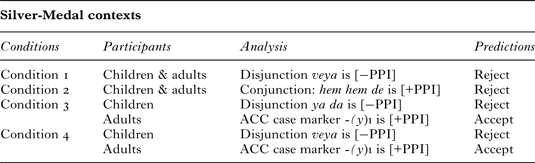
Table 1 provides a summary of the predicted patterns of responses by both children and adults in the critical Silver-Medal contexts. At this point, it is unclear how the adult participants should be expected to respond in the Sad-Face contexts in Conditions 3 and 4. For now, we will defer our discussion of the responses by the adult participants in the Sad-Face contexts. We will provide an analysis of the adult pattern of responses in the Sad-Face contexts after we report the findings, i.e. in the ‘General discussion’.
Predicted responses by children and adults in the Silver-Medal contexts

For both the child and the adult participants, Conditions 1 and 4 were administered in the first session, and Conditions 2 and 3 were administered in the second session, about a week later. This ordering was chosen to ensure that all participants encountered the two conditions with case-marked disjunction phrases in different sessions. This also ensured that participants encountered the test sentences with different words for disjunction in different sessions.
RESULTS
The findings for the Gold-Medal context were the same for both the child and the adult participants. Both groups rejected the sentences 100% of the time in the Gold-Medal contexts, in all four conditions. We therefore limit our report of the findings to the Silver-Medal contexts and the Sad-Face contexts. Because the test sentences in Condition1 contained a disjunction phrase, whereas those in Condition 2 contained a conjunction phrase, we will report the findings separately for the two conditions.
Condition 1
In Condition 1, both Turkish-speaking children and adults were expected to assign a conjunctive interpretation to disjunction phrases without accusative case marking in negative Turkish sentences. For adults, this prediction was based on the observation that disjunction words are [−PPI] in the adult grammar. For children, this prediction was based on the fact that [−PPI] is the subset value, and therefore the default value of the Disjunction parameter. Thus, both children and adults were expected to interpret disjunction phrases without accusative case marking in their surface syntactic position (i.e. in situ) in negative Turkish sentences, resulting in the (NOT > OR) reading. For these reasons, both child and adult participants were expected to reject the test sentences in the Silver-Medal contexts, and accept them in the Sad-Face contexts.
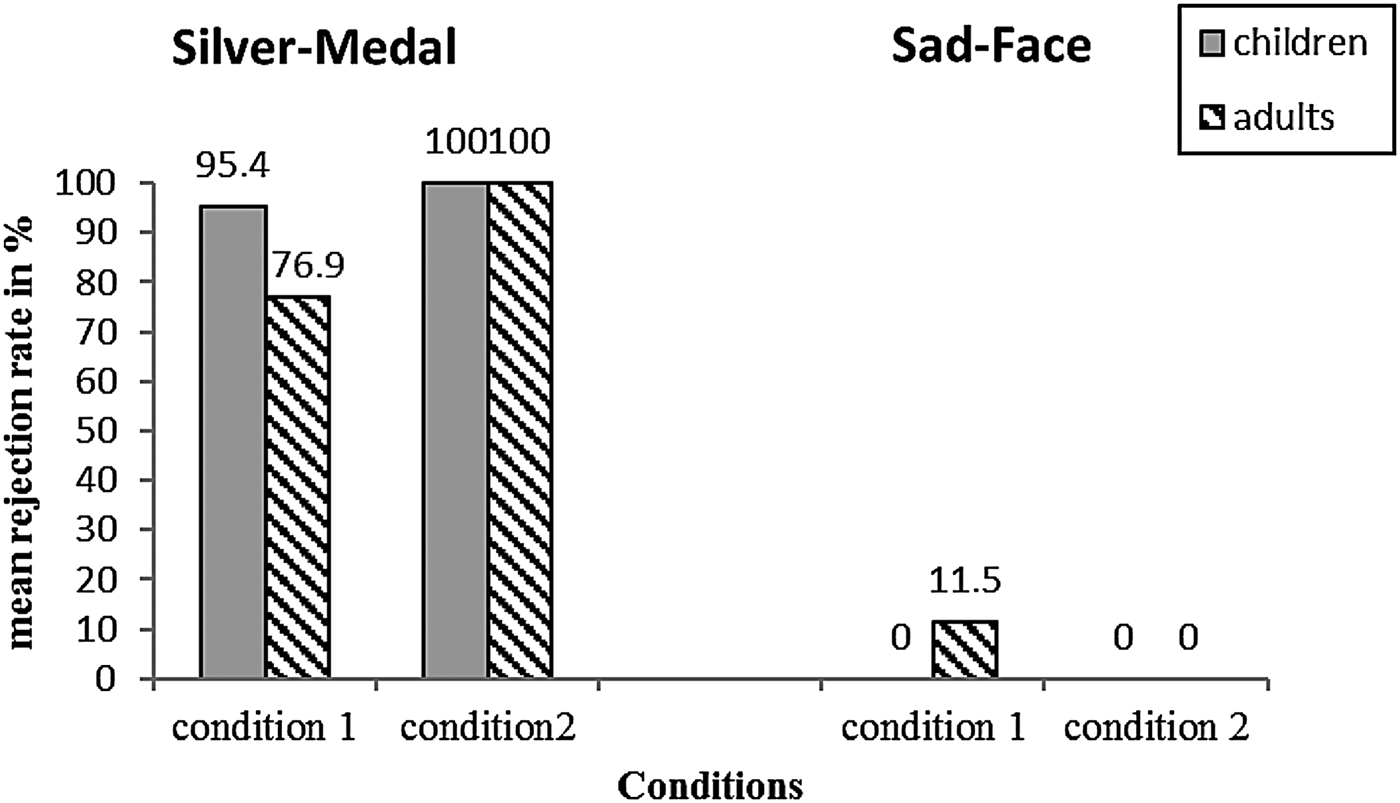
In keeping with these predictions, the child participants rejected the test sentences 95·4% of the time (84/88) in the Silver-Medal contexts, and adults rejected them 76·9% of the time (80/104) in these contexts. Although both groups showed the same pattern of rejection, a Mann–Whitney U test showed that children assigned a conjunctive interpretation significantly more often than adults did (z = 3·06, p = ·002) with a medium to large effect size (r = 0·44). We can only speculate on why the adult participants accepted the test sentences to a greater extent than the child participants did. Perhaps the adult participants were influenced by the fact that the majority of disjunction phrases in adult Turkish do not generate a conjunctive entailment, including disjunction phrases marked with accusative case, as in Conditions 3 and 4.
Condition 2
In Condition 2, the test sentences contained conjunction phrases marked with accusative case. As we have seen, accusative case marking is analyzed as [+PPI] in Turkish (for adults). Therefore, the conjunction phrases in Condition 2 were expected to take scope over negation at the level of semantic interpretation for adult Turkish speakers, yielding the (AND > NOT) reading. The same prediction holds for children, but for a different reason. Children were expected to analyze expressions for conjunction as [+PPI] because this is the subset value, and therefore the default value of the Conjunction parameter. It is interesting to note that the subset value of the Conjunction parameter (AND > NOT) is not the same as the meaning assigned to conjunction in classical logic (NOT > AND). For conjunction, the superset value of the Conjunction parameter yields the truth conditions for conjunction in classical logic.
Regardless of the derivation of the (AND > NOT) scope assignment, both child and adult Turkish speakers were expected to reject the test sentences in the Silver-Medal contexts, and to accept them in the Sad-Face contexts. As predicted, both children and adults rejected the test sentences 100% of the time (104/104) in the Silver-Medal contexts. When children were asked to justify their rejections, their responses can be paraphrased in English in the same way as in Condition 1: Because the animal got a silver medal or Because the animal ate one of the vegetables. In the Sad-Face condition, neither children nor adults rejected a single one of the test sentences (children = 0/104; adults = 0/104). The findings for Conditions 1 and 2 are summarized in Figure 1.
Mean proportions of rejections in Conditions 1 and 2.
Conditions 3 and 4
The only difference between the test sentences in Conditions 3 and 4 was the particular term that was used to express disjunction. The target sentences in Condition 3 contained the disjunction word ya…ya da ‘either or’, whereas the target sentences in Condition 4 contained the disjunction word veya ‘or’. In both conditions, the disjunction phrases in the target sentences were marked with accusative case. We introduced this change to assess the possibility that different disjunction words would result in different scope assignments, either for children or for adults.
Before we report the findings, we will briefly review the predictions we made about the pattern of responses by children and adults in the Silver-Medal contexts in Conditions 3 and 4. For adult speakers of Turkish, accusative case-marked noun phrases are [+PPI]. Disjunction phrases with case-marked nouns are therefore ‘raised’ to take scope over negation, yielding the (OR > NOT) reading. On this reading, adult Turkish speakers were expected to accept the test sentences in the Silver-Medal contexts. On the (OR > NOT) reading, sentences are true if one of the vegetables was not eaten by the animal.
Turkish-speaking children were expected to assign the [−PPI] value of the Disjunction parameter in Conditions 3 and 4, leading children to adopt the (NOT > OR) scope assignment, in contrast to adults. The expectation was that children would adopt the [−PPI] value of the Disjunction parameter, as dictated by the Semantic Subset Principle. On this scope assignment, the test sentences are false in the Silver-Medal contexts, so Turkish-speaking children were expected to reject the test sentences in these contexts in Conditions 3 and 4.
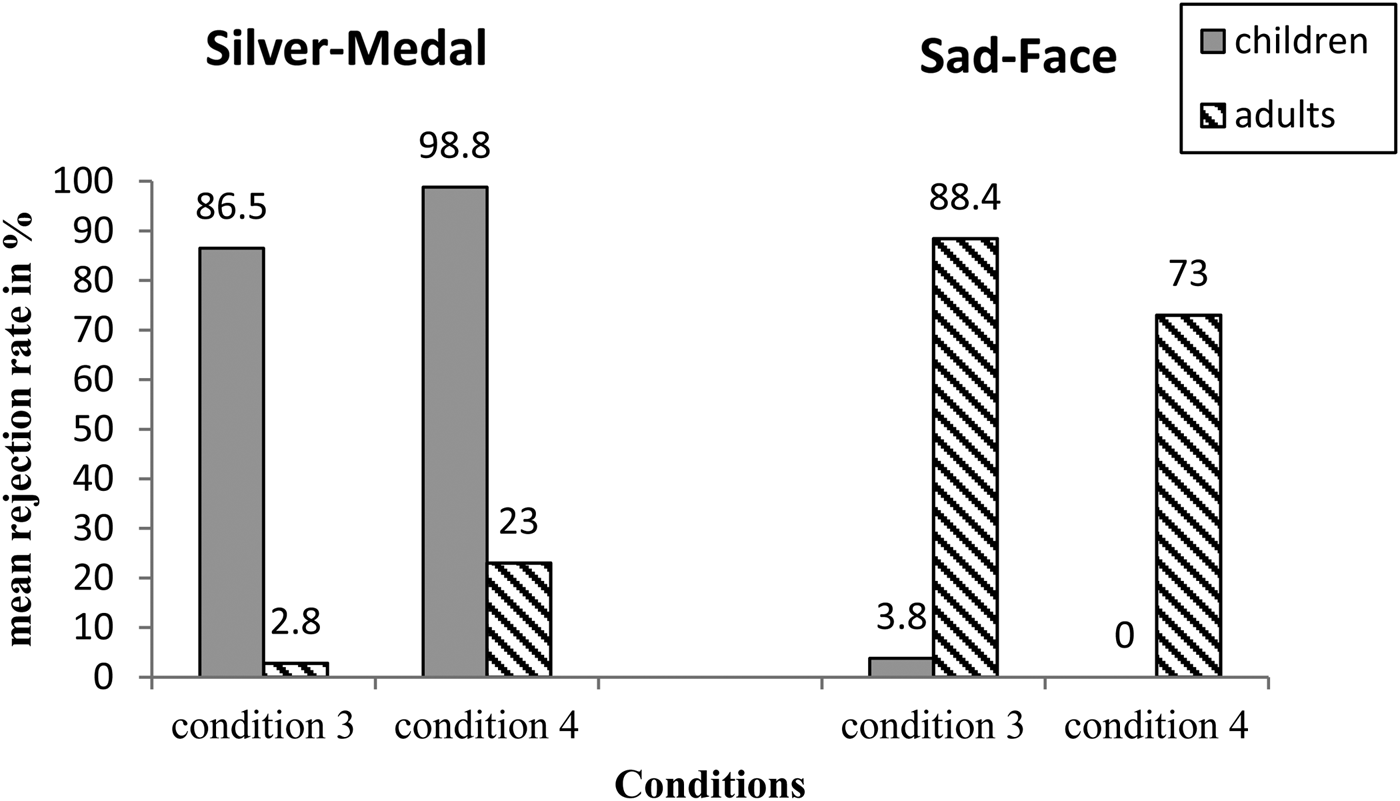
The Semantic Subset Principle also explains the pattern of responses by Turkish-speaking children in the Sad-Face contexts in Conditions 3 and 4. Because disjunction is [−PPI] for children, disjunction is interpreted within the scope of negation (NEG > OR). It follows that disjunction phrases generate conjunctive entailments, making the test sentences true in the Sad-Face contexts. We postpone discussion of the responses by Turkish-speaking adults in the Sad-Face contexts in Conditions 3 and 4, because the interpretation of the findings requires further theoretical background. It must suffice for now to observe that adult Turkish speakers exhibited the completely opposite pattern of responses than children did in the Sad-Face contexts, whereas children accepted the test sentences in these contexts. In Condition 3, children accepted the test sentences 96·2% of the time, whereas adults rejected them 88·4% of the time. This difference proved to be highly significant (Mann–Whitney U test, z = –12·21, p < ·001), with a large effect size (r = 1·69). In Condition 4, children accepted the test sentences 100% of the time, whereas adults rejected them 100% of the time. Again, the different patterns of responses by children and adults proved to be highly significant (Mann–Whitney U test, z = –10·29, p < ·001), with a large effect size (r = 1·48).
As expected, children and adults produced different patterns of responses in the Silver-Medal contexts. In Condition 3, the child participants rejected the test sentences 87% of the time (90/104), whereas the adult participants rejected them only 3% of the time (3/104). A Mann–Whitney U test revealed a significant difference in the response patterns of the two groups (z = 12·10, p < ·001) with a large effect size (r = 1·67). When children were asked to explain why they rejected the test sentences, they offered the same kinds of justifications as in Conditions 1 and 2. Children's responses can be paraphrased in English as follows: Because the animal got a silver medal or Because the animal ate one of the vegetables. Both of these responses indicated that children had generated a conjunctive entailment.
In Condition 4, children and adults also produced opposite patterns of responses in the Silver-Medal contexts. Children rejected the target sentences 98·8% of the time (87/88), whereas adults rejected them only 23% of the time (24/104). A Mann–Whitney U test revealed a highly significant difference between these rates of rejection (z = 10·56, p < ·001), and a large effect size (r = 1·52). As in Condition 3, when children were asked to explain why they rejected the test sentences in Condition 4 (“Why was the puppet wrong?”) they offered two kinds of responses. Their responses can be paraphrased in English as follows: Because the animal got a silver medal or Because the animal ate one of the vegetables. Both of these kinds of responses indicated that children had generated a conjunctive entailment for the Turkish negative sentences with case-marked disjunction phrases, so the expressions that were used for disjunction had little effect on children's responses.
Figure 2 provides a summary of the findings for Condition 3 and Condition 4. As the figure indicates, the Turkish-speaking child participants consistently accepted the test sentences in the Sad-Face contexts, and rejected them in the Silver-Medal contexts. The pattern of responses by Turkish-speaking adult participants was exactly the reverse. Turkish-speaking adults accepted the test sentences in the Silver-Medal condition, and rejected them in the Sad-Face condition.
Mean proportions of rejections in Conditions 3 and 4.
GENERAL DISCUSSION
The responses by the child Turkish speakers in the Silver-Medal contexts in all four conditions were as predicted by the Semantic Subset Principle. This principle of language learnability dictates that children initially analyze disjunction as [−PPI], and will analyze conjunction as [+PPI], as these are the default, subset values of the Disjunction parameter and the Conjunction parameter. These values translate into (NOT > OR) and (AND > NOT) scope assignments, which explains why Turkish-speaking children rejected the test sentences in the Silver-Medal contexts.
The fact that adult Turkish speakers rejected the test sentences in the Silver-Medal contexts in Condition 1, but accepted the test sentences in these contexts in Conditions 3 and 4, was also expected on the parametric account. Turkish disjunction phrases without case marking are [−PPI] for adults. This explains why negative sentences with unmarked disjunction phrases were accepted by adults in the Sad-Face contexts in Condition 1. In Conditions 3 and 4, the disjunction phrases were marked with accusative case, so these phrases were analyzed by adult Turkish speakers as Positive Polarity Items. For adults, therefore, these disjunction phrases take scope over negation at the level of semantic interpretation, so Turkish-speaking adults accepted negative sentences with disjunction in the Silver-Medal contexts, where one of the vegetables was eaten.
One finding remains to be explained, namely why adult Turkish speakers consistently rejected the test sentences in the Sad-Face contexts in Conditions 3 and 4. This finding does not follow from anything we have discussed up to this point. Notice that, according to the adult value of the Disjunction parameter in Turkish, accusatively case-marked disjunction phrases are [+PPI]. These disjunction phrases take scope over negation, (OR > NOT). From a logical point of view, therefore, the test sentences were verified for adult Turkish speakers in the Sad-Face condition. To see this, let us paraphrase the meaning of the Turkish test sentences using an English cleft structure – It's the carrot or the pepper that the animal didn't eat. Clearly, this sentence is true if just the carrot, or just the pepper, wasn't eaten. But it is important to observe that, if disjunction is analyzed as inclusive-or, as in classical logic, then this sentence is also true if neither the carrot nor the pepper was eaten, which is the circumstance depicted in the Sad-Face contexts.
Why then did Turkish-speaking adults reject the test sentences in the Sad-Face contexts in Conditions 3 and 4? First, we wish to point out that this is not just a fact about Turkish. Adult English speakers have the same intuition about the cleft structure in which disjunction takes scope over negation in the surface syntax – It's the carrot or the pepper that the animal didn't eat. English speakers tend to reject this sentence in circumstances where neither vegetable was eaten, e.g. in the Sad-Face condition. To explain why language users reject sentences with disjunction in these circumstances, researchers have invoked pragmatic principles, in addition to principles of logic.
In ordinary conversational contexts, sentences that are logically true may nevertheless be pragmatically odd. For example, sentences can be pragmatically odd, despite being literally true, if they violate one of the basic pragmatic principles. One of the most basic pragmatic principles is the Principle of Cooperation. The Principle of Cooperation is further articulated into a number of maxims, including the Maxim of Quantity. The Maxim of Quantity entreats speakers to use sentences that convey their intended meaning using the most economical sentence at the speaker's disposal, as compared to alternative sentences that the speaker might have produced.
This pragmatic account can be invoked to explain why Turkish-speaking adults rejected the test sentences in the Sad-Face condition. Essentially, rejections by adults are due to a pragmatic implicature of ‘exclusivity’, which follows from the Maxim of Quantity. The implicature results from comparing what the puppet actually said with alternative sentences that the puppet might have used. The implicature of exclusivity applies to sentences with disjunction. What the puppet actually said in the present study were negative sentences with disjunction. We have been paraphrasing the test sentences using the English cleft structure, as in – It's the carrot or the pepper that the animal didn't eat. The critical observation is that, in the Sad-Face condition, the puppet might have used a sentence with conjunction instead – It's the carrot and the pepper that the animal didn't eat.
The fact that the puppet used a sentence with disjunction rather than one with conjunction invites the inference that the puppet did not think that the sentence with conjunction was true. If the puppet thought that the animal did not eat either vegetable, then it would have used the sentence with conjunction – It's the carrot and the pepper that the animal didn't eat. In short, we are entitled to infer from the puppet's disjunctive statement that it believes the following: the animal did not eat the carrot or did not eat the pepper, but the animal did eat one of them.
This pattern of inference does not follow from logic. Rather, it follows from a consideration of what the puppet actually said (a sentence with disjunction), as contrasted with what the puppet might have said (a sentence with conjunction). Based on this contrast, the Turkish-speaking adults judged the puppet's sentences with disjunction to be pragmatically infelicitous in the Sad-Face condition. Given that the task was to judge whether the puppet's statements were true or false, Turkish-speaking adults judged them to be false.
Why is it pragmatically odd to use a sentence with disjunction when the corresponding sentence with conjunction is also true? The intuition is that the sentences with conjunction (e.g. It's the carrot and the pepper that the animal didn't eat) are more informative than the corresponding ones with disjunction. Following a proposal by Grice (Reference Grice, Cole and Morgan1975), words for disjunction and conjunction can be positioned on a scale according to the relative strength of the information they convey, from ‘weaker’ to ‘stronger’. By definition, sentences with a stronger term on the scale are true in a subset of the circumstances that verify sentences with a weaker term (more formally, stronger statements asymmetrically entail weaker ones). One scale contains the words for disjunction and conjunction, yielding <or, and>. The word for disjunction, or, is the weaker term on the scale, because both sentences with or and ones with and are true in circumstances that verify both of the disjuncts/conjuncts, but sentences with or are also true in other circumstances as well, namely when just one of the disjuncts is true. The fact that the puppet used the weaker term or in the Sad-Face condition, rather than the stronger term and, led the Turkish-speaking adult participants to infer that the puppet did not believe that the sentence with the stronger term (and) was true. The adult participants therefore inferred the negation of the sentence with the stronger term. At the end of this line of reasoning, adult Turkish speakers concluded that the puppet believed that the stronger statement was false – It's the carrot and the pepper that the animal didn't eat – contrary to fact. If the puppet believed that the sentence with conjunction was true, the puppet would have produced it, instead of the sentence with disjunction. Consequently, adults rejected the puppet's sentences with disjunction in the Sad-Face condition.
The findings from Condition 1 raise another question. Recall that the pattern of responses by the adult participants adopted the scope assignment that is associated with the [+PPI] accusative case marker (OR > NOT), rather than the (NOT > OR) scope assignment that corresponds to the [−PPI] disjunction words themselves. The question is why the [+PPI] value wins out over the [−PPI] value. One possibility is that principles of computational efficiency favor isomorphic mappings between surface word order and semantic interpretation, but that these principles are overridden whenever there is explicit evidence that an isomorphic mapping does not yield the intended interpretation.
CONCLUSION
As predicted, Conditions 1 and 2 evoked the same patterns of responses by child and adult Turkish speakers, whereas Conditions 3 and 4 evoked different patterns of responses. We attributed these different patterns of responses to different scope assignments. The scope assignment by children was dictated by the Semantic Subset Principle, as applied to a lexical parameter that determines the scope relations between disjunction phrases and negation. The Semantic Subset Principle compels children to adopt the [−PPI] value of the Disjunction parameter, whereas Turkish-speaking adults adopt the [+PPI] value.
The different values of the Disjunction parameter generate different scope assignments. The [−PPI] value yields the (NOT > OR) scope assignment, and the [+PPI] value yields the (OR > NOT) scope assignment. The fact that Turkish-speaking children and adults generate different scope relations between disjunction and negation is important, because it rules out the possibility that Turkish-speaking children ‘learned’ the (NOT > OR) scope assignment based on input from adults, who favor the (OR > NOT) scope assignment. The finding that children and adults differ in this way is consistent with the analysis we proposed, but difficult to reconcile with experience-based accounts of language development. Clearly, Turkish-speaking children do not formulate their initial scope assignment based on the adult input. A more likely source is the Semantic Subset Principle, which dictates that disjunction words are initially [−PPI] for children across languages, and conjunction words are initially [+PPI] for children across languages (Crain, Reference Crain2012).
The final question is how children converge on the adult grammar, when the initial value of the Disjunction parameter differs from the value adopted by adult speakers of the local language. Here is the learnability scenario we propose, based on ‘positive’ evidence, the Semantic Subset Principle, and another sub-Maxim of the Principle of Cooperation: Be Truthful. First, children always assume that adults speak truthfully. Second, adults only produce sentences in circumstances in which they judge them to be true. Together with the Semantic Subset Principle, these two premises guarantee that children will encounter ‘positive’ evidence if the value of the Disjunction parameter differs from that of adult speakers of the local language. According to the Semantic Subset Principle, there is only permissible difference between the parameter values of children and adults. This is the possibility that is substantiated in Turkish, where children initially adopt the [−PPI] value, but adults adopt the [+PPI] value.
It follows from these considerations that when disjunction phrases are assigned the value [+PPI] in a language, adult speakers will produce sentences with disjunction phrases in circumstances that validate one, but not both of the disjuncts. For example, adult speakers of these languages will use negative sentences with disjunction – e.g. The animal didn't eat the carrot or the pepper – in circumstances in which the animal did not eat the pepper, but did eat the carrot. These sentences are false for children on the [−PPI] value of the Disjunction parameter. Because children assume that adults speak truthfully, these sentences inform children that their grammars are in need of repair. In short, sentence/meaning pairs like this represent detectable mismatches between the grammars of children and those of adults. Once a child has encountered a sufficient number of these detectable mismatches, children have no option but to abandon their current value of the Disjunction parameter, [−PPI], in favor of the value that is attested in the primary linguistic data, [+PPI].
We conclude with two general observations, followed by one observation about Turkish in particular. We would note, first, that our findings are compatible with the Continuity Hypothesis (Crain, Reference Crain1991, Reference Crain and Lasser2002; Crain & Pietroski, Reference Crain and Pietroski2001; Pinker, Reference Pinker1984). According to the Continuity Hypothesis, child language can differ from that of adult speakers of the local language only in ways that adult languages can differ from each other. In the present study, we witnessed Turkish-speaking children behaving like child and adult speakers of English, German, and Korean. We attributed this to the Semantic Subset Principle, which compels children to initially make scope assignments that make sentences true in the narrowest range of circumstances. On the account we proposed, the interpretive options are encoded in lexical parameters. This guarantees that children will always be speaking a possible human language, as required by the Continuity Hypothesis. The second observation is that children acquiring all human languages are expected to initially start out along the same path. Since children are predicted to initially assign values of lexical parameters that make sentences true in the narrowest range of circumstances, children will begin with the same initial values, regardless of the values adopted by adult speakers. The final point is about Turkish. Turkish differs in one respect from the other languages whose scope assignments have been investigated within the current framework. Turkish is the first language we have seen in which accusative case marking, rather than the logical connective, is the bearer of the status of a Positive Polarity Item. We assume that this will turn out to be a property of other human languages, but only time will tell.