Introduction
Palliative care has induced paradigm shifts for healthcare professionals in a variety of ways, such as the acceptance of death as part of the natural disease process, equal care for patients and their relatives, appreciation of the patients’ spiritual needs, and a more holistic approach. An important aspect of palliative care is the recognition of the value of culture and ethnicity. Because the psychosocial and spiritual needs of patients facing death and their relatives become increasingly important, healthcare workers should proceed with sensitivity (Bruce, Reference Bruce2007). The National Consensus Project for Quality Palliative Care (2013) has emphasized the significance of culture by putting it under a separate domain in the Clinical Practice Guidelines. It is important to consider ethnical and cultural values of both patients and relatives during the decision-making process, the course of the disease, and the dying and mourning period.
Mourning is an important period in which the family adapts to the absence of their beloved family member and tries to return to their normal, functioning life. It is a complex process, with adaptation that requires the acceptance of death and rebuilding a future without the deceased. Although in many families, mourning takes place at a natural pace, some family members may get stuck. When this happens, the mourning period becomes more complex and painstaking. Helping family members adapt again to normal life is part of the responsibilities of palliative care. The palliative care team may help to prepare the patient's relatives for a meaningful farewell; this preparation usually takes place during several family meetings after the diagnosis, and these meetings become more frequent as death becomes imminent. After the death, the palliative team visits the family according to the needs of the family members.
Many cultures have their own way of dealing with death, the dying process, and mourning. The mourning period is particularly influenced by a variety of factors: religious beliefs, cultural backgrounds, family ties, and so on. These factors have a strong impact on the rituals, length, content, and effectiveness of the mourning period. Cultures that hold strongly to tradition are more dependent on each other and have intense, ritual-rich mourning periods, whereas modern societies deal with this period more silently and independently (Groot-Alberts, Reference Groot-Alberts2012); therefore, a suggestion from one society may not fit well for another. The palliative care team might use some of the traditional rituals to ease the patients and families’ suffering during the mourning period. The effectiveness of the tradition should be evaluated by scientific methods, however, because sometimes the tradition does not always end up helping the families who are suffering. For example, in some cultures, the mourning period is prolonged unnecessarily (Sheldon, Reference Sheldon1998).
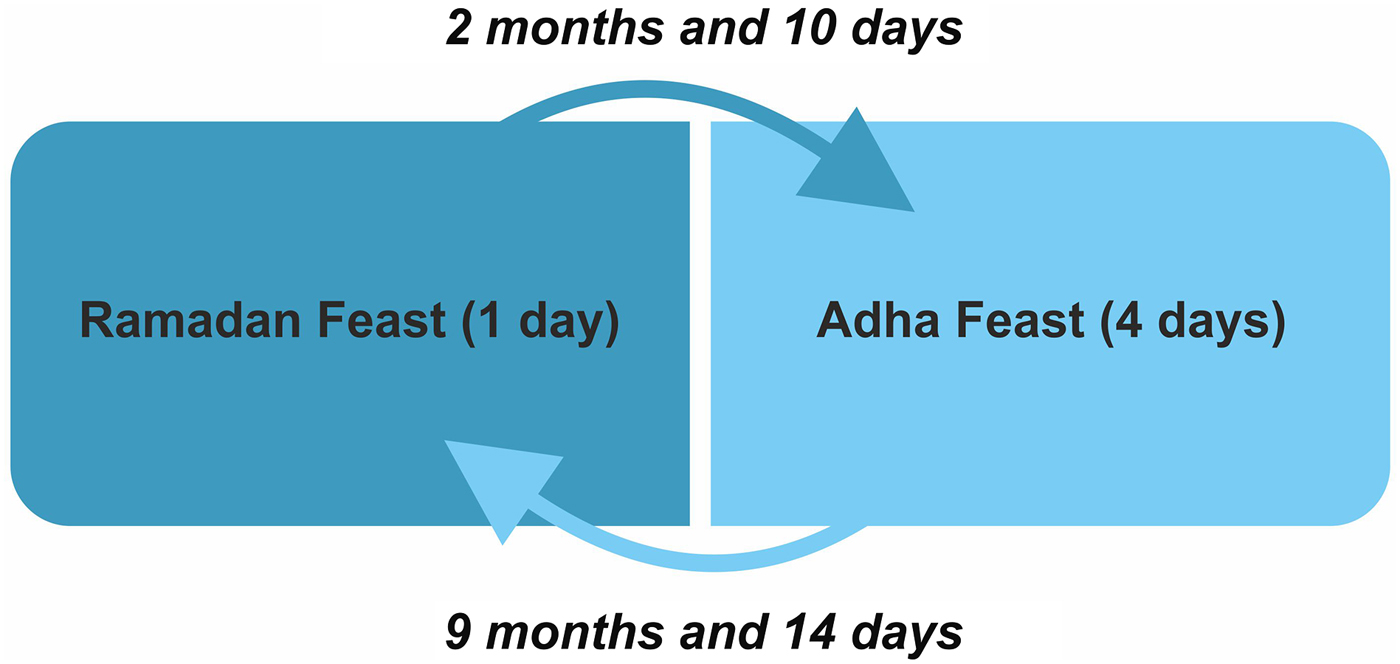
There are two feasts in Islamic societies and in Turkey (Figure 1). One is the Ramadan Feast, which comes after the fasting month of Ramadan. The other is the Feast of Adha, which follows the Ramadan Feast two months and ten days later. Although there are a few differences between the celebrations of these two feasts, there are also commonalities. Both feasts start early in the morning; all family members come together and celebrate with breakfast. The younger members of the family show respect to their parents. Then the younger members visit their close relatives, such as grandparents, aunts, uncles, and cousins, at their home. The unwritten rule is that the elder members await their visitors while the younger members go out to visit. In each visit, sweets are offered. The visits are usually brief because there are many members to visit. In sum, the feast days are days of joy, remembrance, love, and respect.
The relationship of Ramadan and Adha Feasts throughout the year.

In Tokat region where our university is located, there is a tradition after the death of a family member called the “First Feast” or “Black Feast.” The First Feast is part of the mourning tradition in some parts of Turkey. It is literally the first feast that takes place after the death of a family member. This special feast is celebrated differently than that used before the family member died, with subtle changes. The extended family supports bereaved family members in their first feast after a death. It has some different rituals from ordinary feasts and is celebrated with a heavy heart, mixed with joy and sorrow, as the name implies. All members of the extended family, including elder members, start their visit from the grieving home, which is a sign of great respect. Because few studies have been published about the “First Feast tradition, it is difficult to draw conclusions about its prevalence” (Levendoğlu, Reference Levendoğlu2006).
We aimed to evaluate the prevalence and practice of the First Feast tradition in our region, the attitudes for and against the tradition, and comments on its usefulness for the grieving family in the palliative care setting.
Materials and methods
This descriptive and cross-sectional study was conducted at Gaziosmanpasa University in Tokat, Turkey, in the Palliative Care Research and Application Center between January and March 2017. The Palliative Care Study Group (PCSG) is a voluntary research-oriented body in Palliative Care Research Center composed of about 15 professionals including physicians, nurses, social workers, and psychologists. The questionnaire was developed and matured by PCSG through a series of meetings. In short, the items were generated initially, then the questions were stemmed and subsequently the responses (binary, rating type, Likert type, and open) were formatted. After pilot testing and final reformatting of questionnaire, 23 questions centered on the demographic features of the participants, awareness of the First Feast in their tradition, the attitude toward the tradition, and whether it would be useful for the grieving relatives of the deceased patients. All participants were also questioned about nine statements related to the First Feast tradition, such as “It is a ritual to share the grief,” and they were given options to respond such as “I agree, I don't agree, or I'm not sure” in a 3-point Likert system.
Ethical approval was obtained from the ethics committee of the Medical Faculty at the University of Gaziosmanpasa. The study was performed with the relatives of palliative care patients. Those who brought or escorted the patients to palliative care center were also included in the study without considering kinship (e.g., close neighbors, distant relatives with a transportation facility). Those younger than age 17 years, mentally handicapped, or who refused to participate (i.e., too sentimental to speak about the death) to the study were excluded. Because the First Feast is a sentimental issue for the relatives of palliative care patients who were expected to die soon, the questions were structured around whether they witnessed the First Feast at any time for their relatives. The participants were informed about the aims of the study and their consent was obtained before distribution of the questionnaire. Questionnaires were filled out in a separate room, apart from the patients, with the participants by PCSG members. If participants were illiterate, the questionnaires were filled out with a face-to-face approach
The sample size was calculated by conducting a power analysis using the statistical software G*Power, version 3.0.10. To calculate sample size, the following values were used: power = 0.80, effect size = 0.15, alpha = 0.05, and with 2 degrees of freedom. The statistical power analysis revealed that a minimum of 400 participants were required.
Descriptive statistics were used to analyze the demographics of the participants. The chi-square test was applied to identify any difference between various groups. IBM SPSS Statistics, version 20.0, software was used for statistical analysis. A p value of <0.05 was considered statistically significant.
Results
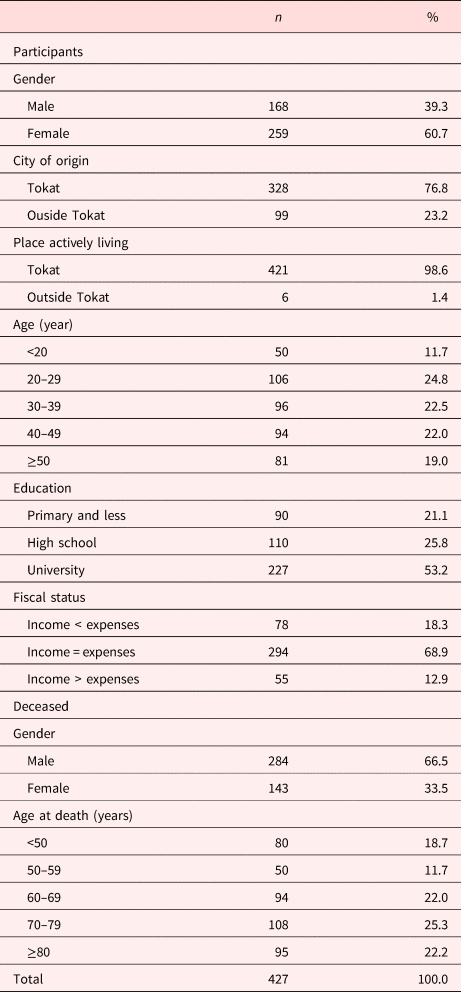
A total of 427 participants were enrolled in the study. Of these, 60.7% were female and the mean age was 36 (±13.4); 76.8% acknowledged that they were from Tokat and 98.6% lived in Tokat. The demographic features of the participants are disclosed in Table 1.
Demographics of participants and their deceased relatives

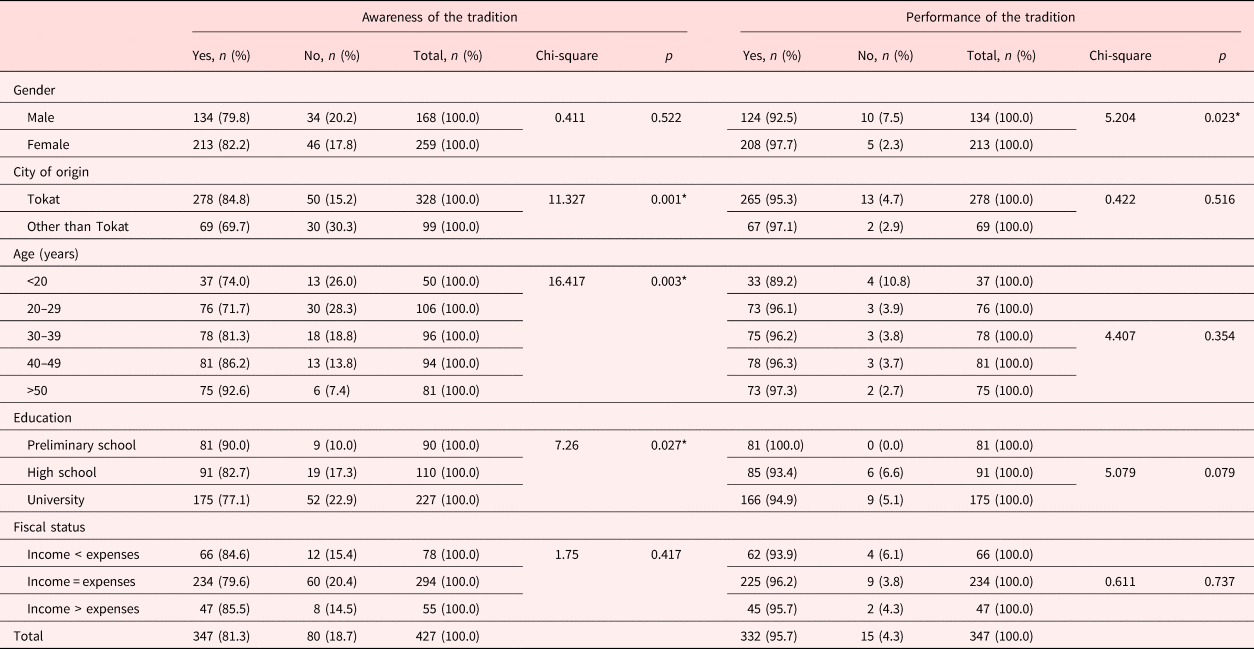
The majority of participants (n = 347; 81.3%) had heard about the First Feast and 77.8% of them (n = 332) also performed the First Feast tradition. A statistical difference in awareness of the tradition was observed between Tokat descendants and non-Tokat descendants (84.8% and 69.7%, respectively; p = 0.001). Performance of the tradition did not change at all between Tokat and non-Tokat descendants as long as they were aware of the tradition (95.3% vs. 97.1%, p = 0.516). A decreasing trend in awareness of the tradition was observed among people who had a university education (90% in primary school graduates, 77.1% in university graduates; p = 0.027). More detailed analysis is shown in Table 2. Significantly more female participants wanted the First Feast tradition to be performed after their own death than male participants (92.5% to 97.7%, p = 0.023).
Awareness and performance of the First Feast tradition

*p < 0.05.
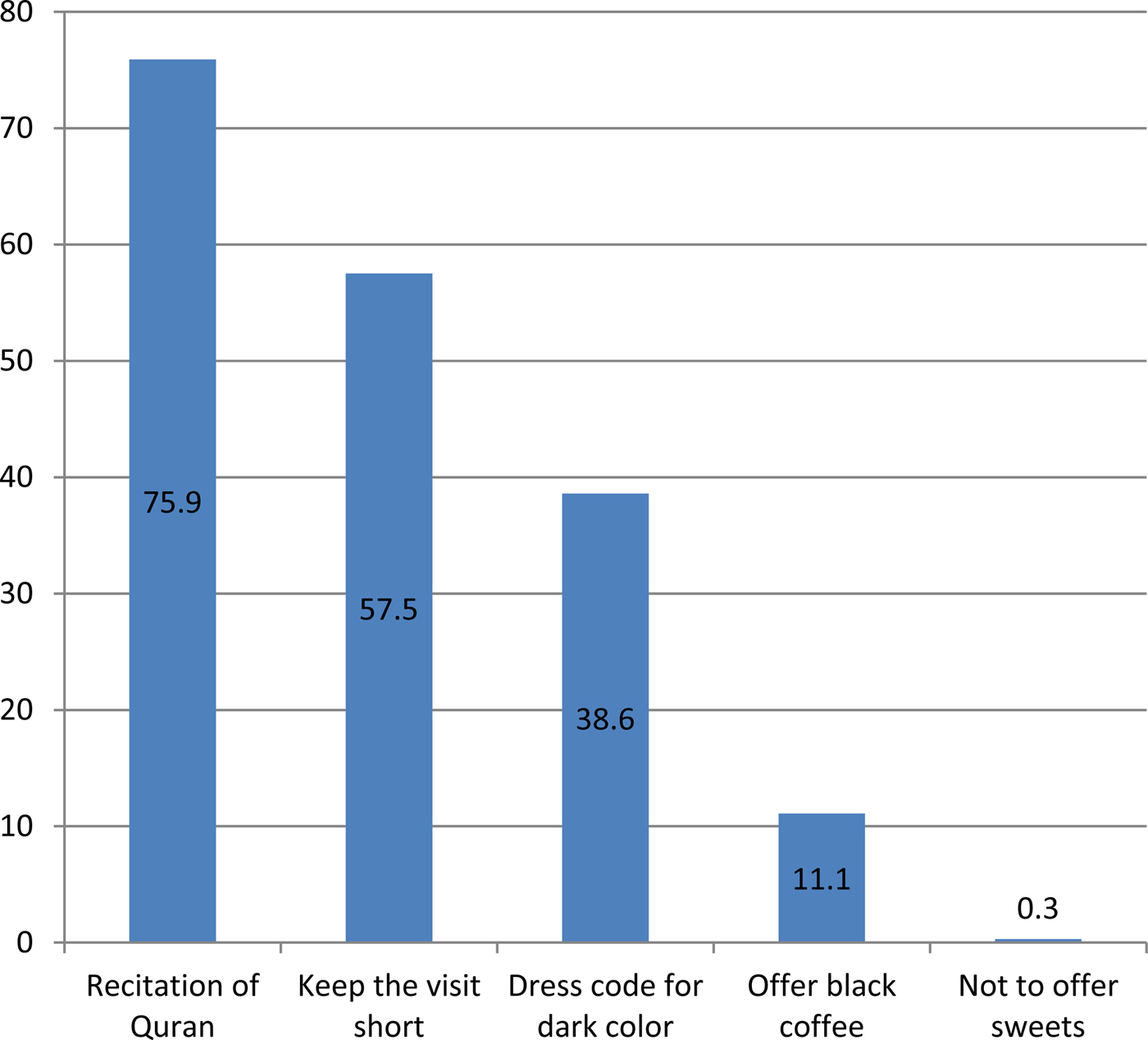
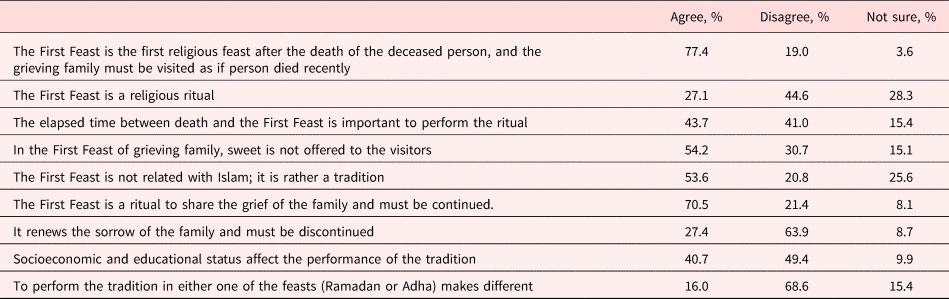
Ninety-one percent of the participants evaluated the First Feast as a positive tradition, giving the following reasons: 51.5% thought that the grief was shared, 19.3% thought that the family ties were strengthened, and 28.3% thought it provided support to the grieving family; however, 42.8% of participants noted negative aspects of the tradition, claiming that it could exacerbate sorrow and make the remembrance process painful. More female participants (n = 93, 64.1%) than males (n = 52, 35.9%) noted that elapsed time after death is important in negating painful memories. The First Feast rituals retrieved from the participants were as follows in decreasing performance frequency: recitation of Quran during the visit (75.9%); keeping the visit short (57.5%); an informal dress code, not wearing bright and colorful dresses (38.6%); offering black coffee during the visit (11.1%); and not offering sweets (because offering sweets is a ritual of the feasts) (0.3%)(Figure 2). Attitudes about the First Feast tradition have been documented in Table 3.
Graphical representation of some of the rituals related with the First Feast visit.

Comments by participants on statements about the First Feast tradition

Discussion
Cultural values and rituals play an important role in palliative care; thus, healthcare professionals should always take into account the patients’ beliefs while treating or caring for them. This becomes more pronounced in palliative care because receiving bad news about a life-threatening disease can cause immense psychosocial and spiritual turbulence in the patient's family. In the last stage of the disease particularly, the spiritual needs of the patient and the patient's family become a primary issue, overshadowing all needs of the patients and their relatives. A well-managed terminal stage is important for the patients and their relatives because it allows for a meaningful and valuable farewell. In some cases, the mourning period is suspended, and it takes years to overcome the grief. Usually each family, and in a broader context each society, has its own way of tackling the mourning period (Wikan, Reference Wikan1988). The palliative care team is a natural partner during the mourning period. Each palliative care team has its own plan for following up with the relatives of recently deceased patients (Sheldon, Reference Sheldon1998). Some pay a visit to the family immediately and attend the funeral, whereas others prepare large reunions with patients’ relatives on the first anniversary of the death. Because the rituals change from society to society, palliative care teams in each society adapt their own strategies to be fully compatible with the values of the community.
First Feast is a well-known tradition in some parts of Turkey. Because of the strong roots of tradition in the society, the feast would be easy to implement and adapt for the palliative care team. The high prevalence of the tradition in our region led us to question whether it could be used as an auxiliary method for palliative care teams trying to help the family after the death of a palliative patient. The first step was to explore the pervasiveness of the tradition, awareness of society, and attitudes about the tradition. We also wanted to find out the pros and cons of the tradition with respect to helping grieving families. We showed that the majority of Tokat-born participants were aware of the tradition, and many of them have been routinely performing it. The tradition is more prominent in female participants, and they were more eager to keep the tradition.
Our study also revealed that the rituals about the First Feast were not strictly determined. The participants mostly agreed on the recitation of short verses from the Quran during the visits. It is typically performed in funeral home visits during the mourning period but not in the feasts. Performance of this ritual might have a role in reminding participants that it is not an ordinary feast but the First Feast. The other rituals, such as an informal dress code or the type of offerings to the visitors, were not clear.
The majority of participants expressed positive feelings about the tradition and pointed out many benefits such as sharing grief, strengthening family ties, and supporting the grieving family. Because family relationships are crucial in Turkey, participants felt that the tradition offered strong support during grief. The First Feast tradition serves to unite the whole family after some time has passed following a death. It underscores the message that they are not alone and that the whole family can come together again for support. The participants expressed feelings of positivity and gratitude for their large family; however, about 42% of participants pointed out that there could be some negative aspects of the tradition. A visit from the palliative care team might exacerbate sorrow and cause unanticipated pain. The discrepancy between the majority of the participants (91%) believed that the ritual was a positive tradition, whereas some believed there were negative aspects, was due to the concern about the time elapsed after death until the First Feast. Because the First Feast could take place quite some time after a death, it might cause family members to relive already forgotten painful memories. In fact, significantly more women raised concerns about the negative side of the tradition and pointed out that the time elapsed between death and the First Feast is especially important to prevent already forgotten, unwanted memories of the death from surfacing.
From the viewpoint of the palliative care team, the elapsed time after death could be important for making a distinction between grief and complicated grief. Complicated grief can be defined as a prolonged, intense grief response, filled with obsessive behaviors and disabling thoughts about the deceased person that result in the cessation of the adaptation process (Bryant, Reference Bryant2012). When speaking of prolonged grief, the elapsed time after a loss should be at least six months (Shear et al., Reference Shear, Simon and Wall2011). According to the literature, the prevalence of complicated grief could range from 7% to 60% and depends on the relationship to the deceased, cultural background, and a lack of established criteria for diagnosis of the syndrome (Kersting et al., Reference Kersting, Brähler and Glaesmer2011; Lobb et al., Reference Lobb, Kristjanson and Aoun2010; Meert et al., Reference Meert, Donaldson and Newth2010; Simon, Reference Simon2013). The implementation of the First Feast visit by a palliative care team could help to identify individuals who are on the verge of complicated grief or are already experiencing it. Because complicated grief is difficult to define, suffering individuals and those surrounding them may think it is simply the “normal” grief process and therefore do not seek medical consultation when it becomes worse with morbidities such as depression, anxiety, and posttraumatic stress disorders (Bui et al., Reference Bui, Horenstein and Shah2015; Simon et al., Reference Simon, Shear and Thompson2007). Because the First Feast occurs, at the latest, at the tenth month of grief, it is a suitable time for identifying relatives who show signs of complicated grief (Figure 1).
There are some limitations of this study. A more direct approach with questions about whether palliative care team visits would help the bereaved family during the First Feast might be more appropriate. But, the recently implemented nature of palliative care services in Turkey and a relatively unknown palliative care approach hindered asking questions about palliative care directly (Suren et al., Reference Suren, Okan and Kaya2014). Rather, we questioned the prevalence and practice of the First Feast tradition in our region and the attitudes for and against the tradition. The implementation and the use of the tradition in palliative care setting is the scope of another study.
Second, although the tradition is well-known in many parts of Turkey, there are not many studies about the sociological value of First Feast. The topic of the First Feast tradition needs a thorough sociological analysis after a well-designed and well-powered study with more participation. Although there are limitations to the study, it is significant for evaluating the benefits of a social and cultural ritual as part of palliative care. Although it is a local tradition, the idea of implementing a cultural event into palliative care deserves more attention by the palliative care community in general; therefore, our study should be considered as a survey of opinions with clinical implications.
The First Feast visit by the palliative care team for the deceased patient could be a good example of incorporating the cultural rituals into clinical practice. The visit to the mourning family after death is already part of the schedule in many palliative care teams. Incorporating an acknowledged ritual in the society by the medical team can be a good example of community-based and value-respecting contemporary medicine. A well-designed follow-up study by the palliative care team who make First Feast visits may provide valuable clues about the applicability of the tradition. A more detailed study might reveal that it is already celebrated in some Muslim countries or by Muslim minorities in other parts of the world (e.g., Turkish people living in Europe and United States). If so, our findings could be of general importance and similar surveys could be undertaken in other cultures.
In conclusion, the tradition of the First Feast is a well-known and well-recognized mourning ritual in some parts of Turkey. It is perceived as a useful ritual to show strong support for grieving individuals by the extended family; however, the time between death and the First Feast is important because, if too much time elapses, it might cause family members to relive unwanted memories. At the same time, a visit from the palliative care team after prolonged period could help to identify individuals who are experiencing complicated grief. Because the First Feast is part of the culture, it can be easily implemented by palliative care teams to help overcome difficulties during the mourning period.
Acknowledgments
We thank all the members of the Palliative Care Study Group at Gaziosmanpasa University, Palliative Care Research, and Application Center and Tokat and Derya Özen for their technical assistance.