In a cartoon Charles Bartholomew penned for the Minneapolis Journal just weeks before America went to war with Spain, Uncle Sam says to his makers, “Don't you think, boys, you could give me a day off? I begin to feel as if I had been worked overtime by you fellows of late” (Figure 1). After Cuba resumed its fight for independence from Spanish colonial rule in 1895, their struggle became a recurring subject in the American press. Fueling the fire, Spain sent Governor-General Valeriano Weyler to Cuba in 1896 to crush the rising insurgency. His policy of reconcentrating villagers into camps lacking adequate food, water, and sanitation failed to suppress unrest. With civilian losses estimated at over a hundred thousand, the Cuban people paid a high price for revolution, though popular destitution was as much a result of the military strategies of the Cuban Liberation Army as of the Spanish response.Footnote 1 The American press reported on the crisis from the Cuban perspective, in part because the Cuban Junta, an organization based in New York and Washington that raised money and awareness for Cuban independence, consistently fed stories of Spanish brutalities to the press. After riots broke out in Havana in January of 1898, President William McKinley ordered the USS Maine to Havana Harbor. In mid-February, the Maine mysteriously exploded in port, killing 266 of the 354 American sailors on board. Although Spanish culpability was not proven, the Maine disaster tipped the scales toward war, and McKinley shifted in the ensuing weeks toward seeking a military solution. The American press helped mobilize its readers to support war by plastering its pages with reports of Spanish atrocities in Cuba and treacherous intent in the Maine disaster. Cartoonists were at the forefront of these campaigns, giving visual expression to Cuba's struggle and empowering Uncle Sam to intervene.
Bart, “Overworked,” Minneapolis Journal, 9 April 1898, 4.

Cartoonists had a crucial charge in the unfolding debates – to distill the urgencies of war in simple and concise visual statements. Cartooning was a vernacular art form with both “opinion-molding” and “opinion-reflecting” capacities that pressed into service familiar visual and cultural allusions, such as symbols, stereotypes, and metaphors, to draw in readers and facilitate comprehension.Footnote 2 Since the 1870s, the cartoons of Thomas Nast, Joseph Keppler, Frederick Opper, and other artists increased demand for visual comment on political topics. The geographic placement of cartoons on the news pages confirmed their rising authority. Papers like the Minneapolis Journal and the Denver Post featured one large daily cartoon in center space on the front page, making it in all likelihood the first thing to meet a reader's eye when coming in contact with the newspaper.Footnote 3 This gave cartoonists substantial power to shape how readers envisioned the conflict. News writer Earl Mayo observed in 1898, “Today the cartoonists of the big dailies occupy offices adjoining those of the editors-in-chief, and their daily pictures are the subjects of careful editorial consultation.”Footnote 4 Though renowned cartoonists wielded considerable influence, editors ultimately retained decision-making power on editorial matters. Imagemaking was essentially collaborative, a meeting ground between the views of the editor (and his editorial staff) and the artist's input and creativity.
This essay considers the work of two influential and prolific cartoonists of the war period – Albert Wilbur Steele of the Denver Post and Charles Bartholomew (“Bart”) of the Minneapolis Journal. Bart, born in Iowa and a graduate of Iowa State College at Ames, came to the Journal as a reporter and gradually took up the art of illustration with no formal training. Steele, born in Illinois and raised in Colorado, briefly attended Agricultural College and then worked as a government surveyor and farmer. Years later, he began drawing cartoon advertisements for the windows at his father's store in Denver. This launched his career as a cartoonist, and Denver's Rocky Mountain News hired him in 1890. Seven years later, he joined the Post.Footnote 5
The Denver Post and Minneapolis Journal had a growing readership in the 1890s. Born only six years before the US declared war on Spain, the Denver Post in 1895 came under the leadership of Harry H. Tammen and Frederick G. Bonfils and grew to a circulation of about 27,000 by 1898.Footnote 6 Although the Post was initially Democratic, Tammen and Bonfils took the paper in a more politically independent direction. Unlike earlier in the nineteenth century when political parties predominantly financed newspapers, the increase of advertising revenue enabled late nineteenth-century newspapers, if they desired, to break from the party line. This changed the financial substructure of the press and its overarching vision, encouraging editors to see readers as “consumers” as well as potential “voters”.Footnote 7 To attract subscribers, Tammen and Bonfils placed their growing profits into acquiring new technologies and hiring talented artists, becoming the first paper west of the Mississippi to publish comic strips.Footnote 8
The Minneapolis Journal, on the other hand, was larger and more established by 1898, with a readership of about fifty thousand, self-professed as “the largest circulation of any daily in the Northwest.”Footnote 9 First published in 1878, the Journal championed the politics of the Republican Party and endorsed McKinley's foreign policy. The Journal printed Bart's first cartoon in 1890 and within a few years the editor-in-chief of the Journal, John S. McLain, promoted him to full-time staff artist. His cartoons enjoyed a national audience, published in bound volumes and widely reprinted nationwide. In fact, Review of Reviews editor Albert Shaw wrote in 1898 that his “esteem” for Bart was evidenced by “the frequency” with which his journal “reproduced” his work.Footnote 10 Bart's cartoons also circulated amongst policymakers, one of which was displayed in the House of Representatives when its topic was under discussion.Footnote 11
By 1898, both artists had local, national, and international reputations and represented important voices for and against war and empire outside the large urban dailies of New York City and Chicago. Histories of the Spanish-American War disproportionately attribute the growing war cry to the sensationalism of the so-called “yellow” press, particularly William Randolph Hearst's New York Journal and Joseph Pulitzer's New York World.Footnote 12 Historians have only begun to recognize the importance of political cartoons in galvanizing popular sentiment for and against war and imperialism in 1898, and still the focus centers on the workings of the New York and Chicago press.Footnote 13 While the graphic output of “yellow” papers may have been more prolific, its cartoonists did not imagine a “yellow” variant to the iconography of war, and in fact they utilized the same visual idioms as did cartoonists from papers, small and large, around the country.Footnote 14
Still, only select newspapers – like the Associated Press; New York's World, Sun, Herald, and Journal; as well as Chicago's Tribune and Record – could afford war correspondents, dispatch boats, and cable fees to procure firsthand reporting. The Minneapolis Journal and Denver Post, among many others, relied on subscriptions to their telegraphic news services. Still, this did not hinder Bart in his cartoons from deriding their unscrupulous tactics, such as printing scandalous headlines and fabricating stories. Smaller papers, like the Post and Journal, strategically distanced themselves from the “yellow” press to proclaim credibility while tapping into a shared network of war information.
The mass circulation of images, and in particular the accessibility and adaptability of the cartoon medium, gave graphic artists a critical voice in the unfolding dialogue about American foreign policy. Together, a small community of artists nationwide produced mass-circulating visual narratives of war and empire. Steele and Bart contributed to this collective vision; they shaped and disseminated a compelling framework to rally Americans for war and propel arguments emerging in the war's divisive imperial aftermath. Their objective was larger than simply to invite humor; they were political propagandists aiming to mobilize readers in only a single frame. Their individual styles and politics aside, they communicated through a shared language of stock images; caricatures of recognizable political entities; and visual codings of gender, race, and sexuality that followed prescriptive patterns of popular iconography. Mirroring a paradigm shift in nationwide graphic art, Steele and Bart's cartoons made critical pictorial adjustments to the war's cast of characters in postwar debates over US responsibilities toward Spain's remaining empire.
THE OBJECT OF THE CARTOONISTS' PEN: CUBA IN CRISIS
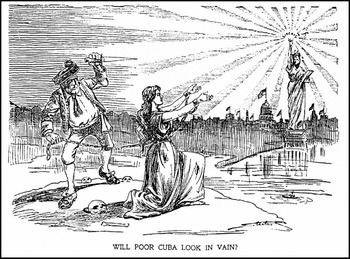
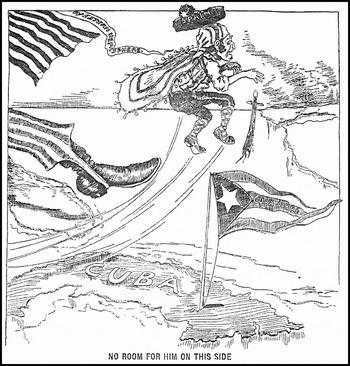
In the period leading up to war, two symbols frequently recur in cartoon art: an oppressed female Cuba and the iconography of Cuba Libre. The American press generally sympathized with Cuban nationalism, and although not all papers favored military intervention, they shared the belief that Spain was acting as a brutal aggressor. The editors of the Journal and the Post favored war, leading Bart and Steele to envision intervention as a dramatic rescue (Figure 6). Working independently but in conversation with each other and other artists, they enacted the political conflict using the cultural rubric of melodrama, with its dashing heroes, dark villains, and damsels in distress. Steele typified how cartoonists refigured the visual language of African enslavement in picturing Cuba, who often appeared as a chained supplicant in the familiar likeness of the abolitionist emblem “Am I Not a Woman & a Sister?” (Figure 3).Footnote 15 Cartoonists, like Bart, cast Uncle Sam in the role of manly hero breaking the chains of an endangered female Cuba and booting the Spaniard, with his bloody knife, out of the western hemisphere (Figure 4). The similarity in Steele and Bart's composition of the Spanish villain reflects the widespread adoption of the graphics of the Black Legend, a series of stereotypes dating back to the sixteenth century that associated Spain with the evils of Catholicism, the brutal conquest of Spanish America, and the barbarities of the Dutch War and Spanish Inquisition.Footnote 16
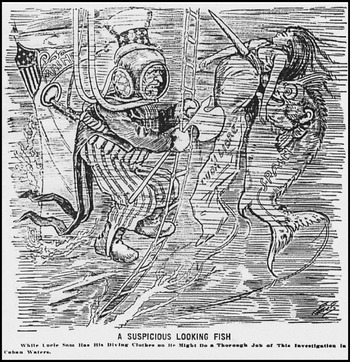
Furthermore, they embedded the female icon in a narrative of sexual danger at the mercy of the violent sexuality of the Spanish pirate. While Americans fixated on the findings of the divers' investigations of the Maine wreck, Bart chose to represent Uncle Sam in the drama as a diver rescuing the Cuban mermaid (tagged Cuba Libre), with her long evocative hair and shapely figure, as she is pierced through her mid-section by the perverse Spanish fish (Figure 2). Once rescued, the narrative repositioned her as ripe for American advances. Steele, for example, presented Cuba as a striking enchantress, with sexy free-flowing hair and draped in the Cuban flag, heightening the allure of her “resurrection” from “Spanish tyranny” (Figure 5). Artists defined her worthiness of rescue by coding her “white,” despite Cuba's racial diversity, and dressing her in classical attire (associating her with a Greek and Roman heritage). Although the nation's dailies brimmed with descriptions of Spanish abuses, cartoonists held the power to break it down in plain terms for readers at a glance: good or evil, liberty or tyranny, deliverance or abandonment. By framing intervention as a captivating and righteous venture, they turned inaction into a show of unmanliness and immoral neglect.
Cuban annexation was a critical policy objective in nineteenth-century diplomacy, marked by repeated attempts to purchase it from Spain. The 1854 Ostend Manifesto, which stated that “the Union can never enjoy repose, nor possess reliable security, as long as Cuba is not embraced within its boundaries,” testifies to the American preoccupation with incorporating Cuba.Footnote 17 But cartoonists, like Bart and Steele, did not frame intervention as a path to annexation. Their endorsement of Cuban independence shaped support for the Teller amendment in the declaration of war that disclaimed “any disposition or intention to exercise sovereignty, jurisdiction, or control” over Cuba and pledged to “leave the government and control of the island to its people.”Footnote 18
President McKinley, however, left the door open for indefinite occupation and never stipulated Cuban independence as his war objective. But even if McKinley desired colonies in order to open new markets, counter the economic downturn of the 1890s, or further an increasingly interventionist foreign policy in the western hemisphere, he chose not to publicize it.Footnote 19 The nation's news- and imagemakers, not its leaders, mobilized Americans to support a war defined simply with the objective of Cuba Libre. With little popular opposition, on 25 April 1898, America declared war.
Bart, “A Suspicious Fish.” Minneapolis Journal, 22 February 1898, 1.

Steele, “Will Poor Cuba Look In Vain?” Denver Post, 28 March 1898, 1.

Bart, “No Room for Him on This Side,” Minneapolis Journal, 5 April 1898, 2.

Steele, “The Resurrection of Liberty,” Denver Post, 9 April 1898, 1.

Steele, “Uncle Sam to the Rescue,” Denver Post, 22 April 1898, 1.

AMERICA FLEXING ITS MUSCLES: THE INTOXICATION OF EARLY VICTORY
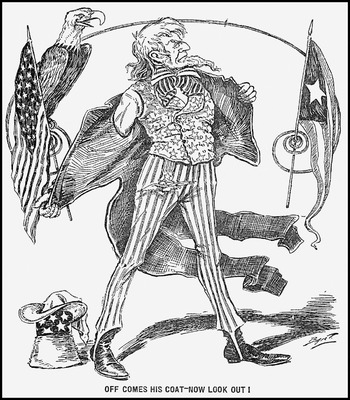
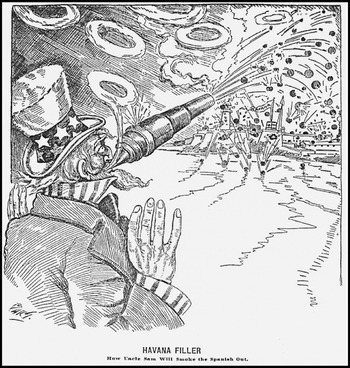
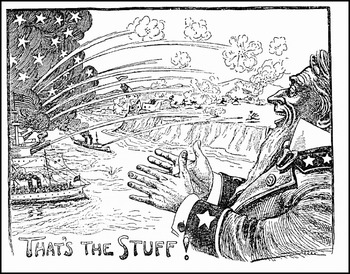
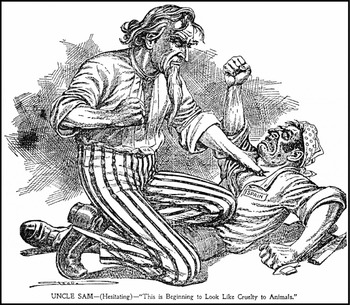
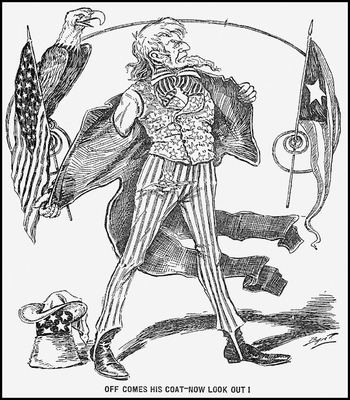
The American press did not expect a war to “save” Cuba to begin halfway around the world, in the Philippines. In total, only three US news correspondents were stationed in the Philippines at the start of the war, compared to hundreds in Cuba. Still, a quick decisive victory in the war's first major engagement, the Battle of Manila Bay, provoked a surge of nationalistic zeal in celebrating America's impressive debut on the world stage. “Off Comes His Coat – Now Look Out,” Bart wrote as he introduced Uncle Sam as a force to be reckoned with, flanked between the American and Cuban flags (Figure 7). Depictions of a strapping Uncle Sam, flexing his muscles, became a popular visual metaphor to demonstrate America's newfound confidence and military might. This celebration of American masculine vigor aligned with a larger ideological purpose of expanding the US global reach at the same time that it countered contemporary concerns that industrial capitalism, class strife, and racial amalgamation had drained the virility from American manhood.Footnote 20 The Dallas News noted that Uncle Sam's “appearance must be made to keep pace with the exciting march of events” and “must acquire an air that suggests the deliverer of slaves from the yoke of the oppressor.”Footnote 21 Bart and Steele embodied Uncle Sam as the nation's military power, single-handedly launching attacks on Spain, and presented the enemy as a barbaric monster, ferocious enough to bring recognition to American military strength without dwarfing Uncle Sam's dominion (Figures 8, 9, and 10).
Stanford University President David Starr Jordan described the “effect of great victories” and “suddenly realized strength” as “delicious” and “intoxicating.”Footnote 22 It was the impetus for a surge of national pride that invested the war with an entirely new mission and displaced the goal of Cuban independence. A Denver Post editorial worried that “the American people are now to be dazzled with thoughts of conquest and with visions of warm isles in the southern seas.”Footnote 23 And this concern had merit; the imperial momentum of the Spanish-American War rode the coattails of Dewey's victory, beginning with the annexation of Hawaii in early July.
Bart, “Off Comes His Coat,” Minneapolis Journal, 4 April 1898, 6.
Bart, “Havana Filler,” Minneapolis Journal, 23 April 1898, 5.

Steele, “That's the Stuff,” Denver Post, 7 June 1898, 1.

Steele, “This Is Beginning to Look Like Cruelty to Animals,” Denver Post, 7 July 1898, 1.

THE IMPERIAL TURN OF THE WAR: THE SHIFT FROM LIBERATION TO CONQUEST
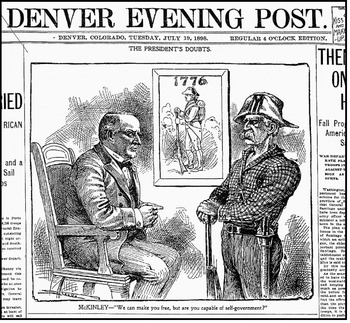
Only once victory was imminent did the press began to reconsider the merits of Cuba's leadership in assuming control of the island. In a cartoon published a few weeks before the armistice was signed on 12 August, Steele echoed the doubts of McKinley, and the pro-imperialist press, in Cuban General Máximo Gómez when just months before Gomez had been touted as a liberator on par with Simón Bolívar and Miguel Hidalgo (Figure 12). This functioned to justify why a war that began for Cuba Libre ended with an abrogation of that promise.
The Spanish-American War enabled the US to acquire its first overseas colonies, but an expansionist foreign policy was not a new departure for the nation. Beginning in the 1850s, businessmen and politicians sought to expand foreign markets to promote a growing industrial economy. Gaining momentum in the 1870s, US foreign policy increasingly promoted US interests in the Caribbean, Pacific, and Latin America and strove to augment American naval power. The State Department worked to establish protective tariffs and trading rights, such as the reciprocity agreement signed with Hawaii in 1875 that granted Hawaii exclusive duty-free access for sugar and other exports. Moreover, the peaceful resolution of the Venezuela border dispute with Great Britain in 1895 reinforced the right of the US to intervene in Latin America to protect its interests (the Monroe Doctrine) and became a springboard for a rekindling of American–British relations, renewed sense of racial affinity and shared imperial ideals.Footnote 24 The trajectory of American diplomacy, economic growth, and foreign policy in the late nineteenth century set the groundwork for the Spanish-American War to launch an overseas empire. Despite the intentions of US involvement in Cuba put forth in print and popular culture, McKinley seized upon it as an opportunity to expand US global interests.
While few newspapers initially objected to war with Spain, the postwar debate over colonial acquisition generated a greater divide in press and public opinion. In December 1898, the New York Herald surveyed 470 dailies and found that 288 newspapers supported formal colonial rule and 182 opposed. Led by influential figures including politicians, intellectuals, editors, labor leaders, reformers, and businessmen, a movement emerged in opposition to formal colonialism, which called for indefinite occupation and the exercise of political and military sovereignty in acquired territories.Footnote 25 Anti-imperialists feared the impact of colonial rule on a republican system that did not allow for ruling subjects without access to political representation. Their racist lens, however, led few anti-imperialists to urge eventual statehood. Most were reluctant for the US to assume the burdens of occupation but favored the extension of trade and cultural dominion, a policy we now call “neo-imperialism.” As debate intensified, American cartoonists took up the job of reshaping the visual apparatus of the war to rationalize (or contest) its new direction. Bart and Steele, whose artistic efforts were collaborative in urging the nation into war, now found themselves on opposing sides.
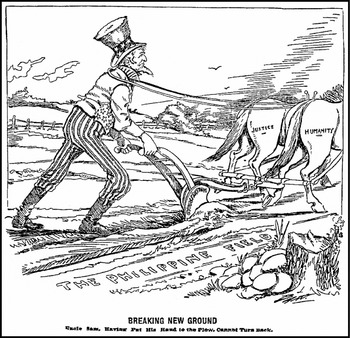
Bart and the Minneapolis Journal supported McKinley's imperial initiatives. In their view, the islands were won “by conquest” and retaining them was what “justice and humanity” and “duty and morality” demanded (Figure 13).Footnote 26 Uncle Sam, shouldering the plow of “civilization,” penned Bart, “cannot turn back.” To justify this, Cuba Libre had to be refigured from securing Cuban independence to replacing Spanish rule with a more “benevolent” brand. Pro-imperialists put forward an interventionist US policy as a moral necessity in line with the war's noble purpose. In Bart's graphic commentary, the Cuba Libre flag disappeared and only the American flag remained (Figure 11). This shift went hand in hand with blackening and infantilizing the Cuban, visually marking the retreat from the mission to free Cuba that had initially propelled Americans into war.Footnote 27 A Journal editorialist epitomized this reversal of opinion by stating that Cubans “deserve the contempt in which they have been held by their Spanish rulers.”Footnote 28 As the Journal increasingly looked to Cuba with an eye of conquest, claiming it afforded “a most inviting field of operations for brains, muscle, and money,” Bart distanced himself from his former portrait of Cuban whiteness and sexual allure.Footnote 29 The possibilities of indefinite possession raised disturbing questions of long-term racial amalgamation. Instead, appropriating the western colonial icon of the “child” to represent the colonies expressed the logic of dependence and immaturity that presented US guardianship as an act of responsibility, not selfish gain.
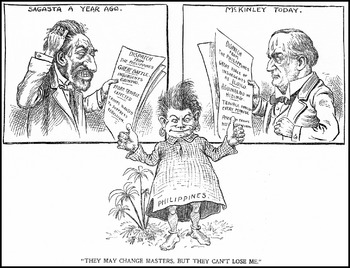
The Denver Post did not share the enthusiasm of the Minneapolis Journal for colonial possession. “In departing from the spirit and letter of that declaration the administration has aroused the ire of the nation,” wrote the Post, asserting that the promise to obtain Cuban independence should not only be kept, but also applied to the Philippines.Footnote 30 The Post was one of a growing number of newspapers that criticized McKinley for betraying Cuba. But despite editorial advocacy for Cuban and Philippine independence, anti-imperialist artists chose not to visualize them as civilized subjects capable of self-government. Steele did not return to the prewar narrative of Cuba Libre or images of Cuban “whiteness” to justify delivering independence as promised; instead, he turned to racial caricature to deter long-term guardianship. As the Senate debated the peace treaty that formalized US possession of the Philippines, Steele presents the Filipino as diminutive and monkey-like (Figure 15). Standing before Spanish Premier Sagasta and President McKinley, who now share the struggle to contain Filipino nationalism, he says, “They may change masters, but they can't lose me.” The pictorial conventions of race became the cartoonists' language to signify colonial competence, even though these demographic portraits were completely divorced from the racial and ethnic diversity of the colonies. They gave expression to the white supremacist political and social values of the 1890s and extended domestic racial and ethnic tensions to the sphere of US foreign relations.
Crippling anti-imperialist arguments was a lack of an effective alternative: if the natives' racial status made them unfit to self-govern but undesirable for incorporation, then what should the US do with them? If left independent, imperialists argued that the Philippines would fall victim to internal dissension, making them easy prey for Germany or Japan, who were itching to step in. Anti-imperialist artists were trapped by the racial contours of their own graphic language, because visualizing an alternative to acquisition would likely have required imagining foreign subjects in non-stereotypical forms. This, in part, accounts for their failure to produce a distinctive and compelling graphic argument to mobilize Americans to protest the imperial turn of the war.
Part of the problem was a practical one, as most artists had rapid deadlines and little knowledge of the colonies. McLain, the editor-in-chief of the Journal, met daily with Bart to discuss the next day's cartoon and then Bart had two hours to produce it. Given these constraints, it is not surprising that artists turned to established visual tropes to convey the stakes of empire. They made foreign subjects into known entities by association, creating images that “sort[ed] out the individuals in knowable groups” and conformed to readers' shared conceptualizations of racial and ethnic groups at home.Footnote 31 Cartoonists put an imperial spin on familiar images of the happy-go-lucky “plantation darky” from the minstrel stage as well as the harebrained black image in the comics, such as Thomas Worth's “Darktown Comics” of the 1880s or the more recent series in the New York World, artist Richard Outcault's “Here's the New Bully.”Footnote 32 Regardless of their stance on acquisition, postwar cartoons proliferated images of colonial subjects with blackface, white lips, gleaming teeth, and kinked hair along with distinctions of colonial primitivism, including loincloths, hoop earrings, nose-/ear-bones, and bows and arrows.
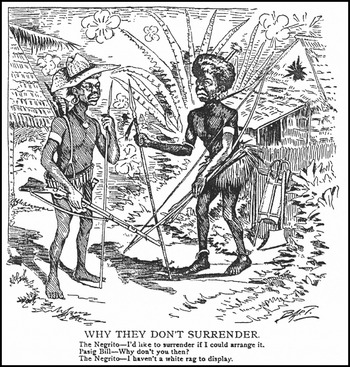
Despite being on opposing sides, Bart and Steele depicted the foreign subjects in similar caricatured form, reinforcing Christopher Lasch's contention that the anti-imperialists shared the same racist assumptions of the colonies as imperialist advocates.Footnote 33 For Bart, imagining colonial figures as black or infantile justified guardianship and downplayed the risks of pacification. In a cartoon published after Filipino nationals and US troops first clashed in February 1899, Bart portrayed the Filipinos as scantily clad, ignorant, and eager to surrender (Figure 16). To stand for the Filipino, he selected the “Negritos,” a minority group in the Philippine uplands of Luzon. This choice is revealing as they comprised a small minority in the conglomerate of racial/cultural groups of the Filipino nationalist movement. In all likelihood, the semantic proximity of the “Negritos” to the American “Negro” attracted Bart. By conflating white supremacist views with the work of colonization, he tapped into popular attitudes stemming from the fall of Reconstruction and the policies of segregation and disfranchisement. Bart imagined the “Negritos” as non-threatening, despite possessing primitive and modern weaponry, in need of a “civilizing” power to step in for their protection.
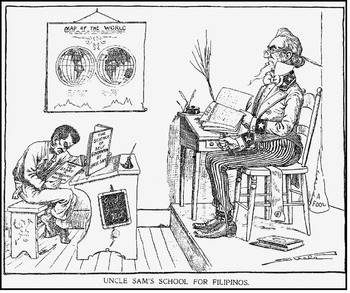
Steele deployed a similar construction of the native as visual shorthand for the cultural, racial, and political perils of empire, suggesting that only a “fool” would think Filipinos would willingly become America's pupil (Figure 14). Despite early reports from General Elwell S. Otis, the US military commander in the Philippines, that the rebellion would be quickly subdued, the Post rightly postulated a more protracted conflict, noting that “the task of the Americans is one no less precarious than that of the Spaniards.”Footnote 34 Steele pictured an unassimilable black Aguinaldo sneaking a book on how to foment rebellions in defiance of Uncle Sam's lessons of self-government. Though articulating different conclusions, Steele and Bart mobilized remarkably similar visual depictions of America's new subjects. Stylistic similarities and shared racial assumptions of the colonies took precedence over the visual expression of opposing viewpoints, placing the onus on editorial commentary and captioning to advance arguments for and against imperialism.
Bart, “Hurrah for the Fourth of July,” Minneapolis Journal, 2 July 1898, 1.

Steele, “The President's Doubts,” Denver Post, 19 July 1898, 1.

Bart, “Breaking New Ground,” Minneapolis Journal, 8 September 1898, 1.

Steele, “Uncle Sam's School for Filipinos,” Denver Post, 28 December 1898, 1.

Steele, “They May Change Masters, But They Can't Lose Me,” Denver Post, 13 January 1899, 1.

Bart, “Why They Don't Surrender,” Minneapolis Journal, 13 February 1899, 1.

REIMAGINING THE SPANISH-AMERICAN WAR: DOING THE WORK OF EMPIRE
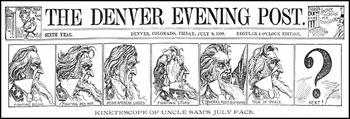
Steele's kinetoscope captures the critical element of contingency in understanding the shifting imperial climate of the Spanish-American War (Figure 17). The war began as a quest for Cuban independence; in the end, the US army occupied Cuba until May of 1902 and only granted independence under provision of the Platt Amendment, which limited Cuban authority to dictate foreign policy, secured an American military base in Guantánamo, and gave the US the right to intervene when necessary. In exchange for twenty million dollars, Spain ceded the entire Philippine archipelago, which remained in US hands until World War II, only achieving independence in 1946. In the bargain the US also acquired (and still retains) the Spanish colonial holdings of Puerto Rico and Guam.
Steele, “Kinetoscope of Uncle Sam's July Face,” Denver Post, 8 July 1898, 1.

There is little data to measure the public impact of these cartoons, but their influence is evident in the extent that these graphic narratives shaped the political defense of US actions in 1898. They advanced US foreign policy to a mass readership on a moral basis and not in explicit terms of American political, economic, or diplomatic interests, setting an important precedent for the media politics of future US foreign relations.Footnote 35 A community of artists, of which Bart and Steele were influential members, constructed the war as a fight for humanity and chose representations to establish a pretext for securing Cuban independence. After decisive victory heightened a militaristic and imperialist consciousness in the nation, Bart and Steele revised the images/narratives justifying US involvement. Despite taking opposing sides, both retreated from prior endorsements of Cuban nationalism and premised their arguments for or against acquisition on racialized visions of native subjects. For readers of this vernacular art, empire predominantly became a racial question.
News- and imagemakers sold the war to the American public without any professed realization of imperial intent and projected that the war would end with an independent Cuba. Still, one could argue that imperial preconditions were built into the melodramatic rescue narrative. At the heart of the campaign to “save” Cuba was a conception of America as the conveyor of humanity and a blatant disregard of Cuba's long-standing efforts to grind down Spanish defenses. Imagining Cuba as gendered and victimized also functioned to sustain later claims that Cuba was unfit to self-govern. But if the rescue narrative was at core an imperial advertisement, then Steele would have resisted it, given his postwar criticism of McKinley's policies, and pro-imperialist artists, like Bart, would not have felt the need to suppress it at the moment that Cuban and Philippine destinies came under debate. By initiating military action in Asian waters, McKinley took the war in an unexpected direction, forcing editors and imagemakers at the last second to scrap the very script of war that had so convincingly persuaded many Americans to support it in the first place.