Introduction
An ileocolic flap can be utilised for voice rehabilitation in patients with aphonia after total laryngopharyngectomy.Reference Chen, Gharb, Rampazzo, Perrone, Chen and Trignano1, Reference Hsiao, Leu, Chang, Yang and Tung2 The factors influencing vocal quality after ileocolic flap reconstruction surgery are unclear. In addition to pre- and post-operative radiotherapy (RT), we hypothesised that a long ileum segment of ileocolic flap may make it difficult for patients to phonate because of increased airflow resistance. This investigation aimed to evaluate the influence of ileocolic flap length.
Materials and methods
This study was approved by the Institutional Review Board of China Medical University Hospital, Taiwan. The charts of all patients who underwent voice rehabilitation with an ileocolic flap after total laryngopharyngectomy between 1 January 2011 and 30 December 2012 were retrospectively abstracted. All patients underwent ileocolic flap reconstruction of the hypopharynx and cervical oesophagus for voice rehabilitation.
The operative technique is described as follows. The peritoneum was incised in the region of the right paracolic gutter, and the ileocolon and appendix were identified via a median celiotomy. The ileocolon was mobilised and harvested, and the superior mesenteric vessels were preserved by transillumination. Diluted povidone-iodine (1:100) was utilised to irrigate the harvested bowel. An appendectomy was performed and end-to-end anastomosis was carried out to connect the ascending colon to the terminal ileum.
The flap was then utilised to reconstruct the laryngopharyngectomy defect by microvascular anastomoses. The external jugular vein was anastomosed to the ileocolic vein, and the transverse cervical artery was anastomosed to the ileocolic artery. The pharyngeal defect was reconstructed using the ascending colon in an isoperistaltic direction to create a conduit between the hypopharynx and oesophageal stump. The terminal ileum was then anastomosed to the tracheal stump. A tube jejunostomy was performed for peri-operative nutritional support. The viability of the flap was observed by loop monitor and/or direct visualisation of the exposed ileum.
The extent of resection was from the terminal ileum to the ascending colon (including the ileocecal valve). The length is very adaptable to the primary laryngopharyngeal defect. We usually harvest the ileocolic flap with a total length of 25–30 cm. The defect is from the hypopharynx to the oesophageal stump (around the second tracheal ring), and is usually 5–14 cm in length. The ileocolic flap is always longer than the defect.
This study aimed to measure the ileum segment we needed to inset. Ileum segment length was measured after vascular anastomosis at the neck. It was measured from the site where ileum joined the colon segment, to the end of the ileum segment where it joined the trachea stump. The measurement was accurate because the ileum had no peristalsis during anaesthesia.
All procedures for all cases were conducted by a single surgeon. Measurements were formal rather than based on estimates. No cases were rejected. The ileum segment length was at least the length required for inset without tension. We sometimes used more length just to cover the redundant vascular pedicle (usually the transverse cervical artery and external jugular vein), so that ileum segment length was longer than the defect length (even longer than 15 cm). The extent of resection was 5–14 cm in all cases. Ileum segment length was stratified into three groups: less than 7 cm, 7–15 cm and more than 15 cm.
The data abstracted included: the aetiology of the defect, the surgical procedure, patient demographics, RT details, surgical complications and ileum segment length.
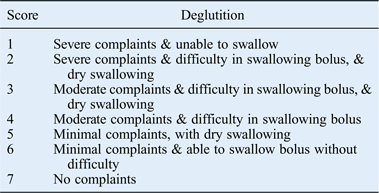
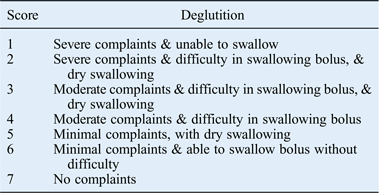
Swallowing function was evaluated in terms of severity of complaints, ability to swallow and presence of dry swallowing. Seven-point Likert scales were employed, wherein a score of 1 indicated that the patient had severe complaints and was unable to swallow, and a score of 7 indicated no complaints (Table I).
Swallowing function scoring scale
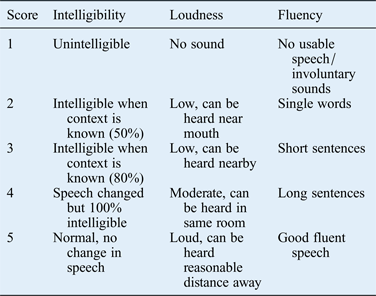
Vocal function was evaluated in terms of loudness of speech, maximum phonation time, percentage of intelligible words during speaking, and speech fluency. Five-point Likert scales were employed, wherein a score of 1 indicated that the patient could not phonate a word and a score of 5 indicated good vocal function (Table II).
Speech function scoring scale

Three recordings were made for each vocal assessment, and the longest was used for analysis. Patients who could phonate for over 3 seconds underwent sound spectrogram analysis with a Computerized Speech Lab system (Model 4500; KayPentax, Lincoln Park, New Jersey, USA), and the outcome factors of average fundamental frequency (F0), sound pressure level and dynamic range were recorded.
Ileum segment length was categorised into three groups: group 1 = less than 7 cm (n = 6), group 2 = around 7–15 cm (n = 13) (Figure 1), and group 3 = more than 15 cm (n = 11) (Figure 2).
Voice tube of around 10 cm in length.
Voice tube over 15 cm in length.
All data were coded and abstracted into SPSS statistical software, version 17.0 (SPSS, Chicago, Illinois, USA). Outcome measures were analysed using Fisher's exact test. A p value of less than 0.05 was considered statistically significant.
Results
Thirty patients underwent laryngopharyngectomy and ileocolic flap vocal rehabilitation. The surgical indications were hypopharyngeal cancer (21 out of 30) and laryngeal cancer (9 out of 30).
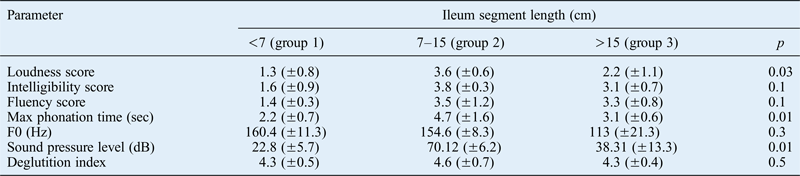
Average ileum segment length (± standard deviation) was 5.4 ± 1.1 cm in group 1, 10.6 ± 2.2 cm in group 2 and 17.6 ± 2.4 cm in group 3.
Voice outcomes for each group are presented in Table III. There were significant associations between ileum segment length and loudness, maximum phonation time and sound pressure level (p < 0.05). All three parameters were best in group 2. There were no associations between ileum segment length and intelligibility, speech fluency, average fundamental frequency or deglutition index (p > 0.05).
Phonation and deglutination results by ileum segment length
Data represent means (±standard deviations) unless indicated otherwise. Statistics calculated using Fisher's exact test; p < 0.05 was considered significant. Max = maximum; sec = seconds; F0 = average fundamental frequency
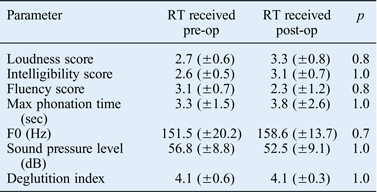
All patients underwent RT because of advanced tumour status. Eleven patients received pre-operative RT and 19 received post-operative RT. There was no association between voice outcome and timing of RT (Table IV).
Phonation and deglutination results by radiotherapy timing
Data represent means (±standard deviations) unless indicated otherwise. Statistics calculated using Fisher's exact test; p < 0.05 was considered significant. RT = radiotherapy; pre-op = pre-operatively; post-op = post-operatively; max = maximum; sec = seconds; F0 = average fundamental frequency
Vascular compromise of the flap secondary to arterial insufficiency occurred in two patients. Both cases were identified and resolved. Five patients suffered regurgitation from the ileocecal valve into the flap. All five patients underwent plication of the ileocecal valve via a transcolonic approach after a two-month period of observation. They could all swallow with no choking after plication surgery. Four patients developed leakage and fistula formation at the coloesophageal junction. Two of these patients received a deltopectoral flap, one received a pectoralis major flap and one received a seromuscular flap. Three patients developed dysphagia secondary to stricture at the coloesophageal junction. All three underwent secondary reconstruction with restoration of swallowing function.
Discussion
Ileocolic flap reconstruction after laryngopharyngectomy for voice restoration has numerous benefits over existing options.Reference Reumueller, Leonhard, Mancusi, Gaechter, Bigenzahn and Schneider-Stickler3, Reference Rossmiller, Ghanem, Gross and Wax4 An artificial electronic larynx produces an unnatural sound, which can lead to social isolation and depression.Reference Cocuzza, Bonfiglio, Grillo, Maiolino, Malaguarnera and Martines5 Voice rehabilitation with a tracheoesophageal prosthesis can result in a foreign body reaction, with crust formation, chronic infection and inflammation.Reference Reumueller, Leonhard, Mancusi, Gaechter, Bigenzahn and Schneider-Stickler3, Reference Hancock, Lawson and Ward6 The prosthesis is also expensive, and time consuming to care for and replace. In addition, it may loosen and become dislodged into the airway. Therefore, an autologous flap has theoretical advantages for voice rehabilitation after laryngopharyngectomy.
However, rehabilitation with an ileocolic flap is not without challenges. Stenosis or stricture of the voice conduit orifice is relatively common, and may be more common in patients who receive pre-operative RT as part of prior organ preservation treatment.Reference Imaizumi, Liem, Ngo and Chen7 Soft tissue stiffness after RT can lead to difficulties in vocal resonance and speaking.Reference Tuomi, Bjorkner and Finizia8 Nevertheless, we could not identify significant differences in vocal functions caused by pre- or post-operative RT. As all of our patients underwent RT for advanced tumour status, we could not compare results with a non-RT group.
• Voice restoration after laryngopharyngectomy can be achieved with an autologous ileocolic flap
• This enables proper speech and swallowing function
• Optimal ileum segment length (using an autologous ileocolic flap) for voice tube reconstruction after laryngopharyngectomy is 10 cm
The most important predictor of voice loudness and speech function was ileum segment length. A longer flap is bulky, and may lead to compression and increased airflow resistance, with a negative impact on voice production. Conversely, a flap that is too short is also unsatisfactory because of shrinkage. A shorter flap causes decreased external tension to the ileocecal valve, which will not be able to close in a natural position, leading to air leakage and aphonia.Reference Plant, Freed and Plant9
Conclusion
Voice rehabilitation after laryngopharyngectomy is possible with an ileocolic flap. The data suggest that voice production is optimal with an ileum segment of approximately 10 cm. Complications are frequent but amenable to revision surgery.
Acknowledgement
Supported by a grant from the Taiwan National Science Council (101-2314-B-039-013-MY3).