Introduction
Paranoid ideation refers to an unjustified suspiciousness towards others’ motives (American Psychological Association, APA, 2013). Paranoid ideation exists along a continuum of symptoms in the general population, ranging from mild to severe (e.g., Freeman, Reference Freeman2016; Freeman & Garety, Reference Freeman and Garety2014; Freeman et al., Reference Freeman, Garety, Bebbington, Smith, Rollinson, Fowler and Dunn2005). Mild paranoia includes, for example, temporary thoughts that there are negative rumors circulating about the self (Freeman & Garety, Reference Freeman and Garety2014). More severe paranoia refers to more persistent, distressing, and convincing beliefs that others aim to deliberately cause some kind of harm to the self (Freeman, Reference Freeman2016). Most severe paranoia refers to psychotic-level persecutory delusions (Freeman, Reference Freeman2016). Paranoid ideation is related to a wide variety of comorbid psychiatric disorders, such as depression, posttraumatic stress disorder, and even suicidality (Alsawy, Wood, Taylor, & Morrison, Reference Alsawy, Wood, Taylor and Morrison2015; Freeman et al., Reference Freeman, McManus, Brugha, Meltzer, Jenkins and Bebbington2011). Importantly, most severe forms of paranoid ideation are suggested to be a crucial risk factor for conducting violent crimes (Coid, Ullrich, Bebbington, Fazel, & Keers, Reference Coid, Ullrich, Bebbington, Fazel and Keers2016; Heinrichs & Sam, Reference Heinrichs and Sam2012). Since the severe forms of paranoia may be related to such adverse outcomes, it is necessary to investigate paranoid ideation in a much earlier phase to provide possibilities for early preventive interventions.
Along with this, there exist several psychological models about the early development of paranoid ideation. The models (e.g., threat–anticipation model of paranoia) have postulated a range of psychosocial factors affecting the onset and maintenance of paranoid ideation (Bentall, Corcoran, Howard, Blackwood, & Kinderman, Reference Bentall, Corcoran, Howard, Blackwood and Kinderman2001; Freeman, Reference Freeman2007, Reference Freeman2016). In the models, the following psychosocial factors, among others, are postulated to play a crucial role for paranoid ideation: experienced stress (e.g., state-level stress related to stressful events), disposition to feel worry or anxiety, social detachment (i.e., distant relationships with others, low need for social interactions, low tendency to discuss one's thoughts with others; and challenges with social functioning), sleep disturbances (e.g., insomnia or disruptions of circadian rhythm), and anomalous experiences, for example, deriving from substance use (Bentall et al., Reference Bentall, Corcoran, Howard, Blackwood and Kinderman2001; Freeman, Reference Freeman2007, Reference Freeman2016). Previously, some studies have found that elevated stress levels predict an increase in paranoid states (Kesting, Bredenpohl, Klenke, Westermann, & Lincoln, Reference Kesting, Bredenpohl, Klenke, Westermann and Lincoln2013; Lincoln et al., Reference Lincoln, Peter, Schäfer and Moritz2009b). Regarding social detachment, previous studies have found that low social support and low self-confidence in social situations (Riggio & Kwong, Reference Riggio and Kwong2009), frequent social fears (Marteinsdottir, Tillfors, Furmark, Anderberg, & Ekselius, Reference Marteinsdottir, Tillfors, Furmark and Anderberg2003 ), high introversion (Tackett, Kushner, Herzhoff, Smack, & Reardon, Reference Tackett, Kushner, Herzhoff, Smack and Reardon2014), and hostile interpretations of others’ socioemotional cues (Bentall et al., Reference Bentall, Corcoran, Howard, Blackwood and Kinderman2001; Freeman, Reference Freeman2007; Tone & Davis, Reference Tone and Davis2012) are related to higher paranoid ideation. Moreover, in line with Freeman's model, paranoid ideation is found to be related to anxiety (Freeman et al., Reference Freeman, Pugh, Antley, Slater, Bebbington, Gittins and Garety2008) and expectations of future negative events (Corcoran et al., Reference Corcoran, Cummins, Rowse, Moore, Blackwood, Howard and Bentall2006). Finally, cross-sectional studies have shown that alcohol use (Dawson, Grant, Stinson, & Chou, Reference Dawson, Grant, Stinson and Chou2005; Grant et al., Reference Grant, Stinson, Dawson, Chou, Ruan and Pickering2004) and sleep disturbances, particularly insomnia, are linked to higher paranoid ideation (Reeve, Sheaves, & Freeman, Reference Reeve, Sheaves and Freeman2015; Scott, Rowse, & Webb, Reference Scott, Rowse and Webb2017).
Importantly, even though previous studies have supported the roles of experienced stressful states, disposition to feel worry, social detachment, sleep disturbances, and alcohol use for paranoid ideation, longitudinal studies with prospective follow-ups of several years have been mostly lacking. Hence, several questions related to the etiology of paranoid ideation have remained unclear. To our knowledge, among previous studies, the longest follow-up of paranoid ideation has been carried out over a time span of 18 months in population-based studies (Freeman et al., Reference Freeman, Stahl, McManus, Meltzer, Brugha, Wiles and Bebbington2012). In clinical populations, the longest follow-up has been in a study of 301 patients first admitted to a hospital with delusional psychoses and then followed-up 5–18 years later by Retterstol and Opjordsmoen in Norway (Opjordsmoen, Reference Opjordsmoen1989). The study in Norway was primarily focused on the relationship of psychiatric diagnosis to outcome and provided only broad descriptions of the associated psychosocial variables.
Given that, owing to the lack of long-term follow-ups of paranoid ideation, two essential topics have remained unclear. First, it has remained largely unknown whether the associations of the psychosocial risk factors with paranoid ideation are stable over age or whether they change from early adulthood to middle age. There is evidence that there are age-related changes in the prevalence of paranoia-related risk factors; for example, level of anxiety proneness seems to slightly decrease with age (Zohar, Zwir, Wang, Cloninger, & Anokhin, Reference Zohar, Zwir, Wang, Cloninger and Anokhin2019).
Second, more research has been recommended in order to clarify the temporal relationships of paranoid ideation with the psychosocial risk factors (i.e., experienced stressful states, disposition to feel worry, social detachment, sleep disturbances, and alcohol use). That is, whether these psychosocial factors are more likely to predict paranoid ideation or vice versa. On the one hand, sleep problems and increased psychosocial stress are found to predict increase in paranoid states (Kesting et al., Reference Kesting, Bredenpohl, Klenke, Westermann and Lincoln2013; Scott et al., Reference Scott, Rowse and Webb2017; Thewissen et al., Reference Thewissen, Bentall, Oorschot, à Campo, van Lierop, van Os and Myin-Germeys2011). In addition, increases in anxiety, worry, and insomnia predict the onset and persistence of paranoid episodes (Freeman et al., Reference Freeman, Pugh, Antley, Slater, Bebbington, Gittins and Garety2008, Reference Freeman, Stahl, McManus, Meltzer, Brugha, Wiles and Bebbington2012). Further, alcohol use in the past is found to correlate with the current level of paranoid ideation (Grant et al., Reference Grant, Stinson, Dawson, Chou, Ruan and Pickering2004). On the other hand, paranoid beliefs are suggested to result in experiences of anxiety and social isolation (Freeman, Reference Freeman2007). In addition, paranoid ideation may commonly cause subjective suffering and stress (Freeman, Reference Freeman2007, Reference Freeman2016), which, in turn, may predispose to alcohol use as a way of stress coping.
The first aim of the present study was to investigate whether experienced stress (stressful states), anticipatory worry (a more stable disposition to feel worry), social detachment, sleep disturbances, and alcohol use are associated with the course of paranoid ideation. We also calculated a cumulative risk score of the risk factors since cumulative risk scores have been widely used previously (e.g., Copeland, Shanahan, Jane Costello, & Angold, Reference Copeland, Shanahan, Jane Costello and Angold2009; el Bouhaddani, van Domburgh, Schaefer, Doreleijers, & Veling, Reference el Bouhaddani, van Domburgh, Schaefer, Doreleijers and Veling2019), but, to our knowledge, they have not been used to date in the research field of paranoid ideation. The second aim was to examine whether the temporal relationships are more likely to proceed from the psychosocial factors to paranoid ideation or vice versa. We used the pre-existing data set of the Young Finns Study that provides unique opportunities to examine the impact of risk factors (presented in previous cognitive models) on paranoia over time. The data include a population-based sample with a 10-year prospective follow-up and several measurement times (the participants were aged between 24 and 50 years). This rare population-based data provide a solid empirical foundation for identifying the conditions that increase the risk of paranoid ideation at both societal and individual levels.
Method
Participants
We used data from the prospective Young Finns Study. The participants were selected randomly from six age cohorts (born between 1962 and 1977) from the population register of the Social Insurance Institution. The Social Insurance Institution covers the whole population of Finland. The original sample included 3596 participants in the baseline measurement in 1980 (when participants were aged 3–18 years). The participants have been followed since that time, so that the latest follow-up measurement was in 2012 (participants were aged 35–50 years). The study was carried out in accordance with the Declaration of Helsinki. Furthermore, the design of the Young Finns Study was approved by all the Finnish universities with medical schools. Before participation, all the participants or their parents (for participants aged below 12 years) provided informed consent after the nature of the procedures had been fully explained. The design of the Young Finns Study is described in more detail elsewhere (see Raitakari et al., Reference Raitakari, Juonala, Rönnemaa, Keltikangas-Järvinen, Räsänen, Pietikäinen and Jula2008).
For this study, paranoid ideation and psychosocial factors (experienced stress, anticipatory worry, social detachment, sleep disturbances, and alcohol use) were evaluated in 2001, 2007, and 2011/2012; participants’ socioeconomic factors in 2011; and parents’ socioeconomic factors in 1980. The final sample included 1534–1553 participants.
Measures
Cumulative risk score
Psychosocial risk factors included anticipatory worry, social detachment, experienced stress, sleep disturbances, and alcohol use in 2001, 2007, and 2012.
Anticipatory worry was evaluated with the Anticipatory Worry Scale of the Temperament and Character Inventory (Cloninger, Przybeck, Svrakic, & Wetzelz Reference Cloninger, Przybeck, Svrakic and Wetzel1994). The Anticipatory Worry Scale included 11 items (e.g., “I'm never worried about terrible things that could happen me in the future” (reversed); Cronbach's α = .80–.81 in 2001, 2007, and 2012) that were responded with a 5-point scale, ranging from 1 (definitely true) to 5 (definitely false). We used this scale to measure trait-level disposition to feel worry. The test–retest correlations of the scale were high (r = .661–.751 between different measurement times in 2001, 2007, and 2012), indicating that the scale measured a comparatively stable disposition. The items were reversed so that high scores referred to higher anticipatory worry. High anticipatory worry was defined to be present if the mean score of the scale was >3.
Social detachment was evaluated with the Attachment Scale of the Temperament and Character Inventory. The Attachment Scale included eight items (e.g., “I usually discuss my experiences and feelings with my friends openly, instead of keeping them inside my mind” (reversed); “I would not be disturbed although I was always alone”; or “Usually, I try to keep distant relationships with others”; Cronbach's α = .82–.84 in 2001, 2007, and 2012) that were responded with a 5-point scale, ranging from 1 (definitely true) to 5 (definitely false). The items were reversed so that high scores referred to lower attachment (i.e., higher social detachment). High social detachment was defined to be present if the mean score of the reversed scale was >3. High social detachment referred to distant relationships with others, low need for social interactions, and low tendency to discuss one's thoughts or emotions with others. There is previous evidence that high social detachment is related to more severe challenges in social functioning (including challenges in social activities and initiatives and aspects of avoidance tendencies) (Jetha, Goldberg, & Schmidt, Reference Jetha, Goldberg and Schmidt2013). In addition, high social detachment correlates with higher scores of asociality (Gutiérrez, Vall, Peri, Gárriz, & Garrido, Reference Gutiérrez, Vall, Peri, Gárriz and Garrido2014) and higher scores of detachment (Jönsson et al., Reference Jönsson, Cichon, Gustavsson, Grünhage, Forslund, Mattila-Evenden and Nöthen2003).
Experienced stress was evaluated with one item that was responded with a 5-point scale (1 = not at all; 2 = only a bit; 3 = somewhat; 4 = quite a lot; 5 = very much). (“Stress refers to such a situation where one feels tensioned up, restless, nervous, or anxious, or where one experiences sleep disturbances because things are bothering one's mind. Do you experience this kind of stress?”) High experienced stress was defined to be present if the participant reported experiencing stress quite a lotor very much. The item of experienced stress is linked to stressful events and is distinct from the scale of worry (for further details, see Supplementary Material).
Sleep disturbances were assessed with two items (“Do you have difficulties to fall asleep?”; “Do you wake up at nights?”) that were responded with a 3-point scale (0 = no; 1 = not sure; 2 = yes). The items were selected from the Vital Exhaustion Questionnaire (Appels, Höppener, & Mulder, Reference Appels, Höppener and Mulder1987) on the basis of a confirmatory factor analysis of the items (see Supplementary Table 1). The reliability and validity of the Vital Exhaustion Questionnaire have been confirmed previously (e.g., Chumaeva, Hintsanen, Juonala, Raitakari, & Keltikangas-Järvinen, Reference Chumaeva, Hintsanen, Juonala, Raitakari and Keltikangas-Järvinen2010; Meesters & Appels, Reference Meesters and Appels1996). Frequent sleep disturbances were defined to be present if the participant responded “yes” to at least one of the items, namely, reported having difficulties in falling asleep or being awake at night.
Alcohol use was evaluated by asking the participants the frequency of alcohol intoxication (i.e., consuming at least six portions at one time). The frequency was evaluated with a 6-point scale, ranging from 1 (two times per week or more often) to 6 (once a year or more seldom). Frequent alcohol use was defined to be present if the participant reported becoming intoxicated at least once a week.
Paranoid ideation
Paranoid ideation was evaluated with the Paranoid Ideation Scale of the Symptom Checklist-90 Revised (SCL-90R; Derogatis, Reference Derogatis1986). The scale consists of six items (e.g., “I think that other people would take advantage of me if I let them to do that”) that are responded with a 5-point scale, ranging from 1 (totally disagree) to 5 (totally agree). The Paranoid Ideation Scale has also been used previously (e.g., Saarinen, Hintsanen et al., Reference Saarinen, Hintsanen, Hakulinen, Pulkki-Råback, Lehtimäki, Raitakari and Keltikangas-Järvinen2018; Saarinen, Rosenström et al., Reference Saarinen, Rosenström, Hintsanen, Hakulinen, Pulkki-Råback, Lehtimäki and Keltikangas-Järvinen2018). Previous studies have confirmed good reliability for the SCL-90R and for the subscale of paranoid ideation (e.g., Olsen, Mortensen, & Bech, Reference Olsen, Mortensen and Bech2004; Schmitz et al., Reference Schmitz, Hartkamp, Kiuse, Franke, Reister and Tress2000). The internal reliability of the scale was good also in our data (Cronbach's α = .75–.79 in 2001, 2007, and 2012).
Covariates
Socioeconomic factors included participants’ and their parents’ level of income and educational level. Parents’ level of income was assessed with an 8-point scale, ranging from 1 (less than 15,000 Finnish mark per year) to 8 (more than 100,000 Finnish mark per year). Participants’ level of income was measured with a 13-point scale, ranging from 1 (less than €5000 per year) to 13 (more than €60,000 per year). Participants’ and their parents’ educational level was classified into three categories (1 = comprehensive school; 2 = high school or occupational school; 3 = academic level). In case mother's and father's educational levels were different, we used the higher level of education.
Statistical analyses
For each measurement year, we calculated the mean score of each risk factor and paranoid ideation for all the participants who had responded to at least 80% of the items. We calculated both continuous and dichotomous (0 = risk not present; 1 = risk present) variables for all the psychosocial risk factors. A cumulative risk score was calculated as the total score of the five dichotomous psychosocial risk factors. Hence, continuous scores were used in the main analyses reported in the tables; and dichotomous variables were used only when calculating the cumulative risk score and when illustrating the findings in the figure.
Statistical analyses were conducted with STATA SE (version 13.0). The association of psychosocial risk factors with paranoid ideation was investigated using multilevel models for longitudinal design (growth curve models). Growth curve models estimate “fixed effects” that refer to classic regression coefficients, and “random effects” that refer to the individual-level variance in the intercept, slopes, and residual variance (i.e., within-individual variance over the follow-up). Before conducting the analyses, the scores of psychosocial risk factors and the cumulative risk score were standardized with the mean and standard deviation of year 2001 scores, in order to stabilize the growth curve trajectories over the follow-up measurements. In all the models, the dependent variable was the course of paranoid ideation (in 2001–2012). We estimated fixed effects for the continuous scores of psychosocial risk factors, age, age-squared, and the age-interactions of the psychosocial risk factors. Age was set both as fixed and random effect. As the sample consisted of six age cohorts (born in 1962–1977), the age range of the participants varied between 24 and 50 years in 2001–2012. Age was centered to 24 years (the age of the youngest participants in 2001). We included age-squared in the model (as a fixed effect) since previous studies have shown that curvilinear trends exist in the development of paranoid ideation over age (e.g., Hintsanen et al., Reference Hintsanen, Gluschkoff, Dobewall, Cloninger, Keltner, Saarinen and Pulkki-Råback2019). All the models were adjusted for sex and participants’ and their parents’ socioeconomic factors. We also calculated the scores of pseudo R2 for each growth curve model (the estimated variance explained by the predictor variables/the estimated total variance in the outcome variable in a null model).
The temporal associations of psychosocial factors with paranoid ideation were investigated using structural equation models with cross-lagged panel design (, i.e. maximum-likelihood missing values (MLMV) estimation). Separate models were estimated for each psychosocial risk factor (i.e., anticipatory worry, social detachment, experienced stress, sleep disturbances, and alcohol use) to investigate its temporal associations with paranoid ideation. We conducted altogether four models: (a) a model including only stability coefficients (the variables at each time point were predicted by the same variables at the next time points) and covariances between the psychosocial risk factor and paranoid ideation at each time point; (b) a model that included also the predictive coefficients from the psychosocial risk factor at each time point to paranoid ideation at the next time points; (c) a model that included the predictive coefficients in the opposite direction (i.e., from paranoid ideation at each time point to the psychosocial risk factor at the next time points); and (d) a model with the cross-lagged predictive coefficients in both directions between the psychosocial risk factor and paranoid ideation. Models 1 to 4 are illustrated in Supplementary Figure 1. In all the models, we used continuous scores of the psychosocial risk factors.
We evaluated the goodness-of-fit of Models 1 to 4 by investigating the values of the comparative fit index (CFI), the root mean square error of approximation (RMSEA), and the Bayesian information criterion (BIC). Previously, it has been recommended that CFI should be >0.95 and RMSEA should be <0.06 (Hu & Bentler, Reference Hu and Bentler1999). Moreover, lower scores of the χ2 test of absolute model fit and BIC indicate better model fit (Schreiber, Nora, Stage, Barlow, & King, Reference Schreiber, Nora, Stage, Barlow and King2006). The final selection of the model with best statistical fit was done on the basis of the χ2 test score of absolute model fit.
Results
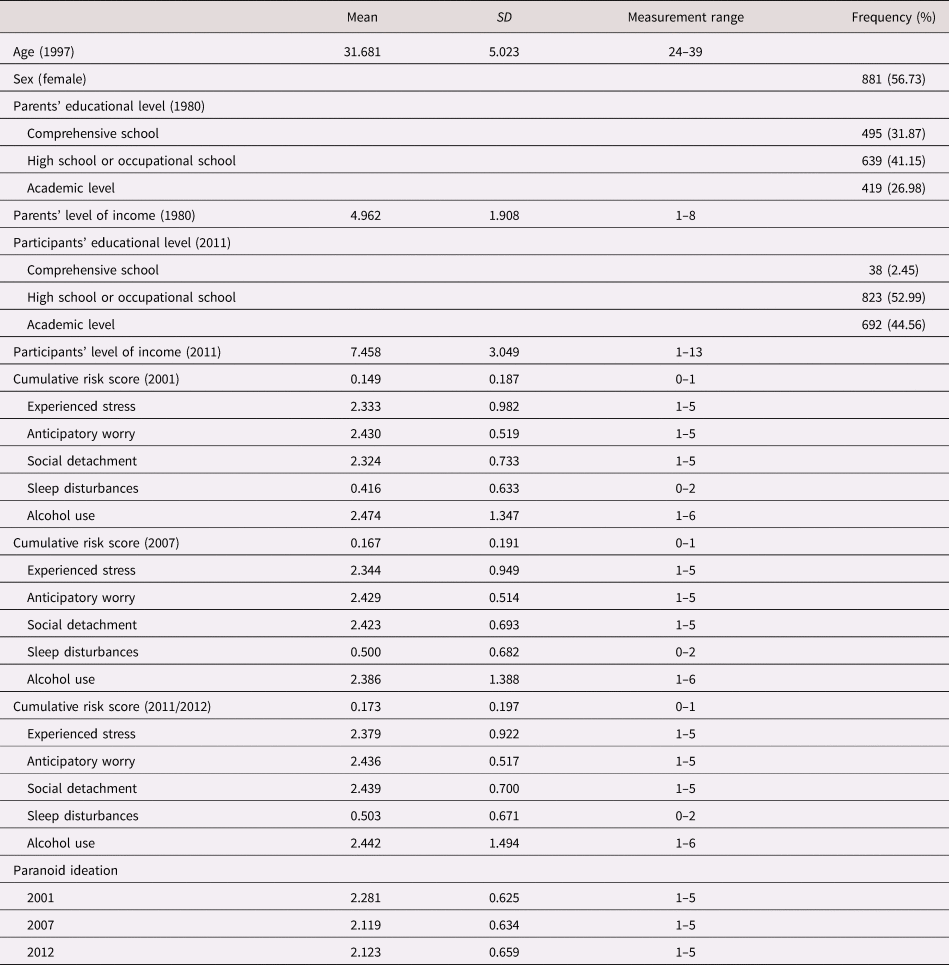
The descriptive statistics of the study variables are shown in Table 1. The correlations between the study variables can be found in Supplementary Table 2. Attrition analyses showed that included participants were slightly older than excluded participants (31.681 vs. 31.261, p < .013), although the effect size of the difference was minor. Further, women were more likely to participate than men (48.090% vs. 38.095%, p < .001). At the baseline measurement point (in 2001), there was no attrition bias in experienced stress or social detachment. We obtained some minor differences (statistically significant differences with minor effect sizes) between included and excluded participants, the risk factors, and paranoid ideation: included participants had slightly lower levels of anticipatory worry (2.430 vs. 2.507, p = .0019), sleep disturbances (0.416 vs. 0.489, p = .014), and alcohol use (2.474 vs. 2.683, p < .001); and slightly lower level of paranoid ideation (2.281 vs. 2.414, p < .001). In socioeconomic factors, we obtained several statistically significant attrition biases that were, however, minor by effect size: included participants had slightly higher level of income than excluded participants (7.458 vs. 7.013, p < .011); and included participants’ parents had a slightly higher level of income (4.962 vs. 4.658, p < .001) and were more likely to have high educational level (26.980% vs. 23.402%, p = .015). The most substantial attrition bias was obtained in educational level: included participants were substantially more likely to have a high educational level (44.559% vs. 9.173%, p < .001). Previously, it has been found that values are missing at random in the psychosocial variables of the Young Finns data (Pulkki-Råback et al., Reference Pulkki-Råback, Elovainio, Hakulinen, Lipsanen, Hintsanen, Jokela and Keltikangas-Järvinen2015).
The means, standard deviations (SD), frequencies, and ranges of the study variables.

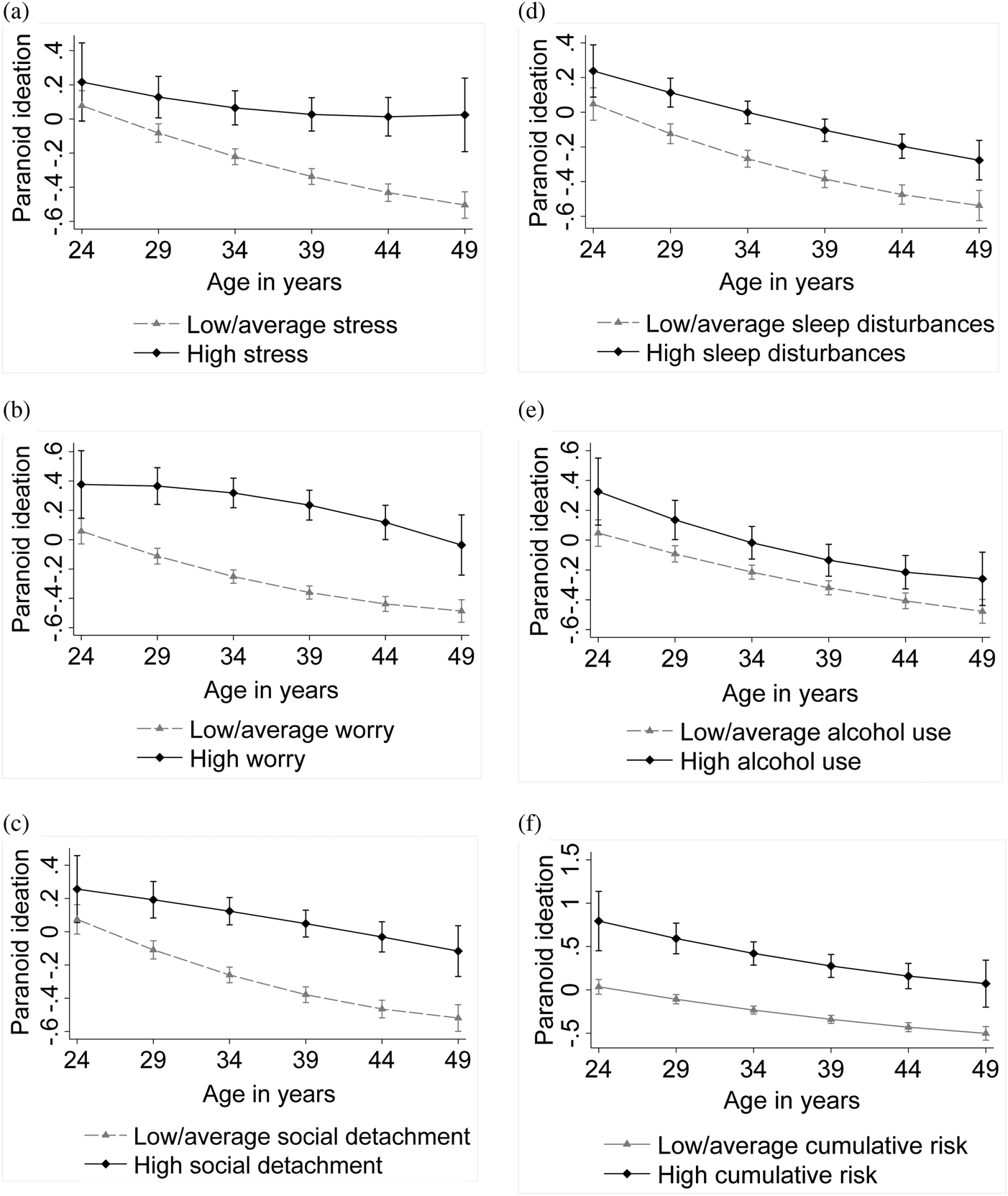
The results of the growth curve models are presented in Table 2. Regarding age-related effects, the trajectories of paranoid ideation were mostly linear, although modest curvilinearity was obtained for some risk factors (experienced stress, social detachment, and sleep disturbances, respectively). High experienced stress, high anticipatory worry, high social detachment, frequent alcohol use, and frequent sleep disturbances had positive main effects on the trajectory of paranoid ideation. When predicting the trajectory of paranoid ideation, there were no significant age interactions with experienced stress, anticipatory worry, sleep disturbances, or alcohol use. This indicated that the associations of these risk factors (experienced stress, anticipatory worry, sleep disturbances, and alcohol use) with paranoid ideation did not change significantly over age. However, there were significant age interactions with social detachment, indicating that age modified the association of social detachment with paranoid ideation. All the findings were controlled for age, sex, and participants’ and their parents’ socioeconomic factors. The scores of pseudo R 2 ranged between [0.216; 0.252]. The lowest pseudo R 2 was obtained for alcohol use; and the highest pseudo R 2 was obtained for the cumulative risk score, although differences in pseudo R 2 appeared not to be very large between different models. The results are illustrated in Figure 1 (please note: we used continuous scores for the risk factors in the growth curve models presented in Table 2; whereas we used split scores for risk factors in the Figure 1).
The trajectories of paranoid ideation in adulthood separately for participants with different levels of (a) experienced stress, (b) anticipatory worry, (c) social detachment, (d) sleep disturbances, (e) frequent alcohol use, and (f) cumulative risk score. Estimated means with 95% confidence intervals. Note: Adjusted for age, sex, and participants’ and their parents’ socioeconomic factors. For this figure, we used categorized scores of psychosocial risk factors.

Results of the multilevel models. Unstandardized estimates (B) with p values (within brackets) of psychosocial risk factors and age, when predicting standardized scores of paranoid ideation in adulthood.

N = 1534–1553.
Adjusted for age, sex, and participants’ and their parents’ socioeconomic factors. Continuous scores of each psychosocial risk factor (experienced stress, anticipatory worry, social detachment, sleep disturbances, frequent alcohol use) were included as predictors separately.
Note: STATA provides the p values for random effects only at the significance level of 0.05 (not the exact p values).
The pseudo R 2 for the models were as follows: 1 Pseudo R 2 = 0.243; 2 Pseudo R 2 = 0.251; 3 Pseudo R 2 = 0.232; 4 Pseudo R 2 = 0.231; 5 Pseudo R 2 = 0.216; and 6 Pseudo R 2 = 0.252.
In addition, the results showed that high cumulative risk score predicted higher trajectory of paranoid ideation. The accumulation of risk factors seemed to result in larger differences in paranoid ideation than any single risk factor. That is, differences in paranoid ideation between participants with low versus high accumulation of risk factors seemed to be greater than the differences between participants with low versus high value of any single risk factor.
When examining correlations between the psychosocial risk factors, the highest correlation was obtained between experienced stress and sleep disturbances (r = .403). Hence, as additional analysis, we examined whether experienced stress has an independent effect on paranoid ideation when controlling for sleep disturbances. We conducted an estimated growth curve model where we predicted paranoid ideation by experienced stress and controlled for sleep disturbances. The association of experienced stress with paranoid ideation remained significant (B = .117, p = .003).
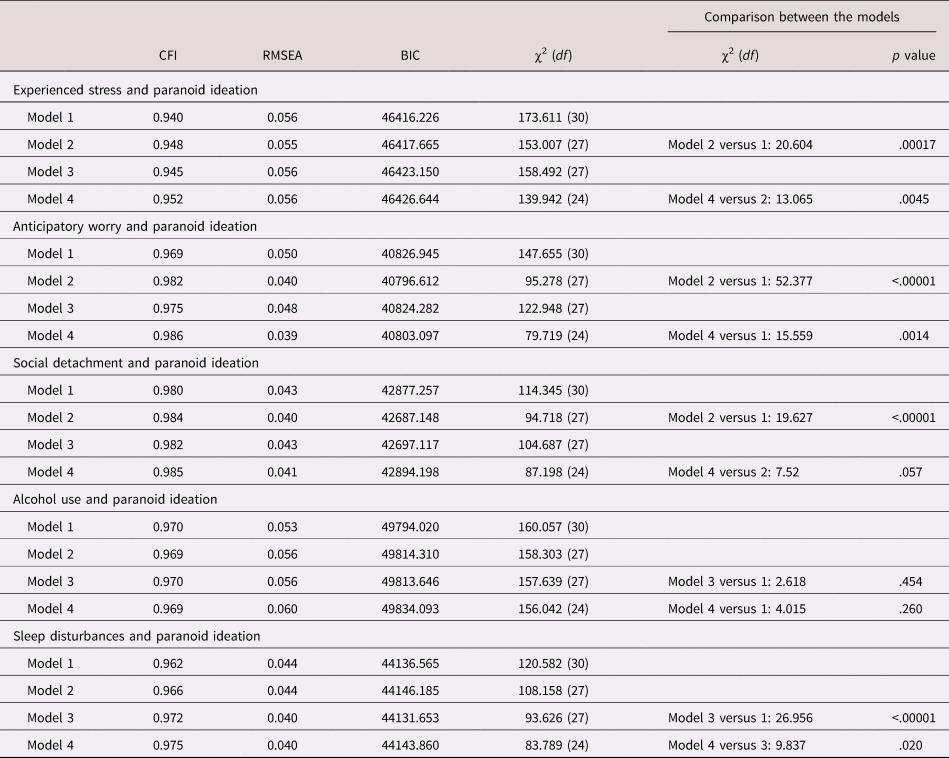
Next, we investigated the temporal associations of psychosocial risk factors with paranoid ideation with structural equation models, when each psychological risk factor was added to the model separately. The goodness-of-fit indices of the structural equation models are shown in Table 3. When investigating the temporal associations of experienced stress, anticipatory worry, and sleep disturbances with paranoid ideation, Model 4 (i.e., predictive relationships in both directions between the psychosocial risk factors and paranoid ideation) fit the data better than any other model (Models 1–3). With regard to the temporal associations of social detachment with paranoid ideation, Model 2 (i.e., predictive pathways from social detachment to paranoid ideation but not in the opposite direction) fit the data better than any other model (Models 1, 3, or 4). Regarding the temporal associations of alcohol use with paranoid ideation, Model 1 (i.e., no predictive relationships between alcohol use and paranoid ideation) fit the data better than any other model (Models 2–4). Taken together, the results indicated that there existed bidirectional associations of experienced stress, anticipatory worry, and sleep disturbances with paranoid ideation. That is, high experienced stress, high anticipatory worry, and frequent sleep disturbances predicted increase paranoid ideation, and vice versa. Further, high social detachment was found to predict increase in paranoid ideation but not vice versa. In addition, there were no predictive relationships between alcohol use and paranoid ideation. Hence, the association of alcohol use with paranoid ideation appeared to be only correlative.
The goodness-of-fit indices of the structural equation models, when including paranoid ideation and one psychosocial factor at a time in the model.
N = 1553.
CFI=Comparative fit index; RMSEA=root mean square error of approximation; BIC=Bayesian information criterion (BIC).
Model 1: A model including only stability coefficients and covariances between the psychosocial risk factor and paranoid ideation at each time point. Model 2: A model that included also the predictive coefficients from the psychosocial risk factor at each time point to paranoid ideation at the next time points. Model 3: A model that included the cross-lagged predictive coefficients in the opposite direction. Model 4: A model with the cross-lagged predictive coefficients in both directions between the psychosocial risk factor and paranoid ideation. Note: In all the models, we used continuous scores of psychosocial risk factors and paranoid ideation.
Discussion
To our knowledge, this study was the first to investigate the relationship of psychosocial risk factors with paranoid ideation over a long-term prospective follow-up. Overall, the results provide strong support for Freeman's (Reference Freeman2007, Reference Freeman2016) model of paranoid ideation. High experienced stress (i.e., state-level experiences of stress), high anticipatory worry (i.e., a comparatively stable disposition to feel worry), high social detachment, frequent sleep disturbances, and frequent alcohol use predicted a higher level of developmental curve of paranoid ideation from early adulthood to middle age. In addition, the accumulation of the risk factors predicted higher trajectory of paranoid ideation. Moreover, there were bidirectional predictive relationships of experienced stress, anticipatory worry, and sleep disturbances with paranoid ideation. That is, high experienced stress, high anticipatory worry, and frequent sleep disturbances predicted increase paranoid ideation, and vice versa. Further, high social detachment was found to predict increase in paranoid ideation but not vice versa. In addition, we obtained no predictive relationships between paranoid ideation and alcohol use, indicating that this association appears to be only correlative.
There are several explanations for the pathways from psychosocial factors to paranoid ideation. First, elevated stress may increase aberrant salience of some socioemotional stimuli and result in a higher level of anxiety and, in this way, increase risk for delusional ideation (Lincoln et al., Reference Lincoln, Peter, Schäfer and Moritz2009b; Westermann, Kesting, & Lincoln, Reference Westermann, Kesting and Lincoln2012). In addition, experienced stress may increase risk for making conclusions on the basis of limited evidence (“jumping to conclusions”) and attributing events to one causal factor, instead of considering the wider circumstances (Moritz, Köther, Hartmann, & Lincoln, Reference Moritz, Köther, Hartmann and Lincoln2015) that, in turn, predispose to paranoid ideation (Lincoln et al., Reference Lincoln, Lange, Burau, Exner and Moritz2009a; Moritz, Bentall, Kolbeck, & Roesch-Ely, Reference Moritz, Bentall, Kolbeck and Roesch-Ely2018; Tone & Davis, Reference Tone and Davis2012). Second, social detachment may reduce the possibilities to receive contradictory evidence for one's current paranoid ideas (Morse & Lynch, Reference Morse and Lynch2004). In some cases, social detachment may also be an indicator of weak self-esteem (Hall-Lande, Eisenberg, Christenson, & Neumark-Sztainer, Reference Hall-Lande, Eisenberg, Christenson and Neumark-Sztainer2007) that is suggested to be a core factor in the etiology of paranoid episodes (Thewissen et al., Reference Thewissen, Bentall, Oorschot, à Campo, van Lierop, van Os and Myin-Germeys2011). Third and finally, sleep disturbances predispose to more frequent anomalous experiences, such as depersonalization (Watson, Reference Watson2001), elevated levels of anxiety (Reeve et al., Reference Reeve, Sheaves and Freeman2015), and reduced abilities to sustain attention on nonemotional stimuli and to leave behind negative memories (Gobin, Banks, Fins, & Tartar, Reference Gobin, Banks, Fins and Tartar2015). All these factors, in turn, are known to elevate the risk for paranoid thoughts (Freeman, Reference Freeman2007). Taken together, the psychosocial risk factors may act in a reciprocal and complicated interplay in the onset and maintenance of paranoid ideation.
Importantly, high paranoid ideation was also found to predict increases in sleep disturbances, experienced stress, and anticipatory worry. In the current classifications of mental disorders, it is stated that a marker of clinical significance of paranoid ideation is that the paranoid symptoms cause subjective stress and anxiety (APA, 2013). Our findings in a nonclinical population suggest that also subclinical paranoia may predict an increase in experienced stress and worry. Elevated levels of stress and worry may also provide an explanation for the pathway from paranoid ideation to increased sleep disturbances. Taken together, there may exist vicious circles between paranoid ideation and psychosocial factors that increase the risk for maintenance of paranoid ideas.
Our findings suggested that the association of paranoid ideation with alcohol use is correlative. That is, even though frequent alcohol users have, on average, a higher level of paranoid ideation, frequent alcohol use may not predict an increase in paranoid ideation or vice versa. This suggests that the link between frequent alcohol use and higher paranoid ideation may be explained by third factors that predispose to both alcohol use and paranoid ideation. Such factors could include for instance the use of other substances, such as cannabis or street drugs (D'Souza et al., Reference D'Souza, Perry, MacDougall, Ammerman, Cooper, Braley and Krystal2004; Grant et al., Reference Grant, Stinson, Dawson, Chou, Ruan and Pickering2004; Verdoux, Gindre, Sorbara, Tournier, & Swendsen, Reference Verdoux, Gindre, Sorbara, Tournier and Swendsen2003). Overall, frequent alcohol use may have a more prominent role for some other psychotic symptom dimensions than paranoid ideation, for example, hallucinations (APA, 2013).
This study had some limitations that need to be taken into consideration. First, the measures of sleep disturbances and stress included only single items. Nevertheless, the items of sleep disturbances were selected from the Vital Exhaustion Questionnaire that has been widely used and validated previously (Chumaeva et al., Reference Chumaeva, Hintsanen, Juonala, Raitakari and Keltikangas-Järvinen2010; Meesters & Appels, Reference Meesters and Appels1996). The construct validity of the items was confirmed with a confirmatory factor analysis. Regarding the stress item, we used it to measure state-level experiences of stress (contrary to the scale of anticipatory worry that was used to measure rather trait-level disposition to feel worry). The stress item had comparatively low test–retest correlations. Further, the correlation of the stress item was quite low with anticipatory worry (i.e., trait-level disposition) but higher with stressful life events. All this provided support that the item provided information about participants’ state-level experiences of stress. In addition, the face validity of the item was good: stress was first defined for the participants in order to ensure that the participants have a similar conception of experienced stress. Overall, more research is needed with more comprehensive and widely validated measures of stress and sleep disturbances.
Second, the level of paranoid ideation was mostly subclinical in our population-based sample. Hence, the results may not be fully generalized to clinical populations like those studied by Retterstol in Norway (Retterstol, Reference Retterstol1966). However, findings in clinical and nonclinical samples have suggested that severe paranoid ideation exists on the same continuum with subclinical paranoid ideation (Johns & Van Os, Reference Johns2001; Van Os, Reference Van Os2003; Verdoux & Van Os, Reference Verdoux2002). Along with this, it has been stated that the involved underlying psychological processes appear to be quite similar in subclinical and clinical paranoia (Elahi, Algorta, Varese, McIntyre, & Bentall, Reference Elahi, Algorta, Varese, McIntyre and Bentall2017). This could be further investigated by considering the temperament and character features that may mediate the effects of psychosocial stressors on the development of paranoid ideation.
With regard to practical implications, there is encouraging evidence that cognitive–behavioral interventions targeting at interpersonal sensitivity, worry, or insomnia (e.g., by means of psychoeducation, practical advice with sleeping circumstances, and relaxation techniques) effectively reduce paranoid ideation (Bell & Freeman, Reference Bell and Freeman2014; Freeman et al., Reference Freeman, Dunn, Startup, Pugh, Cordwell, Mander and Kingdon2015; Myers, Startup, & Freeman, Reference Myers, Startup and Freeman2011). Moreover, interventions that aim to increase metacognitive awareness of emotional processing or reasoning biases seem to be effective treatments for paranoid ideation or paranoia-related distress (Hepworth, Startup, & Freeman, Reference Hepworth, Startup and Freeman2011; Waller et al., Reference Waller, Emsley, Freeman, Bebbington, Dunn, Fowler and Garety2015). In addition, interventions aiming to develop a mature character profile could be an effective intervention for individuals with elevated risk for paranoid ideation. Specifically, mature character profiles including high self-directedness and high cooperativeness are found to act as protective factors against paranoid ideation in individuals with vulnerable temperament profiles (Saarinen, Rosenström et al., Reference Saarinen, Rosenström, Hintsanen, Hakulinen, Pulkki-Råback, Lehtimäki and Keltikangas-Järvinen2018).
On the basis of our findings, early interventions should carefully consider that there may exist vicious circles between psychosocial risks and paranoid ideation. In addition, these bidirectional circles between paranoid ideation and psychosocial risks could provide treatment targets for patients aged from early adulthood to middle age. A common challenge has been that paranoid individuals may not commonly seek help for their paranoid beliefs. However, paranoid ideation could be monitored when treating patients with sleep disturbances or anxiety since they appear to be crucial correlates of paranoid ideation. In addition, our results provide encouraging evidence that reducing the cumulative number of single psychosocial risks may predict a long-term decrease in paranoid ideation, even though early interventions could not efficiently target all the psychosocial risks.
In summary, our findings suggest a diathesis–stress model for elicitation of persecutory ideation in which threats of personal and social harm or injustice precipitate paranoia, particularly in hypersensitive individuals susceptible to feeling inferior or powerless to defend themselves. This has important implications for promotion of health at both individual and societal levels. In individual cases, it is important to use person-centered approaches in which paranoid individuals are treated with respect and compassion in order to provide the conditions for developing more trust and feelings of security.
Supplementary Material
The supplementary material for this article can be found at https://doi.org/10.1017/S0954579420001030.
Funding Statement
This study was supported financially by the Academy of Finland (M.H., grant number 308676). The Young Finns Study has been financially supported by the Academy of Finland: Grants 322098, 286284, 134309 (Eye), 126925, 121584, 124282, 129378 (Salve), 117797 (Gendi), and 41071 (Skidi); the Social Insurance Institution of Finland; Competitive State Research Financing of the Expert Responsibility area of Kuopio, Tampere and Turku University Hospitals (grant X51001); the Juho Vainio Foundation; the Sigrid Juselius Foundation; the Yrjö Jahnsson Foundation; the Paavo Nurmi Foundation; the Finnish Foundation of Cardiovascular Research the Finnish Cultural Foundation; the Tampere Tuberculosis Foundation; the Emil Aaltonen Foundation; and Diabetes Research Foundation of Finnish Diabetes Association.
The funding source had no role in study design, data collection, data analysis, data interpretation, writing of the report, or in the decision to submit the article for publication.
Conflict of Interest
None.