There is strong generally accepted evidence for the efficacy of cholinesterase inhibitors (CHEIs) for patients with mild to moderate Alzheimer's disease (AD) (Reference Birks1–Reference Birks and Harvey3;Reference Loy and Schneider12), but not for severe AD or other causes of dementia (vascular or Parkinson's disease related), Newer evidence also suggests efficacy for severe AD or other causes of dementia, but this is not yet considered definitive internationally. Brazilian and worldwide current treatment guidelines recommend CHEIs for mild to moderate AD (Reference Caltagirone, Bianchetti and Di Luca4–Reference Galvin, Pollack and Morris8;Reference Nakamura14;16). Few studies on the adherence to such guidelines have been published.
In one study, the National Institute of Clinical Excellence (NICE) published a CHEI guideline for AD for the United Kingdom National Health Service in 2001 (15). Individuals residing in their own homes were found to be eligible for one of three CHEIs for short time-periods (up to 6 months) if they had mild to moderate AD, and a Mini-Mental State Examination (MMSE) score greater than 12 (15). Recently, the three CHEIs donepezil, galantamine, and rivastigmine were recommended as options in the treatment of patients with AD of moderate severity only for those who had the MMSE score between 10 and 20 (16). The treatment of AD with CHEIs in UK was found to vary considerably with regard to pretreatment investigations, waiting period for treatment, scales used to assess efficacy, adherence to the NICE guidance, and available resources (Reference Purandare, Swarbrick, Fischer and Burns17).
In France, the national guideline for diagnostic procedures and prescriptions in AD called for referral to a specialist and defined follow-up. More than 90 percent of patients were referred to a specialist, but only 50 percent of patient follow-up was in compliance with the guideline (Reference Dartigues, Douet and Rey6).
In Brazil, we have followed prescription patterns for some national recommendations. It is obviously difficult to obtain doctors’ adherence to such strategies. It was only after a combination of a national guideline with a team of experts providing patient care in Reference Centers that we could show real implementation of recommendations (Reference Krug, Schwartz and de Oliveira11). Since the year 2000, the Brazilian Ministry of Health has supported a Task Force to develop and publish evidence-based national guidelines for high cost drugs. The national guideline for treatment of AD was published in 2002 (Reference Costa, Picon, Amaral, Chaves, Picon and Beltrame5). By decision of the Ministry of Health, this is the only national guideline required by the Brazilian Public Health System in the entire country. Cholinesterase inhibitors (donepezil, galantamine, or rivastigmine) should be provided by the public health system to any patient who fulfills clinical diagnostic criteria established by the guideline. Exclusion criteria include evidence of simultaneous organic cerebral lesion and/or metabolic dysfunction. All patients are required to provide an application to the State Health Secretariat with a prescription attached to a medical report providing evidence of the degree of cognitive impairment and lab tests and neuroimaging results. One of three CHEIs is provided if the individual has a clinical history and neurological evaluation compatible with AD, appropriate International Classification of Diseases (ICD) code, Mini Mental State Examination (MMSE) score ≥12 for literates, and score ≥10 for illiterates, mild to moderate severity by the Clinical Dementia Rating (CDR) scale (scores 1 and 2), and no laboratory or neuroimaging finding indicating other causes of dementia. Treatment is made available for an initial period of 6 months with a requirement of evaluation of overall benefit before extension of the treatment period. Compliance with the guideline may be advantageous for patients for safety reasons and may also prevent false expectations for their families. The stated goal of the national guideline was to prevent irrational use of these drugs.
The objective of this study was to evaluate prescription patterns for AD considering physician's compliance to the national guideline in the public health system of Rio Grande do Sul, the southernmost state of Brazil, with approximately 11 million inhabitants.
METHODS
The evidence-based guideline for the pharmacological treatment in AD was made available to physicians involved in the public health system (see www.opas.org.br/medicamentos/docs/pcdt) in January 2003.
A regional expert-committee reference center was created in the Division of Neurology at the Federal University of Rio Grande do Sul's University Hospital as part of a collaborative program with the State Health Secretariat. The Committee, which continues to function, is composed of a multidisciplinary team of experts to audit prescription patterns and the adherence to the national guideline in the name of the State Secretariat. The AD-Reference Center started the work of evaluation of CHEIs’ requests for the public health system grant in January 2005. Neurologists and psychiatric specialists in dementia and AD make up the expert-committee team and evaluate all the applications for CHEIs presented at the health public system. The results of this study cover the period from January 2005 to December 2007.
To obtain payment for the CHEI, a patient's application should present a clinical history and performance on mental status screening tests (MMSE and CDR). Laboratory and neuroimaging findings must accompany each request. Complete blood test, serum urea and creatinine, electrolytes, fasting glucose, thyroid-stimulating hormone, plasma folate and vitamin B12, VDRL (Venereal Disease Research Laboratory) test, and a computed tomography (CT) or magnetic resonance imaging (MRI) are the tests required for a complete application.
Audit concerning the appropriateness of CHEI prescription in relation to the national guideline is subsequently made by the regional expert team. If the prescription for the CHEI is not accepted, the expert-committee writes to the physician explaining the reasons for rejection, with a recommendation to follow the Brazilian guideline's instructions for diagnosis and treatment of AD.
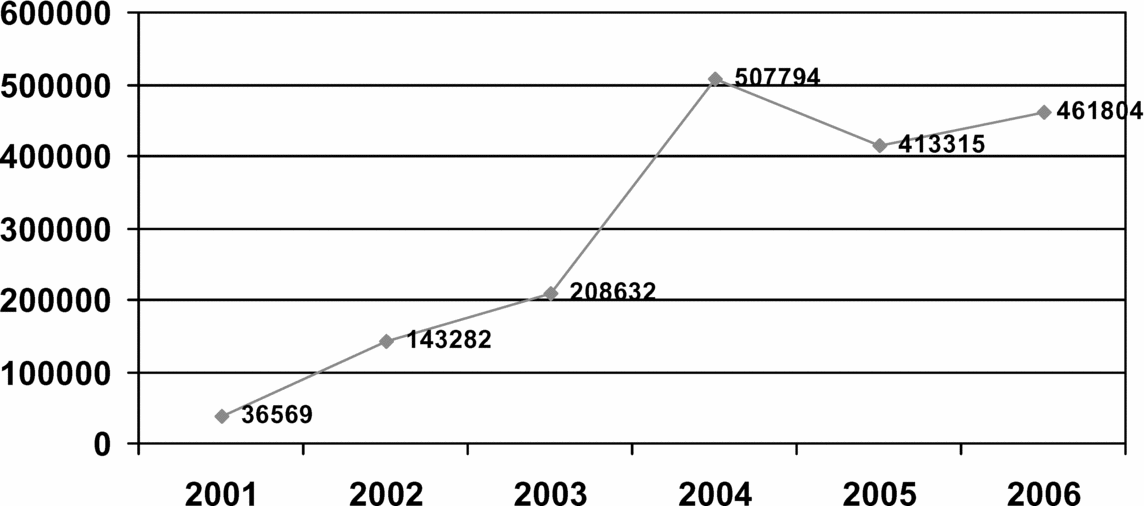
The data of the CHEIs purchased and delivered were obtained from the State Health Administration section and converted to number of units of 3 mg of rivastigmine. This is presented in Figure 1 as an indicator of the treatments covered by the public health services in the State of Rio Grande do Sul.
Number of units of 3-mg doses of rivastigmine distributed by the Rio Grande do Sul State Health Secretary per year. In January 2005 the AD-Reference Center started the work of evaluation of prescription and sending doctors information about the Brazilian Guidelines’ Criteria for rational diagnosis and treatment of Alzheimer's disease (AD).

Demographic data concerning patients, proportion of compliance with the national guideline, years of professional activity of the requesting physicians, and the number of prescriptions for the three drugs were also evaluated. Categorical variables were analyzed with Chi-squared test. Analyses were performed with SPSS for Windows 14.0 version.
The study was approved by the Ethics Committee for Medical Research of Hospital de Clínicas de Porto Alegre, where the regional reference center is located.
RESULTS
The regional expert committee team assessed 1,399 applications for cholinesterase inhibitors presented to the public health system of the state of Rio Grande do Sul (RS) from January 2005 to October 2007.
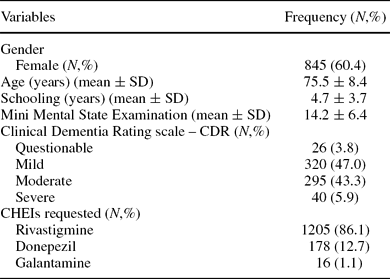
Demographic data and clinical characteristics of patients and the requested drugs are shown in Table 1. Of the 1,399 applications, we found that 60.4 percent were for female patients, with mean (±SD) schooling years of 4.7 (3.7) and the mean (±SD) MMSE rate of 14.2 (6.4).
Demographic and clinical data of the patients (N = 1,399)

CHEIs, cholinesterase inhibitors.
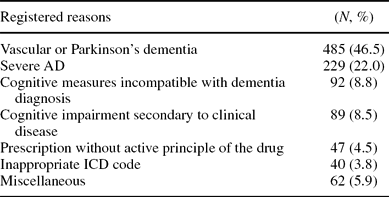
Only 355 (25.0 percent) of the requests were in compliance with the national guideline and were accepted. Among the majority of the requests which were not accepted, vascular or Parkinson's dementia were the leading causes of dementia (46.5 percent). Severe AD (22.0 percent), performance on cognitive tests not compatible with AD diagnosis (8.8 percent) and cognitive impairment due to medical illness (8.5 percent) were other reasons for the nongranted CHEI requests (Table 2). Misdiagnosis was noted in 64.3 percent of the rejected requests in which clinical history and laboratory tests showed that vascular, and mixed, and/or Parkinson's dementia, or dementia due to medical illness, or performance on cognitive tests was not compatible with AD diagnosis.
Reason of refusal for the nongranted CHEIs requests (total refusals = 869)

CHEIs, cholinesterase inhibitors; AD, Alzheimer's disease; ICD, International Classification of Diseases.
Rivastigmine was requested in the great majority of cases (1,205 or 86 percent), donepezil in 13 percent, and galantamine in 1 percent. However, Donepezil prescriptions (n = 178) were approved in a high percentage of cases (51 percent) in comparison with rivastigmine prescriptions approved (22 percent) (P < .001; Chi-square test).
Of note was finding a significant association between years of professional activity of the physicians and adequacy of the applications to the guideline's criteria. The group of physicians that had less then 20 years of activity had more accepted requests (56.7 percent) than the group with more then 20 years (43.3 percent) (Chi-square = 8.8; p = .003) (Table 3).
Association between years of professional activity and frequency of requests granteda

aChi-square = 8.8; p value = .003.
CHEIs, cholinesterase inhibitors
As already noted, the total annual number of prescriptions of 3 mg of rivastigmine (with the other two drugs considered as rivastigmine, and 1.5 mg counting as 0.5 and 6 mg counting as 2) delivered by the State Secretariat per year after 2001 were calculated. The total number of units increased from 2001 until 2004 and then dropped and became stable after the beginning of the work of the expert-review committee in January 2005 (Figure 1).
Discussion
The strategy of combining the standards of the guideline and the expert-review of medical diagnosis and prescriptions for AD highlighted the low rate of adherence to the national guideline by physicians in the State of Rio Grande do Sul. Only 25 percent of CHEIs prescriptions were accepted because the majority of the requests were not in accordance with the national guideline for the pharmacological treatment of AD, which is in accord with guidelines from other countries for the diagnosis of AD and prescription of CHEIs.
Most of the rejections were due to requests where there is limited evidence of efficacy. The high rate of prescription of CHEIs for vascular and or Parkinson's dementia was astonishing and of great concern. Although the course and presentation of AD and vascular dementia are alike and the overall clinical diagnostic accuracy for vascular dementia is low (95 percent specificity and 43 percent sensitivity) (Reference Knopman10), CHEIs have not been approved for the treatment of mixed dementia in Brazil. In addition, the presence of Parkinsonian symptoms before or during the onset of the dementia helps, in most cases, to exclude AD (Reference Galvin, Pollack and Morris8). Evidence for the efficacy of CHEIs for vascular dementia is in initial stage of development (Reference Galvin, Pollack and Morris8), Likewise, there is very little evidence to support the use of CHEIs in severe stages of AD (Reference Birks1;Reference Kavirajan and Schneider9). Nevertheless, 22.2 percent of the prescriptions were requested for severe forms of AD.
Naturally, evidence of efficacy of interventions evolves over time. There is increasing evidence of efficacy in, for example, Parkinson's dementia, indicating a probable need to revise the guideline in the future.
The severity of AD and its high burden on families can result in pressure on physicians to prescribe any drug, even when there is not enough evidence of efficacy. However, several drugs are already used in this group of patients. Therefore, one must have special concern for safety.
Rivastigmine was by far the most prescribed drug (see Table 1), even though there is no evidence for its superiority among the three cholinesterase inhibitors (Reference Birks1;Reference Raina, Santaguida and Ismaila18). This predominance of rivastigmine may be due to intensive marketing strategies noted in Brazil for this drug. However, in the United Kingdom, the expensive and high profile campaigns carried out by the pharmaceutical companies have been negatively received by psychiatrists (Reference Sauer and Howard19).
In relation to professional experience, those physicians who had less then 20 years of professional activity had more accepted requests. This finding deserves further investigation. A survey on the CHEIs practice among older psychiatrists for patients with AD and cardiovascular comorbidity done in United Kingdom showed that the prescribing of CHEIs by older psychiatric practitioners, in this patient group, is varied with no clinical consensus as to who should and should not receive these medications, but this study did not address a comparison with younger psychiatrists’ practice (Reference Loy and Schneider12). The authors also concluded that consensus guidelines are needed to ensure safe and equitable prescribing of CHEIs to this vulnerable group of patients, which is in absolute agreement with our results.
The higher number of donepezil requests approved when compared with the rivastigmine approvals could not be explained. This finding deserves further investigation.
CONCLUSION
This study shows that using an expert committee to evaluate compliance to national guideline with feedback to physicians can lead to a reduction in number of prescriptions and a saving for the public health system contributing to rational use of medicines.
CONTACT INFORMATION
Paulo Dornelles Picon, MD, PhD (paulopicon@gmail.com), Associate Professor of Medicine, Department of Internal Medicine, Universidade Federal do Rio Grande do Sul, Rua Ramiro Barcelos, 2350 – sala 306, 90035-903 Porto Alegre, Rio Grand do Sul, Brazil; Chief of Medicines’ Policy Department, Rio Grande do Sul State Health Secretariat, Rua Borges de Medeiros 151, 4o.Andar, 9020-020 Porto Alegre, Rio Grand do Sul, Brazil
Ana Luiza Camozzato, MD, PhD (anacamoz@gmail.com), Association Professor of Medicine, Department of Internal Medicine, Universidade Federal de Ciências da Saúde de Porto Alegre, Rua Sarmento Leite 245 – sala 105, 90050-170 Porto Alegre, RS. Brazil; Physician of the Medicines’ Policy Department, Rio Grande do Sul State Health Secretariat, Rua Borges de Medeiros 151, 4o.Andar, 9020-020 Porto Alegre, Rio Grand do Sul, Brazil
Elaine A. Lapporte (laporte@saude.rs.gov.br), Pharmacist, Chief of Special Medicines Division, Rio Grande do Sul State Health Secretariat, Rua Borges de Medeiros 151, 4o.Andar, 9020-020 Porto Alegre, Rio Grand do Sul, Brazil
Rafael V. Picon (rafael.picon@terra.com.br), Medical Student, Faculdade de Medicina da Universidade Federal do Rio Grande do Sul, Rua Ramiro Barcelos, 2400, 90035-003 Porto Alegre, Rio Grand do Sul, Brazil
Humberto Moser Filho (humbertoluizmoser@hotmail.com), Medical Student, Faculdade de Medicine da Universidade Federal do Rio Grande do Sul, Rua Ramiro Barcelos, 2400, Bairro Sanra Cecília, 90035-003 Porto Alegre, Rio Grand do Sul, Brazil
Maria Otília Cerveira, MD (mo_cerveira@yahoo.com.br), Neurology Department, Hospital de Clínicas de Porto Alegre, Rio Grand do Sul, Rua Ramiro Barcelos, 2350 – sala 2040, 90035-903 Porto Alegre, Rio Grand do Sul, Brazil
Márcia L. F. Chaves, MD, PhD (mchaves@hcpa.ufrgs.br), Associate Professor of Neurology, Department of Internal Medicine, Faculdade de Medicina, Universidade Federal do Rio Grande do Sul, Rua Ramiro Barcelos, 2350 – sala 2040, 90035-903 Porto Alegre, RS. Brazil; Chief of Neurology Department, Hospital de Clínicas de Porto Alegre, Porto Alegre, Rio Grand do Sul, Brazil