Introduction
Kyrgyz society has had access to abortion as an intervention designed to manage unwanted pregnancies even before it became a sovereign country in 1991. Abortion was an accepted means of fertility regulation in the former Union of Soviet Socialist Republics (USSR), of which Kyrgyzstan was a part. Besides socioeconomic and cultural factors, the policies prevailing in the country affect reproductive health in general and the incidence of induced abortion in particular. The former USSR was perhaps the only nation in the world that facilitated abortion on the request of women with no cost (Heer, Reference Heer1965). Abortion was allowed only in case of danger to life, serious health threat, or in the possibility of transmitting fatal diseases from mother to child under the Soviet Decree, 1936. In 1987, the government made provision to grant abortion on request within 24 weeks of pregnancy (United Nations, 2000). The abortion rate continued to be high in the erstwhile Soviet Union, but variation within the country ranged from 66 abortions per 1000 women aged 15–44 years in the Russian Republic to eighteen abortions per 1000 women aged 15–44 years in Tadjikistan (Henshaw, Reference Henshaw1990; Henshaw et al., Reference Henshaw, Singh and Taylor1999).
According to the Demographic and Health Survey of the Kyrgyz Republic (1997), 30% of women of reproductive age have had at least one induced abortion, and the majority of them (60%) had experienced more than one (Research Institute of Obstetrics and Pediatrics & Macro International, 1998). Mini-abortion, which is convenient and relatively less risky, has been popular in Kyrgyzstan since the 1980s. It does not require overnight hospitalization and thus protects women from social stigma. However, excessive reliance on induced abortion affects a woman's health and her chances of further childbearing adversely, and contributes to maternal and perinatal mortality. Knowing that these are all preventable, induced abortion should be included in the priority agenda for public health (Lazovich et al., Reference Lazovich, Thompson, Mink, Sellers and Anderson2000; Berer, Reference Berer2004; Grimes et al., Reference Grimes, Benson, Singh, Romero, Ganatra, Okonofua and Shah2006).
The post-independent era brought several changes in Kyrgyz society. The new political, economic and social environment introduced Western democratic values, which promoted the small-family norm and egalitarianism. On the other hand, the revival of cultural norms relating to family life and marital relationship was also given priority (Wejnert & Djumabaeva, Reference Wejnert and Djumabaeva2004). Maintaining the equilibrium between these two milieus requires appropriate family life decisions related to marriage, planned parenthood and the role of men and women within and outside the family. This tends to change the abortion practices and demand for family planning services to regulate fertility (Potts et al., Reference Potts, Diggory and Peel1977).
The impact of induced abortion on fertility is evident from various studies. The total fertility rate in many countries would have been between 20% and nearly 90% higher than it actually is, if no induced abortions had been performed. Further, Bongaarts & Westoff (Reference Bongaarts and Westoff2000), quantifying the trade-off between abortion and contraceptive prevalence, showed that a 10 percentage-point increase in prevalence of contraceptive methods with 100% effectiveness could avert 1.6 abortions per woman. In the absence of a suitable method of contraception, women tend to resort to induced abortion to achieve their fertility goals (Curtis & Westoff, Reference Curtis and Westoff1996).
The causes of abortion have been reported to vary by level of development and the socioeconomic and cultural milieu (Heer, Reference Heer1965; Torres & Forrest, Reference Torres and Forrest1988; Bankole et al., Reference Bankole, Singh and Taylor1998). Besides postponement and stopping childbearing, another prominent reason, especially among younger women, was a problematic relationship with the partner. Women's attitude towards motherhood, as well as the partner's perception regarding abortion, influences the abortion-seeking behaviour and intention to use a contraceptive method (DeRose et al., Reference DeRose, Dodoo, Ezeh and Owuor2004). For example, in Kazakhstan, about half of the women aged 15–24 have reported that they had not been happy after getting pregnant (Bankole et al., Reference Bankole, Singh and Taylor1999). Agadjanian (Reference Agadjanian2002), in the context of Kazakhstan, found that the odds of seeking abortion are lower for financial reasons and higher for health problems among higher educated women. He also tested the ethnocultural hypothesis in the context of the former Soviet Union and suggested that the practice of induced abortion was more common among Russian and European women than others. Bankole et al. (Reference Bankole and Singh1998) have shown that women's unhappy attitude towards becoming pregnant increases the likelihood of abortion. Hence one may be inclined to ask whether similar tendencies are seen in Kyrgyzstan too?
Given the context, this paper attempts to estimate the abortion rates by different background characteristics. Age-specific pattern in different reproductive rates was analysed by considering two variables: place of residence (rural or urban) and educational attainment of women. Further, the contribution of selected proximate determinants to fertility regulation by residence and education was also examined. Finally, the enthnocultural and the attitude hypotheses were tested in the study population.
Data and Methods
The study is based on data from the Demographic and Health Survey of the Kyrgyz Republic (KRDHS, 1997). The design of the KRDHS consists of a representative probability sample of 3848 completed individual interviews with women in the age group 15–49 years. The survey was conducted in six provinces (oblasts) and the capital city Bishkek, grouped into four survey regions. The capital city Bishkek and Narynskaya oblast, located in the mountainous eastern part of the Republic, were kept in Region 1 and Region 3 respectively. Issyk-Kulskaya, Chuiskaya and Talasskaya oblasts constituted survey Region 2 (northern part), whereas Region 4 comprises the southern oblasts Oshskaya and Dzhelal-Abadskaya. The sample weights were developed to obtain nationally representative estimates. The KRDHS report can be referred to for details of the sampling plan and survey execution (RIOP & Macro, 1998).
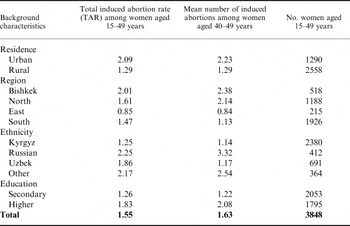
Table 1 shows the number of women interviewed in each category by background characteristics. The majority of women were from the rural, southern region, of Kyrgyz ethnicity and possessed secondary education. Only a negligible proportion of women were educated up to primary level, so primary and secondary levels are merged in this study. Henceforth in this paper, education up to the secondary level will be referred to as ‘secondary’ and other secondary/special and higher as ‘higher’.
Total induced abortion rate (TAR), mean number of induced abortions and number of women by selected background characteristics: Kyrgyzstan, 1997

Further details about the sample were obtained from the dataset. Kyrgyzstan has three major ethnic groups, namely Kyrgyz (62%), Uzbek (18%) and Russian (11%). The regional pattern of ethnicity shows that the eastern region has the highest proportion of Kyrgyz women (99%) followed by the north (67%). The remaining women from the north were equally divided between Russian and others. A major part of the eastern region is rural (76%) and mountainous. The southern region constitutes 58% Kyrgyz women followed by Uzbek (35%). Only 2% of southern women belong to the Russian ethnic group, and the rest (5%) belong to other ethnic groups. Bishkek has 47% Kyrgyz women followed by 35% Russian and 16% others. Only 2% of Bishkek women were Uzbek. With the exception of Region 1, which is completely urban, all the other three regions comprise more than 75% rural women. The city of Osh, which was also included in southern region, is the second largest city in the country. On the other hand, 71% of Russian, 47% of others, 29% of Kyrgyz and 19% of Uzbek women lived in urban area.
Almost 73% of women in the capital Bishkek were educated to the higher level. The figure for the northern region was 52%, positioned next to the capital city in terms of level of women's education. The southern region showed the minimum percentage of higher educated women at only 37%. Uzbek women were the most backwards in terms of education, as only 28% had received education up to the higher level. Almost half of Kyrgyz women (47%) were higher educated, whereas this figure was as high as 71% for Russian women.
The methods adopted to carry out the analysis are percentage, percentage distributions, cross-tabulation, logit regression and modified proximate determinants framework. Age-specific reproductive rates (pregnancy rate, fertility rate, induced abortion rate and total [spontaneous and induced] abortion rate) per 1000 women were calculated independently using the exposure-incidence rate considering a reference period of three years preceding the survey (see Rutstein & Rojas, Reference Rutstein and Rojas2006). Bongaarts & Potter (Reference Bongaarts and Potter1983) proposed a multiplicative model using four principal proximate determinants (marriage (C m), contraception (C c), abortion (C a) and post-partum infecundability (C i)) to estimate total fertility rate (TFR). In this study, the value of the index of marriage (C m) has been taken as 1, as marriage does matter to have a birth in Kyrgyzstan. The modified form of the framework has been used in this study (Stover, Reference Stover1998). Its mathematical form is:

where the index of infecundity (C f) is the proportion of infecund women aged 15–49 and TF is the total fecundity rate.
Binary logit regression analysis
The dependent variable is ‘experienced an induced abortion during the three years preceding the survey date’ (1 yes; 0 no). Independent variables include socioeconomic, demographic and reproductive preferences at the individual level. These variables can be broadly divided into four categories: (a) socioeconomic and ethnocultural, (b) demographic, (c) fertility preferences and attitude, and (d) policy variables. The first category includes women's residence, region, ethnicity, education and occupation. The second category consists of women's age, number of living children, marital duration and any child-loss experience. In the third category, women's fertility preferences, women's attitude towards becoming pregnant, comparison of ideal to living number of children and husband's perception about abortion were taken. The last category consists of discussions on family planning (FP) with the partner and contraceptive status.
Results
Table 1 shows trends in induced abortion obtained by comparing the total induced abortion rate (TAR) with the mean number of induced abortions among women aged 40–49 years. The former is a summary measure of current abortion rates, while the latter represents the actual experience of the older cohort. The mean number of induced abortions among women aged 40–49 years and the total induced abortion rate among women aged 15–49 years are almost equal, which implies that the induced abortion recourse has been stable over the last couple of decades. Nevertheless, the rate has declined over the years in some population subgroups, but this decline was offset by an increase in others. For example, the decline in abortion rate was almost 0.5 per woman in Bishkek city and in the northern region. Similarly, the rate among Russian women was well below the mean number of abortions. In contrast, the TAR (1.47 per woman) exceeds the mean number of abortions (1.13 per woman) for the southern region. Abortion rates seem to have been declining in urban areas, but witnessed stagnation in rural areas. Correspondingly, there was a small increase in TAR among the less educated women against a noticeable decline among the higher educated.
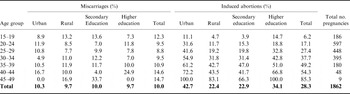
Table 2 shows the percentages of miscarriages and induced abortions among the total pregnancies in different reproductive age groups. One out of ten pregnancies was reported as a miscarriage across educational and residential characteristics. Leaving the last two age groups (due to small number of cases), it can be observed that the percentage of miscarriages in rural areas and among the less educated remains slightly higher in the age group 15–19 and shows a decline in the next two age groups, and then increases slightly thereafter. No clear-cut pattern was seen in urban areas or among the highly educated.
Proportion of miscarriages and induced abortions per hundred pregnancies by place of residence and education in the three years preceding the survey, KRDHS, 1997

On the other hand, 28.3% of the total pregnancies ended in induced abortions. The incidence of induced abortion was higher in urban areas (42.7%) and the highly educated (34.1%) as compared with rural (22.4%) and secondary educated women (22.9%). The incidence of induced abortion increases along with the increase in age. Almost half of the conceptions (49.2%) resulted in induced abortion in the age group 35–39, whereas it was only 6.2% in the age group 15–19. However, it ranges between 17.1% and 37.7% in the prime ages of childbearing (20–34 years). Almost two-fifths (41.6%) of the pregnancies in the age group 25–29 were aborted in urban area as compared with only 19.2% in rural areas.
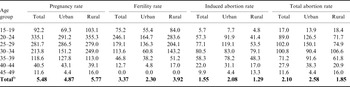
Table 3 shows that on average a woman had 5.48 pregnancies, of which only 3.37 resulted in live births, the remainder ending up either in induced abortions or miscarriages. The fertility rate (75.2 per thousand) and pregnancy rate (92.2 per thousand) remained low in the age group 15–19, but attained the highest level of 335.1 and 246.1 per thousand respectively in the age group 20–24. The induced abortion rate was the highest in the age group 30–34 at 80.5 per thousand. Further, a difference of almost one pregnancy per woman was noticed between rural and urban areas, and abortion had widened this gap to the level of 1.62 live births per woman. The fertility of urban women was so low because of the high prevalence of induced abortion. The induced abortion rate reaches its maximum at 119.1 per thousand in the age group 25–29 in urban and 79.1 per thousand in the age group 30–34 in rural areas. The total abortion rate surpasses fertility rate beyond the age 30 years in urban areas and beyond 35 years in rural areas.
Age-specific reproductive ratesa by residence, KRDHS, 1997

a Age-specific reproductive rates are calculated per 1000 women.
b Total reproductive rates are calculated per woman.
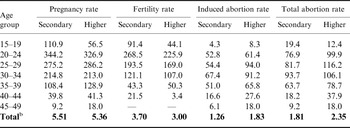
Table 4 shows that women with higher educational attainment were more exposed to induced abortion and miscarriage than less educated women. Interestingly, the pregnancy rates of women belonging to different educational groups did not differ much, but a gap of 0.70 births per woman in the fertility rates was observed. The largest difference between the pregnancy rate and the fertility rate was observed in the age group 25–29 for higher educated women and in the age group 30–34 for secondary educated women. This difference occurred mainly due to the differences in induced abortion rates in the respective age groups.
Age-specific reproductive ratesa by educational level, KRDHS, 1997

a Age-specific reproductive rates are calculated per 1000 women.
b Total reproductive rates are calculated per woman.
Fertility regulation and selected proximate determinants
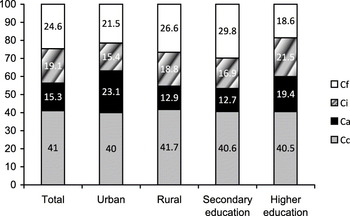
The modified proximate determinant framework shows that the actual total fertility rate and the model total fertility rate were fairly close to each other. The estimated total fecundity rate in Kyrgyzstan was around 15.6 – very similar to the 15.3 given by Bongaarts & Potter (Reference Bongaarts and Potter1983) for developing countries. Figure 1 shows the percentage contribution in fertility inhibition by residence and educational levels. It clearly indicates that fertility inhibition was equally dominated by contraception – around 41% across the groups. For the country as a whole, women's infecundity (C f) contributed to 24.6% of the total fertility reduction. Around one-fifth of the total fertility inhibition was contributed by post-partum insusceptibility followed by induced abortion (15.3%). The share of abortion in inhibiting fertility among urban and higher educated women was relatively large (approximately one-fifth). Infecundity has contributed more to fertility inhibition among less educated and rural women. This illustrates that the rural–urban differentials in fertility have been enlarged mainly due to abortion.
Contribution of proximate determinants to fertility regulation in Kyrgyzstan, 1997.

The complete elimination of induced abortion is not possible for various reasons (Kulczycki et al., Reference Kulczycki, Potts and Rosenfield1996; Entwisle & Kozyreva, Reference Entwisle and Kozyreva1997). However, a simple simulation exercise using a proximate determinants framework was performed to estimate fertility in the absence of induced abortion and the required levels of contraceptive prevalence rate to compensate the fertility inhibition by induced abortion. The complete elimination of abortion would add almost 0.8 births per woman. To maintain the observed fertility level in the absence of induced abortion, Kyrgyzstan needs to raise the contraceptive prevalence level to 70%. The latest figures show that the contraceptive prevalence rate is only 48% (UNFPA, 2009).
Abortion-seeking behaviour and contraceptive use dynamics
Abortion-seeking behaviour is not random, and therefore studying the associated characteristics of women will help to identify the vulnerable population segments. The crosstab analysis (not shown in the paper) reveals that more than half of the women (55%) aged 35 years and above have experienced an induced abortion at least once. Almost 47% among the higher educated women have faced induced abortion; however, the percentage was much lower among women with secondary education. More urban women (55%) experienced an abortion as compared with their rural counterparts (31%). Almost two-thirds of Russian women (higher than among different ethnic groups) have experienced abortion. Similar degrees of educational, residential and ethnic differentials were observed for an intention to opt for induced abortion. A large difference between those who wanted to limit their family size (52% had an induced abortion) and those who did not (only 26% had an induced abortion) was also observed in this analysis.
The contraceptive prevalence rate for modern contraceptive methods was also analysed by selected characteristics (table available on demand). It was found that the intrauterine device (IUD) was the most popular modern method of family planning (38.2%), followed by the condom (5.7%). The use of oral pills and sterilization was minimal (3% each). Condom use was found to be higher among the urban and highly educated (around 11% each), and Russian couples (17.8%). The contraceptive prevalence rate (CPR) for modern method was 55.0% and 46.0% among urban and rural people respectively. By region, almost 60% of currently married women from Bishkek city use modern contraceptive methods as compared with only 45% in the southern region. Education differentials could not be observed in CPR for modern methods (around 50% in both educational groups). Women from other regions showed a prevalence rate close to the national average. Among the four categories of ethnicity, the lowest contraceptive prevalence rate for modern methods was for Kyrgyz women (47%) against the highest of 58% for Russian women. Around 46% of currently married women with one living child use any modern method of family planning as compared with 68% with three living children. Almost 11% of women use traditional methods of family planning, including periodic abstinence (3.2%), withdrawal (6.0%) and the douche (1.5%).
In Kyrgyzstan, 67% of those who came into contact with family planning or health workers during the one year preceding the survey were using a method as compared with 56% of those who did not meet with the workers. Among non-users who contacted the workers, four-fifths intended to use a contraceptive method in the future as against 61% of those who did not do so. A significant proportion of non-user women (around 55%) wanted to stop childbearing, yet did not express their intention to use a method. Further, a considerable proportion (38%) of non-users who said that they would be unhappy to get pregnant, did not intend to use a method.
Results of the binary logit regression analysis
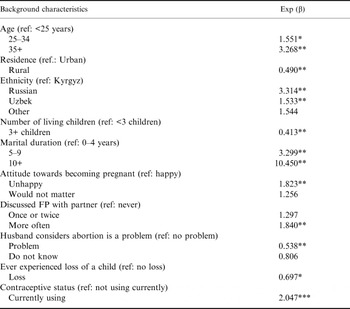
Table 5 shows the regression analysis and highlights those factors that directly address the placed hypotheses. The analysis was based on all women and the dependent variable was whether or not they had experienced an induced abortion during the three years preceding the survey. Controlling for other variables, age, marital duration and number of living children were found to significantly affect the odds of undergoing abortion. The odds ratio of having abortion increases with the increase in age of women and marital duration. Women aged 35 and above were 3.6 times (significant at 1% level) more likely to have an abortion compared with those below 25 years. Similarly, women who had been married 5–9 years or more had 3.3 times higher odds (significant at 1% level) of having an induced abortion than those who had been married for less than five years. Women tend to achieve their fertility goals over the years, and therefore, are more likely to use induced abortion as a fertility regulation measure, especially in the absence of improved family planning services. Conversely, women who had three or more children were significantly less likely to have an induced abortion. The contradiction observed here is due to the selection effect. There are women who never want to go for an induced abortion, and they neither have nor ever will. Consequently, the group of women who disproportionately comprises of ‘non-aborters’ tend to have larger family sizes. Child loss is negatively associated with fertility regulation and it is emotional response rather than conscious choice to achieve reproductive goals. The logit model shows that women who experienced child loss are 30% less likely and statistically significant to have an induced abortion.
Odds ratios of having induced abortion during the three years preceding the survey, KRDHS, 1997

Ref: reference category.
* 5% level of significance;
** 1% level of significance;
*** 0.1% level of significance.
Education, region, desire for additional child, woman's occupation, partner's occupation, comparison of ideal and actual number of children were also controlled in the model.
Russian and Uzbek women were 3.3 and 1.5 times, respectively, more likely (1% level of significance) to experience an induced abortion in comparison with Kyrgyz women. Women with an unhappy attitude towards becoming pregnant have a 1.8 times higher odds (1% level of significance) of opting for an abortion. Analysis also reveals that women who reported the husband's attitude towards abortion as a problem were 36% significantly less likely to experience an induced abortion. Odds of experiencing an induced abortion were significantly two times higher for those who were using a contraceptive method as compared with non-users. It is highly unlikely to happen unless women face frequent failure of contraceptive methods, especially when the majority of them were using the IUD. It might be due to reverse causality – as most women who have had an abortion opted for modern effective contraceptives to protect themselves from pregnancy (Kero & Lalos, Reference Kero and Lalos2005).
Discussion
During the 1990s, Kyrgyzstan underwent various socio-demographic and political transitions. This has influenced not only women's fertility decisions, but also the government's role in providing quality family planning services (Wejnert & Djumabaera, Reference Wejnert and Djumabaeva2004). The recourse of induced abortion in the attainment of desired fertility has remained stable over the study period in Kyrgyzstan. The age pattern of the induced abortion rate clearly indicates women's tendency to opt for induced abortion for fertility regulation. It also suggests that better-off women are the forerunners in regulating fertility through induced abortion. Like anywhere else in the world, this tendency was more common among urban and higher educated women. The major decline in abortion rate has been observed among Russian ethnic women, though they had the highest induced abortion rate. This decline could possible be mainly due to their access to improved and effective contraceptive services, as the majority of Russian women come from the capital city Bishkek and are also highly educated.
The hypothesis that Russian women are more likely to resort to induced abortion was found to be true in this analysis, and corresponds with the findings of other studies (Popov, Reference Popov1991; Agadjanian, Reference Agadjanian2002). Russian-origin women seem to be more determined in their intention to abort an unplanned pregnancy in the future. However, it is difficult to say whether they will be able to transform these intentions into actual practice. The transition towards a smaller family norm and the lack of comfortable access to effective contraceptive services compel younger Uzbek and Kyrgyz women to resort to abortion. Thus, the study indicates that the common practice of induced abortion as a means of fertility regulation among Russian women has been diffused to other ethnic groups, though they are less educated and mainly from rural areas. This observation in fact supports the findings of another study:
… the views expressed by Kyrgyz and Russian women might also be affected by the ‘interaction’ between the women's cultures of the two communities. ‘Interaction’ is not quite the right word here, as, according to my observations, it is primarily Kyrgyz women who seek guidance and advice from their Russian counterparts on many everyday matters, from salad recipes to treating children's proneness to disease, which is so widespread in the area. Kyrgyz women may, therefore, be more willing to recognize Russian women's skills and virtues (Kosmarskaya, Reference Kosmarskaya1996; p. 131).
The application of the proximate determinant framework revealed that the fertility inhibiting effects of induced abortion contributed significantly to the observed fertility differentials. However, it was found that the fertility regulation effect of infecundity (C f) and postpartum infecundability gets weaker during the process of modernization. This is because the women's fecundity level has improved and the duration of breast-feeding declined over the period (Stover, Reference Stover1998). If an increase in fertility under such possible transition in the proximate determinants is not compensated by effective contraceptive use, induced abortion will continue to play a significant role in further fertility decline in Kyrgyzstan.
In general, women achieve their desired number of children as age and marital duration increases. Thus, the odds of experiencing an induced abortion increase over age and marital duration if induced abortion is being used as one of the fertility regulation methods. However, a significant proportion of women have the potential risk of having induced abortion in Kyrgyzstan, as 55% of non-users wanted to stop childbearing but did not intend to use any contraceptive method. End-level service providers should develop a network to counsel these potential clients to motivate them to use an effective method (Phillips et al., Reference Phillips, Hossain, Simmons and Koenig1993; Arends-Kuenning, Reference Arends-Kuenning2001). Adopting a contraceptive method may be a post-abortion tendency among women (Bianchi-Demicheli et al., 2001). This also supports the argument that women experiencing an induced abortion face socio-psychological and physical pain, and therefore would prefer to adopt a contraceptive method to avoid an unwanted or mistimed birth in the future (Agadjanian, Reference Agadjanian2002). The vicious cycle of contraceptive use failure–abortion is a complex one and needs further investigation (Cheng et al., Reference Cheng, Li, Li, Qu and Kang2004). One in every ten women in Kyrgyzstan were using traditional contraceptive methods with a high failure rate, due to which a sizeable proportion of women will continue to experience induced abortion unless they switch over to modern methods.
Woman's unhappy attitude towards becoming pregnant and their husband's perception about abortion were significantly associated with the likelihood of an induced abortion. Nevertheless, one should be cautious in making these interpretations; temporary and situational odd phases in inter-spousal relationships, ups and downs in careers or failing to perform familial and societal norms may alter attitudes and perceptions regarding abortion. The increased involvement of women in the job market poses further challenges, as both direct and indirect costs of childbearing and rearing are perceived to be high (Torres & Forrest, Reference Torres and Forrest1988). The fertility goals and preferences are jointly set by women in consultation with other members of the family in most societies. Therefore, discussion of family planning by husband and wife should have a positive impact on the acceptance and continuity of a method (Thomson et al., Reference Thomson, McDonald and Bumpass1990; Salway, Reference Salway1994; Bankole & Singh, Reference Bankole and Singh1998). However, to understand the influence of such discussions on contraceptive use, a more qualitative analysis of the process may need to be carried out, rather than mere analysis of one discrete type of question, as is available in the KRDHS: ‘Have you ever discussed about contraception with your husband/partner?’ Sometimes woman's attitude may change once pregnancy actually occurs, and she becomes emotionally attached to the unborn child, which has been referred to as ‘ex-post rationalization’ (Rosenzweig & Wolpin, Reference Rosenzweig and Wolpin1993).
In brief, both the descriptive and logit regression analyses provide enough evidence that abortion has been used as a fertility regulation method in Kyrgyzstan. It can be inferred that the role of induced abortion in the family building process might increase during the transformation of a society from traditional to modern, but will eventually decline to its lowest level, if not completely abolished, especially by increasing effective contraceptive use (Potts et al., Reference Potts, Diggory and Peel1977; Bongaarts & Westoff, Reference Bongaarts and Westoff2000). In situations like unprotected sex and contraceptive failures, the promotion of emergency contraception is required. However, this must be done without compromising on providing regular contraceptive services. For societies transiting from high to low fertility, it is complicated to maintain the common ground directives ‘… in no case should [abortion] be promoted as a method of family planning’, and ‘to reduce the recourse to abortion through expanded and improved family-planning services,’ as outlined under the 1994 Cairo ICPD Programme of Action. However, while women struggle to attain their reproductive goals, the government's commitment towards reproductive health and reproductive rights continues to be a top priority. It is not only improving the reproductive health situation, but also empowering women to make their own fertility decisions. The health policy and system should address the contraceptive needs of women from difficult geographical terrains and less developed regions, especially the south and the east of the country. While developing family planning programme strategies to reduce unwanted births, the system must also be equipped to treat women in emergency situations along with making provision for safe abortion services (Jones et al., Reference Jones, Darroch and Henshaw2002; Brookman-Amissah, Reference Brookman-Amissah2004; Juarez et al., Reference Juarez, Cabigon, Singh and Hussain2005; Hodgson, Reference Hodgson2009).
Acknowledgments
The authors are grateful to the anonymous referees and the associate editor of the journal for helpful comments on an earlier draft of this paper. The authors also thank Professor F. Ram, Director, International Institute for Population Sciences, Mumbai, for his suggestions. The authors bear sole responsibility for the analysis and interpretations that are presented in this paper. An earlier version of this paper was presented at the Annual Meeting of the Population Association of America (PAA) at Detroit, Michigan, USA, April 30th–May 2nd 2009.