Introduction
Triticum aestivum L. (Poales: Poaceae), commonly known as wheat, is one of the most cultivated crops in the world due to its adaptability to a wide range of environments and high yield potential. It provides nutrition in the form of vitamins, minerals, amino acids, and beneficial phytochemicals for human food and livestock feed (Shewry, Reference Shewry2009). Wheat production is often constrained by the greenbug Schizaphis graminum (Hemiptera: Aphididae), a cosmopolitan species feeding mainly on Poaceae and posing a significant economic risk if uncontrolled. S. graminum damages host plants not only by extracting phloem sap but also by transmitting several plant viruses (Nancarrow et al., Reference Nancarrow, Aftab, Rodoni and Trebicki2021; Miller et al., Reference Miller and Lozier2022). During feeding, injection of a combination of aphid-salivary proteins in plants’ tissues can induce leaf chlorosis in susceptible plants, resulting in the deterioration of plants (Blackman and Eastop, Reference Blackman and Eastop2000).
Chemical control is the fastest method chosen by farmers to control S. graminum. However, application of insecticides has negative effects on non-targeted organisms and the environment, as well as the health of farmers and consumers (Serrão et al., Reference Serrão, Plata-Rueda, Martínez and Zanuncio2022). To prevent these problems, environmentally friendly methods such as finding resistant cultivars and using efficient natural enemies seem to be effective tactics in pest management. Both methods are compatible with each other and can be applied in IPM programmes (Safarzoda et al., Reference Safarzoda, Bahlai, Fox and Landis2014; Wu et al., Reference Wu, Zhang, Weng, Gao, Chang, Wang and Lu2022).
Wheat breeding produces cultivars with improved agronomic traits, greater stress tolerance, and enhanced disease resistance, thereby helping stabilise yields and increase farmers’ profitability (Guzman et al., Reference Guzman, Pena, Singh, Autrique, Dreisigacker, Crossa, Rutkoski, Poland and Battenfield2016; Li, Murray et al., Reference Li, Murray, Mcintosh and Zhou2019). However, these cultivars may have varying degrees of susceptibility or resistance to aphids and other serious insect pests (Tadesse et al., Reference Tadesse, Harris, Herrera, Kehel and Bouhssini2021; Zhang et al., Reference Zhang, Li, Quandahor, Gou, Li, Zhang, Haq, Ma and Liu2022). The insect-resistant cultivars could reduce pest numbers, insecticide usage, and crop damage through limiting settlement, feeding, and reproduction of the insect pests (El Bouhssini et al., Reference El Bouhssini, Amri and Lhaloui2021; Wu et al., Reference Wu, Zhang, Weng, Gao, Chang, Wang and Lu2022). The resistance of various wheat cultivars to different aphid species has been reported in several studies (Mohammadi Anaii et al., Reference Mohammadi Anaii, Pahlavan Yali and Bozorg-Amirkalaee2018; Simon et al., Reference Simon, Caulfield, Hammond-Kosack, Field and Aradottir2021; Zhang et al., Reference Zhang, Li, Quandahor, Gou, Li, Zhang, Haq, Ma and Liu2022).
Predaceous coccinellids (Coleoptera: Coccinellidae) are being used as alternative biological control agents against numerous insect pests (Dixon, Reference Dixon2000). Among coccinellids, Hippodamia variegata (Goeze) (Coleoptera: Coccinellidae) attacks a wide range of aphid species (Hodek et al., Reference Hodek, van Emden and Honek2012; Mahmoud and Al-Abjar, Reference Mahmoud and Al-Abjar2014). It is originated in the Palearctic region but nowadays has globally expanded its ecological niche (Gordon, Reference Gordon1987; Franzmann, Reference Franzmann2002; Farhadi et al., Reference Farhadi, Allahyari and Juliano2010; Zahedi et al., Reference Zahedi, Razmjou, Rafiee-Dastjerdi, Norman, Leppla, Golizadeh, Hassanpour and Ebadollahi2019). This predator is also part of the natural enemy complex of S. graminum in Iran and has an important role in reducing the aphid’s population (Farhadi et al., Reference Farhadi, Allahyari and Juliano2010).
Tritrophic interactions describe how plants, through their cultivars (as bottom-up factors), influence both insect pests and their natural enemies (as top-down forces) (Ghafouri Moghaddam et al., Reference Ghafouri Moghaddam, Golizadeh, Hassanpour, Rafiee-Dastjerdi and Razmjou2016; Zahedi et al., Reference Zahedi, Razmjou, Rafiee-Dastjerdi, Norman, Leppla, Golizadeh, Hassanpour and Ebadollahi2019; Jafari et al., Reference Jafari, Fathipour, Bagheri and Talebi2020; Goudarzi Mohammadi et al., Reference Goudarzi Mohammadi, Hemmati and Shishehbor2024). Investigation of chemical properties of resistant genotypes and cultivars has shown that the presence of different amounts of bioactive compounds such as flavonoids, phenols, and chlorophyll could influence the performance of the second and third trophic members (Zahedi et al., Reference Zahedi, Razmjou, Rafiee-Dastjerdi, Norman, Leppla, Golizadeh, Hassanpour and Ebadollahi2019; Bonvari et al., Reference Bonvari, Hemmati and Shishehbor2024; Jafari et al., Reference Jafari, Hemmati, Esfandiari and Rasekh2025). Furthermore, increasing activities of defence enzymes such as peroxidase (POD) in plants may be involved in the suppression of the pests (Pahlavan Yali and Hajmalek, Reference Pahlavan Yali and Hajmalek2021; Arab Yabarati et al., Reference Arab Yabarati, Hemmati, Esfandiari and Siahpoosh2025; Jafari et al., Reference Jafari, Hemmati, Esfandiari and Rasekh2025) and consequently affect the natural enemies’ populations.
In order to study the impact of host plants on higher trophic levels, a comprehensive understanding of the demographic parameters of herbivores, as well as their natural enemy, is necessary. The intrinsic rate of natural increase (r) is one of the key demographic parameters used for predicting the population growth potential of an insect under given conditions (Southwood and Henderson, Reference Southwood and Henderson2000). In our previous study, we investigated the effects of different wheat cultivars on the functional response of H. variegate to S. graminum, and found that the cv. Ehsan enhanced the predation efficiency of H. variegate, while cv. Morvarid reduced it (Esmaeili et al., Reference Esmaeili, Hassanpour, Rafiee Dastjerdi, Fathi and Khoshhal Sarmast2024). However, that study focused only on the functional response of H. variegata and did not examine how these cultivars affect the population growth of either the pest or its predator. To complement our previous study, the current research aims to (i) compare the demographic performance of S. graminum and its predator, H. variegata, on three wheat cultivars (Ehsan, Tirgan, and Morvarid), (ii) evaluate cultivar defence mechanisms by analysing defence-related (secondary) metabolites, defence-related enzymes, and photosynthetic pigments at different time intervals. The results will help in the selection of resistant wheat cultivars and provide useful data for future wheat breeding programmes, and will also be practical in pest management programmes developed for wheat-producing agroecosystems.
Materials and methods
Plant source
Seeds of three commonly grown wheat cultivars in Iran, including Ehsan, Tirgan, and Morvarid, were obtained from the Seed and Plant Improvement Institute, Agricultural and Natural Resources Research Centre, Golestan Province, Iran. The seeds were soaked in water for 24 hours and then planted in 15-cm diameter plastic pots filled with a mixture of soil, sand, and cattle manure at a ratio of 2:1:1. The pots were kept in a greenhouse at 25 ± 2°C, 65 ± 5% RH, and a natural photoperiod.
Insects’ cultures
The colony of S. graminum was initiated with apterous aphids collected from unsprayed wheat fields in the suburb of Ardabil, Iran. The collected aphids were transferred to the above-mentioned potted plants and reared for three generations on each cultivar. To maintain the colony, some aphids from infested plants were transferred to new young plants of each cultivar every week.
Adults of H. variegata were collected from the same location as the aphid and then transferred onto aphid-infested plants in the laboratory. The predator reared on each cultivar for three generations. Fresh plants of each cultivar, highly infested with aphids, were offered to the predator every week. The insects were maintained in a growth chamber at 25 ± 2°C, 65 ± 5% RH, and 16 L:8D photoperiod.
Demographic parameters of Schizaphis graminum
In this study, pots (8 cm diameter) of wheat plants at 2 to 3 leaf stages were used. The experiment was conducted in 30 replicates for each cultivar in a completely randomised designed experiment. Apterous females of S. graminum were randomly collected from the colony and placed on each experimental plant by a fine paintbrush. Each female was confined in a clip cage (3 cm diameter × 1 cm height) on a leaf surface, containing 2 cm diameter holes covered by a fine-mesh net on the top and bottom for ventilation. After 24 hours, the females and all nymphs except one were removed from the cages. The remaining nymphs were monitored daily to assess their development and survivorship on different cultivars. After maturity, the fecundity and mortality of the aphids were recorded daily, with their offspring counted and removed from each plant until the death of the last aphid.
Demographic parameters of Hippodamia variegata
Adults of H. variegata were kept in pairs inside clear plastic cages (9 cm opening diameter, 12 cm height) containing each wheat cultivar infested with S. graminum for oviposition. Each cage was covered by a fine-mesh net for ventilation. The produced eggs were collected from each plant with a fine paintbrush. To study the demographic parameters of H. variegata, 70 eggs (as replicates) (<24 hours old) were randomly chosen on each cultivar and isolated individually in Petri dishes (9 cm in diameter). The dishes were kept in a growth chamber at 25 ± 2°C, 65 ± 5% RH, and 16 L:8D photoperiod and monitored daily. After hatching, larvae of the predator were provided daily with ad libitum S. graminum on each cultivar’s leaves until pupation. The predator larvae were monitored daily for moulting and survivorship, as well as duration of the larval and pupal periods. After the emergence of adults, they were paired and placed in Petri dishes containing S. graminum-infested leaves of each cultivar for feeding and oviposition. The oviposition period, longevity, and fecundity of the predator were monitored and recorded daily until the death of the last individual.
Secondary metabolites and photosynthetic pigments
In order to determine the secondary metabolite (total flavonoids and phenols) and photosynthetic pigment (total chlorophyll, chlorophyll a, chlorophyll b, and carotenoids) content of the wheat cultivars, samples were collected from wheat leaves at 2 to 3 leaf stages at different time points after exposure to aphids (represented as 0, 24, 48, 72, 96, and 120 hours post-infestation in the document) (Achilonu et al., Reference Achilonu, Mohase, Musara and Chitamba2014).
Secondary metabolites
To prepare the methanolic extract, 1 g of fresh leaves was crushed in a porcelain mortar and pestle. Soon after, 70 ml of methanol (70%) was added to the contents of the porcelain mortar and permitted to extract for 24 hours. Then, the extract was passed through Whatman filter paper No.1.
Total flavonoid content (TFC) of wheat cultivars’ leaves was measured based on Bannayan et al. (Reference Bannayan, Nadjafi, Azizi, Tabrizi and Rastgoo2008). In this method, a mixture of prepared leaf extract (0.5 ml), methanol (1.5 ml), 1% aluminium chloride solution (0.1 ml), 1 molar potassium acetate (0.1 ml), and distilled water (2.8 ml) was used. After 30 minutes, the absorbance was read at 415 nm using a spectrophotometer (Model 2800, Unico, USA). Three experimental replicates per treatment were used.
To determine the total phenolic content (TPC) of wheat cultivars’ leaves, 20 μl of the prepared leaf extract was mixed with 1.6 ml of distilled water along with 100 μl of Folin-Ciocalteu Reagent. After 5 minutes of incubation, 300 μl of 20% sodium carbonate was added to the solution. After stirring, the samples were kept in a water bath at 40°C for 30 minutes. The absorbance was measured at 760 nm using a spectrophotometer (Model 2800, Unico, USA) (Mrozikiewicz et al., Reference Mrozikiewicz, Bogacz, Karasiewicz, Mikolajcza, Ozarowski, Seremak-Mrozikiewicz, Czerny, Bobkiewicz-Kozlowska and Grzeskowiak2010). Three replicates per treatment were employed.
Photosynthetic pigments
The leaves of wheat cultivars (0.5 g) were crushed and mixed with dimethyl sulfoxide (10 ml). The mixture was incubated in an oven at 10°C for 3 hours and then passed through Whatman filter paper No.1. Later, 1 ml of the filtered solution was diluted to 5 ml with distilled water. The absorbance was read using a spectrophotometer (Model 2800, Unico, USA) at the wavelengths of 480, 510, 645, and 663 nm. Three replicates per treatment were used. The amounts of chlorophyll a, chlorophyll b, and carotenoid were obtained from the following equations (Barns et al., Reference Barns, Balaguer, Manrique, Elvira and Davidson1992):
 \begin{equation}{\text{chlorophyll }}a = \left[ {12.7{\text{ }}\left( {{\text{A}}663} \right) - 2.69{\text{ }}\left( {{\text{A}}645} \right)} \right] \times {\text{V}}/{\text{W}}\end{equation}
 \begin{equation}{\text{chlorophyll }}b = \left[ {22.9{\text{ }}\left( {{\text{A}}645} \right) - 4.68{\text{ }}\left( {{\text{A}}663} \right)} \right] \times {\text{V}}/{\text{W}}\end{equation}
 \begin{equation}{\text{ carotenoid}} = \left[ {7.76{\text{ }}\left( {{\text{A}}480} \right) - 1.49{\text{ }}\left( {{\text{A}}510} \right)} \right] \times {\text{V}}/{\text{W}}\end{equation}
where V and W are the final volume of the solution (ml) and weight of the sample (g), respectively.
Defence enzymes
Extraction of enzymes
To extract the enzymes, leaf samples of different treatments were collected at 2-3 leaf stages at different time intervals (0, 24, 48, 72, 96, and 120 hours post-infestation) and stored at − 80°C until the start of enzyme extraction. Frozen tissues were ground in liquid nitrogen, and the resulting powder (0.5 g) was mixed with 1 ml of 50 mM phosphate buffer and centrifuged at 15 000 rpm for 10 minutes at 4°C. The supernatants were stored in an ice container and used for the determination of enzymatic activities (Beauchamp and Fridovich, Reference Beauchamp and Fridovich1971).
Peroxidase assay
POD activity was determined as the method of Fraga (Reference Fraga2010). The reaction mixture contained 495 μl H2O2 (diluted to 20 ml with phosphate buffer), 495 μl of 45 mmol guaiacol buffer (prepared by diluting 112 µl guaiacol to 20 ml with phosphate buffer), and 10 μl enzyme extract. The reaction was started by adding enzyme extract, and the absorbance was read at 470 nm using the Instruments Itd T80 + UV/VIS PG spectrophotometer. Three replicates per treatment were used. For the blank, 10 μl of 50 mmol phosphate buffer (pH = 7) replaced the enzyme extract. Enzymatic activity was calculated using Birlambert law with the extinction coefficient of guaiacol POD 26.61 mM−1cm−1 and expressed as µmol/g/fw.min.
Polyphenol oxidase assay
To determine the activity of polyphenol oxidase (PPO), the reaction mixture contained 1.5 ml tris buffer (50 mmol, pH = 7(, 0.3 ml pyrogallol (5 mmol), and 100 μl enzyme extract. The resulting solution was then placed into a bain-marie at 25°C for 5 minutes. The absorbance was read at 420 nm. Three replicates per treatment were used. For the blank, 0.05 mol tris-hydrochloride buffer replaced the enzyme extract. Enzyme activity was calculated based on the rate of absorption changes in micrograms of protein per minute (Kar and Mishra, Reference Kar and Mishra1976).
Superoxide dismutase assay
Superoxide dismutase (SOD) activity was measured according to the method described by Giannopolitis and Ries (Reference Giannopolitis and Ries1977). The reaction solution consisted of a sodium phosphate buffer) 50 mmol ((pH = 7.5), Na-EDTA (0.1 mmol), methionine (13 mmol), NBT (75 μmol), Riboflavin (75 μmol), and 50 μl enzyme extract. The reaction solution was exposed for 14 minutes to the fluorescent light, and its absorption was read at 560 nm. Three replicates per treatment were used. The activity of this enzyme was calculated in units of enzyme per milligram of protein (Unitmg−1 protein).
Data analysis
After testing the data for normality using the Kolmogorove–Smirnov test, the data of secondary metabolites, photosynthetic pigments, and defence enzymes of wheat cultivars were analysed by one-way ANOVA, followed by Tukey’s test at P < 0.05 (SPSS, 2007). Demographic parameters, including the intrinsic rate of natural increase (r), gross reproductive rate (GRR), net reproductive rate (R 0), mean generation time (T), and finite rate of increase (λ) were calculated according to the age-stage, two-sex life table method using the TWOSEX-MS Chart (Chi, Reference Chi2020). Differences between the parameters were examined with the bootstrap procedure (with 100 000 resampling for estimating the variances and SE of the data), where bootstrap values of the tested wheat cultivars were compared using a paired bootstrap test (P < 0.05).
Results
Biological and demographic parameters of Schizaphis graminum
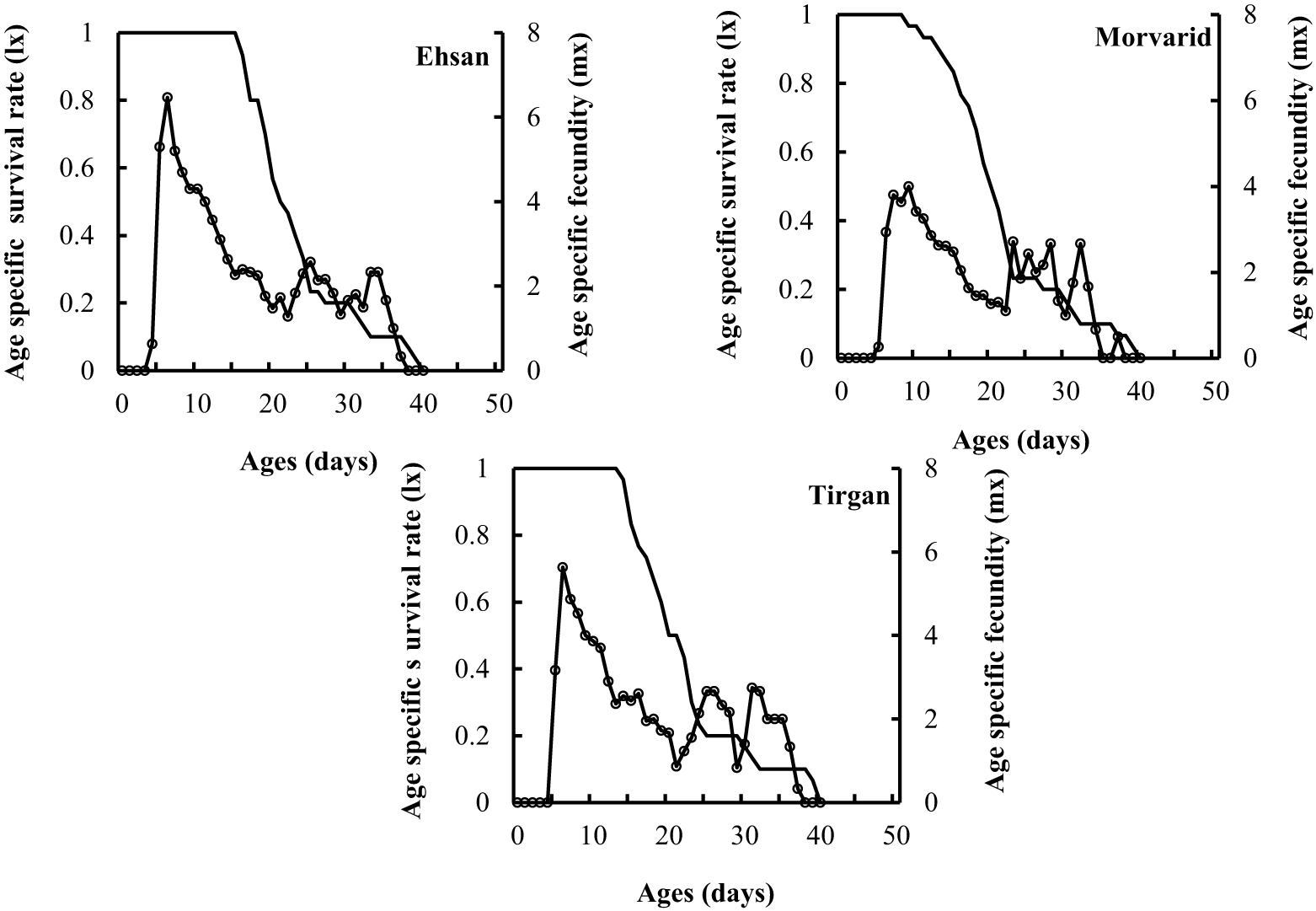
Mean nymphal period of S. graminum on cv. Morvarid was significantly longer than that on Tirgan and Ehsan cultivars (table 1). The APOP (adult pre-oviposition period) of aphid on cv. Morvarid, with no significant differences on cv. Tirgan, was significantly higher than that on cv. Ehsan. The TPOP (total pre-oviposition period) of the aphid were longest on cv. Morvarid, followed by Tirgan and Ehsan cultivars (table 1). Mean fecundity of S. graminum was significantly different among cultivars (P < 0.05), being lowest on cv. Morvarid and highest on cv. Ehsan (table 1). The oviposition period and longevity of S. graminum were lowest on cv. Morvarid (table 1). The highest peak of age-specific fecundity (mx) of the aphid occurred at age 6 (days) on cv. Ehsan, 10 (day) on cv. Morvarid, and 7 (days) on cv. Tirgan (fig. 1).
Duration (mean ± SE) of immature stages, fecundity, oviposition, and longevity of Schizaphis graminum reared on three wheat cultivars

Note: Means followed by different letters in each column are significantly different ( P < 0.05; paired bootstrap test).
APOP, adult pre-oviposition period; TPOP, total pre-oviposition period.
Age-specific survival rate (l x) and age-specific fecundity (m x) of Schizaphis graminum reared on three wheat cultivars.

S. graminum had the highest gross reproductive rate (GRR) on cv. Ehsan and the lowest on cv. Morvarid (table 2). A similar trend was observed for the net reproductive rate (R 0). Intrinsic rate of natural increase (r) of the aphid was highest on cv. Ehsan, followed by Tirgan and Morvarid cultivars. A similar result was obtained for a finite rate of increase (λ) of the aphid (table 2). The mean generation time (T) of the aphid was longest on cv. Morvarid (table 2).
Life table parameters (mean ± SE) of Schizaphis graminum reared on three wheat cultivars

Note: Means followed by different letters in each column are significantly different (P < 0.05; paired bootstrap test).
GRR, gross reproductive rate; R 0, net reproductive rate; r, intrinsic rate of natural increase; λ, finite rate of increase; T, mean generation time.
Biological and demographic parameters of Hippodamia variegata
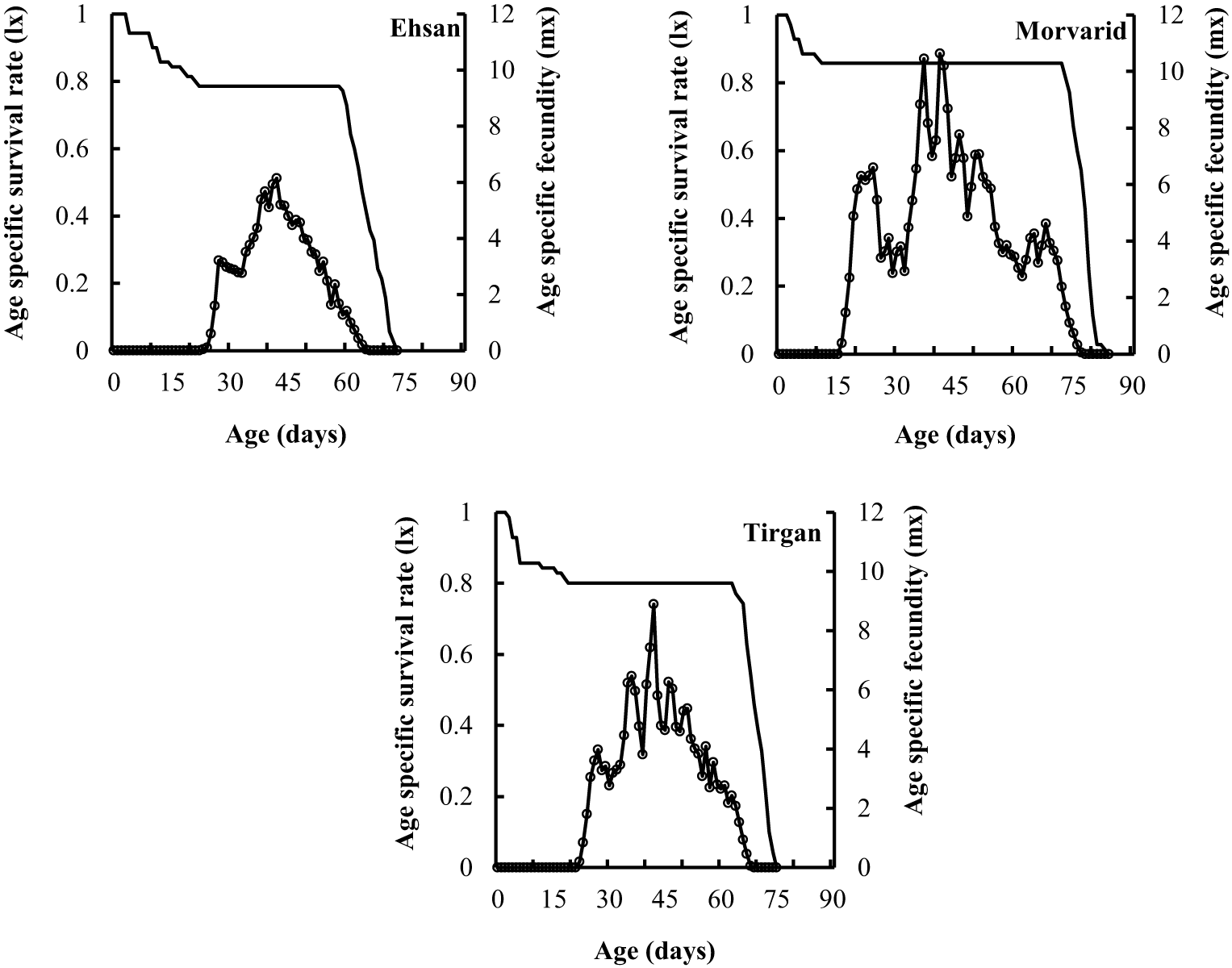
The predator had a significantly lower mean incubation period, larval period, and pupal period on cv. Morvarid as compared to the other two cultivars (P < 0.05) (table 3). The mean developmental time of H. variegata was lowest on cv. Morvarid and highest on cv. Ehsan. The percentages of pre-adult survival of H. variegata were not significantly different among cultivars (P > 0.05) (table 3). The APOP and TPOP were the longest on cv. Ehsan, followed by Tirgan and Morvarid cultivars (table 4). The oviposition period and fecundity of H. variegate were significantly different on the tested cultivars (P < 0.05) (table 4), being highest on cv. Morvarid and the lowest on cv. Ehsan (table 4). The highest and lowest longevity of both males and females of the predator were obtained on Morvarid and Ehsan cultivars, respectively (P < 0.05) (table 4). The age-specific survival rates (lx) of H. variegata on different cultivars decreased as the predator became older, with the last death of the predator occurring at the age of 73rd day on cv. Ehsan, 76th day on cv. Tirgan, and 85th day on cv. Morvarid (fig. 2).
Duration (mean ± SE) of immature stages and pre-adult survival of Hippodamia variegata fed on Schizaphis graminum reared on three wheat cultivars

Note: Means followed by different letters in each column are significantly different (P < 0.05; paired bootstrap test).
The oviposition period, fecundity, and longevity (mean ± SE) of Hippodamia variegata fed on Schizaphis graminum reared on three wheat cultivars

Note: Means followed by different letters in each column are significantly different (P < 0.05; paired bootstrap test).
APOP, adult pre-oviposition period; TPOP, total pre-oviposition period.
Age-specific survival rate (l x) and age-specific fecundity (m x) of Hippodamia variegata fed on Schizaphis graminum reared on three wheat cultivars.

The gross reproductive rate (GRR) and net reproductive rate (R 0) of the predator were highest when H. variegata fed on aphids reared on cv. Morvarid, and lowest when it fed on aphids reared on cv. Ehsan (table 5). The intrinsic rate of natural increase (r) and finite rate of increase (λ) of H. variegata were significantly highest on cv. Morvarid, while the mean generation time (T) of the predator was lowest on this cultivar (P < 0.05) (table 5).
Life table parameters (mean ± SE) of Hippodamia variegata fed on Schizaphis graminum reared on three wheat cultivars

Note: Means followed by different letters in each column are significantly different ( P < 0.05; paired bootstrap test).
GRR, gross reproductive rate; R 0, net reproductive rate; r, intrinsic rate of natural increase;  $\lambda $, finite rate of increase; T, mean generation time.
Secondary metabolites and photosynthetic pigments
The leaves of cv. Morvarid had a high TFC among the cultivars at time 0 post-infestation (F 2,8 = 211.065; P < 0.0001). As the duration of infestation increased, the TFC in cv. Morvarid (F 5,17 = 10.445; P < 0.0001) and cv. Tirgan (F 5,17 = 11.492; P < 0.0001) was significantly affected and reached a very high level at 120 hours post-infestation. However, the TFC in cv. Ehsan was not significantly affected by different time intervals (F 5,17 = 0.376; P = 0.855) (table 6).
Mean (±SE) amount of total flavonoid content (mg QE/gFW) and phenolic content (µg GAE g−1 FW) of three wheat cultivars at 0, 24, 48, 72, 96, and 120 hours post-infestation by Schizaphis graminum

Note: Means in the same row and for each time interval followed by different uppercase letters are significantly different (P < 0.05; Tukey test).
Means in the same column and for each parameter followed by different lowercase letters are significantly different (P < 0.05; Tukey test).
FW, fresh weight of leaf tissue.
As presented in table 6, cv. Morvarid exhibited the significantly highest TPC among the cultivars at time 0 post-infestation (F 2,8 = 146.408; P < 0.0001). The results revealed that the TPC of either cv. Morvarid (F 5,17 = 12.513; P < 0.0001) or cv. Tirgan (F 5,17 = 15.300; P < 0.0001) was significantly affected by duration of exposure, while it was not significant in cv. Ehsan (F 5,17 = 2.646; P = 0.078). The highest amounts of TPC of the cultivars were obtained at 120 hours post-infestation. Cultivar Morvarid still showed the highest level of TPC.
The total chlorophyll content was highest in cv. Morvarid at time 0 post-infestation (F 2,8 = 53.530; P < 0.0001) (table 7). After 120 hours of infestation, the total chlorophyll of cultivars significantly decreased (F 5,17 = 5.006; P = 0.01 for cv. Ehsan, F 5,17 = 77.234; P < 0.0001 for cv. Morvarid, and F 5,17 = 48.349; P < 0.0001 for cv. Tirgan). Cultivar Ehsan and cv. Tirgan had the lowest level of total chlorophyll at 120 hours post-infestation (table 7). According to the results, the amounts of total chlorophyll a, chlorophyll b, and carotenoid were lowest in cv. Ehsan at time 0 post-infestation. However, significant loss of total chlorophyll a (F 5,17 = 3.227; P = 0.45 for cv. Ehsan, F 5,17 = 58.385; P < 0.0001 for cv. Morvarid, and F 5,17 = 33.730; P < 0.0001 for cv. Tirgan), chlorophyll b (F 5,17 = 4.308; P = 0.018 for cv. Ehsan, F 5,17 = 44.203; P < 0.0001 for cv. Morvarid, and F 5,17 = 23.311; P < 0.0001 for cv. Tirgan), and carotenoid (F 5,17 = 108.875; P < 0.0001 for cv. Morvarid and F 5,17 = 296.605; P < 0.0001 for cv. Tirgan) contents in the cultivars were observed upon prolongation of the time intervals from 0 to 120 hours post-infestation (table 7), except carotenoid content in cv. Ehsan (F 5,17 = 1.775; P = 0.192 for cv. Ehsan) (table 7).
Mean (± SE) amount of chlorophyll a (mg g−1 FW), chlorophyll b (mg g−1 FW), total chlorophyll (mg g−1 FW), and carotenoid (µg g−1 FW) content of three wheat cultivars at 0, 24, 48, 72, 96, and 120 hours post-infestation by Schizaphis graminum

Note: Means in the same row and for each time interval followed by different uppercase letters are significantly different (P < 0.05; Tukey test).
Means in the same column and for each parameter followed by different lowercase letters are significantly different (P < 0.05; Tukey test).
FW, fresh weight of leaf tissue.
Defence enzymes
Comparing the tested cultivars at time 0 post-infestation, the amounts of POD (F 2,8 = 52.330; P < 0.0001), PPO (F 2,8 = 5.627; P = 0.042), and SOD (F 2,8 = 90.720; P < 0.0001) were significantly high in cv. Morvarid. As the duration of infestation increased, the activities of enzymes were found to increase in each cultivar, with the exception of PPO in cv. Tirgan (F 5,17 = 2.905; P = 0.060) (table 8). The highest activity of each enzyme was observed over a period of 120 hours post-infestation in cv. Morvarid (table 8).
Mean (± SE) amount of peroxidase (POD) (nkat mg−1protein), polyphenol oxidase (PPO) (nkat mg−1protein), and super oxidase dismutase (SOD) (U mg−1 protein) activity of three wheat cultivars at 0, 24, 48, 72, 96, and 120 hours post-infestation by Schizaphis graminum

Note: Means in the same row and for each time interval followed by different uppercase letters are significantly different (P < 0.05; Tukey test).
Means in the same column and for each parameter followed by different lowercase letters are significantly different (P < 0.05; Tukey test).
Discussion
In the current study, wheat cultivars significantly affected the demographic parameters of S. graminum. Based on the results, the longest developmental time and lowest longevity and fecundity of the aphid were obtained on cv. Morvarid. The life table parameters (GRR, R 0, r, and λ) of the aphid were also lowest on cv. Morvarid, implying that it is an unsuitable cultivar for S. graminum. The elevated levels of defence metabolites (TFC and TPC) and defence-related enzymes (POD, PPO, and SOD) detected in undamaged plants of cv. Morvarid may explain the poor performance of the aphid on this cultivar. Delayed pest development on such hosts consequently limits population growth and increases the duration of exposure to natural enemies (Jafari et al., Reference Jafari, Fathipour, Bagheri and Talebi2020). However, the faster developmental time and increased GRR, R 0, r, and λ of S. graminum on cv. Ehsan suggested that this cultivar was a nutritionally high-quality host plant for the development and population growth of the aphid, which can be due to the presence of low concentrations of toxic substances such as TFC and TPC in this cultivar. The findings of Zahedi et al. (Reference Zahedi, Razmjou, Rafiee-Dastjerdi, Norman, Leppla, Golizadeh, Hassanpour and Ebadollahi2019) revealed that the increased values of life table parameters of Aphis gossypii Glover (Hemiptera: Aphididae) on a cucumber cultivar (cv. Khasib) were related to low amounts of secondary metabolites (TFC and TPC). Mohammadi Anaii et al. (Reference Mohammadi Anaii, Pahlavan Yali and Bozorg-Amirkalaee2018) also reported that the low concentrations of total phenolic compounds in two wheat cultivars (line R3-17 and Pishtaz) contributed to the highest fecundity and survival rate of S. graminum. These findings are consistent with the results obtained in the present study.
The results indicated that defence metabolites (TFC and TPC) and enzymes (POD, PPO, and SOD) in the examined wheat cultivars increased in a time-dependent manner, reaching their maximum levels at 120 hours post-infestation, thus highlighting their role in defence against herbivory. Other researchers demonstrated the same results in their studies. For example, Mai et al. (Reference Mai, Bednarski, Borowiak-Sobkowiak, Wilkaniec, Samardakiewicz and Morkunas2013) reported that colonisation of Acyrthosiphon pisum Harris (Hemiptera: Aphididae) on pea seedlings led to a significant increase in production of reactive chemicals from 0 to 96 hours post-infestation by the aphids. Sytykiewicz (Reference Sytykiewicz2014) reported that increasing the abundance and duration of exposure (8 hours post-infestation) to Rhopalosiphum padi L. (Hemiptera: Aphididae) in maize seedlings induced a considerable response in the antioxidative activities of enzymes. Kaur et al. (Reference Kaur, Salh and Singh2017) reported that the infestation of wheat genotypes by various aphid species, such as Sitobion avenae Fabricius, Sitobion miscanthi Takahashi, R. padi, and Rhopalosiphum maidis Fitch (Hemiptera: Aphididae) resulted in a great increase of secondary metabolites (total phenol) and activity of enzymes (such as SOD, glutathione reductase, phenylalanine ammonia lyase, and PPO) in some genotypes.
The results of the present study revealed significant differences in the content of total chlorophyll, chlorophyll a, chlorophyll b, and carotenoids among the wheat cultivars, with the highest levels observed in cv. Morvarid and the lowest in cv. Ehsan at 0 hours post-infestation. These findings indicate that undamaged wheat cultivars differ not only in their chemical traits but also in their morphological characteristics related to pigments. However, the amounts of photosynthetic pigments in the leaves of each cultivar declined as the length of infestation time increased from 0 to 120 hours. Changes in photosynthetic pigments’ concentrations in response to S. graminum feeding suggest a feeding-induced stress response in the tested cultivars. The content of photosynthetic pigments in plant tissue is an important factor involved in the interactions between host plants and herbivores, as they provide most of the plant’s colour and support the photosynthesis process (Krause and Weis, Reference Krause and Weis1991; Simkin et al., Reference Simkin, Kapoor, Doss, Hofmann, Lawson and Ramamoorthy2022). The concentrations of pigments usually change during plant development, nutritional deficiencies, insect feeding, and pathogen infections (Golawska et al., Reference Golawska, Krzyzanowski and Lukasik2010; Mohammadi Anaii et al., Reference Mohammadi Anaii, Pahlavan Yali and Bozorg-Amirkalaee2018). Losses of pigment content due to insect attack have also been reported in other studies. For example, Golan et al. (Reference Golan, Rubinowska, Kmieć, Kot, Górska-Drabik, Lagowska and Michałek2014) reported that the relative loss in chlorophyll a, chlorophyll b, and carotenoid content in lemon and fern leaves was related to feeding damage caused by various densities of Coccus hesperidum L. (Hemiptera: Coccidae) nymphs. Zahedi et al. (Reference Zahedi, Razmjou, Rafiee-Dastjerdi, Norman, Leppla, Golizadeh, Hassanpour and Ebadollahi2019) reported that cucumber (cv. Storm) apparently synthesised less chlorophyll pigment in the leaves under A. gossypii damage. Conversely, Dancewicz et al. (Reference Dancewicz, Paprocka, Morkunas and Gabrys2018) reported that feeding of A. pisum (Harris) did not alter the content of photosynthetic pigments in pea leaves. This response may reflect rapid plant adaptation or compensatory photosynthesis triggered by aphid feeding. Delayed chlorophyll degradation, increased chlorophyll production, and resource allocation of chlorophyll were also suggested by Heng-Moss et al. (Reference Heng-Moss, Ni, Macedo, Markwell, Baxendale, Quisenberry and Tolmay2003) as possible explanations for the unchanged pigment levels in infested plants compared to uninfested ones.
In the present study, the pre-adult stages of H. variegata developed faster on cv. Morvarid and its adults lived longer and produced more offspring on this cultivar compared to other tested cultivars. Furthermore, preying upon S. graminum on this cultivar resulted in significantly increased amounts of GRR, R 0, r, and λ, followed by Tirgan and Ehsan. Despite the poor performance of S. graminum on cv. Morvarid, the predator performed significantly better when preying on aphids reared on this cultivar. Although aphid size was not measured in the current study, Barkhordar et al. (Reference Barkhordar, Khalghani, Jouzani, Ganbalani, Shojaii, Boustani, Karimi, Soheiliv and Hosseini2013) reported that host plants with poor nutritional quality often produce smaller aphids, which may lead predators to consume more individuals to meet their nutritional requirements. Thus, it seems that the action of predators coupled with partial host plant resistance is a more effective way for suppressing the aphid’s population on wheat plants than either predator or plant resistance alone. Similar to our results, Zahedi et al. (Reference Zahedi, Razmjou, Rafiee-Dastjerdi, Norman, Leppla, Golizadeh, Hassanpour and Ebadollahi2019) showed that H. variegata performed better on A. gossypii-resistant cucumber cultivar (Storm) and had great potential for reproduction on this cultivar. Ghafouri Moghaddam et al. (Reference Ghafouri Moghaddam, Golizadeh, Hassanpour, Rafiee-Dastjerdi and Razmjou2016) reported that the intrinsic rate of natural increase (r) of H. variegata was highest when the predator fed on S. avenae reared on wheat (var. Tajan). Plant biochemistry and defence compounds not only influence the nutritional quality, body size, growth, and development of herbivores but also affect the growth, development, and reproduction of their natural enemies (Giles et al., Reference Giles, Madden, Stockland, Payton and Dillwith2002; Kaur et al., Reference Kaur, Saraf, Kumar, Singh and Kaur2021; Arab Yabarati et al., Reference Arab Yabarati, Hemmati, Esfandiari and Siahpoosh2025; Jafari et al., Reference Jafari, Hemmati, Esfandiari and Rasekh2025). Regardless of the fact that some insect pests utilise plant toxins for self-defence against their natural enemies (Zhang et al., Reference Zhang, van Doan, Arce, Hua, Grueniga, Parisoda, Hibbard, Hervéd, Roberta, Machadoa and Erb2019), no harmful effect of plant defence compounds on H. variegata was detected in the present study, since the predator neither rejected S. gaminum on cv. Morvarid has not experienced a substantial mortality while feeding aphids on this cultivar. Interestingly, it successfully developed on cv. Morvarid gave birth to its offspring. One possible explanation for the success of natural enemies when exposed to plant toxins through herbivore feeding is their ability to resist or tolerate plant defence metabolites (Ode, Reference Ode2006). Alternatively, natural enemies may be affected only indirectly by plant compounds that pass through the herbivore’s body, whereas herbivores experience direct exposure to these metabolites (Karami et al., Reference Karami, Fathipour, Talebi and Reddy2018; Moradi et al., Reference Moradi, Hassanpour, Fathi and Ali Golizadeh2023). Natural enemies even use plant defence compounds as oviposition stimulants (Riddick et al., Reference Riddick, Wu, Eller and Berhow2018). Some natural enemies may also accumulate a plant’s toxins in their tissues, which provide protection against their top enemies (Lampert et al., Reference Lampert, Dyer and Bowers2011).
In our previous study (Esmaeili et al., Reference Esmaeili, Hassanpour, Rafiee Dastjerdi, Fathi and Khoshhal Sarmast2024), the functional response of H. variegata on the studied wheat cultivars showed that predation efficiency was lowest on cv. Morvarid. In contrast, the present study found that cv. Morvarid enhanced the demographic performance of the predator. This apparent discrepancy is mainly due to the fact that the functional response study reflects stage-specific predation efficiency of H. variegate in a short time (24 hours), whereas the demographic parameters integrate the survival, reproduction, and longevity of the predator across its whole life cycle. These findings are complementary, indicating that cv. Morvarid supports long-term population growth of H. variegata despite lower larval predation efficiency. Furthermore, our results suggest that traits of cv. Morvarid may reduce short-term larval predation efficiency but does not negatively impact long-term predator population growth, possibly because elevated secondary metabolites affected aphid size and imposed stress on S. graminum, increasing its susceptibility to predation. Accordingly, we propose that cv. Morvarid represents a more sustainable option for integration with biological control, although the trade-offs between immediate and long-term effects warrant further investigation under field conditions.
In summary, our findings emphasise the importance of host plant cultivars on demographic parameters of S. graminum and its predator, H. variegata. Among the tested cultivars, cv. Morvarid was an unsuitable cultivar for the aphid population build-up and a suitable one for the predator’s fitness, representing the potential complementary interactions of both cv. Morvarid and H. variegata in controlling S. graminum population. High amounts of plant secondary metabolites and enzymes in undamaged and damaged (especially at 120 hours post-infestation) plants of cv. Morvarid may be responsible for the poor performance of S. graminum on this cultivar. Therefore, the findings of the present study can be considered as basic information for the development of a reliable and sustainable IPM strategy for S. graminum. Nevertheless, further studies are required to identify additional biochemical factors contributing to wheat cultivar resistance to S. graminum and to evaluate the tritrophic interactions observed in the present study under natural conditions.
Acknowledgements
This research was financially supported by the University of Mohaghegh Ardabili, Ardabil, Iran, which is greatly appreciated. The authors wish to thank Dr Ali Afshari and Sadegh Atashi for their assistance during the laboratory assays.
Author contribution
M.E. carried out experiments, gathered data, analysed the data, and wrote the article. M.H. designed the experiment, reviewed the article, and analysed the data. H.R.D. and S.A.A.F. reviewed the article. M.K.S. reviewed the article and analysed the data. All authors read and approved the final manuscript.
Competing interests
None.