The role of explicit information (EI) in the acquisition of a second language (L2) has been of great interest to researchers for the last 30 years. In instructed SLA, EI is the information that learners receive about the L2 and how it works. Many researchers claim that EI is beneficial for SLA because it promotes noticing of forms in the input, and learners are thus better able to process these forms than if they are left to their own devices (e.g., DeKeyser, Reference DeKeyser, Doughty and Long2003; Doughty & Williams, Reference Doughty, Williams, Doughty and Williams1998; Ellis, Reference Ellis2002a, Reference Ellis, Hinkel and Fotos2002b; Hulstijn & de Graaff, Reference Hulstijn and de Graaff1994; Long, Reference Long, de Bot, Ginsberg and Kramsch1991; VanPatten, Reference VanPatten1993). A number of studies have demonstrated that learners who received EI performed better than those who did not receive EI in a variety of treatments (e.g., Alanen, Reference Alanen and Schmidt1995; de Graaff, Reference de Graaff1997; DeKeyser, Reference DeKeyser1997; Erlam, Reference Erlam2003; Fotos, Reference Fotos1994; Kubota, Reference Kubota1996; Master, Reference Master and Odlin1994; Robinson, Reference Robinson1996; Rosa & Leow, Reference Rosa and Leow2004; Scott, Reference Scott1989; Williams & Evans, Reference Williams, Evans, Doughty and Williams1998). However, researchers conducting studies with the instructional technique called processing instruction (PI) have observed that EI is not necessary (Farley, Reference Farley and VanPatten2004a) and does not play any role in the correct processing and production of a number of linguistic forms and structures (Benati, Reference Benati and VanPatten2004; Sanz & Morgan-Short, Reference Sanz and Morgan-Short2004; VanPatten & Oikkenon, Reference VanPatten and Oikkenon1996; Wong, Reference Wong and VanPatten2004b): EI did not prove to be beneficial in most of these PI studies. It may be possible, however, that the effects of EI were hidden due to the offline treatments and the pretest and posttest designs used in these PI studies and that learners actually may have benefited from EI at some point in the instruction. In order to observe the possible role of EI in PI, it is necessary to conduct an online study that tracks learners' behavior while they are engaged in activities designed to promote acquisition. A study of this nature might reveal a role for EI that was perhaps overlooked in previous studies. The present study investigates—by tracking moment-by-moment behavior of learners engaged in processing two different linguistic targets—what it is that EI actually does in PI.
PROCESSING INSTRUCTION AND EXPLICIT INFORMATION: REVIEW OF THE LITERATURE
Processing instruction is a pedagogical technique based on the principles of the model of input processing proposed by VanPatten (Reference VanPatten1996, Reference VanPatten2002, Reference VanPatten and VanPatten2004). The principles outlined by this model are based on the default processing strategies that learners' linguistic processors apply to make sense of the input; for example, the lexical preference principle states that learners tend to rely on lexical items and not on grammatical form to get meaning when both encode the same semantic information (VanPatten, Reference VanPatten2002, Reference VanPatten and VanPatten2004). The goal of PI is to alter the nonoptimal default processing strategies that lead L2 learners not to process forms or to process them incorrectly; this is accomplished in part by manipulating the input provided to learners. The modified input, called structured input (SI), pushes learners to change their default processing strategies in favor of other strategies that are more effective. A complete PI treatment promotes such a strategy change by (a) giving EI, (b) giving information about an inappropriate input processing strategy, and (c) exposing learners to SI.
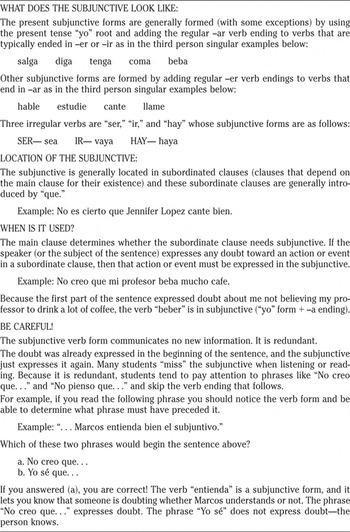
Explicit information is focused on one linguistic form or structure at a time, and it informs learners about how the form or the structure works. It also includes information about a particular default—but inappropriate—processing strategy and how this strategy does not lead learners to correctly process certain forms or structures. Table 1 provides an example of how EI might look in PI. The target form in this example is the third person singular of the Spanish subjunctive in expressions of doubt. EI tells learners what the subjunctive looks like, what its location is in the sentence, and when it is used. The “Be careful!” section also includes information to alert learners about a faulty input processing strategy—in this case, the strategy described in the lexical preference principle (VanPatten, Reference VanPatten2002, Reference VanPatten and VanPatten2004).
Example of explicit information in PI

From “The Relative Effects of Processing Instruction and Meaning-Based Output Instruction on L2 Acquisition of the Spanish Subjunctive,” by Farley, Reference Farley2000. Unpublished doctoral dissertation, University of Illinois, Urbana-Champaign. Reprinted with permission.
The SI is presented in activities called structured input activities, which are of two types: referential and affective. Referential activities always have a correct answer, whereas affective activities do not require a correct answer; rather, learners respond with what is true or false for them, with their opinion, or with what applies for them. A referential activity with the third person Spanish subjunctive in expressions of doubt is presented in (1) and an affective activity also using the subjunctive is presented in (2).
(1)

(2)


In both types of activities, learners must attend to the input and process it correctly in order to understand what they are reading or listening to. In (1), the verbs in the aural sentences are inflected either in the subjunctive or in the indicative mood, and the written options convey the meaning of either doubt (e.g., No creo que … “I don't believe that…”) or certainty (e.g., Yo sé que… “I know that…”). Learners must attend to the inflection of the verb in the aural phrases in order to correctly select the meaning that the speaker is conveying (i.e., doubt or certainty). In (2), learners need to understand both the phrase No creo que… “I don't believe that…” and the subordinate clauses to select the one(s) with which they agree. Note that the input has been structured so that the inflected verbs appear in initial position to make them more salient. Because these are input-based activities, learners are not asked to produce language (see Wong, Reference Wong and VanPatten2004a, for a detailed description of PI).
VanPatten and Oikkenon (Reference VanPatten and Oikkenon1996) began to investigate the role of EI in PI by considering whether the effectiveness of PI demonstrated in an earlier study by VanPatten and Cadierno (Reference VanPatten and Cadierno1993) was due to SI only or to EI. Unlike VanPatten and Cadierno, VanPatten and Oikkenon separated out EI in their treatment and considered it as an independent variable. Three groups were compared in VanPatten and Oikkenon's study: a PI group that received EI, SI activities, and feedback (exactly as in VanPatten and Cadierno's study); a SI group that only received SI activities and feedback on whether their answers were correct or incorrect (but not why; i.e., they did not receive EI in any part of the treatment); and an EI group that only received information about the target structures and the particular input processing strategy that negatively affects their correct interpretation. The target structures were Spanish object-verb-subject (OVS) sentences with clitic pronouns (e.g., lo escucha la abuela “The grandma listens to him,” in which lo is the object, escucha is the verb, and la abuela is the subject). The assessment consisted of an immediate posttest that included both a sentence-level interpretation task and a sentence-level production task. The results showed that both the PI group and the SI group made gains on the interpretation task, and the groups were not different from each other. The EI group showed no improvement at all on the interpretation task. On the production task, all groups improved. The PI group improved significantly more than the EI group. The SI group scores were lower than the PI group scores and higher than the EI group scores, but these differences were not statistically significant. The authors interpreted these findings as indicating that SI alone is sufficient to cause improvement on interpretation and production tasks and that EI is not necessary or even beneficial for PI. Although the EI group improved and had statistically equal gains as the SI group on the production task, the authors argued that these results show that SI alone is sufficient to cause gains, because the SI group performed as well as the PI group in both of the modalities.
Wong (Reference Wong and VanPatten2004b) conducted a study to investigate whether the results of VanPatten and Oikkenon's (Reference VanPatten and Oikkenon1996) study would generalize to other linguistic structures that do not communicate new information and thus present different processing problems. The target forms in her study were the French de/d' forms used in negative constructions. Following the lexical preference principle (VanPatten, Reference VanPatten1996, Reference VanPatten2002, Reference VanPatten and VanPatten2004), learners will skip the grammatical de/d' forms in negative sentences because they compete with the lexical form ne … pas “not” to communicate negation. The de/d' forms, then, are redundant. Wong examined whether SI alone would be sufficient to make learners process these forms or if EI would be beneficial or even necessary. She divided participants into four groups: a PI group that received EI plus SI activities, a SI group that received only SI activities, an EI group that received only EI (as in VanPatten & Oikkenon), and a control group that did not receive any instruction. The treatment for the PI group consisted of giving learners EI on the meaning and the function of the target structures and on the learners' tendency to overlook the forms de/d' in negative structures. After EI, learners did SI activities designed to push them to attend to de/d' or un/une “a” and not to rely on the construction ne … pas “not” to determine whether sentences were negative or affirmative. The SI group did not receive EI; they only did the SI activities and received feedback on whether their responses on each item were right or wrong (but not why). The EI group received the information on the target structures and on the faulty processing strategy but did not do the SI activities. The assessment consisted of an immediate posttest that included both a sentence-level interpretation task and a sentence-level production task. The results showed that on the interpretation test, both the SI and PI groups improved equally and more than the EI and control groups. The EI group improved, but the results were not different from the control group. On the production task, all treatment groups improved. The PI group and the SI group were different from the control group but were not different from each other. The PI group was different from the EI group, and the EI group was not different from the control group. The SI group and the EI group were not different from each other. Unlike in VanPatten and Oikkenon's study, the EI group improved in both of the modalities, which suggests that EI might have helped learners correctly interpret and produce the target structure used for this study. However, Wong argued that because the EI group was not different from the control group, the EI contribution was minimal, particularly when compared with the improvements made by the SI and PI groups. She concluded that SI is sufficient to cause gains in production and interpretation of the target forms and that EI plays no important role.
Benati (Reference Benati and VanPatten2004) set out to replicate VanPatten and Oikkenon's (Reference VanPatten and Oikkenon1996) study, investigating the role of EI in the interpretation and production of Italian third person future forms. As in Wong (Reference Wong and VanPatten2004b), the processing problem these structures present is stated in the lexical preference principle (VanPatten, Reference VanPatten1996, Reference VanPatten2002, Reference VanPatten and VanPatten2004). In this case, learners tend not to attend to the verb ending that denotes future; instead, they rely on adverbial phrases (tomorrow, next week, etc.) to get the meaning. Benati divided 38 college students of Italian into three groups: a PI group that received EI plus SI activities, a SI group that only received SI activities, and an EI group that only received EI. The treatment for the PI group consisted of EI on the form and function of the target forms as well as on learners' tendency to rely on adverbial phrases to get the future tense meaning. After EI, the PI group did SI activities. The SI group did the activities without any EI. The EI group only received the information on the target structures and on the faulty processing strategy. There was an immediate posttest, and a delayed posttest was given 1 month later. Both of the posttests consisted of sentence interpretation and production tasks. For interpretation, the results showed that all groups improved. The EI group was different from both the PI and the SI groups. The PI group and the SI group improved more than the EI group and were not different from each other. The same results were maintained 1 month later. For the production test, all groups improved. The PI group improved more than the EI group but was not different from the SI group, and the pattern of results was maintained 1 month later. Unlike in VanPatten and Oikkenon and in Wong, this time the SI group was different from the EI group on both the interpretation and production tests. Benati concluded that SI is sufficient for learners to correctly process and produce the target structures. However, EI might have an effect—albeit minimal if compared to the improved performance of both the PI and SI groups—as seen in the EI group's improvement in the two modalities.
Sanz and Morgan-Short (Reference Sanz and Morgan-Short2004) examined the effects of computer-delivered EI and explicit feedback on the acquisition of Spanish OVS word order through PI treatment. Participants were randomly assigned to four groups: a PI group that received explicit feedback (+EI, +F), a PI group that did not receive explicit feedback (+EI, −F), a SI-only group that received explicit feedback (−EI, +F), and a SI-only group that did not receive explicit feedback (−EI, −F). The treatment was taken from VanPatten and Cadierno's (Reference VanPatten and Cadierno1993) paper-and-pencil materials and adapted to a computer-assisted language learning format. There were 56 input practice items: Some required learners to read a sentence and choose the picture it referred to, whereas others required learners to do other tasks, such as reading a text or interpreting what a short article was about based on its title. The computer-delivered EI was given to the PI groups right before the activities. Feedback was delivered immediately after each response; it was explicit for the +F groups (e.g., it explained how the Spanish word order works) or in the form of “sorry, try again” or “OK” for the −F groups. Participants also completed an interpretation and production pretreatment test and an interpretation and production posttreatment test based on the VanPatten and Cadierno materials. An additional production posttest, not included in the VanPatten and Cadierno materials, consisted of a written video-retelling task that required learners to produce the target form at the suprasentential level. The results of the study showed that all groups increased in their ability to interpret and produce OVS-type sentences after treatment, but no effect was found for explanation or for feedback on any of the tests. Hence, the amount of EI provided both before the tasks and during the tasks (as explicit feedback) did not have any impact on participants' ability to interpret and produce Spanish OVS-type sentences. Sanz and Morgan-Short claimed that the fact that the SI activities were task-essential (i.e., learners needed to process the critical forms to complete the task) was the reason why supplemental information was not necessary or even beneficial.
Farley (Reference Farley and VanPatten2004a) undertook another replication of VanPatten and Oikkenon's (Reference VanPatten and Oikkenon1996) study in an attempt to determine whether the results observed in this and later PI studies would also obtain with a form, such as the Spanish subjunctive, known to be difficult for learners.Footnote 1 Farley tested whether SI activities alone bring about improved performance on interpretation and production of third person singular Spanish subjunctive forms in expressions of doubt and, if so, whether the gains would be the same for a SI-only group as for a group receiving SI plus EI (i.e., a PI group). Unlike VanPatten and Oikkenon, Wong (Reference Wong and VanPatten2004b), and Benati (Reference Benati and VanPatten2004), Farley's study only included two experimental groups: a PI group and a SI-only group. The SI was designed to (a) push learners to notice and process the meaning of the main clause (i.e., doubt or certainty) by requiring them to attend to the verb inflection to complete the task and (b) increase verb salience by placing the inflected verbs at the beginning of the sentence. The EI explained how the subjunctive works. Results showed that both the PI and the SI groups improved significantly from the pretest to the posttest, but, unlike the previous studies, the PI group improved more than the SI group in both modalities. Because participants had to rely on the subjunctive forms to complete the tasks, the SI group not performing as well as the PI group was not due to a lack of task essentialness; Farley explained this difference in outcome as due to the nature of the target form, arguing that whereas other linguistic features such as tense or agency are readily transparent in meaning, mood as a feature might not be as clear to learners. The range of expressions that convey doubt (it is possible, I'm not sure, etc.) may not communicate uncertainty as clearly as other linguistic features, hence the beneficial effect of EI. Farley concluded that “EI might have helped learners see the form-meaning connections in the SI activities more quickly and reduce the item by item analysis the SI participants might have undertaken” (p. 238). The fact that the SI group also improved indicates that SI is sufficient to have learners process subjunctive forms. These findings suggest that some types of linguistic structures or processing problems might require more exposure to SI or perhaps more explicit treatments.Footnote 2
THE PRESENT STUDY
Given that previous studies on the effects of EI in PI seem to indicate that EI is not necessary for PI, is it possible that EI is nevertheless somehow beneficial for learners? Is it possible that EI assists acquisition in some way that is not measurable by traditional pretesting and posttesting research designs? Is it possible that PI groups that get EI before being engaged in tasks somehow have an easier time processing grammatical features when working through those tasks? Do learners who get EI start making form-meaning connections earlier than those who do not get EI?
To determine whether EI does have a beneficial effect for learners, the present study compares various processing groups with and without EI and examines how learners perform during tasks designed to promote acquisition. An online analysis allows for observation of changes in behavior as learners try to process linguistic forms and structures with and without EI. Through comparisons between PI groups that receive EI and SI-only groups that do not receive EI, this study attempts to observe (a) whether providing EI to learners helps them process two different linguistic targets earlier in a sequence and also more correctly than learners who do not receive EI on the target structures, (b) whether EI helps learners process the linguistic targets faster (i.e., the time it takes them to submit their answer), and (c) whether EI helps learners begin and maintain correct processing strategies in a series of SI items. Instruction was delivered via a computer that tracks response time and response accuracy over time. The criterion for correct input processing was established as the point when learners began and continued to provide correct responses for at least four items—three target items and one distracter—in a row.Footnote 3 The number of SI items encountered by learners before this criterion point of correct processing is referred to as trials to criterion in the analysis.
Two linguistic variables are used to test the effects of EI in PI: Spanish OVS-type sentences with clitic object pronouns and Spanish subjunctive in expressions of doubt. These two linguistic targets were chosen because (a) they represent two different processing problems that require certain processing strategies for their acquisition and (b) previous PI studies with these forms have shown different outcomes regarding the effects of EI. Experiment 1 investigates the effect of EI on the processing of OVS-type sentences, and Experiment 2 investigates the effect of EI on the processing of the Spanish subjunctive. There are two experimental groups: the PI group (which receives EI before engaging in SI activities) and the SI group (which does not receive EI). One might ask why the study does not include an EI-only group—as used in Benati (Reference Benati and VanPatten2004), Wong (Reference Wong and VanPatten2004a), and VanPatten and Oikkenon's (Reference VanPatten and Oikkenon1996) studies—but, given that the question is not whether EI is necessary, it was determined that EI-only treatment groups were not needed for the purpose of the present study.Footnote 4 Of relevance here is the relative effect of EI during the acquisition phase, and the basic question is not whether EI is necessary (as measured by posttests in previous research) but what it does for learners as they go about incorporating particular grammatical features into their linguistic systems. Thus, the relevant comparison is between groups that differ only with respect to EI, holding additional exposure constant: SI plus EI for the PI group versus SI without EI for the SI-only group.
EXPERIMENT 1
Research Questions and Hypotheses
Three research questions guided Experiment 1:
1. Do learners in the PI group correctly process Spanish OVS-type sentences sooner in a series of SI items than learners in the SI group?
2. Do learners in the PI group correctly process Spanish OVS-type sentences faster (as measured by the time they take to submit their answers) than learners in the SI group?
3. Do learners in the PI group process Spanish OVS-type sentences more accurately after having reached criterion than learners in the SI group?
The hypotheses are as follows:
1. Learners in the PI group will start to correctly process OVS-type sentences earlier than learners in the SI group in the series of SI items. This hypothesis is based on the claim that EI helps learners notice forms in the input sooner than if they were left to their own devices. However, due to the effectiveness of SI shown in previous PI studies, it is also expected that learners in the SI group will eventually catch up with the PI group; that is, they will reach criterion later in the sequence of the SI items.
2. Learners in the PI group will respond faster than learners in the SI group. EI will help learners understand the relationship between form and meaning more rapidly, leading PI-group learners to submit their answers more quickly than learners in the SI group.
3. There will not be differences between groups in terms of accuracy once they start and continue to correctly process the input as measured by the criterion of correct responses for three target items and one distracter. Once learners reach the criterion stage in their processing abilities, it is expected that they will continue to process the SI items with the same percentage of accuracy.
Method
Participants
A large number of college-level L2 learners of Spanish from third-semester (i.e., beginning-intermediate level) Spanish classes were solicited for this study; however, only 84 of the 170 who met the study criteria volunteered to participate. These 84 volunteers comprised the final subject pool. The criteria for inclusion were (a) English as L1, (b) no reading or hearing impairment, and (c) inability to correctly process Spanish OVS-type sentences (as demonstrated through the screening test). Volunteers were paid US$10.00 for their participation.
Target Form
The target form was Spanish OVS-type sentences with third person clitic object pronouns. Spanish is a language that has a subject-verb-object (SVO) word order, as shown in (3). However, Spanish also allows OVS word order when a clitic pronoun appears in preverbal position to replace the noun in the object position, as in (4):
(3)
(4)
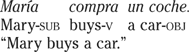
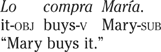
One of the cues that speakers of Spanish have when interpreting sentences like (4) is that agency, or the subject, can be identified by the verb ending, which must agree with the subject.Footnote 5 In this way, whether the subject is explicitly stated or not and regardless of its position in the sentence, it will be identified by the verb ending. For example, the verb ending –a in compra “buys” reliably denotes third person singular.
VanPatten's (Reference VanPatten2002, Reference VanPatten and VanPatten2004) model of input processing proposes the first noun principle, which posits that L2 learners will process the first noun or pronoun in the sentence as the subject or agent of the sentence. They will rely on a processing strategy that uses word order cues—rather than a strategy that uses verb ending cues—to interpret Spanish OVS sentences like (4). The result of this processing strategy is that learners will assign the role of subject to what is actually the object, thereby incorrectly processing and interpreting the sentence.
Materials
The materials used in this study included a paper-and-pencil pretreatment packet in addition to a set of instructions and SI activities for the treatment. The pretreatment packet contained a consent form, a language background questionnaire, and a screening test that tested learners' ability to process OVS-type sentences correctly. For the screening test, participants listened to 15 sentences once and choose the picture (either A or B) that illustrated the sentence they heard. If they were not sure, they could mark letter C as a third option on the scantron sheet. The test included seven target items (OVS sentences) and eight distracters (three subject-object-verb [SOV] and five SVO sentences). Participants were given 8 s between sentences to mark their choice. Figure 1 illustrates two examples of items on the screening test. For the screening test, participants could not have more than three target items correct out of the seven (i.e., 43% maximum score) in order to be included in the study.
Sample screening test items.

The instructions, the EI activities, and the SI activities for the treatment were taken from the materials in both the VanPatten and Cadierno (Reference VanPatten and Cadierno1993) and the VanPatten and Oikkenon (Reference VanPatten and Oikkenon1996) studies and were adapted to be shown on a computer screen. Only referential-type SI activities were included in the treatment because these have a right or wrong answer. Affective-type SI activities generally used in PI were not included because they do not have a correct or incorrect answer (i.e., learners respond with their opinion or with what applies to them), and it is not possible to correct an opinion or a choice based on personal preference. For the PI group, the treatment materials contained (a) EI about OVS-type sentences, (b) information about the nonoptimal default processing strategy L2 learners use when trying to understand OVS-type sentences, and (c) referential-type SI items. For the SI group, the treatment materials were only referential-type SI items. There were a total of 30 SI items: 20 target (OVS) items and 10 distracters (with SOV or SVO word order). The distracters were placed every two or three target items in the series. The first two items in the series were target items (see Appendix B).
Design and Procedure
The 84 participants who volunteered for the study were randomly divided in two groups: 42 comprised the PI group and 42 comprised the SI group. In both groups, each participant wore headphones and was taught individually through a computer program. The EI and the SI items were adapted to a computer program designed with the experiment generator E-prime (http://www.pstnet.com/products/E-prime/default.htm). Participants in the PI group first read the instructions and then read the EI. The EI was presented across seven frames that appeared automatically every 10–45 s, depending on the length of the information. The amount of time that each frame remained on the screen was established based on a pilot test. Participants could not control the pace of the pages on the screen or backtrack. This ensured that all participants had the same time of EI exposure and thus prevented an intervening variable that could affect the interpretation of the results. Once the EI presentation concluded, participants indicated that they were ready to start by pressing the space bar. They listened to the first SI item once (e.g., Lo llaman sus padres por teléfono “His parents call him”) at the same time that two pictures appeared on the screen. Picture A depicted two parents calling a boy, and picture B depicted a boy calling his parents (see Appendix B). Participants had to select the picture that depicted what they heard by pressing either the key with the number 1 (for picture A) or the key with the number 2 (for picture B) on the keyboard.Footnote 6 The SI group went through the same procedure as the PI group, except that these participants started with the SI items immediately after reading the instructions (i.e., they did not have EI). Both groups could take as much time as they needed to answer, and all participants received feedback right after each response (i.e., “correct!” or “incorrect” on the screen). The accuracy of the learners' responses as well as their response times were tracked. After the 30 SI items, a screen appeared to indicate that the treatment was over and to thank participants.
Data Scoring
Trials to criterion, response time, and accuracy after criterion were measured for the treatment tasks. To score the trials to criterion, the researcher counted the number of SI items that participants completed until they reached criterion—that is, the number of items that participants completed up to the point when they correctly answered three target items and one distracter item in a row. Response time is the period of time from the onset of a stimulus to the response of the participant (Schneider, Eschman, & Zuccolotto, Reference Schneider, Eschman and Zuccolotto2002). In this study, it was the period of time from the onset of both the visual (i.e., the pictures) and the aural (i.e., the sentence) stimuli to the time a key was pressed indicating a response. Response time was recorded in milliseconds. Accuracy after criterion was calculated by counting all of the correct SI items after criterion and then dividing them by the total number of SI items after criterion. For example, if a participant started to reach criterion on item 20 (out of 30), the subsequent correct items were counted and then divided by 10 (i.e., the number of items in the sequence after criterion). If a participant had six items correct (i.e., four of criterion plus two more), his or her percentage of accuracy would be 60%.
Results
Number of Participants Who Reached Criterion
Not all of the 84 participants reached criterion; there were participants who did not correctly answer three target items and one distracter in a row. In the PI group, 26 of the 42 participants reached criterion, whereas in the SI group, 21 of the 42 participants reached criterion. A test of differences between proportions was performed to measure whether the difference in the number of participants was significant. The proportion of learners from the PI group who reached criterion was .61, whereas the proportion of learners from the SI group who reached criterion was .5. The difference in proportions was not significant (z = 1.1, p > .05).
Trials to Criterion
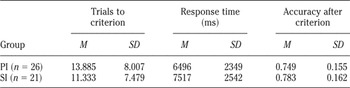
The means and standard deviations for the treatment conditions are shown in Table 2. An independent measures t test revealed no significant difference in trials to criterion between participants in the PI condition and participants in the SI condition, t(45) = 1.118, p = .269.
Mean scores and standard deviations for the processing of OVS sentences

Response Time
The means and standard deviations for the time it took participants to respond are shown in Table 2. An independent measures t test revealed no significant difference in response time between participants in the PI condition and participants in the SI condition, t(45) = −1.427, p = .160.
Accuracy After Criterion
The means and standard deviations are shown in Table 2. An independent measures t test revealed no significant difference in accuracy after criterion between participants in the PI condition and participants in the SI condition, t(45) = −0.730, p = .469.
Discussion
The findings in Experiment 1 indicate that EI did not play any role in the correct processing of OVS-type sentences, because there was no difference between the two groups for any of the three measures. Additionally, a statistically similar number of participants reached criterion in both groups, which indicates that EI did not help more participants reach criterion.
According to hypothesis 1, it was expected that the PI group would start to answer correctly earlier in the sequence of SI items than the SI group, because the information about OVS-type sentences and common processing problems would better prepare learners to focus on clues other than word order and thus to apply more optimal strategies to process the input. In contrast, the SI group would take more trials to process the input correctly, because learners would apply their default processing strategies at the beginning of the sequence of SI items until exposure to input and feedback allowed them to change their processing strategies. This hypothesis was not supported. In hypothesis 2, it was expected that the PI group would be faster in submitting their answers than the SI group, as the EI would aid the participants' comprehension and they would make faster form-meaning connections. This hypothesis was not supported either. Finally, it was expected that both groups would have the same accuracy once they reached criterion. Hypothesis 3 was supported. The findings indicate that EI did not help learners notice the forms or make faster form-function mapping; it seems that SI was the key for learners to notice the target forms and to start to and continue to process OVS sentences correctly.
The question here is why the EI did not help learners correctly process the target structures earlier and faster, as hypothesized. One possible reason why EI did not have the expected effect is that participants did not read the EI carefully, and, as a result, their knowledge about the forms and structures was not complete or accurate. Although explicit knowledge was not directly measured, and thus it cannot be claimed how much or how little explicit linguistic knowledge learners gained, participants had ample time to read the information carefully, as observed in the pilot test. It is true that they could neither control the speed nor backtrack, but the EI stayed on the screen for more than enough time to be read carefully.
A second possible explanation is that participants could not keep the EI in mind during the tasks and thus the EI was useless. Whereas it is quite difficult—and sometimes impossible—to attend to the content of a message and use explicit knowledge of the language at the same time, this possible explanation does not apply here. Learners were not asked to respond right away; rather, they could take as much time as they needed to answer. This aspect of the treatment gave learners the opportunity to think about the language they had just listened to and to apply the information they had previously read to their responses. Therefore, although participants might not have been able to keep the EI in mind at the same time they were listening, they could nevertheless take time to keep the sentence or clause in memory and use their explicit knowledge to answer correctly.
A third possibility is that the EI might not have been adequate or sufficient to help the learners perform the tasks. Perhaps it was too much, too little, or too complex. This explanation seems implausible because the materials used in this study have been used in several previous studies of PI, and their effectiveness was illustrated in the results of those studies. The EI did not contain technical linguistic terms, and the researcher made sure that the amount of information per screen was organized to make it easy to read (i.e., it was kept short and without too much information). Additionally, participants were asked questions (whose answers appeared on the following screen) during the presentation to promote active thinking. Therefore, inadequate or insufficient EI probably would not explain the results.
Perhaps the reason why the EI did not help learners correctly process the target structures earlier and faster is that learners could not make use of the EI to start answering correctly because EI was not what they needed to make sense of the sentences in these tasks. EI might have helped them recognize the different components of the sentences, but this might not have been enough for the participants to grasp the relationships among these components and to derive meaning from them together. It seems that SI was effective for helping learners notice certain clues in the input as well as for helping them parse the input correctly in order to understand the meaning of the sentences. It appears that EI did not prove to be effective for noticing and parsing, as the PI group did not start correctly processing sooner. It could be the case that learners would benefit most from exposure to SI coupled with feedback, rather than EI, in order for them to correctly assign grammatical roles in sentences of this type. In sum, the results of Experiment 1 indicate that EI did not play any role in the correct processing of OVS-type sentences; EI did not even produce the predicted positive effect at the beginning of the task of processing a sequence of SI items.
Regarding hypothesis 2, we observe that the PI group did not make the form-meaning connections more quickly than the SI group, which shows that EI did not aid learners in comprehending the sentences faster, as it was expected. Both groups relied on the SI—not on the EI—to comprehend the sentences.
The results support hypothesis 3. Participants, regardless of the treatment, processed the input with similar degrees of accuracy after having reached criterion, as it was expected. More than 70% accuracy for both groups demonstrates that the strength of the form-meaning connections was similar for both groups after criterion and that these connections were relatively strong.
One of the questions that remains is whether the choice of structure makes a difference. EI proved not to be beneficial for learners during the process of changing their default processing strategies when interpreting OVS sentences, but could it play a role in the processing of redundant and nonsalient forms? Would the results be the same if the target grammatical item (a) were not a sentence and (b) involved other strategies to be processed correctly? We will explore this question in Experiment 2.
EXPERIMENT 2
Research Questions and Hypotheses
Three research questions guided Experiment 2:
1. Do learners in the PI group correctly process Spanish subjunctive forms in expressions of doubt sooner than learners in the SI group when presented with a series of SI items?
2. Do learners in the PI group correctly process Spanish subjunctive forms in expressions of doubt faster (as measured by the time they take to submit their answers) than learners in the SI group?
3. Do learners in the PI group process Spanish subjunctive forms in expressions of doubt more accurately than learners in the SI group after having reached criterion?
The hypotheses are as follows:
1. Learners in the PI group will start to process the target form correctly sooner than learners in the SI group. This outcome is expected based on the same claim on which hypothesis 1 in Experiment 1 was based. It is true that hypothesis 1 in Experiment 1 was not supported, but the processing strategy in the present experiment is different because learners need to notice and process a nonsalient form rather than parsing sentences. It is expected that the SI group will eventually start to process correctly and will catch up with the PI group.
2. Learners in the PI group will respond faster than learners in the SI group. This outcome is expected based on the claim on which hypothesis 2 in Experiment 1 was based, namely that EI will help learners understand the relationship between the subjunctive form of the verb and the meaning of doubt conveyed in the independent clause more rapidly, leading PI-group learners to submit their answers more quickly than learners in the SI group.
3. As also predicted by hypothesis 3 in Experiment 1, there will be no difference between groups in terms of accuracy once they reach criterion: Both groups will process the subjunctive form with equal accuracy after they reach criterion.
Method
Participants
The same 84 students who participated in Experiment 1 volunteered to participate in Experiment 2, and they remained in the same groups they belonged to in Experiment 1. Both experiments were conducted within 3 days. The criteria for inclusion were the same as for Experiment 1, but the screening test in this case was designed to demonstrate participants' inability to correctly process the subjunctive form in expressions of doubt.Footnote 7 All participants met the criteria. Once again, 42 participants comprised the PI group and 42 comprised the SI group. They were paid US$10.00 for their participation.
Target Form
The target form was the third person singular present subjunctive in expressions of doubt. One of the ways in which the subjunctive mood is used in Spanish is in nominal clauses that express doubt, as in Dudo que trabaje mucho “I doubt that I/he/she work-subj a lot.” The lexical item in the main clause introduces the meaning of doubt (i.e., Dudo que…), and the verb in the subordinate clause usually appears inflected with subjunctive morphology (e.g., trabaje “work-subj”).Footnote 8
The lexical preference principle of VanPatten's (Reference VanPatten2002, Reference VanPatten and VanPatten2004) model of input processing posits that L2 learners have the tendency to rely on lexical items and not on grammatical form to get meaning when both encode the same semantic information. Therefore, when processing expressions such as Dudo que trabaje mucho “I doubt that I/he/she work-subj a lot,” learners tend to get the meaning of noncertainty by processing the lexical item in the main clause, and they do not attend to the verb ending (i.e., the grammatical form) in the subordinate clause because it conveys the same information. The result of this strategy is that the verb inflection does not get processed; thus, its acquisition is delayed.
The processing of subjunctive verbs in nominal clauses is also affected by a strategy predicated in the sentence location principle of VanPatten's (Reference VanPatten2002, Reference VanPatten and VanPatten2004) model of input processing. According to this principle, L2 learners first process items that appear in initial position in a sentence, then items that appear in final position, and finally items that appear in the middle. In nominal clauses, the verb inflected for subjunctive usually appears either in final position, as in Dudo que trabaje “I doubt that I/he/she work-subj,” or in middle position, as in Dudo que trabaje mucho “I doubt that I/he/she work-subj a lot.” Therefore, learners of Spanish will tend not to process the verb inflected in subjunctive because their working memory capacity is already depleted by the time the linguistic processors have to process the inflected verb.
Materials
The materials used in Experiment 2 were of the same format as the materials used in Experiment 1; however, the EI and the SI targeted the subjunctive. The pretreatment packet contained the consent form and the screening test (it was not necessary to give a new background questionnaire). The screening test assessed learners' ability to correctly process the subjunctive form in expressions of doubt. In this test, participants listened to the subordinate clause and had to choose, among four options, which main clause must have preceded what they had heard. Options (a) and (b) contained either the incorrect or the correct main clause, option (c) was “both of them,” and option (d) was “neither of them.” There were seven nominal clauses that trigger the verb in the subjunctive form, four nominal clauses that trigger the verb in indicative, and four distracters (e.g., the subject in the first part of a sentence needed to agree with the verb in the second part). Participants were given 8 s between items to mark their choice. An example of a subjunctive item on the screening test is presented in (5).
(5)

The instructions and SI activities for the subjunctive treatment were taken from the materials in Farley's (Reference Farley2000) study.Footnote 9 As in Experiment 1, the materials included EI and referential-type SI activities (see Table 1 and Appendix C). There was a total of 30 items: 20 target items (nominal clauses that trigger the verb in the subjunctive form) and 10 distracters (nominal clauses that trigger the verb in the indicative form). The distracters were placed every two or three target items in the series. The first two items in the series were target items.
Design and Procedure
The procedure was largely the same as in Experiment 1. This time, participants had to listen to the subordinate clause and indicate which of the two main clauses written on the screen must have triggered what they heard. For example, in the first SI item, participants heard …juegue al tenis todos los días “…she/he plays-subj tennis every day” and had to choose between two options: (a) No pienso que. … “I do not think that…” and (b) Es evidente que… “It is evident that…” (see Appendix C). Both options appeared on the screen at the same time as the aural input. Following Farley's (Reference Farley2000) materials, the input was manipulated to have the verb in the subordinate clause always positioned at the beginning of the sentence.
Data Scoring
The data were scored as in Experiment 1.
Results
Number of Participants Who Reached Criterion
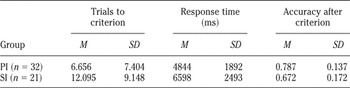
As in Experiment 1, not all participants reached criterion while processing the subjunctive; however, this time the number of participants in the PI group who reached criterion (n = 32) was considerably higher than the number of participants who reached criterion in the SI group (n = 21). A test of differences between proportions was performed to measure whether the difference in the number of participants was significant. The proportion of learners from the PI group who reached criterion was .76, whereas the proportion of learners from the SI group who reached criterion was .5. This time, the difference in proportions was significant (z = 2.55, p < .05).
Trials to Criterion
The means and standard deviations for the treatment conditions are shown in Table 3. An independent measures t test revealed that the participants in the PI group took significantly fewer trials to reach criterion than the participants in the SI group, t(51) = −2.381, p < .05.
Mean scores and standard deviations for the processing of subjunctive

Response Time
The means and standard deviations for the time it took participants to respond are shown in Table 3. An independent measures t test revealed that the participants in the PI group responded significantly faster than the participants in the SI group, t(51) = −2.907, p < .05.
Accuracy After Criterion
The means and standard deviations are shown in Table 3. An independent measures t test revealed that the participants in the PI group responded significantly more accurately after having reached criterion than the participants in the SI group, t(51) = 2.682, p < .05.
Discussion
The results of this experiment contrast with those of Experiment 1, as they show that EI was beneficial for the correct processing of the subjunctive. As stated in hypothesis 1, it was expected that the PI group would start to process input correctly sooner than the SI group but that the SI group would eventually catch up. This hypothesis was supported because participants in the PI group who reached criterion started to process correctly sooner, and half of the SI learners did reach criterion. We must consider, however, that the accuracy after criterion for the SI group was significantly lower than for the PI group, which indicates that the groups might not be comparable after criterion. It was also expected, as stated in hypothesis 2, that the PI group would respond faster than the SI group because EI would help learners make the connection between the form and its meaning more quickly. This hypothesis was also supported. Hypothesis 3 was not supported: The PI group and the SI group did not have the same accuracy after criterion. Finally, the results of this experiment also indicate that EI was beneficial in that it helped more learners reach criterion: Fewer participants were able to correctly process four SI items in a row in the SI group than in the PI group.
It seems that EI was beneficial to induce noticing of the target forms and thus to promote the connection between the main clause meaning and the verb inflection. Knowing that the concept of doubt was conveyed by both the inflection of the verb and the main clause and knowing which inflections are triggered by main clauses, the PI group was better able to recognize the forms in the aural input and match them with the main clauses that trigger them. Additionally, the PI learners knew from the beginning what to pay attention to in the stream of speech in order to perform the task; thus, EI must have worked to focus their attention early in the sequence of SI items. This explanation is further supported by the finding that more participants were able to reach criterion in the PI group than in the SI group.
Another possible explanation for why the PI group processed forms sooner than the SI group may involve a combination of two factors. Given that (a) the input was structured to have the verb at the beginning of the sentence (i.e., in an optimal position for it to be processed) and (b) learners already knew what forms to focus on, the observed results might be due to the synergistic effect of these two factors. In other words, having the input structured might very well have increased the effect of EI.
We should consider that learners in the SI group did eventually start to process input correctly, which shows that SI alone had the effect of promoting noticing and correct processing. However, EI seems to be more efficient than SI, because learners provided with only SI needed more opportunities to discover the need to focus on the verb in the sentence and to learn the correct form-function mapping.
Regarding the results for response time, research in psychology has shown that the relative speed of response is directly proportionate to the degree of difficulty perceived by the performer: Those who make more errors also take more time compared to those who make fewer errors (Schneider et al., Reference Schneider, Eschman and Zuccolotto2002). The findings in this experiment reflect this observed behavior. Because the PI group knew which verb forms were triggered by which clauses, they were able to recognize them faster in the input and thus to mark their responses more quickly. The SI group, in contrast, needed more time to think and to figure out what they should pay attention to in the input as well as to discover which verb forms were triggered by the main clauses. Therefore, the SI participants took more time to respond because they did not comprehend the function conveyed in the verb ending at the beginning of the sequence, making the task more difficult.
Hypothesis 3 predicted that once both groups reached criterion, accuracy would be the same because criterion indicated that learners were at the same stage. This was not the case, as the PI group had fewer errors after criterion than the SI group. Although the SI group caught up with the PI group by reaching criterion, the SI group did not maintain the same level of accuracy as the PI group. It seems that the form-meaning connections of the PI participants were more robust than the connections of the SI group. Because participants in the SI group who reached criterion did so later on in the sequence of SI items, they had less exposure to the input after criterion (i.e., fewer items left) and thus fewer opportunities to test their hypotheses and strengthen their connections.
GENERAL DISCUSSION
The explanation for the contrasting results of Experiments 1 and 2 might be found in (a) the nature of the online tasks or (b) the nature of the processing problem. Regarding (a), remember that the online task for processing the subjunctive required participants to attend to the verb inflection (i.e., the less noticeable form) and match it with the corresponding trigger clause presented on the screen. EI gave information about the regular verb endings and some of the most frequent irregular forms triggered by main clauses that convey doubt, also explaining that the meaning of doubt was expressed in the main clause and giving some examples of clauses that trigger the subjunctive. Furthermore, PI-group participants were informed that doubt was redundant and that it was important not to miss the verb when attending to messages. Therefore, these participants came to the task knowing that the inflection of the verb changes based on the meaning the main clause conveys. If learners know what (lexical and grammatical) forms go together, they will start to match them sooner and faster than if they do not know. In contrast, the SI group not only had to keep guessing what in the aural stimuli indicated which clauses to select but also which of the different verb endings needed to be matched with the clauses.
On the other hand, the task for processing OVS-type sentences required learners to listen to a sentence and interpret its meaning in order to match it with the corresponding picture. There is a difference between linking a grammar form to an expression of doubt and linking a whole sentence to a picture. Although EI informed learners about the difference between objects and subjects in OVS-type sentences in Spanish as well as the tendency of learners to rely on the first noun or pronoun to assign agency, participants still had to understand the relationships between the components of the sentence to perform the task accurately. Participants in the PI group might have recognized the elements in the sentence they heard; nonetheless, they still had to assign each component its grammatical role. With the subjunctive, it was necessary to notice and process one grammatical form. Therefore, the nature of the online task might have been one of the reasons for the difference between the experiments. EI seems to be beneficial when the task is to notice and process a single form, but it seems not to play any role when the task is to assign different grammatical roles in sentences. Further investigation is merited to confirm this claim.
An interesting phenomenon was that although EI informed learners about the forms triggered by the meaning of particular clauses when processing the subjunctive, participants did not start to match the forms correctly right away; rather, it took them a few trials to begin to answer correctly. It seems that EI helped learners notice forms that might not have been noticed or that might have taken more trials to notice, but it did not obviate or reduce the need for minimal exposure time; that is, correct processing was not instantaneous. Perhaps learners were familiarizing themselves with the task, and this affected their performance at the beginning. Further investigation is necessary to understand why the PI group did not start to process the input correctly at the beginning of the task.
Additionally, the nature of the processing problem might have contributed to the different effects of EI on the two target structures. For the Spanish subjunctive, native speakers of English have to process a redundant, less noticeable form in order to acquire it. This linguistic processing strategy was already built in when they learned their L1, because redundant forms in the input are also a feature of English. There are situations in which two forms encode the same meaning and occur in the same sentence—for example, “he talks” or “I missed class yesterday.” Thus, English-speaking L2 learners of Spanish do not have to build a new processing strategy for processing the Spanish subjunctive; they only learn to apply the knowledge they already possess to new linguistic contexts. When processing Spanish OVS sentences, however, native speakers of English have to refrain from using the first noun strategy, which works well in English, and must adopt a new strategy that allows processing of a more flexible system. They must learn a new strategy that does not require them to rely on word order cues but rather has them look for other indications of object, subject, and verb forms to confirm any preliminary assignment of a noun to subject or object role. English-speaking learners of Spanish thus cannot use existing strategies to interpret OVS-type sentences, because they will end up with an incorrect interpretation. It might be that EI has no effect in building a new processing strategy. Although learners have the pieces of the puzzle figured out if they receive EI (e.g., objects vs. subjects, OVS- and SOV-type sentences, L1 strategies), the processing strategy that they are lacking, and that they need to process correctly, can only be built with frequent exposure to input coupled with feedback that indicates whether what was listened to was understood correctly.
LIMITATIONS, DIRECTIONS FOR FUTURE RESEARCH, AND CONCLUSIONS
This study has several limitations that need to be taken into consideration when making generalizations about the findings. One of them is in the use of the instructional approach chosen. The findings should be applied to PI and not to other approaches to grammar teaching. Additionally, even within PI, the reader should keep in mind that participants did not receive the complete set of activities used for PI, such as affective-type SI activities. A second limitation is that both experiments were conducted in laboratory settings that do not reflect classroom dynamics where learners interact with input in a variety of ways (through affective-type SI activities, text enhancement, interaction, recasts, etc.) and have ample access to EI. A third limitation of this study is that it does not address why some participants were able to correctly process at least four items in a row within 30 trials, whereas some participants were not able to do so. Certainly, the role of individual differences while processing input is an issue that needs further investigation in studies of PI and other types of instructional techniques.
The findings of this study suggest that in some cases EI does not help learners process certain structures but it is beneficial for processing of nonsalient forms, depending on the task, the processing problem, or both. In order to investigate this issue further, it will be necessary to conduct more online studies that compare two forms that require applying the same processing strategies and having learners do similar tasks. A potential study could use the preterit and the simple future tense in Spanish as linguistic targets; the lexical principle affects the processing of both of these forms and SI activities for these forms could be structured in similar ways. If it is observed that learners start to make correct form-meaning connections for both structures early in a sequence of SI items, we will have further evidence that EI is beneficial for structures that are processed according to the lexical principle, as shown in the present study.
This study did not include posttests because the goal was to observe learners' behavior during input processing in an effort to discover possible EI effects that might not have been observed in previous PI studies due to the nature of their treatments. It is hoped that by using online treatments to investigate the role of EI during the process of making form-meaning connections, this study has contributed to a better understanding of the role of EI in PI and in instructed SLA.
APPENDIX A: EXPLICIT INSTRUCTION EXPERIMENT 1
The Pronouns
An object of a verb is a grammatical concept different from the subject.
An object is generally defined as a thing or person on which the action or process is performed. Thus, in the sentence “John writes letters,” “John” is the subject and “letters” is the object (the action of writing is performed on the letters). In the sentence, “She has an idea,” “She” is the subject and “idea” is the object (the thing on which the process of having is performed).
What is the subject and what is the object of the verb “mira” in the following sentence?
El padre mira al hijo.
Right! “Padre” is the subject (the father is the one doing the watching) and “hijo” is the object (the thing being watched).
Now, what is the subject pronoun that corresponds to “padre”? “Ellos,” “el,” or “nosotros”?
_____ mira a su hijo.
Right again! “El.” “El padre” is the subject noun and “el” is the subject pronoun. Subject pronouns are already familiar to you:
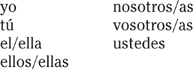
In Spanish (and English), not only are there subject pronouns, but there are also object pronouns:
The father watches “him” (that is, the kid)
El padre “lo” mira (es decir, al hijo)
Here is the set of subject and object pronouns listed in Spanish that you will become familiar with:
Pronouns:

“La,” “lo,” “las,” and “los” are objects of the verb in the right-hand column. In the first example, who is being kissed? Her. In the second example, who is being kissed? Him. In the third example, who is being observed? Them.
There are two things to keep in mind about the object pronouns:
1. They are placed in front of the conjugated verbs.
2. They indicate on whom the action/process is performed, not who or what performed the action/process.
There is also something important to keep in mind about the Spanish word order.
In Spanish, subjects can come before or after the verb:
Juan no viene. No viene Juan.
Object pronouns must always precede a conjugated verb:
El padre “lo” mira.
What can get tricky in correctly understanding a sentence is that often you will see or hear a sentence in which the order is object-pronoun-subject, just the opposite of English!
La invitan los chicos a cenar.
(The boys are inviting her to eat dinner.)
No los comprende el profesor.
(The prof doesn't understand them.)
APPENDIX B: PROCESSING TASK EXPERIMENT 1
You will hear a sentence in Spanish once. Your task is to select the picture that correctly describes what you hear. Press the “1” key to select picture A and the “2” key to select picture B. There is no time limit to answer. You will receive feedback on whether your answer was correct or incorrect right after each response. Press the space bar to begin!
Trial 1. Participant hears: Lo llaman sus padres por teléfono “His parents call him.”

Trial 2. Participant hears: Las invita al cine Manuel “Manuel invites them to the movies.”

Trial 3. Participant hears: El niño besa a la niña “The boy kisses the girl.”

Trial 4. Participant hears: Lo escucha la abuela “The grandma listens to him.”

Etc.
APPENDIX C: PROCESSING TASK EXPERIMENT 2
You will hear the second half of a sentence in Spanish once. Your task is to choose the first half that correctly fits. Press the “1” key to select answer A and press the “2” key to select answer B. You will receive feedback on whether your answer is correct or incorrect right after each response. There is no time limit to answer. Press the space bar to begin!