Introduction
In the quest of producing and sustaining high yields of crops, farmers in developing countries such as Egypt have adopted intensive production systems, which rely on increasing the use of fertilizer nitrogen (N). Consequently, farmers’ profits are decreasing and losses of reactive N are threatening quality of the environment. Conventional or blanket fertilizer N management consisting of applying fixed rates over large areas with similar soils and climates is the generally followed strategy for cereal production in most of the developing countries. This management concept assumes that fertilizer N requirement does not change in large areas and over the years. The traditional N management is based on applying fertilizer N to achieve yield goals plus 10 to 30% additional N to avoid the risk of N short supply (Johnson, Reference Johnson1991; Stanford, Reference Stanford1973). Raun et al. (Reference Raun, Dhillon, Aula, Eickhoff, Weymeyer, Figueirdeo, Lynch, Omara, Nambi, Oyebiyi and Fornah2019) advocated the role of randomness in yearly environmental variability which can influence soil N supply and crop N demand. Thus, unpredictable natures of the effect of the environment on N demand and final yield dictate the need for mid-season correction of the applied fertilizer N using appropriate algorithms.
Increased synchronization between the demand by crop and supply from all sources including fertilizer during the cropping season is the ideal way to optimize fertilizer N application to field crops. This approach revolves around optimally matching the crop N demand at appropriate crop growth stages by applying adequate amounts of fertilizer N. Using canopy reflectance sensors constitutes as one of the strategies increasingly being used to determine the appropriate amount of fertilizer N to be applied in-season. These sensors read the crops in terms of different vegetation indices. A number of vegetation indices have been developed that combine reflectance in two or more bands of the electromagnetic spectrum to reflect certain conditions of canopy. One of the most recognizable vegetation indices is the normalized difference vegetation index (NDVI). As early as 1980s, the in-season estimate of NDVI was used as an indirect measure of crop yield, including that of wheat (Pinter et al., Reference Pinter, Jackson, Idso and Reginato1981; Tucker et al., Reference Tucker, Holben, Elgin and McMurtrey1980). Several studies have shown promise in detecting crop N status using reflectance-based sensing (Ali et al., Reference Ali and Ibrahim2020; Fox and Walthall, Reference Fox and Walthall2008; Hatfield et al., Reference Hatfield, Gitelson, Schepers and Walthall2008; Perry et al., Reference Perry, Fitzgerald, Nuttall, O’Leary, Schulthess and Whitlock2012; Solie et al., Reference Rickman, Waldman and Klepper1996; Stone et al., Reference Stone, Solie, Raun, Whitney, Taylor and Ringer1996; Zhang et al., Reference Bijay-Singh and Ali2019). For instance, Stone et al. (Reference Stone, Solie, Raun, Whitney, Taylor and Ringer1996) and Solie et al. (Reference Solie, Raun, Whitney, Stone and Ringer1996) investigated the relationship between NDVI measurements by proximal sensors and N uptake of wheat and found a possibility to predict N uptake. Zhang et al. (Reference Zhang, Liu, Liang, Cao, Tian, Zhu, Cao and Liu2019) reported that NDVI could explain 68 and 75% of N uptake in wheat at Feekes stages 4–7 and 8–10, respectively. In Egypt, Ali et al. (Reference Ali and Ibrahim2020) found that the relationship between NDVI and N accumulation at jointing stage of wheat followed an exponential function with R 2 value of 0.69.
Raun et al. (Reference Raun, Solie, Johnson, Stone, Mullen, Freeman, Thomason and Lukina2002) concluded that in-season estimate of yield (INSEY) that is obtained from dividing NDVI by the days from planting to sensing date with growing degree days (GDDs) >0 can be reliably used grain predicted yield level. By knowing predicted N uptake and projected grain N uptake, appropriate fertilizer N rates were determined. Nitrogen use efficiency of winter wheat was improved to the tune of 15% compared with the general recommendation by employing this approach. Johnson et al. (Reference Johnson, Raun and Mullen2000) proposed a response index (RI Harvest) to represent the plant response to additional N; it was defined as a yield of a plot receiving adequate N divided by the yield in the field. Despite its accuracy, this estimate is based on post-season measurements and fails to address in-season N application as yield potential is known to change due to temporal variability. The use of an in-season response index (RI NDVI) as the ratio of NDVI of the plot receiving adequate N and that of field in question was proposed by Mullen et al. (Reference Mullen, Freeman, Raun, Johnson, Stone and Solie2003). It provided a possibility of predicting RI Harvest at a time when management decisions are to be made in-season. Mullen et al. (Reference Mullen, Freeman, Raun, Johnson, Stone and Solie2003) found that RI NDVI is satisfactorily correlated (R 2 > 0.56) with post-season response index (RI Harvest). Based on these findings, several algorithms for fertilizer N management using crop canopy sensors are being used in cereal grain production for improving N use efficiency and grain yields (Franzen et al. Reference Franzen, Kitchen, Holland, Schepers and Raun2016). Several studies have been conducted in developing countries in which high N use efficiency was achieved by managing fertilizer N using canopy sensors (Bijay-Singh and Ali, Reference Bijay-Singh and Ali2020; Bijay-Singh et al., Reference Bijay-Singh, Sharma, Jaspreet, Jat, Martin, Yadvinder-Singh, Varinderpal-Singh, Chandna, Choudhary, Gupta, Thind, Jagmohan-Singh, Uppal, Khurana, Kumar, Uppal, Vashistha, Raun and Gupta2011, Reference Bijay-Singh, Varinderpal-Singh, Purba, Sharma, Jat, Yadvinder-Singh, Thind, Gupta, Choudhary, Chandna, Khurana, Kumar, Jagmohan-Singh, Uppal, Uppal, Vashistha and Gupta2015; Xue et al., Reference Xue, Li, Qin, Yang and Zhang2014; Yao et al., Reference Yao, Miao, Huang, Gao, Ma, Zhao, Jiang, Chen, Zhang, Yu and Gnyp2012). In all these studies, yield was predicted from in-season measurements of NDVI with sensors, and to determine N uptake, it was multiplied with an average value of N content in wheat grains for the region. Thus, if N uptake is directly predicted from in-season NDVI measurement in a given field, the difference between N uptake before and after fertilizer N application should provide a better estimate of fertilizer N to be applied than when estimated from predicted yield.
Studies conducted by Ali et al. (Reference Ali and Thind2015) on rice and Ali et al. (Reference Ali, Abou-Amer and Ibrahim2018) on maize have already shown that total N uptake at maturity can be predicted satisfactorily from in-season NDVI measurements. Thus, algorithm based on relationship between NDVI and N uptake rather than yield to translate sensor readings to amount of fertilizer N to be applied should perform better. Therefore, major objectives of this study were as follows: (i) to develop and validate the algorithm based on the prediction of N uptake from NDVI measurements made with GreenSeeker canopy sensor, (ii) to study the performance of fertilizer N management in wheat using the algorithm vis-à-vis the general fertilizer N recommendation, and (iii) to define the appropriate prescriptive doses of fertilizer N before applying a sensor-guided dose at Feekes 6 stage of wheat.
Materials and Methods
Description of the experimental site
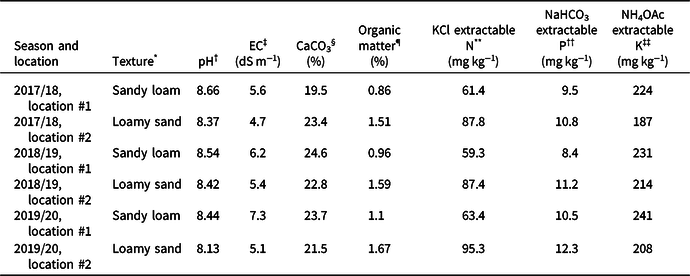
Six field experiments were carried out in calcareous soils during three consecutive wheat seasons (2017/18 to 2019/20) at two locations in the West of Nile Delta in Egypt. The locations were at Mariout Research Station, Desert Research Center (31° 0′ 12.2″ N, 29° 47′ 3.0″ E, and 15 m a.s.l.), and at a farmer field in Bangar El-Sokar area (30° 48′ 11.7″ N, 29° 44′ 59.8″ E, and 42 m a.s.l.). In winter, during the wheat crop growth period, the average daily temperature is around 20 °C and it drops to an average of 10 °C during night. The annual rainfall received mainly in winter is around 180 mm year−1. Prior to sowing, samples from the soil surface (0–30 cm) were collected from the experimental sites for analysis of some physical and chemical characteristics as shown in Table 1.
Some physical and chemical characteristics of the top soil (0–30 cm) of the experimental sites

* Using the pipette method (Page et al. Reference Page, Miller and Keeney1982).
† Measured in soil paste.
‡ Electrical conductivity measured in soil paste extract.
§ Using calcimeter (Nelson Reference Nelson1983).
¶ Walkely and Black (Reference Walkley and Black1934).
** Bremner (Reference Bremner1965).
†† Olsen et al. (Reference Olsen1954).
‡‡ Pratt (Reference Pratt1965).
Experimental design and treatments
In 2017/18 and 2018/19 wheat seasons, four field experiments (two each at both the locations) were conducted to develop the algorithm. The treatments consisted of an increasing rate of fertilizer N ranging from 0 to 320 kg N ha−1 applied as ammonium nitrate in split doses preceding Feekes 6 stage, according to the scale proposed by Large (Reference Large1954). The fertilizer N doses in these experiments were completed at least 10 days preceding Feekes 6 stage. The purpose of this wide range in fertilizer N application levels was to create wide variability in soil N supply and yield potentials in different plots. In the 2019/20 season, two experiments were carried out in two locations to validate the algorithm established based on data collected from the two previous wheat seasons. Besides a no-N control and 250 kg N ha−1 applied in three equal split doses at 10, 30, and 50 days after sowing (DAS), three treatments consisted of applying 100 kg N ha−1 in two splits (40 kg N ha−1 at 10 DAS and 60 kg N ha−1 at 30 DAS) and 80 kg N ha−1 either at 10 DAS or at 30 DAS before applying the sensor-guided dose at Feekes 6 growth stage of wheat. Also, in all the experiments, an N-rich plot was maintained by applying fertilizer N at a rate of 350 kg ha−1. The NDVI measurements from the N-rich plots were needed both for developing and validating the algorithm. In all seasons and locations, the experiments were laid out following randomized complete block design with three replications.
The soil was ploughed twice, leveled, and divided in to 15 m2 plots prior to sowing. In early November, variety Giza 171 of wheat was sown by hand. Phosphorus and potassium fertilizers were applied following the general recommendations. Weeds, insects, and diseases were controlled following the standard procedures.
Optical sensor measurements
Handheld GreenSeeker active optical sensor (Trimble, Sunnyvale, CA, USA) was used to measure the canopy reflectance of visible and near-infrared radiation and it was expressed as NDVI. The sensor has a self-illumination system that collects reflectance from the plant canopy in red (656 nm) and near-infrared (774 nm) bands. The sensor automatically calculates NDVI as follows:
 ${\rm{NDVI}} = \scale 130%{{{F_{{\rm{NIR}}}} - {F_{{\rm{Red}}}}}\over{{F_{{\rm{NIR}}}} + {F_{{\rm{Red}}}}}},$
where F NIR and F Red are the fraction of near infrared and red radiations reflected back from the crop canopy to the sensor, respectively. The NDVI measurements were made at Feekes 6 stage of wheat (around 50 DAS) by walking through the plot at a speed of about 0.5 m s−1 and holding the sensor about 1 m above the canopy.
Plant sampling and analysis
In all the experiments, wheat crop was manually harvested at maturity from a net area of 6 m2 in the center of different plots. Grain and straw were separated, weighed, and samples were collected for analysis. The samples were dried to a constant weight in a hot air oven at 70 °C and ground. The plant samples were digested in sulfuric acid (H2SO4)–hydrogen peroxide (H2O2) mixture, and total N was determined by micro-Kjeldahl method (Kalra, Reference Kalra1997).
Data analysis
Excel software (as a component in Microsoft Office software 2016) was used for calculations and fitting the curves. Data generated from the validation experiments (2019/20 wheat season) were analyzed following the analysis of variance to determine the effects of different fertilizer N treatments using ASSISTAT 7.7 beta statistical assistance software. Duncan’s multiple range test at a probability level <0.05 as described by Gomez and Gomez (Reference Gomez and Gomez1984) was used to detect the differences between mean values. In the validation experiments, recovery efficiency of N (RE N) and agronomic efficiency of N (AE N) in different treatments were calculated as described by Cassman et al. (Reference Cassman, Peng, Olk, Ladha, Reichardt, Dobermann and Singh1998) as follows:
 $$R{E_{\rm{N}}}\left( \% \right) = {{{\rm{Total \ N \ uptake \ in \ fertilized \ plot}} - {\rm{Total \ N \ uptake \ in \ zero \ N \ plot}}} \over {{\rm{Quantity \ of \ applied \ N \ fertilizer}}}}$$
 $$A{E_{\rm{N}}}{\rm{}}\left( {{\rm{kg \ grain \ k}}{{\rm{g}}^{ - 1}}{\rm{N}}} \right) = {{{\rm{Grain \ yield \ in \ N \ fertilized \ plot}} - {\rm{Grain \ yield \ in \ zero \ N \ plot}}} \over {{\rm{Quantity \ of \ applied \ N \ fertilizer}}}}$$
Results and Discussion
The multi-rate fertilizer N treatments in experiments conducted during the 2017/18 and 2018/19 seasons generated a high degree of variability in sensor readings collected at Feekes 6 stage of wheat and grain yield and N uptake. Stepwise calculations of the proposed algorithm as developed in this study are described in the following sections.
Total N uptake for optimum grain yield
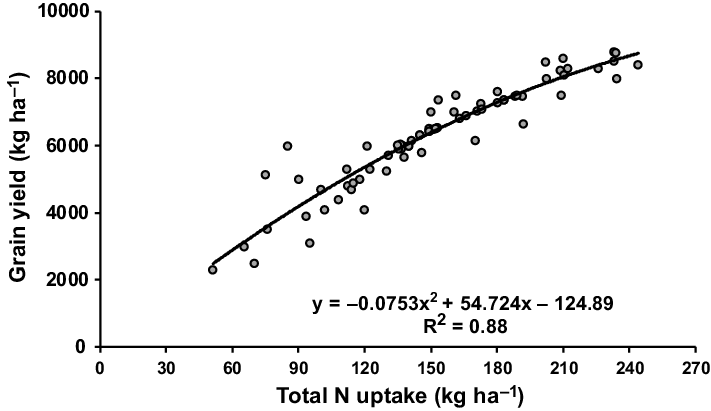
Because the algorithm being developed depends on predicted N uptake, it is crucial that a reasonable uptake limit be established to reflect the optimum grain yield. Grain yield of wheat was found to be dependent on total N uptake following a second-degree function (Figure 1). Derivation analysis of the function revealed that the maximum grain yield is 9818 kg ha−1 which can be achieved by a total N uptake of 363.4 kg N ha−1. By setting the optimum grain yield at 90% of the maximum yield, it is projected that grain yield of 8836 kg ha−1 can be achieved at a total N uptake of around 250 kg N ha−1.
Relationship between total N uptake and wheat grain yields fitted to a second-degree function.

Prediction of total N uptake
Rather than using average grain N content in a region to calculate the uptake of N by grains, the estimation of total N uptake directly from NDVI measurements should provide a better estimate of fertilizer N to be applied to get the optimum yield. Due to the high degree of correlation between plant biomass and cumulative GDDs (Rickman et al. Reference Rickman, Waldman and Klepper1996), the in-season estimate of N uptake (IENU) is proposed in this study and it was calculated by dividing NDVI measurements by the days from sowing to sensing date. The IENU can be calculated as follows:
 $${\rm{IENU}} = {{{\rm{NDVI}}} \over {{\rm{CGDD}}}}$$
where CGDD is cumulative GDDs (number of days from sowing to sensing) where GDDs > 0 following the equation: GDD = (daily low temperature + daily high temperature)/2 − 4.4 °C.
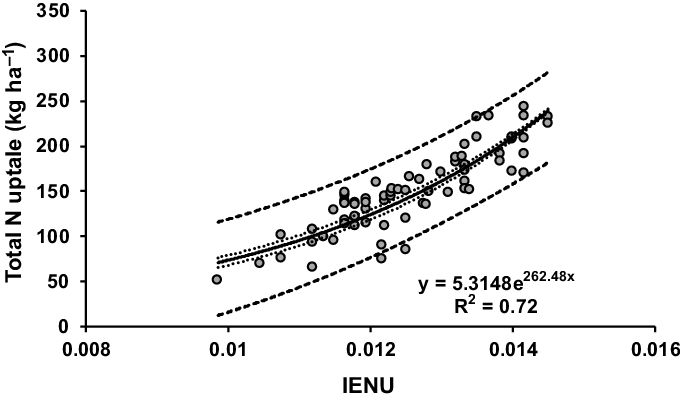
Total N uptake at maturity was then regressed against IENU measurements collected at Feekes 6 stage of wheat and a strong exponential function was generated (Figure 2). Total N uptake at maturity in kg ha−1, defined in this study as UP 0, can be predicted in-season using the empirical model as follows:
 $$U{P_0} = 5.3148{{\rm{e}}^{262.48 \times {\rm{IENU}}}}$$
Relationship between total N uptake at maturity and IENU (in-season estimate of N uptake computed by dividing NDVI measurements by the days from sowing to sensing date) at Feekes 6 growth stage of wheat fitted to exponential function. The dotted lines near and far from the regression line show confidence and prediction intervals at 95% level, respectively.

Feekes 6 stage of wheat was selected as it is considered to be the critical growth stage of wheat when N demand and uptake is very high. Zhang et al. (Reference Zhang, Liu, Liang, Cao, Tian, Zhu, Cao and Liu2019) reported that dry matter accumulations during Feekes stage 4–7 in wheat are more variable than other stages and GreenSeeker sensor can prove to be very reliable in making agronomic decisions during this stage. Work done by Bijay-Singh et al. (Reference Bijay-Singh, Sharma, Jaspreet, Jat, Martin, Yadvinder-Singh, Varinderpal-Singh, Chandna, Choudhary, Gupta, Thind, Jagmohan-Singh, Uppal, Khurana, Kumar, Uppal, Vashistha, Raun and Gupta2011) and Varinderpal-Singh et al. (Reference Varinderpal-Singh, Bijay-Singh, Yadvinder-Singh, Thind, Buttar, Kaur, Kaur and Bhowmik2017) on wheat also concluded that Feekes 6 stage is the appropriate stage top dress sensor-guided corrective fertilizer N dose.
Prediction of in-season response index of N uptake
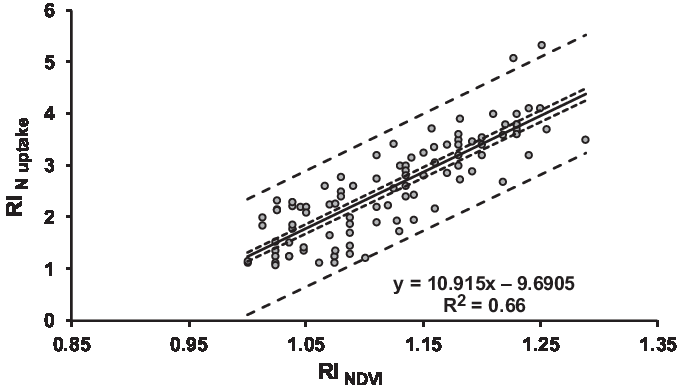
A linear relation was obtained when RI NDVI (ratio of NDVI in the N-rich plot divided by the NDVI in the test plot) was plotted versus RI NU (ratio of optimum N uptake [taken as 250 kg N ha−1] divided by N uptake in plot in question) (Figure 3). The high R 2 value (0.66) indicates that RI NU can be predicted satisfactorily using the linear equation as follows:
 $$R{I_{{\rm{NU}}}} = 10.915R{I_{{\rm{NDVI}}}} - 9.6905$$
Relationship between RI NDVI (response index computed by dividing in-season measurement of NDVI collected at Feekes 6 growth stage of wheat in N-rich strip by NDVI in the tested plot) and RI N uptake (response index computed from dividing optimum N uptake for optimum yield by N uptake in the tested plot of wheat at maturity) fitted to linear function. The dotted lines near and far from the regression line show confidence and prediction intervals at 95% level, respectively.

Mullen et al. (Reference Mullen, Freeman, Raun, Johnson, Stone and Solie2003) and Johnson and Raun (Reference Johnson and Raun2003) found that RI NDVI measured as the ratio of NDVI of the plot received sufficient N and that of test plot was highly correlated with ratio of grain yield in these plots (RI Harvest). Following this concept, Bijay-Singh et al. (Reference Bijay-Singh, Sharma, Jaspreet, Jat, Martin, Yadvinder-Singh, Varinderpal-Singh, Chandna, Choudhary, Gupta, Thind, Jagmohan-Singh, Uppal, Khurana, Kumar, Uppal, Vashistha, Raun and Gupta2011) reported that in northwestern India, RI NDVI could be meritoriously used for identifying the extent of response of wheat to additional fertilizer N application in a given field location.
Prediction of attainable N uptake
The attainable N uptake for optimum yield, defined in this study as UP N, can then be calculated as follows:
 $$U{P_{\rm{N}}} = U{P_0} \times R{I_{{\rm{NDVI}}}}$$
Calculation of in-season fertilizer N requirement
The difference between UP N and UP 0 can determine the amount of N uptake to be compensated in order to achieve target uptake for optimum yield. However, this difference must be divided by an efficiency factor taken as 0.6 as suggested by Morris et al. (Reference Morris, Martin, Freeman, Teal, Girma, Arnall, Hodgen, Mosali, Raun and Solie2006). The functional algorithm that can be used to work out the fertilizer N corrective dose applied at Feekes 6 stage of wheat is as follows:
 $${\rm{Fertilizer\;N\;dose}}\;\left( {{\rm{kg\;h}}{{\rm{a}}^{ - 1}}} \right) = {{U{P_{\rm{N}}} - U{P_0}} \over {0.6}}$$
This algorithm should account for the variation in N uptake caused by the spatiotemporal variability and the extent of responsiveness to additional fertilizer N application. However, before the sensor-based fertilization can be properly used to optimize N applications, it should be ensured that yield variability in the given situation is controlled by N supply. The algorithm developed in this study was verified in the third season in terms of yield and fertilizer N use efficiency by making differences in plant growth through different prescriptive fertilizer N scenarios before applying the sensor-guided dose.
Validation of the established algorithm
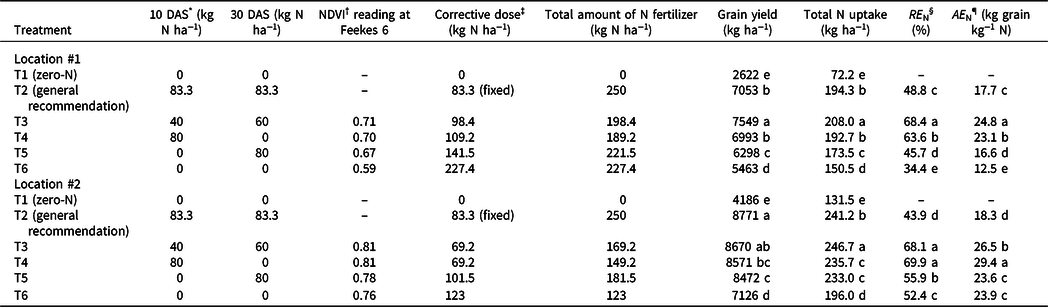
Different scenarios of fertilizer N management involving sensor-guided dose as determined by the algorithm established in this study were evaluated at two locations during 2019/20 wheat growing season. Three prescriptive fertilizer N management scenarios prior to applying the sensor-guided dose at Feekes 6 stage of wheat were evaluated (Table 2).
Total fertilizer N rates, wheat grain yields, total N uptake, and N use efficiencies as influenced by different fertilizer N treatments in the 2019/20 experiments

* DAS = days after sowing.
† NDVI = normalized difference vegetation index.
‡ Corrective dose is based on the developed algorithm.
§ REN = recovery efficiency of N.
¶ AEN = agronomic efficiency of N.
Duncan’s multiple range test (DMRT) at p < 0.05 level was used for comparing mean value.
The mean grain yield in the five treatments ranged between 5463 and 7549 kg ha−1 at location #1, and between 7126 and 8771 kg ha−1 at location #2. The highest grain yield at both the locations was obtained by applying 40 kg N ha−1 at 10 DAS and 60 kg N ha−1 at 30 DAS as the prescriptive doses and the corrective dose as guided by the sensor at Feekes 6 stage of wheat. In location #2, the highest significant grain yields were also recorded in the general recommendation treatment in which the total amount of applied fertilizer N was 250 kg N ha−1. The total amount of fertilizer N in the treatments giving the highest grain yields were 198 and 169 kg N ha−1 at the two locations. The grain yield data shown in Table 2 convincingly suggested that sensor-guided dose of fertilizer N applied at Feekes 6 stage was very efficiently utilized by wheat.
As shown in Table 2, the sensor-guided N treatments resulted in higher agronomic and recovery efficiencies of fertilizer N as compared to the general recommendation. When appropriate prescriptive fertilizer N was applied (40 kg N ha−1 at 10 DAS and 60 kg N ha−1 at 30 DAS) and followed by a corrective dose as guided by the sensor, an increase of 19.6% RE N and 7.1 kg grain kg−1 N AE N than the corresponding values in the general recommendation were observed at location #1. These values at location #2 were 24.2% and 8.2 kg grain kg−1 N, respectively. This increase in N use efficiency measures was due to producing statistically similar or higher yield than the general recommendation, but with the application of less fertilizer N.
The general recommendation in the experimental region constitutes the application of about 250 kg N ha−1 in three split doses. But to ensure high yield levels and to avoid the risk of N deficiency, farmers have a tendency to apply even higher amounts of fertilizer N than the general recommendation. Ali et al. (Reference Ali and Ibrahim2020) demonstrated that applying fertilizer N for wheat as per the general recommendation in this region is higher than the economic fertilizer N level. In the present study, the optimum total rate of fertilizer N using the sensor was found to be 198 kg N ha−1 in location #1 and 169 kg N ha−1 in location #2. These values very convincingly prove that general recommendation for fertilizer N leads to the application of fertilizer to wheat more than the requirement for optimum yields. This is also reflected in substantial increases in N use efficiency measures. It should, however, be kept in mind that sensor-guided fertilizer N management will not result in the application of total fertilizer N less than the general recommendation. In fields with very low soil N fertility, the sensor-guided dose may turn to be high enough that total fertilizer N dose may be higher than the general recommendation.
Difference in the amount of fertilizer N applied at Feekes 6 stage as guided by the optical sensor provides ample evidence that the algorithm developed in the present study works very efficiently for site-specific N management in wheat. The findings of this study are very well supported by the work of Bijay-Singh et al. (Reference Bijay-Singh, Sharma, Jaspreet, Jat, Martin, Yadvinder-Singh, Varinderpal-Singh, Chandna, Choudhary, Gupta, Thind, Jagmohan-Singh, Uppal, Khurana, Kumar, Uppal, Vashistha, Raun and Gupta2011, Reference Bijay-Singh, Varinderpal-Singh, Yadvinder-Singh, Thind, Kumar, Choudhary, Gupta and Vashistha2017) who also reported that applying a sensor-guided dose of N at Feekes 5–6 stage produced yield comparable to the general recommendation, but with less total amounts of fertilizer N. Sulochna et al. (Reference Sulochna, Alam and Ali2019) found that N management based on GreenSeeker sensor produced grain yield of wheat on a par with that recorded with the general recommendation but with higher fertilizer N use efficiency. Cao et al. (Reference Cao, Miao, Feng, Gao, Liu, Liu, Li, Khosla, Mulla and Zhang2017) conducted experiments with a wheat–maize rotation in the North China Plain and reported that, compared with farmer’s practice and the general recommendation, sensor-based management reduced fertilizer N rates by 62 and 36%, respectively.
Conclusion
The NDVI at jointing stage of wheat as measured with GreenSeeker canopy reflectance sensor can reliably predict N uptake by the crop at maturity and the algorithm developed for translating the sensor measurement into fertilizer N needs of the crop based on predicted N uptake in response to fertilizer N application can be used very competently in managing fertilizer in wheat in a site-specific manner. The application of moderate amount of fertilizer (100 kg N ha−1) in two splits at 10 and 30 DAS of wheat to meet the N demand during these stages along with a sensor-based dose at jointing stage can ensure high yields along with high N use efficiency. Although in the present study, the total amount of fertilizer N following sensor-based site-specific N management was substantially less than the general recommendation, further evaluation of performance of the proposed algorithm in diverse environmental conditions is needed.
Acknowledgements
The author would like to acknowledge the support of the STDF.
Financial support
This study was supported by the Science and Technology Development Fund (STDF), Egypt through the research project ‘Nitrogen Fertilizer Optimization Technologies for Wheat in Newly Reclaimed lands (25447)’.