Case report
A 3-year-old boy presented to our institution after a foreign body was detected on his chest X-ray while being evaluated for cough. He was asymptomatic at admission with no visible scar marks on his chest or back. He had normal heart sounds and a grade 2–3/6 parasternal pan systolic murmur, suggestive of tricuspid regurgitation. The rest of his examination was unremarkable except for hepatomegaly.
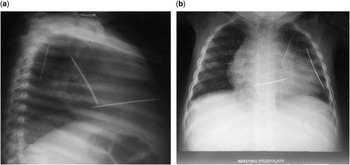
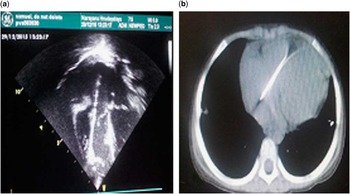
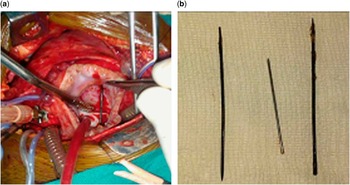
His chest radiographs revealed three sewing needles in the chest cavity (Fig 1a and b); two-dimensional echocardiography and chest CT scan showed a hyper-refractile linear structure in the right heart across the tricuspid valve (Figs 2a and b) and two needles in the left lung. The patient underwent open-heart surgery, and all three needles were removed (Figs 3a and b). The anterior tricuspid leaflet, which was torn into two halves, was repaired, and a posterior tricuspid Doty’s annuloplasty was performed. Postoperatively, the patient developed subglottic stenosis causing stridor, which was relieved by anterior costal cartilage graft laryngotracheal reconstruction surgery. The patient was discharged in stable condition.
( a and b ) Chest radiograph – lateral and postero-anterior view – showing multiple sewing needles in the lung and cardiac silhouette.

( a ) Two-dimensional echocardiography, apical four-chamber view, showing a hyper-refractile structure traversing from the right atrium (RA) to the right ventricle (RV). ( b ) CT scan of the chest showing the needle lying across the RA and the RV.

( a ) Intra-operative picture showing a sewing needle in heart traversing from the right atrium to the right ventricle cavity. ( b ) Showing all three sewing needles removed from the patient’s chest.

In children, injuries caused by sewing needles usually occur accidentally except for some self-inflicted injuries caused by depressive behaviours or suicide attempts. Child abuse issues should be investigated in all such injury cases. In this case, the cause and timing of insertion of the needles into the chest cavity remain unknown. The possibility of child abuse or witchcraft rituals cannot be ruled out.
Acknowledgement
The authors acknowledge Dr Rahul Prakash Saraf for his help in evaluating the patient.
Financial Support
This research received no specific grant from any funding agency, commercial, or not-for-profit sectors.
Conflicts of Interest
None.