INTRODUCTION
Introduction of alien species to new ecosystems is considered a major threat to ecosystem's biodiversity, structure and function (Courchamp et al., Reference Courchamp, Chapuis and Pascal2003; Boudouresque, Reference Boudouresque2005). It is estimated that more than 790 alien species have been introduced into the Mediterranean Sea until today, most of which correspond to benthos and fish species (Zenetos et al., Reference Zenetos, Vasillopoulou, Salomidi and Poursanidis2007). The majority of these have an Indo-Pacific origin; more than 300 Indo-Pacific species of macrophytes, invertebrates and fish (Galil, Reference Galil2000) have migrated from the Red Sea into the eastern Mediterranean Sea since the opening of the Suez Canal in 1869. This massive aquatic invasion was given the name of ‘lessepsian migration’ (Por, Reference Por and Billings1978). Marine biologists have justifiably focused on biology and ecology of alien species and their spreading across the Mediterranean coasts, considering the undisputed effects of their invasion on native marine communities and ecosystems as well as on catch composition in commercial fisheries (Goren & Galil, Reference Goren and Galil2005; Harmelin-Vivien et al., Reference Harmelin-Vivien, Bitar, Harmelin and Monestiez2005).
In the Greek seas, a large increase of alien marine species introductions during the last years is observed for mollusca (Zenetos et al., Reference Zenetos, Koutsoumbas and Vardala-Theodorou2005), fish (Corsini-Foka & Economidis, Reference Corsini-Foka and Economidis2007), macroalgae (Tsiamis et al., Reference Tsiamis, Panayotidis and Zenetos2008) and other marine biota (Pancucci-Papadopoulou et al., Reference Pancucci-Papadopoulou, Kevrekidis, Corsini-Foka, Simboura, Papathanassiou and Zenetos2005a). The increasing rate at which invasions are reported in Greece may result from a multiplicity of interactions, such as the intensive research on the marine biota and increased anthropogenic activities over the last years, e.g. aquaculture, international trade and tourism favour the unintentional introduction of aliens (Carlton, Reference Carlton1996). In addition, global warming and the tropicalization scenario (Occhipinti-Ambrogi, Reference Occhipinti-Ambrogi2007) cannot be ruled out as contributing factors enhancing the opportunities for the introduction of exotic marine species. This phenomenon seems to accelerate the northward expansion and biomass increase of thermophilic species (meridionalization), including non-indigenous tropical and subtropical species (Bianchi & Morri, Reference Bianchi and Morri2003). Marine alien species in Greek waters reached the number of 128 in 2005, with the highest number of species present in the south-east Aegean Sea (69), decreasing significantly to the north and to the west, so that only 30 aliens have been recorded from the Ionian Sea (Pancucci-Papadopoulou et al., Reference Pancucci-Papadopoulou, Zenetos, Corsini-Foka and Politou2005b). Their restricted distribution in the Ionian Sea is probably due to lack of published information and the low shipping traffic in the region (Pancucci-Papadopoulou et al., Reference Pancucci-Papadopoulou, Kevrekidis, Corsini-Foka, Simboura, Papathanassiou and Zenetos2005a).
Taking into consideration that the Ionian Sea belongs to the same biogeographical area as the south Aegean Sea (Bianchi & Morri, Reference Bianchi and Morri2000), the quest for new records of the spreading of alien species in the Greek seas logically turns to the west. The Messiniakos Gulf lies in the south-east Ionian Sea, so it is assumed to be a hot spot area, situated on the path of marine alien species' westwards expansion. Nevertheless, in this area recent studies have focused on alien zoobenthic species (Kambouroglou & Nikolaidou, Reference Kambouroglou and Nikolaidou2006; Thessalou-Legaki et al., Reference Thessalou-Legaki, Zenetos, Kambouroglou, Corsini-Foka, Kouraklis, Dounas and Nikolaidou2006) but there is little information regarding phytobenthos (Tsirika et al., Reference Tsirika, Patoucheas and Haritonidis2003) and alien fishes (ELNAIS, 2008).
The aim of this paper is to contribute to the monitoring of alien species' range expansion in Greek waters, providing new records of fish and macroalgae and describing their current status along the coasts of the south-east Ionian Sea.
MATERIALS AND METHODS
Description of the area
The Ionian Sea is an arm of the Mediterranean Sea, south of the Adriatic Sea. It is bounded by southern Italy, including Calabria, Sicily and the Salento Peninsula to the west and by south-western Albania and the west coasts of Greece to the east. The south-east Ionian Sea mainly includes the Messiniakos Gulf, which is considered as the link of the Aegean Sea to the Ionian Sea.
Sampling
Sampling of fish was done mostly by spear while free diving and complementary gillnets of 18, 22, 30 and 36 mm mesh size at landing, thanks to the cooperation of local professional fishermen. Sampling by spear was carried out through 2006–2008 on a monthly basis, at depths ranging from 0–18 m and from 0–150 m off the coast, on rocky substrate with plenty of crevices and holes and sometimes in close proximity to Posidonia oceanica (L.) Delile meadows. On each sampling day and location the sea surface temperature and salinity were recorded with a precision of 0.1°C and 0.1 psu respectively, using a conductivity hand-held meter. After capture, specimens were preserved frozen at −20°C.
For macroalgae seven sampling locations at the upper infralittoral zone were chosen along the rocky shores of the Messiniakos Gulf. Two seasonal samplings were carried out for each location, one during autumn 2006 and the other one during spring 2008. Samples were collected by free diving from almost horizontal rocky surfaces, 50 cm below the lowest water level. Quadrats of 400 cm2 (20 cm × 20 cm) were scraped off at each site (‘destructive’ sampling). All samples were preserved in formalin until further analysis in the laboratory.
Species identification
The fish were identified to species level following Fischer et al. (Reference Fischer, Bauchot and Schneider1987) and FishBase (Froese & Pauly, Reference Froese and Pauly2008).
When it comes to macroalgae, formalin fixed samples were carefully analysed in the Phytobenthos Laboratory of the Hellenic Centre of Marine Research (HCMR), by identifying species presence and by estimating their vertically projected coverage. For the classification of macroalgae the following Mediterranean Sea check-lists were used: Ribera et al. (Reference Ribera, Gomez-Garreta, Gallardo, Cormaci, Furnari and Giaccone1992) for Fucophyceae, Gallardo et al. (Reference Gallardo, Gomez-Garreta, Ribera, Cormaci, Furnari, Giaccone and Boudouresque1993) for Chlorophyta, and Athanasiadis (Reference Athanasiadis1987) and Gómez-Garreta et al. (Reference Gómez-Garreta, Gallardo, Ribera, Cormaci, Furnari, Giaccone and Boudouresque2001) for Rhodophyta.
Fish morphometrics
Total length (LT) of each individual fish was measured to the nearest mm, while total body weight (WT) was recorded to the nearest g. Meristic features were counted and morphometric measurements were taken with a calliper on defrosted specimens of Siganus rivulatus, Forsskål 1775 and Fistularia commersonii, Rüppel 1835 and also on a subsample of 121 defrosted specimens of Siganus luridus, Rüppel 1829, selected to cover a broad size-range.
RESULTS
Lessepsian fish
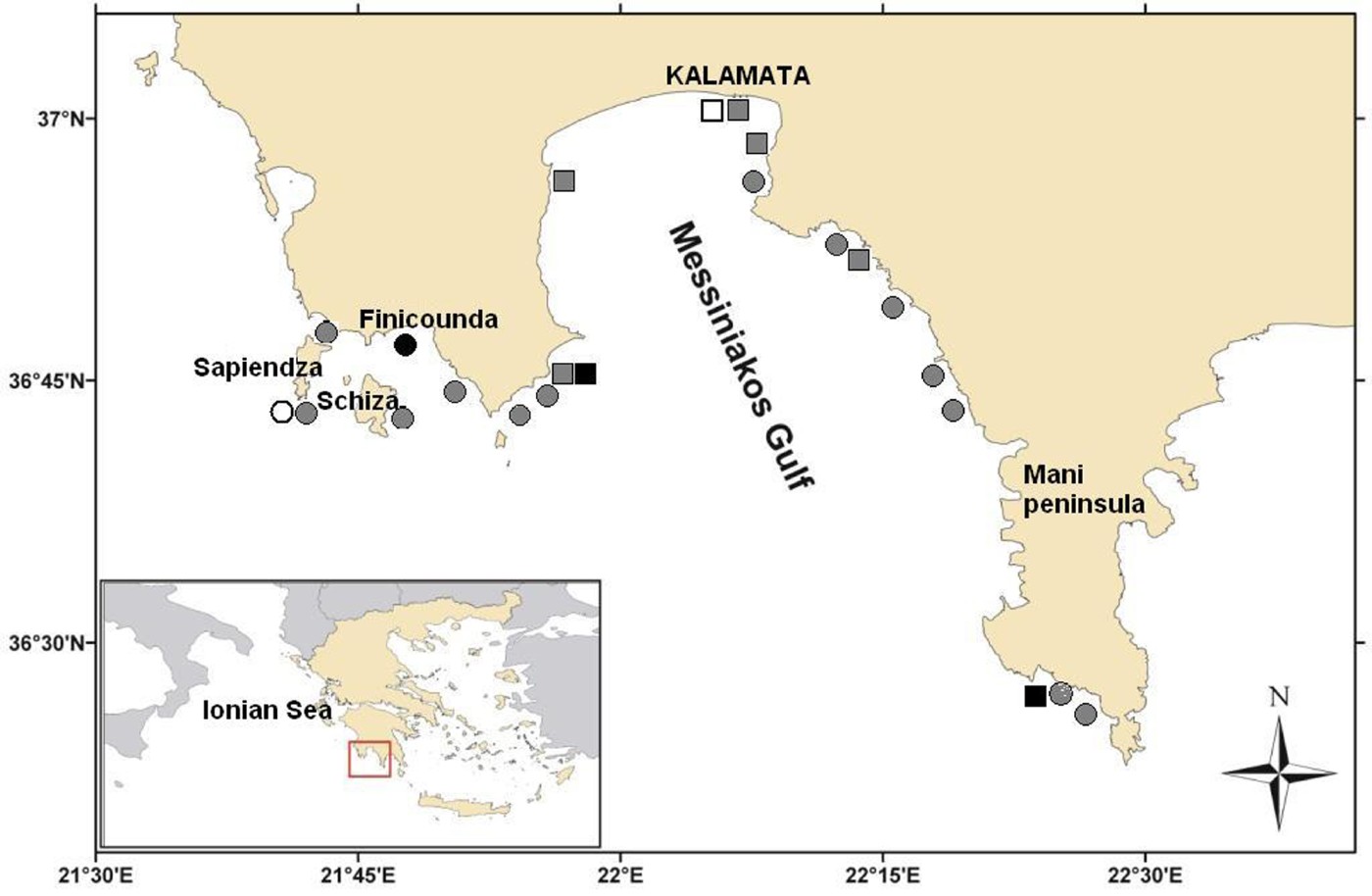
Three lessepsian fish immigrants were recorded from the study area (Figure 1): the dusky spinefoot Siganus luridus, in large numbers, the marbled spinefoot Siganus rivulatus and the blue-spotted cornetfish Fistularia commersonii.
Sampling sites in the Messiniakos Gulf: circles for fish (white, Siganus rivulatus; grey, S. luridus; black, Fistularia commersonii) and quadrats for macroalgae (white, Asparagopsis taxiformis; grey, Caulerpa racemosa var. cylindracea; black, Stypopodium schimperi).
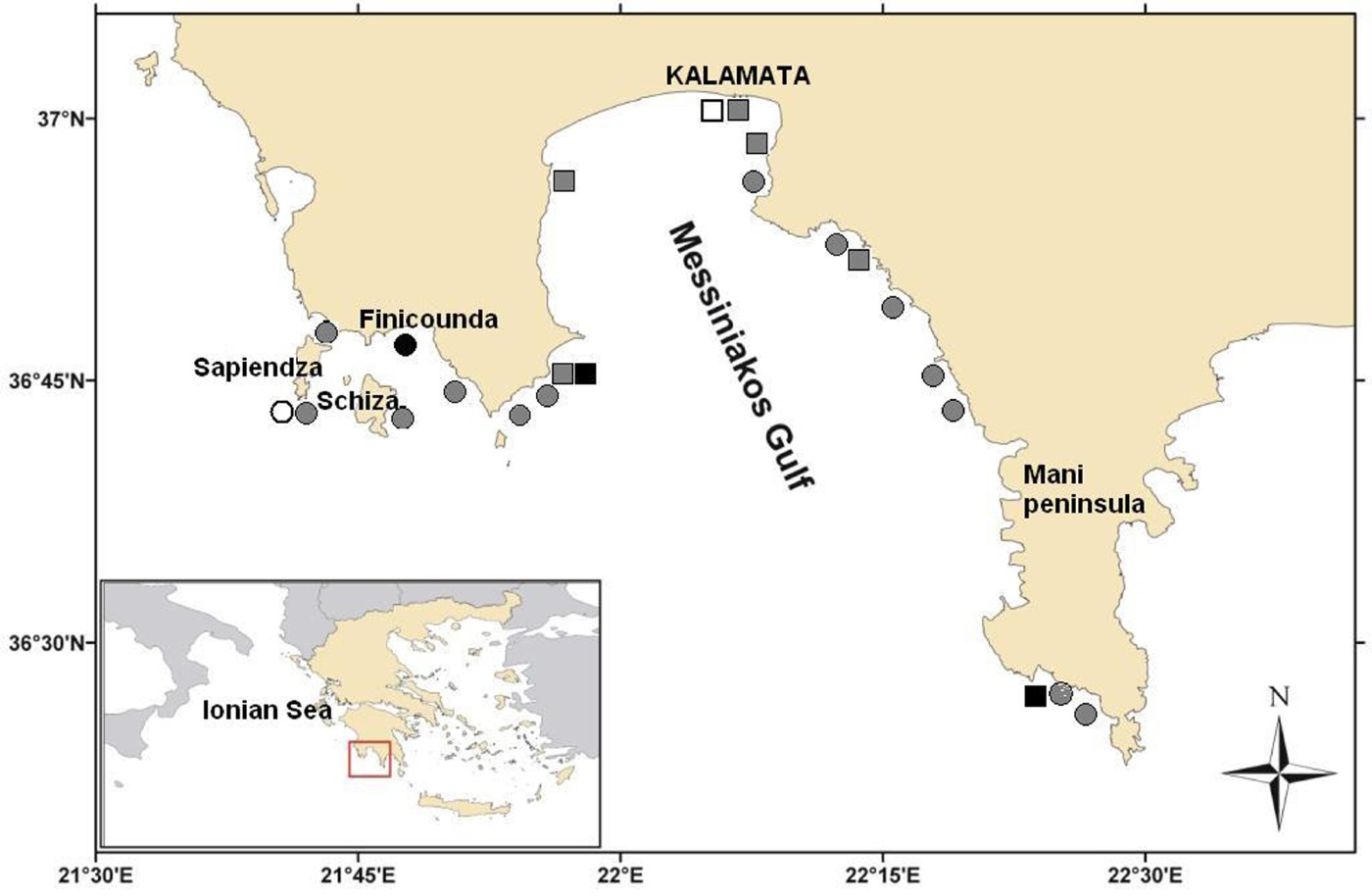
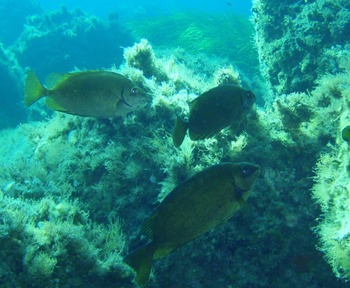
Two hundred and ninety-eight specimens of Siganus luridus were captured by spear during 47 days of sampling from January 2006 to June 2008, ranging from 90–278 mm in total length and from 9–382 g in total body weight. Observations in the field during sampling confirmed the presence of S. luridus (Figure 2) at 13 different coastal sites of the Messiniakos Gulf all the year round. Most specimens were observed and captured at depths often less than 10 m, although some of them were caught down to a depth of 18 m. Surface temperatures varied throughout the year and from site to site from 15°C (January–March 2007) to 28.6°C (August 2006), while surface salinity ranged from 32.1 psu to 40.9 psu. Individuals of S. rivulatus and Fistularia commersonii were not observed directly in the field, neither caught by spear.
Siganus luridus school from the south-east Ionian Sea.

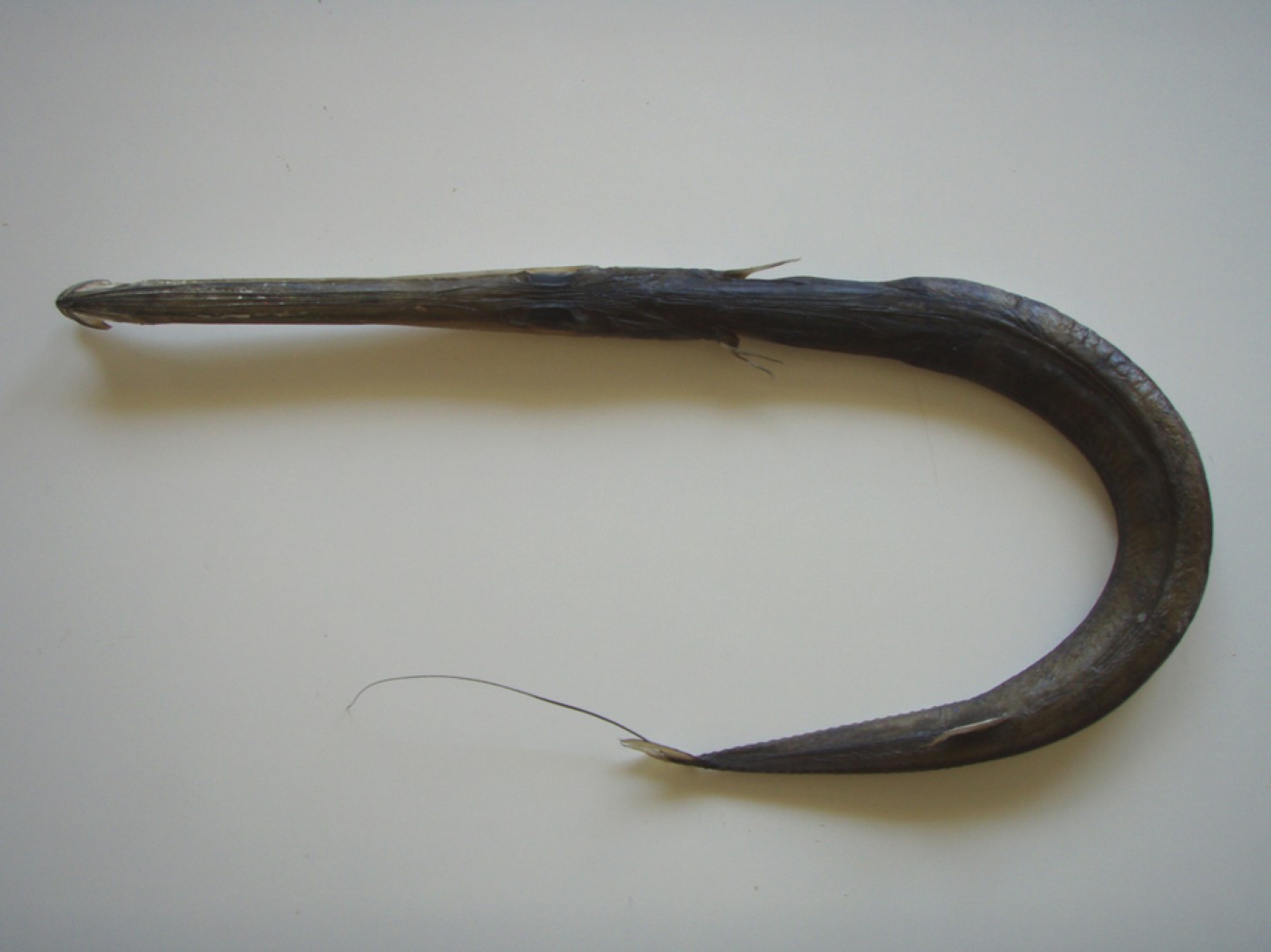
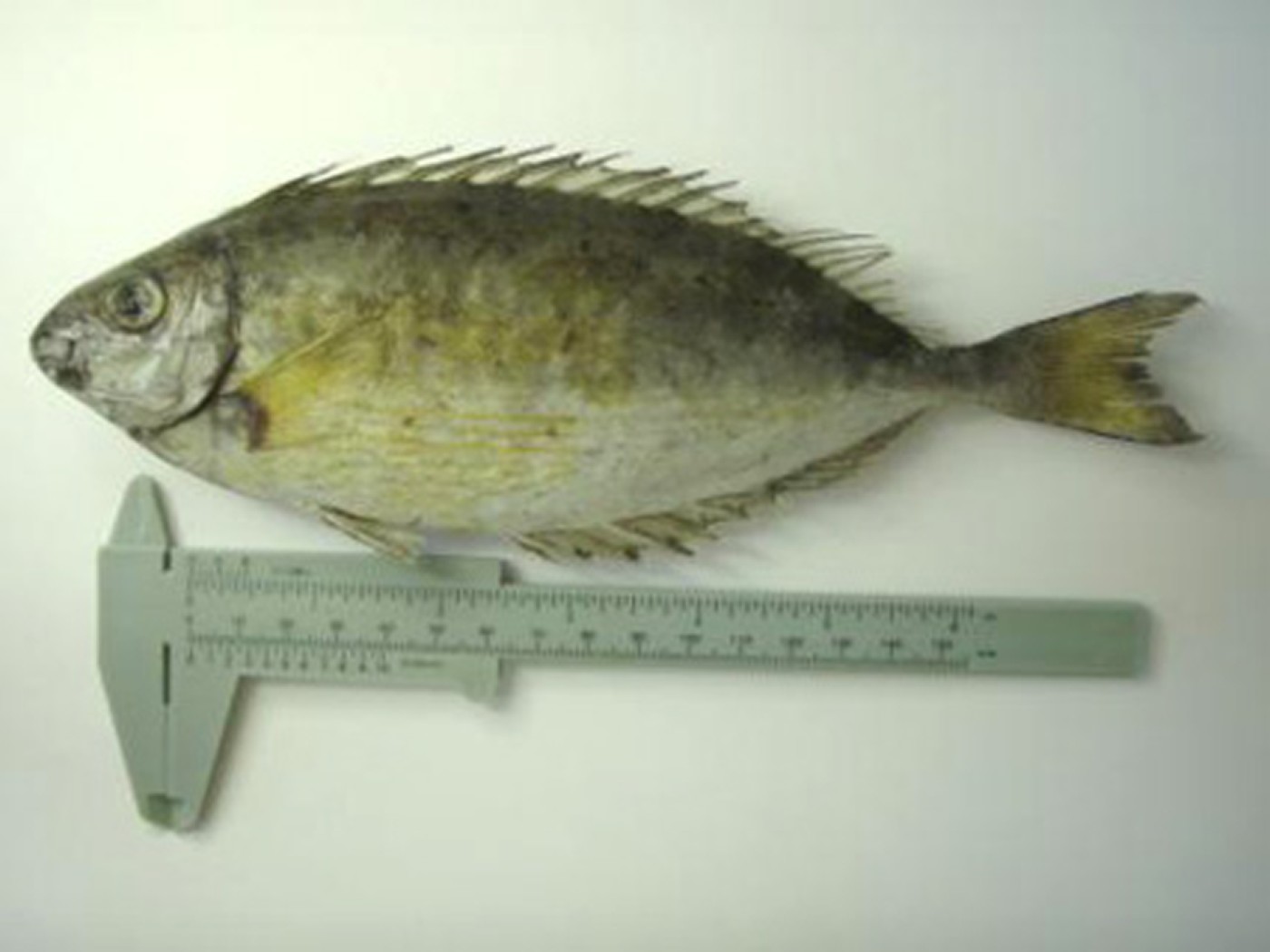
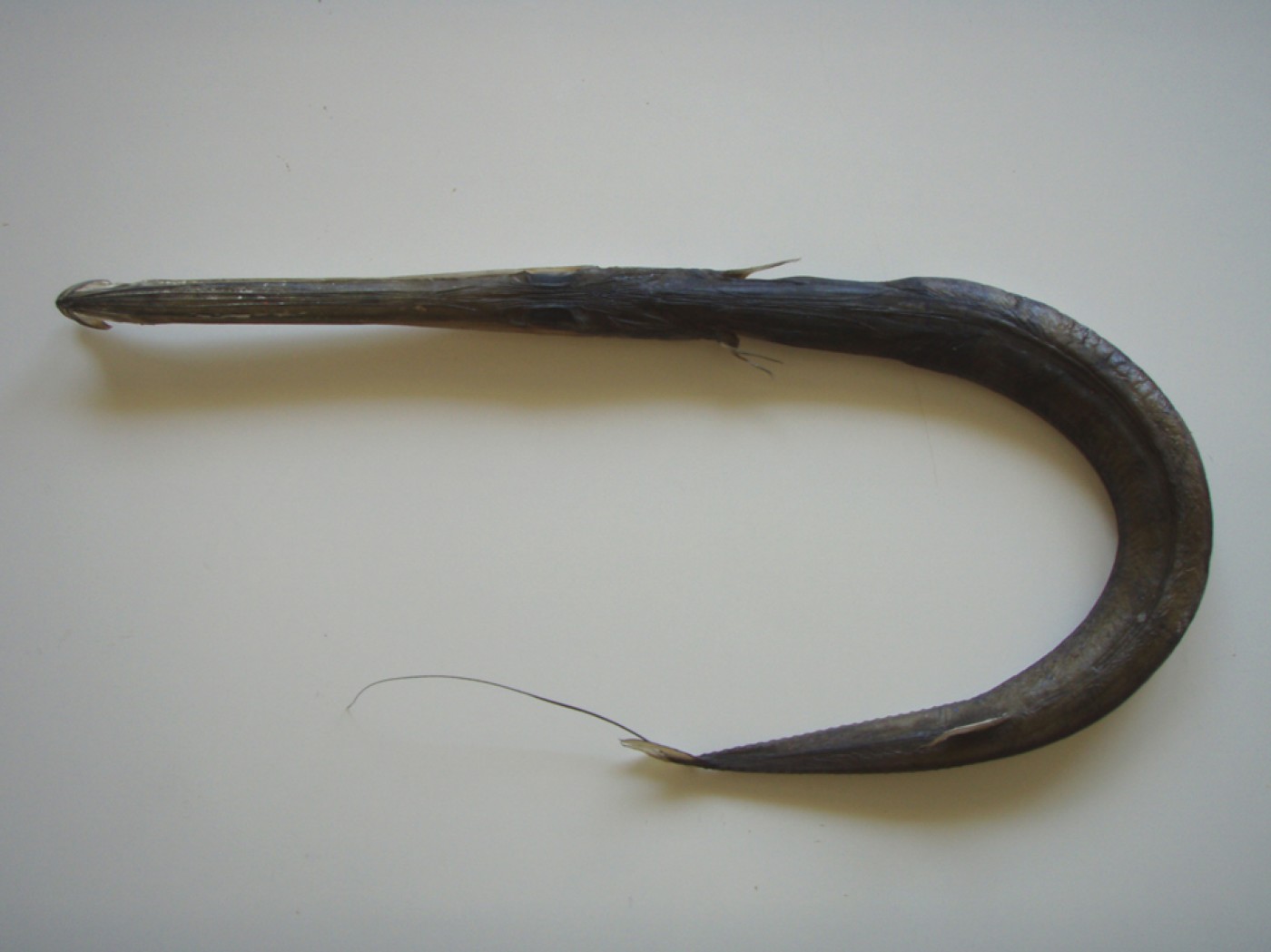
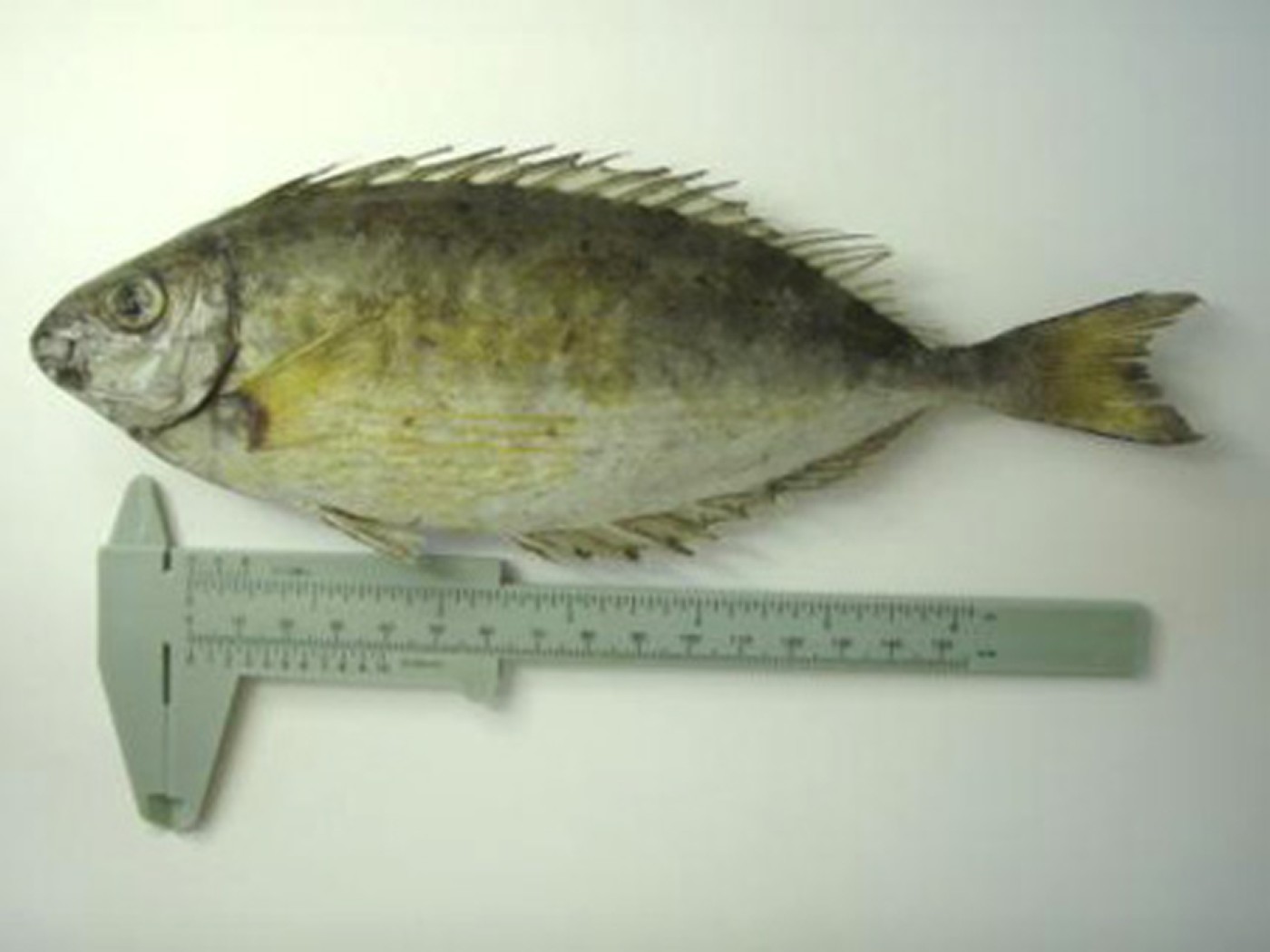
Gillnets of 18, 22, 30 and 36 mm mesh size provided additional information on the presence of two more lessepsian fish immigrants: a single specimen of Fistularia commersonii (Figure 3) of 907 mm LT and 292 g WT was caught by gillnets of 22 mm mesh size at a depth of 7–8 m from Finicounda on 15 January 2008, and one specimen of Siganus rivulatus of 225 mm LT and 140 g WT (Figure 4) was caught by gillnets of 30 mm mesh size at a depth of 17–23 m from Sapiendza Island on 25 May 2008. Furthermore, 243 S. luridus specimens were captured by gillnets of 18, 30 and 36 mm mesh size from the Islands of Schiza and Sapiendza.
Fistularia commersonii specimen of 907 mm LT caught in the south-east Ionian Sea.
Siganus rivulatus specimen of 225 mm LT caught in the south-east Ionian Sea.
Considering meristic features of the dusky spinefoot (N = 121), all specimens had a XIV-10 dorsal fin type, with the first dorsal spine horizontally orientated, looking frontward and I-3-I pelvic fin type. The pectoral fin consisted of 15–16 yellowish soft rays. The anal fin structure displayed worth-mentioning variability: 116 of them had the usual type of VII-9 reported from FishBase (Froese & Pauly, Reference Froese and Pauly2008), but five specimens exhibited differentiated types: VI-10 and VIII-9 in two specimens each and VIII-8 in one specimen. The marbled spinefoot exhibited the following meristic features: dorsal fin XIV-10, anal fin VII-9, pectoral fin 0-16 and pelvic fin I-3-I. For the bluespotted cornetfish the dorsal type was 0-15, anal type 0-14, pelvic type 0-6 and pectoral 0-14.
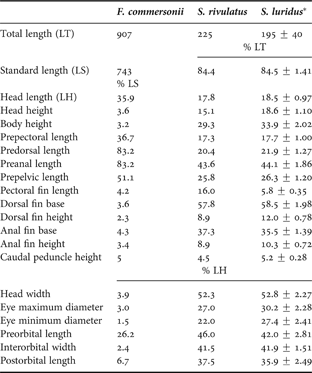
Data from morphometric measurements expressed as % of total length (LT) for the two siganids and as % of standard length (LS) for the bluespotted cornetfish are presented in Table 1.
Morphometric characters of Fistularia commersonii, Siganus rivulatus and Siganus luridus from the south-east Ionian Sea.

LT, LS in mm; *mean±standard deviation.
Macroalgae
A total of 125 macroalgal taxa were identified in the studied area, which is approximate to a past study of the area (Tsirika et al., Reference Tsirika, Patoucheas and Haritonidis2003). Red algae dominate with 81 representatives, whereas the brown and green algae participate with 24 and 20 representatives respectively. The vegetation of the rocky substrate of the studied site is mainly characterized by species of the genus Cystoseira C. Agardh, which play a role of canopy algae and constitute important communities for both algal and fish populations. Other common macroalgal species include the brown alga Sphacelaria cirrosa (Roth) C. Agardh and the red algae Ceramium spp., Herposiphonia secunda (C. Agardh) Ambronn and Jania rubens (Linnaeus) Lamouroux.
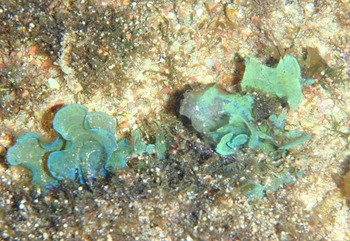
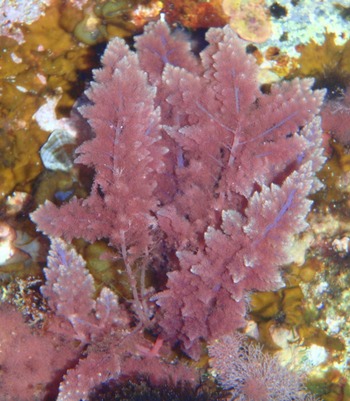
Among all identified species 3 of them are considered as aliens: the green alga Caulerpa racemosa var. cylindracea (Sonder) Verlaque, Huisman & Boudouresque, the brown alga Stypopodium schimperi (Buchinger ex Kützing) Verlaque & Boudouresque (Figure 5) and the red alga Asparagopsis taxiformis (Delile) Trevisan de Saint-Léon (Figure 6), from which the two latter are reported from the Ionian Sea for the first time. A few thalli of S. schimperi were recorded only at the outer Messiniakos Gulf during spring 2008, while in the inner coasts the species was absent (Figure 1). In addition, a single thallus of the haploid gametophytic stage of A. taxiformis was found in the inner Messiniakos Gulf (Kalamata's main port) in spring 2008 (Figure 1). At the same area, a few individuals of the diploid tetrasporophytes of A. taxiformis were found as epiphytes on other macroalgae. Finally, C. racemosa var. cylindracea was found during autumn 2006 and spring 2008, and it was present at most sampling stations (Figure 1), occasionally through high abundances. Among the identified taxa, it is the only alien macroalga that exhibits invasive behaviour in Messiniakos Gulf.
Stypopodium schimperi from the outer Messiniakos Gulf (south-east Ionian Sea).

Asparagopsis taxiformis from the port of Kalamata (south-east Ionian Sea).

DISCUSSION
Alien fish
According to the CIESM (Commission Internationale pour l'Exploration Scientifique de la Mer Méditerranée) Atlases of Alien species (Galil et al., Reference Galil, Froglia, Noël and Briand2002; Golani et al., Reference Golani, Orsi-Relini, Massuti, Quignard and Briand2002; Zenetos et al., Reference Zenetos, Gofas, Russo, Templado and Briand2003), an exotic species is considered to be established in a new area as soon as it is recorded from either different localities or twice (three times regarding fish) in different periods, while alien species are identified as having been recorded only once (no more than twice for fish): they are presumed to be not-established in the basin. Nevertheless, the characterization of an allochthonous species as ‘established’ or ‘alien’ in a new environment depends on the size of the latter, defined by the aims of the study. What is referred to as ‘established’ in the Mediterranean Sea as a whole may have not been recorded even once from several parts. In practice, it is more significant for conservation biology to monitor the establishment of new populations of marine aliens on a smaller geographical scale, since they may have a considerable impact either on local ecosystems and communities or on small scale commercial fisheries.
The blue-spotted cornetfish Fistularia commersonii is one of the most recently recorded lessepsian fish (Golani, Reference Golani2000). It is referred to as a ‘lessepsian sprinter’ (Karachle et al., Reference Karachle, Triantaphyllidis and Stergiou2004), due to its rapid range extension to the north and west, now including the whole Levantine, the Aegean Sea and the central and western Mediterranean Sea (Golani et al., Reference Golani, Orsi-Relini, Massuti and Quignard2006; Corsini-Foka & Economidis, Reference Corsini-Foka and Economidis2007; Sánchez-Tocino, Reference Sánchez-Tocino, Hidalgo Puertas and Pontes2007). This is the second record of F. commersonii from the Ionian Sea—the first was off Corfu Island in 2007 (ELNAIS, 2008)—so it could be described as ‘alien’ in this area, following the CIESM's terminology of exotic species. Yet, more records and/or data on its reproduction in the wild from this area are prerequisites to ensure the existence of an established population.
The first record of the two siganids from the Mediterranean Sea was in 1927 by Steinitz (Reference Steinitz1927) for Siganus rivulatus and in 1956 for Siganus luridus (Ben Tuvia, Reference Ben Tuvia1964). Since then, both species have been well established along the coasts of the Levantine Sea and have invaded the Central Mediterranean Sea (Azzurro & Andaloro, Reference Azzurro and Andaloro2004; Charfi-Cheikhrouha, Reference Charfi-Cheikhrouha2004; Castriota & Andaloro, Reference Castriota and Andaloro2005; Corsini-Foka & Economidis, Reference Corsini-Foka and Economidis2007), on some occasions dominating the herbivorous fish community in terms of abundance and biomass (Papaconstantinou et al., Reference Papaconstantinou, Caragitsou, Vasilopoulou, Petrakis and Stergiou1988; Harmelin-Vivien et al., Reference Harmelin-Vivien, Bitar, Harmelin and Monestiez2005).
This is the first record of Siganus rivulatus from the south-east Ionian Sea and the second from the Ionian Sea taken as a whole (Golani et al., Reference Golani, Orsi-Relini, Massuti, Quignard and Briand2002). Therefore, the marbled spinefoot is considered to be a non-established alien in this area. This finding connects the established populations of the south-east and south Aegean Sea (Papaconstantinou et al., Reference Papaconstantinou, Caragitsou, Vasilopoulou, Petrakis and Stergiou1988; Peristeraki et al., Reference Peristeraki, Lazarakis, Skarvelis, Georgiadis and Tserpes2006), to the records of the Adriatic Sea, where two specimens were reported by Dulčić & Pallaoro (Reference Dulčić and Pallaoro2004). At first glance, it seems peculiar why this species has not established populations in the south-east Ionian Sea area, where its congeneric S. luridus is very abundant (present study). The answer might hide in the question itself: it is possible that the latter species outcompetes the former, occupying an available niche for an additional herbivorous species in the novel environment. Even though the feeding habits of these two siganids have been repeatedly studied in both the Red Sea and the eastern Mediterranean Sea, there are no data quantitatively comparing their diets and assessing whether an overlap in use of food resources exists between them and to what extent (Bariche, Reference Bariche2006).
Kaspiris (Reference Kaspiris1976) recorded one single specimen of Siganus luridus from the Patraikos Gulf, east Ionian Sea, yet this was not enough to support the finding of an established population. Based on the large number of specimens observed directly in the field and caught almost on a monthly basis from 2006–2008, one can say with certainty that the presence of S. luridus in the south-east Ionian Sea is not only the first record of the species in the particular area, but also is proof of a well-established population for the first time in the Greek part of the Ionian Sea. Local fishermen informed us that the dusky spinefoot has become a significant part of their net catches in shallow waters since 2000. Then, how could we explain its previous record by Kaspiris? Following the considerations of Por (Reference Por and Billings1978), we assume that pioneers of the dusky spinefoot had settled small populations at first in the Ionian Sea which escaped scientific attention. Significant populations were built-up later and that brought their existence to light. It is most likely that the dusky spinefoot arrived at the south-east Ionian Sea extending its distribution probably from established populations from the Cyclades Islands in the south Aegean Sea (Corsini-Foka & Economidis, Reference Corsini-Foka and Economidis2007) or alternatively from Crete (Tingilis et al., Reference Tingilis, Anezaki, Valla, Lymberakis, Kapatangakis, Biyiakis and Kaouri2003; Golani et al., Reference Golani, Orsi-Relini, Massuti and Quignard2004) via Antikythera Island, where many specimens were caught in August 2000 (Damalas & Megalofonou, unpublished data). We suppose that range expansion is mediated by larval drift and/or by active migration. The scenario of eggs being transported by currents seems controversial. According to Popper et al. (Reference Popper, Pitt and Zohar1979), its eggs are not pelagic but adhesive and sink slowly to the bottom. On the contrary, Lakkis et al. (Reference Lakkis, Saad, Sabour and Zeidane2004) recognized S. luridus eggs and larvae among plankton sampled off the coast of Syria, while in the CIESM Atlas of Exotic Fishes (Golani et al., Reference Golani, Orsi-Relini, Massuti, Quignard and Briand2002), S. luridus is cited as a species with both eggs and larvae planktonic.
Por (Reference Por and Billings1978) predicted that the expansion of lessepsian immigrants in the Mediterranean Sea would be limited by temperature, with this limit being sought at the 16°C isotherm of minimum winter surface temperature. The dusky spinefoot might be less sensitive to low temperature than expected, since we observed it as abundant with a seawater temperature of 15°C during winter and early spring. The present study also showed that it is tolerant of a fairly wide range of changes in salinity, from 32.1–40 psu, which is in accord with Ben-Tuvia (1964) and Popper & Gundermann (Reference Popper and Gundermann1975).
The maximum depth where the dusky spinefoot was met on the coral reefs of Aqaba in the Red Sea (Bouchon-Navaro & Harmelin-Vivien, Reference Bouchon-Navaro and Harmelin-Vivien1981) was only 6 m. According to Harmelin-Vivien et al. (Reference Harmelin-Vivien, Bitar, Harmelin and Monestiez2005), on the rocky coast of Lebanon Siganus luridus was recorded from the surface down to 40 m depth, but exhibited higher densities in shallow waters of less than 12 m depth. Our observations agree with the latter, confirming the enlargement of the species' ecological niche to deeper waters, compared to the Red Sea populations. This could be explained by the lack of competition from native herbivores in the eastern Mediterranean Sea (Harmelin-Vivien et al., Reference Harmelin-Vivien, Bitar, Harmelin and Monestiez2005), an argument which is further supported by the findings of Azzurro et al. (Reference Azzurro, Fanelli, Mostarda, Catra and Andaloro2007). The authors proved that there is a resource partitioning concerning food between S. luridus and its most suspected native competitor Sarpa salpa (Linnaeus, 1758) in the Central Mediterranean Sea.
All three fish immigrants of the present study are considered to have invasive behaviour in other parts of the eastern Mediterranean Sea (Streftaris & Zenetos, Reference Streftaris and Zenetos2006). The bluespotted cornetfish is a higher order carnivore, often feeding on species of significant commercial importance for fisheries, such as Mullus surmuletus Linnaeus 1758 and is considered abundant in the south-east Aegean (Corsini-Foka et al., Reference Corsini-Foka, Kondilatos and Economidis2002; Kalogirou et al., Reference Kalogirou, Corsini-Foka, Kondilatos and Wennhage2007). The two Siganus species are the most abundant herbivorous fish in shallow coastal waters across the Levantine, and comprise much of the fish biomass along its rocky habitats (Harmelin-Vivien et al., Reference Harmelin-Vivien, Bitar, Harmelin and Monestiez2005). Only S. luridus could be considered invasive in the south-east Ionian Sea for now, thanks to its abundance. Yet, in this area it is discarded as by-catch in fisheries, despite the fact that elsewhere in the eastern Mediterranean Sea it is of moderate commercial importance for inshore fisheries. Characterized as a browser (Ogden & Lobel, Reference Ogden and Lobel1978), S. luridus is an additional consumer of algae in the south-east Ionian Sea, probably exerting a significant impact on the structure of the local algal community.
Alien macroalgae
The brown alga Stypopodium schimperi is a lessepsian immigrant which has been introduced into the eastern Mediterranean Sea since the early 1990s (Nizamuddin & Godeh, Reference Nizamuddin and Godeh1989; Verlaque & Boudouresque, Reference Verlaque and Boudouresque1991). In Greece, it was reported only in the south Aegean Sea, from Milos Island (Sartoni & De Biasi, Reference Sartoni and De Biasi1999) and Rhodes Island (Tsiamis et al., Reference Tsiamis, Panayotidis and Montesanto2007). Its finding in the present study corresponds to the most western record in Greece. Although it exhibits invasive behaviour along the coasts of Levantine (Boudouresque & Verlaque, Reference Boudouresque and Verlaque2002), no invasive behaviour was detected until today for any Greek marine area (Tsiamis et al., Reference Tsiamis, Panayotidis and Zenetos2008). However, north-western expansion in the Ionian Sea as well as towards the inner Messiniakos Gulf is expected during the next years.
Two cryptic taxa seem to coexist under the name of Asparagopsis taxiformis in the Mediterranean Sea: a taxon described in 1813 from Alexandria by Delile (Reference Delile and Anon1813) and confined to the eastern Mediterranean basin—Egypt, Lebanon, Syria and likely Libya—(Ní Chualáin et al., Reference Ní Chualáin, Maggs, Saunders and Guiry2004) and another one, more recently introduced into the Mediterranean Sea, and exhibiting an invasive behaviour in the western basin—Algeria, Balearic Islands, France, western Italy, Sicily, Tunisia—(Ballesteros & Rodriguez-Prieto, Reference Ballesteros and Rodriguez-Prieto1996; Barone et al., Reference Barone, Mannino and Marino2003; Flagella et al., Reference Flagella, Guala, Lorenti and Buia2003; Ní Chualáin et al., Reference Ní Chualáin, Maggs, Saunders and Guiry2004). Recent molecular results showed that the first taxon appears to be of Atlantic provenance, via the Strait of Gibraltar, whereas the second taxon probably colonized the Mediterranean from the Indo-Pacific, most likely via the Suez Canal (Andreakis et al., Reference Andreakis, Procaccini and Kooistra2004, Reference Andreakis, Procaccini, Maggs and Kooistra2007; Ní Chualáin et al., Reference Ní Chualáin, Maggs, Saunders and Guiry2004). The Mediterranean distribution of the two taxa appears to be closely related to their lower survival temperature—17°C and 9–11°C for the Atlantic and the Indo-Pacific taxon, respectively (Ní Chualáin et al., Reference Ní Chualáin, Maggs, Saunders and Guiry2004). Since the seawater temperatures of the Messiniakos Gulf get down to 15°C during winter, it is probable that the specimen of A. taxiformis which was found in the studied site corresponds to the invasive Indo-Pacific strain.
In Greece, Asparagopsis taxiformis was found only recently in the central and south Aegean Sea (Tsiamis & Panayotidis, Reference Tsiamis and Panayotidis2007). Its finding in the south-east Ionian Sea corresponds to the most western record of this species in Greece. Although it was found only in the inner Messiniakos Gulf, at Kalamata's port, north-western expansion is expected in the near future.
When it comes to Caulerpa racemosa var. cylindracea, recent molecular studies indicate that this green alga has been probably introduced into the Mediterranean Sea from south-west Australia, probably through aquarium trade and/or intentional introduction (Verlaque et al., Reference Verlaque, Durand, Huisman, Boudouresque and Parco2003). It was first found in Libya during the early 1990s (Nizamuddin, Reference Nizamuddin1991) and since then it has been spreading extremely rapidly along the whole Mediterranean basin, probably through shipping (fouling and ballast waters; Verlaque et al., Reference Verlaque, Durand, Huisman, Boudouresque and Parco2003), occupying diverse substrata, various depths, polluted and unpolluted areas, revealing, thus, a strong invasive behaviour (Piazzi et al., Reference Piazzi, Meinesz, Verlaque, Akcali, Antolic, Argyrou, Balata, Ballesteros, Calvo, Cinelli, Cirik, Cossu, D'Archino, Djellouli, Javel, Lanfranco, Misfud, Pala, Panayotidi, Peirano, Pergent, Petrocelli, Ruitton, Zuljevic and Cecherelli2005). Similar behaviour is also known from the Greek coasts; however, its direct impact on the native biota has not yet been documented in the eastern Mediterranean Sea (Tsiamis et al., Reference Tsiamis, Panayotidis and Zenetos2008). In the Messiniakos Gulf this taxon was first found by Tsirika et al. (Reference Tsirika, Patoucheas and Haritonidis2003) who mentioned a more significant expansion at deep than at shallow water. Today, its presence in the studied area seems to be stable.
Among the identified macroalgae in the south-east Ionian Sea, only Caulerpa racemosa var. cylindracea exhibits invasive behaviour. This belongs to the 9 most invasive marine macrophytes listed for the Mediterranean Sea (Boudouresque & Verlaque, Reference Boudouresque and Verlaque2002), which are known to displace the indigenous flora, reduce community biodiversity, and modify the basic ecological characteristics of the native benthic ecosystems through the disruption of the trophic food webs, and thus resulting in negative consequences on human activities, such as fisheries and tourism (Schaffelke & Hewitt, Reference Schaffelke and Hewitt2007).
CONCLUSIONS
It is of great interest to record any new trophic relationships among alien marine organisms as well as between aliens and native species in a marine area. There is evidence that Siganus luridus consumes Caulerpa racemosa along the Middle East coast (Bariche, Reference Bariche2006), while Fistularia commersonii feeds on fry of the family Siganidae (Popper & Gundermann, Reference Popper and Gundermann1975) among other taxa of prey. Groupers feed mainly on siganids in Israeli waters (Galil, Reference Galil2007). In that case, the ecosystem itself probably finds balance into a new level.
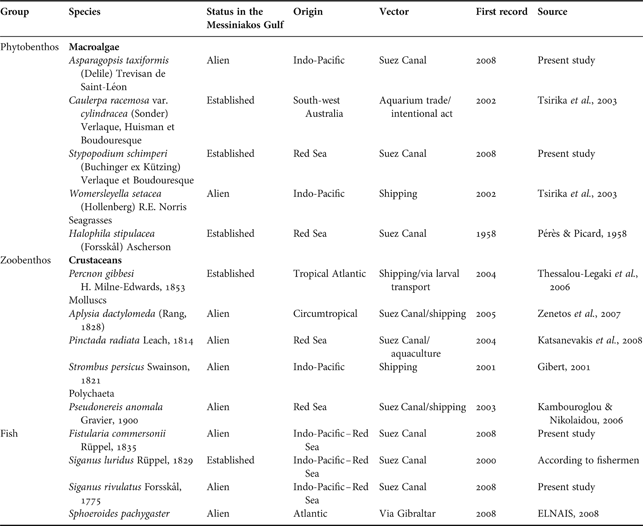
The finding of five new alien species in the studied site (Fistularia commersonii, Siganus rivulatus, Siganus luridus, Stypopodium schimperi and Asparagopsis taxiformis) increases the total number of alien marine species of the Messiniakos Gulf to 14 species (Table 2). The majority of those are lessepsian immigrants originating in the Red Sea, enhancing the assumption that Messiniakos Gulf is a hot-spot area on the way of lessepsian immigrants spreading from the eastern to the western basin. The Suez Canal is the main vector for the alien species of the south-east Ionian Sea, while other significant vectors include shipping (fouling and ballast waters), probably due to the influence of Kalamata's main port.
Alien marine species reported from the Messiniakos Gulf (south-east Ionian Sea) until today.

The north-western spread of alien marine species of the south-east Ionian Sea as well as the introduction of new aliens in the area is prospective in the next few years. Taking for granted that the influx of alien species has brought up impressive changes in the marine communities and ecosystems of other parts of the eastern Mediterranean Sea, their spreading in the Greek waters towards the northern coasts of both the Ionian Sea and Aegean Sea should be monitored, while more knowledge about their biology and ecology would be helpful to suggest an appropriate management plan.
ACKNOWLEDGEMENTS
The authors are grateful to fishermen P. Agelopoulos, D. Agelopoulos and S. Fassos for their valuable contribution to sampling. We thank C. Tzanetis, N. Alexiou and E. Kirousis for their participation in sampling as safety divers. We are also grateful to Dr A. Zenetos for her valuable comments.