Introduction
A considerable number of refugees have immigrated to Germany in recent years. While the reasons for their migration may have varied, one of the primary reasons is forced migration. 1 Refugees and asylum seekers who reside in Germany have often been exposed to numerous stressors and traumatizing experiences, which have strongly enhanced their vulnerability toward the development of severe mental health problems.Reference Richter, Lehfeld and Niklewski 2 , Reference Belz, Belz and Özkan 3 Newly arrived asylum seekers and refugees in refugee camps encounter more severe psychological and emotional challenges, compared to other populations.Reference Satinsky, Fuhr and Woodward 4 Therefore, it is pertinent to facilitate the process of seeking asylum and reduce psychological distress among asylum seekers and refugees in Germany.Reference Höhne, Banaschewski and Bajbouj 5
The process of seeking asylum can be conceptualized as a journey from experiencing negative stressors to personal growth, influenced and facilitated by various factors. Tedeschi and CalhounReference Tedeschi and Calhoun 6 indicate in their model of posttraumatic growth that posttraumatic stress and growth can coexist.Reference Tedeschi and Calhoun 6 Posttraumatic growth is defined as constructive psychological change that is considered an outcome of struggling with life-threatening conditions.Reference Tedeschi and Calhoun 7 A review study also showed that posttraumatic growth and resilience are crucial reaction patterns following the experience of traumatic events.Reference Mangelsdorf 8 , Reference Mangelsdorf and Eid 9 In other words, resilience may be a reaction to traumatic events within a brief period of time, allowing the individual to resume normal life after undergoing an adaptation phase.Reference Mangelsdorf 8 In a study on Iranian and Afghan refugees in Germany, Walther et al.Reference Walther, Amann and Flick 10 found that resilience and social support can promote positive adaptation.Reference Walther, Amann and Flick 10 In a study conducted by Huang et al.Reference Huang, Wu and Yeh 11 high scores in psychological flexibility were associated with higher posttraumatic growth and lower rumination in individuals who had experienced trauma.Reference Huang, Wu and Yeh 11 Conversely, Walther et al.Reference Walther, Amann and Flick 10 demonstrated that a sense of meaninglessness and feeling of emptiness can lead to emotional distress.Reference Walther, Amann and Flick 10
A significant number of refugees who arrived in Germany in recent years are Farsi-speaking asylum seekers and refugees. 1 It is crucial to assess their traumatic experiences, the condition of their mental health, and the protective factors that enable them to cope with new situations. However, only a few studies related to this group have been conducted in Germany. Given the paucity of empirical research on Farsi-speaking refugees in Germany, this study aimed to quantitatively assess the emotional distress of Farsi-speaking refugees in Germany and to evaluate the factors related to posttraumatic growth. The present study primarily focused on the assessment of emotional distress and overall mental health. Additionally, the relationships between protective factors, such as resilience, psychological flexibility, perceived social support, and the search for meaning in life, and posttraumatic growth were examined. The findings may assist mental health professionals in considering psychological distress, protective factors, and posttraumatic growth when interacting with asylum seekers and refugees and to formulate strategies to facilitate successful adaptation.
Methods
Data were collected from August 2022 to November 2022. The participants, who were residing in refugee camps in Berlin and Brandenburg, were informed about the project through the distribution of flyers a few weeks prior to the administration of the research questionnaires.
Instruments
The questionnaires included a range of demographic information, such as age, sex, nationality, educational background, status of residency, and type of traumatic experiences. Furthermore, participants completed questionnaires about the status of emotional distress, protective factors, and posttraumatic growth. These questionnaires were selected based on their availability in Farsi and high validity and reliability.
The Refugee Health Screener (RHS-15)
The RHS-15 was employed to assess recent general mental health conditions and the intensity of psychological distress. The questionnaire was developed by Hollifield et al.Reference Hollifield, Verbillis-Kolp and Farmer 12 to assess the three most common mental illnesses among refugees: depression, anxiety, and PTSD.Reference Hollifield, Verbillis-Kolp and Farmer 12 The original questionnaire (RHS-15) is available in Farsi and includes 13 questions about recent general mental health status. It also includes an item about general coping behavior and a “distress thermometer” (DT) that evaluates the intensity of psychological distress. The 13 symptom items and the self-assessment item are rated on a 5-point Likert scale from zero to four. A screening is considered positive if the result is a value of ≥12 or if the distress thermometer has a value of ≥5. RHS-15 showed good sensitivity and specificity.Reference Hollifield, Verbillis-Kolp and Farmer 12 The reliability of the RHS-15 in the present study was evaluated using the Cronbach’s alpha coefficient, which was found to be .97.
The Connor-Davidson Resilience Scale (CD-RISC)
The CD-RISC comprises 25 items, each of which is rated on a 5-point scale: not true at all (0), rarely true (1), sometimes true (2), often true (3), and true nearly all of the time (4). The total score ranges from 0 to 100, with higher scores indicating greater resilience.Reference Kathryn, Connor and Jonathan 13 The CD-RISC-25 has been demonstrated to be a valid and reliable instrument for the assessment of resilience. The internal consistency (Cronbach’s alpha) for the full scale was 0.89. In the present study, Cronbach’s alpha for the entire scale was found to be 0.87.
The Posttraumatic Growth Inventory (PTGI)
Tedeschi and CalhounReference Tedeschi and Calhoun 6 developed the Posttraumatic Growth Inventory (PTGI) to assess the posttraumatic growth and self-improvement that a person undergoes. This 21-item scale, built on the 5-factor model of Tedeschi, is one of the most valid and reliable resources for evaluating personal growth following a stressful encounter. Respondents are asked to provide their answers on a 6-point Likert scale, ranging from 0 (none, I didn’t experience any change) to 5 (I experienced a lot of change). In the study of Tedeschi and Calhoun,Reference Tedeschi and Calhoun 6 the overall Cronbach’s alpha coefficient of the questionnaire was 0.90, and alpha for each subscale ranged from 0.67 to 0.85.Reference Tedeschi and Calhoun 6 Seyed-Mahmoudi et al.Reference Seyed-Mahmoudi, Rahimi and Mohammadi-Jaber 14 assessed the psychometric features of the posttraumatic growth questionnaire on Iranian students. The results demonstrated a Cronbach’s alpha of 0.92 for the entire scale. Additionally, the study confirmed the divergent and convergent validity of the PTGQ within the Farsi-speaking group.Reference Seyed-Mahmoudi, Rahimi and Mohammadi-Jaber 14 The results of the present study indicated a Cronbach’s alpha of 0.97 for the entire scale.
The Acceptance and Action Questionnaire (AAQ-II)
The AAQ-II assesses the constructs of acceptance, experiential avoidance, and psychological inflexibility. Higher scores in the questionnaire are associated with reduced psychological flexibility.Reference Bond, Hayes and Baer 15 Results from 2,816 participants across 6 samples indicate the satisfactory structure, reliability, and validity of the questionnaire. For example, the mean alpha coefficient was reported to be 0.84 (0.78–0.88), and the 3- and 12-month test-retest reliability is 0.81 and 0.79, respectively. The AAQ-II also demonstrates appropriate discriminant validity.Reference Bond, Hayes and Baer 15 In the present study, the results showed Cronbach’s alpha for the whole scale to be 0.94.
Multidimensional Scale of Perceived Social Support (MSPSS)
The questionnaire was developed by Zimet et al.Reference Zimet, Dahlem and Zimet 16 to assess the perceived support from multiple sources such as family, friends, and significant others.Reference Zimet, Dahlem and Zimet 16 Bagherian et al.Reference Bagherian, Hajian and Hadi-Bahrami 17 demonstrated that the Persian version of the multidimensional scale of perceived social support has good psychometric properties in Iran. The Cronbach’s α coefficient for the scale was found to be 0.84, while the coefficients for the friends, significant others, and family subscales were 0.90, 0.93, and 0.85, respectively.Reference Bagherian, Hajian and Hadi-Bahrami 17 In the current study, the Cronbach’s α coefficient for the entire scale was found to be 0.92.
Meaning in Life Questionnaire (MLQ)
The Meaning of Life Questionnaire assesses the two dimensions of meaning in life, the presence of meaning and the search for meaning, using 10 items based on a 7-point Likert scale, ranging from completely false (1) to completely true (7).Reference Steger 18 Research has demonstrated the reliability and stability of questionnaire scores and their convergent and inferential validity.Reference Steger and Shin 19 Good internal consistency (Cronbach’s alpha between 0.82 and 0.87) has been reported for both scales.Reference Steger 18 In the current study, Cronbach’s alpha for the entire scale was found to be 0.93. In this study, the total score was used.
Recruitment and data collection
A total of 230 participants were recruited for the study, with data collection taking place between August 2022 and November 2022. The study focused on Farsi-speaking refugees, 18 years or older, from Iran and Afghanistan who were residing in refugee homes in Berlin and Brandenburg. Participants who could not complete the questionnaire by themselves or did not give informed consent were not included in the study. A convenience sampling method was used in this study.
The organizational procedures have been coordinated with the management and coordinators of the refugee camps to allow access for the data collection. There were 2 complementary methods used in the recruitment, and they were neither mutually exclusive nor parallel. First, flyers were put up in the refugee camps with a brief overview of the study and contact information, and links to messaging applications such as WhatsApp and Telegram. Refugees who saw the flyers and were interested in participating could initiate contact through these applications.
Flyers were given in the camps weeks before data collection to make residents aware of the existence of the study and provide them with some way of learning more. After these outreach and awareness-raising measures, the first author personally visited the refugee homes to gather data from them. During these actual visits, the researcher introduced the research study in full, obtained informed consent, and distributed questionnaires to willing and eligible participants. This 2-step process, information provision via flyers, facilitated trust-building and ensured that participation was truly informed in the camp contexts.
All participants were informed about the voluntary nature of their participation and their right to withdraw from the study at any time without providing any explanation. The questionnaires were distributed by the first author and took between 30 and 45 minutes to complete. Forty participants expressed concerns about answering the questions and were uncertain about the research’s objectives. Despite being fully informed about the research’s objectives and the intended use of the data, they decided not to participate due to concerns about the potential consequences of their involvement, including the possibility of losing their resident permit. A number of them only completed some of the research questionnaires; for this reason, these questionnaires were excluded from the study and considered as missing data.
The study was conducted according to all relevant guidelines and regulations, including the Declaration of Helsinki. Ethical approval has been granted by the Witten/Herdecke University independent ethical review board (No. S-245/2021).
Statistical Analysis
All data was processed and stored in anonymized form using SPSS (version 27). Descriptive statistics as frequencies and percentages were used to present categorical and continuous variables, including sociodemographic data, traumatic events, general mental health status, and intensity of psychological distress (RHS-15) among the respondents. To compare mean differences of DT and RHS-15 scores based on gender and residency, independent t-tests were used. A linear regression analysis was conducted to evaluate the relationship between posttraumatic growth and protective factors, including resilience, psychological flexibility, perceived social support, and meaning in life, in accordance with the assertion of Tedeschi and CalhounReference Tedeschi and Calhoun 6 that posttraumatic stress and posttraumatic growth may coexist.Reference Tedeschi and Calhoun 6 Additionally, given that the sample size was limited, we decided against a latent variable modeling framework to examine the relationship between the variables.
Results
A total of 230 respondents aged 18-60 (137 males and 93 females) participated in the study. The mean age of the respondents was 30.6 years. The median number of years that participants had been living in Germany was 3 years, ranging from 1 to 6 years. More than two-thirds of the male and female participants had personally experienced a traumatic event. The types of Trauma experienced or witnessed by the participants ranged from combat situations to experiencing ill health without access to medical care, as indicated in Table 1.
Sociodemographic characteristics of Farsi-speaking refugees in Germany (N = 230)

The mean and median scores for the RHS-15 were above average, with a mean (SD) score of 17.05 (11.8), ranging from 0 to 56, and a median score of 14. This mean score was indicative of a high amount of emotional distress symptoms among Farsi-speaking refugees in the sample. More than two-thirds of the respondents (n = 159, 69.1%) scored ≥12 on the sum of the first 14 items of the RHS-15 scale. Additionally, two-thirds (n = 158, 68.7%) scored ≥5 on the distress thermometer (DT) item, and 8 respondents (3.5%) scored 10, which was the highest score on the DT item. In general, 68.7 percent of refugees were at high risk for depression, anxiety, and PTSD symptoms.
To compare mean differences of DT and RHS-15 scores based on gender and residency, independent t-tests were used. The independent t-test revealed a significant difference in intensity (DT) scores between males and females (t = −12.03, df = 226.71, M = −3.17, P = .001), also in RHS-15 scores (t = −12.93, df = 129.75, M = −1.36, P = .001). It showed that female participants had significantly higher scores, as shown in Table 2 and Figure 1.
Independent t-test of Farsi-speaking refugees in Germany (N = 230)

The DT item of the RHS-15 and the gender of Farsi-speaking refugees in Germany (N = 230).

Also, there was a significant difference in intensity (DT) scores between asylum seekers and refugees (t = −7.54, df = 228, M = −2.33, P = .001), also in RHS-15 scores (t = −8.53, df = 138,59, M = −.88, P = .001). The mean difference suggested that asylum seekers had significantly higher intensity (DT) and RHS-15 scores compared to refugees, as indicated in Table 2 and Figure 2. Furthermore, the resident status was found to be related to the severity of emotional distress. Asylum seekers were found to experience more intense emotional distress than refugees, as revealed in Table 2.
The DT item of the RHS-15 and the residency of Farsi-speaking refugees in Germany (N = 230).

Based on the descriptive statistics of research variables, the mean (SD) of the total score for the PTGI among refugees was 2.61 (1.52), which represents a moderate level of growth. All PTGI subscales showed moderate sub-scores. The majority of participating refugees exhibited a moderately positive outcome in several areas, including an enhanced understanding of spiritual matters and stronger religious beliefs, more positive relations with others, new possibilities, personal strength, and an appreciation of life. The mean (SD) of the action and acceptance scale was 4.49 (1.34), with a range of 1 to 7, indicating a high level of psychological flexibility among refugees. The mean (SD) of the resilience scale was 2.27 (0.88), indicating moderate levels of tolerance among refugees. The mean (SD) of the meaning in life scale was 36.4 (15.4), ranging from 10 to 70, indicating moderate levels of meaning in life among refugees. Finally, the mean (SD) total social support scale score was 3.84 (1.27), with a range of 1 to 7, indicating low to moderate perceived social support. These large ranges across the measures reflect significant heterogeneity in the study sample, especially in posttraumatic growth, meaning in life, and perceived social support.
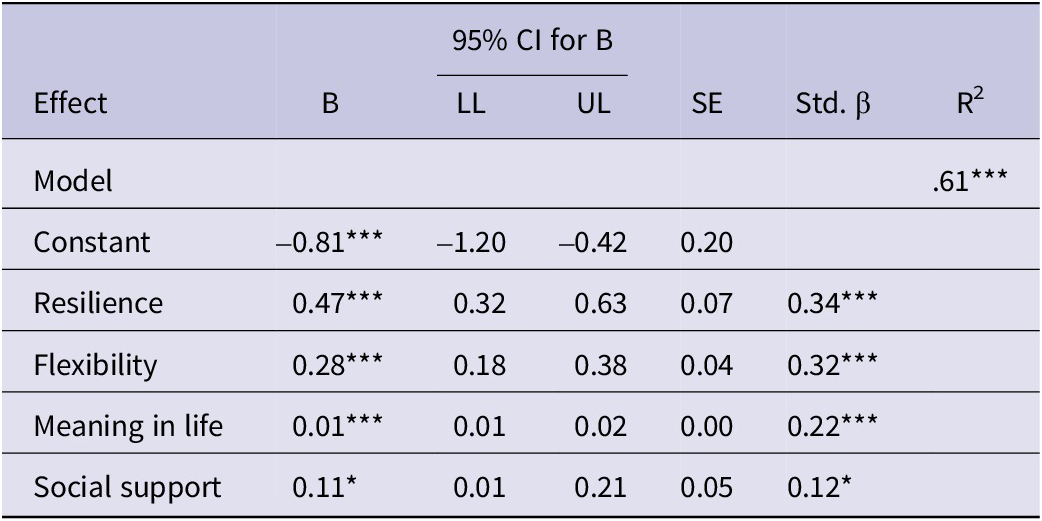
Furthermore, to examine the relative influence of protective factors on posttraumatic growth, a multiple linear regression analysis was conducted using resilience, psychological flexibility, meaning in life, and perceived social support variables as predictors.
The ratio of Durbin Watson test (1.08) showed that there was no relationship between the residuals and the variable and the results of the Modified Breusch-Pagan test were: Chi square = 2.31, df = 1, P = .12 for heteroskedasticity. Also, there is no multicollinearity between predictor variables. As demonstrated in Table 3, the results indicated that resilience, psychological flexibility, meaning in life, and perceived social support collectively explained 61% of the variance in posttraumatic growth. Resilience, psychological flexibility, meaning in life, and perceived social support were found to significantly predict posttraumatic growth.
Multiple linear regression predicting posttraumatic growth of Farsi-speaking refugees in Germany (N = 230)

Note. CI = confidence interval; LL = lower limit; UL = upper limit; df: 225,4
*p <.05. **p <.01. ***p <.001.
The Regression analysis showed that resilience, psychological flexibility, and meaning in life were the strongest predictors of PTG, each contributing substantially to the explanation of its variance, and they appeared to be a key sustainer of posttraumatic growth. Also, perceived social support was likewise a predictor but contributed less than the other factors. This would suggest that personal psychological resources like resilience, psychological flexibility, and meaning in life are more prominent in fostering PTG in this refugee sample.
Discussion
The objective of the present study was to examine the nature of traumatic experiences and the status of emotional distress, as well as to investigate the relationships between protective factors and posttraumatic growth.
All Farsi-speaking refugees and asylum seekers in the study had experienced traumatic events or had witnessed them for family or friends, and had experienced different types of traumatic events. Both male and female participants exhibited high scores on the emotional distress screener. Belz et al.Reference Belz, Belz and Özkan 3 found that most refugees in Germany underwent numerous traumatizing events, and the majority suffered from psychological distress and the symptoms of posttraumatic stress disorder.Reference Belz, Belz and Özkan 3
Female participants exhibited more severe scores on the emotional distress screener, suggesting greater vulnerability to traumatic events. These findings were consistent with previous studies among Syrian refugee women, which reported high scores (90,5) in RHS-15 for emotional distress symptoms of depression, anxiety, and PTSD.Reference Kheirallah, Al-Zureikat and Al-Mistarehi 20 Similarly, Hollander et al.Reference Hollander, Bruce and Burström 21 have shown that refugee women exhibited higher levels of psychological distress than women in high-income countries.Reference Hollander, Bruce and Burström 21 Refugees and asylum seekers in the early years after resettlement have high mental health care needs in comparison to other populations, and there is a discrepancy between their mental health needs and perceived social care.Reference Satinsky, Fuhr and Woodward 4
In addition, the resident status was found to be related to the severity of emotional distress, with asylum seekers experiencing more intense emotional distress than refugees. This confirms findings by Boettcher and NeunerReference Boettcher and Neuner 22 who conducted a study in Germany and found that an insecure resident permit can lead to more severe psychological and mental conditions after resettlement.Reference Boettcher and Neuner 22 Satinsky et al.Reference Satinsky, Fuhr and Woodward 4 found that the emotional distress of newly arrived asylum seekers and refugees is higher than that of other groups.Reference Satinsky, Fuhr and Woodward 4 This revealed that psychological distress is often associated with displacement, and the asylum process leads to challenges of adapting after resettlement.
The present study showed that Afghan and Iranian Farsi-speaking refugees and asylum seekers exhibited high scores on the emotional distress screener, while simultaneously demonstrating mild to moderate scores on the resilience, psychological flexibility, and posttraumatic growth scales. It is well documented that many refugees and asylum seekers are resilient and willing to face numerous challenges in order to find safety and build a future for themselves and their families.Reference Fisseha, Yeop and Yoon 23 Rosner, Powell, and ButolloReference Rosner, Powell and Butollo 24 found that although many refugees experience and witness traumatic events, the majority of survivors do not develop significant mental disorders.Reference Rosner, Powell and Butollo 24 This finding is highly meaningful, given that Tedeschi and CalhounReference Tedeschi and Calhoun 7 demonstrated in their model of posttraumatic growth that mental distress and posttraumatic growth could coexist.Reference Tedeschi and Calhoun 7
Mangelsdorf and EidReference Mangelsdorf and Eid 9 investigated the significant factors associated with posttraumatic growth, including the presence of positive emotions, social support, and the search for meaning in life.Reference Mangelsdorf and Eid 9 All factors were strongly linked to posttraumatic growth and were consistent with the findings of our study.
However, social support was not the primary factor associated with posttraumatic growth. In other words, relationships do not serve as a source of social support and opportunities unless the individual perceives them as suitable and appropriate resources to fulfill their needs.Reference Feeney and Collins 25 In the present study, the scores for perceived social support were relatively low. Kheirallah, Al-Zureikat, and Al-MistarehiReference Kheirallah, Al-Zureikat and Al-Mistarehi 20 found that although many refugees have experienced traumatic events and stressors before and after migration, and have lost their social support, they have high scores in posttraumatic growth, self-resilience, personal strength, and positive spiritual change.Reference Kheirallah, Al-Zureikat and Al-Mistarehi 20
One can posit that the majority of Farsi-speaking refugees who seek asylum enter the host country independently and employ various strategies, including resilience and the search for meaning in life, to persevere. Many have lost their families, friends, and social support networks, necessitating the development of alternative resilience mechanisms and the adaptation to challenging circumstances. In a study conducted in Germany with Farsi-speaking refugees and asylum seekers, Walther et al.Reference Walther, Amann and Flick 10 found that individuals with a stronger sense of meaningfulness and resilience were better able to overcome the challenges of life after resettlement.Reference Walther, Amann and Flick 10 Also, heterogeneity observed in outcomes likely reflects a variation in the severity of trauma experienced prior to migration, variation in psychological symptom levels, status of residency, length of stay, and different levels of individual coping strategies such as resilience, psychological flexibility and meaning in life; hence, standardized interventions may not be adequate, and there may be a need for specialized and individualized mental health strategies.
Future research could help to elucidate the impacts of emotional distress on posttraumatic growth. Additionally, in the present study, we solely concentrated on the associations between protective factors and posttraumatic growth. However, we propose that future research should separately examine the barriers and obstacles that inhibit posttraumatic growth, given that postmigration living difficulties can be considered a traumatic experience. In this study, we considered participants in refugee shelters because these camps themselves present unique environmental difficulties, for example, limited access to social support. Thus, it is also suggested that we investigate differences in psychological distress and posttraumatic growth among asylum seekers in refugee shelters compared to those living in other populations.
Limitations
This study is subject to certain limitations. We only selected individuals residing in the refugee shelters in the states of Berlin and Brandenburg. It is important to note that the participants were selected through convenience sampling, which may result in sampling bias. Additionally, the findings may not be generalizable to other groups than Farsi-speaking refugees. Furthermore, the study design was quantitative based on descriptive and detective methods, which preclude inferences of causality. To gain further insight and a more nuanced comprehension of the circumstances of Farsi-speaking refugees, it is essential to conduct further qualitative investigations.
Conclusion
This study has demonstrated that Farsi-speaking refugees and asylum seekers in Germany are at elevated risk of emotional distress in refugee camps. However, there are protective factors that may serve as significant resources for regulating the process of posttraumatic growth.
At the social and health levels, it is crucial to reduce psychological distress in this group by focusing on interventions through health care providers in refugee camps. At the policy level, the findings indicate the necessity for asylum and refugee policies that promote comprehensive health-related programs to establish equitable conditions in refugee camps. The well-being of refugees can be greatly impacted by decisions made by policymakers and government policies. Thus, it is crucial to conduct further empirical, including qualitative, research across various refugee camps to explore the needs of refugees and asylum seekers during different resettlement phases.
The findings of this study can help to inform recommendations for mental health professionals on how to effectively address the vulnerabilities of Afghan and Iranian refugees, as well as enhance health care and living conditions in refugee camps in order to improve the mental health of refugees.
These results underscore the complicated dynamic between trauma and posttraumatic growth in refugees and the requirement for one to account for both vulnerability and resilience in any exploration of these communities. From a programmatic standpoint, the implications of the results are that the provision of mental health services to Farsi-speaking refugees should not be restricted to the reduction of symptoms but should actively promote posttraumatic growth. Trauma-informed and culturally responsive interventions that have incorporated meaning-making, social support, and resilience-building strategies may be most beneficial. The variability in the mental health outcomes for the refugees also underscores the need for a more flexible approach to interventions rather than a one-size-fits-all strategy.
Funding statement
There is no financial support.
Competing interests
The authors have no personal relationships or competing financial interests to influence the work reported in this paper.
Ethical approval
The study was conducted in accordance with all relevant guidelines and regulations, including the Declaration of Helsinki. Ethical approval has been granted by the independent ethical review board of Witten/Herdecke University (No. S-245/2021).