Introduction
Emotional problems are among the most common problems in the school-aged population (Kovess-Masfety et al., Reference Kovess-Masfety, Husky, Keyes, Hamilton, Pez, Bitfoi and Otten2016; Polanczyk, Salum, Sugaya, Caye, & Rohde, Reference Polanczyk, Salum, Sugaya, Caye and Rohde2015). In Europe, approximately 4% of children have an emotional disorder such as anxiety or depression (Kovess-Masfety et al., Reference Kovess-Masfety, Husky, Keyes, Hamilton, Pez, Bitfoi and Otten2016). In particular, international studies suggest that anxiety and depression affect 6.6% and 2.6%–3.2% of children, respectively, although this prevalence increases in studies conducted with a Spanish sample (Canals-Sans, Hernandez-Martinez, Sáez-Carles, & Arija-Val, Reference Canals-Sans, Hernandez-Martinez, Sáez-Carles and Arija-Val2018; Canals, Voltas, Hernández-Martínez, Cosi, & Arija, Reference Canals, Voltas, Hernández-Martínez, Cosi and Arija2019; Ghandour et al., Reference Ghandour, Sherman, Vladutiu, Ali, Lynch, Bitsko and Blumberg2019; Polanczyk et al., Reference Polanczyk, Salum, Sugaya, Caye and Rohde2015). Comorbidity between anxiety and depression symptoms is also often high in the child population (20%–80%), worsening the prognosis and increasing the use of health services (Cummings, Caporino, & Kendall, Reference Cummings, Caporino and Kendall2014; Melton, Croarkin, Strawn, & McClintock, Reference Melton, Croarkin, Strawn and McClintock2016). Because emotional problems have an early age of onset, preventive interventions with school-age children should be promoted to reduce the risk of more severe disorders in the future (Canals-Sans et al., Reference Canals-Sans, Hernandez-Martinez, Sáez-Carles and Arija-Val2018; Canals et al., Reference Canals, Voltas, Hernández-Martínez, Cosi and Arija2019; Melton et al., Reference Melton, Croarkin, Strawn and McClintock2016).
Preventive cognitive behavioral therapy (CBT)-based interventions have been developed and validated aimed at reducing anxiety symptoms in children and have also shown decreases in depressive symptoms (Ahlen, Lenhard, & Ghaderi, Reference Ahlen, Lenhard and Ghaderi2015; Mychailyszyn, Brodman, Read, & Kendall, Reference Mychailyszyn, Brodman, Read and Kendall2012). These disorders are currently known to share common risk factors and underlying core mechanisms (e.g., negative affectivity and thinking, stress, selective attention, avoidance/withdrawn behavior, etc.) (Bullis et al., Reference Bullis, Sauer-Zavala, Bentley, Thompson-Hollands, Carl and Barlow2015; Craske, Reference Craske2012; Sandín, Chorot, & Valiente, Reference Sandín, Chorot and Valiente2012). Although reductions in co-occurring symptoms may result from disorder-specific therapies, these improvements are not always stable over time (Pearl & Norton, Reference Pearl and Norton2017). In fact, the review and meta-analysis by Werner-Seidler, Perry, Calear, Newby, and Christensen (Reference Werner-Seidler, Perry, Calear, Newby and Christensen2017) suggests that preventive programs targeting anxiety and/or depression in children have obtained significant but small effects at both posttest and follow-up. For this reason, interest in transdiagnostic interventions for emotional problems has increased in recent years, as they address the common processes by several disorders through a single protocol (Cummings et al., Reference Cummings, Caporino and Kendall2014; García-Escalera, Chorot, Valiente, Reales, & Sandín, Reference García-Escalera, Chorot, Valiente, Reales and Sandín2016; Sandín et al., Reference Sandín, Chorot and Valiente2012). Studies have shown that this approach is more efficient and cost-effective for a wide range of patients with comorbid disorders because these can be treated simultaneously rather than sequentially (Bullis et al., Reference Bullis, Sauer-Zavala, Bentley, Thompson-Hollands, Carl and Barlow2015; Farchione et al., Reference Farchione, Fairholme, Ellard, Boisseau, Thompson-Hollands, Carl and Barlow2012). In addition, this approach allows for more flexibility in the implementation of different evidence-based components and may be adjusted by the clinician on a wide variety of problems (Halliday & Ehrenreich-May, Reference Halliday, Ehrenreich-May, Friedberg and Nakamura2020; Wiltsey Stirman & Comer, Reference Wiltsey Stirman and Comer2018).
Recent studies on transdiagnostic programs targeting children with emotional problems have shown promising results in reducing anxiety and depression symptoms, both after the intervention and at follow-up (Kennedy, Halliday, & Ehrenreich-May, Reference Kennedy, Halliday and Ehrenreich-May2020; Martinsen et al., Reference Martinsen, Rasmussen, Wentzel-Larsen, Holen, Sund, Løvaas and Neumer2019; Orgilés, Fernández-Martínez, Espada, & Morales, Reference Orgilés, Fernández-Martínez, Espada and Morales2019; Weersing et al., Reference Weersing, Brent, Rozenman, Gonzalez, Jeffreys, Dickerson and Iyengar2017). Furthermore, some have found positive effects on other comorbid symptoms, such as behavioral problems, peer problems, and hyperactivity (Essau et al., Reference Essau, Olaya, Sasagawa, Pithia, Bray and Ollendick2014; Orgilés et al., Reference Orgilés, Fernández-Martínez, Espada and Morales2019). However, data from these studies were analyzed using variable-oriented statistical approaches, in which the results are presented as an average effect. These approaches are unable to detect heterogeneity of participants and different patterns of response to treatment, thus a person-centered approach is an effective alternative (Jiang, Santos, Mayer, & Boyd, Reference Jiang, Santos, Mayer, Boyd, van der Ark, Bolt, Wang, Douglas and Wiberg2016; Thompson, Macy, & Fraser, Reference Thompson, Macy and Fraser2011). Person-oriented statistical approaches, such as latent class analysis (LCA), classify individuals into distinct subtypes based on their response patterns, grouping those with similar characteristics and different from those in other groups (Jiang et al., Reference Jiang, Santos, Mayer, Boyd, van der Ark, Bolt, Wang, Douglas and Wiberg2016). Membership in each class or latent group may be stable or change over time. Latent transition analysis (LTA) is a longitudinal variant of the LCA that is used to estimate transitions between profiles from one time point to the next (Collins & Lanza, Reference Collins and Lanza2010). LTA can also be conducted to analyze which participant profiles benefit most from interventions, even if the whole sample did not seem to benefit (Jiang et al., Reference Jiang, Santos, Mayer, Boyd, van der Ark, Bolt, Wang, Douglas and Wiberg2016; Thompson et al., Reference Thompson, Macy and Fraser2011).
Analyses employing LTA may be especially useful for monitoring children's progress after the implementation of preventive interventions, but few studies have used this strategy to evaluate programs (Collins & Lanza, Reference Collins and Lanza2010; Jiang et al., Reference Jiang, Santos, Mayer, Boyd, van der Ark, Bolt, Wang, Douglas and Wiberg2016). Early detection of individuals who exhibit slow trajectories or limited symptom change is key to tailoring interventions to make them more targeted and parsimonious (Kennedy et al., Reference Kennedy, Halliday and Ehrenreich-May2020). One of the few studies that examined the trajectories of change in a transdiagnostic treatment for anxiety and depression in youth yielded three latent classes: a high severity group that exhibited rapid improvement and two groups, moderate and low severity, with steady improvement (Kennedy et al., Reference Kennedy, Halliday and Ehrenreich-May2020). Possible indicators that influence response to treatment, such as sociodemographic variables, have also been explored. Research has found that older age was associated with more severe symptoms and modest improvement, and that girls were more likely to manifest more pronounced emotional symptoms than boys, but boys had a delayed response to treatment (Kennedy et al., Reference Kennedy, Halliday and Ehrenreich-May2020; Maalouf et al., Reference Maalouf, Porta, Vitiello, Emslie, Mayes, Clarke and Keller2012; Skriner et al., Reference Skriner, Chu, Kaplan, Bodden, Bögels, Kendall and Barker2019). Distinguishing across different disorders, previous research has mostly found that children with generalized anxiety disorder (GAD) responded better to CBT-based programs than children with other anxiety problems, such as social anxiety (SA) (Hudson et al., Reference Hudson, Rapee, Lyneham, McLellan, Wuthrich and Schniering2015; Kodal et al., Reference Kodal, Fjermestad, Bjelland, Gjestad, Öst, Bjaastad and Wergeland2018). Therefore, other interventions, such as the Super Skills for Life program, may be particularly helpful for this group due to the exposure and social skills training elements (Essau et al., Reference Essau, Olaya, Sasagawa, Pithia, Bray and Ollendick2014).
To our knowledge, to date, no studies have analyzed the trajectories of change in the evaluation of a transdiagnostic preventive program aimed at children with emotional problems. For this reason, the current study aimed to explore the different profiles in a sample of Spanish children who participated in the Super Skills for Life (SSL) program, a transdiagnostic protocol for the prevention of anxiety and depression in children at risk (Essau et al., Reference Essau, Olaya, Sasagawa, Pithia, Bray and Ollendick2014). Although this program has proven to be effective in reducing emotional symptoms and other comorbid problems (Essau et al., Reference Essau, Olaya, Sasagawa, Pithia, Bray and Ollendick2014; Orgilés et al., Reference Orgilés, Fernández-Martínez, Espada and Morales2019), this research aimed to identify which profile of individuals benefited most from the intervention and the likelihood of transition of symptom patterns over time. In addition, the influence of some sociodemographic variables (age, gender, and number of siblings) on class membership and trajectories of change was examined. We hypothesized that most children who exhibit low symptoms initially will remain in this profile, the program will address some anxiety disorders which have not been adequately treated in previous interventions, and older age and female gender will be associated with higher emotional symptoms throughout the assessments (Hudson et al., Reference Hudson, Rapee, Lyneham, McLellan, Wuthrich and Schniering2015; Kennedy et al., Reference Kennedy, Halliday and Ehrenreich-May2020; Kodal et al., Reference Kodal, Fjermestad, Bjelland, Gjestad, Öst, Bjaastad and Wergeland2018; Maalouf et al., Reference Maalouf, Porta, Vitiello, Emslie, Mayes, Clarke and Keller2012; Skriner et al., Reference Skriner, Chu, Kaplan, Bodden, Bögels, Kendall and Barker2019).
Method
Participants
This study involved an incidental sample of 119 children aged 8–12 years old (42.9% were female). Group mean age was 9.39 (SD = 1.26) and the mean number of siblings for this sample was 1.06 (SD = .58; range = 0–3). Most of the children were born in Spain (96.6%) and the rest in the United States, Austria, Polonia, and Russia, but all of them were Spanish-speaking. Children were recruited from nine schools located in the south-east of Spain. Schools were selected based on their availability and their representativeness of the socioeconomic structure of the Spanish population. Middle and high socioeconomic class predominated in this sample.
Inclusion criteria to participate were: (a) children aged 8–12 years old and (b) who reached or exceeded a cut-off point of four on the Emotional symptoms (i.e., anxiety and depression) subscale of the Strengths and Difficulties Questionnaire – parent version (SDQ-P; Goodman, Reference Goodman2001) which indicates the presence of pronounced symptoms, and the risk of anxiety and/or depression disorders. Exclusion criteria were that the children (a) had a psychiatric/psychological diagnosis already established or (b) were receiving pharmacological or psychological treatment for their psychological problems.
Measures
Sociodemographic data
Children provided sociodemographic data, including gender, age, and number of siblings.
Screening for emotional symptoms
The SDQ-P (Goodman, Reference Goodman2001) is a 25-item screening instrument that assesses emotional and behavioral problems and prosocial behavior in children and adolescents. The questionnaire consists of five scales: Emotional symptoms, Conduct problems, Hyperactivity/inattention, Peer problems, and Prosocial behavior. Items are rated on a 3-point scale ranging from 0 (not true) to 2 (certainly true). Only the Emotional symptoms score was used in this study for participant selection purposes. Following the original three-band categorization, cut-off scores of 4 or above were established, corresponding to the borderline and abnormal categories. These bands represent the presence of anxious and depressive symptoms in children, which increase the risk of developing more severe difficulties (Goodman, Reference Goodman2001). Thus, children included in these bands were selected to receive the program. The Spanish parent version showed a Cronbach alpha coefficient of .71 for the Emotional symptoms subscale (Rodríguez-Hernández et al., Reference Rodríguez-Hernández, Betancort, Ramírez-Santana, García, Sanz-Álvarez and De las Cuevas-Castresana2012). In the current study, ordinal alpha of the Emotional symptoms subscale was .72.
Depression
The Child Depression Inventory (CDI; Kovacs, Reference Kovacs2003) assesses depressive symptoms experienced in the past two weeks in children aged 7–17. Twenty-seven items assess two dimensions: dysphoria (17 items) and negative self-esteem (10 items). Ratings from 0 to 2 indicate symptom severity. The CDI total score is obtained by summing all the items (range: 0–54). Higher scores indicate more severe symptoms of depression. The severity cut-off point is set at 19 or above (Figueras, Amador-Campos, Gómez-Benito, & Gándara, Reference Figueras, Amador-Campos, Gómez-Benito and Gándara2010). The Spanish version of the CDI has good internal consistency (α = .79) and psychometric properties (Del Barrio & Carrasco, Reference Del Barrio and Carrasco2004). Ordinal alpha for the current sample was .91.
Anxiety
The Screen for Child Anxiety Related Emotional Disorders (SCARED; Birmaher et al., Reference Birmaher, Brent, Chiappetta, Bridge, Monga and Baugher1999) is a 41-item self-report questionnaire that measures the frequency with which symptoms of the most common anxiety disorders occur in children, via five subscales: panic disorder or significant somatic symptoms, generalized anxiety, separation anxiety, social anxiety, and school anxiety. Responses are made via a 3-point rating scale, ranging from 0 (never or almost never) to 2 (often). The total score is obtained by summing scores for each subscale (scores range from 0–82). Higher scores denote more severe symptoms. A cut-off score at or above 25 indicates the presence of clinically significant anxiety problems (Canals, Hernández-Martínez, Cosi, & Domènech, Reference Canals, Hernández-Martínez, Cosi and Domènech2012). The Spanish version of SCARED has good psychometric properties, with acceptable reliability (global Cronbach's alpha of 0.83, and .44–.72 for the subscales) (Doval, Martınez, & Domenech-Llaberia, Reference Doval, Martınez and Domenech-Llaberia2011). Ordinal alpha for SCARED in the current sample was .92.
The accepted cut-off points based on the literature were used to categorized variables, as suggested (Schellingerhout, Heymans, de Vet, Koes, & Verhagen, Reference Schellingerhout, Heymans, de Vet, Koes and Verhagen2009). This decision was based on at least three reasons: (a) sample in this study is subclinical (i.e., skewed distributions, extreme values), (b) sample size is small (i.e., small groups), and (c) the use of categorical variable facilitates the understanding, simplifies the model and the application in clinical practice (i.e., comparison between children with clinically significant symptoms vs. those who do not present them) (see Royston, Altman, & Sauerbrei, Reference Royston, Altman and Sauerbrei2006).
Procedure
The Ethics Committee of the authors’ institution approved this work (DPS.MO.02.14). Principals of nine schools in southeast Spain were contacted. A total of 2,700 families of children aged 8–12 were invited to participate in the study. Parents of 2,519 (93.3%) children did not respond the screening survey to identify those with emotional symptoms. A total of 181 participants’ parents responded to the screening survey. Of them, 119 children met the criteria and responded the pretest evaluation and received SSL program. Participants were evaluated at baseline (pre-intervention), immediately after receiving the program, and 12 months post-intervention. All the children's parents signed an informed consent to get involve in the study. No incentives were provided, and participation was voluntary.
Super Skills for Life intervention
The SSL is a transdiagnostic CBT-based program that addresses anxiety and depression symptoms and other comorbid difficulties (Essau et al., Reference Essau, Olaya, Sasagawa, Pithia, Bray and Ollendick2014). The SSL program was originally developed in the United Kingdom and was translated into European-Spanish and culturally adapted for the Spanish population by two bilingual researchers from the authors’ institution. Prior to the intervention, six psychologists (all women) were trained as program facilitators in a one-day workshop by the researchers in charge of the study. They all had a master's degree in child and adolescent psychology and at least 2 years’ experience. In this workshop, the objectives, contents, methodology, and materials of each session of the program were presented, as well as contingency management strategies with the children. In addition, the facilitators received an implementation manual and weekly meetings were held with them to ensure the implementation fidelity, resolve doubts, and provide materials.
The SSL intervention consisted of eight 60-minute group sessions and was delivered in the afternoon at the children's schools, once a week. During the sessions, the children learned skills such as identifying and managing their emotions and those of others, cognitive reappraisal (e.g., detecting and changing negative thoughts), relaxation strategies, social skills training, self-monitoring through video-feedback with cognitive preparation, problem-solving strategies and behavioral activation (e.g., involving positive and reinforcing activities, how to develop new skills). The children's active engagement (e.g., attendance, participation, doing/trying homework, respecting/supporting peers) was rewarded by the facilitators through social reinforcement, colorful stickers, and stamps on the workbook. After each session, the children were given a Super-Task (homework) to reinforce and practice the skills they had learned. Parents were informed weekly of their children's progress through email information (i.e., objectives addressed, exercises practiced and guidelines to reinforce the skills learned) and they received a final report on the results obtained after the program.
Statistical analysis
Latent transition analysis
LTA was computed with Mplus 8 (Muthén & Muthén, Reference Muthén and Muthén1998–2017). For model estimation, robust maximum likelihood estimation (command MLR in Mplus) was chosen with 500 sets of random start values. Initially, the ideal number of latent statuses was determined at baseline and then tested for each consecutive time point (posttest, follow-up); a model with fixed indicator probabilities across time was tested to examine latent transitions over time (Collins & Lanza, Reference Collins and Lanza2010). Due to the small sample size, predictors of latent statuses and changes were examined post hoc to reduce model complexity. For each time point the estimation started with two latent classes indicating high and low symptomatology, and the number of latent classes was increased up to five.
The number of latent classes was selected based on indicators of overall model fit, parameter sparseness, classification quality, and theoretical tenability (Nylund, Asparouhov, & Muthén, Reference Nylund, Asparouhov and Muthén2007; Tomczyk, Isensee, & Hanewinkel, Reference Tomczyk, Isensee and Hanewinkel2016, Reference Tomczyk, Schomerus, Stolzenburg, Muehlan and Schmidt2018). The bootstrapped likelihood ratio test (BLRT) was chosen as an overall fit measure that compares the estimated model to a model with one less class: a significant value indicates better fit of the current model. We chose 50 random starts with 20 bootstrap draws for each comparison. For parameter sparseness, the Akaike information criterion (AIC) and the sample-size adjusted Bayes information criterion (BIC) were reported, where a lower value indicates a sparser model. As indicators of classification quality, Average latent class probabilities (ALCP) and entropy were chosen. Their values range from 0 and 1, the closer to 1 the better the fit; a value of at least .7 is recommended (Nylund et al., Reference Nylund, Asparouhov and Muthén2007). As a final criterion, classes were chosen on grounds of their compatibility with the literature and the theoretical background.
Finally, for the selected models, logistic regression models examined associations with sociodemographic data as well as depression and anxiety scores at baseline using Stata 15 (StataCorp, Reference StataCorp2017). Adjusted odds ratios (AOR) for predictor variables were informed. All analyses were based on α = 0.05.
Between-groups differences in CDI total score and SCARED subscales at baseline, posttest, and the follow-up were analyzed using Mann–Whitney U tests due to the lack of normality. Non-parametric effect sizes were reported as Rosenthal's r, for which common thresholds are small (0.1), medium (0.3), and large (0.5) (Rosenthal, Reference Rosenthal1986). Between-groups differences in sociodemographic variables (gender, age, and number of siblings) at baseline, posttest, and the follow-up were analyzed using χ2, and Cramer's V as effect size coefficients, for which common thresholds are very strong (>0.25), strong (>0.15), moderate (>0.10), weak (>0.05), and no or very weak (<0.05) (Akoglu, Reference Akoglu2018).
Results
Latent transition analysis
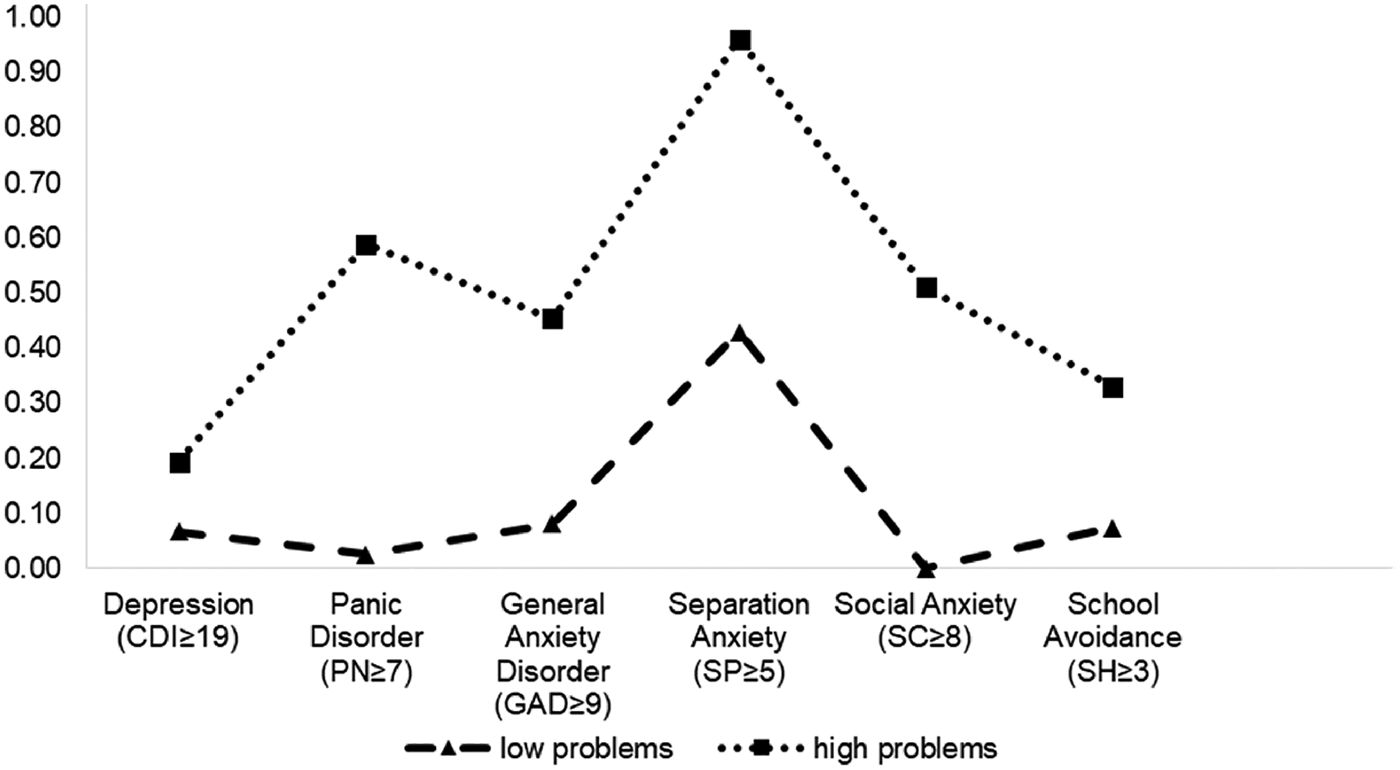
In the first step, models with two to five latent statuses were calculated for each time point, using dichotomized scales of the CDI and the five SCARED subscales (see supplementary Tables S1–S3 for model fit estimates). For each scale, cut-off was based on the literature to identify children with clinically relevant symptoms of depression and anxiety (Birmaher et al., Reference Birmaher, Brent, Chiappetta, Bridge, Monga and Baugher1999; Kovacs, Reference Kovacs2003). Across all three time points, two latent statuses had the best model fit with a sufficient entropy (see supplementary Tables S1–S3). An examination of latent statuses further supported the decision, as two latent classes showed distinct differences between children with low symptoms and high symptoms (Figure 1), with separation anxiety disorder being most prevalent across groups.
Response probabilities for two latent classes of depressive (children's depression inventory [CDI]) and anxiety symptoms (panic disorder [PN], generalized anxiety disorder [GAD], separation anxiety [SP], social anxiety [SC], school avoidance [SH]) (cut-offs are printed for each scale) in a sample of Spanish adolescents (N = 119).

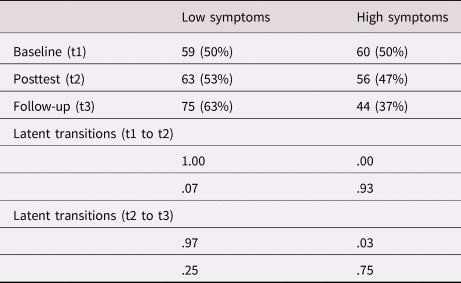
At baseline, both classes were almost equal in number, but the group with low symptoms increased over time, thus indicating a trend in reduction of symptoms (see Table 1). Regarding latent transitions, the group with low symptoms remained stable, whereas 7% (baseline to posttest) and 25% (posttest to follow-up) of children with high symptoms reduced their symptomatology. Noticeably, these changes were much larger from posttest to follow-up of the program, pointing to potential long-term effects.
Prevalence of latent status at baseline (t1), posttest (t2), and follow-up (t3) as well as latent transitions over time

In the second step, binary logistic regression models examined baseline predictors of latent statuses at follow-up (low vs. high problems). Among sociodemographic predictors of latent statuses, higher baseline age was connected to lower problems at follow-up (AOR = .66 [0.48; 0.91]), the remaining coefficients did not reach statistical significance (further results available upon request). A change variable was then created by coding (a) reduction (i.e., moving to a status with fewer symptoms over time), (b) increase (i.e., moving to a status with more symptoms over time), and (c) stability (i.e., either remaining at one status over time or moving back to the original t1 status at follow-up t3). Overall, most children reported stability (n = 99; 83%), followed by reduction (n = 18; 15%) and increase (n = 2; 2%). Due to low cell counts, increase was excluded for subsequent analyses, so that change was reflected by a binary variable [0 (stability), 1 (reduction)].
Bivariate correlations between change, depression and anxiety scores point to significant associations between symptom reduction and higher baseline levels of panic disorder (r = .21, p < .05), generalized anxiety disorder (r = .23, p < .05), as well as social anxiety (r = .29, p < .01). A binary logistic regression predicting change by baseline values of said psychiatric symptoms, and controlling for age showed that children with higher social anxiety at baseline were more likely to reduce their symptoms over time (AOR = 1.23 [1.00; 1.52]; p = .046).
Association between sociodemographic variables and latent classes
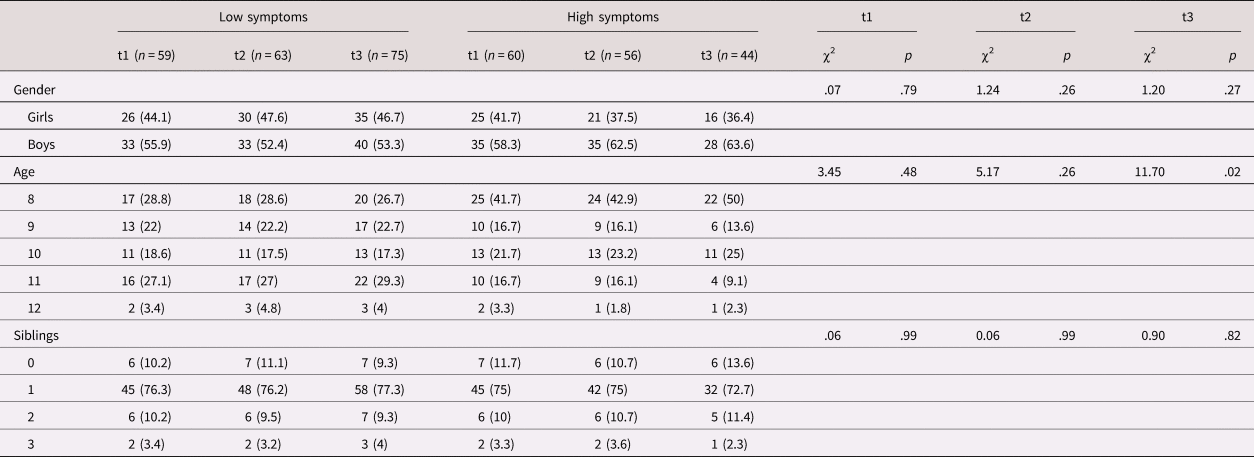
Table 2 indicates that children in the low symptoms group and children in the high symptoms group were equivalent in gender, mean age, and mean number of siblings at baseline, posttest, and the follow-up, except for age in the follow up. The proportion of children aged 8 was higher in the high symptoms group, compared to the low symptoms group. However, the proportions of children aged 11 and 12 were higher in the low symptoms group (p ≤ .05; Cramer's V = 0.31), compared to the high symptoms group. The effect size was very strong, according to Akoglu (Reference Akoglu2018).
Results of the chi-square associating sociodemographic variables and latent class memberships, n (%), at baseline (t1), posttest (t2), and follow-up (t3)

Association between the subscales of the CDI and SCARED subscales and latent classes
Table 3 presents means, standard deviations for CDI and subscales between both latent class groups and results of the Mann–Whitney U tests. Statistically significant differences were observed for CDI total score and SCARED subscales between both comparison groups at baseline, posttest, and follow-up. As expected, the high symptoms group showed higher mean scores in all main outcomes compared to the low symptoms group in the three time points. Effect sizes ranged from medium (r = .23) to large (r = .63).
Results of the Mann–Whitney U test associating CDI and SCARED subscales, and latent class memberships, means (M) and standard deviations (SD), at baseline (t1), posttest (t2), and follow-up (t3)

M = mean; SD = standard deviation. *p ≤ .05; **p ≤ .01; ***p ≤ .001.
Discussion
This study was conducted applying a longitudinal person-oriented approach called LTA to a sample of Spanish children who received the SSL program to reduce their anxiety and depression symptoms. Using this approach, our purpose was to explore different latent classes or symptom profiles and analyze individuals’ transitions between these classes from baseline to posttest and one-year follow-up. These analyses allowed us to identify which subgroups of children benefited most from the SSL program based on their symptoms. In addition, gender, age, and number of siblings were added as possible sociodemographic variables associated with class membership and transition.
Results from LTA revealed the presence of two latent profiles depending on the severity of the anxiety and depression symptoms: Low symptoms group (children with low risk and normative scores) and High symptoms group (children with high scores in all primary outcomes). In contrast, other studies that have explored the latent classes in the evaluation of intervention programs with schoolchildren have found moderate risk/severity groups in addition to the high and low groups (Jiang et al., Reference Jiang, Santos, Mayer, Boyd, van der Ark, Bolt, Wang, Douglas and Wiberg2016; Kennedy et al., Reference Kennedy, Halliday and Ehrenreich-May2020; Thompson et al., Reference Thompson, Macy and Fraser2011). This may be due to the small size or heterogeneity of our sample, since it is a specifically selected sample and children with less severe or moderate symptoms could not be well-represented. Moreover, we used cut-offs to classify symptoms, which is more rigorous. At the beginning of the SSL intervention, the percentage of children in each group was equivalent, but across the time points, the reduction in symptoms resulted in some of the high-symptom children switching into the low-symptom group. This improvement was greater one year after the intervention than between baseline and posttest, and finally only 37% of the sample exhibited elevated symptoms, which is evidence of the long-term effectiveness of the program (Essau et al., Reference Essau, Olaya, Sasagawa, Pithia, Bray and Ollendick2014; Orgilés et al., Reference Orgilés, Fernández-Martínez, Espada and Morales2019). As in previous studies, the profile of children with low symptoms remained steady and stable (Jiang et al., Reference Jiang, Santos, Mayer, Boyd, van der Ark, Bolt, Wang, Douglas and Wiberg2016; Kennedy et al., Reference Kennedy, Halliday and Ehrenreich-May2020). These data suggest that the program aids children in following a healthy mental development pathway over time.
After examining the latent statuses obtained according to the disorders, it was found that separation anxiety (SAD) was the most prevalent among both groups. This contrasts with previous studies on childhood anxiety, which found a higher predominance of generalized anxiety disorder (GAD) (Canals et al., Reference Canals, Voltas, Hernández-Martínez, Cosi and Arija2019; Hudson et al., Reference Hudson, Rapee, Lyneham, McLellan, Wuthrich and Schniering2015; Kodal et al., Reference Kodal, Fjermestad, Bjelland, Gjestad, Öst, Bjaastad and Wergeland2018). A possible reason could be the age range of our sample, since SAD is more frequent in young children and GAD is usually higher in older children and adolescents (Canals et al., Reference Canals, Voltas, Hernández-Martínez, Cosi and Arija2019; Mohammadi et al., Reference Mohammadi, Pourdehghan, Mostafavi, Hooshyari, Ahmadi and Khaleghi2020; Vicente et al., Reference Vicente, De La Barra, Saldivia, Kohn, Rioseco and Melipillan2012). These previous studies also indicated that children with social anxiety (SA) experienced slower change and poorer results in the short and long term than children with other anxiety disorders (Hudson et al., Reference Hudson, Rapee, Lyneham, McLellan, Wuthrich and Schniering2015; Kodal et al., Reference Kodal, Fjermestad, Bjelland, Gjestad, Öst, Bjaastad and Wergeland2018). However, our study showed completely opposite results, with children with SA benefiting most from the program. This may be due to the fact that these generic CBT-based interventions do not address the specific characteristics of children with SA, even though some do include social skills training (Hudson et al., Reference Hudson, Rapee, Lyneham, McLellan, Wuthrich and Schniering2015; Kodal et al., Reference Kodal, Fjermestad, Bjelland, Gjestad, Öst, Bjaastad and Wergeland2018). The SSL program includes, in addition to social skills training, the video-feedback with cognitive preparation component, which has been shown to improve social competence, decrease signs of anxiety, and modify children's negative thinking (Orgilés, Melero, Fernández-Martínez, Espada, & Morales, Reference Orgilés, Melero, Fernández-Martínez, Espada and Morales2020). Therefore, although the children who participated in the SSL program reduced their symptoms of the different anxiety disorders (Orgilés et al., Reference Orgilés, Fernández-Martínez, Espada and Morales2019), those with greater SA at baseline showed greater improvement over time (p = .046). These findings may be of great interest in cases where other interventions have been unsuccessful with children with SA and comorbid problems (Jiang et al., Reference Jiang, Santos, Mayer, Boyd, van der Ark, Bolt, Wang, Douglas and Wiberg2016; Werner-Seidler et al., Reference Werner-Seidler, Perry, Calear, Newby and Christensen2017).
Based on previously identified patterns, we hypothesized that age, gender, and number of siblings would vary across subgroups. Our results showed that the proportion of older children in the high symptoms group decreased over time. This indicates that older children were more likely to improve rapidly one year after the intervention compared to younger children. These results are consistent with the study by Skriner et al. (Reference Skriner, Chu, Kaplan, Bodden, Bögels, Kendall and Barker2019), as older age was associated with more rapid improvement in youth receiving CBT for anxiety (Barry, Yeung, & Lau, Reference Barry, Yeung and Lau2018). However, they differ from the findings on the transdiagnostic treatment by Kennedy et al. (Reference Kennedy, Halliday and Ehrenreich-May2020) in which older children exhibited higher symptoms, but this research used a clinical sample and did not examine long-term outcomes. The rapid response to the SSL intervention could be explained by the fact that in late childhood, more active coping tends to develop, and therefore older children are provided with more coping strategies in anxiety-provoking situations (Eschenbeck, Schmid, Schröder, Wasserfall, & Kohlmann, Reference Eschenbeck, Schmid, Schröder, Wasserfall and Kohlmann2018). For this reason, it is important to implement preventive interventions at these ages to decrease the incidence of more severe emotional problems (Canals-Sans et al., Reference Canals-Sans, Hernandez-Martinez, Sáez-Carles and Arija-Val2018; Canals et al., Reference Canals, Voltas, Hernández-Martínez, Cosi and Arija2019; Martinsen et al., Reference Martinsen, Rasmussen, Wentzel-Larsen, Holen, Sund, Løvaas and Neumer2019; Melton et al., Reference Melton, Croarkin, Strawn and McClintock2016).
Gender was not a significant predictor of class membership at any of the three-time points in this study. However, previous studies have found that girls showed a tendency to maintain greater internalizing problems, but the trajectory of change was slower in boys (Kennedy et al., Reference Kennedy, Halliday and Ehrenreich-May2020; Skriner et al., Reference Skriner, Chu, Kaplan, Bodden, Bögels, Kendall and Barker2019). The lack of gender differences may be because our sample did not include adolescents, and at this stage the vulnerability to depressive symptoms and comorbidity with anxiety increases, especially in girls (Canals-Sans et al., Reference Canals-Sans, Hernandez-Martinez, Sáez-Carles and Arija-Val2018; Canals et al., Reference Canals, Voltas, Hernández-Martínez, Cosi and Arija2019; Melton et al., Reference Melton, Croarkin, Strawn and McClintock2016). No differences were detected according to the number of siblings, since the presence of psychopathology in children can be influenced by the quality of the relationship between siblings, rather than the number of siblings (Buist, Deković, & Prinzie, Reference Buist, Deković and Prinzie2013).
The findings of this study should be interpreted considering some limitations. The relatively small sample size may have limited the capture of other latent profiles of children with different symptoms or severity of symptoms. In addition, it should be noted that the sample in this study was subclinical, thus it may not have covered the extensive range of severity of the disorders measured. Dichotomization of continuous variables may have some methodological disadvantages; however, it is widespread in clinical research due to its advantages (e.g., easy interpretation, when using nonrepresentative samples) (Royston et al., Reference Royston, Altman and Sauerbrei2006). Participants were recruited from a specific area of Spain, which raised issues related to the representativeness and generalization of the results. The analyses were conducted on the basis of the children's self-reports, since at these ages they are good informants of their internalizing problems (Canals-Sans et al., Reference Canals-Sans, Hernandez-Martinez, Sáez-Carles and Arija-Val2018; Canals et al., Reference Canals, Voltas, Hernández-Martínez, Cosi and Arija2019). Future studies should include a multi-informant assessment to confirm the results obtained (Kennedy et al., Reference Kennedy, Halliday and Ehrenreich-May2020).
This is the first study that employs LTA to examine the latent profiles of symptoms and the transitions between them over time for children receiving a transdiagnostic prevention program aimed at emotional problems. Despite the limitations discussed above, our study contributes to research and clinical practice on children's mental health. Furthermore, the findings may be of substantial interest to community mental health services to guide interventions planning based on some indicators at baseline. This study provides information to consider when implementing preventive interventions for schoolchildren and to tailor them according to the characteristics of the target population, in order to increase their effectiveness.
Supplementary Material
The supplementary material for this article can be found at https://doi.org/10.1017/S0954579421000249
Acknowledgments
We would like to thank the children and their families for their participation and the schools and facilitators for their collaboration in the study.
Funding Statement
This work was supported by the Ministry of Education, Culture and Sport of Spain (FPU16/02157), and the Ministry of Economy and Competitiveness (MINECO) of Spain (PSI2017-85493-P).
Conflicts of Interest
None.