Introduction
Microwave and radio frequency sensors have been successfully designed for humidity monitoring applications, that address material moisture content, the food industry, environmental detection, health care and intelligent packaging [Reference Virtanen, Ukkonen, Björninen, Elsherbeni and Sydänheimo1–Reference Feng, Xie, Chen and Zheng6]. These sensors provide a robust, real-time and nondestructive measurement platform for passive microwave sensing. In particular, compared with single resonator sensors, differential microwave sensors can mitigate the effects of cross-sensitivity caused by environmental factors and can thus provide higher detection accuracy and sensitivity [Reference Ebrahimi, Scott and Ghorbani7–Reference Vélez, Muñoz-Enano and Martín9]. However, because differential sensors have two relatively independent resonators, this may lead to complex and bulky sensors. Recently, substrate integrated waveguide (SIW)-based resonators are being considered for compact microwave humidity sensors due to their merits of compact size, simple manufacturing process, low radiation loss, high humidity sensing performance and good stability [Reference Chen, Xu and Yao10–Reference Wei, Huang, Li, Li, Liu and Ni12]. In [Reference Matbouly, Boubekeur and Domingue13, Reference Benleulmi, Boubekeur and Massicotte14], SIW-based resonators with simple structures were demonstrated to achieve a good humidity response by introducing a sensitive region inside the cavity in a certain humidity range. To further reduce the dimensions of the sensors, half-mode SIW and quarter-mode SIW structures were used to achieve miniaturization while maintaining excellent humidity sensing performance [Reference Chen, Xu and Yao15, Reference Jones, Zarifi and Daneshmand16]. Nevertheless, these abovementioned SIW-based sensors are fabricated on rigid substrates such as RO4350, ceramics and Teflon, which constrains their applications in sensing fields where the geometric shapes of the materials under test are not flat. For instance, in the context of real-time monitoring of the relative humidity (RH) level of human skin or the ambient humidity surrounding the human body, the potential applications would involve the evaluation of human physiological health conditions. Split ring resonator-based pressure sensor arrays are successful examples of flexible microwave sensors that can be applied to human health monitoring [Reference Dijvejin, Kazemi, Zarasvand, Zarifi and Golovin17]. In other applications, such as the early detection of coating breaches in steel pipelines, flexible sensors are also required to conform with the geometrical cylindrical structure [Reference Zarifi, Deif, Abdolrazzaghi, Chen, Ramsawak, Amyotte, Vahabisani, Hashisho, Chen and Daneshmand18]. These studies have provided valuable guidance for the design of high-performance flexible microwave sensors.
It is well known that a substrate with flexible mechanical properties is a key component for fabricating flexible microwave sensors. Several flexible substrates including paper [Reference Li, Wang, Lu and Liu19, Reference Ullah, Islam, Alam and Ashraf20], liquid crystal polymer [Reference Kao, Cho, Zhang, Chang, Wei, Dai and Chiu21, Reference Jilani, Munozc, Abbasi and Alomainy22], polyimide (PI) [Reference Peng, Qu, Xia and Yang23, Reference Russell, Swithenbank, Wood, Burnett, Li, Linfield, Davies and Cunningham24], and polyethylene terephthalate (PET) [Reference Guo, Hang, Xie, Wu, Gao and Liu25, Reference Castro and Sharma26] have been successfully developed into flexible antennas with good performance. Among these materials, PI possesses excellent RF characteristics and low dissipation factors [Reference Wang, Qin, Chen, Yang and Qu27, Reference McGibney, Barton, Floyd, Tassie and Barrett28], so it has become a candidate substrate for the design of microwave humidity sensors [Reference Chang, Kim, Kim and Yoon29, Reference Salas-Sánchez, López-Martín, Rodríguez-González and Ares-Pena30]. However, in these works, the effects of bending behaviors on the humidity sensing performance have not been systematically studied. Moreover, to date, few researchers have investigated PI-based compact flexible SIW humidity sensors.
On the other hand, humidity sensors are usually integrated with sensing material to achieve high sensitivity. From this perspective, a variety of humidity sensing material including zero-dimensional fullerenes (C60) [Reference Radeva, Georgiev, Spassov, Koprinarov and Kanev31], carbon nanotubes [Reference Su and Tsai32], nanodiamonds (NDs) [Reference Yao and Xue33] and graphene oxide [Reference Yuan, Tai, Ye, Liu, Xie, Du and Jiang34, Reference Kuznetsova, Anisimkin, Kolesov, Kashin, Osipenko, Gubin, Tkachev, Verona, Sun and Kuznetsova35] have been successfully employed to implement impedance-type or capacitance-type humidity sensors at low frequencies. ND, which is regarded as a functional nanocarbonaceous material, has recently gained increasing interest for the fabrication of humidity and gas sensors due to its excellent electronic, water adsorption capacity and chemical properties [Reference Ahmad, Parada and Jackman36, Reference Williams, Nesladek, Daenen, Michaelson, Hoffman, Osawa, Haenen and Jackman37]. ND provides a high Young's modulus, large surface area and rich surface groups (carboxyl and hydroxyl groups) [Reference Mochalin, Shenderova, Ho and Gogotsi38]. This makes it a particularly promising and attractive sensing material for environmental monitoring applications. For example, Ahmad et al. investigated gas sensing characteristics by coating ND films on a silicon cantilever array; the gas chemisorption of ND films then resulted in an increase in its mass, accordingly changing the resonant frequency of the sensor [Reference Ahmad, Parada, Hudziak, Chaudhary and Jackman39]. In 2014, Yao et al. designed novel QCM humidity sensors using ND material as sensing films and found that the ND-coated humidity sensors exhibited outstanding humidity response owing to the large specific surface area of NDs in the presence of water molecule adsorption [Reference Yao, Chen, Ma and Ling40]. More recently, a flexible wearable humidity sensor with ND sensing films has been demonstrated highly sensitive characteristics [Reference Yu, Chen, Yu, Chen, Ding and Zhao41]. However, it is worth noting that most of the ND-coated sensors studied in the literature operated under either low resonant frequencies or direct current (DC) conditions. To the best of our knowledge, few works have developed flexible SIW-based humidity sensors based on ND sensing materials.
Herein, we propose a high-sensitivity and low-humidity hysteresis flexible SIW humidity sensor using NDs as sensing films in the C-band frequency range. Using simple printed circuit board (PCB) processes, three humidity sensor prototypes with different bending radii are fabricated on PI substrates, and their humidity sensing properties are comparatively analyzed and discussed.
Theory and design
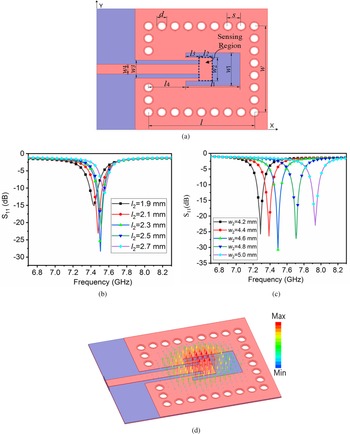
Figure 1(a) shows the planar geometrical structure of the proposed microwave humidity sensor. It consists of an SIW cavity with a feeding microstrip line, a rectangular patch, and a U-shaped slot that is etched on the top metal layer. The substrate is PI with ɛ r = 3.5 and tan δ = 0.0009, and the thickness is 0.13 mm. The length and width of the SIW cavity can be determined based on the design theory of SIWs [Reference Cassivi, Perregrini, Arcioni, Bressan, Wu and Conciauro42]. To ensure that the resonator can obtain the best S 11 and have the strongest electric field distribution in the sensing region, the length l 2 of the rectangular patch, the width w 2 of the rectangular patch, and the depth l 1 of the U-shaped slot are carefully optimized by using high frequency structure simulator tools. The reflection parameters of the resonator are mainly affected by l 2 and w 2. Figures 1(b) and 1(c) shows the frequency curves with different lengths l 2 and w 2. These figures show that when the optimal values of l 2 and w 2 are 2.3 and 4.6 mm, respectively, the magnitude of S 11 reaches the maximum value. Since the loss of the resonator can be characterized by S 11, the optimal geometric size of the sensor at a resonant frequency of 7.5 GHz can be obtained by comparing the S 11 of the corresponding simulated curves. Table 1 lists the general physical parameters of the proposed resonator. Figure 1(d) also displays the simulated vector curves of the electric field distribution of the SIW cavity at 7.5 GHz. The electric field is mainly concentrated in the metal patch region, indicating that the patch region is the best geometric location for depositing the sensing films to enhance the humidity response, as shown in the dotted box in Fig. 1(a).
The proposed sensor model and the simulated results. (a) Structure of the SIW resonator. (b) The S 11 with different length l 2 of the sensing region. (c) The S 11 with different width w 2 of the sensing region. (d) The electronic field distribution of the cavity at 7.5 GHz.

The general physical parameters of the proposed resonator

The proposed structure can be regarded as an SIW resonator with a slot. Its central resonant frequency can be approximately expressed as [Reference Cassivi, Perregrini, Arcioni, Bressan, Wu and Conciauro42]

where Leff represents the effective resonance length of the resonator, ɛeff is the effective dielectric constant and c 0 is the light velocity in vacuum. In this design, Leff is mainly determined by l 1 and l 2, while the ɛeff of equation (1) is given by [Reference Eyebe, Bideau, Boubekeur, Loranger and Domingue4]

where qPI and qND represent the partial filling factors of the PI and ND material, respectively. They are closely associated with the thickness of the sensing films, the substrate, the dimensions of the U-shaped slot, and the length (l 2) and width (w 2) of the sensing region. The coefficients ɛr,PI and ɛr,ND are the relative permittivity of the substrate and the ND films, respectively.
Equation (2) reveals that the effective dielectric constant ɛeff is determined by ɛr ,PI when the sensing region is not filled with any sensing material. Therefore, the electromagnetic characteristics of the resonator rely on the dielectric properties of the air surrounding the resonator. When the ND films are coated on the sensing region, due to the PI substrate's insensitivity to humidity [Reference Yu, Chen, Yu, Chen, Ding and Zhao41], ɛeff will strongly depend on the dielectric properties of the ND films (ɛr ,ND) in the case of humidity change. Obviously, the presence of the ND material within the sensing region will increase the effective dielectric constant. Thereafter, any change in ɛr ,ND will be translated to a change in f res according to equation (1). Due to their hydrophilic character, the ND material induces a change in ɛr ,ND as a function of humidity. As a result, electromagnetic waves traveling through the resonator will be influenced as a function of humidity. Under the excitation of electromagnetic fields, water molecules attached to sensing materials will adsorb electromagnetic energy and show the polarization phenomenon. Accordingly, the dielectric properties of the water molecules will change with the variation in moisture, which are reflected by ɛeff in equation (2). Based on these principles, the proposed SIW resonator can be used to detect humidity variations around the cavity with microwave parameters.
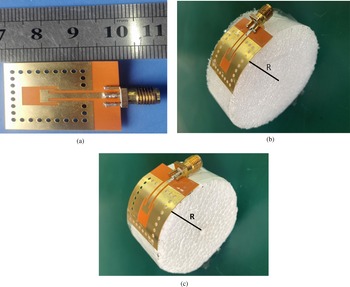
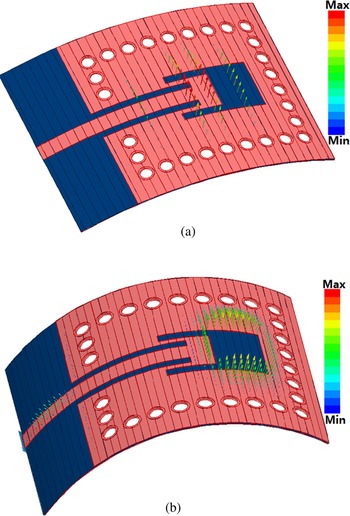
As shown in Figs 2(a)–2(c), three prototypes of resonators with different bending radii are fabricated to investigate their electromagnetic properties. For simplicity, we define the bending radius of the resonator as R. For the flat resonator, the bending radius can be expressed as R = ∞. We bent the fabricated resonator until the radius reached a minimum of 19.74 mm (the moment when the SMA connector nearly touches the other end of the PCB). Therefore, the radius range of the bending test is 1.5 mm to ∞. Three resonators with bending radii of R = ∞, 39.47 and 19.74 mm are labeled as sensors A, B, and C. To accurately display the bending radius of the sensor, sensors B and C are mounted on two foam cylinders corresponding to the bending radius. As shown in Figs 3(a) and 3(b), it is clear that the electric field intensity of the sensing region at 7.5 GHz decreases as the bending radius decreases. This means that the absorbed electromagnetic energy of the flexible resonators also decreases with the reduction of the bending radii.
The photographs of the fabricated sensors with different radii. (a) Sensor A (R = ∞). (b) Sensor B (R = 39.47 mm). (c) Sensor C (R = 19.74 mm).

The simulated electronic field distribution of the bending sensors at 7.5 GHz. (a) Sensor B. (b) Sensor C.

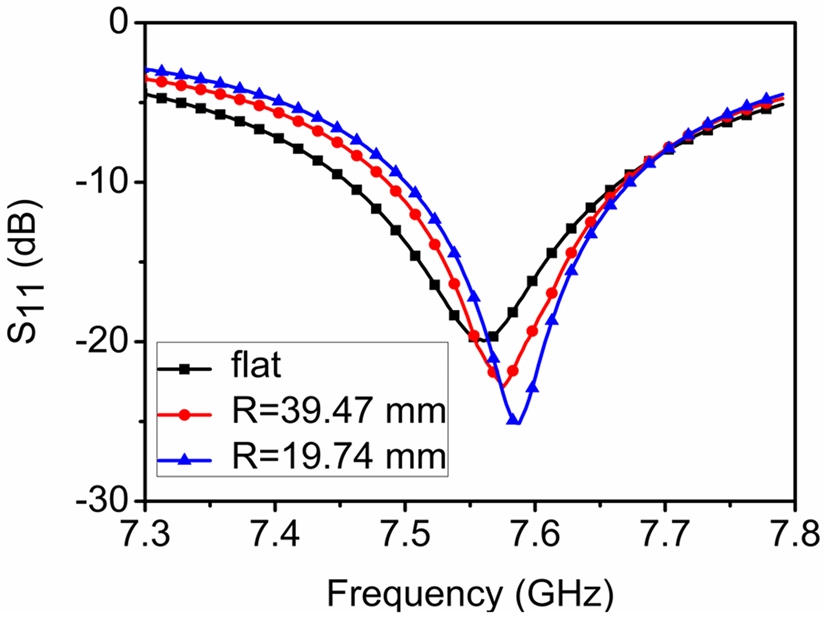
The measured S 11 values of the three resonators without sensing materials are plotted in Fig. 4. Examination of this figure clearly shows that the resonant frequencies of the resonators increase with decreasing bending radius. As reported in [Reference Salonen and Rahmat-Samii43], this can be attributed to the fact that the bending strip line affects the resonator's effective resonance length. The greater the resonator is bent, i.e. around a smaller bending radius, the greater the effective resonance length is reduced, and thus, the resonant frequencies are shifted up according to equation (1).
The measured S 11 of the fabricated three sensors.

Humidity measurement
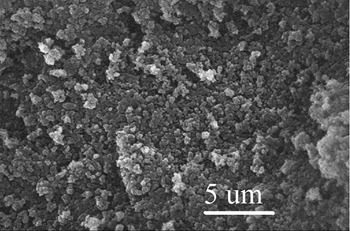
A commercial colloidal suspension of ND (1 mg/ml) was purchased from Nanjing Xianfeng Nano Co. Ltd., China. Seven microliters of ND solution was coated on the sensing region of the cavity by using a drop-coating process. Then, the three prototypes of sensors were naturally dried for two hours at room temperature. Figure 5 shows a field-emission scanning electron microscopy (FESEM, Hitachi S-4800) image of the ND films. The surface morphology of the ND is granular, and the particle size is ~10 nm. These small particles are characterized by a large surface area and surface state densities. This is beneficial for enhancing the humidity sensing performance.
The SEM image of the ND films.

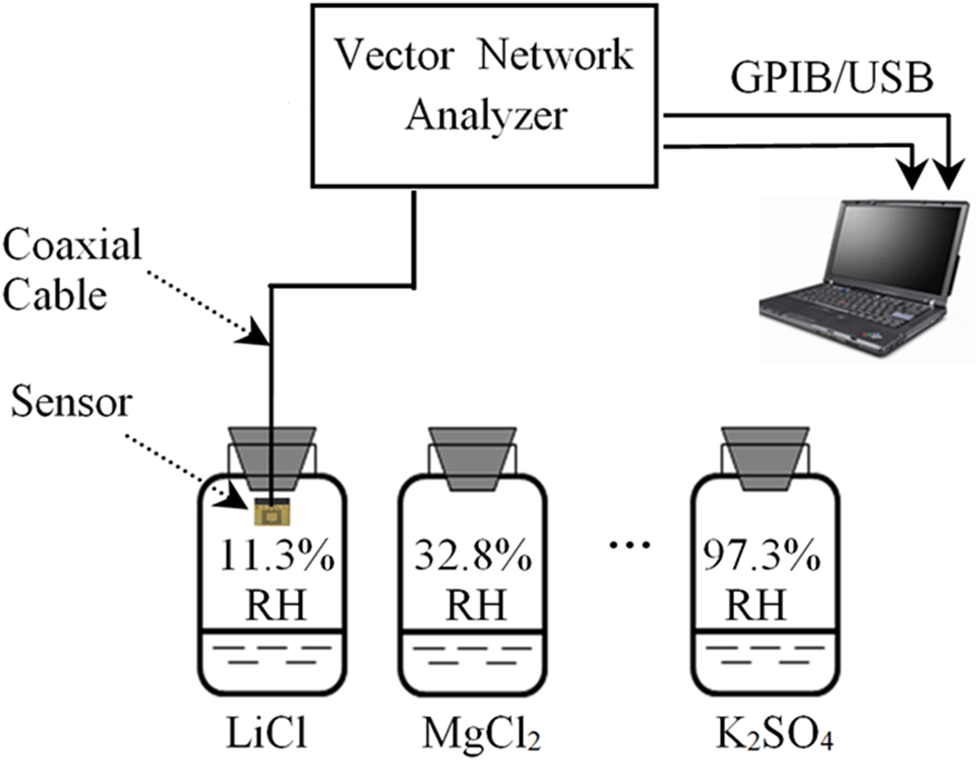
A schematic diagram of the overall experimental setup is shown in Fig. 6. For the convenience of testing, sensors B and C were kept in the bending state but with the foam cylinder removed. The scattering parameters of the sensors were measured using a vector network analyzer (N5244A, Agilent). Saturated LiCl, MgCl2, Mg(NO3)2, NaCl, KCl, and K2SO4 solutions at room temperature were used to provide approximately 11.3, 32.8, 54.3, 75.3, 84.3 and 97.3% RH environment levels, respectively. First, the humidity characteristics of three sensors without sensing materials were tested. We found that the sensors had almost no humidity response, and the measured results were consistent with those shown in Fig. 4. This further confirms that the PI substrate is insensitive to moisture. Therefore, we only investigated the humidity performance of the sensors using ND sensing films in this work. To ensure the repeatability of the humidity response measurement, each fabricated sensor was continuously carried out for three days, and the measured data were recorded under the same experimental conditions.
Humidity experimental setup.

Results and discussion
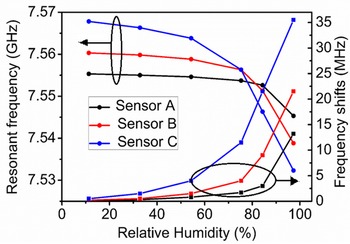
Figure 7 plots the measured resonant frequency shift curves of the three sensors with the ND material as a function of RH. The resonant frequency of each sensor shifts toward a lower frequency with increasing RH levels accordingly. These measurements show that the frequency shift depends closely on the humidity adsorption properties of the ND-sensitive films. These features can be attributed to the increase in the dielectric permittivity of the ND, which is caused by the adsorption of a large number of water molecules in the ND sensing films [Reference Denisov, Sokolina, Bogatyreva, Grankina, Krasil'nikova, Plotnikova and Spitsyn44], resulting in an increase in the effective dielectric constant (ɛeff). According to equation (1), the resonance frequency, f res, will decrease with increasing RH levels.
Measured resonant frequency shifts of the three sensors at different humidity levels.

Figure 7 also shows that in the range of 11.3–97.3% RH, the maximum frequency shift values of sensors A, B, and C are approximately 10, 21.5, and 35.5 MHz, respectively. Obviously, the frequency shifts of sensors B and C are larger than that of sensor A. We can calculate that sensor C obtains the largest humidity sensitivity of 172 kHz/%RH from 11.3 to 75.3% RH and 1.09 MHz/%RH in the RH range of 75.3–97.3%. These results indicate that the humidity sensitivity of the fabricated sensors can be significantly enhanced by reducing the resonator's bending radius under the limitation that the bending radius of the substrate can reach the minimum value. The possible reasons can be explained as follows: the interspaces between ND particles will expand due to the stretching of the bending sensing films, thus forming wider sensing channels [Reference Yu, Chen, Yu, Chen, Ding and Zhao41]. Among the three sensors, sensor C with the smallest bending radius can absorb more water molecules to diffuse through the sensing films due to the largest interspaces and the widest channels between ND particles, thus producing a higher frequency shift than that of sensors A and B. These experimental results demonstrate that the humidity response performance of the sensors can be effectively improved by coating ND sensing films, and the flexible SIW structure can significantly enhance the humidity sensitivity of the sensors.
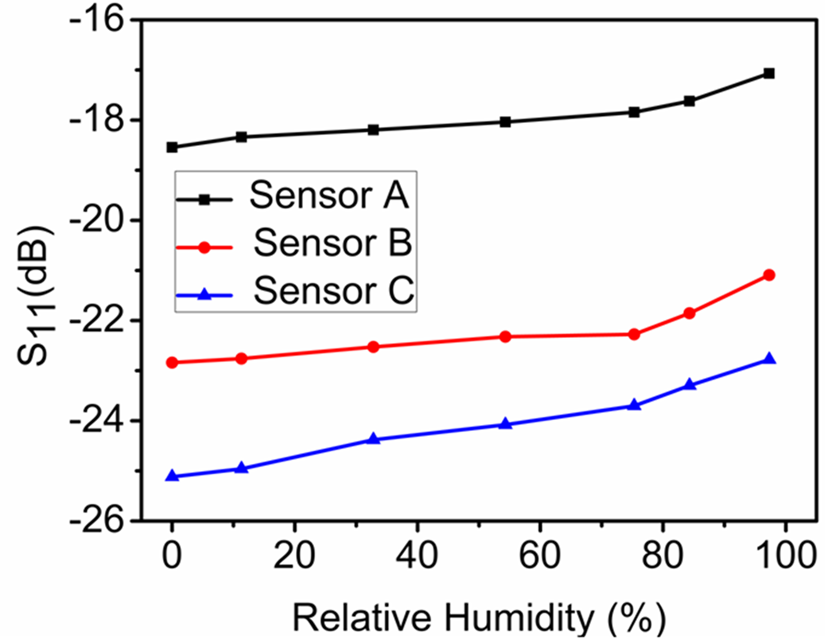
Figure 8 displays the variation in S 11 with RH for the three sensors. The magnitude of S 11 of each sensor decreases with increasing humidity. This means that the electromagnetic energy loss of the resonator increases as the humidity level increases. We note that the measured maximum loss of sensor C is −2.34 dB, which indicates that the ND-based flexible sensor only introduces a small dielectric loss to obtain a large humidity response. These results suggest that the proposed resonators are more suitable to operate under flexible conditions.
Measured S 11 of the fabricated sensors as a function of humidity.

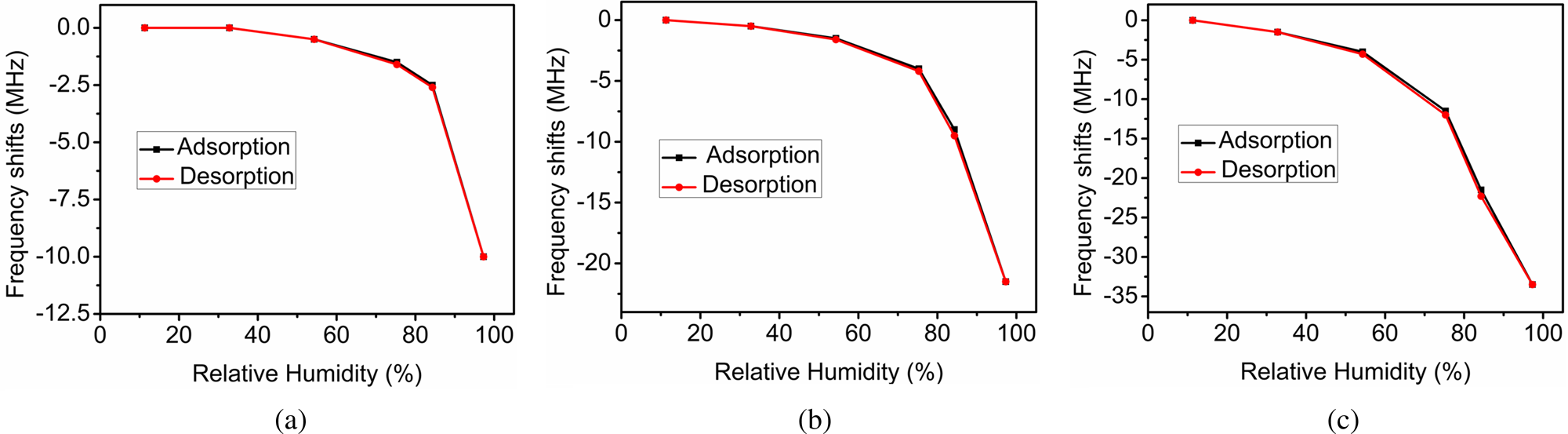
To examine the humidity hysteresis characteristics, the three fabricated sensors first carried out a series of RH points from low to high for water molecule adsorption and then from a high to low RH environment for water molecule desorption. At each RH point, we recorded the stable frequency shift values of the sensors. Figure 9 plots the humidity hysteresis curves of the three sensors with 7 μl of deposited ND suspension. This figure shows that the humidity hysteresis of sensors A, B and C are approximately 0.23, 0.93 and 1.8% RH, respectively. The possible causes for this phenomenon are as follows: the water molecules surrounding the sensors are mainly adsorbed on the surface of the ND films due to the good hydrophilicity of the ND material [Reference Mochalin, Shenderova, Ho and Gogotsi38]. As reported in the literature [Reference Wang, Kreuzer, Grunze and Pertsin45], water molecules will vibrate violently under high-frequency electromagnetic field excitation. As illustrated in Figs 1(d), 3(a) and 3(b), the sensing region of sensor A has the strongest electric fields. Therefore, water molecules on the sensing films will obtain enough electromagnetic energy to achieve a fast dynamic equilibrium of adsorption and desorption. Compared with sensors A and B, although sensor C has a slightly larger humidity hysteresis, it is still superior to the values of ND-coated humidity sensors operating under low-frequency or DC conditions [Reference Yao, Chen, Ma and Ling40, Reference Yu, Chen, Yu, Chen, Ding and Zhao41].
The humidity hysteresis. (a) Sensor A. (b) Sensor B. (c) Sensor C.

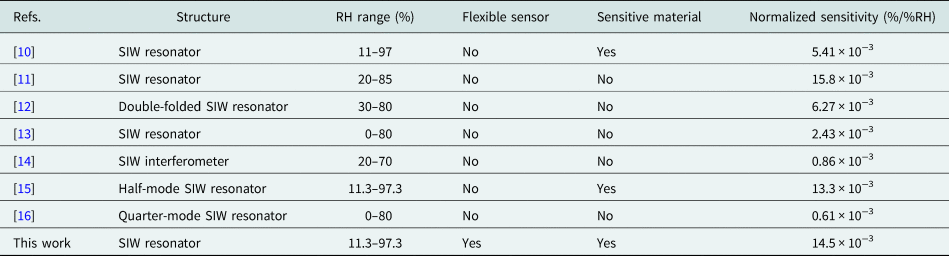
A comparison between the fabricated flexible SIW sensor with ND sensing films and previous SIW humidity research works is presented in Table 2. Considering that the operating frequency of each sensor may be different, we normalized the sensitivity of the sensors to ensure fair comparisons. Notably, the air-filled SIW sensor in reference [Reference Ndoye, Kerroum, Deslandes and Domingue11] shows the highest sensitivity but has a narrow range of RH responses. Compared with most of these reported SIW humidity sensors, our SIW sensors exhibit the merits of flexibility, high humidity sensitivity, wide humidity response range and low fabrication cost.
Comparison of other SIW humidity sensors in the literature

Conclusion
In this work, flexible SIW resonators have been proposed for humidity monitoring applications. Three kinds of humidity sensors using ND sensing material are fabricated on a PI substrate, and their humidity sensing characteristics are comparatively investigated and discussed. The experimental results demonstrate that the proposed SIW resonator can provide the flexible sensor with the best humidity sensitivity, and the introduction of ND sensing material can significantly enhance the sensor's humidity response. This study provides a promising candidate to implement a high-sensitivity flexible microwave humidity sensor. Moreover, this research also indicates the potential applications of the proposed flexible SIW sensor for human health monitoring or other nonplanar material dielectric property detection.
Acknowledgements
This work was supported by the National Natural Science Foundation of China (grant no. 61401047).
Author contributions
Chang-ming Chen: conceptualization, data curation, funding acquisition, and writing & editing. Lu Chen: investigation, data curation. Yao Yao: formal analysis. Peng Ye: formal analysis.
Conflict of interest
The authors declare no conflict of interest.
 Chang-Ming Chen was born in Sichuan, China. He received his Ph.D. degree at the School of Physical Electronics, University of Electronic Science and Technology of China (UESTC). He is currently a professor in the College of Communication Engineering, Chengdu University of Information Technology (CUIT). His current research interests include microwave and millimeter-wave circuits and system.
 Lu Chen was born in Sichuan, China. She received her BS degree from the School of Microelectronics and Solid-State Electronics, University of Electronic Science and Technology of China (UESTC), Sichuan, China in 2018. She received her MS degree from the School of Materials Science and Engineering, Beihang University (BUAA), Beijing, China in 2021. She is currently an assistant lecturer in the Chengdu Aeronautic Polytechnic. Her current research interests include microelectronics materials and devices.
 Yao Yao was born in Sichuan, China. He received his BS degree from the School of Information Science and Technology, Southwest Jiaotong University (SWJTU), Sichuan, China in 2006. He received his Ph.D. degree at the Southwest Jiaotong University (SWJTU), Sichuan, China in 2013. He is currently an associate professor in School of Automation Engineering, University of Electronic Science and Technology of China (UESTC). His current research interests include carbon-based electronics and acoustic sensors.
 Ye Peng was born in Sichuan, China. She is currently an associate professor in the Engineering Practice Center, Chengdu University of Information Technology (CUIT). Her current research interests include RF and microwave sensors.