Generations of scholars have debated the influence, or lack thereof, of a host of factors on judicial behavior since Pritchett’s (Reference Pritchett1941) claim that the “the private attitudes of the majority of the Court … become public law” (890). These factors generally relate to the policy preferences of judges (e.g., Segal and Spaeth Reference Segal and Spaeth2002), legal constraints judges face (e.g., Richards and Kritzer Reference Richards and Kritzer2002), or a judge’s strategic considerations (e.g., Caldeira, Wright, and Zorn Reference Caldeira, Wright and Zorn1999; Black and Owens Reference Black and Owens2009). Yet despite the extensive research on the behavior of judges, little scholarly work allowed for any theoretically motivated influence from the economy on judicial decision making.
That is, until recent research by a collection of prominent legal scholars on the macroeconomic theory of judging (Brennan, Epstein, and Staudt Reference Brennan, Epstein and Staudt2009a, Reference Brennan, Epstein and Staudt2009b; Staudt and He Reference Staudt and He2010) opened the door to economic influences. In their research, Brennan et al. suggest that the justices of the US Supreme Court, as national policy makers (Dahl Reference Dahl1957) addressing a litany of important economic issues, shift their voting behavior in light of prevailing economic conditions. Interpreting the status of the economy as indicative of the quality of current economic policy, the Court supports the government in cases dealing with economic issues more often during expansionary periods than during contractionary periods. As contraction reaches the depths of atypical recessions or depressions, judges are more deferential to policy makers in order to encourage a return to periods of economic growth.
The potential importance of economic influence is not hard to document; one need only look to the Court’s behavior during the New Deal Era to find evidence of why such variance would have important implications. Yet the US Supreme Court is only one court, addressing a limited number of economic cases under unique institutional parameters. Many more courts, from US courts of appeals and district courts to state courts of last resort, address issues with important economic consequences. Do judges across these different institutional settings also respond to economic conditions? And, if so, does the variation in institutional settings condition the judicial response to the state of the economy? As with any theory of judicial behavior, the robustness of the theory can and should be tested across a variety of institutional settings (Brace and Hall 1997).
To answer these questions, I turn to state courts, which offer an optimal avenue for deeper investigation for two important reasons. First, just as the US Supreme Court does for the country, state courts address a litany of issues—licensing, taxation, and transportation, to choose but a few—with important economic ramifications for the state. The recent Supreme Court case Caperton v. A.T. Massey Coal Co. (556 U.S. 868, 2009) is illustrative. Though the case explicitly dealt with the recusal of a state court judge, the underlying issue was more than $3 million contributed by Massey-related entities to the election campaign of a West Virginia Supreme Court of Appeals judge, who subsequently presided on a case addressing $50 million in damages that Massey was to pay. Second, the variation in institutional vulnerability across state courts has been proven repeatedly over the years to matter for judicial decision making (e.g., Hall 1995, 2001; Brace and Boyea 2008), including in recent research on the variation in the responsiveness of state court judges to public opinion when deciding death penalty cases (Canes-Wrone, Clark, and Kelly 2014). According to Canes-Wrone et al., with judicial campaign advertisements addressing issues including tax policy and collective bargaining, there is ample reason to suspect variation in concerns for these issues across selection systems.
To that end, I examine changes in the decision making of state supreme court justices in light of changes in their respective state economies as well as changes in the national economy. I find evidence that suggests that judges on state courts of last resort respond to economic signals. Moreover, and fitting with a long line of literature suggesting that institutional designs matter, I find that the judicial response to the economic climate is conditional on the electoral vulnerability of judges. Elected state supreme court justices defer less to the government in economic cases when the economy is struggling, while unelected justices defer more when the economy struggles. Further examination reveals that responsiveness varies even further within the subset of elected justices, with those facing potential challengers exhibiting the greatest sensitivity to changes in the economy.
Ultimately, this research speaks to ongoing debates both on judicial independence and state judicial selection systems and on the macroeconomic theory of judging. In the former case, I provide evidence that judicial behavior varies across state selection systems in economic cases just as it does in other issue areas (e.g., Hall 1995; Brace and Boyea 2008; Canes-Wrone et al. 2014). In the latter case, I find further evidence suggesting the importance of economic factors in judicial decision making in economic cases.
Decision Making on State Courts of Last Resort
As Brace and Hall (Reference Brace and Gann Hall1997, 1207) state, “To understand judicial behavior, the pivotal role of institutions must be taken into account.” To that end, scholars have significantly advanced our understanding of judicial behavior by examining decision making under the disparate institutional designs of state courts (e.g., Hall Reference Hall1995; Brace and Hall Reference Brace and Gann Hall1997; Langer and Wilhelm Reference Langer and Wilhelm2005). Across states, judges face different electoral pressures owing to varied state judicial selection and retention procedures. Generally speaking, sitting judges on state courts of last resort face either reelection or reappointment considerations.
For judges facing reelection, success is far from ensured (Hall Reference Hall2001). Instead, these elections introduce popular accountability. For instance, scholars have found evidence that state supreme court justices are held accountable for criminal issues, notably increases in the murder rate (Hall Reference Hall2001; Brace and Boyea Reference Brace and Boyea2008). Moreover, with “new-style” judicial campaigns, judges subject to popular vote are potentially held accountable for any of a variety of decisions (Canes-Wrone, Clark, and Park Reference Canes-Wrone and Clark2012; Canes-Wrone et al. Reference Canes-Wrone, Clark and Kelly2014). All the while, quality challengers take into account the vulnerability of incumbent judges in choosing whether to run (Hall and Bonneau Reference Hall and Bonneau2006).
Given the electoral vulnerability and accountability of these elected judges, it is perhaps not surprising that, in noneconomic issue areas, scholars have consistently found evidence that elected judges react to public opinion within the state (Hall Reference Hall1995, Reference Hall2001; Brace and Hall Reference Brace and Gann Hall1997). Not only do these judges respond to public opinion, but their behavior varies across their electoral vulnerability (Hall Reference Hall2001; Huber and Gordon Reference Huber and Gordon2004; Brace and Boyea Reference Brace and Boyea2008). For judges facing reelection, factors beyond ideology and legal constraints exert influence on judicial decision making.
This extensive array of high-quality research has clear implications for the rule of law and conceptions of justice and suggests the critical importance of institutional designs. But while much has been learned, no attention has been given to the effect of the economy. The concern restraining scholarly inquiry is the visibility, or lack thereof, of state supreme court economic cases. To wit, Hall (2001) postulates that justices would not be held accountable for economic decisions because citizens are not aware of state supreme court decisions in economic cases. In other electoral contexts, numerous studies have documented that the effect of the economy on electoral outcomes is contingent on voters attributing blame to the incumbent party (e.g., Powell and Whitten 1993). Thus, this argument holds that if voters are unaware of the courts’ role in economic cases, it may be unlikely for voters to deem the courts responsible for economic conditions and thus to vote them out. In all, state court decisions lack sufficient visibility to encourage any change in voting behavior across electoral contexts for state supreme court judges.
Responding to Changes in the Economy
The dearth of attention paid to economic factors influencing judges stands in stark contrast to research in other venues. A rich empirical research tradition has documented the relationship between the state of the economy and the way political actors behave. There is a general consensus among scholars and political commentators that the economy matters for citizens when they step into the voting booth. With changes in the economic health of the country come shifts in support for Congress (Kramer Reference Kramer1971; Kinder and Kiewiet Reference Kinder and Kiewiet1981; Conover Reference Conover1985; Lockerbie Reference Lockerbie1991) and shifts in support for the president and the president’s party (Kernell Reference Kernell1978; Hibbs Reference Hibbs1982; Markus Reference Markus1988, Reference Markus1992; Alvarez and Nagler Reference Alvarez and Nagler1995, Reference Alvarez and Nagler1998). In all, there is little debate that the economy matters in the voting decisions of citizens.
These same dynamics have been observed at the state level. Building on insights gleaned at the national level, research by Peltzman (1987) suggested that voters also held governors accountable for changes in the economic climate. While there has been debate over whether or not national or local economic factors matter (e.g., Atkeson and Partin 1995, 1998; Niemi, Stanley, and Vogel 1995; Carsey and Wright 1998a, 1998b), scholars are generally in agreement that, at the state level, economic factors matter in citizen voting decisions.
It is unsurprising, therefore, that elected officials are attuned to the state of the economy and adjust their behavior in light of the sentiment of their constituents. Extensive evidence supports the responsiveness of elected officials to the concerns and ideology of voters (Miller and Stokes 1963; Erikson, Wright, and McIver 1993; Stimson, Mackuen, and Erikson 1995; Erikson, Mackuen, and Stimson 2002; Jones, Larsen-Price, and Wilkerson 2009). Elected officials, driven by a desire for reelection (Downs 1957), are therefore attentive to the state of the economy. Depending on their proximity to elections, elected officials may respond to the economy differently (Persson and Tabellini 2000). Overall, for nearly all actors involved in governance, there is evidence of changes in behavior in response to changes in the economy.
Despite the breadth of research suggesting that the economy matters for political actors, little attention had been paid to the potential influence of the economy on judges. By incorporating the state of the economy, Brennan et al. (2009a, 2009b) propose an approach to judicial decision making for a specific category of cases, those dealing with economic issues, that postulates a theoretically motivated avenue for the economy to influence judicial decisions. This economic theory of judging begins with the straightforward claim that justices prefer “national prosperity to an economy plagued by high unemployment, high inflation, and low productivity” (Staudt and He 2010, 91). As rational actors, justices “seek to advance their economic preferences through their Article III decision-making power” (92). In other words, the theory makes the relatively uncontroversial assumption that justices prefer a prosperous national economy to the alternative. Accordingly, while justices cannot “create” economic policy, they can use their privileged position as the decision maker in cases challenging various provisions of law to promote policies that they believe enhance growth while deterring policy when it appears that policy makers have ineptly handled the economy.
Under this macroeconomic theory of the Court, justices do not need to be skilled in economics. Rather, they need only have a preference for a prosperous economy, be able to interpret whether the economy is expanding or contracting, and have some conception of whether a downturn is typical, such as a momentary slowing in the business cycle, or atypical, such as a deep recession or depression (Staudt and He 2010). Insofar as this is true, then when the economy is expanding, the Court believes that policy makers are performing well and will vote in favor of the government. When the economy contracts, however, the justices will have one of two reactions. If the contraction is short-term or minor, it is interpreted by the Court as reflective of poor policy-making choices. Thus, the Court will vote more often against the government’s policy position. However, when the economy enters an atypical recession or depression, the Court will seek to work with policy makers to encourage an economic turnaround.Footnote 1 In sum, the macroeconomic theory of judicial behavior holds that unless there is a depression or recession, justices of the US Supreme Court use the economy as a signal of economic competence and enable or stymie policy makers according to their perceived success or failure.
The theory and empirical support for the theory have faced a myriad of criticisms (Baker, Feibelman, and Marshall 2009; Young and Blondel 2009). To start, critics argue that bias could arise in these models from selection effects, as during different periods of economic success or decline there may be different pools of cases before the Supreme Court. This selection bias could be driven either by changes in the litigants bringing the cases or by changes in decision making on certiorari. In either case, the justices may be hearing fundamentally different cases during different economic periods, a process that could drive the observed change in voting patterns. Beyond selection effects, the empirical evidence provided for the theory has come under criticism for not conclusively demonstrating whether the Court’s response is deliberately intended to affect the economy (Young and Blondel 2009).Footnote 2 As one alternative explanation of the observed behavior, critics point out that the state of the economy may actually be legally relevant to the decision at hand in regulation cases. Finally, critics have challenged the underlying theory that judicial behavior will vary like that of voters or elected officials. In suggesting future refinements, these critics suggest looking in other venues for evidence that macroeconomic decision making occurs, particularly in lower federal courts and in state courts.
Macroeconomic Behavior in State Courts
This latter suggestion is especially compelling for two reasons. First, state courts address a host of important economic issues. A state court decision, while not of the same far-reaching importance as US Supreme Court decisions, still has important ramifications for the economy of the respective state. Second, and quite importantly, the economic voting literature becomes directly relevant as judges face varying institutional pressures across different states. As mentioned above, judges on courts of last resort are elected in some states, while in other states these judges are appointed. In both instances, having attained a seat on a court of last resort, these judges are not ensured continued tenure. Rather, they face the prospect of being reappointed or reelected.
These different institutional contexts present varying institutional pressures that should be observable in light of the macroeconomic theory of judicial behavior. Recall that the macroeconomic theory of judging suggests that Supreme Court justices use economic signals to determine the competency of the incumbent government in economic policy making. Now consider elected judges. As documented above, electoral considerations often matter for these judges. Facing reelection, they are subject to the same electoral considerations as other elected officials in the economic voting literature. Add to this the fact that judicial elections are traditionally low-information elections (Baum 2003). The low-information environment opens the door for factors like the economy to exert influence. Therefore, if a judicial response to economic conditions exists anywhere, it would be in these venues where the justices themselves are subject to election.
Research by Huber and Gordon (2004) suggests that judges, in criminal sentencing, do consider the influence of their decisions on their likelihood of reelection. This being the case, elected state judges are the most likely to support the government during periods of economic growth and oppose the government during periods of economic decline, insofar as they believe that improved economic conditions enhance their opportunities for reelection. Here, the macroeconomic theory and prior research on the influence of judicial selection thus suggest that state court judges, as they perceive a changing probability of reelection in light of economic circumstances, will alter their voting behavior to support or stymie the economic policies of the incumbent government.
On the other hand, we have states like Delaware that maintain appointment and reappointment systems. In these states, judges may have been directly appointed by, or may face subsequent reappointment from, the very government that appears before their court. In the case of the US Supreme Court, Brennan et al. (2009b) originally hypothesized that the insulation afforded the Court through lifetime tenure would encourage “teamwork” with other institutions when the country faces change in economic circumstances, with the Court seeking to further the government’s goal of economic growth. While Brennan et al. did not find evidence for the teamwork theory, the same reasons and more suggest that it may arise in state courts in which justices are appointed. In the context of these state courts, with appointment as well as the explicit connection to the government through reappointment, incentives are such as to encourage justices to vote in line with the teamwork theory.
Given the above, an analysis of macroeconomic voting behavior in state supreme courts offers the opportunity to expand on our understanding of judicial behavior at numerous levels. The analysis expands on research of the factors influencing justices and variation in the influence of these factors across institutional contexts. Judges subject to reelection face the same considerations as other political actors in line with the economic voting literature and thus are the most likely to act in concert with the macroeconomic theory, voting against the incumbent government in order to distance themselves from the economic policy of the incumbent government. On the other hand, judges facing reappointment are most likely to exhibit teamwork, as their ability to secure reappointment likely turns on the success of the incumbent government.
Additional Benefits of State Court Analyses
While an analysis of state courts of last resort thus offers obvious benefits for the analysis of judicial behavior in line with prior studies of judicial behavior on state courts as well as the macroeconomic theory, analysis of state courts has the added benefit of addressing two criticisms—legal relevance and selection effects—of prior research on the macroeconomic voting behavior at the Supreme Court. The first of these criticisms is whether the results are driven by cases in which the state of the economy is legally relevant. If the legal relevance criticism were to hold true, the influence of economic indicators should be constant across judicial selection systems. In short, there is no reason to expect that states with different selection systems would also systematically vary, in accord with the method of judicial selection, in the way they determine the legal relevance of the economy in cases. On the other hand, if we observe judicial behavior varying systematically between states with different selection systems, it suggests that the shifts in behavior are not due to changes in the legal relevance of the economy.
The second criticism, selection effects, is similarly addressed by analyzing state courts of last resort. Here, the concern is that the observed Supreme Court results arise from different types of cases being brought and heard systematically by periods of economic success or decline. For instance, litigants may be more selective in choosing cases to pursue during economic downturns. Yet, as in the case of the legal relevance criticism, the influence of any possible selection effects offers little explanation for systematically different behavior across selection systems. To be more specific, if all state judges, regardless of methods of selection, are found to respond consistently to economic indicators, it would suggest that litigants may be more selective in bringing cases across periods of economic contraction or expansion, lending credence to the selection effects criticism. On the other hand, if there is significant variation by selection methods in judicial behavior as a function of the status of the economy, then proponents of the selection effects explanation would have to believe that the selectiveness of litigants in choosing to pursue cases varies both by the status of the economy and by methods of judicial selection. From the macroeconomic view, however, the variation in judicial behavior fits both with the expected response of judges to economic indicators and with prior studies indicating evidence that judicial responses vary by institutional conditions (e.g., Hall 2001; Huber and Gordon 2004; Brace and Boyea 2008).
In the remainder of the article, I analyze the responsiveness of judges on state high courts to changes in the economy, conditional on state judicial selection systems. The analyses provide new evidence of the primacy of institutional factors in the decision making of judges, with shifting behavior in light of economic factors across electoral contexts, and also provide additional support for the macroeconomic theory of judging.
Analysis
To assemble the data, I begin with the State Supreme Court Data Project, a collection of variables gathered on a sample of state supreme court cases decided from 1995 through 1998 across all 50 states (Brace 2007). In order to test for macroeconomic judicial behavior, the data set was reduced to solely cases dealing with economic issues in which the government was a party.Footnote 3 The final database consists of 201 cases, featuring 435 unique justices and covering all 50 state supreme courts. The database is organized into a cross-sectional data set with each observation representing an individual justice vote.
The dependent variable is a justice vote, with 1 indicating that the state supreme court justice voted for the state government in an economic case and votes not in favor of the government coded as 0. According to the macroeconomic theory, the probability of a state supreme court justice voting in favor of the government’s position in this subset of cases dealing with economic issues should decrease as the economy worsens, with the status of the economy serving as a signal of the policy-making competence of the incumbent government.
To test whether state court judges respond to the economy, I include an indicator of the status of the state economy. To begin, I use the change in the employment rate, which translates nicely to the state level, where state employment varies greatly from state to state and where the data are widely available through the US Department of Labor’s Bureau of Labor Statistics.Footnote 4 Because a month-to-month change in the employment rate may ignore shifts in the state of the economy across periods beyond 1 month, I estimate models with five different indicators of shifts in the employment rate, based on changes in the monthly state employment across different periods of time. Specifically, I estimated the difference in the employment rate at time t and time t − i, for lags of 1, 2, 3, 6, and 12 months. Because the value is calculated as a difference, interpretation requires a brief explanation. Specifically, positive values indicate that the economy has worsened (e.g., if the employment rate has decreased from last month to this month), while negative values indicate that the economy has improved (the employment rate has increased).
The variety of selection mechanisms used to determine the makeup of state supreme courts means that state supreme court justices face varying levels of accountability with voters. This variation, as detailed above, matters for the decision making of state supreme court justices on criminal issues but has not been documented as mattering for decision making on cases involving government regulation of the economy. With the importance of the economy on reelection decisions in other political spheres, there is considerable reason to suspect that electoral vulnerability also matters to judges on state courts of last resort.
Therefore, to capture the electoral accountability of state supreme court justices, I include a dichotomous variable indicating whether or not the judge is subject to any election. This variable takes on the value of 1 if the judge is subject to a retention, nonpartisan, or partisan election. All judges subject to election are coded as such, in accordance with previous research showing that all elected judges are subject to relatively high levels of electoral defeat and partisan pressures (Hall 2001).Footnote 5 If the judge is subject instead to solely reconfirmation via either the governor, the legislature, or some combination, this variable takes on the value 0.
Most importantly, I include an interaction term for the change in the employment rate (Δunemployment) and selection systems in order to account for differences in responsiveness conditional on the electoral system. The evidence above indicated that unelected justices of the US Supreme Court were more likely to oppose the government when the economy was performing poorly during typical downturns. With the economy of the nation not in any atypical cycle during the period under study (1995–98), Supreme Court–level findings suggest that unelected state supreme court justices would vote more (less) often against the government during downturns (upswings).
I expect that elected justices, because of their concerns over electoral accountability, are even more vociferous in their opposition to the perceived failures of the government. Elected judges have the greatest incentive to encourage economic growth, insofar as they believe that economic downturns decrease their likelihood of reelection. In other words, any downturn in the economy is worthy of an atypical reaction for the elected state supreme court justice. Judges not subject to election, on the other hand, are still likely to be subject to gubernatorial or legislative reconfirmation. They are most likely, therefore, to support the policies of the incumbent government in an effort to secure reconfirmation.
While the macroeconomic theory suggests that such a dynamic may exist in the context of state courts, the theory, as detailed above, is also subject to continued criticism. An additional benefit of this analysis stems directly from the inclusion of the interaction term for judicial selection systems. To wit, if selection effects or legal relevance drives the macroeconomic behavior of judges, as some critics hypothesize, or if elected judges simply perceive no electoral accountability for their actions, then we are unlikely to observe a difference across electoral contexts. If selection effects or the legal relevance of the economy drives the empirical results supporting the macroeconomic behavior, as critics have persuasively argued, there is no reason to expect an observable difference between states using different judicial selection mechanisms. In other words, to the extent that these are biasing results, the bias induced by selection effects or legal relevancy would need to correlate with both electoral contexts and economic indicators and would need to do so in ways also consistent with the macroeconomic theory of judicial behavior.
With decades of research suggesting the importance of ideological factors for judicial behavior (e.g., Pritchett 1948; Segal and Spaeth 2002), I include an independent variable accounting for the ideological predispositions of the justices. Of the many options, I use the Brace, Langer, and Hall (2000) measure of state supreme court justice ideology, PAJID.Footnote 6 The authors derive PAJID ideology scores by accounting for the party affiliation of state elites and the ideology of the electorate at the time the judge assumes his or her seat. Scores on the measure range from 1 to 100, with 1 indicating conservative and 100 indicating liberal. Here, I expect that Republicans will vote less often in favor of the government position on economic regulation than Democrats. I also account for the differential success rate for the government between cases in which they are petitioner and in which they are appellant by including a dichotomous variable indicating if the government was the petitioner. For this variable, 1 indicates that the government is the petitioner; I expect the coefficient estimate to be positive in line with prior research on the US Supreme Court (Brennan et al. 2009b). Finally, I include a variable to account for party agreement between the judge and the government involved in the litigation. State supreme court justices addressing cases featuring policies supported by members of their own party are likely to be more receptive to those arguments. To address this, I include a dichotomous variable, with 1 indicating that the voting judge is of the same party as the state governor and 0 indicating otherwise.
With the variables and expectations in place, I turn to the estimation. The voting variable exhibits a large amount of variance across state contexts, necessitating statistical consideration but also allowing for analysis of state-specific influences on the likelihood of a progovernment vote. In order to account for this variance, the model estimation again utilizes a mixed-effects approach that allows for state-level variation but borrows on the observations available in other states in order to generate estimates near a standard level.
I estimate a mixed-effects logit model (see Bailey and Alimadhi 2007; Imai, King, and Lau 2007), which, in this analysis, allows me to group effects by state and by individual court cases. I allow random-effect intercepts across both of these groupings, which accounts for the variation in state-specific receptivity to government regulation and case-specific factors, which may affect justices’ votes. My approach avoids wildly inconsistent and different coefficient estimates that would arise from no-pooling estimates while also accounting for state-level influences on judicial decisions not included in the model. For these very reasons, estimation of mixed-effects models is optimal in analyses with small sample sizes grouped by common variables, such as the states or cases used in this study (Gelman and Hill 2007; Lax and Phillips 2009). Mixed-effects logit thus offers a robust opportunity for estimating the relationship between the independent variables and the likelihood of a vote in favor of the government.
Results
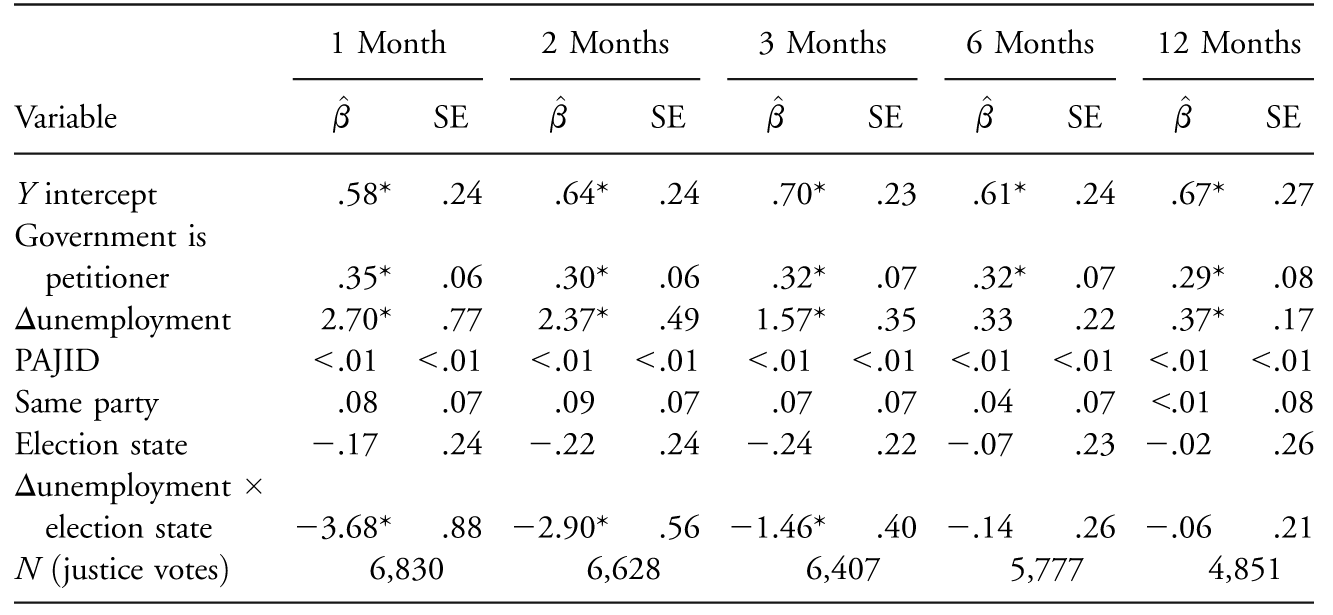
The results of the models are presented in table 1. First, as expected and consistent with prior research (e.g., Brennan et al. 2009b), I find that the government is more likely to have been successful in a case when it was the petitioner. Contrary to ideological accounts of judging, I do not find a statistically significant correlation between the justices’ party and their level of deference to the government in economic cases. Nor do I find substantial evidence of any influence from ideological congruence, as there is little relationship between the variable indicating that the judge and governor are of the same party and support for the government’s position on economic regulation.
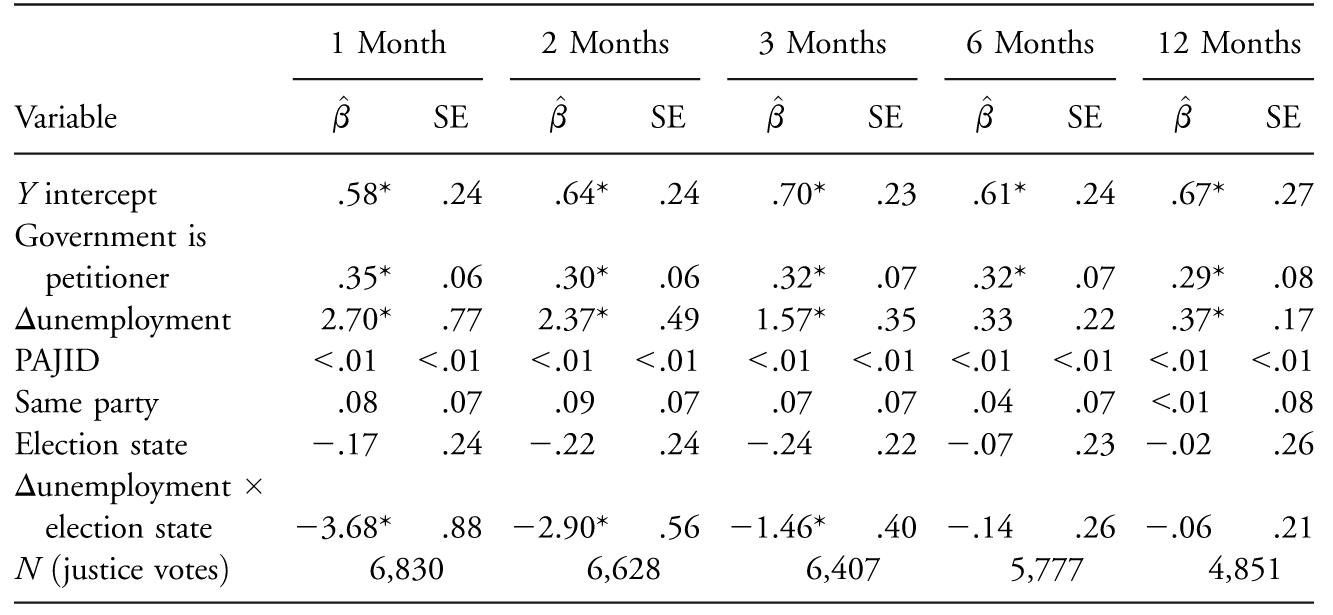
Note—Each “months” model represents the difference between the unemployment rate at time t and at time t − x months, where x takes on values of 1, 2, 3, 6, or 12. Negative values of Δunemployment represent improved economic conditions, as the unemployment rate has decreased.
* p < .05.
The role of the economic indicator, Δunemployment, is of greater importance for the macroeconomic theory of judging. The impact of economic conditions is conditioned by the state judicial selection system; therefore, interpreting the coefficient requires consideration of the selection system. When judges are not subject to election, decreases in the employment rate (the economy is getting worse) correlate with increases in the probability of a government win in an economic court case. In other words, in cases in which judges are not subject to election, the judges are more deferential to elected officials as the economy worsens. On the other hand, when judges are subject to election, short-term decreases in the employment rate correlate with decreases in the probability of a government win in an economic court case. In election states, 1–3-month decreases in the number of employed citizens correlate with decreased probabilities of judges supporting the government’s position in court cases.
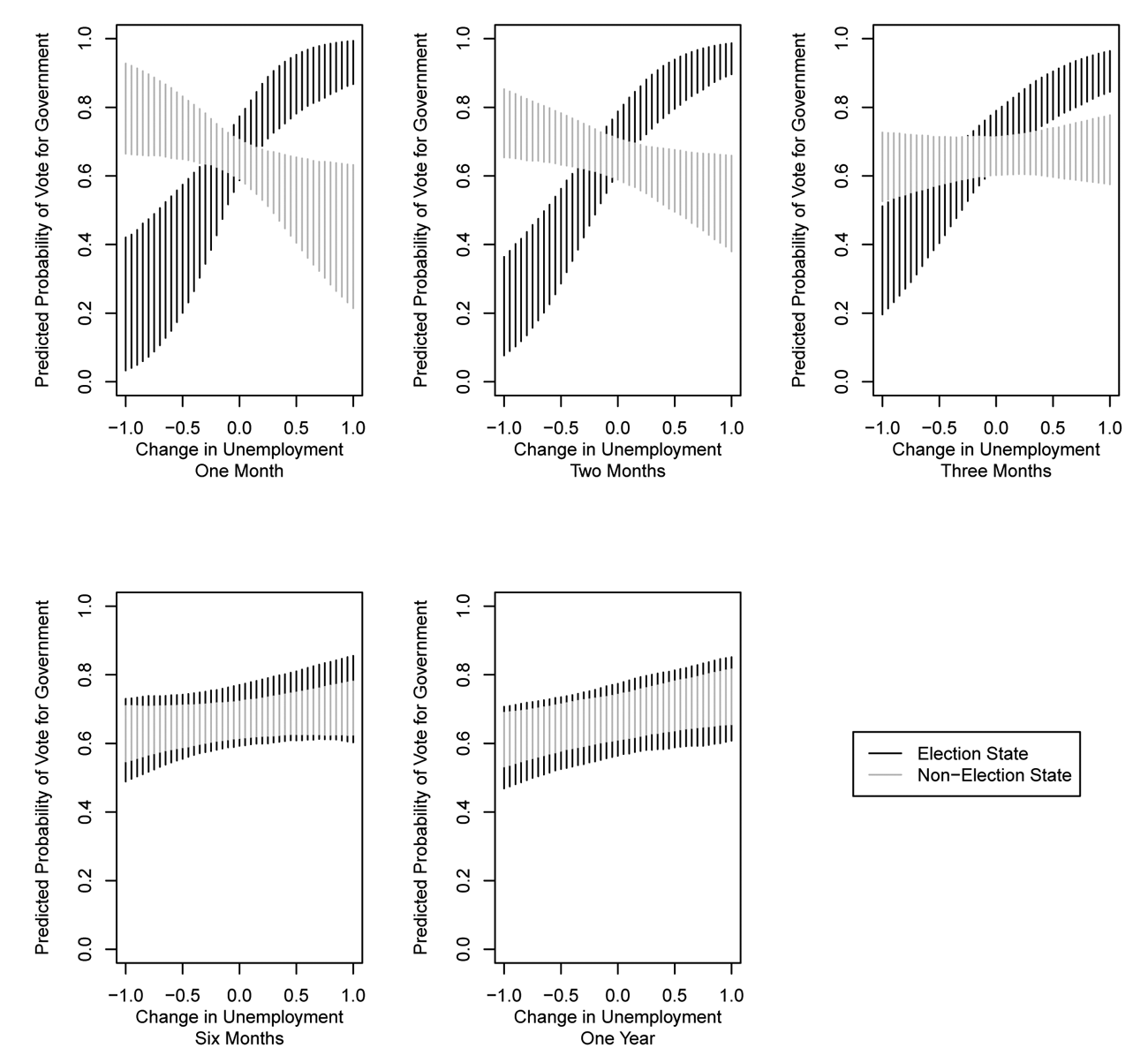
While the coefficients confer some information, the relationship is made plain in figure 1. Here, for each of the five models, I plot predicted probabilities across the range of values for Δemployment for both those justices subject to reelection and those not subject to reelection. It is important to note that in a large number of cases, the deference exhibited across justices in different electoral contexts is substantially similar. In terms of figure 1, this can be seen by the area of unemployment approximately between −0.25 and 0.25. Within this region, the confidence intervals for the predicted probability of a judge supporting the government largely overlap, indicating that there is little difference whether a judge is elected or not when changes in the economy are minimal.
Predicted probabilities of justice vote in favor of state government in economic cases across values of Δunemployment. Plots of the 95% confidence intervals for the probability of a government vote across change in employment rates, with other variables held constant at their mean values. Each “months” model represents the difference between the unemployment rate at time t and at time t − x months, where x takes on values of 1, 2, 3, 6, or 12. Negative values of Δunemployment represent improved economic conditions, as the unemployment rate has decreased.
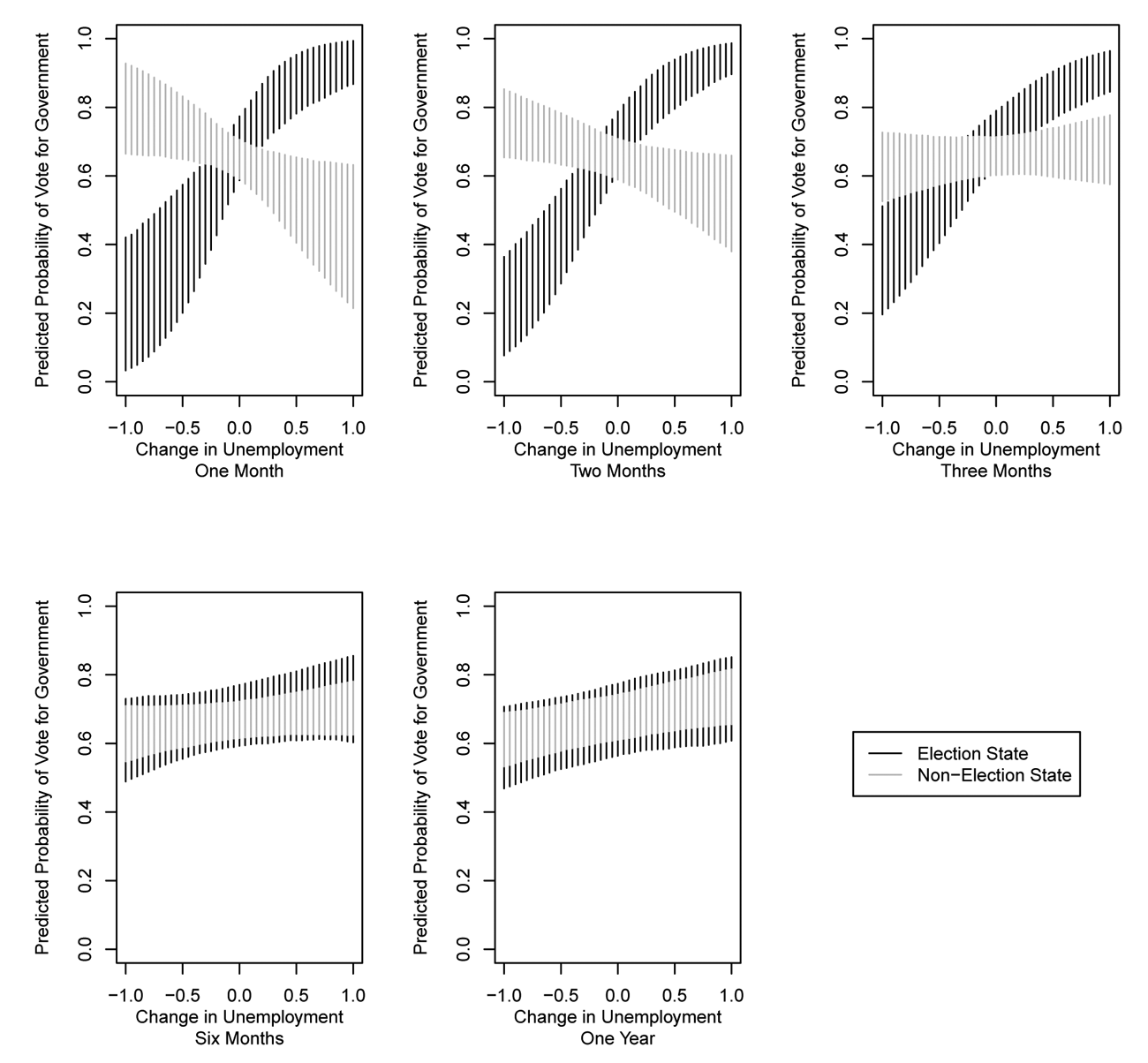
As the shifts in the economy become more pronounced, though, notable patterns emerge. First, the elected judges in this analysis exhibit patterns consistent with that observed of US Supreme Court justices when the shift in the economy is short-term. Here, short-term—from 1-month to 3-month—increases in the employment rate correlate with less deference to the incumbent government. Longer-term shifts in state economies, though, correlate with shifts in judge behavior toward greater deference to the incumbent government. This result is consistent with the macroeconomic theory of judging, as severe economic crisis—recessions or depressions—is hypothesized to lead judges to defer more. For these elected judges, corrections to the economy are necessary insofar as the judge believes the economy to matter for his or her reelection efforts. For state court judges, short-term shifts offer signals of the policy-making competence of the incumbent government, and the decisions offer an opportunity to correct errant policies. As the declines become more severe, however, the necessity of broad government action correlates with elected judges deferring more often to other elected officials. These dynamics, with elected state court judges seeking improvements in the economic well-being of their states, are consistent with prior research (e.g., Huber and Gordon 2004) indicating that elected justices alter their behavior in light of reelection considerations.
Now compare these elected justices to state supreme court judges insulated from electoral concerns. Here, judges not facing reelection defer more often to the government when the state economy is struggling. These unelected judges behave in the way originally predicted by Brennan et al. (2009b) on the basis of their teamwork theory. Within the time period under study, declines in the economy, whether short-term or long-term, correlate with increased deference from unelected state supreme court justices. This, of course, runs counter to the behavior observed of unelected US Supreme Court justices but is consistent with the prior expectations that relatively insulated courts like the US Supreme Court would defer more often. Moreover, as mentioned above, these state court judges are likely to have greater incentives to exhibit teamwork with governors and legislatures, given the nomination and reconfirmation mechanisms in the unelected states. The lack of independence associated with reappointment systems, in sum, may encourage these justices to exhibit greater teamwork. Whether or not this is good or bad for purposes of encouraging economic growth is, of course, a matter of perspective.
Together, these results suggest starkly different behavior in light of economic conditions by judges on state courts of last resort, with variation according to the state’s method of judicial retention. Of course, the dichotomous measure used above to account for whether judges are reappointed or reelected obscures variation in selection procedure. While the dichotomous measure captures accountability to the public or other institutions, it does not account for variation in elective retention designs. This stands in contrast to recent research suggesting variation even within electoral contexts (e.g., Canes-Wrone et al. 2012, 2014), as well as the above theory, which suggests that these may mask meaningful distinctions.
To wit, in states with popular election as a component of retention, judges face one of three election types: partisan, nonpartisan, or retention elections. In the first two cases, a judge faces a challenger on the ballot. Though retention elections have become increasingly politicized in recent years (e.g., Canes-Wrone et al. 2012), the elections lack challengers and party labels. Given this, judges facing retention encounter fewer incentives to distance themselves from failing economic policies. Contrast this with the judge facing partisan or nonpartisan reelection, who, in the face of a struggling economy, would likely face a challenger eager to point out the judge’s support for failing policies. In all, to the extent that judges are responding to electoral concerns, we would expect judges facing partisan or nonpartisan reelection to exhibit greater responsiveness to the economy than judges facing retention elections.
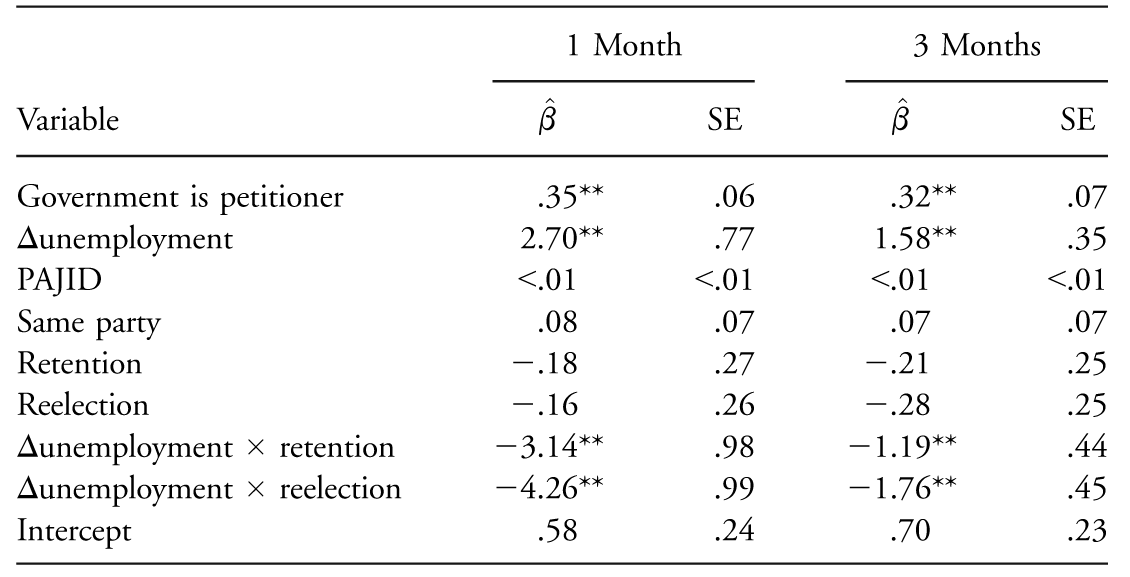
To test this, I estimate a model in the same way as before but create separate dichotomous indicators for retention elections and reelections facing challengers. I include an interaction term of the indicator variable and Δunemployment at 1 month and 3 months. Given the above, I expect results consistent with table 1 and figure 1. Given particularized incentives, however, I expect that justices facing challenged reelections will exhibit greater responsiveness to changes in the status of the economy. The model results are presented in table 2 and figure 2.
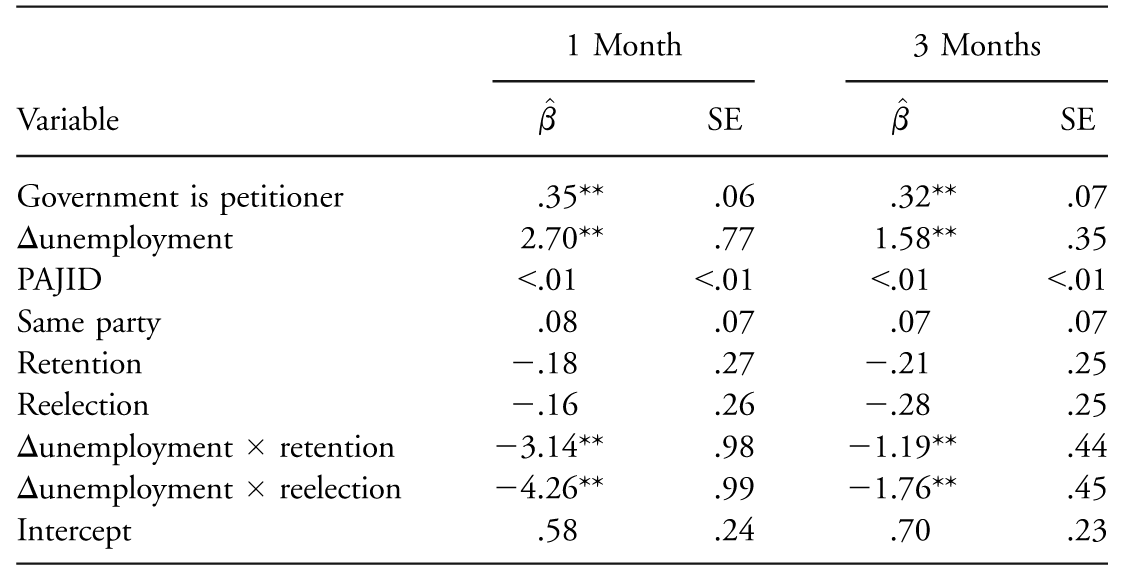
Note—N = 6,830 for the 1-month model and 6,407 for the 3-month model.
** p < .01.
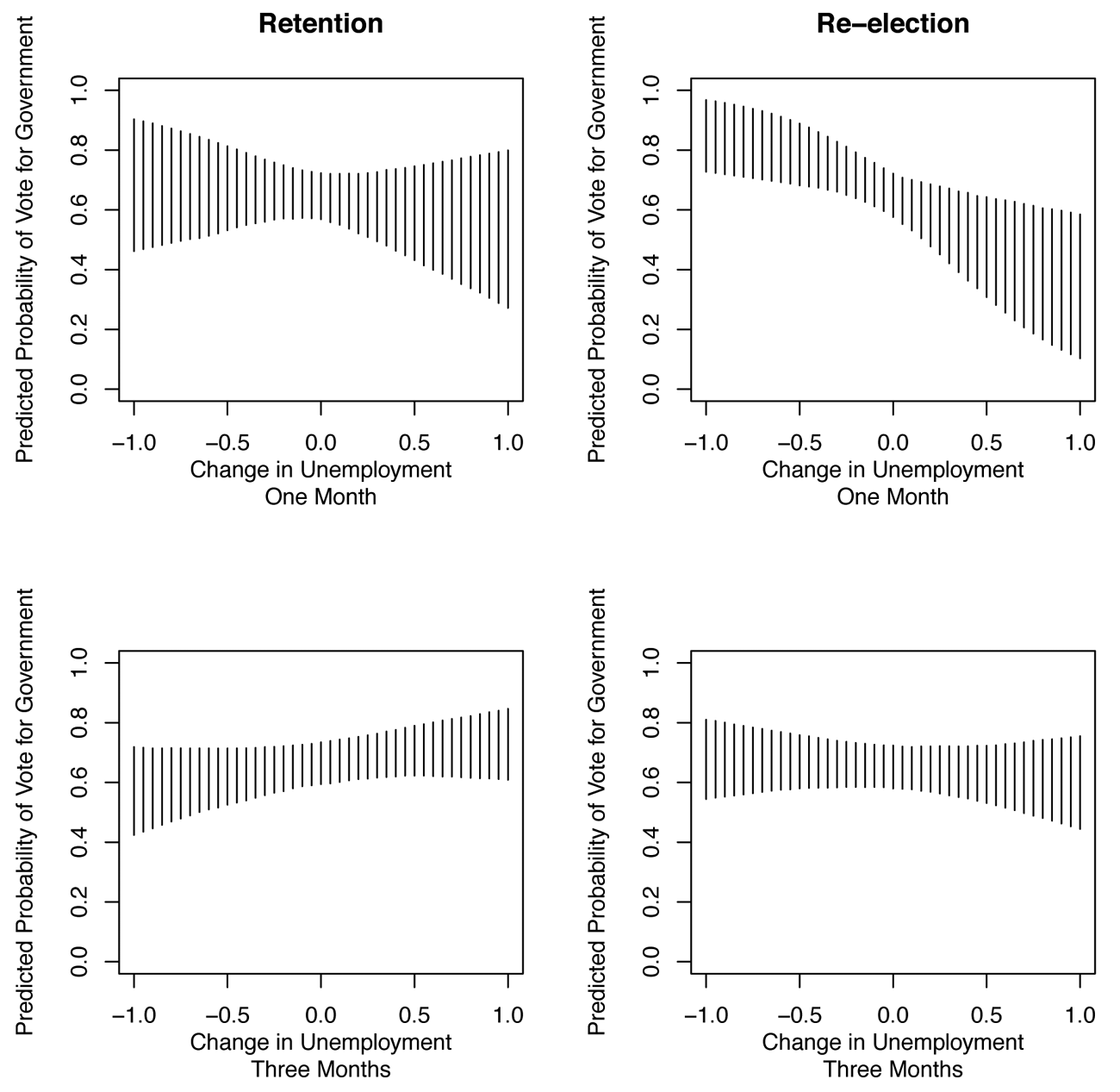
Predicted probabilities of justice vote in favor of state government in economic cases across values of Δunemployment. Plots of the 95% confidence intervals for the probability of a government vote across change in unemployment rates, with other variables held constant at their mean values. Negative values of Δunemployment represent improved economic conditions, as the unemployment rate has decreased.
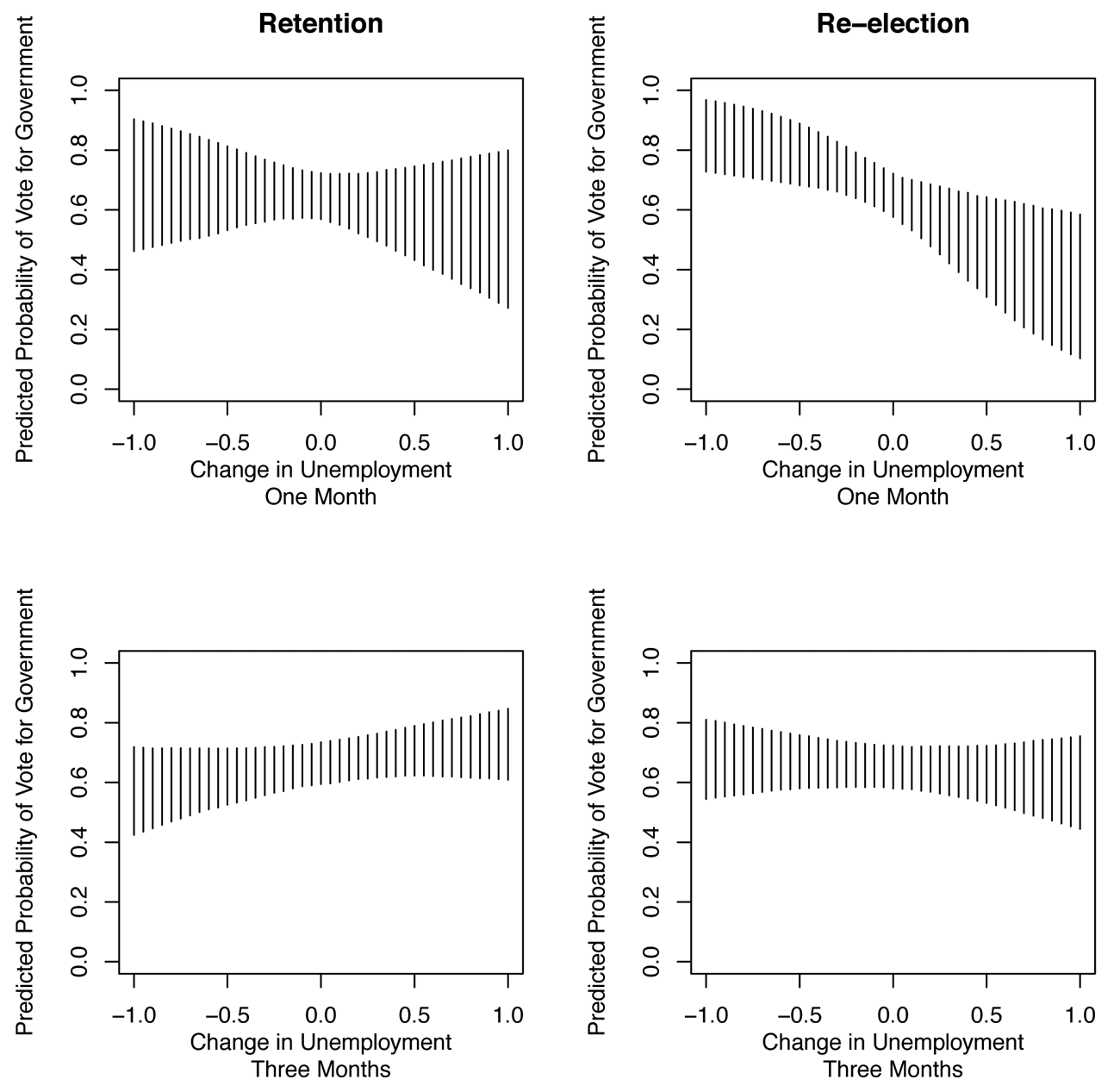
The results generally support the dynamics suggested and provide further corroborative support for the importance of retention methods for macroeconomic judicial behavior. These results are clearly evident in the plots of predicted probabilities in figure 2. To start, the top row contrasts retention elections with nonpartisan and partisan reelections. As predicted, responsiveness to economic conditions is more moderate under retention elections than under partisan and nonpartisan elections. Lacking challengers as well as a party label on the ballots, judges facing retention elections have less incentive to adjust their behavior in light of economic concerns. Still, I find evidence that judges facing retention elections and contracting economies are slightly less likely to exhibit support for the government. This adjustment is in line with recent research suggesting that judges facing retention elections adjust their behavior according to public opinion on high-salience issues such as abortion or the death penalty (e.g., Canes-Wrone et al. 2012, 2014). However, the effect of changes in the economy on their behavior is more muted as compared to judges subject to partisan and nonpartisan elections, who face the additional possibility of potential challengers in difficult political climates when the economy struggles.
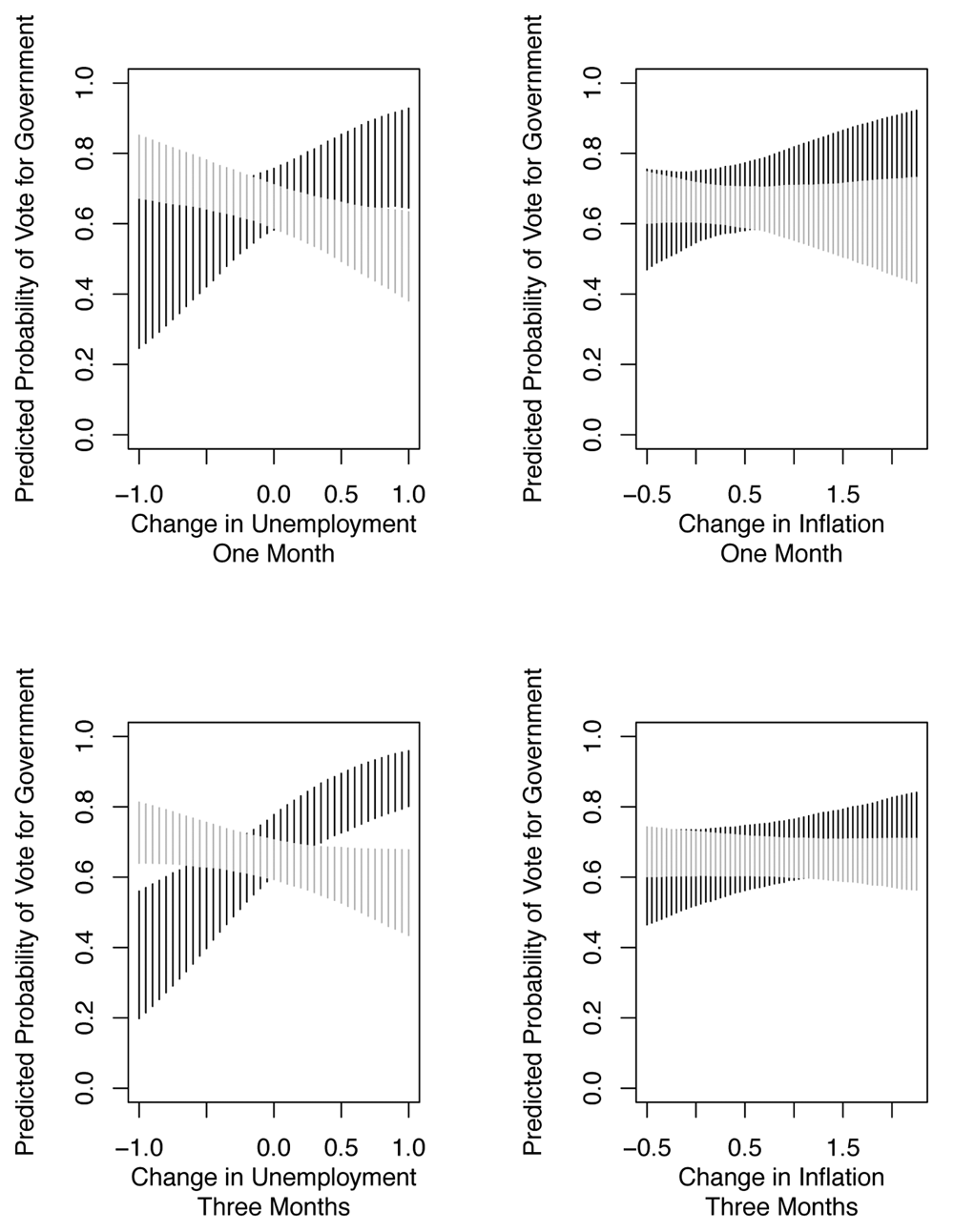
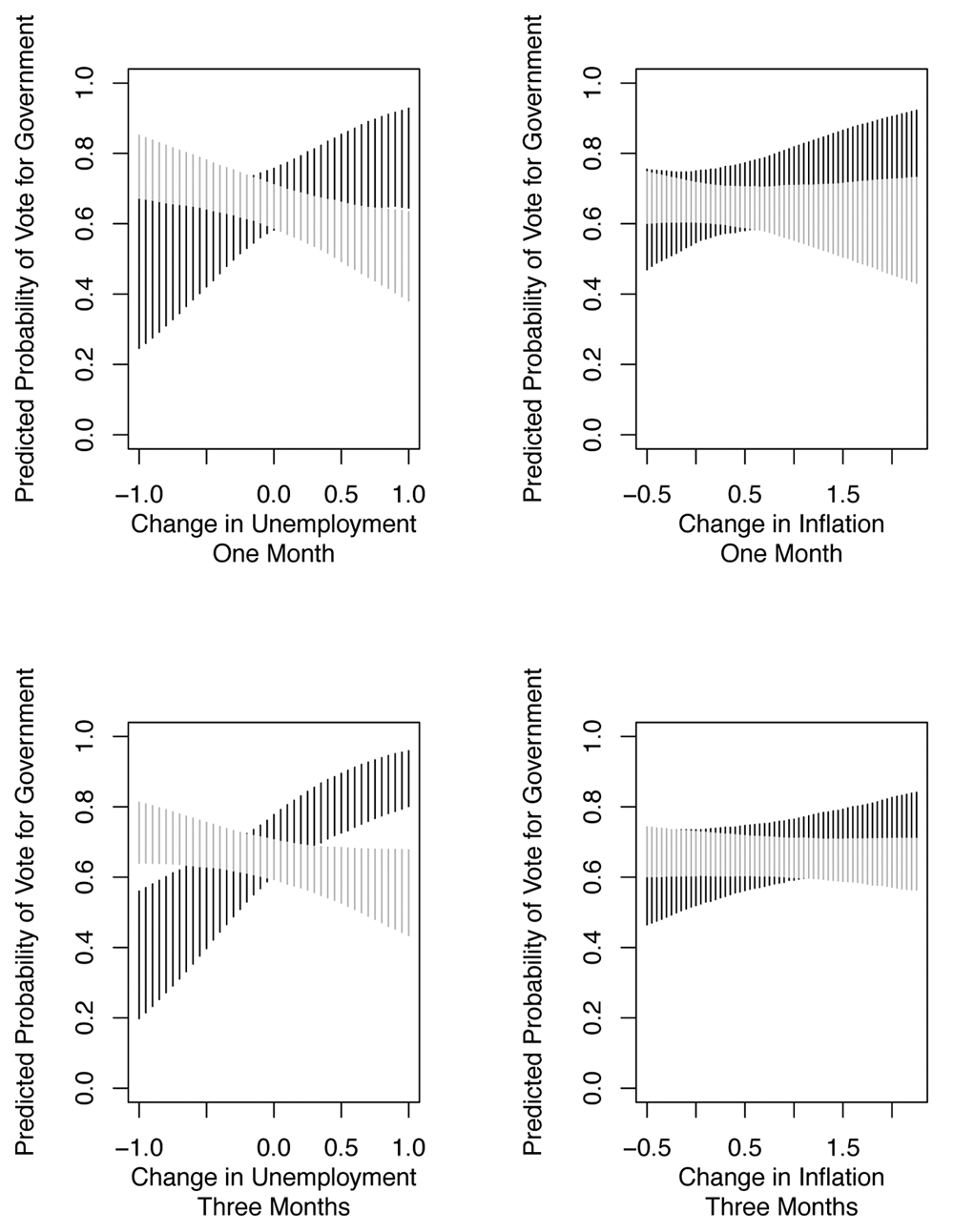
As a final robustness check, I estimate additional models using alternative indicators of economic conditions. First, one potential problem in this analysis would arise if state employment rates do not offer an observable enough signal to anticipate any relationship with judicial decision making. Therefore, I estimate two additional models utilizing as a predictor the change in the national employment rate as a predictor at 1-month and 3-month lags, respectively. Further, I move beyond the employment rate and utilize the change in inflation at 1-month and 3-month lags as a measure of the state of the economy. All other variables remain the same as in prior analyses.
The results are presented in figure 3. Note, first, that the observed relationship persists in models using national employment conditions as a predictor, though the dynamics are less clear. This provides support for the findings reported above but also indicates that the use of state employment figures, likely more relevant to state judges, offers a superior signal for studies of the influence of economic conditions on state judges. With regard to inflation, the general dynamics of the relationships are again the same, though also less clear than in prior analyses, as unelected judges are slightly more likely, on average, to vote for the government during periods of increasing inflation as compared to decreasing inflation, across both 1- and 3-month lags. Thus, the use of national economic indicators in place of state employment rates further substantiates the core results of the analyses reported above and provides corroborative evidence of the relationship between the state of the economy and judicial decision making.
Predicted probabilities of justice vote in favor of state government in economic cases across national economic indicators. Plots of the 95% confidence intervals for the probability of a government vote across change in the national unemployment rate (first column) and inflation (second column), with other variables held constant at their mean values. Models in the first row represent the difference between the given indicator at time t and at time t − 1 month, and models in the second row represent the difference between the given indicator at time t and at time t − 3. Negative values for change in unemployment, and positive values for change in inflation, represent improved economic conditions.
Discussion and Concluding Thoughts
Taking up the call of some legal scholars for analysis of judicial behavior in the states (Hall 1995) and the call of other legal scholars (Young and Blondel 2009) for greater and more rigorous analysis of the macroeconomic theory of judging, this article has sought to understand if and how macroeconomic judicial behavior operates in the varied institutional contexts of state courts. The analysis above, documenting evidence of variations in the macroeconomic theory of judicial behavior across state contexts, adds to the extensive and ongoing literature (e.g., Brace and Boyea 2008; Canes-Wrone et al. 2012) documenting the importance of state judicial selection and retention mechanisms. As state economies grow or struggle, judges respond differently according to their election or appointment status.
The research above thus offers substantial enhancements to our understanding of judicial decision making in economic cases, the macroeconomic theory of judicial behavior, and judicial selection. As in prior research in other issue areas before the courts, I find that the electoral vulnerability of state court judges matters for their decision making. Unelected state supreme court justices defer more often, on average, to the government when the economy is struggling and less often when it is doing well, while elected judges in state courts respond to short-term downward shifts in the economy by opposing the government more frequently. Additional corroborative support is seen as more long-term declines in the economy correlate with increased deference to the government in economic court cases, consistent with the macroeconomic theory’s holding that the severity of crisis could lead to additional teamwork.
The above findings do, of course, pose the question of why elected state supreme court justices respond to short-term changes in the economy in the same way as the unelected US Supreme Court justices. This “why?” question is especially difficult to answer but may speak to initial conjectures in Brennan et al. (2009b) that Supreme Court justices feel a responsibility, or accountability to the public, for the state of the economy. Across state court analyses, I have documented evidence that judicial support for government regulation varies according to whom the judges believe they are dependent on for continued tenure. Judges on state courts of last resort who are facing elections, and are thus accountable to the public, respond to economic declines by supporting the government less. On the other hand, judges who face reappointment are accountable to other institutions and thus support the government’s position more often as the economy struggles. This suggests that Supreme Court justices, insulated from institutional reappointment, lean toward accountability to the public without the direct election mechanism seen in state courts.
Moving forward, future research could explore the role that within-court panel dynamics have in the decision-making process in these cases. In this study, I have controlled for specific panels by utilizing mixed effects across cases. However, a large body of literature within judicial decision making suggests that panel-specific voting patterns may shift according to the other members of the court, their positions and expertise, and strategic concerns (Caldeira and Zorn 1998; Kastellec 2007; Boyd, Epstein, and Martin 2010). With judges facing different times to retention decisions within panels, there is the possibility of panel-specific dynamics not covered here.
In all, though, this analysis provides evidence of new influences on the voting of judges on state courts of last resort and offers substantial encouragement for scholars interested in macroeconomic explanations for judicial behavior. Moreover, the research suggests additional evidence for the importance of judicial selection mechanisms on judicial decision making in the area of economic regulation. With ongoing debate on the viability of different selection mechanisms, the research suggests the important influences of those decisions on judicial outcomes.