Kawasaki disease is a systematic and self-limited vasculitis occurring mainly in young children and infants. It is a leading cause of acquired heart disease of infants and young children. About 30% untreated and 5–10% of treated children have been suffering from coronary artery lesions.Reference Burgner and Harnden 1 However, the etiology of Kawasaki disease remains unknown, although an infectious agent has been considered as the pathogen responsible for Kawasaki disease development.
Studies have shown that genetic factors may have an important role in the development of Kawasaki disease.Reference Fujita, Nakamura and Sakata 2 Vascular endothelial inflammation, resulting from the secretion of cytokines and chemokines, also has a significant role in the immunopathogenesis of Kawasaki disease. Various studies have indicated that the increased level of proinflammatory and anti-inflammatory cytokines can be seen in the acute stage of Kawasaki disease.Reference Kim, Lee, Noh, Lee and Lee 3 – Reference Tsukahara, Hiraoka and Saito 6 Furthermore, the decreased level of IL-10 can be seen in the subacute and convalescent phases of Kawasaki disease.Reference Kim, Lee, Noh, Lee and Lee 3 , Reference Hirao, Hibi, Andoh and Ichimura 7 In addition, the elevated IL-10 levels decreased promptly after the administration of intravenous immunoglobulin, which coincides with rapid improvement in inflammatory symptoms.Reference Noh, Lee, Lee and Lee 8 Therefore, the association between genetic variation of IL-10 and Kawasaki disease risk is worthy of being investigated.
The human IL-10 gene, which locates on 1q31-1q32, consists of five exons and four introns. Several single-nucleotide polymorphisms of the IL-10 gene promoter region correlate with increased IL-10 serum production including -1082 A/G, -819T/C, and -592 A/C. Of all the above polymorphisms, the association between IL-10 -592 A/C polymorphism and Kawasaki disease risk was mostly studied. However, the results of previous studies about IL-10 -592 A/C polymorphism with Kawasaki disease risk remain inconsistent or controversial.
So far, there is no specific literature that investigates the association between IL-10 -592 A/C polymorphism and Kawasaki disease risk. Hence, in this study, we perform this meta-analysis on all published case–control studies to derive a more precise estimation of IL-10 -592 A/C with Kawasaki disease risk.
Materials and methods
Search strategy
PubMed, Embase, and CNKI (China National Knowledge Infrastructure) databases were searched using the terms as follows: (“IL-10” or “Interleukin-10”) in combination with (“polymorphism” or “variant” or “mutation”) and in combination with “Kawasaki disease”, updated on February, 2015 for all publications on the association between IL-10 -592 A/C polymorphism and Kawasaki disease risk. To identify other relevant studies, additional literatures were identified through scanning the references of original literatures, which are included in the present meta-analysis. Review articles were also examined and inspected to find other eligible literature.
Inclusion and exclusion criteria
The inclusion criteria for the present literature selection were as follows: a case–control study; assessment of the relationship between IL-10 -592 A/C polymorphism and Kawasaki disease risk; and offering distribution of genotypes or other data to compute odds ratio (ORs) and 95% confidence intervals (CIs). Accordingly, studies were excluded if one of the following exclusion criteria existed: studies that contained overlapping data; studies not offering necessary data such as the distribution of alleles or genotypes; and studies in which family members had been investigated because of linkage disequilibrium.
Data extraction
All the data were independently reviewed and extracted by two investigators (X.C. and X.J.). In addition, the result was reviewed by a third investigator (S.J.). From each study, the following information was recorded: first author, publication year, country, ethnicity, the number of cases and controls, allele frequency, genotype distribution in cases and controls, genotyping methods, and evidence of Hardy–Weinberg equilibrium in control subjects. Different ethnic descents were categorised as Caucasian, Asian, African, or mixed population.
Statistical analysis
The OR and corresponding 95% CI were calculated to assess the association strength between IL-10 -592 A/C polymorphism and Kawasaki disease risk. We evaluated the Kawasaki disease risk with IL-10 -592 A/C polymorphism by five genetic models including allele contrast, heterozygote comparison, homozygote comparison, dominant genetic model, and recessive genetic model.
The χ2-test-based Q-statistic and I2 statistics were applied to assess heterogeneity among eligible studies.Reference Higgins and Thompson 9 If there was no obvious heterogeneity, the fixed-effects model was applied to calculate summary OR.Reference Mantel and Haenszel 10 If not, the random-effects model was used.Reference DerSimonian and Laird 11 To detect the possible source of heterogeneity, we examined the sources of heterogeneity such as publication year, source of control, genotyping method, and sample size. Moreover, meta-regression was also applied to detect any sources of heterogeneity.
Sensitivity analysis was conducted to appraise the stability of the results and identify potentially influential studies. Any single study from the meta-analysis was deleted each time to calculate the influence of the individual data set to the pooled OR. Funnel plots and Egger’s linear regression test were applied to detect the potential publication bias.Reference Begg and Mazumdar 12 An asymmetric plot infers a possible publication bias. The significance of the intercept was determined by the Student’s t test suggested by Egger (p<0.05 was considered representative of statistically significant publication bias). All analyses were conducted using Stata software (version 12.0; StataCorp LP, College Station, Texas, United States of America).
Results
Eligible studies
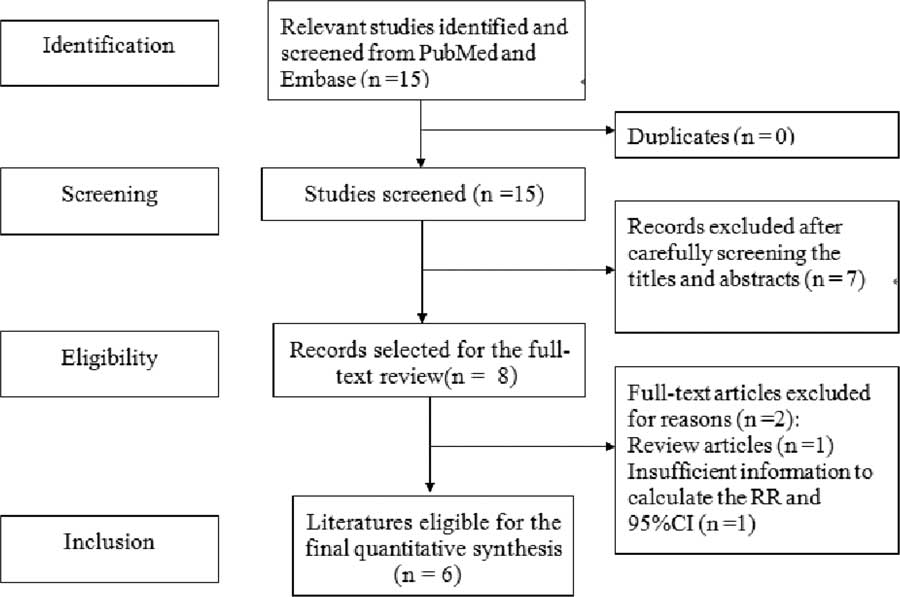
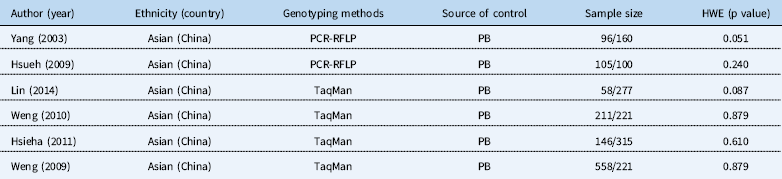
A flow diagram of the search process is shown in Figure 1. We search all the eligible studies using three databases including PubMed, Embase, and CNKI. On the basis of the predefined search strategy and inclusion criteria, a total of six studies were finally included for our meta-analysis.Reference Yang, Li and Li 13 – Reference Lin, Lan and Lai 18 In addition, all of the six studies came from PubMed and Embase. None of them came from CNKI. All of the six studies investigate the Chinese population and they are population-based. Several genotyping methods were used in the eligible studies such as TaqMan probe and PCR-restricted fragment length polymorphism. The genotype frequency in controls of all studies was consistent with Hardy–Weinberg equilibrium (p>0.05). The main characteristics of all the case–control studies included in our meta-analysis are listed in Table 1.
Flow diagram for the identification of eligible studies for this meta-analysis. CI=confidence interval; RR=relative risk.

Main characteristics of all case–control studies included in meta-analysis.

PB=population based; HWE=Hardy–Weinberg equilibrium; RFLP=restricted fragment length polymorphism
Quantitative synthesis of data
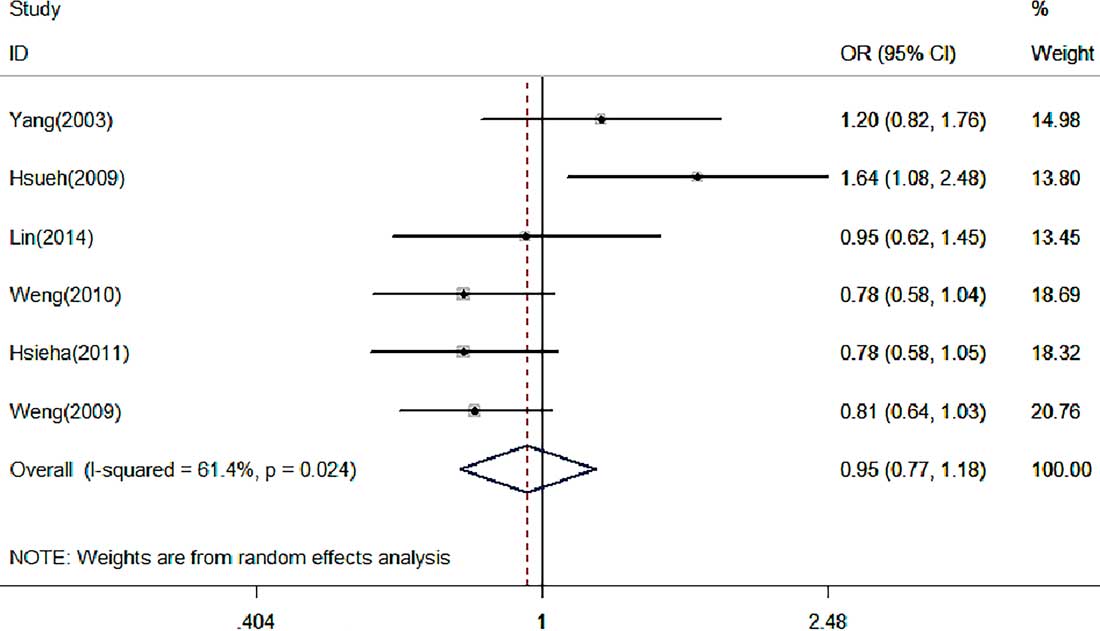
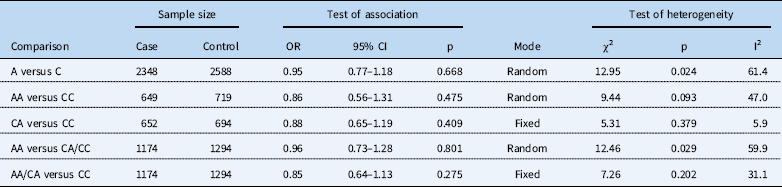
Overall, no significant association between IL-10 -592 A/C polymorphism and Kawasaki disease risk was found under allele contrast (A versus C: OR=0.95, 95% CI=0.77–1.18, p=0.668, Fig 2), homozygote comparison (AA versus CC: OR=0.86, 95% CI=0.56–1.31, p=0.475), heterozygote comparison (CA versus CC: OR=0.88, 95% CI=0.65–1.19, p=0.479), recessive genetic model (AA versus CA/CC: OR=0.96, 95% CI=0.73–1.28, p=0.801), and dominant genetic model (AA/CA versus CC: OR=0.85, 95% CI=0.64–1.13, p=0.275). The summary results for the association of IL-10 -592 A/C polymorphism with Kawasaki disease risk are shown in Table 2.
Forest plot of IL-10 -592 A/C polymorphism with Kawasaki disease risk (allele contrast A versus C). CI=confidence interval; OR=odds ratio.

Meta-analysis of the IL-10 -592 A/C polymorphism with Kawasaki disease risk.

CI=confidence interval; OR=odds ratio
Test of heterogeneity
There was significant heterogeneity in IL-10 -592 A/C polymorphism with Kawasaki disease risk under allele contrast (pheterogeneity=0.024, I2=61.4%) and recessive genetic model (pheterogeneity=0.029, I2=59.9%). To explore the sources of heterogeneity, we evaluated allele contrast by considering possible sources including publication year, genotyping methods, and sample size. We found that sample size (χ2=4.39; df=1; p=0.036) could substantially influence the initial heterogeneity. In addition, meta-regression analyses revealed the sources of heterogeneity. The sample size could explain almost 80% of I2 in meta-analysis.
Sensitivity analysis
Sensitivity analysis was conducted by sequential removal of individual eligible studies, which were included in the present meta-analysis. In the present meta-analysis, any single study could not influence the overall results qualitatively, indicating robustness and reliability of our results.
Publication bias
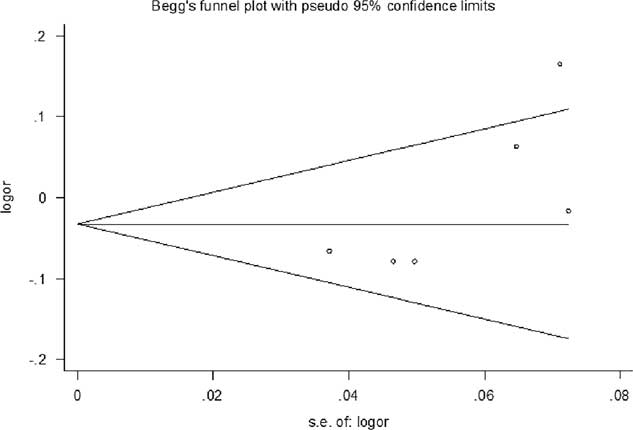
Begg funnel plot was created to assess the publication bias of selected literatures. Although slightly asymmetrical funnel plots were detected in our results (p=0.107) (Fig 3), Egger’s test did not exhibit obvious publication bias in the allele comparison model (p=0.118) and the recessive model quantitatively (p=0.167).
Funnel plot of IL-10 -592 A/C polymorphism with Kawasaki disease risk (homozygote comparison AA versus CC).

Discussion
The incidence of Kawasaki disease is highest in some Asian countries such as Japan, China, and Korea, and it is still a leading cause of acquired heart disease in many countries.Reference Kuo, Yang and Juo 19 Its clinical characteristics include bilateral non-purulent conjunctivitis, polymorphous skin rashes, indurative angioedema, and prolonged fever. What is worse, coronary artery lesions are the most terrible complications of Kawasaki disease.Reference Arj-Ong, Thakkinstian, McEvoy and Attia 20 Therefore, obtaining insight of its exact pathogenesis is of great importance to its treatment and prognosis. The efforts attempting to obtain knowledge of its etiology had never been stopped. However, the clear etiology remains unclear.
Kawasaki disease has been considered as an infectious disease for many years. In recent years, Kawasaki disease has been regarded as an immune disorder of the host. Furthermore, various cytokines which are related with immune were reported.Reference Kim, Lee, Noh, Lee and Lee 3 – Reference Tsukahara, Hiraoka and Saito 6 Several literatures reported the association between polymorphism of cytokines and Kawasaki disease risk such as TNF-α-308, ITPKC (rs28493229), and rs72689236 of caspase-3.Reference Arj-Ong, Thakkinstian, McEvoy and Attia 20 – Reference Xing, Wang and Liu 22 In this study, we critically performed a meta-analysis of IL-10 -592 A/C with Kawasaki disease risk. To the best of our knowledge, the present meta-analysis was the first to explore the association between IL-10 -592 A/C polymorphism and Kawasaki disease risk. The results of our meta-analysis showed no significant association between IL-10 -592 A/C polymorphism and Kawasaki disease risk. Our results are similar to the previous studies that focus on gene polymorphism of cytokine with Kawasaki disease risk. For example, Arj-Ong et alReference Arj-Ong, Thakkinstian, McEvoy and Attia 20 found no significant association between TNF-α-308 polymorphism and Kawasaki disease risk.
The heterogeneity is an important factor when performing meta-analysis. Finding the sources of heterogeneity and solving the heterogeneity are of great significance to the final results. In our study, we found that significant heterogeneity existed in IL-10 -592 A/C polymorphism with Kawasaki disease risk under allele contrast and recessive genetic model. Therefore, we calculated the overall population by method of random-effects model. Then, we conducted meta-regression and subgroup analysis. Sensitive analysis demonstrated that any single study could not affect the final result of the present meta-analysis, indicating that our results were stable and reliable. The publication bias is another important factor that may influence the reliability of meta-analysis. We failed to find any evidence to demonstrate the existence of publication bias, suggesting that publication bias has little effect on the results in our study and the results of our meta-analysis are relatively stable.
Although a comprehensive meta-analysis was conducted to demonstrate the association between IL-10 -592 A/C polymorphism and Kawasaki disease risk, there are still some limitations that should be pointed out. First, the primary studies included in our meta-analysis mainly investigated the Asian population. As IL-10 -592 A/C polymorphism substantially varies across different ethnicities, more primary studies that focused on other ethnicities such as Caucasian population, African population, and mixed population should be carried out. Second, we should be cautious to the results because only six eligible studies were included in our meta-analysis. The sample size was relatively small and only the Asian population was investigated. Third, because of the lack of sufficient primary data, hence, subgroup analysis according to age, gender, radiation exposure, and other confounding factors could not be performed in the present meta-analysis.
In spite of the limitations above, our meta-analysis had also several advantages. First, a meta-analysis of the association of IL-10 -592 A/C polymorphism on Kawasaki disease risk is statistically more powerful than any other single study. Second, all of the eligible studies included in our meta-analysis were population-based. It has been accepted that population-based studies were more representative of the general population than hospital-based studies. Third, the quality of our eligible studies was relatively high, and the sensitivity analysis and publication bias analysis suggested the stability and credibility of the meta-analysis, which leads to a more convincing result. More important, the process of literature selection, data extraction, and data analysis in the meta-analysis was well designed and conducted.
In conclusion, this is the first meta-analysis that investigates the association between IL-10 -592 A/C polymorphism and Kawasaki disease risk. We conclude that IL-10 -592 A/C polymorphism was not associated with Kawasaki disease risk in the Chinese population. However, more primary large-scale and well-designed studies are still required to further evaluate the interaction of IL-10 -592 A/C polymorphism with Kawasaki disease risk.
Acknowledgements
None.
Author Contributions. X.C. conceived and designed the experiments, performed the experiments, contributed reagents/materials/analysis tools, and wrote the paper. X.J. conceived and designed the experiments, performed the experiments, contributed reagents/materials/analysis tools, and wrote the paper. S.Y. performed the experiments, analysed the data, contributed reagents/materials/analysis tools, and wrote the paper. Y.Z. performed the experiments, analysed the data, contributed reagents/materials/analysis tools, and wrote the paper.
Financial Support
This research received no specific grant from any funding agency or from commercial, or not-for-profit sectors.
Conflicts of Interest
None.