I. Background
In the early part of the twentieth century, writers on moral philosophy—prominently Bertrand Russell, C. D. Broad, H. A. Prichard, and W. David Ross—noted that there are many situations in which an agent's misapprehension of his circumstances results in an evaluator's feeling pulled to evaluate the agent's actions as both morally right and morally wrong.Footnote 1 Consider, for example, the following case:
Twin Towers I: Following the crash of an airplane into a skyscraper, security guard Tom, believing that the elevators will cease working, tells office workers to evacuate the building via the stairwell rather than the elevators. In this case, using the stairs takes too long and all the office workers are killed when the building collapses, whereas the elevators remain operational long enough for the employees to have used them to evacuate safely.
When we focus on the actual outcome of Tom's action of telling the employees to use the stairwell, we want to say that it is wrong—indeed tragic, since it results in the avoidable deaths of scores of office workers. But if we focus on what Tom reasonably believes about the employees' options at the time he advises them, we want to say that he did the right thing. Consider also the following case:
Twin Towers II: Following the crash of an airplane into a skyscraper, security guard Joan, believing that the elevators will cease working, but nursing a grudge against her ex-husband who works for High Tower Investments, tells the High Tower employees to evacuate the building via the elevators rather than the stairwell. The employees comply, and reach safety, whereas if they had taken the stairwell the building would have collapsed and killed them.
Here, when we focus on the actual outcome of Joan's action, we want to say that it is right—that she saved the employees' lives. But if we focus on her giving them advice that she thought would result in their death or injury, we want to say that what she did was very wrong.
To resolve the apparent paradox of such actions being judged both right and wrong, moral theorists in the first half of the twentieth century argued that we must recognize several different senses of such moral terms as “right,” “wrong,” “obligatory,” and “permissible.” In one sense of “morally right,” they argued, we mean something like “the morally best action in the actual circumstances”; while in another sense of “right,” we mean something like “the action that is morally most appropriate in light of the agent's beliefs about those circumstances, even if the beliefs are mistaken.”Footnote 2 Granting that there are different senses of these terms dissolves the paradox arising from our judgment that each security guard's action is both morally right and morally wrong, since the act can be right in one sense but wrong in the other. Moreover, for those theorists disconcerted by the idea that an act might be an agent's duty even though the agent (through ignorance or mistakes about factual matters) doesn't know the act to be his duty, the concept of an act that is best relative to the agent's beliefs identifies a type of duty to which the agent would always have epistemic access, and thus could fairly be held to blame for violating.Footnote 3
Many writers have come to see the importance of making such a distinction. The terms used for expressing these different senses of “right” and “wrong” have varied, but contemporary usage has coalesced around the term “objectively right” for the first sense, and “subjectively right” for the second. The use of these terms to express this distinction is now widely, although not universally, accepted among moral philosophers.Footnote 4
The gap between what is best in light of the actual circumstances of an action, and what is best in light of the agent's beliefs about the circumstances, arises most visibly in the context of consequentialist theories in which the long-term consequences of an action—not readily knowable by its agent—determine its moral status. But this gap can easily arise for deontological or nonconsequentialist theories as well, since the relevant circumstances or nature of an action (apart from its consequences) may also be difficult for the agent to ascertain accurately.Footnote 5 Deontological theories may forbid killing the innocent, lying, committing adultery, convicting innocent defendants, stealing, failing to compensate those whom one has unjustifiably harmed, and so forth. But any given agent may be mistaken as to whether a possible killing victim is innocent, whether the statement he makes is untrue, whether the person with whom he has sexual relations is married, whether the defendant is guilty of the crime, whether an item of property belongs to him or to someone else, or whether a given level of compensation covers the loss. Thus, the pressure to recognize two senses of “right” and “wrong” arises equally for both consequentialist and nonconsequentialist moral theories.
The argument for distinguishing objective from subjective rightness may have originally arisen to deal with the fact that in certain circumstances we are pulled to evaluate an agent's action as paradoxically both right and wrong. However, it quickly became clear that another need is served by this distinction as well. It is commonly held that a—or the—main function of moral theories is to guide agents in making decisions about what to do.Footnote 6 Suppose the security guards in our cases have moral codes that tell them to save the lives of people in the building.Footnote 7 Tom, in Twin Towers I, can use his moral code to guide his decision, since, in light of his belief that using the stairwell is the only safe evacuation route, he can infer from his moral code that he ought to direct the employees to use the stairwell. His code can guide his decision even though he is mistaken about the facts, and thus chooses, on the basis of his theory, an act that the theory condemns. But consider the following case:
Twin Towers III: Following the crash of an airplane into a skyscraper, security guard Pete must advise the office workers how best to evacuate. Pete believes there is an 80 percent chance that the elevators will become inoperative before they reach the ground floor, and also believes there is a 50 percent chance that people evacuating via the stairwell will not escape the building before it collapses. Pete directs the employees to use the stairwell, but descending takes too long and all the employees are killed when the building collapses. The elevators, however, remain operational long enough for the employees to have used them to evacuate safely.
In this case, Pete cannot use his moral code to make a decision, because it simply tells him to save the lives of people in the building; it tells him nothing about what to do when the probability of saving their lives is less than 100 percent. However, since advising the employees to use the stairwell has a 50 percent chance of saving their lives, whereas advising them to use the elevators has only a 20 percent chance of saving their lives, there is a clear sense in which Pete's advising them to use the stairwell is the better action. Unfortunately, there is an equally clear sense in which this action is the worse action, since it leads to the employees' death, whereas advising them to use the elevators would have saved their lives. Twin Towers III demonstrates that the concept of “subjective rightness” can usefully serve a second function: it can be used to pick out the action that it would be wise to perform even though the agent cannot derive guidance directly from his moral code. For Pete, telling the employees to use the stairs is the subjectively right action, while telling them to use the elevators is subjectively wrong; he can decide what to do by choosing the action that has the superior subjective status. Consideration of cases such as this led theorists to recognize that the original distinction between objective and subjective rightness could be leveraged: the concept of subjective rightness can be utilized to provide the moral guidance needed by agents who are uncertain (as opposed to mistaken) about the circumstances or consequences of their actions, and who therefore need some standard beyond objective rightness in deciding what to do. The frequent uncertainty that agents have about the objective moral status of their prospective actions means that many agents are unable to use their moral code directly to make decisions about what to do. Ideally, the concept of subjective moral rightness dissolves this problem: for every agent who is capable of making a moral decision, on each occasion for decision-making there will be some act identifiable by the agent as one that is subjectively right for her to perform. If she looks to morality for guidance, she can choose the subjectively right act even when she cannot identify which act is objectively right.Footnote 8
Of course, the concepts of moral rightness and wrongness are heavily linked to the concept of moral blameworthiness.Footnote 9 Once the distinction between objective and subjective rightness/wrongness is recognized, it becomes natural to say something like, “An action is blameworthy only if it is subjectively wrong.” An action can be objectively wrong but still not blameworthy, as Twin Towers I and III show: security guards Tom and Pete are not blameworthy for directing the employees to use the stairwell, even though their actions are objectively wrong. One promising way to explain why these actions are not blameworthy is to invoke the concept of subjective rightness, and say that the actions are subjectively right, and hence not blameworthy, even though they are objectively wrong.
Thus, it appears as though the distinction between objective and subjective rightness is an extremely valuable contribution to moral theory. However, it might be claimed that we do not really need this distinction—that we can do all the work we want to do with a more limited set of moral concepts that includes objective rightness/wrongness and blameworthiness/praiseworthiness, but not subjective rightness/wrongness. Thus, it might be claimed that we can say all we need to about Twin Towers I and II by saying that Tom's act is objectively wrong but not blameworthy (because he believed his act to be objectively right, and had the excuse of ignorance), while Joan's act is objectively right but still blameworthy (because she believed her act to be objectively wrong, but nonetheless chose it). But we cannot say all we need to about Twin Towers III by using just these concepts, since we need some way to articulate the moral appropriateness of Pete's act of advising the employees to use the stairwell rather than the elevators (even though this leads to their deaths). It is true that Pete's act is objectively wrong, and that he is not blameworthy for this act. But we cannot explain why he is not blameworthy by saying that Pete believes his act to be objectively right (as we explain Tom's not being blameworthy). By hypothesis, Pete's moral code does not evaluate his act as objectively right, and Pete himself does not believe that it is objectively right, since he is uncertain which act would satisfy his duty to save lives. Thus, it appears we need the distinction between objective and subjective rightness to articulate the moral status of the choice-worthy action in cases where the agent is uncertain which action would be objectively best. Once we have accepted the need for the distinction in these cases, we can accept its usefulness in cases such as Twin Towers I and II as well.
While some theorists might have hoped we could make do with just the standard concepts of objective rightness/wrongness and blameworthiness/praiseworthiness, other theorists (let us call them “Remodeling” theorists)Footnote 10 have tried to simplify our moral toolbox by abandoning the traditional concept of objective rightness/wrongness, and elevating the concept of subjective rightness/wrongness to take its place. On this view, an action can have only one type of rightness or wrongness, but this fundamental status is determined, not by the action's actual circumstances and consequences, but rather by the content of the agent's beliefs about its circumstances and consequences. A Remodeling theorist would say that the only “right or wrong” judgment we need to make about Tom's action in Twin Towers I is that it is right because it is the action most appropriate to the agent's beliefs about its circumstances and consequences.Footnote 11 According to such theorists, there is no need to go beyond this by evaluating the action in light of its actual circumstances. Theorists who take this stance are often moved by what they take to be the chief function of moral theories, namely, to guide agents' decision-making. They argue that because agents are frequently mistaken or uncertain about the circumstances and consequences of their actions, it is better to eliminate any evaluation that rests on facts that are unknown to them, and focus solely on evaluations that rest on the decision-maker's beliefs about his circumstances, beliefs which are more accessible to him. For example, many utilitarians have proposed that act or rule utilitarianism be formulated in terms of the expected rather than actual consequences of the act or rule. According to such Remodeling theorists, Tom's act is right in this fundamental sense of “right”; it can guide him in making his decision. There is no need to introduce any additional concept of rightness. The concept of blameworthiness is then tied fairly directly to the “fundamental” wrongness of the action.Footnote 12
I believe that such Remodeling theorists are mistaken, and that we need both the concepts of objective and subjective moral status. It is not the purpose of this essay to argue for this view. However, before we can seriously assess the view of these theorists, we need a firm grasp on the concept of subjective rightness/wrongness, so that we can accurately determine whether it is sensible to elevate this concept in the manner that Remodeling theorists recommend. The aim of this essay is to propose a novel definition for the concept of subjective moral status. I shall review the definitions available in the literature, and argue that the general approach embodied in these definitions is wrongly conceived and must be abandoned in favor of a more fruitful strategy. A successful definition will help us understand the distinction between objective and subjective moral status, will create an important foundation for evaluating proposed substantive principles of subjective rightness, and will provide groundwork for assessing the claims of the Remodeling theorists.
One final clarification: agents can be mistaken or uncertain about normative matters, as well as about matters of non-normative fact. The difficulties facing such agents, and what to say about them, are deep problems.Footnote 13 However, in this essay I will focus only on the difficulties arising from agents' mistakes and uncertainty about matters of non-normative fact, and, where necessary, I will assume the agent has the requisite beliefs about normative matters.
II. Defining “Subjective Rightness” and “Subjective Wrongness”
Despite the fact that theorists have converged on the terms “objective” and “subjective” rightness/wrongness to draw the distinction I have described, the definitions proposed for the terms “subjective rightness” and “subjective wrongness” have varied significantly. Clearly, we need to establish acceptable definitions for these crucial concepts.
The terms “subjective rightness” and “subjective wrongness” were introduced to fill gaps in the existing common and philosophical vocabulary. Hence, assessing the adequacy of any proposed definition will not be a matter of simply determining how accurately it reflects common usage, but rather determining whether it fills the perceived gaps in the desired ways. Reflection on the discussion so far suggests certain criteria that any acceptable definition must meet. One complexity we must acknowledge is that (a) dissolving the paradoxical tension created by evaluating an agent's action as both right and wrong (for example, in the Twin Towers I and II cases) may have slightly different requirements from (b) providing an uncertain agent with guidance (for example, in the Twin Towers III case). In stating the criteria for an acceptable definition of “subjective rightness,” I will give pride of place to the need to provide guidance for a decision-making agent. Thus, the first-person perspective—that of the agent deciding what to do—will predominate.
A. Criteria of adequacy
I shall work with the following set of criteria of adequacy for a definition of “subjective rightness.” These are somewhat rough, but are usable for our purposes.
Criterion 1. Normative Adequacy:
A definition of subjective rightness should enable us to identify principles of subjective rightness that will accurately assess (given appropriate background information) the subjective moral status of actions, where an action's subjective moral status will often contrast, in an acceptable manner, with its objective moral status. The principles of subjective rightness should classify actions as subjectively right that strike us as ones it would be reasonable or wise for the agent to choose, given the agent's (possibly faulty) grasp of the situation.
Criterion 2. Domain Adequacy:
The definition of subjective rightness should enable us to identify principles of subjective moral status that assign subjective status to every action that has objective moral status.Footnote 14
Criterion 3. Guidance Adequacy:
The definition of subjective rightness should endorse a system of principles of subjective rightness from which agents can derive moral guidance in every situation in which they find themselves, even though an agent may be uncertain or mistaken about which actions have the features that would make them objectively right in that situation.Footnote 15
Criterion 4. Relation to Blameworthiness:
The action classifications arising from the definition of subjective rightness should bear appropriate relationships to assessments of whether the agent is blameworthy or praiseworthy for her act.
Criterion 5. Normative Compatibility:
The definition of subjective rightness should be compatible with the full range of plausible theories of objective moral rightness, so that it is possible to identify acts that are subjectively right relative to each such theory.Footnote 16
Criterion 6. Explanatory Adequacy:
The definition of subjective rightness should provide illumination about why subjectively right acts are reasonable or wise to perform, why agents should guide their conduct by reference to such acts, and why these acts are linked to accountability.
I shall use these criteria as guides in assessing proposed definitions of “subjective rightness.” However, the Guidance Adequacy Criterion requires further comment. What is it to use a normative principle—such as a principle of subjective rightness—to guide one's decision? Consider John, who wants to follow the principle “Always stop at red traffic lights, and always proceed at green traffic lights.” He believes that he sees a red light, and forms the desire to stop his car. But things don't go according to plan: perhaps he stops, but the light was actually green, and what he saw was a red beer advertisement; or perhaps the traffic light was red, but his brakes fail and the car doesn't stop. In both these cases, there is an obvious sense in which he has not regulated his behavior in accordance with his principle—but there is another obvious sense in which his decision clearly has been guided by it. Reflecting on this case, we may draw the following distinction: an agent is able to use a principle as an internal guide for deciding what to do just in case the agent would directly derive a prescription for action from the principle if he wanted to, while an agent is able to use a principle as an external guide for deciding what to do just in case the agent would directly derive a prescription for action from the principle if he wanted to, and the act whose prescription he would derive in fact conforms to the principle.Footnote 17
Clearly, it would be ideal if every normative principle, whether it be a principle of objective or subjective rightness, could be used by each agent as an external guide for decision-making. But we have already seen that principles of objective rightness fall short of this ideal, and we must be prepared to discover that principles of subjective rightness may fall short of it as well. However, it seems realistic to insist that principles of subjective rightness—which, after all, are designed to guide agents in making decisions when they are mistaken or uncertain about what the governing principle of objective rightness requires of them—should at least be capable of being used as internal decision guides. An agent who cannot find any way to translate his moral values into his choice of what to do is an agent who cannot find a way to govern his decision by the considerations he deems most relevant. His decision does not express his moral values, and so in an important way undermines his autonomy.Footnote 18 Thus, we want principles of subjective rightness to be capable of being used as internal guides to action, even if they cannot successfully be used as external guides to action. I shall interpret the Guidance Adequacy Criterion as requiring that principles of subjective rightness jointly be usable as internal decision-guides in every situation in which an agent must make a decision.
There are, of course, possible principles of subjective rightness which are not usable as internal guides by a given agent here and now, precisely when the agent must make her decision—but would be usable if she had more information, or had more time to reflect on her circumstances, or had the mental acuity to notice that her beliefs entail, via some complex chain of reasoning, that a certain act is the one prescribed by the principle. By the same token, however, a principle of objective rightness that may not be usable as an internal guide by a given agent here and now, when she must make her decision, would be so usable if only the agent had more information, or more time to reflect, or greater mental acuity. We need principles of subjective rightness precisely because agents must often make decisions despite their lack of information or time or ability to deliberate further. Principles of subjective rightness are needed precisely to assist agents in deciding what to do in these circumstances. Hence, when we ask whether a given principle of subjective rightness satisfies the Guidance Adequacy Criterion, we should understand the question to be whether agents are able to use that principle of subjective rightness at the time they are making a decision, with just the intellectual and informational resources they have at hand—not whether they would be able to use it if they had more time or some idealized set of resources. Of course, an agent may be blameworthy for not having better resources—perhaps she should have researched her decision more thoroughly before having to make it. But we and she want to know what is best for her to decide, given her actual information, however culpably impoverished it may be.
B. Approaches to defining “subjective rightness”
In the literature, there have been four prominent approaches to defining “subjective rightness.” Although details vary, these four approaches can be stated as follows:
(1) Act A is subjectively right just in case A is the act most likely to be objectively right; and
A is subjectively wrong just in case A is not the act most likely to be objectively right.Footnote 19
(2) Act A is subjectively right just in case A is the act that has the highest expected value; and
A is subjectively wrong just in case there is some alternative to A that has a higher expected value than A.Footnote 20
(3) Act A is subjectively right just in case A would be objectively right if the facts were as the agent believed them to be; and
A is subjectively wrong just in case A would be objectively wrong if the facts were as the agent believed them to be.Footnote 21
(4) Act A is subjectively right just in case A is best in light of the agent's beliefs at the time he performs A; and
A is subjectively wrong just in case A is not the best act in light of the agent's beliefs at the time he performs A.Footnote 22
I have phrased several of these definitions in terms of what the agent actually believes. But one popular family of variant definitions involves defining “subjective rightness” in terms of what the agent ought to have believed, what a reasonable person in the agent's position would have believed, what the agent would have believed if she had exercised due diligence, what she would have been justified in believing, etc.Footnote 23 Thus, Definition (1) might alternatively read: “Act A is subjectively right just in case A is the act that a reasonable agent would believe to be objectively right.” For brevity, I will discuss these popular “reasonable belief” variants only in footnotes until Section VI. Each of these definitions, except (4), assumes a background understanding of the concept of “objectively” right/wrong. For the purposes of this essay, I will assume the informal characterization given in Section I: namely, that an action is objectively right just in case the action is the best one in the actual circumstances. However, subsequent discussion will shed some light on this characterization.
C. Definition (1)
Definition (1) states that an act A is subjectively right just in case A is the act most likely to be objectively right; and A is subjectively wrong just in case A is not the act most likely to be objectively right.
This definition, like Definition (2), but unlike Definitions (3) and (4), contains a substantive rule for determining an action's subjective status.Footnote 24
As a number of writers (but not all) have noticed, Definition (1) must be rejected, because it often delivers an unacceptable appraisal of an act as subjectively right. Consider the following case (a variant of one much discussed in the literature):Footnote 25
Strong Medicine: Patient Ron consults his physician, Sue, about a moderately serious ailment. Sue can treat Ron with either of two drugs. She believes that giving him no treatment would render his ailment permanent; that drug X would cure Ron partially; and that there is an 80 percent chance that drug Y will cure Ron completely, but a 20 percent chance that Y will kill him.
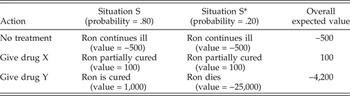
Suppose Sue's moral code tells her to maximize the welfare of her patients. Her choice, then, appears to be as follows, if we supply some reasonable figures as estimates of the welfare of the patient. “Situation S” is the situation in which if Ron takes drug Y he will be completely cured, while “Situation S*” is the situation in which if Ron takes drug Y he will be killed. Of course, the outcome for Ron if he receives no treatment, or if he takes drug X, is the same whether Situation S or Situation S* obtains.
Possible outcomes in Strong Medicine

According to Definition (1), the subjectively right act for Sue is to prescribe drug Y, since it is most likely to be objectively right. Prescribing drug Y has a .80 probability of maximizing Ron's welfare (and so being objectively right), since there is a .80 probability that Situation S will obtain and Ron will be cured—the best possible outcome. Prescribing drug X has only a .20 probability of maximizing his welfare (and so being objectively right), since there is a .20 probability that Situation S* will obtain, in which case prescribing drug Y would kill Ron (whereas prescribing drug X would partially cure him), and giving him no treatment would also have a worse outcome than prescribing drug X. Giving him no treatment has a zero probability of maximizing his welfare (and so being objectively right).
But clearly this is incorrect: Sue should not run a 20 percent risk of killing Ron in order to possibly achieve a full cure in this case; it would be wiser of her to prescribe drug X, which will not achieve a full cure, but runs no risk of killing him. Definition (1) gives Sue the wrong advice about what choice to make because it fails to take into account how bad (or good) the possible outcomes of her actions are, apart from the bare comparative fact that one outcome is better or worse than another. Hence, it is insensitive to the fact that when prescribing drug Y to Ron does not produce the best outcome, it produces an outcome far worse than anything that might be produced by any of the other options. Definition (1) fails the Normative Adequacy Criterion.Footnote 26
D. Definition (2)
Definition (2) states that an act A is subjectively right just in case A is the act that has the highest expected value; and A is subjectively wrong just in case there is some alternative to A that has a higher expected value than A.
Definition (2) is explicitly formulated to overcome the problem just seen for Definition (1), since it is formulated to take into consideration, not just the probabilities of the various outcomes of an agent's actions, but also how good or bad those options are, beyond the bare comparative fact that they are better or worse than the outcomes that would be produced by another of the agent's alternatives. The “expected value” of an act is the sum of the expected values of each of its possible upshots, where the expected value of an upshot is the value of that upshot, weighted by the probability of the upshot's occurring. Thus, the expected values of Sue's acts in the Strong Medicine case would be as follows:
According to Definition (2), Sue's prescribing drug X to Ron would be the subjectively right act, because it has the highest expected value (100). Prescribing drug Y would be subjectively wrong, because its expected value (−4,200) is less than the expected value of prescribing drug X. This recommendation to prescribe drug X has vastly more intuitive appeal than the recommendation derived from Definition (1). Because of the intuitive appeal of such recommendations, as well as other reasons, Definition (2) has a long history of support from moral philosophers and decision theorists.
Expected values in Strong Medicine

However, even though Definition (2) offers an account of subjective rightness that accords well with our intuitive understanding of what makes some acts better choices than others when the agent is uncertain about the actual facts of his situation (and thus satisfies the Normative Adequacy Criterion), it fails to satisfy the Guidance Adequacy Criterion. The Guidance Adequacy Criterion requires that a definition of subjective rightness endorse principles of subjective rightness that provide guidance to an agent who cannot decide what to do because he is uncertain about the facts of his situation. The principle of subjective rightness endorsed by Definition (2) is simply: “An act is subjectively right if it would maximize expected value, and subjectively wrong otherwise.” To apply this principle in making a decision, an agent such as Sue need not have certainty about her circumstances; she need not, for example, feel certain that drug Y would cure Ron. But she does need to have probability estimates—not mere “possibility” judgments—about the relevant circumstances. Sue, for example, must be able to assign probabilities to drug Y's curing Ron and to drug Y's killing Ron. Moreover, she must have beliefs about the expected values of her various alternatives, which would normally require her to have calculated these values.Footnote 27 In a simple case such as Strong Medicine, many (although not all) agents could do this. But many of the decisions that agents must make would necessitate their assigning values and probabilities to events about which they have very little notion what their likelihood is, and would involve the agents' making enormously complex calculations to arrive at each action's expected value. It is completely implausible that every agent has beliefs about the required value assignments and probability estimates, or has the time or ability to make these calculations, or, more generally, has the belief about some action that it would maximize expected value, before a decision must be made.Footnote 28 We must conclude that Definition (2), although it directly endorses what is often the correct principle to use in selecting an action, nonetheless violates the Guidance Adequacy Criterion, because this principle cannot be used as a guide by many agents who lack the necessary beliefs or ability or time to apply it.Footnote 29
E. Definition (3)
Definition (3) states that an act A is subjectively right just in case A would be objectively right if the facts were as the agent believed them to be; and A is subjectively wrong just in case A would be objectively wrong if the facts were as the agent believed them to be.
Definition (3) works well in cases such as Twin Towers I. In that case, in light of security guard Tom's beliefs about the elevators and the stairs, he also believes that he will save the lives of people in the building by directing the employees to evacuate by the stairs rather than the elevators. Were the facts as Tom believed them to be, his act of directing the employees to use the stairs would be objectively right, so this act counts as subjectively right according to Definition (3). This prescription satisfies the Normative Adequacy Criterion in this case, since we feel that this act is the wisest act for Tom to perform (despite the fact that it results in avoidable tragedy). It also satisfies the Guidance Adequacy Criterion, since Tom can use it to decide which act to perform.
Unfortunately, Definition (3) does not meet these criteria in every case. Consider how to apply it to Twin Towers III, in which security guard Pete's relevant beliefs are probabilistic ones: he believes that there is an 80 percent chance that the elevators will become inoperative before they reach the ground floor, and he believes there is a 50 percent chance that people evacuating via the stairs will not get out of the building before it collapses. He further believes that directing the employees to the stairs has the greatest chance of saving the employees' lives. To apply Definition (3) to Pete's decision requires us to determine what act would have been objectively right if the facts were as Pete believed them to be. This was easy enough in Twin Towers I, since we only needed to ask which act would have been objectively right if the facts were as Tom believed them to be (i.e., if he were correct in believing that he would save the employees' lives by directing them to use the stairs). In a case such as Twin Towers III, however, it is much less easy to see how to apply Definition (3). What would the “facts” be if they were as Pete believed them to be? We might try to identify a probabilistic “objective fact” corresponding to Pete's belief that directing the employees to the stairs offers the greatest chance of saving their lives. On some views about probability, there are no “objective” probabilistic “facts” such as a probabilistic fact that directing the employees to the stairs has the greatest chance of saving their lives.Footnote 30 On these views, we are blocked from applying Definition (3) to Pete's decision, since we cannot determine which act would be objectively right if the “facts” were as Pete believed them to be—there are no such “facts.” In this circumstance, Definition (3) fails to satisfy the Normative Adequacy Criterion, the Domain Adequacy Criterion, and the Guidance Adequacy Criterion, since it cannot identify any act as the subjectively right act.
On other views about probability, there might be a sense of objective probability according to which directing the employees to the stairs offers the greatest objective chance of saving their lives. On these views, we would apply definition (3) by asking what act would be objectively right if directing the employees to the stairs offers the greatest objective chance of saving their lives. But Pete's moral code, like most moral codes, ascribes objective moral status to an action in virtue of its non-probabilistic features: his moral code says that an action is objectively right if it will actually save the employees' lives. His moral code says nothing about the objective status of an action that has the greatest objective chance of saving their lives. In the context of his moral code, this probabilistic characteristic of the action is morally irrelevant. Hence, his moral code does not provide an assessment of the objective moral status of any of Pete's options as he understands them. Once again, we are blocked from applying Definition (3) to Pete's decision, since it cannot evaluate actions as subjectively right or wrong in the context of a theory of objective moral rightness that does not ascribe moral relevance to probabilistic features of those actions.Footnote 31 Definition (3) must be rejected as violating the Normative Adequacy Criterion, the Domain Adequacy Criterion, and the Guidance Adequacy Criterion in the many cases in which agents have probabilistic beliefs about their options.Footnote 32
III. “Best in Light of the Agent's Beliefs”
We have now seen that Definitions (1), (2), and (3) fail to satisfy all the criteria we introduced for evaluating proposed definitions of the concept of subjective rightness/wrongness.
This leaves us with
Definition (4) , which states that an act A is subjectively right just in case A is best in light of the agent's beliefs at the time he performs A; and A is subjectively wrong just in case A is not the best act in light of the agent's beliefs at the time he performs A.
Although worrisomely vague, Definition (4) looks promising. Since it states that an act is evaluated for subjective rightness in light of the agent's beliefs, it is at least consistent with the appropriate evaluations of the agents' choices in Twin Towers I, II, and III, and in Strong Medicine, and thus seems likely to satisfy the Normative Adequacy Criterion. Moreover, since agents normally have access to the contents of their beliefs, it appears that agents can ascertain which action is subjectively right, and hence can apply this concept, as characterized by Definition (4), in their decision-making—which enables it to meet the Guidance Adequacy Criterion. Since blameworthiness is clearly a function (at least in part) of what the agent believes about the circumstances of her choice, Definition (4) appears likely to satisfy the Relation to Blameworthiness Criterion. And, since it appears compatible with any plausible theory of objective rightness, it appears likely to meet the Normative Compatibility Criterion as well.
Nonetheless, there are difficulties with Definition (4). Let us examine them.
A. The accessibility of beliefs
Definition (4) states that whether or not an action is subjectively right (or wrong) is a function of the agent's beliefs. For example, in Twin Towers I, it suggests that even if Tom's action of directing the employees to use the stairs is objectively wrong, nonetheless this act is subjectively right, because Tom believes that the employees' lives would be saved by their taking the stairs rather than the elevators. For a principle of subjective rightness, built on Definition (4), to meet the Guidance Adequacy Criterion—to guide any agent in making a moral decision—it must be the case that agents always have access to their own beliefs. Thus, it must be the case that even though security guard Pete in Twin Towers III does not know (or believe) which escape route would actually be best, he does have access to his belief that directing the employees to the stairs has the greatest chance of saving their lives. If what it is subjectively right for him to do is a function of this belief, and he is aware that he has this belief, then he can make a choice based on a principle of subjective rightness that tells him what to do in light of his beliefs. But if Pete is unaware or uncertain what his relevant beliefs are, then he cannot apply any principle of subjective rightness that meets Definition (4) in deciding what to do. If agents can be uncertain about the existence and content of their relevant beliefs, then any principle of subjective rightness meeting Definition (4) would fail to satisfy the Guidance Adequacy Criterion in those cases.
Or suppose it is possible for an agent to feel certain what his relevant beliefs are, but to be mistaken about this. Imagine that Pete feels certain he believes that directing the employees to the elevator has the greatest chance of saving their lives, even though he actually believes just the reverse. In such a case, it appears that Definition (4) implies that Pete's subjectively right act is to direct the employees to use the stairs, but he would believe that his subjectively right act is to direct the employees to use the elevators. This possibility would open up a gap between what is actually subjectively right for the agent and what the agent may conclude is subjectively right: a gap somewhat parallel to the original gap between what is objectively right for the agent to do and what is subjectively right for him to do. It would undermine one of the original attractions of the concept of subjective rightness, which is that it could be used to identify a type of duty to which the agent has infallible access in his decision-making, even though he may be mistaken or uncertain about which act is objectively right.Footnote 33
But can agents be uncertain or mistaken about the content and existence of their own beliefs in the way I just proposed? Of course, in many cases, people do have accurate access to their own beliefs. Some philosophers have argued that this is always the case. However, most philosophers and psychologists now hold that a person's own beliefs are not necessarily accessible to that person (or at least accessible in the time available for making a quick decision). Agents may be unaware of, mistaken, or uncertain regarding the existence or content of their beliefs, just as they can be unaware of, mistaken, or uncertain about the consequences of their actions. Many of our beliefs are “tacit” or stored at an unconscious level—many people believe, for example, that their house has a roof, but that belief is not one of which they are typically conscious or aware in the course of their day-to-day activities. Sometimes we are simply mistaken: a person may, without reflection, assume she has a certain belief, but under the right revelatory circumstances discover she does not have the belief at all. For example, a churchgoer brought up in a conventional religious family may believe that she believes in God, but be mistaken about this, as she discovers when challenged about the content and foundation for this belief. Some beliefs are, and often remain, unconscious because we are motivated not to acknowledge them. Someone raised in a racist community may believe that he personally no longer harbors racist beliefs, but he may be mistaken about this. Or, alternatively, he may have become convinced (through attendance at too many diversity workshops) that he does harbor racist beliefs, when actually he does not. Our beliefs, in other words, are not “luminous.” (A belief is luminous just in case it is true that if we have that belief, we believe that we have that belief.) Nor are we infallible with respect to our beliefs. (We are infallible with respect to belief B just in case it is true that if we believe we have belief B, then we do have belief B.)Footnote 34
To see the implications of this for Definition (4), consider the following case:
Learning Disability I: Allison has overwhelming evidence, and in her heart of hearts she recognizes, that her daughter has a significant learning disability. However, she cannot bring herself to consciously face this fact. If asked, she would truthfully say that she believes that she does not believe her daughter to have any disability. She also believes that having her daughter tested would subject her daughter to peer teasing and undermine her self-confidence, but would maximize her happiness if the test were positive and resulted in remedial action. When given the option to have her daughter tested for the disability, Allison declines.Footnote 35
Let us say that the governing principle of objective rightness tells Allison that an act is objectively right just in case it will maximize her daughter's lifetime happiness, and the governing principle of subjective rightness tells Allison that an act is subjectively right just in case she believes the chance of the act's maximizing her daughter's lifetime happiness is no lower than the chance of any alternative act's maximizing her daughter's happiness.Footnote 36 Let us assume that on this theory Allison's declining to have her daughter tested is objectively wrong and—according to Definition (4) and the governing principle of subjective rightness—is also subjectively wrong, since in her heart of hearts Allison believes that her daughter has a learning disability and that having her tested will maximize her lifetime happiness. However, since Allison does not recognize all her own beliefs, she does not regard declining to have her daughter tested as either objectively or subjectively wrong—instead, she holds that this action is both objectively and subjectively right.
Allison's psychology might be somewhat different, as described in the following version of the case.
Learning Disability II: Allison has substantial evidence, and in her heart of hearts she recognizes, that her daughter has a significant learning disability. However, she cannot bring herself to consciously face this fact, even though from time to time it strikes her that her daughter is not learning as fast as other children. When push comes to shove, Allison is uncertain what degree of belief she has that her daughter has a disability, or what degree of belief she has that her daughter's learning ability is within the normal range. She believes (and knows she believes) that having her daughter tested would subject her daughter to peer teasing and undermine her self-confidence, but would maximize her happiness if the test were positive and resulted in remedial action. When given the option to have her daughter tested for a disability, Allison is uncertain about what to do.
Allison's declining to have her daughter tested would be objectively wrong and—according to Definition (4) and the governing principle of subjective rightness—would also be subjectively wrong, since in her heart of hearts Allison believes that her daughter has a learning disability and that having her tested would maximize her daughter's lifetime happiness. However, if Allison accepts Definition (4) and the governing principle of subjective rightness, she is uncertain about whether declining to have her daughter tested is subjectively right or wrong, since she knows that subjective wrongness depends on what probabilities she ascribes to the various relevant facts, but she is uncertain about what she believes on this score.
Thus, if Definition (4) is correct in stating that the subjective moral status of an act depends on the agent's beliefs, there can be cases in which an agent (unaware of or mistaken about her beliefs) can be mistaken about an action's subjective status; and there can also be cases in which an agent (uncertain about her beliefs) can be uncertain about an action's subjective status. The fact that agents can be unaware, mistaken, or uncertain about their own beliefs means that Definition (4) fails the Guidance Adequacy Criterion: there are cases in which the agent can derive no moral guidance from the principles of subjective rightness that the definition endorses, even though some of the actions available to her are subjectively right.Footnote 37
B. The moral significance of beliefs
The discussion up to this point has assumed that the moral significance of beliefs arises only because an agent may be mistaken or uncertain about the features of his possible actions that are relevant to their objective moral status—what we may call the “objective right-making” or “objective wrong-making” features of his acts. As we have seen, because of agents' frequent errors and uncertainties regarding objective right- and wrong-making features of actions, it is useful to define a secondary type of moral status that an action may have in virtue of an agent's beliefs. This secondary status—subjective rightness or wrongness—can be used to pick out the action that it would be best for the agent to choose in light of what he believes, even when his beliefs about the action's objective right- and wrong-making characteristics are faulty.
What we must realize, however, is that there are moral views according to which an action's objective moral status may be partly or wholly a function of the agent's beliefs.Footnote 38 In other words, an action's objective right- or wrong-making features may include the agent's beliefs. For example, on many moral views, lying is wrong, where “lying” is defined (roughly) as asserting what the agent believes to be a falsehood with the intention of deceiving his audience.Footnote 39 To perform an act of lying requires the agent to have two beliefs: the belief that his assertion is false, and the belief that his assertion will deceive his audience.Footnote 40 Other types of acts commonly held to be wrong also involve attitudinal states that, on analysis, turn out to involve the agent's beliefs.Footnote 41 Examples include stealing (taking possession of property one believes to belong to another) and committing murder (acting in a way that one believes and intends will result in the death of another person). The canonical statement of the Doctrine of Double Effect specifies (among other things) that it would be wrong for an agent to intend a bad effect that he believes will bring about a disproportionately larger good effect.Footnote 42 We regard certain kinds of “attempts”—such as attempting to murder someone—as objectively wrong, and in such cases, too, the agent must have certain beliefs about the possible upshot of his bodily motions for his act to count as an attempt. Similarly, we think that an agent's risking certain grave harms is an objectively wrongful act in itself, even if the harms fail to materialize.Footnote 43 Finally, some moral codes prescribe or proscribe certain purely mental acts or attitudes that include beliefs: for example, the Ten Commandments tell us to honor our parents (which includes believing one's parents are worthy of respect), but not to covet our neighbor's house or wife (which includes believing that the house or wife belongs to one's neighbor); and Christianity tells us to have faith (which involves believing in God).Footnote 44
It could be cogently argued (and I am sympathetic with this argument) that in the case of each of these types of performance (except those that involve purely mental activities, such as believing in God), it is only the underlying non-mental activity that is objectively wrong. On this view, when we evaluate as “right” or “wrong” the more complex act (such as lying or stealing)—an act that involves bodily motions, the surrounding circumstances, and the agent's beliefs and desires—we are using a kind of time-saving (but misleading) shortcut that merges together considerations of objective moral status, subjective moral status, and blameworthiness. Thus, in the case of lying, it could be argued that what is genuinely objectively wrong is making an assertion that misleads the person who hears it; what is subjectively wrong is making an assertion in the belief that it is false and will mislead; and what is blameworthy is performing an act that one believes to be subjectively wrong. Similar analyses, identifying an objectively wrong bodily movement (and set of circumstances) at the core of each of these acts, could be offered for stealing, committing murder, and harming someone in order to bring about a good effect.
However, successfully carrying out this program of eliminating reference to any mental aspects when defining objectively wrong actions may not be easy. For example, philosophers who have worked on precise definitions of “lying” have concluded that one can only lie to one's intended audience, not to an eavesdropper who happens to overhear and be misled by one's statement.Footnote 45 But if we agree that lying must involve misleading an intended audience, we have re-imported into the morally relevant definition of the act a reference to the agent's beliefs about his audience that would be difficult to eliminate. It would also be difficult to provide an eliminative account of “attempting” and “risking” harms.Footnote 46 And even if the “elimination” program were successful, it would undeniably fly in the face of the stated content of many commonly accepted moral codes, which incorporate, in the list of activities that are objectively wrong, activities whose definitions undeniably refer to the agent's beliefs. And, of course, such a program could not touch activities, such as coveting one's neighbor's wife or believing in God, which are purely mental and involve beliefs. Finally, if we ask a deeper question about what kinds of human conduct are properly subject to moral evaluation, the answer must include human acts as contrasted with mere human behavior such as sneezing. But acts are human behaviors that the agent intends to perform (or which are generated by more basic acts that the agent intends to perform). To intend to perform an act, in most cases, involves having certain beliefs, such as the belief that one's moving one's finger will pull the trigger and fire the gun. Thus, the performance of even an unintentional and unforeseen act (such as accidentally killing Jones) requires the agent to have certain beliefs (say, the belief that moving his finger will pull the trigger, fire the gun, and kill the deer that the agent mistakenly believes he sees).
It appears, then, that many activities are commonly deemed to be objectively right or wrong in whole or in part because of the agent's beliefs—in short, that the agent's beliefs are, in some cases, objective right- or wrong-making features of an act. Definition (4), however, defines an act A as subjectively right just in case A is best in light of the agent's beliefs at the time he performs A; and it defines A as subjectively wrong just in case A is not the best act in light of the agent's beliefs at the time he performs A. A deontological moral code that prohibits lying (as it is usually understood) implies that an act of lying is wrong at least partly in light of an agent's beliefs. According to Definition (4), it appears as though such a moral code could be interpreted as saying that lying is subjectively wrong, whereas the aim of the code is to prohibit lying as objectively wrong. The point of an objective code prohibiting lying is not to offer an agent guidance about what it is wisest to do when the agent's grasp of his circumstances is faulty or inaccurate; that is the aim of principles of subjective, not objective, rightness. Exactly how Definition (4), would handle “mixed” acts—ones whose right- and wrong-making features include the agent's bodily movements, surrounding circumstances, and the agent's beliefs—is somewhat unclear.Footnote 47 However, if a moral code prescribes or prohibits certain beliefs in themselves, such as the belief in God, it seems clear that it would be classified by Definition (4) as a code of subjective rightness. And this seems to be a mistake, since the point of the principle prescribing belief in God is to tell an agent what it is simply best for him to believe—not to tell him what it is best for him to believe in light of the fact that he is mistaken or uncertain about what he believes.
What we are seeing here is that an agent's beliefs might be relevant to the objective moral status of an activity, not just to the subjective moral status of that activity. Whether or not an agent believes P is, of course, an “objective” fact, just as whether or not her act would cause pain to someone else is an “objective” fact. Clearly, a moral theory can cogently entail that an agent's beliefs affect the objective moral status of her actions in the same way that the consequences of the action affect its objective moral status, or in the same way that the fact that the action would break a promise affects its objective moral status.Footnote 48 Whether and how the agent's beliefs affect the objective status of her actions is an entirely separate question from the question of whether and how the agent's beliefs affect what we are calling the “subjective” status of her actions. One can hold that lying is objectively wrong, and that lying necessarily involves making a statement one believes to be false, without addressing our initial question of how to reconcile apparently conflicting evaluations of an agent who acts from false beliefs about the nature of her act, or our initial question of how a moral code can provide guidance to an agent even though she may be mistaken or uncertain about the nature of her action.
Moreover, it is clear that a moral code that deems an agent's beliefs to be relevant to the objective moral status of her actions needs the distinction between objective and subjective rightness, just as does a moral code that deems only non-mental states to be relevant to the objective moral status of an action. Suppose one accepts that an agent's beliefs affect the objective moral status of her activities (one accepts, for example, that lying is wrong, and that in order to lie one must believe one's statement to be false; or one accepts that faith in God is morally required). As we saw in Section III.A, agents may be unaware of, mistaken, or uncertain regarding the existence or content of their beliefs, just as they can be mistaken or uncertain about the consequences of their actions. The churchgoer brought up in a conventional religious family believes that she has faith in God, but she may be mistaken about this. The person raised in the racist community believes that he no longer harbors racist beliefs, but he may be mistaken about this. Allison is mistaken or uncertain about what she believes regarding her daughter's learning abilities. Thus, a moral code that assesses the objective moral status of actions partly or wholly in terms of the agent's beliefs must confront situations in which what the agent actually believes diverges from what she believes (or is certain) her beliefs are. These are the very kinds of situations that the concept of subjective rightness was invented to handle.
What this means is that we cannot tell, merely by noting that an isolated moral principle ascribes moral status to an action in virtue of the agent's beliefs, whether that principle is a principle of objective or subjective rightness. The schema “An act is morally right if it has features F, G, and H,” where at least one of these features involves the agent's beliefs, could be either a principle of objective rightness or a principle of subjective rightness. Content alone will not tell us this, because the agent's beliefs might be right-making for a principle of objective rightness, or right-making for a principle of subjective rightness. What we must recognize is that the concept of subjective moral status always implicitly imports a paired concept of objective rightness, relative to which it must be understood.Footnote 49 A principle of subjective rightness has to be defined in relation to a foundational principle of objective rightness, and the principle of subjective rightness can only be understood and assessed as appropriate relative to the principle of objective rightness.
IV. Proposed Solution to Defining “Subjective Rightness”
We need to find a definition of subjective rightness that satisfies the six criteria set out in Section II.A and avoids the problems we have noted for the preceding four definitions. I believe the best way to do this is to approach the question somewhat differently. Up until now, we have focused on proposed definitions of an act's being subjectively right/wrong. What we need to do instead is to focus first on characterizing what makes a normative principle a principle of subjective rightness/wrongness, and then use this definition to characterize when an act is subjectively right/wrong. What makes a normative principle a principle of subjective rightness is not its content per se, but rather its relation to some governing principle of objective rightness. The principle of subjective rightness lays out the evaluative status of actions, relative to the principle of objective rightness, for agents who are mistaken or uncertain about whether those actions have the right-making features specified by the principle of objective rightness. Our definition must capture this essential fact.
Our definition of a principle's being subjectively right/wrong also needs to accommodate the fact that a given principle of objective rightness may need to be supplemented by several substantive principles of subjective rightness, since a principle of subjective rightness that one agent may be able to apply in one set of circumstances may not be usable by other agents (or by the same agent in a different set of circumstances) when those agents have less rich sets of beliefs about their options. For example, an agent who does not have a rich enough set of beliefs to use a principle prescribing the maximization of expected value might still have a sufficiently rich set of beliefs to use a satisficing principle, or the maximin principle. These principles of subjective rightness can be understood as forming a rough hierarchy. If the agent has a set of beliefs that would enable him to use a more highly ranked principle in this hierarchy, then what is subjectively right for him will be the act prescribed by the more highly ranked principle.Footnote 50 Clearly, a normative standard is needed for determining what makes one principle “higher” than another, but developing such a standard must be the work of another occasion.
Given these ideas, we can characterize a principle of subjective status (rightness or wrongness) as follows:
Definition (5): If Q is a principle of objective moral status, and Q stipulates that F is a right-makingFootnote 51 feature of actions and that G is a wrong-making feature of actions, then
(1) A normative principle P is a principle of subjective rightness relative to principle Q just in case, for any agent S, either of the following is true:
(A) if agent S believes (correctly or incorrectly) of some act A that A is possible for him to perform and that A has feature F, then principle P prescribes A, relative to principle Q and relative to S's non-normative beliefs about A; or
(B) if (i) agent S believes (correctly or incorrectly) of some act A that A may be possible for him to perform, and if (ii) S is uncertain whether any act available to him has feature F, and if so, which act does have F, then principle P prescribes A relative to principle Q and relative to S's non-normative beliefs about A; and
(2) A normative principle P is a principle of subjective wrongness relative to principle Q just in case, for any agent S, either of the following is true:
(A) if agent S believes (correctly or incorrectly) of some act A that A is possible for him to perform and that A has feature G, then principle P prohibits A, relative to principle Q and relative to S's non-normative beliefs about A; or
(B) if (i) agent S believes (correctly or incorrectly) of some act A that A may be possible for him to perform, and if (ii) S is uncertain whether any act available to him has feature G, and if so, which act does have G, then principle P prohibits A relative to principle Q and relative to S's non-normative beliefs about A.Footnote 52
Definition (5) is intended to capture several ideas: (i) that we need to focus first on a definition of what makes a moral principle a principle of subjective moral status (rather than objective status) before moving on to say what makes a given act subjectively right; (ii) that a principle of subjective status has that standing relative to some principle of objective status, not simply taken in isolation; (iii) that when an agent believes that some act has a right-making (or wrong-making) feature identified by the principle of objective status, then an agent can use the principle of objective status internally to make a decision, so that it can serve as a principle of subjective status; and (iv) that provision must be made for the fact that in cases of uncertainty, there may be more than one principle of subjective status available to decision-making agents.
Thus, for example, suppose Q is a principle of objective status stating that an action is wrong if it involves killing an innocent person. One possible subordinate principle P states that when an agent is uncertain about whether act A would involve killing an innocent person, it would be wrong (relative to Q, and to the agent's non-normative beliefs) for her to perform act A if she believes that the action has a probability greater than .001 of killing an innocent person. Principle P qualifies as a principle of subjective wrongness relative to Q. To say that principle P qualifies as a principle of subjective wrongness relative to Q is not, of course, to say that it is an acceptable principle of this sort, or that, if acceptable, it ranks high in the hierarchy of appropriate principles of subjective wrongness relative to Q. It is only to say that principle P should be understood and evaluated as a candidate principle of subjective wrongness relative to Q.
What does Definition (5), together with principle Q, imply for a case in which the agent believes that act A would definitely involve killing an innocent person? In such a case, Q can serve as a principle of subjective wrongness relative to itself, prescribing the wrongness of A, given that the agent believes of A that it has a wrong-making feature stipulated by Q. Thus, Q can be a principle of subjective wrongness relative to itself when the agent has sufficiently rich non-normative beliefs to apply Q itself, whether his beliefs are correct or incorrect.Footnote 53
Let us consider some of the implications of Definition (5). First, it implies, as I have argued it must, that one cannot simply examine the right-making features identified by a normative principle in order to ascertain that it is a principle of subjective rather than objective rightness. (Henceforward, for simplicity of exposition, I shall focus on principles of subjective rightness, and let the reader infer parallel statements about subjective wrongness.) One has to know whether the principle is part of a larger moral theory in which it plays the role of prescribing choices for agents who are mistaken or uncertain about which act the governing principle of objective rightness prescribes.Footnote 54
Second, like Definition (4), it identifies the agent's beliefs as the basis (along with the governing principle of objective rightness) for the action's subjective evaluative status.Footnote 55 Definition (5) specifies that the beliefs in question are the agent's non-normative beliefs. This enables us to deal correctly with cases in which the agent has beliefs about the objective or subjective rightness of his action, but these normative beliefs do not relate appropriately to his non-normative beliefs. For example, suppose an agent Ralph believes that his pulling the trigger has a probability of .25 of killing an innocent person—and also believes that his pulling the trigger is subjectively right. According to the principle P just described, Ralph's act is subjectively wrong relative to principle Q, even though he believes it to be subjectively right.Footnote 56 Once we note that the action an agent believes to be subjectively right may be different from the action that is actually subjectively right, the question arises which of these actions is the one most relevant for blameworthiness. Is Ralph blameworthy for doing what he believes to be subjectively right? In the normal case, it appears to me that agents' blameworthiness depends on what they believe to be subjectively right or wrong, not on what is actually subjectively right or wrong for them. On this view, Ralph is not to blame for pulling the trigger.Footnote 57 Thus, there is a connection between subjective rightness and blameworthiness, but it is less direct than we might have supposed.
Third, Definition (5) allows room for principles of subjective rightness whose right-making features do not “match” the right-making features of the underlying principle of objective rightness. For example, the principles of subjective rightness may evaluate actions in terms of their probabilistic features, even though the governing principle of objective rightness evaluates actions in terms of their nonprobabilistic features. On some views, the lack of match could be even more extreme: for example, some act-utilitarians hold that a principle such as “It is wrong to kill an innocent person” is an appropriate principle of subjective wrongness relative to act-utilitarianism, since people are more likely to have beliefs, and indeed true beliefs, about whether their proposed action would involve killing an innocent person than they are to have beliefs about whether their action would maximize utility.Footnote 58 It is sometimes held that what makes a principle of subjective rightness appropriate to an underlying principle of objective rightness is the actual pattern of actions that agents would (or would likely) perform if they tried to follow the principle of subjective rightness.Footnote 59 This view about what justifies principles of subjective rightness implies that, so long as agents are sometimes mistaken about what objective right-making features actions have, there will be nonmatching objective and subjective right-making features.
Fourth, Definition (5) includes a clause specifying that the action is prescribed as relative to the agent's non-normative beliefs, including her beliefs about which acts are possible for her. This feature allows for cases in which the agent is physically unable to perform some act, but because she is unaware of this, her non-normative beliefs entail that this act would be best among all her alternatives. Thus, an agent Rachel might believe it would be best for her to turn the car ignition key, only to discover after she tries that she has suffered a stroke and cannot move her arm. In terms of her beliefs at the time of choice, turning the ignition key would be prescribed, and we want to recognize this fact, and give her credit (if there is any blame in question) for making the best choice, even though it turns out that this act was not possible for her.Footnote 60 This feature also allows for cases in which the agent does not believe of some action that it is physically possible for her, although in fact it is possible. Such an action might be objectively right (or wrong) according to Q, but it will have no subjective moral status.
Fifth, Definition (5) does not provide a substantive account of the content of principles of subjective rightness. It does not tell us, for example, that an agent who is uncertain which action would maximize utility would be subjectively right to choose the act that he believes would maximize the expectation of utility. But it is not the job of a definition of subjective rightness to provide such a substantive account (despite the fact that some of the definitions we examined earlier attempt to do this). The job of the definition is to provide an understanding of the concept of subjective moral status. Once we have that understanding, including a grip on the six criteria advanced in Section II.A of this essay for evaluating proposed definitions, we can proceed to find and evaluate substantive principles that will serve this role.
Sixth, it appears that Definition (5) satisfies our six criteria, or comes as close as possible. Because it bases subjective rightness on the agent's beliefs, principles that accord with it can recommend actions that strike us as reasonable or wise for the agent to choose, given his (possibly faulty) grasp of the situation. Thus, it satisfies the Normative Adequacy Criterion. Because the definition permits multiple principles of subjective rightness to augment any governing principle of objective rightness, each principle of objective rightness can be supplemented with a broad array of principles of subjective rightness designed to assess the status of every action assigned objective moral status—and, indeed, because principles satisfying Definition (5) assess the status of actions that are not possible for the agent to perform, it may ascribe subjective status to actions that cannot have any objective status. Thus, Definition (5) satisfies the Domain Adequacy Criterion.Footnote 61 However, the fact that an agent may be mistaken or uncertain about what her (relevant) beliefs are raises the question whether there will be cases in which an agent (such as Allison in Learning Disability I or II) cannot derive any guidance from an appropriate principle of subjective rightness. If such cases exist, then we would have to conclude that Definition (5) fails to fully satisfy the Guidance Adequacy Criterion. Since we cannot answer this question until we have seen how the notion of “the subjectively right act” should be defined, I will place this question temporarily on hold. The Relation to Blameworthiness Criterion seems to be satisfied by Definition (5), since it is reasonable to say that (in most cases) agents ought to guide their decisions by reference to what they believe to be objectively right, or in the case of cognitive impediments, by reference to what they believe to be subjectively right as characterized by Definition (5). An agent who decides to do what he believes to be either objectively or subjectively right is normally not blameworthy for his choice. Furthermore, given its generous breadth, Definition (5) appears to be compatible with the full range of plausible theories of objective moral status, and thus appears to satisfy the Normative Compatibility Criterion. Finally, Definition (5) provides some illumination about why subjectively right acts are reasonable or wise for agents to perform. Given their mistakes or uncertainty about the facts directly relevant to their principle of objective rightness, their need to make a decision, the importance of their being able to exercise moral autonomy through their decisions, and the dependence of blameworthiness on an agent's psychological states, these agents' best recourse is to guide their actions by principles that recommend actions in light of the agents' actual beliefs. The hierarchy of principles of subjective rightness provides normatively appropriate guidance. Thus, Definition (5) appears to satisfy the Explanatory Adequacy Criterion. Unlike the previous contenders we have surveyed, Definition (5) appears to be a successful characterization of what makes a normative principle a principle of subjective rightness.Footnote 62 However, the extent to which it satisfies the Guidance Adequacy Criterion remains to be determined.
V. The Subjectively Right Act
Given Definition (5), which defines when a normative principle is a principle of subjective rightness/wrongness, we can now provide a definition of an act's being subjectively right/wrong:
(1) Act A (which would be performed at time tj) is subjectively right at ti relative to principle of objective status Q just in case A is an act prescribed by the highest principle of subjective rightness relative to Q that the agent is able to use as an internal guide at ti; and
(2) Act A (which would be performed at time tj) is subjectively wrong at ti relative to principle of objective status Q just in case A is an act proscribed by the highest principle of subjective wrongness relative to Q that the agent is able to use as an internal guide at ti.Footnote 63
Definition (6) only states what makes an act count as subjectively right or wrong relative to some principle of objective status or other. However, we may want to know whether the act is subjectively right or wrong relative to the correct principle of objective status. To capture this idea, we can define the concept of absolutely subjectively right/wrong actions:
(1) Act A (which would be performed at time tj) is absolutely subjectively right at ti just in case A is an act prescribed by the highest principle of subjective rightness (relative to the correct principle of objective rightness) that the agent is able to use as an internal guide at ti; and
(2) Act A (which would be performed at time tj) is absolutely subjectively wrong at ti just in case A is an act proscribed by the highest principle of subjective wrongness (relative to the correct principle of objective wrongness) that the agent is able to use as an internal guide at ti.
Both Definitions (6) and (7) utilize the concept of an agent's being “able to use” a given principle of subjective status as an internal guide. The basic idea, articulated in Section II.A of this essay, is that the agent can derive a prescription or proscription for an action from the principle. But in an obvious sense an agent often “can derive” a prescription from a principle, even if the agent cannot derive the prescription for any action under what Eugene Bales calls “an immediately helpful description.”Footnote 64 Some descriptions may accurately pick out an action, but not in a manner that enables the agent to identify it in such a way as to perform it if he wants to. Such descriptions are “unhelpful.” Thus, someone who has no idea what the consequences would be of his various alternatives can still derive a “prescription” from act-utilitarianism—he can derive the prescription “Perform the act that would maximize utility.” The description “act that would maximize utility” picks out a unique act, but this is no help if he cannot identify which act this is in terms that would enable him to perform it in the way that describing the act as “Tell the employees to use the stairwell” enables one of the security guards to perform this act. To get around this problem, we need a somewhat complicated definition, as follows (here, again, I shall focus just on prescriptive principles):Footnote 65
Definition (8): An agent S is able at ti to use normative principle X as an internal guide to decide at ti what to do at tj just in case (1) there is some (perhaps complex) feature F such that X prescribes actions that have feature F, in virtue of their having F; (2) S believes at ti of some act-type A that S could perform A (in the epistemic sense) at tj;Footnote 66 (3) S believes at ti that if she performed A at tj, her action would have feature F; and (4) if S wanted at ti to derive a prescription from principle X at ti for an act performable at tj, S would derive a prescription for A in virtue of her belief that it has feature F.Footnote 67
For example, Rachel (the unwitting stroke victim) is able to use the normative principle “Maximize utility” to make a choice, since (i) this principle prescribes actions having the feature that they will maximize utility; (ii) Rachel believes that she can turn the ignition key; (iii) she believes that turning the ignition key would maximize utility; and (iv) if she wanted to derive a prescription from the principle “Maximize utility,” she would derive a prescription to turn the ignition key in virtue of its being the act that would maximize utility.
Note several implications of Definition (8). First, while S believes she can perform A, it may not be true that she can. Second, while S believes that if she performed A, her action would have feature F, in reality her performing A may not have F. Third, the time at which the choice would take place is not necessarily identical with the time at which the act would take place; one can choose now to perform an act later on (although typically one has to reaffirm this choice when the time for action comes). Fourth, S may believe that there are several acts performable at tj that have feature F; for S to be able to use X to make a choice, all that is necessary is that S would derive a prescription for one of these acts.
Definitions (6) and (7) also utilize the notion of a principle of subjective rightness being “the highest” principle of subjective rightness relative to some principle of objective rightness. As I have noted above, to accommodate the great variation in the kinds of beliefs agents have when they must make moral decisions, we need a rough hierarchy of principles of subjective rightness that are appropriate for a given principle of objective rightness. Thus, agent S's beliefs might make it possible for her either to use principle P1 (advising her to maximize expected utility) or to use principle P2 (advising her to minimize the maximum loss of utility). Both of these principles may have a place in the hierarchy of principles of subjective rightness appropriate for the act-utilitarian principle of objective rightness. But if S is able to use either one, P1 is arguably higher in the hierarchy than P2, and the act prescribed by P1 is subjectively right relative to act-utilitarianism.
Using these new tools, let us now ask whether or not Definition (5) licenses principles of subjective rightness that satisfy the Guidance Adequacy Criterion, which requires that a definition of subjective rightness should endorse principles of subjective rightness that agents are able to use as an internal guide for decision in every situation in which they find themselves, even though an agent may be mistaken or uncertain about which actions have the features that would make them objectively right in that situation.
Since Definition (5) identifies a principle as a principle of subjective rightness, relative to some governing principle of objective rightness, based on the beliefs of the agent, and since agents are typically better informed about their beliefs than they are about the circumstances and consequences of their actions, it appears that Definition (5) should have little problem meeting the Guidance Adequacy Criterion. But we have seen that agents are sometimes mistaken or uncertain about their beliefs. How does Definition (5) deal with these situations?
To see this, let us consider the following moral theory (MT-1) and its implications in a case in which the agent is mistaken about her own non-normative beliefs. MT-1 is comprehensive, in the sense that it includes not only a principle of objective rightness, but also principles of subjective rightness, a rank-ordering of these principles, and a statement of when it deems an action to be subjectively right.
Principle of objective rightness:
Q: An act X is objectively obligatory if and only if X maximizes value.
Principles of subjective rightness:
P: An act Y is a candidate for being subjectively obligatory if Y would maximize value.Footnote 68
R: An act Z is a candidate for being subjectively obligatory if Z would maximize the minimum value.
The subjectively right act:
(a) Principle P is higher than principle R; and
(b) An act W is subjectively obligatory if and only if W is prescribed by the highest principle of subjective rightness listed above that the agent is able to use as an internal guide.
Consider how MT-1 applies in the following (abstract) case in which the agent (S) is mistaken about her own beliefs:
(a) Agent S believes MT-1 is the correct moral theory.
(b) S believes of act A that it would maximize value.
(c) S does not believe that she believes of any act that it would maximize value (this is S's mistake about her beliefs).
(d) S believes of act B that it would maximize minimum value.
(e) S believes that she believes of act B that it would maximize minimum value.
(f) Act A would maximize value.
(g) Act B would maximize minimum value.
Taking MT-1, the facts in Case 1, and our definitions of what it is for a principle to be internally usable (Definition [8]) and of what it is for an act to be subjectively right relative to a principle of objective rightness (Definition [6]), we can infer the following:
(1) According to Definition (8), on the straightforward version of the psychology in this case, principle P is not usable by S, because it is false that if S wanted to derive a prescription from P, she would do so. (She would fail to derive a prescription from P because she does not believe that she believes of any act that it would maximize value.)
(2) S would believe that P is not usable by her.
(3) According to Definition (8), principle R is usable by S, since she believes of act B that it would maximize the minimum value, and it is true that if she wanted to derive a prescription from R, she would do so.
(4) Thus, R is the highest usable principle of subjective rightness for S.
(5) In light of her information, S is in a position to conclude that R is the highest usable principle of subjective rightness for her.
(6) Hence, S is in a position to conclude that act B is subjectively right, since she is in a position to conclude that B is prescribed by the highest usable principle of subjective rightness relative to principle Q.
(7) Act A is not subjectively right, because even though it is prescribed by principle P (the highest principle of subjective rightness relative to Q), principle P is not usable by S.
(8) Act B is in fact the subjectively right act for S relative to principle Q, since it is prescribed by the highest usable principle of subjective rightness relative to Q.Footnote 69
Thus, MT-1, founded on Definition (5), provides an internally usable decision guide for this agent, even though she is mistaken about her relevant beliefs.Footnote 70Case 1 serves to reassure us that an agent's mistakes about her beliefs will not prevent her from using principles of subjective rightness as internal decision guides.
Suppose that in Case 1, S is mistaken in believing that act B would maximize minimum value; in fact, some third act C has this characteristic. Then act B would not actually be subjectively right for S; instead, act C would. This case shows us that principles of subjective rightness, even when they are usable as internal decision guides, are not necessarily usable as external decision guides. We suspected from the beginning that even principles of subjective rightness would not succeed as external decision guides, and this case confirms this suspicion. Just as there can be a gap between what is objectively right for an agent and what she believes is objectively right, there can be a gap between what is subjectively right and what she believes is subjectively right. Invoking the concept of subjective rightness does not ensure that agents are infallible when they seek to perform the wisest action. In our case, this feature does not depend on the agent's mistakes about her own beliefs. It could crop up in any case in which the agent is mistaken in believing that an action has a subjective-right-making feature that it lacks.
The analysis of MT-1's usability can be duplicated for cases in which an agent is uncertain about her own beliefs—for example, the agent actually believes that act A would maximize value, but is uncertain whether she believes that A would maximize value. In these cases, too, the agent is able to derive internal guidance for what to do.Footnote 71 Thus, it appears that mistakes or uncertainty about her non-normative beliefs do not stand in the way of an agent's finding an internally usable guide for her decision-making, appropriate to a principle of objective rightness Q, so long as Q is supplemented by a rich enough set of principles of subjective rightness (and the agent is familiar with these). Although normative ignorance or mistake may stand in her way, non-normative ignorance or mistake, even about her own beliefs, will not. Definition (5), when combined with Definitions (6) and (8), appears to license moral theories whose subordinate principles of subjective rightness will jointly meet the Guidance Adequacy Criterion.
VI. Reasonable Beliefs as the Ground for Subjective Rightness
As I have noted, many theorists hold that “subjective rightness” should be defined in terms of what it would be reasonable for the agent to believe (or what an agent would be justified in believing, etc.), rather than in terms of what the agent actually believes. Given the tools we have developed, let us consider this suggestion more fully. In light of our earlier rejection of this approach based on Definitions (1), (2), (3), and (4), the natural strategy for a proponent of this approach would be to offer a revised version of Definition (5) that incorporates reference to reasonable beliefs in place of (5)'s reference to actual beliefs. A version of such a definition (here stated for rightness only, in the interests of brevity) could be stated as follows:
Definition (5)*: If Q is a principle of objective moral status, and Q stipulates that F is a right-making feature of actions and that G is a wrong-making feature of actions, then
(1) A normative principle P is a principle of subjective rightness relative to principle Q just in case, for any agent S, either of the following is true:
(A) if it would be reasonable for agent S to believe of some act A that A is possible for him to perform and that A has feature F, then principle P prescribes A, relative to principle Q and relative to the non-normative beliefs that it would be reasonable for S to have about A; or
(B) if (i) it would be reasonable for agent S to believe of some act A that A may be possible for him to perform, and if (ii) it would be reasonable for S to be uncertain whether any act available to him has feature F, and if so, which act does have F, then principle P prescribes A relative to principle Q and relative to the non-normative beliefs it would be reasonable for S to have about A.Footnote 72
The standard principles of subjective rightness licensed by Definition (5)* would refer to the beliefs it would be reasonable for an agent to have. For example, such a principle might state that an act would be subjectively right just in case it would be reasonable for the agent to believe that it would maximize expected value. Unfortunately for this approach, it is clear that agents frequently have no beliefs about what it would be reasonable for them to believe, or are uncertain or mistaken about what it would be reasonable for them to believe. Hard-pressed decision-making agents typically do not ask themselves what it would be reasonable for them to believe. And even an agent who does ask herself this, and realizes that she should have investigated further (or deliberated more carefully or longer) before making a decision, and who therefore believes that her present beliefs may not be reasonable, may have little idea what beliefs about the facts she would have had if she had investigated or deliberated further.
What does this imply about the acceptability of Definition (5)*? To see this, consider the following moral theory (MT-1*) and its implications. MT-1* is modeled on MT-1, but substitutes “it would be reasonable for the agent to believe” for “the agent believes.”
Principle of objective rightness:
Q: An act X is objectively obligatory if and only if X maximizes value.
Principles of subjective rightness:
P*: An act Y is a candidate for being subjectively obligatory if it would be reasonable for the agent to believe that Y would maximize value.
R*: An act Z is a candidate for being subjectively obligatory if it would be reasonable for the agent to believe that Z would maximize the minimum value.
The subjectively right act:
(a) Principle P* is higher than principle R*; and
(b) An act W is subjectively obligatory if and only if W is prescribed by the highest principle of subjective rightness listed above that the agent is able to use as an internal guide.
Now consider a case in which the agent does not have the relevant beliefs about what it would be reasonable for her to believe.
(a) Agent S believes that MT-1* is the correct moral theory.
(b) It would be reasonable for S to believe of act A that it would maximize value, and reasonable to believe of act B that it would maximize minimum value.
(c) S does not believe that it would be reasonable for her to believe of any act that it would maximize value, or would maximize minimum value.
(d) Neither principle P* nor principle R* is usable by S, because it is false that if S wanted to derive a prescription from P* or from R*, she would do so. (She would fail to derive a prescription from either of these principles because she does not believe of any act that it would be reasonable for her to believe of that act that it would maximize value, or maximize minimum value.)
(e) Since neither P* nor R* is usable by S, there is no act which is subjectively right for S to perform.
(f) S would not conclude about any act that it is subjectively right for her to perform it.
Thus, application of MT-1* to Case 2, in which S does not believe that it would be reasonable for her to believe of any act that it either maximizes value or maximizes minimum value, indicates that there is no act that is subjectively right for S, and MT-1* provides S with no usable internal decision guide.
Of course, MT-1* is a highly impoverished theory, and could be expanded by adding more principles of subjective rightness. This might help the usefulness of MT-1*, since the expanded version might include some lower-level principle of subjective rightness which would be usable even if higher-level principles are not. For example, if the expanded MT-1* includes principle T* (“An act W is a candidate for being subjectively right if it would be reasonable for the agent to believe that W might produce some positive value”), and S believes it would be reasonable to believe of act A that it might produce positive value, then T* would be usable by S as an internal guide for making decisions according to MT-1*.
But even though the lower-level principles of subjective rightness for the expanded MT-1* (such as principle T*) would not place heavy demands on the agent's beliefs about what it would be reasonable for her to believe, nonetheless there will be many cases in which the agent must decide here and now what to do, and in which—because she hasn't asked herself the question—she has no beliefs about what it would be reasonable for her to believe. In such cases, even an expanded MT-1* would not provide any decision guide for the agent—even though the agent may well have beliefs about various features her actions have, and so would be able to use MT-1 to guide her decision.Footnote 73
Thus, since agents often lack beliefs about what it would be reasonable for them to believe about their various options, Definition (5)* licenses moral theories that are usable in a significantly smaller range of cases than the moral theories that are licensed by Definition (5). Adoption of Definition (5)*, as opposed to Definition (5), would result in numbers of agents who lack any usable principle of subjective rightness at all. I conclude that we should reject Definition (5)* on the grounds that it cannot provide sufficiently widely usable decision guides.Footnote 74 Even an agent who has given no thought to what it would be reasonable for her to believe, or has no idea which belief would be reasonable, still has to make a decision, and her moral theory should enable her to do so.
VII. Conclusion
The concept of subjective rightness was originally introduced to enable us to deal with two issues: (1) the paradoxical tension between (a) what is best for an agent to do in light of the actual circumstances in which she acts and (b) what is wisest for her to do in light of her mistaken or uncertain beliefs about her circumstances; and (2) the need to provide moral guidance to an agent who may be uncertain about the circumstances in which she acts, and hence is unable to use her principle of objective rightness directly in deciding what to do. Surprisingly, there have been relatively few attempts to provide a clear and detailed analysis of the concept of subjective rightness. In this essay, I have described criteria of adequacy for any successful definition of subjective rightness, canvassed the major existing strategies for defining this notion, and rejected each of them as inadequate. I then argued we must take a different approach to the problem, focusing on defining principles of subjective rightness rather than subjectively right acts. I proposed Definition (5), which captures the crucial insight that a normative principle can be characterized as a principle of subjective rightness only relative to a governing principle of objective rightness. Along the route, I have argued that the concept of subjective rightness should be defined by reference to the agent's actual beliefs, rather than by reference to the beliefs it would be reasonable for an agent in her position to have. Definition (5) provides a solid framework for addressing our two issues: it enables us to dissolve the tension of issue (1) by distinguishing what an agent ought objectively to do from what she ought subjectively to do, and it enables us to address issue (2) by using principles of subjective rightness to provide moral guidance to agents who are uncertain about the circumstances or consequences of their actions. Armed with Definition (5), we can recognize that each moral theory must include a multiplicity of principles of subjective rightness to address the epistemic situations of the full range of moral decision-makers. Definition (5) places us in a position to evaluate and rank-order substantive principles of subjective rightness, to explore more adequately the links between subjective rightness and blameworthiness, and to assess the Remodeling proposal that principles of subjective rightness be elevated to the status of principles of objective rightness. There is much work to be done, but the groundwork has been laid.