


%20--%3e%3c!DOCTYPE%20svg%20PUBLIC%20'-//W3C//DTD%20SVG%201.0//EN'%20'http://www.w3.org/TR/2001/REC-SVG-20010904/DTD/svg10.dtd'%3e%3csvg%20version='1.0'%20id='Layer_1'%20xmlns='http://www.w3.org/2000/svg'%20xmlns:xlink='http://www.w3.org/1999/xlink'%20x='0px'%20y='0px'%20width='64px'%20height='64px'%20viewBox='5.5%20-3.5%2064%2064'%20enable-background='new%205.5%20-3.5%2064%2064'%20xml:space='preserve'%3e%3cg%3e%3ccircle%20fill='%23FFFFFF'%20fill-opacity='0'%20cx='37.785'%20cy='28.501'%20r='28.836'/%3e%3cpath%20fill='%23595959'%20d='M37.441-3.5c8.951,0,16.572,3.125,22.857,9.372c3.008,3.009,5.295,6.448,6.857,10.314%20c1.561,3.867,2.344,7.971,2.344,12.314c0,4.381-0.773,8.486-2.314,12.313c-1.543,3.828-3.82,7.21-6.828,10.143%20c-3.123,3.085-6.666,5.448-10.629,7.086c-3.961,1.638-8.057,2.457-12.285,2.457s-8.276-0.808-12.143-2.429%20c-3.866-1.618-7.333-3.961-10.4-7.027c-3.067-3.066-5.4-6.524-7-10.372S5.5,32.767,5.5,28.5c0-4.229,0.809-8.295,2.428-12.2%20c1.619-3.905,3.972-7.4,7.057-10.486C21.08-0.394,28.565-3.5,37.441-3.5z%20M37.557,2.272c-7.314,0-13.467,2.553-18.458,7.657%20c-2.515,2.553-4.448,5.419-5.8,8.6c-1.354,3.181-2.029,6.505-2.029,9.972c0,3.429,0.675,6.734,2.029,9.913%20c1.353,3.183,3.285,6.021,5.8,8.516c2.514,2.496,5.351,4.399,8.515,5.715c3.161,1.314,6.476,1.971,9.943,1.971%20c3.428,0,6.75-0.665,9.973-1.999c3.219-1.335,6.121-3.257,8.713-5.771c4.99-4.876,7.484-10.99,7.484-18.344%20c0-3.543-0.648-6.895-1.943-10.057c-1.293-3.162-3.18-5.98-5.654-8.458C50.984,4.844,44.795,2.272,37.557,2.272z%20M37.156,23.187%20l-4.287,2.229c-0.458-0.951-1.019-1.619-1.685-2c-0.667-0.38-1.286-0.571-1.858-0.571c-2.856,0-4.286,1.885-4.286,5.657%20c0,1.714,0.362,3.084,1.085,4.113c0.724,1.029,1.791,1.544,3.201,1.544c1.867,0,3.181-0.915,3.944-2.743l3.942,2%20c-0.838,1.563-2,2.791-3.486,3.686c-1.484,0.896-3.123,1.343-4.914,1.343c-2.857,0-5.163-0.875-6.915-2.629%20c-1.752-1.752-2.628-4.19-2.628-7.313c0-3.048,0.886-5.466,2.657-7.257c1.771-1.79,4.009-2.686,6.715-2.686%20C32.604,18.558,35.441,20.101,37.156,23.187z%20M55.613,23.187l-4.229,2.229c-0.457-0.951-1.02-1.619-1.686-2%20c-0.668-0.38-1.307-0.571-1.914-0.571c-2.857,0-4.287,1.885-4.287,5.657c0,1.714,0.363,3.084,1.086,4.113%20c0.723,1.029,1.789,1.544,3.201,1.544c1.865,0,3.18-0.915,3.941-2.743l4,2c-0.875,1.563-2.057,2.791-3.541,3.686%20c-1.486,0.896-3.105,1.343-4.857,1.343c-2.896,0-5.209-0.875-6.941-2.629c-1.736-1.752-2.602-4.19-2.602-7.313%20c0-3.048,0.885-5.466,2.658-7.257c1.77-1.79,4.008-2.686,6.713-2.686C51.117,18.558,53.938,20.101,55.613,23.187z'/%3e%3c/g%3e%3c/svg%3e)
%20--%3e%3c!DOCTYPE%20svg%20PUBLIC%20'-//W3C//DTD%20SVG%201.0//EN'%20'http://www.w3.org/TR/2001/REC-SVG-20010904/DTD/svg10.dtd'%3e%3csvg%20version='1.0'%20id='Layer_1'%20xmlns='http://www.w3.org/2000/svg'%20xmlns:xlink='http://www.w3.org/1999/xlink'%20x='0px'%20y='0px'%20width='64px'%20height='64px'%20viewBox='5.5%20-3.5%2064%2064'%20enable-background='new%205.5%20-3.5%2064%2064'%20xml:space='preserve'%3e%3cg%3e%3ccircle%20fill='%23FFFFFF'%20fill-opacity='0'%20cx='37.637'%20cy='28.806'%20r='28.276'/%3e%3cg%3e%3cpath%20fill='%23595959'%20d='M37.443-3.5c8.988,0,16.57,3.085,22.742,9.257C66.393,11.967,69.5,19.548,69.5,28.5c0,8.991-3.049,16.476-9.145,22.456%20C53.879,57.319,46.242,60.5,37.443,60.5c-8.649,0-16.153-3.144-22.514-9.43C8.644,44.784,5.5,37.262,5.5,28.5%20c0-8.761,3.144-16.342,9.429-22.742C21.101-0.415,28.604-3.5,37.443-3.5z%20M37.557,2.272c-7.276,0-13.428,2.553-18.457,7.657%20c-5.22,5.334-7.829,11.525-7.829,18.572c0,7.086,2.59,13.22,7.77,18.398c5.181,5.182,11.352,7.771,18.514,7.771%20c7.123,0,13.334-2.607,18.629-7.828c5.029-4.838,7.543-10.952,7.543-18.343c0-7.276-2.553-13.465-7.656-18.571%20C50.967,4.824,44.795,2.272,37.557,2.272z%20M46.129,20.557v13.085h-3.656v15.542h-9.944V33.643h-3.656V20.557%20c0-0.572,0.2-1.057,0.599-1.457c0.401-0.399,0.887-0.6,1.457-0.6h13.144c0.533,0,1.01,0.2,1.428,0.6%20C45.918,19.5,46.129,19.986,46.129,20.557z%20M33.042,12.329c0-3.008,1.485-4.514,4.458-4.514s4.457,1.504,4.457,4.514%20c0,2.971-1.486,4.457-4.457,4.457S33.042,15.3,33.042,12.329z'/%3e%3c/g%3e%3c/g%3e%3c/svg%3e)
Originating in China in December 2019, coronavirus disease 2019 (COVID- 19) rapidly spread to more than 216 countries in the world by May 2020. 1 The common symptoms of severe acute respiratory syndrome coronavirus-2 (SARS-CoV2) infection include fever, cough, sore throat, myalgia, dyspnea, nausea, vomiting, diarrhea. Reference Wang, Hu and Hu2 Infected individuals can be asymptomatic and potential carriers of the virus, which may account for the cascading spread of the disease. Reference Lin3,Reference Holshue, DeBolt and Lindquist4
Self-quarantine and isolation of symptomatic patients with physical distancing of individuals (who may be asymptomatic carriers) along with hand hygiene and cough etiquette are suggested by the World Health Organization (WHO) to abort the contact transmission of virus. 5 Most of the countries, including India, have adopted a nationwide lockdown to halt the community transmission. Anxiety and depression are reported to be the detrimental effects of the lockdown, with mental distress and fear in public caused by pervasive viral outbreaks. Reference Brooks, Webster and Smith6,Reference Ahorsu, Lin and Imani7
Health-care professionals especially dentists are at a higher risk of contracting the disease, as the virus spreads primarily through droplets and aerosols. Reference Ge, Yang and Xia8 The physical effects of the disease and startling reports in social, print, and electronic media may add to the panic of dentists fearing getting infected. Fear of the disease impacts psychological well-being, as well as rational discrimination and clinical decision making. Therefore, it becomes critical to determine the level of fear of COVID-19 among the cohort of dentists. Understanding this need, the present study aimed at assessing the fear and anxiety around contracting COVID-19 among dental practitioners in the state of Telangana, India.
METHODS
An online cross-sectional survey was conducted using Google forms and circulated through WhatsApp among dental practitioners in Telangana. Participation was voluntary, with submission of the completed questionnaire signifying informed consent. Anonymity and confidentiality was maintained throughout the survey. Inclusion criteria for the study were practicing dentists in the state of Telangana with a Smartphone and WhatsApp application and those who consented for the study. The approval for the study was obtained from the review board of ethical committee.
A questionnaire by Ahmed et al. comprising 8 questions to record fear and anxiety was used. A question whether COVID-19 vaccine would bring reassurance was added. The demographic details recorded were age, gender, qualification (Bachelor of Dental Surgery [BDS] and Master of Dental Surgery [MDS]), type of practice, years of practice, and place of residence. A pilot study was conducted to determine the sample size and to ascertain any complexity in questionnaire. Sample size was determined using the formula n = Z 2 pq/d 2. Where Z = standard normal variate value (Z-value) = 2.58, P = prevalence = 62.71, q = 100-p, and d = precision (%) = 4.
The response to each question was recorded in a YES (Score one, 1) or NO (score zero, 0) format; minimum score being 0 and maximum 1 for each question. The total score was calculated by summing up scores of all questions (ranging from 0 to 9), with a maximum possible score of 9. A mean fear score was calculated and taken as a cutoff value to categorize into low and high levels of fear. A frequency distribution of responses in the form of number and percentage was calculated. Comparison of mean fear score was done using t-test for 2 variables and analysis of variance (ANOVA) for 3 or more than 3 variables. Multiple logistic regression analysis of the levels of fear with demographic variables was done. P < 0.05 was considered statistically significant. Data were analyzed using SPSS software.
RESULTS
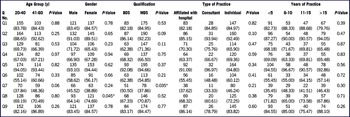
A total of 307 complete responses were received of which the majority of the dentists were between 20 and 40 y age (185; 60.26%), with MDS qualification (206; 67.10%), and had individual practices (173; 56.35%) (Table 1). The YES/NO responses to questions 1 to 9 in number and percentage is represented in Table 2, which reveals majority of responses (80%) in the form of “YES” recorded for Questions (Qs) 1, 2, 5, and 9. Table 3 highlights the comparison of “YES” responses based on the demographic variables. A variation was observed for all variables, with an exception for Q7 and Q8 with regard to qualification and gender respectively. For Q7, “Are you anxious about the cost of treatment if you get infected?”, a marked anxiety was observed in respondents with a BDS degree (P = 0.035). A significantly greater number of females replied “YES” (P = 0.045) when compared with their male counterparts to the Q8, “Do you feel afraid when you hear that people are dying because of COVID-19?”
Demographic Profile of Respondents

Questions and Responses of Respondents

Comparison of YES Responses Based on Demographic Variables

*P < 0.05.
Although the mean fear and anxiety scores of this study population reported was high (6.57 ± 2.07), a high percentage of the population presented with a low level of fear and anxiety (58.31%). A comparison of mean fear and anxiety scores with demographic variables by analysis of variance (ANOVA) is represented in Table 4. Multiple logistic regression analysis of the levels of fear and anxiety with demographic variables revealed none of the predicted demographic variables had a significant association with high level of fear (Table 5).
Comparison of Demographic Variables With Mean Fear and Anxiety Scores by 1-Way ANOVA

* P < 0.05.
Multiple Logistic Regression Analysis of Levels of Fear and Anxiety

* P < 0.05.
DISCUSSION
The present public health crisis due to COVID-19 has triggered intense fear, anxiety, and stress challenging the psychological well-being among various groups. Reference Grover, Dua and Sahoo9 With lack of sufficient literature determining fear of coronavirus among dentists, and to provide an insight into fear and anxiety toward COVID-19, the present study was undertaken. Due to lack of a standardized questionnaire, one by Ahmed et al., which was simple, comprehensive, practical, objective, and with a good validity (0.74), was used in the present study. Reference Ahmed, Jouhar and Ahmed10 Although an attempt was made to include all the age strata, our study did not have any respondents older than 60, which could be due to the methodology of data collection (the phone-based application WhatsApp).
Dentists account for one of the groups of health-care workers most susceptible to this disease, as established by the evidence of transmission of virus through fomites, aerosols, and droplets. Reference Peng, Xu and Li11-Reference Gamio13 The viral load of SARS-CoV2 in human saliva, which was proven to be very high along with transmission even by asymptomatic carriers, places dentists into high-risk group. Reference Peng, Xu and Li11,Reference Meng, Hua and Bian12 The psychological well-being of dentists may be affected and may manifest as fear of getting infected from co-workers or patients with elevated levels of anxiety when providing treatment. The same is supported by the findings of our study, wherein 80% of dentists reported positively to Q1 and 2. Likewise, in a global study that assessed anxiety and fear of dentists across 30 countries, around 90% of the respondents reported fear of getting infected from patients or co-workers. Reference Ahmed, Jouhar and Ahmed10
The present survey was conducted from May 9, 2020, to May 11, 2020, where the number of COVID-19 positive cases were steadily increasing both at national and state level. 14,15 This has also affected dental practices, with 60% of our surveyed population favoring closure of practices until the number of cases start declining, indirectly signifying fear and anxiety among them.
One of the easiest and most recommended methods for reducing the transmission of the virus is practicing physical distancing. However, dental practice involves close contact with patients during routine treatments. Hence, 60% of the respondents felt nervous while talking to patients in close vicinity.
Around 90% of our study population feared carrying infection back home. The ability of the virus to thrive on inanimate surfaces for hours to days with a long incubation period makes it easy for transmission and cross-infection. Reference van Doremalen, Bushmaker and Morris16 This could significantly contribute to infection being carried back home and a major cause of fear among dentists as reported in a similar study, wherein 92% of dentists surveyed across 30 countries reported fear of carrying infection back home. Reference Ahmed, Jouhar and Ahmed10
The Ministry of Health, Medical, & Family Welfare, Government of Telangana established quarantine and isolation facilities for management of suspected and infected patients. Confusion, fear, and anxiety due to isolation and quarantine has been reported in the literature. Reference Brooks, Webster and Smith6 The apprehension of getting quarantined thus affects the entire family, which has been noted in the present study with more than 50% of the respondents reporting the fear of quarantine (Q6).
Although in India, the burden of COVID-19 treatment is borne by the Government, the anticipated burden of postrecovery complications could be a factor in influencing the high level of fear of respondents to Q7 in the present study. A pronounced fear of cost of treatment when infected was noted in BDS than MDS respondents (P = 0.035), as it could negatively affect their prime source of income.
Greater mortality rates associated with COVID-19 is 1 of the most significant factors for fear among different sections of the population, with females susceptible to greater levels of stress and anxiety. Reference Lim17-Reference Doshi, Karunakar and Sukhabogi19 In our study, females had greater fear of dying due to COVID-19 compared to male counterparts (P = 0.045), which could be attributed to the traditional family system still followed in India, with females as the primary care providers for households, increasing their responsibility and, thus, fear of the entire family being susceptible to consequences of COVID-19 infection. Approximately 84% of the study population had a positive attitude regarding development of a COVID-19 vaccine that could also play a vital role in controlling the pandemic.
Irrespective of the age, gender, qualification, type of practice, and years in practice, the levels of fear reported in the present study was high, similar to several studies reported in the literature. Reference Ahmed, Jouhar and Ahmed10,Reference Lim17,Reference Sakib, Bhuiyan and Hossain20,Reference Soraci, Ferrari and Abbiati21 Overall, based on the mean fear score (6.57 ± 2.07), our study population presented a high level of fear. The augmented fear could be attributed to the probability of direct and close interaction when treating COVID-19 positive patients and a knowledge of the disease and mortality associated with the contagion. Respondents between 41 and 60 y of age exhibited high fear scores, with a mean of 6.70 ± 2.01, which depicts the fear of productive, potent, thriving practitioners, who are primarily involved in providing the necessities of life to their families. Dentists with individual practices recorded a high mean fear score (6.70 ± 2.06), which could be an effect of following the stringent guidelines and protocols issued by regulatory bodies. 22-25 Nevertheless, those with practices affiliated with hospitals may have better support systems and facilities.
The present study, being an online survey done in a very short period of time, could not establish a cause-and-effect relationship. It being a self-reported one, the probability of social desirability bias cannot be eliminated. The results of the present study have to be carefully interpreted and cannot be generalized, as they pertain to the state of Telangana only.
CONCLUSIONS
Pandemic outbreaks usually lead to widespread fear and mental distress in the population. The current strategies in management of COVID-19 are primarily concentrated toward controlling the disease, neglecting the psychological consequences. The present study demonstrates cross-sectional data of fear and anxiety among dental practitioners in Telangana during the COVID-19 outbreak. The heightened levels of fear observed call for a nationwide analysis of fear among dentists and deliberate management strategies for the same. The influence of gender based on the primary care provider for households and its impact on the fear of COVID-19 could form potential basis for future studies.




 Open access

