Disasters have negatively affected people’s lives and imposed considerable destruction.Reference Sohrabizadeh1 Because the combination of hazard and vulnerability can cause a disaster, vulnerability and its multiple dimensions contribute the various destructions in the affected communities.Reference Ginige, Amaratunga and Haigh2 There are many dimensions of vulnerability, arising from different physical, economic, social, and environmental factors.3 The social vulnerability approach to disasters indicates that women and men are not equally affected by natural disastersReference Ginige, Amaratunga and Haigh2 and gender can shape people’s capacity and vulnerability to disasters.Reference Sohrabizadeh4 That is, distinct roles played by women and men and their different needs and responsibilities result in different impacts of disasters on them.Reference Sohrabizadeh and Rahimi5 For instance, women died because they protected their children during the Indian Ocean tsunami.Reference Doppler6 In addition, men were more affected by floods than women in Hunan province, China, because of more relief work in dangerous conditions.Reference Li, Tan and Li7
Gender is considered as a socio-cultural factor that makes women and men experience the consequences of disasters in different ways.Reference Enarson, Fothergill and Peek8,Reference March, Smyth and Mukhopadhyay9 For example, a survey on the effects of disasters in a sample of 141 countries between 1981 and 2002 showed that higher socio-economic status of women led to lower female disaster mortality rates in disasters.Reference Neumayer and Plümper10 In addition, some literature reported that using religious coping strategies is more common among women living in religious contexts.Reference Koenig and Pritchett11
Assessment of needs, demands, and capacities of disaster-affected people can be conducted based on gender, which is called gender analysis in disasters.Reference Anderson12 Gender analysis can provide the researchers and decision-makers an in-depth understanding of the status of men and women in different communities. Gender analysis tools can help collect the gender-disaggregated data to meet different needs of men and women as well as improving their community engagement.Reference Sohrabizadeh, Tourani and Khankeh13 Furthermore, gender analysis tools are increasingly being applied in health-related research in disasters. Health status of women and men can be assessed by gender analysis tool as well.Reference Morgan, George and Ssali14
Although gender analysis can help understand who will be at greater risk in disasters and identify what are the specific impacts of disasters on women and men,Reference Anderson12 it has been ignored in disaster research studies. For instance, gender has been commonly measured as a demographic data rather than the main variable of studies in which in-depth surveys of gender-based capacities are conducted and efficient decisions are made accordingly.Reference Aboobacker and Nakray15 On the other hand, while gender analysis can play an important role in the assessment of needs, capacities, and roles of women and men during recovery phase,Reference Bradshaw16 lack of valid and reliable gender analysis tools used for postdisaster surveys has been reported by the literature.Reference Sohrabizadeh, Tourani and Khankeh13 For example, the gender analysis guide of the Caribbean provides a methodological approach and tool for conducting postdisaster gender analysis in the context of the Caribbean.Reference Deare17 The other example is the checklist to facilitate gender sensitivity of relief and reconstruction efforts for earthquake survivors in Pakistan.18 While several checklists of gender analysis have been designed in the different contexts, their validity and reliability criteria have not been measured.Reference Enarson19,20 Measuring validity and reliability criteria are considered as the main quality indicators of tools, and a valid and reliable gender analysis tool can guarantee relevant and accurate gender-sensitive data.Reference Kimberlin and Winterstein21,Reference Rattray and Jones22 Filling these gaps, the present study is aimed to explore a valid and reliable gender analysis tool to assess different needs and capacities of disaster-affected people based on their gender.
The importance of gender-sensitive policies, plans, and programs has been mentioned in the priority 4 for action and role of stakeholders sections in the Sendai Framework for Disaster Risk Reduction (SFDRR) as well as the fifth goal of the Social Development Goals (SDGs) guideline.23,24 In total, the valid and reliable gender analysis tool developed in the present study helps disaster policy-makers, managers, and researchers achieve the subsequent advantages: A valid and reliable gender analysis tool can provide accurate data for making postdisaster policies and plans gender-sensitive. On the other hand, data extracted from the valid and reliable gender analysis tool can shape a gender-disaggregated database at the local, national, and international levels to provide information for future disaster studies as well as efficient decision-making at the time of disasters.Reference Sohrabizadeh, Tourani and Khankeh13 The data provided by gender analysis tool can improve the ability of health system to provide women and men effective health services.Reference Morgan, George and Ssali14 Furthermore, relevant and accurate measurement made by a valid and reliable gender analysis tool can improve the resilience of communities through identifying the gender-based capacities for development of disaster-affected regions.Reference Sohrabizadeh, Tourani and Khankeh25
METHODS
Design
A mix method approach was applied for conducting this study. A qualitative study using content analysis was done in the first stage. The results of the qualitative study were used to design the gender analysis tool, the validity and reliability criteria of which were achieved through a quantitative study at the final stage.
Setting
Iran (the Islamic Republic), is a highly disaster-prone country, frequently affected by natural disasters including flood, earthquake, and drought. This country has a population of approximately 80 million with an almost equal gender distribution. The vast majority (99.4% of the population) of Iranian people are Muslim, and Farsi is the current formal speaking language of Iranians.Reference Sohrabizadeh, Jahangiri and Jazani26 The first stage of this study was conducted in 3 disaster-affected regions of Iran, including East Azerbaijan, Bushehr, and Mazandaran, which were destroyed by earthquakes and floods between 2012 and 2013.Reference Sohrabizadeh, Tourani and Kankeh27 The second stage of the study was performed in the earthquake-stricken villages of Razavi Khorasan province to evaluate the tool’s reliability. This region was destroyed by earthquake in April 2017, with 90% of structures destroyed, as well as 24 injuries and 1 death in the affected villages.28
Qualitative Stage
Participants
The participants of the qualitative stage were men and women who survived in the affected regions of East Azerbaijan, Bushehr, and Mazandaran, as well as several key informants. All participants were selected by a purposive sampling method. A list of affected people, containing their addresses and contact information, was provided by native health officials who worked in the public health centers of the destroyed regions. Furthermore, key informants who worked as researchers or professors of disaster health management and had field-based experience on gender and disaster issues were approached for interviews. The number of participants was determined based on the saturation principles, that is, sampling continued until 29 interviews and 1 additional interview was done to make certain that no new concepts were developed. A total of 30 participants, 20 people affected by the earthquakes and floods as well as 10 key informants, were interviewed.
Data Collection
Data were collected through an in-depth unstructured interviews carried out in the disaster-stricken regions and key informants’ offices as well as field observations. The researchers were accompanied house to house by native public health colleagues who knew most of the disasters’ survivors. Each participant was asked “please explain to me about your experiences on negative effects of the quake or flood” or “please tell me your postdisaster story since the disaster happened.” Each interview lasted between 60 and 90 min. Probing was conducted to encourage the interviewees to describe their detailed experiences and feelings. All interviews were recorded and transcribed verbatim in Farsi. Data gathering and data analysis were performed simultaneously and iteratively in a way that retrieved information became a guide for further data collection.
Data Analysis
Qualitative content analysis using the Graneheim approach was used for data analysis.Reference Graneheim and Lundman29 Accordingly, several steps were conducted to analyze the data. First, all interviews were read several times to obtain a sense of the whole. Second, selecting the unit of analysis and bringing the entire material into a single text. Third, forming meaningful units by extracting the text. Fourth, labeling the condensed meaningful units with a code. At the same time, the quality of codes was controlled by peer check. Finally, comparing the emergent codes according to differences and similarities and grouping them into categories formed the first draft of the gender analysis tool in disasters. Word processing software was applied for typing the transcribed interviews.
Quantitative Stage
At this stage, the validity and reliability of the tool were measured. Thus, this stage was conducted in 2 phases: (1) measuring validity (2) measuring reliability.
Measuring Validity
Content validity was measured through content validity ratio (CVR) and content validity index (CVI) criteria. In this phase, the participants were 12 experts from related disciplines, including gender and disasters (2 experts), disaster and emergency health (6 experts), and disaster management and disaster sociology (4 experts).
To calculate the CVR, the experts were asked to specify whether an item is necessary or not to be included in the tool. That is, they were requested to score each item from 1 to 3, with the range of “not necessary, useful but not essential, essential,” respectively. The range of CVR varies between 1 and -1. The Lawshe Table was used to determine the value of the CVR. Accordingly, the acceptable level of significance of items is greater than 0.56, based on there being 12 panelist members.
CVI was another approach for quantifying the content validity of the gender analysis tool in disasters. All 10 experts were requested to rate the tool items in terms of relevancy and clarity based on a 4-point scale: “not relevant (1), somewhat relevant (2), quite relevant (3), highly relevant (4).” To calculate CVI, the number of experts giving a rate of 3 or 4 to the relevancy of each item divided by the total number of experts. The item will be appropriate if the CVI is higher than 79%. The item will need revision if the CVI is between 70 and 79%. If the CVI is less than 70%, the item will be eliminated.
Measuring Reliability
Internal consistency of the whole tool was measured by Cronbach’s alpha. In addition, test-retest was used to measure the external stability of the instrument. To estimate the Cronbach’s alpha, gender analysis items were asked from 30 affected men and women living in disaster-stricken regions of Khorasan. The acceptable value of Cronbach’s alpha coefficients for the tool is more than 0.7.
Test-retest reliability was undertaken with participation of 16 disaster-affected people (8 women and 8 men), randomly selecting from the earthquake-stricken villages of Razavi Khorasan province. One month was considered a suitable interval time between the 2 tests. Intraclass correlation (ICC) was carried out to determine if there was any significant relation between the responses at each time point. According to 95% confident interval of the ICC estimation, values less than 0.5, between 0.5 and 0.75, between 0.75 and 0.9, and greater than 0.90 are indicative of poor, moderate, good, and excellent reliability, respectively.
A guideline was prepared for explaining study objectives, target population, serial number, questioners’ training and field communication, data collection method, and all necessary information needed at the time of gender analysis survey in disaster-affected regions.
Ethical Approval and Consent to Participate
This study was approved by the ethics committee of Shahid Beheshti University of Medical Sciences, Tehran, Iran (IR.SBMU.RETECH.REC.1395.414). All participants were asked to sign the written consent form to participate in the study. The participants were informed about the confidentially of their names and other private information in the related reports and papers. Furthermore, the participants were provided the possibility of leaving the project at any phase of the study.
RESULTS
The results of the study have been reported in 3 sections: qualitative research, designing gender analysis tool in disaster, and tool’s validity and reliability.
Qualitative Research
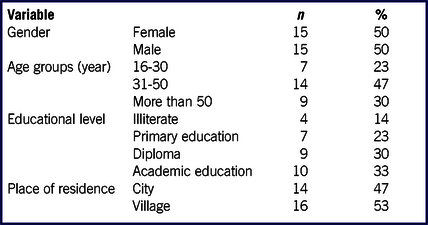
All participants of this stage were in the age range of 16-65 years, mostly between 31 and 50 years (47%). Furthermore, 50% were female (10 affected women and 5 key informants), and the remaining 50% were male, including 5 key informants and 15 affected men. The majority had an academic education (33%) and lived in the affected villages (53%) (Table 1).
Demographic Information of Participants (Qualitative Study)

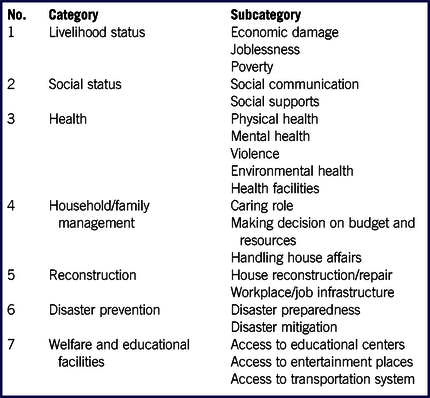
Seven categories were extracted from the data, namely, livelihood status, social status, health, household/family management, reconstruction, welfare and educational facilities, and disaster prevention. Each category consisted of subcategories composed the gender analysis items in the tool (Table 2).
Categories and Sub-categories Extracted From Qualitative Data

Livelihood Status
This category reflects all economic damage experienced by women and men, including house and furniture destruction, postdisaster joblessness due to destroying physical structures, and tools and instrument applied for their predisaster jobs. Poverty was considered, as the most current challenge of disasters resulted from loss of livelihood.
Social Status
The possibility of interactions with the community and support centers can be disaggregated by gender. This category indicates whether a man or a woman has the responsibility of communicating with their community or receiving aid from social support centers.
Health
Physical and mental health as well as environmental health have been considered postdisaster health issues. Furthermore, the concepts of domestic and sexual violence were extracted as considerable health issues postdisaster. Access to health facilities was one of the important items of the health category, which determines the possibility of receiving health-care services.
Household/Family Management
This category reflects the power of men and women to make decisions on spending money as well as resource allocation at the household level. In addition, handling household affairs and taking care of family members were considered as other aspects of the household management category.
Reconstruction
This category included 2 concepts: house reconstruction or repair and reconstruction of the workplace or job infrastructure postdisaster. For example, the collaboration of men and women for reconstructing the destroyed houses or their efforts to build back their jobs are examples of the reconstruction concept.
Welfare and Educational Facilities
This category highlights men’s and women’s accessibility to the educational organizations, such as schools and colleges, as well as entertainment places, including park and gyms.
Disaster Prevention
Preparedness and mitigation are reflected in this category. Access to preparedness information and plans as well as the insurance coverage are good examples for the category of disaster prevention.
Designing Gender Analysis Tool in Disaster
At this stage, all categories and subcategories extracted from the qualitative study were applied for designing the gender analysis tool. The concepts were developed in the form of questions with gender-based “yes” or “no” answers and a column for respondents’ descriptions and comments. A 25-question gender analysis tool was considered for measuring validity and reliability criteria. The questions were designed in a way to achieve a suitable result. For instance, based on the experts’ opinions, the questions of physical health were moved from the gender analysis section and added to the household information section of the tool.
Tool’s Validity and Reliability
Content Validity
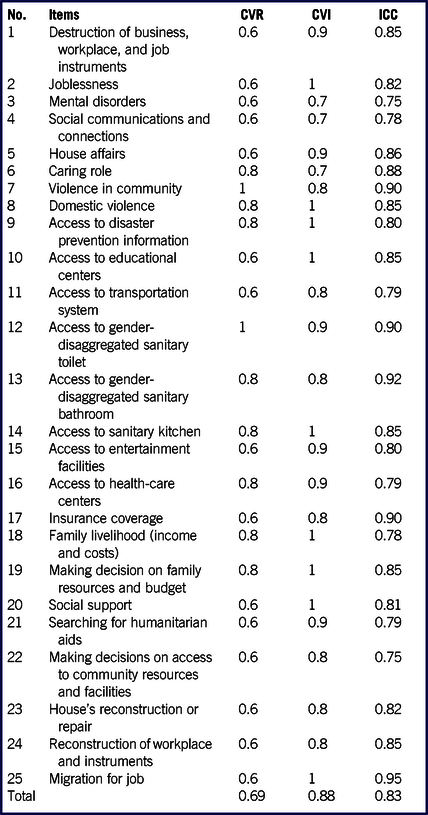
The CVR and CVI were computed for each question as well as the whole tool. Questions with CVI < 0.79 and CVR < 0.56 (based on the Lawshe Table) were removed. Minimum and maximum CVR were 0.6 and 1, which was higher than the acceptance level (0.56). Total CVR (average of CVRs of all items) for the whole tool was 0.69. Minimum and maximum CVI were 0.7 and 1, respectively. All items were higher than 0.79, and total CVI (average of CVIs of all items) for the whole tool was 0.88 (Table 3). Thus, the results of CVR and CVI confirmed the validity of the tool, and 25 questions were considered for the reliability measurement.
Results of Validity and Reliability Measurements

Reliability
The internal consistency of the tool was measured using a Cronbach’s alpha coefficient, which was 0.75. This value confirmed the acceptable level of reliability regarding internal consistency of the tool. The stability of the tool was computed by ICC, which was higher than 0.75 for all questions. ICC of the whole tool was 0.83, which indicated a desirable reliability of the gender analysis tool (Table 3). P-value for all items was higher than 0.05.
Gender Analysis Tool in Disasters
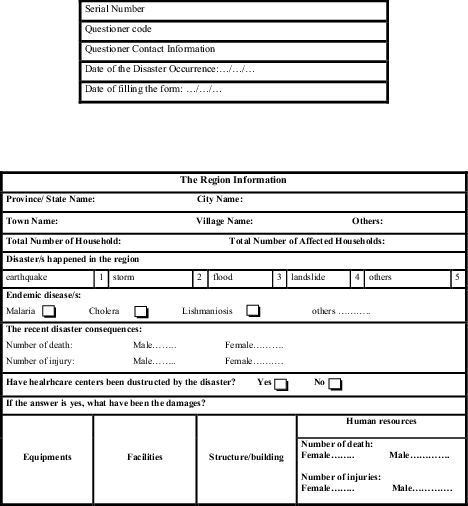
The current tool has been developed for gender analysis during the postdisaster phase. The final version of the gender analysis tool consists of 3 sections: regional information regarding the effects of the disaster, gender-disaggregated household information, and gender analysis questions.
Information needed for sections 1 and 2 were collected in health-care centers at local, regional, and national levels as well as the national statistical center. However, a community-based survey should be performed to gather section 3 data.
DISCUSSION
Developing a valid and reliable gender analysis tool for disasters can be considered one of the important scientific attempts to assess the needs and capacities of men and women living in the disaster-stricken regions. The validity and reliability features of the tool indicate that it is accurate enough for performing gender analysis in the disaster-affected area. The current tool consists of items extracted from a field-based qualitative study conducted in disaster-affected communities in Iran.
A review of gender analysis tools found that gender analysis has been rarely identified or applied in the field of disasters.Reference Sohrabizadeh, Tourani and Khankeh13 Most gender analysis literature reflected women’s status with a focus on women’s vulnerabilities rather than their capacities to contribute in disasters.Reference Sohrabizadeh4 In addition, men’s needs and vulnerabilities are rarely highlighted in the gender analysis tools.Reference Sohrabizadeh and Rahimi5,Reference Zara, Parkinson and Duncan30 The present gender analysis tool includes both women and men for postdisaster data collection and survey.
In line with the SFDRR,23 developing a valid and reliable gender analysis tool for disasters can facilitate gender-mainstreaming in all policies and practices of disaster risk reduction and promote gender equity in response, recovery, rehabilitation, and reconstruction phases. That is, gathering gender-disaggregated information on the social, economic, and health aspects of affected people’s lives with a valid gender analysis tool can provide details of men’s and women’s relationships and power in disaster-stricken communities. In addition, when conducting gender analysis, tools may help to help community engagement and to provide a framework to ensure that gender issues are assessed.Reference Birks, Powell and Hatfield31 The results of assessments provided by gender analysis tools can assist decision-makers to reduce gender-based vulnerabilities and strengthen women’s and men’s capacities to achieve a postdisaster-resilient community.
The fifth goal of SDGs highlights gender equality and women’s empowerment regarding health status and access to health-care services, education, employment, and unpaid domestic and care work.24 Disasters have been considered a destructive intervention of the nature that can exacerbate gender-based vulnerabilities and inequality in affected regions. Conducting gender analysis with a valid and reliable tool can facilitate the assessment of men’s and women’s accesses to health-care services and educational centers as well as gender-based violence, health status, and employment in the disaster-stricken communities. For example, as it has been reported by several authors that the amount of domestic and care work conducted by girls and women are increased postdisasters.Reference Sohrabizadeh4,Reference Enarson32-Reference Reid34 Such gender-based information extracted from the gender analysis tool can help the planners and decision-makers to decrease the negative health effects of disasters on women and girls and prevent second disasters. The current gender analysis tool has included information on men’s vulnerabilities and capacities as well. On the other hand, disasters may provide a unique opportunity for reducing discrimination based on gender. Analyzing gender-disaggregated data can be an initial step in hazard-prone countries with a considerable gender gap, such as Iran.
Gender has been recognized as one of the social determinants of health.Reference Solar and Irwin35 Although health systems’ needs, experiences, and outputs are affected by gender relationships in different contexts, incorporation of gender analysis in health plans, policies, and interventions has been inadequately considered.Reference Morgan, George and Ssali14 Because a disaster can destroy health systems, using gender analysis tool helps collect gender-disaggregated data and assessment of men’s and women’s status as well as gender inequity in disaster-stricken contexts.
Health-care providers need the gender analysis information to conduct health plans and interventions in the disaster-affected regions. In Iran, the capacity of the primary health-care network, spread out across the whole country from villages to the Ministry of Health,Reference Mehrdad36 can facilitate the postdisaster gender analysis through integrating the valid and reliable gender analysis tool into current assessment forms. The results of gender analysis cover livelihood and social factors, and welfare and education, which can directly and indirectly influence the health status of men and women living in the disaster-affected regions, thus facilitating improvement of health-care services through comprehensive information postdisaster. In addition to health-care providers, disaster-affected people can be involved in collecting gender analysis data after receiving basic training. The support, participation, and commitment of the affected populations can be considered an important factor for conducting any gender analysis effort in health systems. That is, using a community-based approach can facilitate postdisaster gender analysis.
The research team encountered several limitations during both the qualitative and quantitative stages of the study. At the qualitative phase, including women and men affected by earthquakes and flood in several regions of Iran may not be representative of all women and men who experienced disasters, so that the results may not be generalizable. Lack of facilities and transportation systems in the destroyed regions made the data collection process difficult. In addition, lack of disaster experts with field-based experiences to measure the validity of the tool was the main limitation of the quantitative stage. The current gender analysis tool has been developed in the Persian language and then translated in English. Thus, translation validity should be conducted by researchers who are not Persian speaking.
CONCLUSION
The results of content validity and reliability measurements show that the gender analysis tool can be applied for postdisaster gender analysis surveys. A user-friendly tool that can be easily used by researchers and local health-care providers was designed. However, we confirm that the current version of gender analysis tool needs to be revised, developed, and improved through future disaster field surveys. Although the current gender analysis tool has been developed for Iran’s context, other countries or regions with similar socio-culture context to Iran can apply this tool after disasters. Accordingly, the tool was translated into English (Table 4). Use of the information provided by gender analysis tool is highly recommended for future disaster management plans, programs, and policies in health systems. Furthermore, gender analysis tools should be used in all phases of disaster management, including mitigation, preparedness, and response. Further research is needed to identify all important factors of postdisaster gender analysis and modify the current gender analysis tool.
Post-disaster Gender Analysis Tool


Acknowledgments
The authors gratefully acknowledge the participation of the health-care providers in the fields of study as well as the collaboration of key informants who shared their experiences with the researchers.
Conflicts of interest
The authors declare that they have no competing interests.