Recent years have seen a surge in interest in exploring corporate social responsibility (CSR) as a political phenomenon (Banerjee, Reference Banerjee2007; Frynas & Stephens, Reference Frynas and Stephens2014; Gond & Nyberg, Reference Gond and Nyberg2017; Scherer & Palazzo, Reference Scherer and Palazzo2007, Reference Scherer and Palazzo2011; Vallentin, Reference Vallentin, Pullen and Rhodes2015). However, research has not paid much attention to how political ideology plays into developments in this field (cf. Hanlon, Reference Hanlon, Crane, Matten and Moon2008). There are different possible explanations for this. One has to do with the oppositional nature of ideologies. In a field that tends to consider consensus as an important resource for development (Garsten & Jacobsson, Reference Garsten and Jacobsson2013), awareness of ideological difference (what divides us rather than what unites us) can appear to be little more than a source of distraction and potential conflict. Indeed, ideological reflection may be seen as something that gets in the way of productive understanding or effective practical solutions, rather than lending support. Furthermore, ideology is often associated with bias and misrepresentation of social reality. The classical, structural Marxist or ideology critical view thus construes ideology as a moralizing discourse that conceals material interests and is constantly contradicted by practice (Freeden, Reference Freeden2005; Harvey, Reference Harvey2005). Crane, McWilliams, Matten, Moon, and Siegel (Reference Crane, McWilliams, Matten, Moon, Siegel, Crane, McWilliams, Matten, Moon and Siegel2008) have argued that defining CSR must be an ideological as well as a technical and normative exercise. But what is this supposed to mean if ideology is little more than a mask veiling reality, a mode of deception, or a sham (Boltanski & Chiapello, Reference Boltanski and Chiapello2007)?
Instead of arguing that we need to warn against and most often reject ideology as false universalism or dogmatic self-righteousness (Eastman, Reference Eastman2013), we want to acknowledge and engage with the roles that ideology plays in how we think about and theorize CSR. Our starting point is that CSR is fundamentally an ideological construct and that ideology provides us with an analytical lens that allows us to give a novel and nuanced account of the diverse politics that have sustained—and sustain—developments in CSR. Furthermore, we live in an age of man-made climate change and aspirational policy making, where calls for green transition, sustainable development and sustainable finance are putting renewed and urgent pressures on businesses large and small to step up and be part of the solution (Sjåfjell, Reference Sjåfjell2018). Under these conditions, the ideological lens allows us to expose and untangle ideological assumptions and allegiances that are often glossed over in the name of instrumentalism and expeditiousness or obliterated by radical critique.
Against sweeping characterizations of contemporary CSR as neoliberal CSR (Djelic & Etchanchu, Reference Djelic and Etchanchu2015; see also Kinderman, Reference Kinderman2011; Midttun, Reference Midttun2005; Sadler & Lloyd, Reference Sadler and Lloyd2009; Shamir, Reference Shamir2008), we argue for the need to consider the “varieties of liberalism” that are at play in CSR (Vallentin & Murillo, Reference Vallentin, Murillo and Sales2019). Hence, we approach CSR as a liberal conception, and we propose that there is a variety of liberal imaginations that lend support to and construe CSR in different ways. More specifically, we propose that the bulk of the modern (post–World War II) CSR debate is constituted ideologically by four analytically distinct but interrelated liberal positions: 1) the embedded liberalism that sustains the classical, normative literature on CSR and is reflected in later developments in stakeholder theory and institutional approaches; 2) the ideals of classical liberalism that underpins the “business of business is business” mindset promoted by Milton Friedman and likeminded commentators; 3) the neoliberalism found in the literature on CSR as a mode of value creation; and 4) the re-embedded liberalism found in recent contributions that places the responsibility debate in a global(ized) setting (Vallentin & Murillo, Reference Vallentin, Murillo and Sales2019).
Importantly, this analytical focus does not imply that we can or should assign sole significance (or credit) to liberalism—and liberal thinkers—for the developments that have taken place in CSR and in business and society relations since World War II. It would, particularly in a European context, be misleading to assert such monopoly, considering the plethora of actors and sociopolitical agendas that have taken part in creating the socially embedded market economy. A broader, empirical study of ideological influences would, for instance, have to account for national and supranational rule making, governance, and institution building supporting social welfare agendas and labor rights, to name but a few of the business-related policy concerns that do not usually carry the flag of liberalism.
We acknowledge that if our aim were to provide grounded empirical accounts of how CSR has developed historically in different societies, the singular focus on liberalism would be too simplistic. What we are proposing is that the lens of liberalism has considerable analytical and explanatory value when applied conceptually to developments in the scholarly literature on CSR as a realm of beliefs, ideas, and prescriptions for action—a scholarly literature that for decades had an exclusive American imprint, thus reflecting the American experience of capitalism and liberal market economy, with national institutions encouraging individualism and discretionary agency (Matten & Moon, Reference Matten and Moon2008). Our constitutive focus on liberalism is supported by the fact that most understandings and institutional manifestations of CSR maintain a considerable level of corporate discretion and thus voluntariness (Knudsen & Moon, Reference Knudsen and Moon2021; Vallentin & Murillo, Reference Vallentin and Murillo2012). Furthermore, most scholarly work uses the liberal model of a market economy—the neoclassical theory of the firm and its liberal underpinnings—as an analytical reference point (Richter, Reference Richter2010; Vallentin & Murillo, Reference Vallentin, Murillo and Sales2019).
Theoretically, our sidelining of nonliberal alternatives means that we bracket the more radical critical scholarship (Banerjee, Reference Banerjee2007, Reference Banerjee2018; Fleming & Jones, Reference Fleming and Jones2012; Hanlon, Reference Hanlon, Crane, Matten and Moon2008; Shamir, Reference Shamir2008) and its wholesale rejection of all that is potentially positive and transformative about CSR—seeing it as a signifier of deregulation, privatization, marketization. The critical political discourse perpetuates a grand narrative of neoliberalism and, against this, advocates nonliberal courses of action as it replaces corporate voluntariness (and thus CSR) with government rule and capitalism with more radical imaginaries of inclusive democracy (we return to the issue of what nonliberal ideology can entail in regard to CSR). While we acknowledge the relevance and political significance of a more radical critique, we find that it can result in political knee-jerk reactions and intellectual laziness. And we find that the different streams of liberal thought that sustain the CSR discourse deserve to be considered on their own terms, rather than being subject to ideological stereotyping and indiscriminate labeling.
To speak of “varieties of liberalism,” then, is one way to look for more difference and nuance and to pave the way for a more fine-grained understanding of the ideological underpinnings of CSR as a political thought-practice (Freeden, Reference Freeden2005). We proceed to elaborate our approach to ideology and to develop our mapping of liberal ideologies, combining insights from Michael Freeden on liberal languages, John Ruggie and Karl Polanyi on embedded forms of liberalism, and Michel Foucault and associated scholarship on the distinction between classical liberalism and neoliberalism. This leads into our conceptual exploration of the four “varieties of liberalism” in CSR. In the discussion and conclusion, we synthesize the insights of our analysis and show how the different positions play into the contemporary “battle of ideas” (Crook, Reference Crook2005) and connect to each other through relations of divergence and convergence.
IDEOLOGY, RESPONSIBILITY, AND “VARIETIES OF LIBERALISM”
Even in political CSR, research matters of ideology are not usually foregrounded. This arguably reflects a broader tendency in organization and management studies to dismiss or declare the end of ideology or to substitute it with less overtly political notions, such as “discourse,” “frames of reference,” “cognitive maps,” or “beliefs” (Seeck, Sturdy, Boncori, & Fougere, Reference Seeck, Sturdy, Boncori and Fougere2019). However, to embrace ideology is to forgo belief that there can be such a thing as value-free theorizing within the realm of the social sciences (Geertz, Reference Geertz1973; Mannheim, 1929/Reference Mannheim1991).
Venturing beyond a structural Marxist or ideology critical approach, we consider ideology as a practical concern with real impact, that is, as “a set of shared beliefs, inscribed in institutions, bound up with actions and hence anchored in reality” (Boltanski & Chiapello, Reference Boltanski and Chiapello2007: 3). Thus, we do not associate ideology with an effort to debunk and dismantle theoretical thinking about CSR. Instead, we want to contribute to a better understanding of the ideological positions that have dominated or dominate the scholarly CSR debate and how they interact. To focus on ideology is one way to work toward a politically and historically embedded understanding of CSR.
Prior research that explicitly addresses “ideology” in regard to corporate responsibility has tended to have a relatively narrow and empirically grounded focus on the ideological leanings (Blue, Red, Purple) of top management (in the United States) (Chin, Hambrick, & Treviño, Reference Chin, Hambrick and Treviño2013; Hafenbrädl & Waeger, Reference Hafenbrädl and Waeger2017; Walters, Reference Walters1977), corporate ideology (Goll & Zeitz, Reference Goll and Zeitz1991), and policy preferences in the institutional environment of business (Detomasi, Reference Detomasi2008). Gond and Nyberg (Reference Gond and Nyberg2017) reflect on ideology (without engaging theoretically with the construct as such) in their analysis of how power is constituted and expressed in business and society research, and Scherer and Palazzo (Reference Scherer and Palazzo2007) touch briefly on ideology in their conceptualization of political CSR (see later). To iterate, we build on an understanding of ideology as “inherently political, social and pervasive” (Seeck et al., Reference Seeck, Sturdy, Boncori and Fougere2019: 16); our focus is the ideological constitution of the scholarly CSR debate more broadly, and our starting point is that it comprises different forms of liberal ideology.
Liberal Languages, Political Thought-Practices, and the Mapping of Ideology
Speaking of “varieties of liberalism” in CSR, we are drawing on different analytical sources. On the more general analytical level, we find inspiration primarily in the work of Michael Freeden on the workings of diverse and multiple languages of liberalism (Freeden, Reference Freeden2005). Freeden suggests that all liberalisms share an affinity with seven core concepts: liberty, individuality, progress, rationality, the common good, sociability, and constrained power (pluralism) (Freeden, Reference Freeden2005: chapter 9). However, different variants understand and situate these components in different ways and draw different social and political recommendations from them (Freeden & Stears, Reference Freeden, Stears, Freeden, Sargent and Stears2013). Liberal ideology is thus plastic and malleable; it differs over time and in different spaces. It does not constitute a straightforward conceptual ordering but comprises “a cluster of concepts that sit in relationship to each other and to a range of claims about the world” (Freeden & Stears, Reference Freeden, Stears, Freeden, Sargent and Stears2013: 14).
On top of these more basic constructivist insights, Freeden provides us with some important analytical cues. First, a liberal ideology is a political thought-practice that is defined partly via its competitive relations to other political thought-practices. Ideologies often stand in rivalrous relations to each other in struggles over power and legitimacy—aiming to evoke emotional support and to influence the manner in which people ascribe meaning to structures, actions, and events in society. The experience of rivalry, with its implications of choosing between opposing systems of ideas, is central to the creed and rhetoric of ideology itself (Freeden, Reference Freeden2005: chapter 12). Second, the study of such rivalrous positions goes beyond mere description. The study of ideologies is a matter of identifying, reinterpreting, and reconstructing the overt and covert interpretations contained in ideologies. This means that mapping can be considered a major interpretative—as opposed to representational—feature of the study of ideologies (Freeden, Reference Freeden2005: chapter 12). Gond, Mena, and Mosonyi (Reference Gond, Mena and Mosonyi2020) similarly ague that literature reviewing needs to be considered as a performative endeavor that re-presents and intervenes in the literature. Third, such mapping will often—as in the analysis presented in this article—involve reconstruction of traditions retrospectively. There is a risk here of providing accounts that are in conflict with individual contributors’ self-definitions and preferred label(s). Freeden (Reference Freeden2005: chapter 12) uses Ricoeur’s notion of the “surplus of meaning” to suggest that an utterance can contain more than its author intends. With regard to intentionality, an ideological statement can thus be a blend of deliberate and unconscious thought. Concretely, in regard to our analysis, we acknowledge that our ideological mapping of the CSR field is a product of interpretation and subject to contestation in terms of both how it defines and negotiates boundaries between ideological positions and how it frames individual contributions by placing them within particular categories. That being said, we do believe that it provides a valid, well-supported, and nuanced account of 1) how CSR has evolved as a political thought-practice in the post–World War II period and 2) how ideology manifests in the contemporary CSR landscape.
Embeddedness and the Forms of Embedded Liberalism
More specifically, in terms of how we construe our four liberal positions analytically, we are drawing primarily on the work of John Ruggie and Karl Polanyi on (dis)embedded forms of liberalism and on Michel Foucault and associated scholarship on the distinction between classical liberalism and neoliberalism. It was Karl Polanyi (Reference Polanyi1944/2001) who first, in The Great Transformation, developed the distinction between “embedded” and “disembedded” economic orders (Ruggie, Reference Ruggie1982). In his seminal book, Polanyi (Reference Polanyi1944/2001) describes embedding and disembedding as a dialectical process—a double movement—pitting forces of social protection against forces of marketization.
We acknowledge the polyvalent meaning of embeddedness and the resulting need to clarify how we use this term (Beckert, Reference Beckert2007; Krippner & Alvarez, Reference Krippner and Alvarez2007). Polanyi has been criticized for making statements suggesting that there can be such a thing as a disembedded market economy that is subject to its own internal logic while being fully autonomous from society. This flies in the face of sociological insistence on the “always embedded market economy” (Block, Reference Block2003; Krippner et al., Reference Krippner, Granovetter, Block, Biggart, Beamish, Hsing, Hart, Arrighi, Mendell, Hall, Burawoy, Vogel and O’Riain2004). Hence, it is well established that there are inconsistencies in Polanyi’s own treatment of embeddedness (cf. Polanyi Reference Polanyi1944, Reference Polanyi, Polanyi, Arenseberg and Pearson1957). However, speaking of political thought-practices, we approach embeddedness as an epistemological—not an ontological—matter. Our analytical concern is not whether a disembedded market economy is or can become reality. Our research interest lies in how this imaginary or possibility is framed ideologically and the political consequences this can have. To this end, we find the concept of ideational embeddedness, proposed by Somers and Block (Reference Somers and Block2005), useful. Somers and Block expand the perimeter of embeddedness from standard legal, political, and organizational structures to include the ideas, public narratives, and explanatory systems that are used by societal actors to construct, transform, and normalize market processes (see also Block & Somers, Reference Block and Somers2014: chapter 6). Hence, we consider the disembedded market economy as a product of ideology and rhetorical strategy—alongside other ideologies and rhetorical strategies.
We open and close our ideological mapping with the notion of embedded liberalism. The term was first introduced by John G. Ruggie (Reference Ruggie1982), who used it to signify the kind of liberalism that was restored after World War II and differed in kind from previously known forms. To clarify, we read the contribution of Ruggie through the lens of ideational embeddedness, which means that we consider embedded liberalism not just as a historical occurrence, situated in a particular time and space, but as an ideological mode of arguing that also pertains to contemporary developments (see, critically, Levy & Kaplan, Reference Levy, Kaplan, Crane, Matten and Moon2008; Moncrieff, Reference Moncrieff2015; Utting, Reference Utting2007). Keeping in mind our initial comments regarding the empirical limitations of our focus on liberalism, what Ruggie provides us with is a broad (rather than very detailed) basis for theorizing the ideological leanings of the scholarly literature on CSR.
Embedded liberalism was, in its original postwar form, reflective of how capitalist countries sought “to reconcile the efficiency of markets with the values of social community” (Ruggie, Reference Ruggie, Held and Koenig-Archibugi2003: 1)—partly as a reaction against the collapse of laissez-faire capitalism in the Great Depression. Embedded liberalism took different forms in different countries, reflecting different political realities: in the United States, the New Deal or Keynesian state; in Europe, social democracy or the social market economy. But, as Ruggie points out, the underlying idea of reconciling capitalism with democracy was the same: “a grand social bargain whereby all sectors of society agreed to open markets …, but also to contain and share the social adjustment costs that open markets inevitably produce.” In Ruggie’s (Reference Ruggie, Held and Koenig-Archibugi2003: 1) terms, “that was the essence of the embedded liberalism compromise: economic liberalization was embedded in social community.” We argue that the classical CSR literature can be seen as an effort to hold businesses and businesspeople accountable to the social values of embedded liberalism. It urged the private sector to uphold the business end of the bargain, so to speak. Moreover, we argue that the ideology of embedded liberalism remains a major factor and influence in the contemporary CSR landscape.
However, the globalization of financial markets and production chains has dramatically challenged the premises underlying embedded liberalism and has in many ways undermined national social bargains (Ruggie, Reference Ruggie, Held and Koenig-Archibugi2003). With the demise of the postwar compromise, it is no longer adequate to define corporate responsibilities within the boundaries of a liberal market economy as it pertains to the nation-state and a national society (Richter, Reference Richter2010). At the global level, there is no government to act on behalf of the common good and set authoritative rules (through the use of hard law), and international institutions are too weak to compensate fully. Along with inclusive forms of global governance (soft law), CSR is one of the forces that are called on to address the resulting governance gaps (Ruggie, Reference Ruggie, Held and Koenig-Archibugi2003). Ruggie (Reference Ruggie1997: 10) speaks of the need for “a new embedded compromise, a new formula for combining the twin desires of international and domestic stability, one that is appropriate for an international context in which the organization of production and exchange has become globalized, and a domestic context in which past modalities of state intervention lack efficacy or legitimacy.” Under these conditions, a new brand of political thinking about CSR has emerged. We describe it as reflecting a form of re-embedded liberalism.
Forms of Economic Liberalism
On the marketization side of the movement, we distinguish between classical liberalism and neoliberalism. In making this distinction, we turn to Michel Foucault and associated scholarship, as its take on the difference is helpful in capturing the developments that have taken place over time in economic reasoning about CSR. According to Foucault, classical liberalism has called on government to respect the form of the market—as a space of autonomy that was to be carved out of the state through the unconditional right of private property. Neoliberalism, meanwhile, provides a radically altered view of relationships between society and economy and between state and market (Foucault, Reference Foucault2008; Read, Reference Read2009; Vallentin & Murillo, Reference Vallentin, Murillo and Sales2019: 48). Whereas classical liberalism argues for disembedding of markets and separation of business and politics, the radicality of neoliberalism lies in how it breaks down this separation with the aim of expanding the reach of the economic market as a mode of thinking and a mode of doing. The economy is no longer considered a social domain among others with its own intrinsic rationality. Instead, “the area covered by the economy embraces the entirety of human action” (Lemke, Reference Lemke2001: 197). Foucault (Reference Foucault2008: 243) speaks of the absolute and unlimited generalization of the economic form of the market: “it involves generalizing it throughout the social body and including the whole of the social system not usually conducted through or sanctioned by monetary exchanges.” Consequently, relationships are inversed so that the functioning of society becomes subservient to the economy and the market becomes the principle underlying the workings of the state and public policy (Lemke, Reference Lemke2001).
Hence, neoliberalism promotes an enterprise society that is subject to the dynamic of competition (Foucault, Reference Foucault2008). Whereas classical liberalism has focused on exchange (as spontaneous order or anthropology), the pivotal concern of neoliberalism is competition as the organizing principle of markets (Lazzarato, Reference Lazzarato2009). Competition is an artificial construct that necessitates continual government intervention to function properly (Read, Reference Read2009). Therefore it is a fundamental mistake to associate neoliberalism with a minimalist state and laissez-faire (Mirowski, Reference Mirowski, Mirowski and Plehwe2009). Neoliberalism is, according to Foucault (as cited in Vallentin & Murillo, Reference Vallentin, Murillo and Sales2019: 47), “a call for vigilance, activism and perpetual intervention.” Unlike idealized notions of exchange, the principle of competition is all about gaining (competitive) advantage; it is not about putting market participants on an equal footing. Furthermore, neoliberalism tends to obscure possible tensions between corporate and societal interests (Mirowski, Reference Mirowski, Mirowski and Plehwe2009), thus “doing away with the antagonism and social insecurity of capitalism” (Read, Reference Read2009: 32). Although the two positions are often lumped together, we will argue that there is a marked contrast between the sort of economic appropriation of CSR that we can associate with modern neoliberalism and the message of disembedding supported by classical liberalism (Vallentin & Murillo, Reference Vallentin, Murillo and Sales2019).
Turning now to our ideological mapping, we aim to flesh out the analytical properties and boundary conditions of the proposed positions. For this purpose, we have chosen, in the section on classical liberalism, neoliberalism, and re-embedded liberalism, to build our analysis primarily on a few dominant expressions of ideological sentiment—expressions that excel in terms of their relative ideology clarity, allowing us to lay bare fundamental arguments and what is at stake in the “battle of ideas.” We associate “dominant expression” here with material significance in terms of impact on theory development and practice.
EMBEDDED LIBERALISM
Embedded liberalism is one way to encapsulate not only the humble beginnings of CSR as a modern—post–World War II—scholarly discourse but also, as we will argue, the ideological creed of much current thinking about corporate responsibilities. Compared with its classical liberal counterpart, however, this tradition does not have a very clearly defined ideological center. We do not find canonical texts comparable to Friedman’s (Reference Friedman1962, Reference Friedman1970), and therefore it does not convey the same sense of theoretical coherence or unity. Speaking of embedded liberalism, we argue, is one way to organize disparate contributions that assume or posit business as socially embedded and saddled with responsibilities toward society or a broader range of stakeholders—contributions that share a basic concern regarding the integration of business and society by democratic means. We will argue that the diverse expressions can be roughly divided into three parts: 1) the classical expressions of CSR from the 1950s, 1960s, and 1970s; 2) developments in stakeholder theory that got under way in the 1980s and 1990s; and 3) developments in institutional and comparative studies that started to proliferate in the first decade of the twenty-first century.
Classical Expressions of CSR
What we find, initially, is a series of statements supporting an embedded view of corporate capitalism based on the socioeconomic experience of America in the postwar years—statements espousing social and democratic values and arguing for the importance of their integration into the system of free enterprise (Carroll, Lipartito, Post, & Werhane, Reference Carroll, Lipartito, Post and Werhane2012; Frederick, Reference Frederick2006), in other words, a politics of social protection espousing a friendly view of state interventionism and processes of democracy. Howard R. Bowen’s (Reference Bowen1953) book Social Responsibilities of the Businessman is often considered to have marked the beginning of the modern, post–World War II era of corporate responsibility (Carroll, Reference Carroll1999). Bowen was a macroeconomist whose work was influenced by institutional economics and Keynesian ideas. In the words of Acquier, Gond, and Pasquero (Reference Acquier, Gond and Pasquero2011: 611), “Bowen considered social responsibility from the viewpoint of a welfare economist interested in the regulation of capitalism.” Hence, it is implicit in his book that the limitations on the powers of business leaders for which he argues would serve a general social good and benefit everyone, including the business community (Marens, Reference Marens2004). The idea was that “assuming social responsibilities would not only ward off excessive government regulation but also reinforce modern capitalism by preserving a just balance between market regulation and government intervention” (Acquier et al., Reference Acquier, Gond and Pasquero2011: 616; see also Mizruchi, Reference Mizruchi2013). This reflected an underlying systemic and pluralist view of responsibility that would find affirmation in other contributions over the next couple decades (Carroll, Reference Carroll1999).
These would include the “iron law of responsibility” proposed by Davis (Reference Davis1960), who argued that the social responsibilities of businesspeople should be commensurate with their social power (see also Davis, Reference Davis1967; Davis & Blomström, Reference Davis and Blomström1966; Frederick, Reference Frederick1960). Corporate responsibility as a reflection of embedded liberalism arguably reached its academic zenith in the seminal book by Preston and Post (Reference Preston and Post1975), Private Management and Public Policy. Preston and Post argued that society exerts its most significant effect on business through the realm of public policy, defined as an inclusive deliberative process involving individuals, organizations, and interest groups. Frederick’s (1978/Reference Frederick1994) notion of corporate social responsiveness (see also Ackerman & Bauer, Reference Ackerman and Bauer1976) served to codify this effort to turn ideological principle into corporate practice. While this novel conception marked a break from normative idealism, pure and simple, it did not represent an ideological departure or rupture. Hence, Frederick maintained a socially embedded view of CSR as driven to a large extent by political forces. In his view, the notion of corporate social responsiveness assumed that the central question of whether companies should respond to social pressures “has already been answered affirmatively by general public opinion and a host of government social regulations and that the important task for business now is to learn how to respond in fruitful, humane, and practical ways” (Frederick, 1978/Reference Frederick1994: 156).
Theoretical justifications of this brand of CSR include theories of moral agency, social contracts, and social power (Schwartz & Carroll, Reference Schwartz and Carroll2008). With regard to the latter, the focus is on individual managers whose businesses are embedded within a functioning liberal democracy (nation-state), where they can be held accountable for their actions and engage in deliberation over public policy. A national (as opposed to global) setting and the role of government as democratic provider of rules and norms are either assumed or made explicit.
Stakeholder Theory and the Institutional Perspective
From the early to mid-1990s and onward, we have seen an explosion of research and public awareness regarding CSR. From being a discourse that by and large reflected the American experience of capitalism, the literature has increasingly started to reflect a wider range of institutional frameworks and legacies—albeit still with a penchant for applying concepts, models, and ways of thinking born out of the American experience.
Uses of the stakeholder model illustrate the latter point. From the 1980s and 1990s and onward, the stakeholder model and attendant (normative, instrumental, managerial) prescriptions regarding stakeholder management (Donaldson & Preston, Reference Donaldson and Preston1995) gained ground as a mode of embedding that was arguably better attuned to the changing opinion climate: instead of the Keynesian view of state intervention in the economy being the predominant one, Milton Friedman’s “business of business is business” emerged as the dominant and widely accepted economic view of business and society—the new ruling orthodoxy in business circles (and in business schools). R. Edward Freeman’s (Reference Freeman1984) original take on and further developments of the concept (Freeman, Harrison, Wicks, Palmar, & de Colle, Reference Freeman, Harrison, Wicks, Palmar and de Colle2010) have been particularly influential over the years. Following Freeman (Reference Freeman1984), stakeholder management grew out of strategic management and was fundamentally about value creation among stakeholders based on joint interests, thus substituting the broader view of society (and societal politics) with social relations (the concreteness of business–stakeholder relationships) (see, critically, Barnett, Reference Barnett2019). The role of the state and government was acknowledged—but only as one among a range of stakeholders affecting or affected by corporate activity. The notion of “stakeholder capitalism” has thus gained prominence compared to “stakeholder democracy” (Matten & Crane, Reference Matten and Crane2005b; Moriarty, Reference Moriarty2014). Although Freeman has argued that his influential notion of stakeholder capitalism is rooted in libertarianism (Freeman & Phillips, Reference Freeman and Phillips2002), we will argue that stakeholder thinking in theory and practice embodies ideals of social embeddedness and opposition to (or certainly important correctives to) the shareholder value paradigm—and therefore can be considered supportive of the ideology of embedded liberalismFootnote 1 (alongside other functions—we do not claim to provide more than a cursory review of the rich and varied stakeholder management literature). To quote the Business Roundtable (2019) Statement on the Purpose of a Corporation, “We commit to deliver value to all of [our stakeholders], for the future success of our companies, our communities and our country.”
However, though stakeholder analysis can and will often acknowledge the central role of government as a salient corporate stakeholder combining the features of power, legitimacy, and urgency (Mitchell, Agle, & Wood, Reference Mitchell, Agle and Wood1997), it fails to capture fully the constitutive role the state can play in defining the “rules of the game” of responsibility. Institutional and comparative studies of CSR have been instrumental in bringing the state and government back into the picture (Aguilera, Rupp, Williams, & Ganapathi, Reference Aguilera, Rupp, Williams and Ganapathi2007; Campbell, Reference Campbell2007; Kourula, Moon, Salles-Djelic, & Wickert, Reference Kourula, Moon, Salles-Djelic and Wickert2019; Matten & Moon, Reference Matten and Moon2008, Reference Matten and Moon2020; Schneider & Scherer, Reference Schneider and Scherer2019). This literature has served to explicate the institutional conditions for corporate responsibility beyond the, in many ways exceptional, American experience (Brammer, Jackson, & Matten, Reference Brammer, Jackson and Matten2012; Gond, Kang, & Moon, Reference Gond, Kang and Moon2011). With this development, the academic literature has begun to explore, for instance, how CSR relates to and unfolds within the Western European experience of liberal democracy, coordinated market economy, social democracy, and social liberalism (Jackson & Apostolakou, Reference Jackson and Apostolakou2010). Research has shown how CSR generally tends to be more government driven in Europe compared to the United States (Matten & Moon, Reference Matten and Moon2008). Research on the roles of government in CSR has provided support for the ideology of embedded liberalism by focusing mainly on initiatives taken by government bodies to support the uptake of social responsibility by business—with the explicit (espoused) aim of strengthening social bonds between business and society (Albareda, Lozano, & Ysa, Reference Albareda, Lozano and Ysa2007; Dentchev, Haezendonch, & van Balen, Reference Dentchev, Haezendonch and van Balen2017; Knudsen & Moon, Reference Knudsen and Moon2019; Steurer, Reference Steurer2010).
European principles and practices of regulation maintain high levels of corporate discretion and voluntariness, with widespread use of liberal and indirect means of steering that are meant to enable and empower the development of corporate responsibility rather than forcing the issue (Vallentin & Murillo, Reference Vallentin and Murillo2012). Schneider and Scherer (Reference Schneider and Scherer2019) explore the different social mechanisms and processes by which governments seek to shape market actors’ CSR behavior. A crucial mechanism in the current landscape is disclosure requirements, which are often supported by comply or explain regulation—making it mandatory to disclose information, but not to do CSR in any particular way. The EU Taxonomy for sustainable activities and the Corporate Sustainability Reporting Directive are among the most ambitious efforts yet to use informational means to support corporate responsibility and sustainable development (EU High-Level Expert Group on Sustainable Finance, 2018). Developments in other parts of the world, including China (Xu & Liu, Reference Xu and Liu2020) and Russia (Zueva & Fairbrass, Reference Zueva and Fairbrass2021), point to the emergence of more directly state-driven and authoritarian forms of corporate responsibility (on the interplay of socialist ideology and CSR, see Jiang, Zalan, Tse, & Shen, Reference Jiang, Zalan, Tse and Shen2018). While such forms call for reflection that transcends liberal thinking and the experiences of modern liberal democracies in the Global North, we would expect liberal forms of government to play a role even in such contexts (with regulations effectively leaving a free space for private actors to act with discretion), albeit with the threat of authoritarian sanction creating a different political dynamic around CSR, as companies will be extremely aware of the need to signal goodwill and maintain good relations with government.
In sum, using Freeden’s fundamental components of liberalism and synthesizing across the three research streams, we find here a liberal ideology that puts the common good and the sociability of business at the top of the list of priorities. The moral imperative is for businesses to be responsive—in word and deed—to societal norms and values. With institutional theory, this becomes a matter of effective compliance and rule following by business. CSR is considered to be supportive of pluralism, in the sense that social responsibilities should be commensurate with corporate power and serve to maintain a just balance between market forces and social protection. Progress—economic and social—is made dependent on business leaders adopting a democratic mindset and serving as public trustees. This implies a softening of economic rationality to the benefit of a broader social or societal outlook. Instead of giving primacy to shareholders, businesses are called on to serve a broader range of stakeholders. Finally, with regard to liberty and individuality, this view of responsibility is underpinned by voluntariness—embedded within ideals of liberal democracy.
Assumptions of a socially embedded market economy that involves a balancing of market principles and principles of social protection serve as a common denominator that, implicitly or explicitly, hold together disparate academic contributions and policy initiatives. It continues to serve as a baseline for expression of pro-CSR sentiment and has recently found high-level reaffirmation in the Business Roundtable (2019) Statement and the Davos Manifesto 2020: The Universal Purpose of a Business in the Fourth Industrial Revolution presented by the World Economic Forum (2019). Apart from these symbolic reaffirmations, embedded liberalism is, more manifestly, reflected in contemporary government-driven efforts to support corporate responsibility and sustainable development through the use of hard and soft law—while to a large extent relying on voluntary and innovative contributions from the private sector. We turn now to the ideology that for many years represented the dominant oppositional view of CSR, or rather, the dominant opposition to CSR as defined within the purview of embedded liberalism.
CLASSICAL LIBERALISM
The classical liberal position is simpler and more unified than its counterpart. It is more polarizing, more battle-prone and unrelenting (and in that sense, more obviously ideological). The renowned Chicago School economist Milton Friedman was and remains the symbolic figurehead of this position. The sentiment of Friedman (Reference Friedman1962, Reference Friedman1970) is echoed in an earlier but much less well-known article on corporate responsibility by Friedrich A. Hayek (Reference Hayek and Ansoff1960b; see also Hayek, Reference Hayek1960a). In this part of the analysis, we focus mainly on the contributions of Friedman and Hayek, as they capture the fundamentals of the classical liberal opposition to more progressive thought about CSR (see also Levitt, Reference Levitt1958). Although this may seem like a narrow analytical focus, the point is that the classical liberal position is narrow and simplified (and most often associated with or addressed though Friedman’s short treatments; see also Crook, Reference Crook2005; Henderson, Reference Henderson2001; Karnani, Reference Karnani2011; Porter & Kramer, Reference Porter and Kramer2002). Our treatment is centered on the few pages Friedman and Hayek devoted to the matter of CSR, and we make no claims about their respective oeuvres more broadly. Needless to say, they are both widely considered as master thinkers of neoliberalism and as emblematic of the neoliberal turn that took place with Thatcher and Reagan in the 1970s and 1980s (Appelbaum, Reference Appelbaum2019). However, we follow the argument, so to speak, instead of the entrenched ideological label. That is, we argue that their highly influential reasoning regarding CSR belongs to classical liberalism (rather than neoliberalism) because they argue for the separation of business and politics and thus for a disembedding of markets. In his seminal opinion piece in the New York Times Magazine, Friedman declared that he, apart from the facts of the matter, shared Adam Smith’s skepticism about “those who affected to trade for the public good” and that the social responsibility of businessmen must be rejected on the grounds of principle (Friedman, Reference Friedman1970). This is not the neoliberal creed.
Although Friedman’s view of the social responsibilities of businessmen did not change over the years, the status of his position did. It is characteristic of the promoters of the classical liberal view that they positioned themselves as being in opposition to the dominant view in society that businesses (or rather businesspeople) ought to take upon themselves more broadly defined social responsibilities. In 1970, Friedman spoke of “the present climate of opinion with its widespread aversion to ‘capitalism,’ ‘profits,’ the ‘soulless’ corporation and so on.” The aim was not to maintain the status quo but to effect a change of mindsets and practices, with individual freedom as the core value. Anything “social” was regarded with skepticism as a reflection of collectivist tendencies, socialism, and the totalitarian state (cf. Hayek, 1944/Reference Hayek2007). Hayek (Reference Hayek and Ansoff1960b: 230) spoke of how just about anything can be brought under “the vague and almost meaningless term social,” and Friedman (Reference Friedman1970) accused the promoters of social responsibility of “analytical looseness and lack of rigor.” As a starting point, he insists that only individuals can have responsibilities, whereas collective entities, such as businesses, cannot, and therefore we need to talk about the social responsibilities of businesspeople (Hayek, Reference Hayek1960a, similarly suggests that responsibility must be individual responsibility to be effective).
According to Friedman (Reference Friedman1962), there are two fundamental ways of coordinating economic activity in society: 1) the use of coercion perpetrated by the modern totalitarian state and 2) the voluntary cooperation of individuals using the technique of the marketplace. Either you support one or the other. The problem with CSR is that it effectively supports the constraining and conformity-inducing mechanism of politics (Friedman, Reference Friedman1970). Hence, CSR is a subversive doctrine because it involves “the acceptance of the socialist view that political mechanisms, not market mechanisms, are the appropriate way to determine the allocation of scarce resources to alternative uses” (Friedman, Reference Friedman1970). This is the reasoning behind the famous quote from Capitalism and Freedom suggesting that CSR can “undermine the very foundations of our free society” (Friedman, Reference Friedman1962: 133). The implied view of pluralism is that unless the functions of government and of business are kept separate in all respects, they will eventually be combined in every respect (Levitt, Reference Levitt1958). Friedman has little to say about the workings of the political process, though. It is somehow the responsibility of people (all of us) to partake in establishing “a framework of law such that an individual in pursuing his own interest is, to quote Adam Smith again, ‘led by an invisible hand to promote an end which was no part of his intention’ ” (Friedman, Reference Friedman1962: 133). Here is, on one hand, an admission that free market exchange to some extent is a product of public policy. On the other hand, the inner workings of business are effectively separated from the political process.
What the promoters of embedded liberalism see as supporting devices for pluralism, Friedman and Hayek see as dangerous, subversive tendencies giving less sway to market forces and undermining the model of free enterprise. The classical liberal argument, following Friedman and Hayek, is that private companies, if they “expand their sphere of influence beyond the market, acquire arbitrary and politically dangerous powers, and that government at some point will have to step in to address the resulting imbalance.” CSR is thus “a slippery slope leading to a more powerful and controlling state.” The sole—and proper—task of business is to put assets to the most profitable use and maximize shareholder value (Vallentin & Murillo, Reference Vallentin, Murillo and Sales2019: 50).
This does not render calls for individual responsible behavior (beyond profit making) altogether obsolete. Friedman (Reference Friedman1970) speaks in minimalist terms of how business must be conducted in accordance with the basic rules of society, laws, and ethical custom. However, the call for social responsibility does not qualify as a meaningful way to hold businesspeople accountable for their actions. Corporate executives are supposed to be experts in running their companies and producing, selling, or financing products or services (Friedman, Reference Friedman1970). They are not experts in determining what is socially desirable (Hayek, Reference Hayek and Ansoff1960b). Friedman (Reference Friedman1962: 133) writes, “Can self-selected private individuals decide what the social interest is?” Hayek (Reference Hayek and Ansoff1960b) does acknowledge that corporations ought to be restrained by general legal and moral rules, but these rules should only limit what they may do in pursuit of their concrete and proper aims.
As indicated, this view reflects a particular understanding of corporate power that is typical of neoclassical economics and made explicit by Hayek in regard to CSR. He writes, “Even the largest aggregation of potential power, the largest accumulation of resources under a single control, is comparatively innocuous so long as those who exercise such power are entitled to use it only for one specific purpose and have no right to use it for other aims, however desirable in themselves” (Hayek, Reference Hayek and Ansoff1960b: 226). To allow companies to focus only on profit making constitutes a limitation on their powers vis-à-vis the rest of society. In other words, corporate power (in its proper function) is made more or less synonymous with market power, and ideal conditions of market exchange are assumed. This point is made explicit by Friedman (Reference Friedman1970), according to whom an ideal free market rests on private property and involves voluntary cooperation among parties without any means of coercion.
Another feature of Friedman’s argument lends support to the classical liberal insistence that the disembedding of markets is socially desirable. He considers corporate executives as agents acting on behalf of the owners (the principals) of the business. Defining CSR as a cost in a zero-sum game, this allows him to speak of reckless business leaders who spend other people’s money (“taxation without representation”) and in effect come to act as civil servants when they pursue social goals (Friedman, Reference Friedman1970). To iterate, corporate executives become too powerful when they operate outside their proper mandate. The principle of shareholder value is a much more useful way to ensure that they serve corporate—and ultimately societal—interests and are not just acting on their own personal whims, egged on by public opinion.
While Friedman and the popular paraphrase the “business of business is business” have been ubiquitous in representations of the classical liberal position, the seminal paper by Jensen and Meckling (Reference Jensen and Meckling1976) on the “Theory of the Firm” provided an important stepping-stone and scientific legitimation for the view that managers of firms should (and could only) rightly be working for shareholders (Dobbin & Jung, Reference Dobbin and Jung2010). It also served to further disembed CSR socially and entangle it instead in a web of strong and somewhat opaque economic assumptions. Hence, Jensen and Meckling (Reference Jensen and Meckling1976: 311) argued that the personification of the firm implied in questions such as
“does the firm have a social responsibility” is seriously misleading. The firm is not an individual. It is a legal fiction which serves as a focus for a complex process in which the conflicting objectives of individuals … are brought into equilibrium within a framework of contractual relations.… In this sense, the “behavior” of the firm is like the behavior of a market, i.e., the outcome of a complex equilibrium process.
The Jensen and Meckling paper was instrumental in promoting shareholder primacy as the norm and, more broadly, agency theory and its assumptions regarding rational economic behavior (information asymmetry, opportunism and moral hazard) as the bedrock of modern corporate governance, corporate strategy, and executive remuneration (Dobbin & Jung, Reference Dobbin and Jung2010; see, critically, Ghoshal, Reference Ghoshal2005). Since the early 1980s, large corporations in the United States and around the world have transformed themselves to conform to this shareholder value model of the firm—a model that assumes and strongly emphasizes, echoing Friedman, that there are potential conflicts of interest between managers and shareholders and that managers can best be incentivized to act in the corporate interest and optimize performance by tying their compensation to stock prizes and shareholder returns (Dobbin & Jung, Reference Dobbin and Jung2010). Although Jensen (as cited in Agle, Donaldson, Freeman, Jensen, Mitchell, & Wood, Reference Agle, Donaldson, Freeman, Jensen, Mitchell and Wood2008: 167) has more recently acknowledged that “stockholder value maximization has been wrong from the social viewpoint from the start,” he maintains that stakeholder theory builds on naive assumptions about benevolent behavior and, if adopted (as stakeholder governance), would leave managers unmonitored and unaccountable in any principled way, with potentially disastrous consequences (Jenson, as cited in Agle et al., Reference Agle, Donaldson, Freeman, Jensen, Mitchell and Wood2008: 168; Jensen, Reference Jensen2002).
In sum, the classical liberal view defines itself in opposition to the influence of embedded liberalism (oftentimes framed as socialism). It represents a very different ordering of liberal priorities. It puts liberty and individuality at the very top in the sense that it considers individual freedom as the highest value and indeed gives primacy to individual freedom over democracy and all things social (Friedman, Reference Friedman1962). It presents economic rationality as a bulwark against undue social influences on business. Indeed, actions of business leaders are seen to positively reflect the value of freedom only to the extent that they adhere to a market logic, with minimal interference from government and other nonmarket constraints. If business leaders use the powers at their disposal to influence developments beyond the confines of the market, it will have detrimental consequences for pluralism. Progress is thus made contingent on a disembedding of markets that find support in agency theory and is manifest in the shareholder value model of the firm and notions of shareholder governance. The common good is an outcome rather than a starting point. It is best served by upholding a clear separation between business and society (or between business and politics). Sociability comes down to a division of labor within modern liberal democracies (nation-states). It is the responsibility of government to define the minimal rules of the game for business and take care of social and democratic needs and issues. It is the responsibility of businesses to create value and contribute to economic development and prosperity based on sound economic principles.
The classical liberal view of CSR has served many functions over the years, one being as the moral cornerstone of the shareholder value paradigm. It would take a barrage of corporate scandals in the new millennium (Enron, Tyco, WorldCom, etc.) and a worldwide financial crisis—and legitimacy crisis of corporate capitalism—to unsettle this foundation. These conditions arguably called for new, more accommodating approaches to CSR. The financial crisis effectively took the wind out of the sails of the “business of business is business” as the dominant mode of economic engagement with CSR. The neoliberal imagination has served to fill the void.
NEOLIBERALISM
Under the heading of neoliberalism, we need to distinguish between two types of approaches. The first constitutes a passive acquiescence to a neoliberal mindset, the second an active and programmatic embrace of such a mindset. The former is brought to bear in the extensive research focusing on the business case for CSR. This research is centered on the notion of corporate social performance (CSP) (Carroll, Reference Carroll1979) and is devoted to measuring the economic impact of social responsibility (Margolis & Walsh, Reference Margolis and Walsh2003; Orlitzky, Schmidt, & Rynes, Reference Orlitzky, Schmidt and Rynes2003; Peloza, Reference Peloza2009). Normatively speaking, the instrumentalism brought forward by this research can be a means to an end rather than an end in itself (Vogel, Reference Vogel2005). Indeed, it can be used to reject the notion developed by neoclassical economists that CSP is necessarily inconsistent with maximization of shareholder wealth (Orlitzky et al., Reference Orlitzky, Schmidt and Rynes2003). However, whether intended or not, this sort of research effectively subjects CSR to an economic measure of worth and thus contributes to the marketization of CSR (Margolis & Walsh, Reference Margolis and Walsh2003). What makes it neoliberal is that instrumental reasoning is used to positively support and enable CSR as an instrumental practice guided by instrumental considerations rather than deep-seated values or democratic concerns.
The normalization of the business case for CSR from the 1980s onward has coincided with the normalization of a neoliberal mindset in the business community and in society. It signifies a sort of passive surrender to instrumentalism and the tenets of cost–benefit analysis (Gond, Palazzo, & Basu, Reference Gond, Palazzo and Basu2009). However, the active and programmatic embrace of the neoliberal mindset we associate, first and foremost, with the work of esteemed (now retired) Harvard Business School professor Michael Porter and his coauthor and business partner Mark Kramer (Porter & Kramer, Reference Porter and Kramer2006, Reference Porter and Kramer2011).
Porter and Kramer are obviously not alone in associating CSR with value creation and stressing the opportunity side of developments (see, e.g., Grayson & Hodges, Reference Grayson and Hodges2004). Messages of win–win (or triple-win, vis-à-vis Elkington, Reference Elkington1994, on the triple bottom line) and doing well by doing good (DWDG) (Falck & Heblich, Reference Falck and Heblich2007) are legion (see, critically, King & Pucker, Reference King and Pucker2021). However, we attribute a particular material significance to the work of Porter and Kramer (Reference Porter and Kramer2006, Reference Porter and Kramer2011), as their notions of strategic CSR and creating shared value (CSV) have not only been explicitly adopted by many businesses, business consultancies, and trade organizations but have also become institutionalized in public policies regarding CSR and sustainable development and used to anchor and legitimize instrumental approaches to social and economic development (Horan, Reference Horan2019; Vallentin & Murillo, Reference Vallentin and Murillo2012). With regard to their concrete contribution and instrumental prescriptions, they have been accused of intellectual piracy and of lacking originality (Crane, Palazzo, Spence, & Matten, Reference Crane, Palazzo, Spence and Matten2014; see also, critically, Aakhus & Bzdak, Reference Aakhus and Bzdak2012; de los Reyes & Scholz, Reference de los Reyes and Scholz2019; de los Reyes, Scholz, & Smith, Reference de los Reyes, Scholz and Smith2017; Dembek, Singh, & Bhakoo, Reference Dembek, Singh and Bhakoo2016). However, we find that this critique fails to acknowledge the ideological aspects—and novelty—of their argument and how Porter and Kramer (Reference Porter and Kramer2006, Reference Porter and Kramer2011) set themselves apart ideologically from many of the contributions with which their work is associated.Footnote 2
Moreover, Porter and Kramer (Reference Porter and Kramer2006, Reference Porter and Kramer2011) provide a clear articulation of the ideological underpinnings of their position in regard to corporate responsibility, which is useful for our purposes. Hence, they do not hide their allegiance to economic liberalism, and they explicitly frame their contributions as being outside and different from what the “CSR movement” stands for. They do not turn to theories of moral agency and stakeholder democracy for guidance but build on and extend theories of competitive strategy (Porter, Reference Porter1980), competitive advantage (Porter, Reference Porter1985), and business clusters (Porter, Reference Porter1998). They combine Porter’s industry-based view of corporate strategy with a resource-based view (McWilliams & Siegel, Reference McWilliams and Siegel2011) in the sense that they focus on how companies can strengthen their competitive context while promoting an inside-out view of how they can best put their resources and capabilities to use and create social impact.
Hence, their 2006 paper reads as a programmatic statement of strategic CSR, which is about realizing that social responsibility “can be much more than a cost, a constraint, or a charitable deed—it can be a source of opportunity, innovation, and competitive advantage” (Porter & Kramer, Reference Porter and Kramer2006: 82). Porter and Kramer propose that creation of shared value—not moral obligations or personal values—should be the guiding principle of corporate engagement in CSR. They argue that the moral purpose of business is, first and foremost, to contribute to a prosperous economy, and they make a virtue out of presenting an unreservedly pro-capitalist, corporate-minded, and business-driven approach. The problem they address is not a lack of social responsibility among businesses but widespread failure to approach CSR strategically and the consequences hereof. If anything, they find that there has been too much focus on frictions and tensions between business and society to the detriment of mutual dependencies and points of intersection. They have no qualms about corporate power and its societal impacts, arguing that when “a well-run business applies its vast resources, expertise, and management talent to problems that it understands and in which it has a stake, it can have a greater impact on social good than any other institution or philanthropic organization” (Porter & Kramer, Reference Porter and Kramer2006: 92).
In their very influential follow-up paper from 2011, Porter and Kramer push the argument even further by suggesting that CSR should be replaced by a new core concept: CSV. With this concept, they mean to redefine the very purpose of the corporation, no less. They see it as the next step in the evolution of capitalism, which is no longer supposed to be about profits per se. A more sophisticated capitalism, one that is better attuned to the present circumstances, must be imbued with a social purpose. This social purpose does not, however, arise “out of charity but out of a deeper understanding of competition and economic value creation” (77). They make it clear that CSV is not a formula for sharing or redistributing existing wealth. CSV is all about creating additional wealth—based on sound business principles. Importantly, Porter and Kramer argue that the CSV mindset has application beyond the corporate world and the private sector. The principle of shared value creation cuts across the traditional divide between the responsibilities of business and those of government or civil society. What matters is that benefits are delivered by those organizations—or combinations of organizations—that are best positioned to achieve the most impact for the least cost (Porter & Kramer, Reference Porter and Kramer2011: 72).
“Not all profit is equal,” they write, “an idea that has been lost in the narrow, short-term focus of financial markets and in much management thinking. Profits involving a social purpose represents a higher form of capitalism” (Porter & Kramer, Reference Porter and Kramer2011: 75). However, this elevated form is not defined by personal values or altruism. It is rooted in utilitarianism, with social impact as the ultimate measure of worth (Vallentin & Murillo, Reference Vallentin, Murillo and Sales2019). A higher form of capitalism, in this view, is “one that will enable society to advance more rapidly while allowing companies to grow even more” (Porter & Kramer, Reference Porter and Kramer2011: 75). Porter and Kramer consider CSV as “a broader conception of Adam Smith’s invisible hand. . . . It is not philanthropy but self-interested behavior to create economic value by creating social value” (77). In other words, personal values are immaterial. Economic value creation, self-interest, and market incentives are the proper drivers (reflecting neoclassical proclivities to privatize morality).
Speaking of the legitimacy crisis of capitalism, Porter and Kramer (Reference Porter and Kramer2011: 64) find that it is companies that must now “take the lead in bringing business and society back together again.” They are adamant that “using the profit motive and the tools of corporate strategy to address social problems, a practice that is growing rapidly in part motivated by the shared value concept, can contribute greatly both to the redemption of business and to a better world” (Porter & Kramer, Reference Porter and Kramer2014: 150). In other words, there is corporate salvation to be found in value creation. In sum, the notions of strategic CSR and CSV are certainly open to different types of interpretation. However, ideologically speaking, the reasoning supporting these notions embodies many of the distinguishing features of neoliberalism (as we have defined it). In terms of the ordering of liberal priorities, neoliberalism puts individuality and progress first in the sense that it strongly emphasizes the need for individual ingenuity, creativity, and strategy to advance economic progress, growth, and prosperity. Neoliberalism thus substitutes the political concerns of classical liberalism regarding individual freedom rights (liberty) with instrumentalism: effectiveness and social impact. The focus is on opportunity, accomplishment, high performance—underpinned by economic rationality (albeit with a broader outlook) and the tools of corporate strategy. Classical liberalism’s naturalized view of economic exchange is substituted with a more operational and hands-on focus on competition, competitive advantage, and new business models, products, and markets. The ultimate goal is to build a stronger and more competitive economy that is better equipped to deal with social and environmental issues. Importantly, sociability is conditioned on economization of the social: not only CSR but also government and civil society are collapsed into the economic realm of the market, subjecting all social action to the tribunal of cost–benefit analysis and economic value creation—with little attention paid to democratic issues, equality, redistribution, or altruism. Economic performance (creation of shared value) is made the salient measure of the societal worth and legitimacy of business, and government is given an active (facilitating) role to play as enabler of business-driven corporate responsibility. It goes for the functioning of business as well as government that adherence to market principles can best serve the common good. Classical liberal concerns and antagonisms regarding pluralism are thus gone. Corporate power is seen as a force for good and rendered unproblematic.
Porter and Kramer’s work on strategic CSR and CSV stands as “a self-assured and unapologetic take on the positive prospects of merging responsibility and development with value creation, competitiveness and growth”—while downplaying conflicts and tensions between business and society, risks and adverse effects. Hence they “promote an economic ‘truth’ of CSR that promises alignment of economic and social objectives and sells itself on being more focused and productive than the alternatives” (Vallentin & Murillo, Reference Vallentin, Murillo and Sales2019: 53).
RE-EMBEDDED LIBERALISM
As a pushback against economic globalization and the rise of the multinational enterprise over the last twenty to thirty years, a new normative discourse has emerged from the end of the 1990s and onward that goes beyond the nation-state as explicit or implicit reference point and seeks to (re-)embed corporate responsibilities in international principles, global governance regimes, multistakeholder initiatives, and deliberative democratic processes. This discourse builds on a strong globalization thesis; it evokes a post-Westphalian world order or a post-national constellation (Scherer & Palazzo, Reference Scherer and Palazzo2011) and focuses primarily (but not exclusively) on trans- or multinational corporations with a special emphasis on the need to address and alleviate governance gaps and regulatory vacuums. John Ruggie has played a crucial role in giving form and substance to this form of re-embedded liberalism. As assistant secretary-general of the United Nations (UN) from 1997 to 2001, he was instrumental in establishing the UN Global Compact and launching the UN Guiding Principles on Business and Human Rights. Most recently, the UN Sustainable Development Goals have played—and continue to play—a vital role in establishing a shared language and common set of goals involving business and supporting sustainable development globally.
While re-embedded liberalism has been brought to bear in the development of social institutions, it has, in parallel, been theorized as a particular space for the responsibilization of business. Ruggie himself has contributed to the theorizing of this form of embedding, speaking for instance of the constitution of a global public domain (Ruggie, Reference Ruggie2004). Theoretically, however, the most substantial efforts have centered on notions of extended corporate citizenship (Crane, Matten, & Moon, Reference Matten and Moon2008; Matten & Crane, Reference Matten and Crane2005a) and, in particular, political CSR (Scherer & Palazzo, Reference Scherer and Palazzo2007, Reference Scherer and Palazzo2011). Scherer and Palazzo have laid the ground for a rich stream of research exploring and contesting the boundary conditions and political implications of political CSR (Banerjee, Reference Banerjee2018; Ehrnström-Fuentes, Reference Ehrnström-Fuentes2016; Hussain & Moriarty, Reference Hussain and Moriarty2018; Mäkinen & Kasanen, Reference Mäkinen and Kasanen2016; Mäkinen & Kourula, Reference Mäkinen and Kourula2012; Scherer, Reference Scherer2018; Scherer, Rasche, Palazzo, & Spicer, Reference Scherer, Rasche, Palazzo and Spicer2016; Schrempf-Stirling, Reference Schrempf-Stirling2018; Whelan, Reference Whelan2012). That being said, re-embedded liberalism as presented here has affinities with a variety of research themes, including CSR and globalization (Berger-Walliser & Scott, Reference Berger-Walliser and Scott2018; Haque & Azmat, Reference Haque and Azmat2015; Scherer, Palazzo, & Matten, Reference Scherer, Palazzo and Matten2009), global justice (Arnold, Reference Arnold2013), social responsibilities of multi- or transnational enterprises (Detomasi, Reference Detomasi2015; Yeganeh, Reference Yeganeh2019), global governance (Eberlein, Reference Eberlein2019; Fritsch, Reference Fritsch2008), private regulation (Vogel, Reference Vogel2010), and multistakeholder initiatives (de Bakker, Rasche, & Ponte, Reference de Bakker, Rasche and Ponte2019; Soundararajan, Brown, & Wicks, Reference Soundararajan, Brown and Wicks2019). Overall, the research supporting re-embedded liberalism represents a democratic pushback against the marketization of corporate responsibilities and, more broadly, the instrumental urges of corporate capitalism (Gond et al., Reference Gond, Palazzo and Basu2009). Re-embedding signifies a democratic urge to (re)capture spaces that have otherwise been captured by economic forces.
Political CSR and extended corporate citizenship, as reflections of re-embedded liberalism, share a focus on, again, large multinationals and argue that such firms often operate under conditions where laws and regulations are absent, weak, or poorly enforced and that they are therefore drawn into political roles where they perform tasks that are normally associated with the state, such as provision of public goods (Ruggie, Reference Ruggie2018). The politics of political CSR are thus associated both with an empirical observation that companies are assuming statelike roles and a theoretical claim that the globalization of the economy, along with the rise of the multinational corporation, calls for a politically enlarged conceptualization of CSR (Scherer & Palazzo, Reference Scherer and Palazzo2007).
For a theoretical underpinning, Scherer and Palazzo turn to Jürgen Habermas’ (Reference Habermas1998) theory of deliberative democracy, which, they argue, can serve to embed corporate responsibilities in processes of democratic will formation involving and giving rights to, in particular, civil society organizations. According to Scherer and Palazzo (Reference Scherer and Palazzo2011), a number of developments in the (global) governance of business lend support to this normative conception. Among these are transitions from national to global governance, from hard law to soft law, and from liability to social connectedness. Most importantly for our purposes, they argue for a shift from liberal democracy to deliberative democracy in what they see as a change in the societal foundation of CSR. In making this argument, they are associating the liberal model of democracy with a strict separation of political and economic realms (akin to Friedman’s dichotomous view). Against this, they propose to build an alternative model of democratic politics that is able to overcome the public–private divide by embedding business in processes of democratic will formation (Scherer & Palazzo, Reference Scherer and Palazzo2011; see also Sabadoz & Singer, Reference Sabadoz and Singer2017). This model of more inclusive and direct democracy is meant to strengthen ties between political and economic power and public deliberation. It entails a politization of business that is now supposed to help alleviate or solve societal problems in collaboration with state and civil society actors. The deliberative concept of CSR is meant to enhance the legitimacy and credibility of corporate action through the “scrutiny of open public debate, review, and determination” (Scherer & Palazzo, Reference Scherer and Palazzo2007: 1112; see also, on the input and output legitimacy of multistakeholder initiatives, Mena & Palazzo, Reference Mena and Palazzo2012). Among the preferred examples of political CSR in action, they include multistakeholder initiatives, such as the Forest Stewardship Council and the Marine Stewardship Council (Scherer & Palazzo, Reference Scherer and Palazzo2007).
This form of embedding, without recourse to hard and binding law, has to rely on soft law, soft power, and the goodwill of powerful corporations when they engage in democratic exchanges with much weaker counterparts. However, in response to various critics (Mäkinen & Kasanen, Reference Mäkinen and Kasanen2016; Mäkinen & Kourula, Reference Mäkinen and Kourula2012; Whelan, Reference Whelan2012), it has recently been acknowledged that the state and government regulation have significant roles to play even within the purview of political CSR (see also Schrempf-Stirling, Reference Schrempf-Stirling2018). Scherer, Rasche, Palazzo, and Spicer (Reference Scherer, Rasche, Palazzo and Spicer2016: 283–84) speak of the misunderstanding that political CSR considers “government regulation ‘old fashioned’. . . and tries to impose private regulation as an ideal.” They continue, “PCSR makes no normative claims about the superiority of soft law over hard law. However, the debate on PCSR might have been too skeptical with regards to governmental regulation both on a national and international level and too much focused on soft-law initiatives and the significance of private authority.”
In sum, re-embedded liberalism (as conceived through the lens of political CSR) is centered on the sociability of big business and on pluralism as a matter of ensuring inclusion of civil society interests, the concentrated and unregulated power of multinational corporations being a fundamental concern. Progress is defined exclusively in democratic terms, more specifically, in terms of businesses being engaged in and committed to processes of direct democracy and public deliberation supporting legitimacy. Against the hegemony of economic rationality and instrumentalism, re-embedded liberalism argues for democratization of social and economic relations, thus giving primacy to global democratic or civil values. Re-embedded liberalism has a role to play for government as promoter and facilitator of international principles and global governance. Moreover, as we have seen, it is acknowledged that the role of government as regulator needs to be taken into account—even within the purview of political CSR. That being said, re-embedded liberalism still defines the common good in terms of democratic participation first and foremost, with liberty and individuality, and thus individual freedoms, being subject to social processes of public deliberation.
DISCUSSION AND CONCLUSION
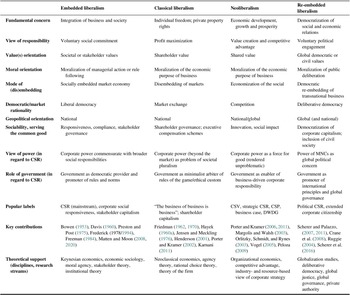
The works of Freeden, Ruggie, Polanyi, and Foucault have provided a conceptual frame for exploring the development of CSR as a phenomenon rooted in ideological precepts. We have argued that there are ruptures, movements, and reorientations worth accounting for within liberalism and that economic liberalism is not just one and the same thing in regard to CSR. Table 1 provides a summary and systematic comparison of the key findings of our ideological mapping.
Varieties of Liberalism in Overview

Note. CSP = corporate social performance. CSR = corporate social responsibility. CSV = creating shared value. DWDG = doing well by doing good. MNC = multinational corporation.
Though this allows for reflection on the four positions as ideal or pure types, there are obviously many ways in which theoretical and practical applications combine insights from different positions and thus assert some level of “ideological infidelity” and involve a blurring of boundaries. Looking for dynamic interactions, we find relations of both divergence and convergence between ideological positions in the contemporary CSR landscape.
We find some relatively straightforward instances of convergence on both sides of the aisle, so to speak. Embedded liberalism converges with re-embedded liberalism through the medium of global supply chains (Bhatia & Makkar, Reference Bhatia and Makkar2020; Boyd, Spekman, Kamauff, & Werhane, Reference Boyd, Spekman, Kamauff and Werhane2007; Lund-Thomsen & Lindgreen, Reference Lund-Thomsen and Lindgreen2014): when home-country corporate responsibilities (in developed nation-states) invariably intersect with host-country responsibility and development issues (in developing countries). This involves discussions of whether or how home-country norms of responsibility should also apply to host countries. Besides, as we have seen, re-embedded liberalism converges with embedded liberalism when the continued significance of the state as regulator, driver, and facilitator of CSR and sustainable development is recognized—alongside the workings of globalization, civil society organizations, and multistakeholder initiatives. This is a two-way relationship in the sense that nation-state policies increasingly have a broader geopolitical scope, government support of the UN Global Compact and the UN Sustainable Development Goals being cases in point. Knudsen and Moon (Reference Knudsen and Moon2019) show how governmental CSR policies are partly embedded within global forces, thus suggesting that the institutional brand of embedded liberalism is converging with the globalism and democratic ideals of re-embedded liberalism.
Classical liberalism converges with neoliberalism when the shareholder value paradigm is made to accommodate demands and expectations regarding responsibility and sustainability, while maintaining an instrumental focus on material indicators and financial returns. In finance, this is reflected in developments regarding sustainable finance and environment, social, governance (ESG) investment (Bril, Kell, & Rasche, Reference Bril, Kell and Rasche2021; European Union High-Level Expert Group on Sustainable Finance, 2018). In our mapping, neoliberal financialization combines elements of classical liberalism and neoliberalism, with the former providing the axiomatic preoccupation with shareholder value maximization and the latter providing the vigilant urge to appropriate CSR and sustainability by instrumental means. Importantly, the workings of the EU Taxonomy and current and future regulation of corporate sustainability disclosure in Europe cannot be contained solely within the categories of classical liberalism and neoliberalism. Corporate sustainability reporting and the demands and expectations of the investment community are gaining significance as social mechanisms driving sustainable development (Schneider & Scherer, Reference Schneider and Scherer2019), leading some professionals to consider the ESG concept as a replacement for CSR or corporate sustainability. However, this development, which is taking place at both national and supranational levels (Giamporcaro, Gond, & O’Sullivan, Reference Giamporcaro, Gond and O’Sullivan2020), also lends itself to embedded liberalism interpretations as developments and growth in ESG investments are increasingly intertwined with government regulation aiming for greater transparency and comparability in support of more effective channeling of investment capital into the green transition (on the re-embedding of finance in the socioeconomic realm, see Lagoarde-Segot & Paranque, Reference Lagoarde-Segot and Paranque2018).
Moreover, classical liberalism converges with neoliberalism when the work of Porter and Kramer and other supporters of win–win and DWDG is considered as “updated Friedman” or “Friedman with a softer touch,” reflecting a more modern form of economic liberalism that is better attuned to present market and social realities. This is the convergent argument. It was, however, never Friedman’s argument. Until the end of his life, he maintained that the primary moral responsibility of corporate managers is toward their shareholders and that any managerial action that would have a negative impact on shareholder return is immoral (Bakan, Reference Bakan2004: chapter 2). Indeed, the hardline version of classical liberalism stays a more divergent and antagonistic course and continues to reject positive notions of CSR across the board. When market failures are addressed, regulatory failure is a favored pivot, and CSR is presented as either irrelevant (when market-aligned) or dangerous (when not). Win–win is considered a pipe dream or as having limited application and relevance (Crook, Reference Crook2005; Karnani, Reference Karnani2011).
Classical liberal divergence is also reflected in wholesale rejections of climate change and sustainable development as products of a left-wing conspiracy, echoing Friedman’s earlier antagonism (on how climate change is engulfed in the “culture war” between liberals and conservatives in the United States, see Hoffman, Reference Hoffman2012). There is an element of déjà vu over recent developments in this space in the United States in particular. They are reminiscent of the polarized debate over social responsibility that took place in the United States in the postwar years between Keynesians and supporters of free market capitalism (see Kaplan, Reference Kaplan2014). Once again, CSR is associated with tropes of socialism (slippery slope, Trojan horse) and with the intrusion of big government in the market economy. This time, the hardened rhetoric is arguably fueled by the climate change issue and how sustainable development is emerging as a government-driven agenda, involving a high level of social and economic planning—not to mention the COVID-19 crisis and how the pandemic, for better or worse, has provided a large-scale affirmation of the primacy of government intervention in dealing with grand societal issues.
A concrete target of current classical liberal critique is stakeholder capitalism as a model of governance, not least following the Business Roundtable (2019) Statement. Friedman’s earlier concerns about analytical looseness and lack of rigor are now reflected in efforts to expose stakeholder capitalism as a perhaps well-meaning but ultimately diffuse idea that is lacking in terms of economic sense and democratic accountability and therefore can have negative consequences for businesses as well as society. The adoption of principles of stakeholder governance may turn out to make corporate owners as well as the broader range of corporate stakeholders worse off than the orthodox alternative: shareholder governance (vis-à-vis Jensen, Reference Jensen2002). So the classical liberal argument goes. In light of the two-year anniversary of the Statement, and in response to the polarized capitalism versus socialism debate to which it has given rise, the Business Roundtable (2021) has clarified that it reflects “an unambiguous defense of the free market system” but also “a call to action to ensure the benefits of capitalism are shared more broadly.”
This takes us to the contemporary “battle of ideas” between neoliberalism and re-embedded liberalism. This is not only—or primarily—a matter of defining what CSR is or ought to be. It is a battle over the very fundamentals of sustainable development. Efforts to support the UN Sustainable Development Goals provide an illustrative battleground. The goals are, on one hand, presented as “a compelling growth strategy for individual businesses, for business generally and for the world economy” (Business and Sustainable Development Commission, 2017: 11). This is a clear-cut example of how the neoliberal imagination gives primacy to the economic pillar (over the social and environmental pillars). On the other hand, delivering on the goals is seen to involve democratic and multistakeholder engagement “across the public sector, the private sector, civil society, government, individuals, academia, research centres, foundations, and so on. People from every part of society must be involved” (Sachs, Reference Sachs2015: 496). The neoliberal market logic is pitted against the call for global democracy, democratic participation, and deliberation, but there is more than divergence to the interaction. While re-embedded liberalism is sustained by skepticism toward instrumentalism and concerns regarding the power of multinational enterprises, value creation as an economic driver of development is embraced by many civil society organizations. This again points to the allure of neoliberalism and its ability to downplay tensions between economic and social interests.
To conclude, it would be anathema to the preoccupation with ideology to suggest that the political battle over CSR is in any way fixed or settled. We acknowledge that other forms of ideological conflict or opposition can define the rules of engagement in particular contexts. Our deductive approach can indeed be supplemented by more inductive and open-ended approaches. However, our mapping of ideologies at the level of theoretical discourse can serve as a starting point and backdrop for exploration of other forms of ideological difference in the theory and practice of CSR. Hence, there is a need for studies of the politics and ideology of CSR and corporate sustainability beyond the confines of liberalism and liberal democracies in the Global North—and the biases and blind spots that accrue to these points of orientation. Looking at illiberal, authoritarian, state-driven developments regarding CSR and sustainability in China and other emerging markets (Yin & Zhang, Reference Yin and Zhang2012) are good starting points.
Our article is a call for researchers to acknowledge and reflect on the—often implicit—ideological roots of normative as well as instrumental and empirical approaches to CSR. This leads us, in closing, to the classical quote from Keynes’s (Reference Keynes1964: 383) General Theory: “Practical men, who believe themselves to be quite exempt from any intellectual influences, are usually slaves of some defunct economist. . . . I am sure that the power of vested interests is vastly exaggerated compared with the gradual encroachment of ideas.” Speaking of corporate responsibilities, the defunct economist may be Bowen, Friedman, Hayek, Keynes himself—or Marx.
Acknowledgments
In memory of John G. Ruggie (1944–2021). We thank the two anonymous reviewers for their fruitful, constructive, and challenging feedback. Their insights and suggestions have helped us consolidate, strengthen, and expand our argument in important ways. Among the people who have provided us with feedback, good ideas, inspiration, and encouragement for this article, we thank Glen Whelan, Dirk Matten, Christian Borch, Zlatko Bodrozic, Paul Adler, Arnaud Sales, and Lot Elshuis.
Steen Vallentin (sv.msc@cbs.dk, corresponding author) is associate professor in the Department of Management, Society, and Communication at Copenhagen Business School. He serves as academic director of the CBS Sustainability Centre. His research interests are centered on CSR as a social and political phenomenon in the broadest sense, increasingly with a focus on corporate sustainability, circular economy, and business model transformation—along with the politics and aspirational aspects of sustainable development more broadly. He regularly contributes to international journals in his fields of study.
David Murillo is associate professor in the Department of Society, Politics, and Sustainability at the Ramon Llull University (ESADE Business School), where he conducts research in areas like business ethics, globalization, and critical management studies. Among his latest works are From Walmart to Al Qaeda: An Interdisciplinary Approach to Globalization (2017). Other articles have appeared in journals including Technological Forecasting and Social Change, Globalizations, International Politics, International Sociology, International Review of Sociology, Organization, Journal of Business Ethics, Business Ethics: A European Review, and Business Research Quarterly.