INTRODUCTION
When the desirability and reasonableness of their requests, directives, proposals, and claims is unclear to others, speakers can use a justification. In the following justification construction Now it's his turn because the seals are tired out, right? (Kyratzis, Reference Kyratzis, Hall, Bucholtz and Moonwomon1992), a four-year-old girl makes a proposal to her peer that her seal should have a turn. In order to persuade her peer to comply, she accompanies the proposal with a justification, because the seals are tired out.
The use of justifications is an index of children's developing social knowledge and communicative competence (Ervin-Tripp & Gordon, Reference Ervin-Tripp, Gordon and Schiefelbusch1985; Barbieri, Colavita & Scheuer, Reference Barbieri, Colavita, Scheuer, Conti-Ramsden and Snow1990; Goetz & Shatz, Reference Goetz and Shatz1999; Veneziano & Sinclair, Reference Veneziano and Sinclair1995). Justifications are developmental advents. ‘Although basic instrumental moves are present early in children's speech, two- and three-year-olds infrequently provide spontaneous explanations or justifications of their requests’ (Ervin-Tripp & Gordon, Reference Ervin-Tripp, Gordon and Schiefelbusch1985: 72). Part of the difficulty for young children is that justifications require an understanding of others' point of view or state of mind. ‘An explanation does not merely imply that the speaker can make causal links between one event and another; an explanation is viewed as a two-step communicative act in which the first step is to consider that an action or utterance might constitute a problem for one's interlocutor’ (Veneziano & Sinclair, Reference Veneziano and Sinclair1995: 558).
Although developmental researchers have noted the importance of children's realizing that an action or utterance might constitute a problem for one's interlocutor (as in conflict), because of the relationship of this form of knowledge to children's developing theory of mind (Veneziano & Sinclair, Reference Veneziano and Sinclair1995), they have been less recognizant of other contexts requiring justifications, including ‘situations in which partners verbally assist in the construction of justifications as a means to maintain contact or create solidarity’ (Goetz & Shatz, Reference Goetz and Shatz1999: 722). The motivating contexts of justifications, or when a pair or group of interlocutors who interact frequently together feel that a justification is needed, may be negotiated by them over a period of time (Goetz & Shatz, Reference Goetz and Shatz1999). The motivating contexts of their justifications may be part of peer group members' ways of displaying solidarity to one another and peer group membership, not only of addressing problems in the uptake of speakers' own actions and utterances. There may also be gender influences on these practices. Coates (Reference Coates1996), for example, has noted that expansion of interlocutors' utterances and co-construction are common occurrences in the talk of (white, middle-class, British) female friends and argued that ‘when [female] friends share in the construction of utterances, they are demonstrating in a very concrete way that they can operate as if they were a single speaker’ (1996: 266–7). There is a gap in the literature in terms of understanding how children negotiate appropriate motivating contexts for justifications in interaction with their peers in spontaneously occurring interaction within friendships, and the relationship of these practices to their gender identity positioning.
Definition of a justification
The definition of a justification used in this paper is partially based on Goetz & Shatz's definition (Reference Goetz and Shatz1999: 722). A justification is evidence or reasons for one's conclusions, statements, requests, proposals, or actions. The statement (action, request, etc.) justified is the head act. A justification construction is one which contains both a stated head act and a justification. The head act can precede or follow its justification, and be joined to it with a connective such as because or so, but it is also possible for there to be no connective between them. In fact, most justification constructions occurring in spontaneous discourse lack a connective (Hood & Bloom, Reference Hood and Bloom1979). The two utterances, head act and justification, can be produced by the same speaker, or across two different speakers' turns. In the examples of justification constructions that follow, which came from free play talk among child peers collected for the present study, the justification will be shown in bold and the head act will be in italics. (In cases in which an utterance is the head act of a subsequent justification but is itself the justification of another head act which came before it, the utterance will be shown in both bold and italics.) In the justification construction in (1), the head act, produced by the second speaker, is shown in italics. It is a proposal for an object identification in the pretend play of a group of four-year-old preschool girls. It elaborates a similar proposal made by Speaker 1. After making her proposal, the second speaker justifies it with the information shown in bold. In this example, the justification is joined to its head act with the connective because.
(1) Children: Emily (4 ; 7), Piper (4 ; 9)Footnote 1
1 Emily: Pretend those are called rices/
2 Piper: And those are called chanizas/
3 because they're a special kind of tortilla and and we always need it/
Motivating contexts of justifications
Several studies suggest that salient contexts for justifications, especially for younger children, are disagreement and control, as justifications have often been found to follow oppositional moves in disputes and requests. Studies observing very young children in family settings, including Dunn & Munn (Reference Dunn and Munn1987), Eisenberg (Reference Eisenberg1992), Hood & Bloom (Reference Hood and Bloom1979), Shatz's (Reference Shatz1994) longitudinal study of her grandson, and Veneziano's longitudinal study of four mother–child dyads (Veneziano & Sinclair, Reference Veneziano and Sinclair1995; Veneziano, Reference Veneziano, Nelson, Aksu-Koc and Johnson2001), all found that children aged 1 ; 6 to 4 ; 0 used justifications mostly in the context of requests, refusals to comply, and in conflicts (see Goetz and Shatz (Reference Goetz and Shatz1999) for an earlier review). In both mother–child and peer conflicts, justifications have been found to play an important role. Veneziano (Reference Veneziano, Nelson, Aksu-Koc and Johnson2001) reported that, for mother–child conflicts involving children aged between 1 ; 5 and 2 ; 3, both children's or mothers' provision of justifications in oppositional second moves resulted in decreased likelihood of insistence by the party who made the original request in the third move. Among preschool peers, Eisenberg & Garvey (Reference Eisenberg and Garvey1981) described justifications as an effective means of negotiating a resolution in conflict situations, and Sheldon (Reference Sheldon1990), who examined talk within same-sex triads of preschool girls and boys, found that boys had lower utilization of justifications which may have contributed to longer conflicts and more disruption of the play scenario. Goodwin (Reference Goodwin1990), however, found that in peer disputes of nine- to thirteen-year-olds, justifications could also lead to further argumentation. Justification is thought to be occasioned in conflict because intentions and beliefs that are in opposition need to be brought into alignment (Dunn & Munn, Reference Dunn and Munn1987; Eisenberg, Reference Eisenberg1992; Veneziano, Reference Veneziano, Nelson, Aksu-Koc and Johnson2001).
In addition to conflicts, requests have also been found to be a salient context for justifications. Similar to use of justifications in dispute, justifications that accompany requests may anticipate disagreement or non-compliance (Goetz & Shatz, Reference Goetz and Shatz1999: 744). Hood & Bloom (Reference Hood and Bloom1979) followed eight children longitudinally between the ages of 2 ; 0 and 3 ; 5 in naturally-occurring conversations with their mothers. The children expressed causal relations of negation, intention, and direction much more often (at least 75% of the time) than relations of physical causation. Veneziano & Sinclair (Reference Veneziano and Sinclair1995) found that the appearance of justification of requests co-occurred with the onset of children's references to the past, showing children's ‘use of the newly apprehended informative potentialities of language’ (Veneziano, Reference Veneziano, Nelson, Aksu-Koc and Johnson2001: 136), which are enabled in part by children's new-found ability to ‘apprehend their interlocutor, who starts to be viewed as … a person whose psychological states may be different from the child's own’ (Veneziano, Reference Veneziano, Nelson, Aksu-Koc and Johnson2001: 137). The use of explanations, justifications, and references to the past also co-occurred with children's ability to use language to create displaced or non-present situations in pretend play (Veneziano, Reference Veneziano and Mitchell2002). Ervin-Tripp, Guo & Lampert (Reference Ervin-Tripp, Guo and Lampert1990) found that the tendency of children to use justifications as supports for requests in family interactions increased sharply after 3 ; 6, and continued to develop in terms of taking into account the perspective of the addressee, through twelve years of age.
Despite these studies showing use of justifications in conflict situations and in requests, three studies have found children using justifications after affirmative claims. Orsolini (Reference Orsolini1993) examined the justifications produced by six target children in a preschool classroom in Italy in two contexts: disputes and classroom conversations. In the classroom conversations, children used justifications as expansions of affirmative claims, stating generalizations equally as often as they used them as expansions of negative claims and descriptions of negative events, which, like disputes, involve ‘break of some normative expectations’ (Orsolini, Reference Orsolini1993: 294). Teacher requests for explanations were even more likely to follow children's affirmative claims stating generalizations than they were to follow the children's norm-breaking statements, suggesting that teacher input renders affirmative claims a particularly salient context for pupils' justifications during classroom conversations. Barbieri et al. (Reference Barbieri, Colavita, Scheuer, Conti-Ramsden and Snow1990) observed three-year-old child peers engaged in free play and book-reading, and found that, although most explanations occurred ‘when requesting help from a partner, [and] when trying to block an undesired or wrong action’ (1990: 270) (i.e. in request- or conflict-like contexts), children could also give explanations in more conflict-free contexts – when encountering unexpected events or to establish a shared understanding in symbolic play. Goetz and Shatz (Reference Goetz and Shatz1999), in their study of dyadic friendships of nine- to eleven-year-olds engaged in elicited gossip exchanges, found that justifications were used for disagreement only about a third of the time; justifications were more often idea-expansions, that is, were ‘justifications … which elaborate on a previously made claim despite there being no indication of disagreement from the partner’ (1999: 744). There were two types of such idea-expanding uses of justification: cases in which the justification followed the speaker's own source statement (self-expansions) and cases in which the justification followed a source statement of the partner's (other-expansions). Self-expansions were a main category of justification in Goetz & Shatz's study, accounting for 44% of the justifications produced, exceeding the second most predominant category, conflict-motivated uses, which accounted for 36% of the uses. This led the researchers to conclude that ‘although conflicts are an important context for children to develop their ability to justify their positions, the children in this study produced the majority of justifications not during a conflict but when they were expanding on previously made statements’ (1999: 743).
A less frequently occurring category of motivating context of a justification in Goetz & Shatz's study of dyads of preadolescent children were partner-expansions, accounting for 5% of the data. In another study, expansions of partner ideas were found to be a major category of motivating context for justifications, especially among dyads of four- and seven-year-old girls (Kyratzis, Reference Kyratzis, Hall, Bucholtz and Moonwomon1992). The next section considers previous research on gendered patterns in language use and their influence on the motivating context of justifications.
Gender influences on the motivating contexts of justifications
Goetz & Shatz (Reference Goetz and Shatz1999) observed dyads of preadolescent girls and boys to use expansions of partner ideas infrequently; only 5% of their justifications were partner expansions in their data. There were also individual differences in this. Some dyads made frequent use of ‘an elaborated style’, which involved use of longer justifications in the form of narratives as well as co-constructed justifications. Other dyads did not rely on co-constructed and narrative justifications. The fact that justifications were nearly equally distributed between both members of almost all of the dyads led Goetz & Shatz to conclude that ‘the partners may engage in negotiation’ (1999: 746), both on when a justification is needed as well as on how elaborated a justification should be. Although there were individual differences in co-constructed justifications, there were no gender differences.
Justifications that support partner proposals rather than self-proposals were also identified in a study by Kyratzis (Reference Kyratzis, Hall, Bucholtz and Moonwomon1992). Although these were not a salient category for the preadolescent children in Goetz & Shatz's study, co-constructed justifications were commonly produced in Kyratzis' study of preschool children, among dyads of girls. Five boy dyads and five girl dyads were observed playing with a researcher-provided circus- or medical-scenario toy at each of two ages, four and seven years. Girl dyads frequently produced co-constructed (also called ‘validating’) justifications, in which one child would designate a proposal or control move and the other would provide a justification for it. Boy dyads were more likely to produce justifications in ‘obstacle moves’, moves which were likely to be opposed by the addressee, which were like Goetz & Shatz's ‘conflict-motivated’ type. Justifications in obstacle or oppositional moves were justifications that followed a prohibition to the partner, refusal of a request made by the partner, or a move otherwise likely to be opposed by the partner. The gender difference in the production of co-constructed/validating justifications vs. justifications in obstacle or oppositional moves may be reflective of the collaborative vs. adversarial agendas that are often (though not always) observed in the talk of American and British middle-class girls and women vs. boys and men, respectively (Maltz & Borker, Reference Maltz, Borker and Gumperz1982; Sheldon, Reference Sheldon1990; Coates, Reference Coates1996).
Co-constructed or validating justifications may be a gendered practice, a way for girls to mark themselves as feminine. Co-constructed justifications involve uptake and repetition of the partner's idea, as in the justification in (2), taken from an episode of pretend play between two four-year-old girls (Kyratzis, Reference Kyratzis, Hall, Bucholtz and Moonwomon1992: 331).
- (2)
A: And I say, ‘That's my mom’. [‘I’ refers to the character the child is voicing]
B: And he, and he says ‘that's my mom’. [‘he’ refers to the character the child is voicing]
A: They both say that because they're twins.
In this example, B repeats in part the proposal made by A, and then A finds a way in which both partners' proposals can be right. The causal relation is co-constructed across speaker turns. As described by Coates (Reference Coates1996: 266), repetition and co-construction of utterances are ‘regular feature(s) of the talk of women friends’. Co-construction of utterances is a major way of affirming the group voice. ‘When friends share in the construction of utterances, they are demonstrating in a very concrete way that they can operate as if they were a single speaker’ (Coates, Reference Coates1996: 266–7). ‘It is a powerful way of affirming the group voice, since it means that two or more speakers say the same thing in some form or another’ (1996: 266).
Co-construction of utterances and affirmation of a group voice may be ‘stances’ associated with femininity in particular communities (Ochs, Reference Ochs, Gumperz and Levinson1996), for example among white middle-class girls and women in the United States and Great Britain (where Coates conducted her study of adult female friends). Alternative stances may be valued for girls in other cultural groups or communities, for example displays of ‘competitive and self-defense skills’ (Goodwin, Reference Goodwin, Holmes and Meyerhoff2003: 239) as used by African-American working-class girls. As gendered practices (Eckert & McConnell-Ginet, Reference Eckert and McConnell-Ginet1992), co-constructed utterances and validating justification constructions may not always be in evidence, as girls may wish to ‘play up or play down their female gender identity’ (Ochs, Reference Ochs, Gumperz and Levinson1996: 424) in different contexts (Ervin-Tripp, Reference Ervin-Tripp1978). Such flexibility would be in keeping with recent, ‘performativity’- based models of gender identity (Butler, Reference Butler1990; Cameron, Reference Cameron, Johnson and Meinhof1997; Goodwin, Reference Goodwin, Bucholtz, Liang and Sutton1999, Reference Goodwin, Holmes and Meyerhoff2003, Reference Goodwin2006). Cameron (Reference Cameron, Johnson and Meinhof1997: 48), citing the work of Butler (Reference Butler1990), claims that ‘“feminine” and “masculine” are not what we are nor traits we have but effects we produce by way of particular things we do’. As a gendered practice, we may expect the co-constructed or validating type of justification construction to occur in talk within girls' friendship groups more than in talk within boys' friendship groups.
Outcomes of validating and oppositional motivating contexts of justifications
There is evidence to suggest that there may be consequences of different motivating contexts of justifications, validating and oppositional, on the linguistic marking of the justification constructions with a causal connective, and on the types of causal theories accessed in the talk.
Validating justifications may be a site for connective use and subordinate syntax. Kyratzis (Reference Kyratzis, Hall, Bucholtz and Moonwomon1992) examined marking of justifications with a syntactic connective between the head act and justification. Consistent with previous studies of children's justifications (Hood & Bloom, Reference Hood and Bloom1979; Veneziano & Sinclair, Reference Veneziano and Sinclair1995; Goetz & Shatz, Reference Goetz and Shatz1999), marking with because occurred less than half of the time. However, there was a gender difference in this (Kyratzis, Reference Kyratzis, Hall, Bucholtz and Moonwomon1992). Girls linguistically marked their justifications 54% of the time, while boys did so only 31% of the time. Chafe (Reference Chafe1984) argued that a maximal non-integration of the clauses, head act and justification (as through comma or period intonation or omission of the connective), allows for maximal assertion of the information in the main clause. Greater integration of the two clauses (as through continuous intonation or inclusion of the connective) focuses attention on the reason and does not allow the main clause to be asserted strongly. Since girls in Kyratzis' study produced more validating justifications in their dyadic interactions, they were agreeing with the partner, hence the head act did not have to be asserted strongly because it was already accepted on the conversational floor.
In conflict-motivated justifications, which were produced more frequently in the talk of the boy dyads, speech acts in the main clause tended to be urgent, including direct commands and prohibitions (so don't put it back on; watch; I need this) and refusals (no). Because these need to be stated urgently, a less integrated construction excluding the connective is appropriate (No Greg!, this isn't your place, it's mine!). In these constructions, the focus is on the acceptance of the main clause speech act (e.g. No Greg!), rather than on the reason itself (this isn't your place, it's mine). Kyratzis' (Reference Kyratzis, Hall, Bucholtz and Moonwomon1992) suggestion that conflict-motivated uses of justification may support less integrated syntax and that validating uses of justification may support more integrated syntax and the use of a causal connective received some support from findings of subsequent studies. Goetz & Shatz (Reference Goetz and Shatz1999) found that idea-expanding justifications (although these were predominantly of the self- rather than other-expanding type) received more connective marking than conflict-motivated justifications, and Veneziano (Reference Veneziano, Nelson, Aksu-Koc and Johnson2001) reported that the majority of justifications produced in mother–child conflicts which were conflict-motivated, lacked a connective. It remains to be seen whether validation and co-construction per se are the factors accounting for greater because (or other connective) marking in justifications. At age 4 ; 0, boys have been found to produce less complex utterances with a lower MLU than those produced by girls (Bornstein, Hahn & Haynes, Reference Bornstein, Hahn and Haynes2004; see also Coates, Reference Coates2004: 150). If developmental psychologists and educators are interested in enhancing the use of connectives and a more integrated syntax by children, then it would be helpful for them to understand the interactive contexts and functions for which subordinate constructions with connectives are used by children in naturally occurring discourse. One purpose of this study is to inform this understanding.
Ervin-Tripp & Gordon (Reference Ervin-Tripp, Gordon and Schiefelbusch1985) noted that in addition to knowing when a justification is needed, another factor that develops about justifications in requests is in the content of the justification, specifically the ‘capacity of children over the age of 8 years to take the perspective of their partners’ (Reference Ervin-Tripp, Gordon and Schiefelbusch1985: 89). By eight years of age, a child could make their request more amenable to the addressee by casting it as ‘part of a proposal for play in which the [addressee] had a desirable role’ (1986: 89). Dunn (Reference Dunn, Slobin, Gerhardt, Kyratzis and Guo1996) reported a similar capacity. When children aged 3 ; 11 interacted with a friend rather than a sibling, they were more likely to use ‘conciliatory’ arguments that took into account the perspective of the addressee, and were less likely to use to ‘self-interested’ arguments.
Observing groups of preschool friends that play frequently together, we would expect that the children's knowledge of the roles or actions that would persuade their addressees would be optimized. However, there is research to suggest that there would be a gender difference in this. Sheldon (Reference Sheldon1990) reported that triads of preschool girls playing together were more likely to use ‘the pretend frame to argue for a compromise’ (Reference Sheldon1990: 97). In contrast, although boys also reasoned from the pretend frame, they could also refer to conventional rules of fairness and goods-distribution, or even to their own needs or wants as a justification. Kyratzis (Reference Kyratzis, Hall, Bucholtz and Moonwomon1992) similarly observed dyads of four- and seven-year-old boys to use explanations that had an ad hoc nature, referencing speakers' wants, or arbitrary relationships. In contrast, girls were concerned with social-conventional rules pertaining to the scenarios they were enacting.
There is a gap in the literature on how young preschool-aged children reason from play frames when they are engaged in play with their peers, and the types of causal relationships that they access from these frames. There is considerable agreement among developmental psychologists that children from a very young age ‘spontaneously and actively build intuitive foundational theories’ to make sense of the world around them (Au, Romo & DeWitt, Reference Au, Romo, DeWitt, Siegal and Peterson1999: 210; see also Wellman & Gelman, Reference Wellman and Gelman1992; Au, Reference Au1994; Carey & Spelke, Reference Carey, Spelke, Hirschfeld and Gelman1994). According to Au et al. (Reference Au, Romo, DeWitt, Siegal and Peterson1999: 210), ‘theories outline the ontological/fundamental categories and basic causal devices in their respective domains, thereby offering coherent bases for reasoning about relevant phenomena’. Although it is widely believed that children construct their theories through talk and interaction (e.g. in family dinner-time narratives and conversations, and in gossip exchanges (Blum-Kulka, Reference Blum-Kulka, Blum-Kulka and Snow2002; Goetz & Shatz, Reference Goetz and Shatz1999; Ochs, Taylor, Rudolf & Smith, Reference Ochs, Taylor, Rudolph and Smith1992)), with the exception of a few studies (Dunn, Reference Dunn, Slobin, Gerhardt, Kyratzis and Guo1996; Ervin-Tripp & Gordon, Reference Ervin-Tripp, Gordon and Schiefelbusch1985; Goetz & Shatz, Reference Goetz and Shatz1999; Goodwin, Reference Goodwin1990; Kyratzis, Reference Kyratzis, Hall, Bucholtz and Moonwomon1992; Sheldon, Reference Sheldon1990), little or nothing is known about how young children build their causal theories of the world together with same-age peers through naturally occurring interaction in play, or how their theory-building with peers is influenced by their interactive goals and gender identity positioning.
The present study
This study examines the motivating contexts of children's justifications in spontaneously occurring free-play conversations in preschool friendship groups, to examine: (1) the preferred motivating contexts of justifications in this developmental age group (Will children predominantly use conflict-motivated justifications, or will validating and idea-expanding uses of justification also occur?); (2) whether there are gender influences on the motivating contexts of children's justifications; and (3) whether there are outcomes of gender and motivating contexts of justifications for their linguistic marking, and for the content of the causal theories accessed in the talk.
METHOD
Participants
Participants were preschool children enrolled in a preschool center serving a middle-class community in California. Children in two preschool classrooms were followed over an academic year. The two classrooms were mixed-age, and they contained an equal number of children who would be entering kindergarten the following year, and of children who were two years from entering kindergarten. There was an equal number of boys and girls. Of children at the center, approximately 60% were Caucasian and approximately 40% were from other cultural groups, including African-Americans, Asian-Americans, and Mexican-Americans.
Procedure
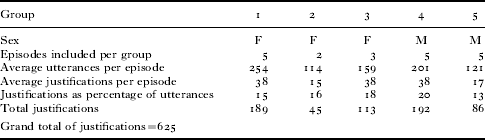
A researcher was assigned to two classrooms, which she visited two to three times a week during the free-play period of the day. She took detailed fieldnotes, indicating who was playing with whom (all interactions lasting more than three minutes were noted), and what activities were engaged in. Based on these ethnographic fieldnotes, the friendships in the classroom were identified. The focus of the study was on same-sex groups of three children or more, and from fieldnotes and video-recording, by winter quarter, five such groups, three of girls (hereafter referred to as Groups 1–3), and two of boys (Groups 4–5), were identified across the two classrooms (see Table 1). All five groups had started out as dyadic friendships in fall quarter, but by winter had expanded to include more children. The same-sex friendship groups tended to involve the children from the older cohort of each classroom, but this was not exclusively so. Twenty-one of the thirty-two children in the two classrooms participated in these five friendship groups.
In fall quarter, all the children were video-recorded in their most representative friendships. By winter quarter, the larger friendship groups had been identified. Each of these groups was video-recorded in free play several times. The video-recordings were made by placing a transmitter microphone in a belt pack on one of the members of the group. Video-recordings were made of sustained thematic episodes of play (e.g. pretending to be baby kitties; the camera was turned on when the theme began and was turned off when the children ceased to pretend to be kitties).
These video-recorded episodes of friendship talk were transcribed utilizing the Gumperz & Berenz (Reference Gumperz, Berenz, Edwards and Lampert1993) transcription system and analyzed for features of justifications. Multiple video-recordings of the groups made available several thematic episodes of play for each group. The exact numbers of episodes that were transcribed were as follows: Group 1 (8); Group 2 (4); Group 3 (7); Group 4 (7); and Group 5 (5). Episodes of sustained play ranged in length from 9 to 40 minutes. For purposes of the current analysis, all of the transcribed episodes from the later (winter, spring, and summer) quarters of the school year were utilized, resulting in 20 episodes of play: 10 of girls' groups and 10 of boys' groups. Fall episodes were omitted from the analysis, as groups were smaller and had not yet stabilized in terms of their play patterns.
The five friendship groups identified ranged from 3 to 6 members apiece. The children that were in these five friendship groups were 10 girls (Groups 1–3) and 11 boys (Groups 4–5). The mean age of the girls across the episodes considered in the analysis was 4 ; 7 (range 3 ; 7 to 5 ; 4) and of the boys across the episodes utilized was 4 ; 9 (range 3 ; 6 to 5 ; 4).
Identifying justification constructions
To identify justification constructions, the main coder (first author) went through each transcript of a play episode and looked for ‘statements that seemed to act as evidence for other statements or actions which preceded or followed them’ (Goetz & Shatz, Reference Goetz and Shatz1999: 729). Although in justification constructions the head act can either precede or follow the justification, for purposes of this analysis, only justification constructions in which the head act preceded the justification were considered. Clause sequences having the order (possible) justification first, head act second, because they obey real-world temporal event order or thought order, may be juxtaposed without the speaker intending to relate a causal or justification relationship, rendering such sequences difficult to interpret. In our database of preschoolers' free-play interactions, we were not able to obtain acceptable levels of inter-rater reliability for constructions with this clause order, so they were excluded from the analysis.
Coding categories – identifying motivating context of the justification
The justification constructions produced by the children were coded for two factors: (1) the motivating context of the justification; and (2) whether the relation between the head act and justification was marked with because or other connective.
The code for motivating context of the justification identified the context that motivated the speaker to produce a justification construction. There were four categories of motivating context that were initially coded: validating, oppositional, oppositional-validating, and self-expanding.
Validating justification construction
A validating justification construction is one in which a partner's proposal is validated or affirmed through a justification. Validating a partner's proposal was defined as occurring in three ways in the present study, and was more broadly defined than ‘other-expansion’ in Goetz & Shatz's (Reference Goetz and Shatz1999) study. The first way of validating a partner's proposal consisted of cases in which the speaker followed a partner's proposal by providing a reason for it in their next turn. In example (3), the second speaker expands a head act introduced earlier by her partner.
(3) Children: Emily (4 ; 7), Piper (4 ; 9)
1 Emily: we are picking lots of white/ right?
2 Piper: because we always need it/
A second way of validating a partner's proposal was through the speaker agreeing with a partner's suggestion, and using a justification to justify the agreement. In example (4), the second speaker expands her agreement with the partner (yeah) with justification.
(4) Children: Ginger (5 ; 4), Bridget (5 ; 3)
[Ginger and Bridget are pretending to be dinosaur spouses procuring food for dinner. Ginger returns and throws some blocks inside their pretend house.]
1 Bridget: mmm/ looks good/
2 maybe we should- maybe I should find some weeds,
3 to put on top of it/
4 Ginger: yeah/ they can't (x) without any-
5 I mean they are not meat eaters or vegetarians/
6 [tries to find a way that Bridget's proposal can be correct
7 despite their earlier decision that the dinosaurs eat
8 ‘only green meat’]
A third way of validating the partner's proposal was through the speaker elaborating on the partner's suggestion, and using a justification to justify the elaboration. Example (1) exemplified this type of validating justification construction, as does example (5), in which Ginger elaborates on her partner's idea of being in love and then expands her elaboration with a justification.
(5) Children: Ginger (5 ; 4), Bridget (5 ; 3)
1 Ginger (as Prince): you're my best friend/
2 Bridget (as Princess): I know, and now we're *in love/
3 Ginger (as Prince): i'm sure glad that we're both handsome and pretty
4 because if *I married Raggedy A::nn/
5 *I would have areally dumb life/
6 ’cause (“because”) *she's horrific
Oppositional justification construction
An oppositional justification construction is one in which a partner is opposed, as through being prohibited from doing something, having their play proposal or claim rebuffed, being told they cannot play, being topped or bested, or being given an undesirable role in play. Within the construction, a reason is given for the opposition, as in examples (6) and (7).
(6) Children: Bruce (5 ; 1), Brad (5 ; 3)
1 Bruce: [trying to make Brad let the butterfly go in a game of ‘Step
2 on Bees’]
3 … when i say you can step on it, you step on it/
4 .. when i say **don't.. step **on it/
5 those guys get mad easy/ okay?
(7) Children: Pete (4 ; 8), Fred (3 ; 11)
1 Pete: I got a (xx)/ here you go (xx)/ I got *two (xx)/ 2, 4, 6/ I got 8/
2 I got all of 'em (‘them’)/ I got eight of 'em (‘them’)/
3 all mine all mine/
4 *sixteen/ [competing with group members, claiming
5 to have largest number of coins]
6 Fred: I got all of 'em/
Oppositional-validating justification
An oppositional-validating justification construction is one in which a partner is opposed. However, the construction simultaneously contains elements of validation, either of the same partner, through the speaker accepting part of what the partner proposed at the same time that another part of their proposal is opposed, or, of another partner, through validating that partner's opposition of the first partner, as in example (8).
(8) Children: Bruce (5 ; 1), Brad (5 ; 3), George (5 ; 2)
1 Bruce: [pointing at George] George, you're-.. you are the big lizard/
2 Brad: … see/ [running away from George]
Self-expanding justification construction
This is a justification construction that neither supports the partner nor opposes the partner (in the ways described above), but merely expands the partner's own idea. Since it was infrequent in these data for speakers to justify in ways that were neither opposing nor affirming, this usage could occur when a speaker introduced a new sub-theme into the play, or interrupted an ongoing game to make an unrelated proposal, and then justified it. In example (9), the speaker introduces a new sub-theme into an ongoing game of nurturing stinkbugs.
(9) Child: Bruce (5 ; 2)
1 Bruce: almost got him, come on, good little stink bug/
2 [static] (xxx Ha ha) [static] (xxxx going on?)
3 wait, I'll get, umm (xx) this, (I'm) spectacular man/
Reliability of coding and data treatment
The first author coded all of the twenty episodes (transcripts) of play for identification of justifications and for coding of the justifications into the main categories of motivating context type: validating, opposition-motivated (combining oppositional and oppositional-validating, see later this paragraph), and self-expanding justifications. A second coder independently coded nine of the twenty play episodes for these phenomena. Regarding identification of justifications, of the 341 justifications identified by either or both of the coders, 280 (82·1% agreement) were identified by both coders. Regarding motivating context of the justification, the average percentage agreement for each category was: (1) validating justifications, 95% (k=0·90); (2) opposition-motivated justifications, 95% (k=0·90); and (3) self-expanding justifications, 99% (k=0·84). The two opposition-motivated categories, oppositional and oppositional-validating, were collapsed because it was not possible to obtain an acceptable level of agreement in coding them separately.
For the purpose of statistical analysis, each of the twenty episodes of play was treated as ‘a subject’. Mann–Whitney U tests for independent samples were used for comparisons of girls' and boys' episodes in terms of the overall number of justifications produced, the percentage of validating justifications, the percentage of opposition-motivated justifications, the percentage of self-expanding justifications, and the percentage of justifications that were marked with a connective. Wilcoxon matched-pairs signed-ranks tests for related samples were used to compare the percentages of validating and non-validating justifications that received marking with a connective.
RESULTS
Friendship group characteristic activities and discourse contexts
The justification results need to be contextualized in terms of overall differences in the characteristic play activities of the different friendship groups. The three girls' groups (Groups 1–3) did dramatic role-play, both in the director's voice and enacting character voices. They pretended to be: playing at being ‘little Cinderellas’ and making friends and cooking for others, to be ‘kitties’, to be a Cinderella-like character going to a ball with a prince and challenged by a contender, and other themes. One of the boys' groups enacted play that could be characterized as rule-based games. For example, in one game, one boy told the others who could enter a haunted house and on what basis. The second boys' group enacted what could be characterized as posturing or contesting. They argued over who had the biggest, most powerful knife (e.g. this is an exploding knife). They competed in physical play.
Basic results about the whole corpus
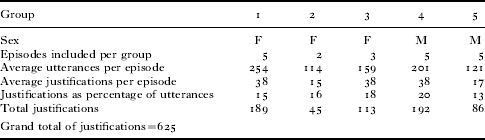
Results are reported in terms of average frequency of justifications across girls' and boys' episodes and in terms of mean percentage of justifications of particular motivating context types (validating, etc.) across girls' and boys' episodes. To assist in interpreting the mean percentages, the reader is referred to Table 1 which provides figures for the average number of utterances and justifications produced across episodes for each of the five friendship groups.
Descriptive information about friendship groups, play episodes, and justifications included in study
Motivating context for the justification: gender and contextual differences
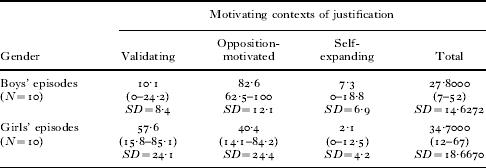
Table 2 presents the average number of justifications produced per episode for boys' and girls' episodes. The mean number of justifications produced per episode was 27·80 and 34·70 for boys' and girls' episodes respectively. In a Mann–Whitney test comparing girls' and boys' episodes (n1, n2=10), the mean rank for boys' groups was 9·75 and for girls' groups was 11·25. This difference was not significant (U=42·500, p=0·579).
Distribution (in mean percentage out of total justifications) of motivating contexts of justifications in girls' and boys' episodes
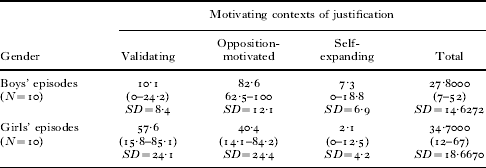
Validating justifications were produced in both girls' and boys' play episodes, but more so in girls'. As Table 2 shows, the mean percentage of validating justifications produced in boys' and girls' episodes was 10·1% (ranging from 0–24·2%) and 57·6% (ranging from 15·8–85·1%) respectively. In a Mann–Whitney test comparing girls' and boys' episodes, the mean rank for boys' episodes was 5·90 and for girls' episodes was 15·10. This difference was significant (U=4·000, p<0·001).
There was a notable contextual difference in one of the three friendship groups of girls, Group 1. The episodes of girls' play that ranked lowest on the proportion of validating justifications were two episodes in which girls in Group 1 instantiated athletic play themes, climbing a hammock and playing at being ‘supergirl’, yielding percentages of 15·8% and 23·3% validating justifications respectively. These episodes occurred at the end of the school year. A few months earlier, when under the influence of a particular group member before she left the group, they had enacted more feminine, nurturing themes of pretend play, such as a mommy taking her children hiking, a mommy with baby ‘kitties’, and playing at being ‘little Cinderellas’ and cooking for others and being of different ethnicities, these group members utilized high percentages of validating justifications: 65·6%, 77·4%, and 84·4% for each of those play themes respectively. The large difference in preference for validating justifications across the two time points and different preferred activities suggest that girls may associate validating justifications with femininity, and ‘play down’ (Ochs, Reference Ochs, Gumperz and Levinson1996) their use of this feature when they view it as less appropriate to the context or activity at hand (e.g. when they enact more athletic personae).
As reported in the section on reliability, the two opposition-motivated categories of justification, oppositional and oppositional-validating, were collapsed to form a category of opposition-motivated justifications. As can be seen in Table 2, the mean percentage of opposition-motivated justifications produced in boys' and girls' episodes was 82·6% (ranging from 62·5–100%) and 40·4% (ranging from 14·1–84·2%) respectively. Although the percentage of opposition-motivated justifications produced in both girls' and boys' episodes were substantial, there was a gender difference in this. In a Mann–Whitney test, the mean rank for boys' groups was 14·80 and for girls' groups it was 6·20. This difference was significant (U=7·000, p<0·001).
The mean percentage of self-expanding justifications produced in boys' and girls' episodes was 7·3% and 2·1% respectively (see Table 2). In a Mann–Whitney test the mean rank for boys' groups was 12·85 and for girls' groups it was 8·15. Although this difference approached significance (U=26·500, p=0·075), self-expanding justifications were the most infrequently produced functional category of justifications for both boys' and girls' episodes.
Marking of justifications with a connective in boys' and girls' episodes and its determinants
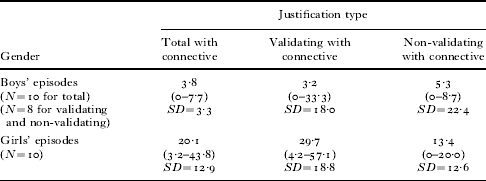
Earlier, it was proposed that the function of validation may itself account for the greater degree of marking of the causal relation with a connective (mainly because) in girls' groups than boys' groups that has been found (Kyratzis, Reference Kyratzis, Hall, Bucholtz and Moonwomon1992). In validating justifications, the head act is already accepted on the conversational floor. Therefore, the focus can be on the reason rather than the acceptance. To investigate this proposal systematically, we first examined the degree of marking of justifications with a connective in boys' and girls' episodes. As Table 3 reveals, on average, only 3·8% (ranging from 0–7·7%) of the justifications received marking with a connective in boys' episodes, while on average 20·1% (ranging from 3·2–43·8%) of the justifications produced in girls' episodes received marking with a connective.
Mean percentage of total justifications, validating justifications, and non-validating justifications marked with a connective in girls' and boys'episodes
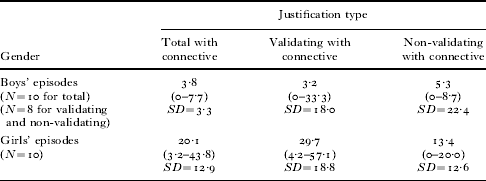
A Mann–Whitney test was used to compare girls' and boys' episodes on the proportion of marking of justifications with a connective. The mean rank for boys' groups was 5·95 and for girls' groups it was 15·05. This difference was significant (U=4·500, p<0·001).
To what extent might the low rate of marking of justifications with a connective that occurs in boys' episodes be due to the low rate of validating justifications produced in those episodes? To examine the proposal that validating justifications privilege marking with a connective, we attempted to compare the extent to which validating justifications received a connective in boys' and girls' episodes to the extent to which non-validating justifications (i.e. all other categories, collapsing across opposition-motivated and self-expanding justifications) received a connective. Since boys produced validating justifications rather infrequently (five out of ten boys' episodes had fewer than three validating justifications, and in two of these episodes no validating justifications were produced at all), there were insufficient data to make the comparison for boys' episodes, so we made the comparison for girls' episodes only. In girls' episodes, the mean percentage of validating justifications that were marked with a connective was 29·7% and the mean proportion of non-validating justifications that were marked with a connective was 13·4%. A Wilcoxon matched pairs test indicated that this difference was marginally significant (sum of positive ranks=9·00, p=0·064). It would appear, then, that in episodes in which a sufficient number of validating justifications are produced to be able to make the comparison, that is, in girls' episodes, validating justifications privilege marking with a connective over non-validating justifications. This finding suggests that the low rate of validating justifications produced in boys' episodes may be a salient reason for the low rate of connective use in two-clause causal constructions that is seen in boys' episodes.
Summary
The group comparison of the data shows that preschool children interacting with their peers in friendships do not use justifications solely when they contest an action or utterance produced by the interlocutor. They can use justifications in a way that expands and supports their conversational partner. Although boys greatly preferred opposition-motivated uses of justification, which accounted for 82·6% of their justifications, they could use validating justification, at a rate that averaged 10% across ten play episodes involving two different friendship groups of boys.
Using justification solely for the purpose of validating or expanding the proposal of a partner occurred significantly more frequently in play episodes involving friendship groups of preschool girls than boys in this study. This finding is consistent with past studies. Validating justifications involve the co-construction of utterances across speakers' turns, and as described by Coates (Reference Coates1996: 266) for white upper-working and middle-class British women, co-construction of utterances and ‘establish[ing] a collaborative floor’ are major goals of the talk of women friends. Girls in this study may have been influenced by similar, white middle-class-based images of girls and women. Although the girls were not all white and middle-class (the preschool center families were 60% European-American, and predominantly middle-class), such images were available to center children from the media, and from the observed practices of parents, classmates, classmates' parents, and other adults in the school community. These images would have therefore been available in the school culture to be taken up in the play of the children. As a result, girls in this study may have viewed expansion and affirmation of the partner as an appropriate way for girls to speak, and may have used validating justifications in order to construct themselves as feminine. However, consistent with a more performativity-based view of gender, girls could diminish their use of this gender-marked feature under certain circumstances. One of the groups showed a marked difference in their proportional use of validating justifications when enacting more feminine themes of play such as being mommies, kitties, and Cinderellas, which they did under the influence of a particular group member, than when they enacted more athletic themes (supergirl and climbing a hammock). These findings suggest that girls may view validating justifications as a means to project more sweet, caring, and feminine personae, but that they may diminish the use of this feature in contexts in which they wish to ‘play down their femininity’ (Ochs, Reference Ochs, Gumperz and Levinson1996).
In boys' play episodes, justifications were less likely to receive marking with a connective than they were found to do in girls' episodes. To examine whether low use of validating justifications could account for boys' lower use of subordinate syntax, an attempt was made to compare the proportion of validating justifications that received marking with a connective to the proportion of non-validating justifications that received marking in both girls' and boys' episodes. It was not possible to do this in boys' episodes because boys produced validating justifications at a low rate or not at all in five episodes. However, in girls' episodes, it was found that validating justifications significantly more often privileged marking with a connective than non-validating justifications. These findings suggest that validation, possibly because of the presupposition factors implicated by Chafe (Reference Chafe1984), provides a salient context for the marking of justifications with a causal connective. As boys less often make use of validating justification and presupposition, their clause-combining syntax will be characterized by less subordination. Below we present a qualitative analysis of two long examples to examine how validating and opposition-motivated justifications are used in extended sequences of talk.
Qualitative analysis of justifications produced in girls' and boys' play episodes
Long examples can show how validating and opposition-motivated justifications occur in extended sequences and influence one another. Moreover, one aim of the present study was to examine how young preschool-aged children build their theories of the world together with same-age peers through naturally occurring interaction. Although the types of causal theories accessed eluded aggregation into broad mutually exclusive categories, we hope to give a flavor of the types of causal theories accessed in girls' and boys' episodes through specific examples.
Example (10) is an excerpt from an episode of play involving Group 1. Emily, Piper, and Debbie are sitting on the grass together, pretending to cook and be of different nationalities. Example 1 demonstrates this girls' group's reliance on validating justifications, and tendency to mark justifications with the connective because. It also exemplifies the types of discussion of social–conventional causality that often occurred in girls' play episodes.
(10) Children: Emily (4 ; 7), Piper (4 ; 9), Debbie (3 ; 9)
1 Emily: pretend this (xx)/ pretend (xx) are called (rices)/
2 Piper: and those are called chaniza/
3 because they're- they're special kind of tortilla/
4 and we always need it/
5 Emily: aha/aha/
6 Debbie: we make (lots of fresh rice)
7 'cause (‘because’) we're Chinese people/
8 pretend/ I'm a Chinese/
9 Piper: pretend/ this is cabbage/this is cabbage right?
10 Emily: yeah/pretend I'm- pretend I'm American/
11 pretend I come from- from America/
12 Piper: =={I come from china [f]}/
13 Emily: yeah/ 'cause (‘because’) you're a China person/
14 pretend I come from- from- from Korea
15 'cause (‘because’) I'm a Korean person/
In lines 2–3, Piper produces a justification (‘and those are called chaniza/because they're- they're special kind of tortilla’). Here, she uses a because to justify her own elaboration of Emily's proposal in the previous turn. Emily had proposed a suggestion for what one kind of food is called, and Piper proposes what another kind is called. Hence, Piper uses a justification to support her elaboration of Emily, and therefore in a validating way. In lines 6 and 7, Debbie uses the connective 'cause in another validating justification (‘we make (lots of fresh rice) 'cause (‘because’) we're Chinese people’). In this, Debbie expands the idea of making rice that Emily had proposed in line 1 with a reason; it is a good idea to make rice because they are pretending to be Chinese people. In line 10, Emily agrees with Debbie's idea that she is a particular nationality, then elaborates by proposing a nationality for herself, American, and justifying it by the place of origin, coming from America. Piper expands this proposal by proposing to come from a special place as well, China, and Emily in line 13 agrees with Piper's proposal and gives a reason for Piper to come from China – because she's a China person. Emily expands on this theme further: in line 14 (‘pretend I come from- from- from Korea 'cause (‘because’) I'm a Korean person’), she elaborates Piper's idea of coming from a special place by proposing to pretend that she herself comes from one, and providing a justification for her elaboration (hence validation) of Piper. The girls continually affirm and further one another's proposals, a feature consistent with the collaborative agenda that has been described for girls' and women's speech (Coates, Reference Coates1996; Maltz & Borker, Reference Maltz, Borker and Gumperz1982). Because of the apparent agenda of ratifying their partners' proposals and showing their support, group members treat partners' suggestions as given information and delve deeply into the causal relationships underlying the frame of play. Collaboratively, the girls build an understanding of what it means to be of different nationalities. The personae that the girls project through the way they use justifications are very supportive.
Later in the school year, when Piper left the group, without her influence group members, particularly Emily, gravitated towards more athletic themes of play, such as showing one another how to climb and playing supergirl. The personae that Emily projected through her use of features of justification were very different. She opposed group members (‘do what Debbie? I *can do it. I bet you can't do *this Debbie’ only if you have straight long legs). She used more arbitrary justifications in opposing group members (e.g. ‘no; that's not what I told you’), grounding her opposition in terms of her own activity and wishes. Through these features, she projected a harsher, more competitive persona in keeping with the new activities the group was enacting: supergirl and climbing. Hence the low rates of validating justification that were reported for these episodes in the group and contextual comparisons section.
Example (11) is an excerpt from an episode of play involving Group 4, one of the boys' groups. Brad, Ted, Greg, and Bruce are playing ‘power rangers’. Here, the intriguing and masculine theme of power rangers momentarily unites the boys and leads to the production of two validating justifications in lines 3–8. Ted expands on Brad's proposal in line 3 that the barbells are the boys' ‘powers’ with the justification that it is consistent with the theme they had been playing earlier, power rangers. Greg, in turn, expands on Ted's idea that they play power rangers by launching into the allocation of the roles that go with that frame (line 7) and providing a justification (line 8). However, the bout of validation quickly gives way to opposition (beginning in line 10) as group members attempt to top one another in the display of their knowledge of this masculine theme.
(11) Children: Brad (5 ; 1), Ted (5 ; 0), Greg (4 ; 10), Bruce (4 ; 11)
1 Brad: [returns to boys, with weights]
2 pretend these are our power-
3 pretend these are our powers
4 Ted: [whispering to Greg] remember we were playing play
5 power rangers?
6 Greg: [Ted and Greg talking by tree]
7 pretend my name is night wing,
8 because I forgot what the (red's) name is/
9 Ted: tommy?
10 Greg: no/
11 Ted: oh/oh the re- my name is tommy/
12 Greg: nuh-uh/
13 Ted: yeah/
14 Greg: ==you're the red one
15 and the red one's name is rocky/
16 Ted: rocky/
17 Greg: ah, rocky/
18 Bruce: [Bruce hears and joins in] I'm the black one/
19 Greg: okay, if you want to be the dumbest/
20 Bruce: what?
21 Ted: who's the dumbest?
22 Greg: the, um, black one/
23 Ted: he's du-
24 Bruce: okay, I'll be the.. purple/
25 Ted: the blue one is the boy/
26 Greg: if-if there is a purple-if there is a purple one on here,
27 [he points to Ted's belt pack (microphone)]
28 you can do it/ that's blue/ so there isn't any purple/
29 so …
30 Ted: you want to be pink? that's the girl/
31 Bruce: I wanna be blue/
32 Ted: right/ that's the boy/ [Ted jumps on tree]
33 where does it go?
34 [Brad tries to get on the same tree branch as Greg;
35 argument ensues]
36 Greg: get do::wn/ I said get down/I got here first/
In line 13, Ted is told by Greg that he cannot have the power ranger role of Tommy because he is the red power ranger, whose name is Rocky. Next, Bruce receives opposition to his decision of which power ranger to be. His first choice, of being the black power ranger (line 18), is opposed by Greg in the next turn for the arbitrary reason that the black one is the dumb one. Ted in line 21 then validates Greg in his opposition of Bruce by expanding on Greg's opposition with the reminding utterance ‘who's the dumbest’. This statement reminds the boys that earlier they had designated the black power ranger as the dumb one. Bruce's next choice, of being the purple power ranger (line 24) is expanded on by Greg, who gives an oppositional-validating justification to his proposal – Bruce can be the purple power ranger, but only if a purple power ranger is featured on the belt pack that Ted is wearing, which it is not. Next, in line 30, Ted opposes Bruce with the mock suggestion that he be the pink power ranger, because that's a girl's color. Only after Bruce concedes to be the blue power ranger, which Ted had earlier told him is a boy's color, does Ted (line 32) tell him that that is acceptable, and reiterates his own earlier-stated reason – that the blue one is a boy. Therefore, his seeming validation of Bruce, ‘right’, and the subsequent justification, are coded as oppositional-validating, because they come only after a concession to Ted's power. After this, Ted begins to climb the tree, and the boys become distracted from the power rangers frame entirely by an argument that ensues over this, in which Brad and Greg climb onto the same tree branch and argue over which one of them should get off. Greg justifies his opposition (‘get do::wn’) by using an arbitrary justification in terms of his own activity (‘I said get down’). This example demonstrates that although boys can be united and validate one another in their interest in a masculine theme (Cameron, Reference Cameron, Johnson and Meinhof1997), their tendency to compete can introduce opposition, and can also easily distract them from the frame (see Sheldon, Reference Sheldon1990). The example also shows how opposition can lead to arbitrary reason-giving – in their enthusiasm to one-up a partner, they can invoke some arbitrary reasons (e.g., the black power ranger is dumb), and reasoning in terms of their own wants and abilities (‘pretend my name is night wing because I forgot what the red's one's name is’; ‘I got here first’). In contrast, the girls in the previous example strictly adhered to the frame in justifying their proposals. The mocking, imposing, and oppositional tone of the boys' statements such as ‘nuh-uh’, ‘okay, if you wanna be the dumbest’, ‘you want to be pink’, ‘get do::wn’, and ‘I said get down’ (lines 12, 19, 30, and 36), and the lack of presupposition and acceptance that these head acts entail, seem to predispose omission of the connective. Other than the because in the second justification construction, which is a validating one, no other connectives are produced in the excerpt.
These two long examples show the kinds of causal relationships discussed in children's justifications during play – of what underlies cultural/ethnic identity (example (10)), of what constitutes masculinity (example (11)). These causal relationships can provide ‘foundational knowledge’ upon which more advanced theories of ethnicity/ethnic identity, gender, and gender roles can be built (Au et al., Reference Au, Romo, DeWitt, Siegal and Peterson1999). Validating justifications in particular, because they involve interlocutors expanding one another over several turns and because they seem to minimize arbitrary reasoning, may be particularly conducive to the elaboration of foundational causal knowledge among child peers. A second point demonstrated was that preschool boys could use validating justifications (example (11)), but that such justifications could easily give way to opposition-motivated justifications as boys explored more competitive aspects of the same theme or script.
DISCUSSION
The present study demonstrated that young preschool-aged children playing with other young children can use justification in an affirmative and idea-expanding way, and not only to support prohibitions and negative statements in disputes. Both girls' and boys' play episodes contained validating justifications. Although some play episodes of boys contained rather low rates of their use, only two boys' episodes failed to yield any validating justifications. This finding is notable since, as suggested by many studies focusing on conflict-motivated justifications, idea-expanding justifications may be a late-emerging and cognitively advanced type, as well as one that has been understudied, particularly in preschool-aged children.
That validating justification occurred more in episodes of talk and play involving girls' friendship groups than boys' groups is consistent with past studies of gender and language. Validating justifications involve the co-construction of utterances across speakers' turns, and as described by Coates, co-construction of utterances is a ‘regular feature of the talk of women friends’ (1996: 266). Girls in this study seemed to view affirmation of the partner as an appropriate way for girls to speak, and may have used validating justifications in order to construct themselves as feminine. Methodological features of the present ethnographic study may partially account for the strong gender difference in production of validating justifications that obtained. Children were observed in self-selected activities in spontaneously occurring interaction, and were observed (for purposes of this study) at a period in their school year after larger friendship clusters had formed. Gendered patterns of behavior are more likely to be evidenced in large public groupings of children (such as occur in large peer groups in classrooms), where children's behavior is observable to their peers (Thorne, Reference Thorne1993).
With regard to our third research question, there did seem to be some cognitive and linguistic consequences of different motivating contexts for justifications. Validating justifications seemed to yield higher rates of marking of the causal relationship with a connective. We hypothesized that validating justifications, because of the presupposition involved in agreement and co-construction of causal relationships across speaker turns (Chafe, Reference Chafe1984), would privilege a more embedded syntax (Matthiessen & Thompson, Reference Matthiessen, Thompson, Haiman and Thompson1988) and greater use of a connective between the head act and justification. The results supported this expectation. In girls' episodes, in which validation was used frequently enough to examine the relationship, validating justifications yielded a higher rate of marking of the causal relationship with a connective than non-validating justifications. Boys' dispreference for agreement and expansion of partners' ideas may partially account for findings in the literature reporting that girls exceed boys in MLU and complex sentence structure in the pre-school years (between the ages of 2 ; 0 and 5 ; 0) (Bornstein et al., Reference Bornstein, Hahn and Haynes2004). If it is the case that different pragmatic uses of justification yield different grammatical marking, this would provide support for functionalist theories (Slobin, Reference Slobin and Slobin1985) and discourse-based theories (Ervin-Tripp, Reference Ervin-Tripp and Clark1993; Budwig, Reference Budwig1995; Matthiessen & Thompson, Reference Matthiessen, Thompson, Haiman and Thompson1988) of grammar use and development. However, we would expect permanent outcomes of stylistic preferences to be moderated by the breadth of types of play and friendship groups in which individual children participate. On the bases of recent studies that have documented flexibility in children's language use across different contexts (Goodwin, Reference Goodwin1990, Reference Goodwin2006; Kyratzis & Guo, Reference Kyratzis, Guo and Kyratzis2001; Nakamura, Reference Nakamura2001), we may expect that, to the extent that girls and boys are afforded the opportunity to participate in different types of friendship groups and play, they would gain exposure to different kinds of pragmatic functions and use grammar accordingly. This would include boys using more validating justifications and causal constructions with connectives.
There seemed to be some cognitive consequences for the different motivating contexts of justifications, in terms of the types of causal relationships accessed in the talk. The interactive goals of supporting the partner and showing why their proposals were good ones, seen in the greater use of validating justifications in girls' play episodes, seemed, in the qualitative analysis, to have positive outcomes for justification in terms of allowing girls opportunity to deeply explore the causal relationships encompassed in a particular frame or script and in terms of yielding a low reliance on arbitrary justifications. Arbitrary justifications represent ‘speaker and his comfort becom[ing] the point of reference for judging what everyone else is doing and the current progress of the activity. This extreme egocentrism … is found frequently in the directives of boys portraying themselves as leaders’ (Goodwin, Reference Goodwin1990: 97–98). Girls would avoid the use of arbitrary justifications focused on their own needs and wants if they wished to mask a power agenda. The kinds of causal relationships discussed in children's justifications – of what underlies cultural/ethnic identity (example (10)), of what constitutes masculinity (example (11)), of what meat eaters and vegetarians can and cannot eat (example (4)) – and of counting (example (7)) can provide foundational knowledge for more advanced theories of ethnicity/ethnic identity, gender, gender roles, biology, and number (Wellman & Gelman, Reference Wellman and Gelman1992; Au et al., Reference Au, Romo, DeWitt, Siegal and Peterson1999). Although boys also access foundational knowledge in their justifications with peers in play (e.g. examples (7) and (11)), their competitive agenda can lead to breakdown of thematic play and more arbitrary reasoning. Future research should explore how foundational knowledge for more advanced causal theories is co-constructed in the naturally occurring conversations of young members of girls' and boys' friendship groups.
Despite the importance of possible cognitive and linguistic ramifications of different motivating contexts of justifications, one of the most important findings to emerge from this study was about children's pragmatic sensitivity to the contexts requiring justification. As noted, ‘an explanation does not merely imply that the speaker can make causal links between one event and another’ (Veneziano & Sinclair, Reference Veneziano and Sinclair1995: 558), the speaker needs also to be socially sensitive to when an explanation is needed (see also Ervin-Tripp & Gordon (Reference Ervin-Tripp, Gordon and Schiefelbusch1985), Barbieri et al. (Reference Barbieri, Colavita, Scheuer, Conti-Ramsden and Snow1990), and Goetz & Shatz (Reference Goetz and Shatz1999) for this point). Although traditionally researchers were more concerned about settings in which ‘an action or utterance might constitute a problem for one's interlocutor’ (Veneziano & Sinclair, Reference Veneziano and Sinclair1995: 558), the findings of this study highlight that settings in which ‘partners verbally assist in the construction of justifications as a means to maintain contact or solidarity’ (Goetz & Shatz, Reference Goetz and Shatz1999: 722) can also be salient sites for justification. The findings of the study suggest that gender mediates this sensitivity; groups of preschool girls appear to feel the necessity for justification in such a setting more than groups of preschool boys do. Designating particular types of motivating contexts as appropriate for justifications may be part of peer group members' ways of displaying peer group membership and identity.
Although considerable subtlety and socio-cognitive skill would be needed to negotiate these understandings, dichotomous descriptions such as girls expand one another and boys oppose one another, underestimate the pragmatic skill that is actually entailed in justifying in ways appropriate to the peer group. Validating justifications were found to be used in a contextually sensitive ways in two senses in this study. First, although boys did not prefer validating justifications, they did not avoid them completely. Boys sometimes validated one another when talking about issues that affirmed their masculine identity, such as in the discussion about power rangers. They used validating justification when combined with elements of opposition (i.e. in oppositional-validating justifications), as when one boy expanded a proposal of a partner in order to oppose a third group member (examples (8) and (11)). Cameron similarly found a group of college-aged males to use features associated with both women's speech (gossip talk, tag questions) and men's speech (topping one another) in a conversation in which they criticized non-present males for violating norms of ‘masculine appearance, clothing, and speech’ (1997: 279). Cameron concluded that through these behaviors the men were displaying their own heterosexuality, and that under certain circumstances ‘perhaps it becomes acceptable to transgress one gender norm (‘men don't gossip, gossip is for girls’) in order to affirm what in this context is a more important norm’ (‘men in all-male groups must unambiguously display their heterosexual orientation’) (1997: 281). In the present study, boys' need to affirm their masculinity and toughness may have allowed them to transgress a perceived norm against openly supporting their conversational partners.
A second way in which contextual sensitivity was seen in these data was in the use of validating justifications at quite different rates in one group of girls depending on the theme of play. When enacting nurturing themes such as a mommy taking her children hiking, or a mommy with baby ‘kitties’, or being ‘little Cinderellas’ and making food for others and trying out different ethnicities, group members utilized high rates of validating justifications. When these same girls, minus a group member, began to enact less feminine and more athletic themes of play such as climbing and playing supergirl, they utilized very low rates. These findings suggest that girls may associate validating justifications with feminine play themes, and ‘play down’(Ochs, Reference Ochs, Gumperz and Levinson1996) their use of this feature when they view it as less appropriate to the context or activity at hand.
Contextual sensitivity such as this points to the complexity of sociolinguistic and pragmatic skill involved in negotiating when to justify with one's peer group members. It also provides a hopeful note on cognitive and linguistic outcomes of different motivating contexts of justifications. It is known that when conversational topic has been controlled by researchers in studies of talk in boys' groups and dyads (e.g. Goetz & Shatz, Reference Goetz and Shatz1999; Nakamura, Reference Nakamura2001), boys have been found to use features of adversarial and conflict-motivated speech style to a lesser degree than has been found in other settings in which the conversational topic has not been controlled (e.g. as in the present study). To the extent that boys experience a range of different kinds of play groups and play frames (see Thorne (Reference Thorne1993), Kyratzis (Reference Kyratzis and Budwig2001), and Goodwin (Reference Goodwin2006) for some naturally-occurring variations in these phenomena in the peer social lives of boys and girls), we may expect that such a breadth of experiences would moderate any permanent influences of boys' oppositional speech style on their grammatical development and on the opportunities afforded them to lay foundational knowledge for more advanced causal theories collaboratively with their (male) peers in play.
APPENDIX: TRANSCRIPTION CONVENTIONS
- /
Falling intonation at end of intonation contour
- ?
Rising intonation at end of intonation contour
- ,
Holding intonation at end of intonation contour
- ::
Lengthened segments
- -
Truncation
- ==
Latching
- *
Accented syllable
- (xx)
Inaudible speech; each x indicates inaudible syllable
- [ ]
Description of non-verbal events
- {[f]}
Non-verbal phonemena that overlay the stream of speech, such as forte
- - - - - - -
Indicates utterances not shown on transcript