The process of democratization in Britain—in particular the franchise expansions legislated in the 1832, 1867, and 1884 Reform Acts—has attracted intensive scholarly attention.Footnote 1 One long-standing view, rooted in a classical “Whig” interpretation of history (see critique by Butterfield Reference Butterfield1965), is that Britain was distinctive in requiring little social and political conflict in the modern era to democratize. Others argue that, whether driven by destabilizing constitutional crises or even the threat of mass revolution (Therborn Reference Therborn1977; Acemoglu and Robinson Reference Acemoglu and Robinson2005; Morrison Reference Morrison2011; Aidt and Franck Reference Aidt and Franck2013), the process of democratization in Britain was deeply conflict-ridden even into the nineteenth century.
A key empirical issue is the level of perceived political risk during each of Britain's major nineteenth century episodes of suffrage expansion. To date, scholars on both sides of the debate have relied considerably on the written and verbal statements of the historical protagonists to try to reconstruct their perceptions of political risk (Himmelfarb Reference Himmelfarb1966; Cowling Reference Cowling1967; Collier Reference Collier1999; Acemoglu and Robinson Reference Acemoglu and Robinson2005). Since politicians are strategic in their rhetoric, it is difficult to accurately reconstruct how fearful political and other social actors actually were of the political events surrounding democratization on the basis of such statements.
This article takes a different empirical approach, based on an examination of the response of the market for British sovereign bonds to the Reform Acts. We analyze high-frequency yield data on the British 3 percent consol, a perpetual government bond that was perhaps the most widely-traded security in nineteenth-century Europe.Footnote 2 Because they incorporate default and currency risk associated with possible regime instability, bond yields represent a reliable contemporaneous indicator of perceived political risk, or as contemporaries called the bond market during the 1832 Reform crisis a “barometer of the agitation which is working the public mind.”Footnote 3 Fluctuations in bond yields represent revealed preferences and therefore can plausibly be viewed as less strategic and more “sincere” than political speeches alone. Finally, analysis of bond yields has two further benefits: it enables comparison of perceived political risk within Britain over the course of the nineteenth century and also allows a comparison of British reform episodes with analogous events in other countries.
Our analysis of trends in 3 percent consol yields around the passage of each of the Reform Acts finds that franchise extension was preceded by a sharp increase in perceived political risk in 1832 and 1867 but not for the 1884 Reform Act, with yields returning to pre-crisis levels upon passage of each Act. We also examine two well known “failed” cases of attempted democratization that were also characterized by social unrest: the Chartist agitations for franchise extension of 1842 and 1848. Here we find a similar pattern of a rise in yields followed by a decline, suggesting that the bond market also viewed repression as an effective form of political stabilization. A comparison of these reform episodes to other periods of time within nineteenth-century Britain suggests that successful and failed reform episodes were both associated with high levels of bond market volatility. At the height of the 1832 reform crisis, investors discounted the value of consols by 16.6 percent from the pre-crisis baseline, while at the height of the 1867 reform crisis investors discounted the value of consols by 8.7 percent. In addition, cross-country comparisons suggest that bond market volatility in Britain was comparable to that of major reform episodes in other western European countries.
To identify the source of this perceived political risk, we conduct structural break analyses utilizing daily and weekly 3 percent consol yield data and historical analysis of the events corresponding to the detected breaks. We find that two types of events drove major increases in yields: incidents of social unrest, for example, the 1831 Swing Riots, as well as elite political deadlock, including the failure of reform bills in the legislature.Footnote 4 Onward parliamentary momentum of reform, such as Benjamin Disraeli's pivotal acceptance of the Hodgkinson amendment to the 1867 reform bill, drove major decreases in bond yields. We corroborate these findings qualitatively, utilizing the major financial news sources of the time—The Times of London, The Economist, and The Investor's Monthly Manual.
Our findings counter the classical “Whig” view that the “constitutional watershed” of 1688 meant that democratization thereafter could proceed absent significant political crisis. We argue that Britain's democratization, especially in 1832 and in 1867, was turbulent. However, we find that the bond market reacted favorably to forward progress and eventual passage of reform with sharp drops in the premium that investors demanded to hold British sovereign debt, suggesting that the market viewed democratic reform in Britain as an effective form of political stabilization.
THEORETICAL DEBATE
Why incumbent nondemocratic elites dilute their power by expanding the franchise is a central question for the historical study of democratization.Footnote 5 Normally, intense social conflict accompanies major shifts in political power.Footnote 6 Thus, the case of Britain with its unusually gradual and consensual experience of nineteenth century democratization has attracted attention as a peculiarly settled case of mass democratization.
This relatively tranquil political trajectory is typically explained with reference to the institutional checks embedded in the constitutional settlement of the Glorious Revolution in 1688. In this view, England's pre-industrial political violence, and the fact that its constitutional order was secure long before the age of mass suffrage and the early supremacy of its Parliament, assured not only long-run economic growth (North and Weingast Reference North and Weingast1989; Cox Reference Cox2012), but also a smooth passage to mass democracy in the nineteenth century in Britain as a whole (Moore Reference Moore1966; Dahl Reference Dahl1971). Some argue nineteenth-century suffrage expansion occurred as a result of an effort by political elites to shift British politics away from patronage to programmatic party competition (Lizzeri and Persico Reference Lizzeri and Persico2004). Others, including Maurice Cowling (Reference Cowling1967) and (Gertrude Himmelfarb Reference Himmelfarb1966) argue that suffrage reform resulted from partisan political competition. For all of these views democratization in Britain was a low-stakes political process because they were occurring in a constitutional system that already provided well-institutionalized guarantees for secure property rights.
Challenging this account are those who highlight the presence of major social unrest and constitutional crisis in nineteenth-century Britain, asserting that the old regime elites reluctantly conceded suffrage reform only in the face of intense social and political instability (Acemoglu and Robinson Reference Acemoglu and Robinson2005; Morrison Reference Morrison2011; Aidt and Franck Reference Aidt and Franck2013).Footnote 7 Proponents of this view point to the steady stream of public demonstrations and strikes and other forms of extra-parliamentary pressure that led to each of Britain's major democratic reforms. These include the chaotic “Days of May” of 1832, the Hyde Park riots of 1867, and the anti-House of Lords protests of 1884. In the view of one analyst, 1831 was the closest Britain has ever come to a revolution (Evans Reference Evans1994).Footnote 8 A critical point for this perspective is that democracy, while preferable to old regime elites than outright revolution, was nonetheless less desirable than the pre-revolutionary status quo ex ante.
Proponents of this “revolutionary unrest” view typically point to the statements of politicians such as Thomas Babington Macaulay, the Whig member of Parliament who in 1831 famously urged the House of Commons to pass the Reform Bill as an essentially conservative measure: “Reform that you may preserve!”Footnote 9 Others suggest that both historians and historical protagonists exaggerated actual perceptions of a threat of revolution. Himmelfarb (1966, p. 106), for example, argues that the much vaunted Hyde Park riots of 1867 amounted to little more than “broken railings and trampled flower beds.”
Overall, the scholarly debate has been oddly and unsatisfyingly inconclusive and confusing. Dietrich Rueschmeyer, Evelyne Huber Stephens, and John D. Stephens (1992, p. 95) state: “The British case is so singular in so many ways, both in terms of the antecedents of democracy and the process of democratization, that is impossible to decide which factor(s) was (were) the most important on the basis of comparative analysis.” A central source of this confusion, we argue, is that reconstructing historical perceptions, especially on the basis of statements by strategic politicians, is a challenging task. Scholars on both sides of the debate have been able to select statements and evidence supporting their views. Yet we have no method, besides individual judgment, for assessing these competing bodies of evidence, making it difficult for a consensus to emerge. The empirical challenge is fundamental: “The empirical challenge associated with testing [the theory that that franchise expansion was driven by the threat of revolution] is that, while reform actions can usually be observed, we can never observe threat perceptions” (Aidt and Franck Reference Aidt and Franck2013, p. 13).
EMPIRICAL STRATEGY AND DATA
Our empirical approach allows us to adjudicate between these competing theories of British democratization. We exploit the fact that changes in bond yields incorporate default and currency risk associated with regime instability. British bond yield data are, therefore, an accurate indicator of contemporaneous perceptions of political risk during the historical process of democratization, because the actions of buyers and sellers, unlike the statements of politicians, represent revealed preferences. Bond yields also enable us to compare political risk across various democratic reform episodes in Britain and to risk during democratic reform episodes in other countries.
A now considerable literature documents the relationship between political risk and financial markets. Larry Neal (Reference Neal1993, p. 14) argues that the attractiveness of a British sovereign bond “to the investing public depended on the relative ease by which it could be acquired and disposed of, the clear terms of the interest payments, and the readily available information about its current price and the military and political events likely to affect its price.” Niall Ferguson (Reference Ferguson2006) finds that wars and revolutions were the source of the largest spikes in European long-term bond yields between the revolutions of 1848 and World War I and uses historical European bond yield data to show that World War I came as a “bolt from the blue” (Ferguson Reference Ferguson2006, p. 1). Kristen Willard, Timothy Guinnane, and Harvey Rosen (Reference Tombs1996) attempt to identify important turning points in the U.S. Civil War by looking at fluctuations in the price of the “greenback.” Raymond Fisman (Reference Cheyney2001) uses Indonesian stock market responses to news of Suharto's ill health to estimate the value to Indonesian firms of political connections. Our approach adds to this literature by utilizing bond market data to quantify perceptions of democratic reform events in nineteenth-century Britain.
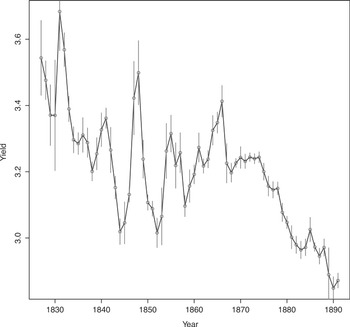
We utilize high-frequency data on the yield of the British 3 percent consol.Footnote 10 The British 3 percent consol, a perpetual government bond, was among the most widely traded securities in nineteenth-century Europe. It is ideal for our purposes because it was widely held and frequently traded and its existence over the entire time period enables us to compare perceptions of political risk across the 1832, 1867, and 1884 Reform Acts as well as two failed drives for franchise expansion, the Chartist agitations of 1842 and 1848. Annual average yields on the 3 percent consol are displayed in Figure 1, with vertical lines representing plus or minus the standard deviation of monthly averages of yields in that year. Mean yields trend down over the course of the century, and there are clear spikes in the data corresponding to times of democratic tumult.
PLOT OF MEAN AND VOLATILITY OF YIELDS ON 3 PERCENT CONSOL BY YEAR

The empirical analysis comprises a number of steps. First we use semi-parametric regression methods to estimate patterns in 3 percent consol yields, averaged by month, in the four-year windows around the passage of the 1832, 1867, and 1884 Reform Acts to test statistically whether the process of democratization was associated with departures in yields from the pre-existing mean, and to assess the impact of the passage of democratic reform on yields. As a robustness check, we also apply our analysis to the two well-known “failed” cases of agitation for reform. Although the Chartist agitations for franchise extension of 1842 and 1848 ended in repression, we can compare levels and patterns of political risk in “failed” versus “successful” episodes of franchise expansion.Footnote 11
To assess the magnitude of political risk around reform episodes in Britain, we compare within-country and cross-country. Within-country we compare the bond yield volatility in times of political agitation to “typical” (non-agitation) levels of consol yield volatility in Britain. We do this by randomly drawing many four-year series of monthly British consol data from the nineteenth century to generate a distribution of volatility statistics, against which to compare critical months in 1832, 1842, 1848, 1867, and 1884. Across-country we compare political risk during reform episodes in Britain to political risk during reform episodes in other western European countries.Footnote 12
To identify the source of major increases and decreases in perceived political risk during reform episodes in Britain, we conduct a structural break analysis for each of the Reform Acts, utilizing daily yield data in the case of the 1832 Reform Act, and weekly data in the case of the 1867 and 1884 Reform Acts.Footnote 13 Structural break analysis has the advantage of allowing the consol yield data to “speak for itself” rather than specifying a priori which are events we judge to have been pivotal, but also the disadvantage of permitting ex post rationalization. Thus, to qualitatively corroborate the conclusions of the structural break analysis, we analyze the reactions of the major financial news sources of the time period: The Times of London, The Economist, and The Investor's Monthly Manual.
RESULTS
To semi-parametrically estimate patterns in 3 percent consol yields in the periods of time around the passage of democratic reform, we estimate a generalized additive model (GAM).Footnote 14 We estimate a model of the form:

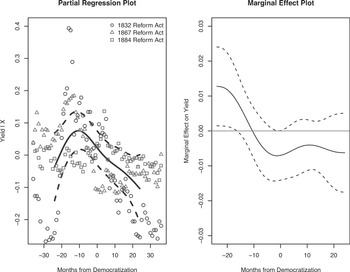
where TIME it represents time in months (from −24 to 24) from the passage of Reform i (which occurs in month zero) and at time t. Bond yields are represented by Y it for episode i at time t. Month zero is coded as the month in which reform took place in the House of Commons (June 1832; July 1867; December 1884). In this specification, the empirical sample includes only the 49-month windows around each Reform episode. The “episode fixed effect” τ i is a vector of dummy variables, one for each episode to control for time-invariant omitted variables in each 49-month period. The estimates are not particularly sensitive to the choice of time span as is visually evident in Figure 2 in the residuals displayed outside of the 49-month span (from −24 to 24) used in the analysis.
The function f (·) is a smooth “penalized spline” function, with the degree of flexibility (number of knot points) optimized through cross-validation. The model also stipulates a Reform-specific AR(1) normal distribution of errors; in other words, within each 49-month window the error in any single month is assumed to be normally distributed and correlated with the last month's.Footnote 15 Because GAM point estimates are difficult to interpret, we report in Figure 2 the model estimates in the form of a partial regression plot (including residuals) of the estimated effect of time to democratization on bond yields along with a plot of the marginal effect of time to democratization on bond yields, which can be interpreted as reporting the estimated rate of change in bond yields at different points of time relative to the passage of reform.
SEMI-PARAMETRIC ESTIMATE OF CHANGE IN YIELD AROUND PASSAGE OF REFORM

Figure 2 “pools” data from across the Reform Acts and suggests a statistically significant increase in yields prior to democratic reform, followed by a return to the pre-existing mean with the passage of democratic reform. Yields are estimated to begin to decline approximately ten months in advance of reform, plausibly due to rational expectations and anticipation of the passage of reform; later we provide evidence for this in the structural break analysis, which finds that news of events corresponding to forward progress on reform reduced yields. We find considerable heterogeneity across Reform Acts, with a large spike in bond yield preceding the 1832 Reform Act, on the order of a 65 basis point difference between minimum and maximum, a more moderate spike prior to the 1867 Reform Act, on the order of a 31 basis point difference, and a 21 basis point difference for the passage of the 1884 Reform Act. There is some evidence, therefore, that the bond market volatility associated with reform episodes declined over the course of the nineteenth century.
SEMI-PARAMETRIC ESTIMATE OF CHANGE IN YIELD AROUND FAILURE OF REFORM

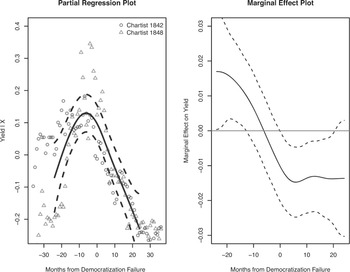
As a robustness check using the same empirical strategy, we examine cases of agitation for democratic reform that ultimately failed: the Chartist agitations of 1842 and of 1848. In this case, month zero is coded as the month in which the movement failed.Footnote 16 Our results are shown in Figure 3.
Interestingly, we observe a pattern in bond yields similar to that for episodes of successful suffrage reform. Bond yields rose initially, presumably with the threats to political stability posed by Chartist strikes and demonstrations, but fell with the ultimate failure/repression and dissipation of these threats. There is some evidence that the bond market did not anticipate repression to the same extent that it anticipated reform, with yields estimated to decline roughly five months in advance of repression (as compared to ten months before the passage of reform). Taken together we argue that bond markets perceived a genuine threat to political stability in the tumultuous political processes both leading up to the Reform Acts and in the Chartist agitations and that both the passage of democratic reform and the repression of the Chartist movements were viewed as successful forms of political stabilization.
COMPARISON OF CONSOL YIELD VOLATILITY WITHIN BRITAIN

Notes:
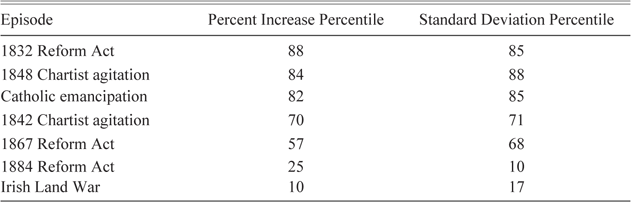
Columns indicate different volatility statistics: percentage increase of maximum from minimum yield and standard deviation of yields. Values represent the percentile in which each reform episode falls for a given volatility statistic, relative to 1,000 randomly drawn 49-month windows of British consol yield data between 1825 and 1890.
Source:
Global Financial Database.
An obvious question is how big these spikes in bond yields are. We take two empirical approaches, within-country and cross-country, in assessing the magnitude of political risk in Britain during reform episodes. First, we compare consol yield volatility in the time windows under analysis to “typical” levels of consol yield volatility observed in similar spans of time for other periods in Britain. To do this, we randomly draw 1,000 49-month windows from the full monthly consol yield data series from 1825 to 1890. For each randomly drawn window of yield data, we compute two volatility statistics: the percentage increase of maximum from minimum and standard deviation. As a result, we can compute the percentile in which each episode of reform in Britain falls, as shown in Table 1.
In terms of within-country variation, the results reported in Table 1 suggest that consol yields were considerably more volatile around the passage of the 1832 and 1867 Reform Acts and the 1842 and 1848 Chartist agitations than at other times. For instance, the percentage increase around the passage of the 1832 Reform Act was larger than in approximately 88 percent of all 49-month windows between 1825 and 1890.Footnote 17 Yields were relatively stable around the passage of the 1884 Reform Act, suggesting that the bond market perceived relatively low levels of political risk during this episode. To compare these volatility levels to those of other known periods of social upheaval in Britain, we also include in this analysis the windows of time around Catholic emancipation and the Irish Land War.Footnote 18 We find that the threat of revolt in Ireland leading to Catholic emancipation was associated with considerable bond market volatility, though less than in the case of the 1832 Reform Act. The Irish Land War appears to have provoked little concern in the bond market when compared to the 1867 Reform Act, which was enacted just a decade earlier.
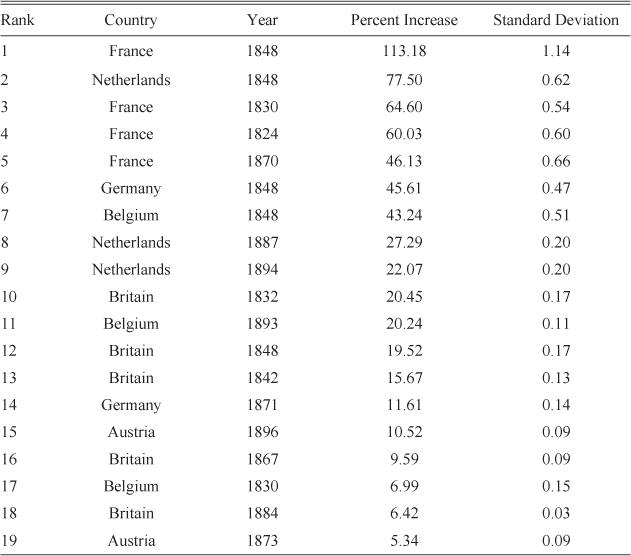
To compare across countries, we compile a list of major nineteenth century episodes of democratic reform and revolutionary events for a sample of western European countries—Austria, Belgium, Germany, France, and the Netherlands—based on catalogues of major reform episodes compiled by Toke Aidt (2011) and Daniele Caramani (2000). For each episode, we again compute the same two volatility statistics, ranking all episodes by the magnitude of these volatility statistics. Placing reform episodes in Britain within their cross-country context is revealing. The results reported in Table 2 suggest that the bond market volatility associated with reform in Britain is comparable to the volatility associated with some similar episodes in other western European countries. To be sure, Britain's democratic episodes were associated with far less bond market volatility than were some events in France, the Netherlands, and Germany. But the comparability of the 1832 and 1867 Reform Acts and the 1842 and 1848 Chartist agitations to major reform events in other European countries challenges the notion that British democratization was exceptionally risk-free.
COMPARISON OF BOND YIELD VOLATILITY ACROSS COUNTRY-EPISODES

Note:
Columns represent different volatility statistics: percentage increase of maximum from minimum yield and standard deviation of yields. Values represent the value of each reform episode for a given statistic, based on monthly long-term sovereign bond yields in the five years window of time around the recorded year of occurrence. Episodes are ranked by percentage increase of maximum from minimum yield. List of major reform episodes compiled from Aidt (2011) and Caramani (2000).
Source:
Global Financial Database.
Finally, we supplement our empirical assessments with some “back of the envelope” calculations based on a simple bond-pricing model of the default risk embodied in these changes in yields. In an efficient market the equilibrium price, P, ∗ of a consol is equal to the net present value of coupon payments from the next period onward, discounted according to the per-period market interest rate, R, as well as political risk of default, θ, which we parameterize here in the form of a short run risk of default on all future coupon payments.

This implies that yield, Y, computed by dividing the coupon by the market price, embodies the market interest rate and the short run political risk of default:

In the case of the 1832 Reform Act, if we assume that the pre-crisis baseline yield of 3.25 represents the risk free interest rate, R, and the increase to 3.9 is driven entirely by political risk-induced changes in θ, we compute that at the height of the reform crisis the default risk was perceived to be 16.6 percent. Similar calculations can be performed using the monthly average maximum (3.46) and minimum (3.16) around the 1867 Reform Act, suggesting that the height of the reform crisis default risk was perceived to be 8.7 percent. These are large implied probabilities, based on the conservative simplifying assumption of a short-run political risk of total sovereign default.Footnote 19
Together each of these analyses tell us that British bond markets perceived significant risk in the political processes associated with the Reform Acts as well as the Chartist agitations for reform, at least on par with some episodes for democratization in other European countries, even if well short of the most turbulent events.
STRUCTURAL BREAK ANALYSIS
If the bond market in nineteenth-century Britain perceived significant political risk during reform episodes in Britain we must inquire into the source of this perceived political risk. Two broad strands of theory account for sources of political risk in nineteenth-century Britain: one emphasizes mass social unrest “from below” and one that emphasizes elite conflict “from above.” Each has distinct predictions about the types of events associated with bond yield spikes during reform episodes. Advocates of the “social unrest” hypothesis would associate major bond yield increases with major instances of social unrest, revolutionary violence, or uncontrolled social uprisings, while advocates of the “elite conflict” hypothesis would above all expect to see policy uncertainty from elite stalemate in Parliament, triggering bond yield rises.
To adjudicate between these two competing accounts, we conduct structural break analyses (Bai and Perron 2003), statistically to differentiate dates associated with large changes in the mean of our consol yield series from ordinary financial volatility, for each of the Reform Acts. Compared to a traditional event study analysis which seeks to specify important events a priori and tests their impact on markets, a structural break analysis allows the bond market data to “speak for itself” in identifying which events were viewed contemporaneously as important.Footnote 20 , Footnote 21
1832 Reform Act
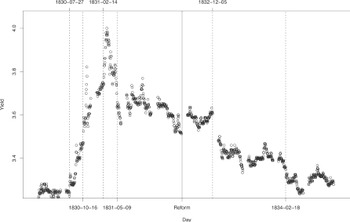
To assess whether social unrest or elite competition drove bond market volatility, we begin with the five-year window of bond yield data around the passage of the 1832 Reform Act, for which we have daily data.Footnote 22 The data series, as well as the estimated break points, are displayed in Figure 4.
We find six break points; three corresponding to an increase in the mean in the bond yield series: on 27 July 1830, 16 October 1830, and 14 February 1831, and three with declines: 9 May 1831, 5 December 1832, and 18 February 1834. Our examination of events finds that social unrest and elite stalemate, often in combination, drove the increases. The first break point of 27 July 1830 corresponds to the outbreak of the July Revolution in Paris, at which time yields rose sharply before partially dipping back down. The following days of political unrest culminated in the abdication of Charles X on August 1, which had threatening implications for political elites across Europe.Footnote 23 By contrast, since Parliament was not in session in July 1830, there is no evidence that elite or policy stalemate, at least in the legislative arena, caused this spike in yields. In short, this first major break point in the bond yields is clearly consistent with a “social unrest” theoretical perspective.
STRUCTURAL BREAK POINTS AROUND PASSAGE OF 1832 REFORM ACT

The second break point of 16 October 1830 corresponds to a combination of elite political division and social unrest. In October, the well-known “Swing Riots” of landless agricultural workers accelerated, reaching a peak in November.Footnote 24 The Swing riots, not unrelated to the revolutionary events earlier in the year in France, involved arson, attacks on landowners property, as well as calls for suffrage reform. In this chaotic context, yields displayed a tendency to rise but spiked the day after the Duke of Wellington's conservative government collapsed after a no-confidence motion, a result of the unrest and some highly controversial remarks, made on 2 November 1830, that “as long as he held any station in the government of the country, he should always feel it his duty to resist [reform] measures, when proposed by others.” (Quoted in Cheyney 1922, p. 680.)
The third structural break point, 14 February 1831, corresponding to an increase in yields, comes six days before a party meeting of the Conservative opposition that agreed to allow the introduction of the first reform bill in Parliament; the first reform bill was introduced in the House of Commons on 1 March 1831. The bond market may well have been reacting to advance news of the introduction of the reform bill and anticipated, correctly, that a divided elite implied conflict over its passage.Footnote 25
The two break points in Figure 4 associated with major declines in bond yields, 9 May 1831 and 5 December 1832, correspond to forward progress on the reform bill.Footnote 26 Yields fell sharply on 9 May 1831, when results began to emerge in the general elections held between April and June 1831. The reform bill was the major election issue and the election generated a landslide pro-reform Whig majority of 136 seats. Bond yields continued to display a general pattern of decline until the reform bill was eventually enacted in June 1832. Likewise, the breakpoint of 5 December 1832 corresponds to a several week shutting of the bond market during which general elections, the first since the passage of the 1832 Reform Act in June, were held. The re-election of a solid Whig majority government cemented the passage of reform and brought the reform crisis to a comfortable close.
From the 1832 Reform Act we see a distinctive pattern that reconciles the competing “social unrest” and “elite stalemate” accounts: Major increases in bond yields were typically initially triggered by social unrest and subsequently compounded when elites were divided and unable to forge a resolution to the crisis. Bond yields re-stabilized when elite divisions were overcome and progress on parliamentary reform bills occurred.
1867 Reform Act
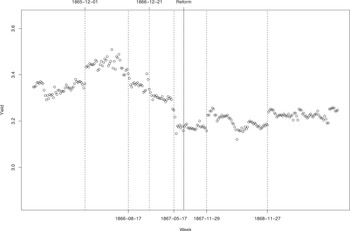
In this case, our examinations of bond yields show a break point of 1 December 1865 as displayed in Figure 5, corresponding to the initiation of an elite-level conflict over reform. In December pro-reform Prime Minister Russell, who had recently come to power after the death of anti-reform Palmerston, secured cabinet approval for the introduction of a reform bill (Seymour 1915). The markets may well have been reacting to advance news of this development and anticipating political conflict over its passage, generating a rise in yields.
Subsequent estimated break points chiefly correspond to forward reform progress within Parliament with yields falling sharply when elite divisions were overcome, facilitating democratic reform. For example, the break point on 17 August 1866 comes just one week following the prorogation of Parliament until the November session, shortly following a transfer of power from a Whig cabinet which had failed to pass reform to a conservative cabinet led by Derby as Prime Minister and Disraeli as Chancellor or the Exchequer. This transfer of power marks the beginning of Disraeli and the conservative party's attempt to “dish the Whigs” by passing the reform bill themselves (McLean 2001). Yields fell again on 21 December 1866, after a brief spike due to growing unrest and demonstrations by the Reform League. Another break point is detected on 17 May 1867, the day on which Disraeli in principle accepted the “Hodgkinson amendment” to a franchise reform bill tabled by the conservative party themselves—a radical amendment that paved the way for the eventual passage of the bill.
In sum, in 1867, elite cohesion and fragmentation appeared to be the main driver of significant bond market fluctuations around the passage of reform, with social unrest, such as the Reform League demonstrations, playing a lesser role. This stands in contrast to the 1832 Reform Act where social unrest set the agenda of policy reform and cohesive or split elites were a secondary factor exacerbating or resolving the political risk perceived by markets.
STRUCTURAL BREAK POINTS AROUND PASSAGE OF 1867 REFORM ACT

1884 Reform Act
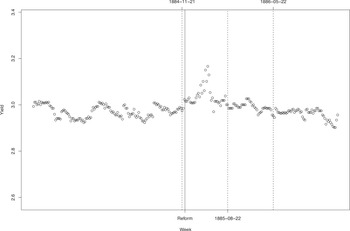
Our previous results established that the 1884 Reform Act was associated with relatively low levels of bond market volatility, which is apparent from visual inspection of Figure 6.
We detect a break point on 21 November 1884, a moment of significant impasse between the House Commons and the House of Lords over franchise reform. Mass meetings in Hyde Park had the appearance of social unrest until the Prince and Princess of Wales “gave it their unofficial patronage by viewing it publicly” (Hayes 1982, p. 185), with the result that bond yield spikes in 1884 never approached the levels they did in the two earlier episodes. In fact, the main source of volatility during this episode comes from an event completely unrelated to domestic conflict over reform; we detect a break point on 22 August 1885, corresponding to the alleviation of momentary fears of a possible border conflict between Britain and Russia on the Afghan border, which sparked a small panic before a re-stabilization of yields.Footnote 27
It would appear that the bond market reacted consistently negatively to events that heightened the conflict over franchise reform, whether incidents of mass unrest, such as the Swing Riots, or incidents of elite political conflict, such as deadlock over reform bills. Events that were viewed as alleviating conflict by facilitating reform, such as the election of a large pro-reform Whig majority in 1831, or the acceptance of the Hodgkinson amendment in 1867, provoked consistently positive reactions.
FINANCIAL PRESS ANALYSIS
We now turn to an examination of how the financial press described the sources of major increases and decreases in bond yields during these reform episodes. Our examples are drawn from the Times of London, The Economist, and The Investor's Monthly Manual, three of the most important financial news sources that together provide coverage of the entire period.
Our analysis of the financial press confirms four key points that are consistent with the quantitative findings. First, in moments of rising bond yields during the windows of time under analysis domestic conflict over reform becomes the major focus of financial news reporting. Second, especially in the case of the 1832 Reform Act, the financial press reports that it is the combination of social unrest over the issue of reform and partisan deadlock that drive major increases in bond yields. Third, forward progress on reform bills is linked in financial press accounts to the re-stabilization of bond yields. Fourth, social and political conflict over reform is a focus of financial reporting in the case of the 1832 and 1867 reform episodes but not at all in the case of the 1884 Reform Act.
STRUCTURAL BREAK POINTS AROUND PASSAGE OF 1884 REFORM ACT

In the case of the 1832 Reform Act, consistent with the structural break analysis the financial press reported a negative market reaction to the Duke of Wellington's renunciation of reform against a backdrop of revolution in France and mass agitation in Britain. The Times’ “Money Market and City Intelligence” column reported:
“The alarm in the city continues; and the funds have had a further decline…A report got out into the city that the Duke of Wellington had resigned, or was on the point of doing so…and what obtained for it a far greater share of belief that it is in all probability entitled to is of the Duke's having greatly lost popularity since the opening of parliament.” (The Times, 5 November 1830)
The peak and fluctuation in yields in February and March of 1831 were reported to have been driven by anticipation of the first reform bill:
“Consols fell soon after the commencement of business from 76 7/8 to 76 1/4; but rallied rather suddenly in consequence of an intimation…that the reform question was likely to be carried by a large majority…the foreign arrivals have brought no news, or none that has attracted the least attention amidst the interest awakened by the approaching decision of the reform question.” (The Times, 2 March 1831)
The reform crisis drove yields well into 1831. For example, when a reform bill was stopped in its tracks by a House of Lords veto on 8 October 1831:
“Nothing can exceed the indignant feeling and the consternation which have been manifested today in the city on the throwing out of the reform bill in the House of Lords…The city is doomed to a long period of anxious suspense, during which nothing will be talked or thought of but the Reform Bill.” (The Times, 10 October 1831)
In its discussion of popular reactions to the House of Lords first veto, The Times’ “Money Market and City Intelligence” column reported that the combination of social unrest and uncertainty about the prospects for a political resolution to the reform crisis were the main perceived sources of political risk:
“Prices are well maintained at the Stock Exchange but the state of feeling in the money market is not on the whole so tranquil as yesterday. Some uneasiness is created at the continuance of the riots at Derby and at Hottingham and still more by doubts as to the period to which Parliament is to be prorogued. The opinion generally is, that the peace of the country can only be maintained by a short prorogation attended with some indicators to show the success of the Reform Bill is certain.” (The Times, 13 October 1831)
In April, as progress was made toward the passage of the 1832 reform bill The Times reported:
“The better prospects which by the debate of last night would appear to await the Reform Bill have given a greater degree of firmness to the funds.” (The Times, 13 April 1832)
That consol yields were directly tied to the intensity of social unrest and the reform crisis comes from a report on 12 May 1832, after Lord Grey's resignation from his office as Prime Minister in response to the House of Lords’ second veto:
“The funds have fluctuated very considerably today and are becoming, much more than was the case at first, the barometer of the agitation which is working the public mind. Prices rose and fell as circumstances rendered it more or less probable that Lord Grey will resume office. The Consol market opened at 83 3/8 but rose to 84 1/3 in consequence of last night's vote in the House of Commons.” (The Times, 12 May 1832)
The financial press consistently reacted positively to forward progress on the reform bill. For example, consol prices were interpreted to rise (yields fall) in response to news in May 1832 that the King would introduce new Peers to the House of Lords to force passage:
“Near to the termination of business a report reached the Stock exchange that all was settled and that the King, displeased at the conduct of the Duke of Wellington and Lord Lundhurst [Tory Party opponents of reform], had conseted to the creation of Peers to any extent that may be necessary. This report produced some activity…at an advance of nearly 1/2 percent in Console. It may be mentioned as a proof of the absorbing interest of the reform question that the death of M. Casimir Perier [French Prime Minister] scarcely received a passing notice. A few days ago the event would have been speculated on as involving the most important change in the state of Europe. The subject will not evidently acquire its due importance with our city politicians until the present crisis has passed over.” (The Times, 19 May 1832)
A similar pattern of financial reporting is evident in the case of the 1867 Reform Act, though with less intensity and alarm. The financial pages of The Economist expressed concern with the “reform question” and relief upon its resolution. Consistent with the first major increase in yields detected in the structural break analysis, The Economist reported anticipation of a Liberal reform bill in December of 1865:
“It is of great significance at the present moment that Mr Forster [a radical pro-reform MP] should have accepted office…Such a man neither could not would accept office unless he believed…that the Government were fully determined as soon as may be…to bring in a considerable and substantial measure of Parliamentary reform.” (The Economist, 1 December 1865)
Consistent with the structural break analysis, the Hyde Park riots of December 1866 sparked a small panic that subsided quickly due to the underwhelming extent of the protests:
“There was certainly nothing terrific in the Reform procession of last Monday…there was less than 25,000 instead of 200,000. And it was difficult to think it a procession of political zealots. Old men who remember the 1832 Reform gatherings say they were quite of another sort.” (The Economist, 8 December 1866)
By February 1867, as a political settlement on the issue of franchise reform neared, the reaction was almost dismissive of previous concerns about the threat of mass unrest:
“By this time, the few foreign investors in English mercantile paper have, no doubt, been enabled to calculate the importance of the Reform agitation which was but a short time back looked on as something dangerous to the mercantile position of this country. Such an idea is apparently discarded and the matter attracts as little observation abroad as at home.” (The Economist, 23 February 1867)
Nonetheless, The Times continued to report in April 1867 that a “speedy settlement” of the reform issue remained an important issue in the perception of investors:
“In the City it is felt that the importance a speedy settlement of the Reform question at the present juncture cannot be overrated, and that a heavy responsibility will fall upon any parties who may obstruct the disposition apparently manifested by a large majority of the House of Commons to mould satisfactorily the Ministerial Bill.” (The Times, 3 April 1867)
With the official passage of the 1867 Reform Act, the response of the “Banker's Gazette” was one of satisfaction:
“The passage of the Reform Bill has been but little commented on in connection with stocks, but the settlement of a question that might have led to grave inconveniences, and perhaps to worse results, had it been long delayed, can but be regarded with feelings of satisfaction.” (The Economist, 20 July 1867)
In the case of the 1884 Reform Act, though the financial press continued to follow closely important political events that might affect the markets, we found only a single obligatory mention, with no reference to social or political conflict, in The Investor's Monthly Manual annual review of 1884— consistent with our quantitative results showing low levels of market bond market volatility during this time:
“Politically, 1884 will be a landmark in the history of the country…. These consultations finally led to the framing of a Redistribution bill acceptable to both sides, and in consideration of the Government pressing this bill forward and staking their existence upon it, the Lords passed the Franchise Bill, which has become law. Thus in domestic legislation the Government has been successful beyond expectation.” (Investor's Monthly Manual, 31 December 1884)”
CONCLUSION
Britain is typically viewed as a model of gradual, stable, political, and economic development. Our findings cast doubt on the idea that England's pre-democratic constitutional order was so fully consolidated after 1688 that the movement to mass democratization in Britain was predestined to be an utterly tranquil process. The 1832 and 1867 Reform Acts as well as the failed Chartist agitations for reform of 1842 and 1848 were each associated with large-scale volatility in bond yields. The magnitude of this volatility was large by the standard of other periods within Britain and relative to reform episodes in other countries. The analysis of overall trends, structural break point analyses, and financial press analysis, confirm that increases in the premium demanded by investors to hold British debt rose as a result of social unrest and political deadlock, alleviated only by forward progress on reform.
The findings show that Britain's path of democratization was more turbulent than traditional accounts suggest, challenging the “Whig” characterization of England as an entirely consolidated constitutional regime after 1688 that left Britain sharing few similarities with the rest of Europe. Footnote 28 The analysis has also found that while bond markets responded to unrest before democratic reforms early in the century, by 1884, reform episodes were taken in stride by the market. The findings also suggest, counter-intuitively, that throughout the century bond markets were not frightened by but reacted positively to the passage of democratic reform because, although altering the median voter in ways that it is often thought threatening to debt-holders (Meltzer and Richard, 1981), such reform was perceived as offering stability in a context of deep social and political disorder. We also find, however, that, as the 1842 and 1848 episodes of “failed” democratization demonstrate, bond markets, when faced with apparent instability, also reacted positively to stabilization through repression.
Looking forward, topics for future research include: first, why similar levels of perceived political disorder were resolved in some cases through the passage of democratic legislation and in other cases through repression; and, second, how and whether the findings hold up in a broader sample of European cases.