Introduction
Despite declines in tobacco use in the USA population, people in prison and under community supervision (i.e. probation and parole), a group of 6.33 million, are up to four times more likely to use tobacco than non-incarcerated adults (Glaze & Kaeble, Reference Glaze and Kaeble2014). In the USA, state and federal prisons generally incarcerate people who have been convicted and are serving a year or more or have violated the terms of their community supervision (US Department of Justice, ‘State and Federal Prisoners’). This vulnerable population, which carries a higher risk of medical illness, mental illness, substance use disorders, and low socioeconomic status (SES), also bears a heavier burden of tobacco-related disease and mortality than the general population (Binswanger, Blatchford, Mueller, & Stern, Reference Binswanger, Blatchford, Mueller and Stern2013; Healthcare, 2002; Kalman, Morissette, & George, Reference Kalman, Morissette and George2005; Lasser et al., Reference Lasser, Boyd, Woolhandler, Himmelstein, McCormick and Bor2000; Mumola, Reference Mumola2007; Wilper et al., Reference Wilper, Woolhandler, Boyd, Lasser, McCormick and Bor2009). Specifically, in a cohort study of over 76,000 people who had been in prison, all-cause mortality was 3.6 times higher than the general population (Binswanger et al., Reference Binswanger, Blatchford, Mueller and Stern2013). The high prevalence of tobacco use contributes to this excess mortality (Binswanger et al., Reference Binswanger, Blatchford, Mueller and Stern2013).
Estimates from 2006 and 2009 suggest that smoking prevalence ranges between 50–83% among people in USA prisons (Binswanger, Krueger, & Steiner, Reference Binswanger, Krueger and Steiner2009; Cropsey, Eldridge, Weaver, Villalobos, & Stitzer, Reference Cropsey, Eldridge, Weaver, Villalobos and Stitzer2006; Lincoln et al., Reference Lincoln, Tuthill, Roberts, Kennedy, Hammett and Langmore-Avila2009). Despite this, most people who have been in prison want to quit smoking, 70%, (Kauffman, Ferketich, Murray, Bellair, & Wewers, Reference Kauffman, Ferketich, Murray, Bellair and Wewers2011) and would be interested in participating in a smoking cessation program, 64% (Cropsey, Eldridge, & Ladner, Reference Cropsey, Eldridge and Ladner2004; Kauffman et al., Reference Kauffman, Ferketich, Murray, Bellair and Wewers2011). Smoking characteristics in the community supervision population have seldom been described. In one study, 72% were current smokers (Cropsey, Jones-Whaley, Jackson, & Hale, Reference Cropsey, Jones-Whaley, Jackson and Hale2010). Over the past two decades, prisons have been instituting tobacco product restrictions. These include prohibiting smoking cigarettes (smoking bans) and/or all tobacco products, including smokeless tobacco (tobacco bans). These bans can be applied to indoor or outdoor environments, or both. By 2011, 48 states had implemented some type of ban on smoking in prison. (Binswanger et al., Reference Binswanger, Carson, Krueger, Mueller, Steiner and Sabol2014) Unfortunately, 98% of former smokers who are released from prisons with tobacco restrictions relapse on tobacco (Lincoln et al., Reference Lincoln, Tuthill, Roberts, Kennedy, Hammett and Langmore-Avila2009).
To place the challenge of addressing tobacco use among people who have been in prison in context, it is helpful to describe the post-release period. Release from prison is often characterized by risky health behaviours and social stressors: alcohol and substance use, unemployment, low educational achievement, housing insecurity, depression, and problems with family and significant others (Greifinger, Bick, & Goldenson, Reference Greifinger, Bick and Goldenson2007). Other challenges upon release from prison include government-sanctioned discrimination in voting, federal housing, transitional assistance, employment, and federal loan assistance for higher education (Alexander, Reference Alexander2010). The communities to which people who have been in prison return are typically disadvantaged by high rates of unemployment and poverty as well as a deprivation of resources to meet basic health needs (Greifinger et al., Reference Greifinger, Bick and Goldenson2007). Many of these challenges may outweigh the urgency of smoking cessation or make it harder to avoid relapse or quit after release from prison.
In the general population, risky health behaviours and social stressors have an effect on smoking cessation. People with mental illness and substance use disorders are two to five times less likely to quit than those in the general population (Grant, Hasin, Chou, Stinson, & Dawson, Reference Grant, Hasin, Chou, Stinson and Dawson2004; Hitsman, Moss, Montoya, & George, Reference Hitsman, Moss, Montoya and George2009; Lasser et al., Reference Lasser, Boyd, Woolhandler, Himmelstein, McCormick and Bor2000). Several studies suggest that tobacco use and relapse is associated more with a hazardous pattern of alcohol use rather than with moderate drinking (Kim, Reference Kim2014; Leeman et al., Reference Leeman, McKee, Toll, Krishnan-Sarin, Cooney and Makuch2008; Matthews et al., Reference Matthews, Riley, Everett, Hughes, Aranda and Johnson2014). Mood disorders also impact tobacco cessation. The odds of quitting smoking increase for every one-unit decrease in physical quality of life, defined as perceived health, physical limitation, pain, role, and social functioning, but only among those with little to no depressed mood (Hayes, Dunsiger, & Borrelli, Reference Hayes, Dunsiger and Borrelli2010). Depressive mood is predictive of smoking relapse (Bold et al., Reference Bold, Rasheed, McCarthy, Jackson, Fiore and Baker2014; Nakajima & al'Absi, Reference Nakajima and al'Absi2012). Specific social stressors have been shown to be associated with tobacco use in the general population. Although tobacco use is prevalent in the homeless population (80%), homelessness does not diminish the desire to quit smoking, where 84% of homeless smokers report wanting to quit (Baggett, Lebrun-Harris, & Rigotti, Reference Baggett, Lebrun-Harris and Rigotti2013; Baggett & Rigotti, Reference Baggett and Rigotti2010; Tsai & Rosenheck, Reference Tsai and Rosenheck2012). SES indicators are associated with tobacco cessation behaviours. Smoking rates among low SES groups have been declining at a slower rate than higher SES groups, widening the disparity in smoking prevalence, despite the fact that people from low SES backgrounds try to quit at a similar rate (Dube, Asman, & Malarcher, Reference Dube, Asman and Malarcher2008; Hiscock, Bauld, Amos, Fidler, & Munafò, Reference Hiscock, Bauld, Amos, Fidler and Munafò2012). Quitting smoking often requires prodigious social support. Although greater social support does not predict smoking outcomes, it is positively correlated with motivation, confidence, and plans for remaining abstinent; these latter variables are, in fact, predictive of smoking outcomes (Bock et al., Reference Bock, Lopes, van den Berg, Roberts, Stein and Martin2013).
In 2010, in the general population 65–69% of adult smokers wanted to stop smoking, 52–54% had made a quit attempt in the past year, and 6.2–6.8% had recently quit (CDC, 2011; Yong, Luckhaupt, Li, & Calvert, Reference Yong, Luckhaupt, Li and Calvert2014). To our knowledge, this data is not available for the subgroup of individuals who have been in prison.
Aims
Little is known about tobacco use among people recently released from prison in the context of widespread tobacco restrictions in USA prisons. Understanding social stressors and risky health behaviours that may impede smoking cessation could lead to recommendations for interventions that curb the high rate of smoking relapse among people transitioning from prison to society. This study assesses the relationship between (1) self-reported ‘trying to quit smoking’ and (2) social stressors and risky health behaviours in a sample of men and women recently released from prison. We hypothesize that the tobacco relapse rate among people recently released from prison will be high and that risky drinking behaviour, recent drug use, and moderate clinical depression will negatively affect participants’ efforts to try to quit smoking.
Methods
Sampling Frame, Setting, and Participants
This study is a secondary analysis of data that was originally collected to examine the HIV risk behaviours of people recently released from prison (Binswanger, Mueller, Beaty, Min, & Corsi, Reference Binswanger, Mueller, Beaty, Min and Corsi2014). The original study was a prospective cohort study of people released from a western state prison system to a single metropolitan area. The prison system had approximately 11,000 releases from over 20 facilities in 2010, of which approximately 13% were women. The target sample size of 200 was based on the power calculations to address our original primary hypotheses and feasibility considerations. Given their low representation in the prison system, women were oversampled (Binswanger et al., Reference Binswanger, Carson, Krueger, Mueller, Steiner and Sabol2014). To achieve our target sample size, we screened 322 people between November, 2010 and February, 2012, of whom 217 were eligible. Reasons for ineligibility included release from prison more than three weeks previously (n = 71), release from jail (n = 24), and current inmate status (n = 9). People released from jails were excluded because jails in the USA generally hold people who are awaiting trial or serving short sentences (US Department of Justice, ‘Key Statistic’). Sixteen participants did not attend the first interview, one died between screening and enrolment, and one declined. Two hundred were enrolled. Median time from release to first interview was 13 days (25th–75th percentile 8–18). A research assistant used flyers and presentations to recruit from a re-entry centre, correctional facilities, parole and social service providers, and by word of mouth. The research assistant, who had a Master of Social Work Degree, conducted the interviews. Compensation for participants included $20 for completing an interview, $5 for referring additional eligible participants, and bus tokens to cover transportation costs. This study was approved by the Colorado Multiple Institutional Review Board (protocol 10–0220).
Measures
The interview included questions regarding age, race, ethnicity, housing security (‘housed’ was defined as sleeping in your own or someone else's house/apartment; ‘housing insecure’ was defined as sleeping in a hotel/motel, rooming, boarding, or halfway house; ‘homeless’ was defined as sleeping in shelter, on streets, or in a car), highest educational level achieved, current employment status, number of problems with spouse, family member(s), or sexual partner(s) (based on an item from the Addiction Severity Index-Lite), moderate depression (Patient Health Questionnaire-9 (PHQ-9) > 10), drug dependence (as defined by the Diagnostic and Statistical Manual of Mental Disorders-IV), any drug use in the past 30 days, and risky drinking behaviour (defined as at least one day of drinking to intoxication in last 30 days or at least one day of experiencing alcohol problems in last 30 days). In addition, we included a supplemental analysis using the Alcohol Use Disorders Identification Test-Consumption (AUDIT-C), which is a 3-item alcohol screen that reliably identifies patients who are hazardous drinkers or have active alcohol use disorders. ‘Risky drinking behaviour’ was preferable to the AUDIT-C in our study because it emphasizes recent alcohol use, helping us to focus in on the post-release period.
The primary interest of this analysis was to determine what factors are associated with ‘trying to quit smoking’ (primary outcome) among participants who immediately relapsed on tobacco after being released from prison. To ascertain the primary outcome, participants were asked, ‘Are you currently trying to quit smoking?’ Assessing trying to quit smoking as an indicator of future tobacco use is a valid approach because studies indicate that successful smoking cessation is often augmented by a clear intention to quit (Echer & Barreto, Reference Echer and Barreto2008; Hughes et al., Reference Hughes, Solomon, Naud, Fingar, Helzer and Callas2014; Thibodeau, Jorenby, Seal, Kim, & Sosman, Reference Thibodeau, Jorenby, Seal, Kim and Sosman2010).
Statistical Analysis
Study data were managed using the Research Electronic Data Capture (REDCap) tool hosted at the University of Colorado Anschutz Medical Campus. REDCap is a secure, web-based application designed to support data capture for research studies (Harris et al., Reference Harris, Taylor, Thielke, Payne, Gonzalez and Conde2009).
Individuals trying and not trying to quit smoking were first compared on selected social stressors and risky health behaviours using the Pearson chi-squared test of association. Single variable logistic regression models with an outcome of ‘trying to quit smoking’ were calculated for all factors of interest with odds ratios (ORs), corresponding 95% CIs, and p values. Statistical significance was set to 0.05. Factors having a p value of less than 0.25 in the single variable models were included for consideration in the model selection process for the final multivariable logistic regression model. The final multivariable logistic regression model was selected based on comparison of Akaike Information Criterion (AIC) values where the lowest AIC among all possible models was selected. If any models had nearly the same AIC (within 2.0), the model with the fewest variables was selected. AIC is a statistical criterion used to compare statistical models when more common criteria, such as R2, are inappropriate. The demographic variables age and race/ethnicity were then examined for possible inclusion in the selected model. A backward elimination algorithm was used to select significant covariates among the demographic variables. The analysis was conducted using SAS/STAT® Software version 9.3 (SAS Institute, Inc., Cary, NC).
Results
Among participants, 146 answered that they had recently quit smoking because they were in a smoke-free prison or jail. Of those 146 individuals who effectively had to quit while in prison, 12% reported smoking in prison (presumably due to smuggled contraband) and 143 (98%) started smoking by the interview. For this study, we included these 143 participants who reported currently smoking cigarettes either every day (n = 107) or some days (n = 36) in the post-release period. Participants who claimed to currently smoke ‘not at all' were excluded from the analysis (n = 57).
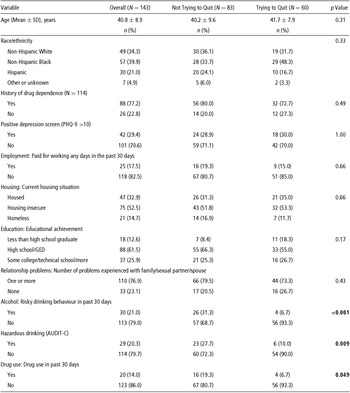
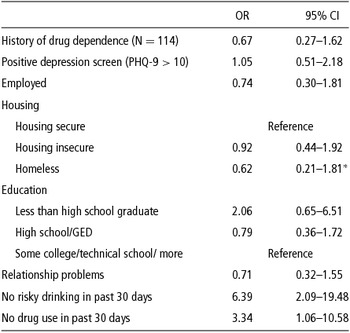
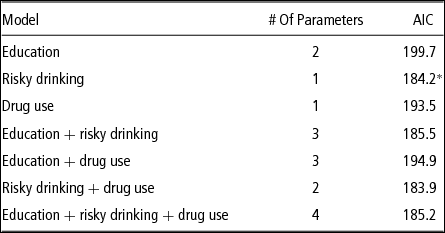
Of all the participants interviewed (n = 200), 72% were smoking in the post-release period. Among the 143 participants in the data analysis (those who had relapsed), the mean ± SD of age was 40.8 ± 8.9 years, the mean ± SD of total lifelong prison/jail/juvenile detention time was 12.3 ± 8.2 years, 74% started smoking within one day of their release, 26% started smoking between two days and 21 days post-release, and 42% (n = 60) were trying to quit smoking. There was no significant difference in age or race/ethnicity between those trying to quit smoking and those not trying to quit smoking. In both the Pearson chi-squared test of association and the single variable logistic regression models, the absence of risky drinking behaviour and the absence of drug use in the last 30 days were significantly associated with trying to quit smoking (See Tables 1 & 2). Other social stressors and risky health behaviour variables were not associated with trying to quit smoking, including history of drug dependence, depression, employment, housing security, educational achievement, and problems with significant others and family. Considering the candidate variables – education, risky drinking behaviour and drug use – the lowest (best) AIC value was found to be the model which included risky drinking behaviour and drug use; however, the model with solely risky drinking had a comparatively low AIC (within two units) and fewer predictors making it a more desirable fit (See Table 3). Thus, the model based solely on risky drinking behaviour best explains the association between trying to quit smoking and social stressors/risky health behaviours. That is, adding ‘drug use in the last 30 days’ as another variable does not strengthen the association with trying to quit smoking significantly.
Descriptive characteristics of participants overall and by whether participant was trying to quit smoking

Unadjusted associations for each factor with trying to quit smoking, using single variable logistic regression models

* Degree of freedom = 2.
AIC values for combinations of candidates for final regression model of factors associated with trying to quit smoking

* Lowest AIC calculated.
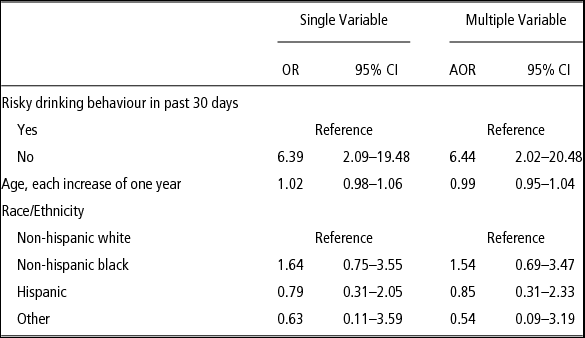
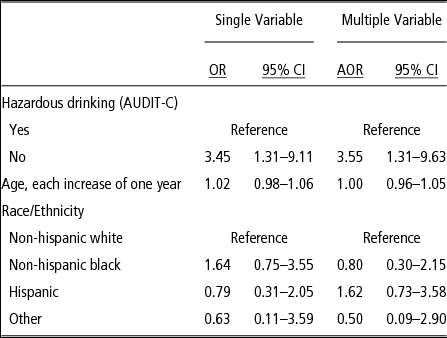
Following a variable selection process for demographic variables, age and race/ethnicity were not significant covariates. The existing relationship in the significant model (OR (95% CI) for risky drinking behaviour: 6.39 (2.09–19.48)), however, was largely unaffected when adding age and race/ethnicity (6.44 (2.02–20.48)). Therefore, we decided to present the model adjusting for age and race/ethnicity, although non-significant, in Table 4 to assess the independent association(s) between risk factor(s) and trying to quit smoking (See Table 4). People recently released from prison who had not engaged in risky drinking behaviour had greater adjusted odds of trying to quit smoking compared to those who had engaged in risky drinking behaviour. Table 5 shows the supplemental analysis using the AUDIT-C, which screens for “hazardous drinking” instead of “risky drinking behavior,” as a factor associated with trying to quit smoking.
Association between risky drinking behaviour with trying to quit smoking using a single and a multivariable logistic regression model adjusting for age and race/ethnicity

Analysis of association between hazardous drinking (AUDIT-C) and trying to quit smoking using a single and a multivariable logistic regression model adjusting for age and race/ethnicity

Of the 30 participants engaging in risky drinking and the 20 participants with recent drug use, nine had engaged in both activities in the past 30 days. Of the 60 individuals trying to quit smoking, 92.9% had no drug use or risky drinking in the past 30 days.
Discussion
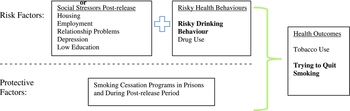
In this study, we found that risky drinking behaviour was strongly associated with not trying to quit smoking among people recently released from prison. Forty-two percent of the participants reported that they were trying to quit smoking, which is slightly less than the proportion found in other studies; however, much of that research focused on people in prison rather than people who were recently released from prison (Cropsey et al., Reference Cropsey, Eldridge and Ladner2004; Cropsey et al., Reference Cropsey, Jones-Whaley, Jackson and Hale2010; Kauffman et al., Reference Kauffman, Ferketich, Murray, Bellair and Wewers2011). In unadjusted analyses a model containing both risky drinking behaviour and recent drug use was significantly associated with trying to quit smoking; further analysis (via AIC), however, revealed that the model containing only the variable ‘risky drinking behaviour in the past 30 days’ was the best fitting model. Although risky drinking behaviour has been associated with tobacco use, its association with not trying to quit smoking in the post-release period is a novel finding (Kim, Reference Kim2014; Leeman et al., Reference Leeman, McKee, Toll, Krishnan-Sarin, Cooney and Makuch2008; Matthews et al., Reference Matthews, Riley, Everett, Hughes, Aranda and Johnson2014). This finding suggests that providers and transitional experts must consider the role that risky drinking behaviour plays when considering effective tobacco cessation strategies in people recently released from prison. (See Figure 1)
The model for tobacco use & cessation among people recently released from prison.

We did not find associations between trying to quit smoking and several variables previously identified in the literature. Higher educational achievement and employment may lose their empowering effect on tobacco cessation in individuals during the post-release period. The evidence linking housing status with smoking behaviours is largely based on chronically homeless individuals, which may not accurately reflect the transitional housing insecurity experienced by people recently released from prison (Baggett & Rigotti, Reference Baggett and Rigotti2010; Baggett et al., Reference Baggett, Lebrun-Harris and Rigotti2013; Tsai & Rosenheck, Reference Tsai and Rosenheck2012). General relational problems in the post-release period may not be as important as the specific smoking behaviours of friends and family members. Finally, depressive symptoms in the transitional period may reflect emotional disturbances caused by adjustment rather than a strict biological manifestation of major depressive disorder, whose relationship with tobacco has been studied in greater detail.
A movement toward tobacco-free prisons, which commenced in 2004 with a Federal Bureau of Prisons policy requiring that all 105 federal prisons become tobacco-free, had the potential to alleviate the harmful effects of second-hand smoke and to curb the prevalence of smoking among people who have been in prison. Research has repeatedly demonstrated that smoking cessation due to tobacco-free prison policy is not the same as voluntary smoking cessation (Cropsey et al., Reference Cropsey, Eldridge, Weaver, Villalobos, Stitzer and Best2008; Lincoln et al., Reference Lincoln, Tuthill, Roberts, Kennedy, Hammett and Langmore-Avila2009; U.S. Department of Justice, 2004). In our study, almost all participants who smoked prior to prison resumed smoking within a few days of release from prison. Thus, it is unlikely that tobacco restrictions will result in long-term smoking cessation. Before disregarding their utility, however, tobacco restrictions in prisons are associated with a 9% reduction in smoking related deaths and bans in place for greater than 9 years are associated with reductions in cancer mortality (Binswanger et al., Reference Binswanger, Carson, Krueger, Mueller, Steiner and Sabol2014).
The time under correctional supervision, whether in prison or on parole/probation, provides easy access to a vulnerable population that could benefit from health promotion and prevention messages and interventions (Cropsey, Binswanger, Clark, & Taxman, Reference Cropsey, Binswanger, Clark and Taxman2012). The National Commission on Correctional Health Care reinforces this message by recommending that all people in prison have access to tobacco-free environments and smoking cessation materials and programs (National Commission on Correctional Health Care, 2002). While most prison systems with an indoor tobacco ban (86%) reported having tobacco cessation programs, few of those with total bans (39%) continued such programs after the initial transition to prison. Such practices fall short on maximizing long-term smoking cessation, resulting in a missed public health opportunity and higher health care costs in both the public and private sectors (Kauffman et al., Reference Kauffman, Ferketich, Murray, Bellair and Wewers2011; Kauffman, Ferketich, & Wewers, Reference Kauffman, Ferketich and Wewers2008).
An effective approach to reduce tobacco use among people who have been in prison includes in-prison tobacco control policies with effective smoking cessation interventions, both during and after incarceration (Awofeso, Reference Awofeso2005; Kauffman et al., Reference Kauffman, Ferketich, Murray, Bellair and Wewers2011; Lincoln, Chavez, & Langmore-Avila, Reference Lincoln, Chavez and Langmore-Avila2005; Thibodeau et al., Reference Thibodeau, Jorenby, Seal, Kim and Sosman2010). Tobacco counselling, peer-support groups, and peer counselling services are effective adjuncts (Cork, Reference Cork2012). One successful intervention in a tobacco-free prison based on motivational interviewing and cognitive behavioural therapy beginning 8 weeks prior to release resulted in a 25% abstinence rate at 3 weeks post-release, which was 6.6 times higher than those not receiving the intervention (Clarke et al., Reference Clarke, Martin, Stein, Lopes, Mello and Friedmann2011; Reference Clarke, Stein, Martin, Martin, Parker and Lopes2013). Pre-release planning should include information about how to avoid common triggers that lead to relapse, tobacco cessation materials, referrals to community health services for tobacco counselling and pharmacotherapy, and Quitline information (Break Free Alliance, 2012; Thibodeau et al., Reference Thibodeau, Jorenby, Seal, Kim and Sosman2010). Furthermore, these resources should be expanded to correctional staff, a large percentage of whom are also nicotine-dependent (Cork, Reference Cork2012).
Smoking cessation services offer a cost-effective strategy for reducing smoking prevalence. A study published in 2010 revealed that in the general population, for every dollar a state spends on smoking cessation treatments, it saves an average of $1.26 – a 26% return on investment (Penn State University, 2010). An effort to curb smoking in a high prevalence population, such as people recently released from prison, could yield more impressive cost-savings. The Department of Corrections, Medicaid, Medicare, and private insurance companies would all share in the benefits of cost-savings.
Limitations
This study had several limitations. We cannot assume causality with this cross-sectional study design; i.e., we do not know if risky drinking behaviour prevented people from trying to quit smoking or if individuals who were trying to quit smoking were simply less likely to engage in risky drinking behaviour. The study was conducted in Denver, Colorado, an urban environment, which may not be representative of other areas in the USA. The participants may not be reflective of all people who have been in prison. Due to fear of criminal repercussions, participants may not have accurately answered some questions (e.g. drug use). The sample is small for multivariate analysis and may be underpowered, explaining some of our non-significant results. Finally, because this study is a secondary analysis of data collected to measure HIV risk factors, it was not designed specifically to examine smoking as the primary outcome.
Conclusion
Smoking is common among and has a harmful impact on people in prison and recently released from prison. Although tobacco restrictions in prisons have significant benefits, such as reducing in-prison mortality, they are not an effective strategy for long-term smoking cessation. Nearly all prisoners relapse on release. Despite this, many attempt to quit smoking. Those attempting to quit are also those who are not engaging in risky alcohol use. Leaders designing strategies to reduce tobacco use in people recently released from prison must focus on the interaction between trying to quit smoking and risky drinking behaviour. Further research should focus on (1) the relative efficacy of various smoking cessation services and when those services are best offered to people in prison and people recently released from prison, (2) the benefit of integrating smoking cessation, alcohol use, and drug use counselling and services in the post-release period, and (3) understanding who is likely to engage in risky behaviours and why.
Acknowledgements
We wish to acknowledge the Colorado Department of Corrections and the Re-entry Center for their assistance in the recruitment for this study. We also appreciate the contributions of Dr Lillian Gelberg, who assisted with the initial conception of the study. Results from this study were presented on a research poster at the Society of General Internal Medicine (SGIM) Mountain West Meeting in Denver, CO, on 10 October 2014 and at the SGIM Annual Meeting in Toronto, Canada, on 23 April 2015.
Financial Support
This work was supported by the National Institute on Drug Abuse (Grant Number 1R03DA029448); and the National Institutes of Health/National Center of Research Resources Colorado Clinical and Translational Sciences Institute (Grant Number UL1 TR001082). Contents are the authors’ sole responsibility and do not necessarily represent official National Institutes of Health views.
Conflict of Interest
None.
Ethical Standards
The authors assert that all procedures contributing to this work comply with the ethical standards of the relevant national and institutional committees on human experimentation and with the Helsinki Declaration of 1975, as revised in 2008. The lead author affirms that this manuscript is an honest, accurate, and transparent account of the study being reported; that no important aspects of the study have been omitted; and that any discrepancies from the study as planned have been explained. This study was approved by the Colorado Multiple Institutional Review Board (protocol 10-0220).
Contributions
MRF designed the study. IAB, SRM, DW, and SJM provided guidance and support in the design of the study. IAB wrote the protocol and supervised data collection and analysis. SRM participated in data collection. RB, DW, BB, and SJM participated in data interpretation and analysis. MRF conducted a literature search and drafted the manuscript. MRF is the guarantor.