INTRODUCTION
Innovation can provide competitive advantages, especially under the key conditions of increasing global competition, rapid technological advances, and frequent shifts in customer preference (Chandy & Tellis, Reference Chandy and Tellis1998). More specifically, both radical and incremental innovations, as two fundamental innovation types, are imperative for organizations to survive and prosper in dynamic business environments (Roy & Sarkar, Reference Roy and Sarkar2016). The theories of organizational learning (Huber, Reference Huber1991) and dynamic capability (Teece, Pisano, & Shuen, Reference Teece, Pisano and Shuen1997) have both highlighted the inherent link between learning as input and innovation as output (e.g., Adams, Day, & Dougherty, Reference Adams, Day and Dougherty1998). In particular, exploitation and exploration have been recognized as two core learning modes (input) to enable two core innovation types (output), with exploration more salient for radical innovation in contrast to exploitation more salient for incremental innovation (e.g., Kim & Atuahene-Gima, Reference Kim and Atuahene-Gima2010).
Despite this assumed link between learning (as the input, means, and antecedent) and innovation (as the end, goal, and outcome), the theoretical argument and empirical evidence regarding why and how exploration and exploitation interactively shape innovation outcomes remain ambiguous (see Gupta, Smith, & Shalley, Reference Gupta, Smith and Shalley2006; Lavie, Stettner, & Tushman, Reference Lavie, Stettner and Tushman2010; Zacher, Robinson, & Rosing, Reference Zacher, Robinson and Rosing2016, for reviews). The confusion seems to derive from the paradoxical nature of exploration–exploitation link not only as an inherent tradeoff, but also as a potential synergy (e.g., Levinthal & March, Reference Levinthal and March1993; March, Reference March1991; also see Gupta et al., Reference Gupta, Smith and Shalley2006; Papachroni, Heracleous, & Paroutis, Reference Papachroni, Heracleous and Paroutis2016; Zacher et al., Reference Zacher, Robinson and Rosing2016).
In particular, the extant approaches tend to share an underlying assumption that the basic interaction between exploitation and exploration is linear, either as a negative interaction for conflicting tradeoff so that the two should be fully separated (e.g., Tushman & O'Reilly, Reference Tushman and O'Reilly1996), or a positive interaction for complementary synergy so that the two should be fully integrated (e.g., Cao, Gedajlovic, & Zhang, Reference Cao, Gedajlovic and Zhang2009; Zacher et al., Reference Zacher, Robinson and Rosing2016). However, the more recent advance in paradox research (e.g., Miron-Spektor, Ingram, Keller, Smith, & Lewis, Reference Miron-Spektor, Ingram, Keller, Smith and Lewis2018; Schad, Lewis, Raisch, & Smith, Reference Schad, Lewis, Raisch and Smith2016; also see Hargrave & Van de Ven, Reference Hargrave and Van de Ven2017; Luger, Raisch, & Schimmer, Reference Luger, Raisch and Schimmer2018; Smets, Jarzabkowski, Burke, & Spee, Reference Smets, Jarzabkowski, Burke and Spee2015; van Neerijnen, Tempelaar, & van de Vrande, Reference van Neerijnen, Tempelaar and van de Vrande2021), especially reframed from the meta-perspective of yin-yang balancing (e.g., Li, Reference Li2016, Reference Li, Bednarek, Cunha, Schad and Smith2021), inspires us to take exploration and exploitation as a learning duality, so their inherent interaction could be nonlinear as both partially conflicting and partially complementary (Li, Reference Li2014, Reference Li2016; Schad et al., Reference Schad, Lewis, Raisch and Smith2016). For the best result of exploration–exploitation duality, how to balance the two elements is key to the ‘golden duality’ with the opposite elements becoming ‘a productive partnership’ (Sugarman, Reference Sugarman, Noumair and Shani2014: 142). Despite the above promising theoretical path, no empirical research has been conducted to explain or prescribe how such a balance would work, especially the possibility of an inverted U-shaped interaction between exploration and exploitation under the goal of innovation.
To close the above gap, this study theoretically proposes and empirically tests a unique duality model of exploration–exploitation link for the inverted U-shaped interaction effects of exploration and exploitation on both radical and incremental innovations. Specifically, by using Chinese survey data, we find that the positive link between exploratory learning and radical innovation is the strongest with a mixed interaction of high exploration and moderate exploitation as two learning modes, but that link would be weaker when exploitation is either low (weak) or high (strong); also, the positive link between exploitative learning and incremental innovation is the strongest with a mixed interaction of high exploitation and moderate exploration as two learning modes, but that link would be weaker when exploration is either low (weak) or high (strong).
This study seeks to make three unique contributions to the body of knowledge concerning the exploration–exploitation link, innovation, and paradox. First, we contribute to the research on ambidexterity by reframing the prevailing views as either a positive or negative (linear) interaction between exploration and exploitation into a third possibility about an inverted U-shaped (curvilinear) interaction, echoing the idea of yin-yang balancing mindset (Li, Reference Li2016) and paradox literature (Schad et al., Reference Schad, Lewis, Raisch and Smith2016; Smith & Lewis, Reference Smith and Lewis2011). By testing the nonlinear effects of exploitation–exploration links on both radical and incremental innovations, this study provides a richer and deeper view concerning the novel effect of exploration–exploitation link as partially conflicting and partially complementary (Li, Reference Li2016). More specifically, this study helps reconcile the mixed findings by shedding a new light on the enduring puzzle of ambidexterity (e.g., Lavie et al., Reference Lavie, Stettner and Tushman2010; Miron-Spektor et al., Reference Miron-Spektor, Ingram, Keller, Smith and Lewis2018), thus extending the theoretical view of Li (Reference Li2016) with detailed explanations about how exploration and exploitation interactively play both primary and subordinate roles in two different scenarios: radical and incremental innovations. In other words, adopting the meta-perspective of yin-yang balancing (Li, Reference Li, Bednarek, Cunha, Schad and Smith2021), our novel approach provides an alternative view about the hidden nature of exploration–exploitation ambidexterity for the two distinctive goals of radical or incremental innovations.
Second, we advance innovation research by framing the exploration–exploitation duality as a salient antecedent to innovation, extending the theoretical reasoning of Li (Reference Li2016) and responding to the call of Lauritzen and Karafyllia (Reference Lauritzen and Karafyllia2019) for innovation scholars to embrace more paradoxical thinking beyond their suggestion concerning differentiation-integration integration. Specifically, our study specifies a unique nonlinear approach to balancing exploratory and exploitative learning for both radical and incremental innovations. While Li (Reference Li2016) inspired us about how exploration and exploitation may interact in asymmetrical and curvilinear ways, our study offers detailed elaborations in terms of underlying mechanisms for exploration and exploitation to interact in an inverted U-shaped pattern, as well as the concrete evidence with a large sample and a bunch of robust analyses. This is a novel approach to managing innovation via the ambidextrous links between exploitation and exploration as the input or means of learning for different innovations as the output or ends of learning modes.
Finally, this study enriches the current paradox research by demonstrating that any paradox can be better managed as a duality in terms of reframing the paradoxical elements as partially complementary and partially conflicting in an inverted U-shaped pattern of interaction, where both positive and negative effects of paradoxical ambidexterity can be better explained and managed by the novel mechanisms of partial separation and partial integration in contrast to full separation and/or full integration (Li, Reference Li2016; Smets et al., Reference Smets, Jarzabkowski, Burke and Spee2015). In particular, this duality model sheds unique light on the challenge of ‘maintaining an appropriate balance’ between paradoxical elements as ‘a primary factor in system survival and prosperity’ (March, Reference March1991: 71), even though ‘the precise mix’ as ‘optimal is hard to specify’ (Levinthal & March, Reference Levinthal and March1993: 105). This is highly consistent with the emerging trend of reframing paradox as a special balancing between opposite elements (Li, Reference Li2016; Schad et al., Reference Schad, Lewis, Raisch and Smith2016), rooted in the meta-perspective of yin-yang balancing (Li, Reference Li, Bednarek, Cunha, Schad and Smith2021).
THEORETICAL BACKGROUND AND HYPOTHESES DEVELOPMENT
The Lingering Debate: Exploration–Exploitation Link as Tradeoff or Synergy
As a multi-dimensional concept, organizational learning is analyzed on the dimension of learning mode in terms of exploration and exploitation (March, Reference March1991). Exploration indicates the learning mode of discovering and developing novel knowledge; in contrast, exploitation refers to the learning mode of refining and reusing the existing knowledge (Atuahene-Gima, Reference Atuahene-Gima2005; Cao et al., Reference Cao, Gedajlovic and Zhang2009). Hence, the essence of exploration is path-breaking experimentation with new options, closely related to distant search, and the essence of exploitation is path-dependent enhancement of existing options, closely related to local search (Lavie et al., Reference Lavie, Stettner and Tushman2010).
In the research streams on organizational learning and ambidexterity (e.g., Cunha, Bednarek, & Smith, Reference Cunha, Bednarek and Smith2019; Luger et al., Reference Luger, Raisch and Schimmer2018; March, Reference March1991; Raisch, Birkinshaw, Probst, & Tushman, Reference Raisch, Birkinshaw, Probst and Tushman2009), the fundamental consensus is that exploration and exploitation are paradoxical or duality-based in nature in terms of ‘persistent contradictions between interdependent elements’ (Schad et al., Reference Schad, Lewis, Raisch and Smith2016: 10). Scholars have adopted various approaches to explaining and managing the exploration–exploitation paradox or duality, which involve either separating (i.e., structurally or temporarily) or integrating (e.g., the contextual approach for synergy) (Gibson & Birkinshaw, Reference Gibson and Birkinshaw2004; Lavie et al., Reference Lavie, Stettner and Tushman2010; Raisch et al., Reference Raisch, Birkinshaw, Probst and Tushman2009; Smith & Lewis, Reference Smith and Lewis2011).
The early approaches to the paradox of exploration–exploitation prioritize separation (structurally in different spaces or domains or temporally at different times), thus neglecting the need for integrating exploration and exploitation in the same space and at the same time (Raisch et al., Reference Raisch, Birkinshaw, Probst and Tushman2009). The later approaches adopt the contextual and other views to highlight integration, thus downplaying the need for separation (e.g., Gibson & Birkinshaw, Reference Gibson and Birkinshaw2004). Hence, there is a conspicuous absence of any balanced approach that embraces both separation and integration (Li, Reference Li2016). The tension inherent in the learning paradox has caused lingering debates concerning the exploration–exploitation link (e.g., Gupta et al., Reference Gupta, Smith and Shalley2006; Lavie et al., Reference Lavie, Stettner and Tushman2010). One of the controversial issues is about how to explain the paradoxical link between exploitation and exploration in terms of their interdependent effect.
There are two key reasons to reflect a potentially negative interaction (i.e., inherent tradeoff) between exploration and exploitation. One is their direct competition for limited resources in terms of financial investment, human resource, and managerial attention allocated to different modes (we may call it resource-competition effect). Another is the driving-out effect, which derives from the habitual inertia or trap of over-reliance on one mode at the expense of the other, especially the tendency in favor of exploitation as learning myopia (Levinthal & March, Reference Levinthal and March1993), and also the severe incompatibility between different mindsets and routines needed for these two learning modes (Greve, Reference Greve2007; March, Reference March1991). This effect, which Leonard-Barton (Reference Leonard-Barton1992) referred to as capability rigidity, highlights the danger that favoring exploitation at the expense of exploration can make firms incapable of effectively leveraging external changes (Christensen, McDonald, Altman, & Palmer, Reference Christensen, McDonald, Altman and Palmer2017). To minimize capability rigidity, an interaction between exploration and exploitation is necessary as a special form of complementarity for the purpose of counter-balancing the driving-out effect.
In contrast, there are also sound reasons for a potentially positive interaction (i.e., synergy) between exploration and exploitation. One is the spillover effect that exploration could create new knowledge that a firm can exploit both currently and in the future; exploitation could also produce knowledge to support exploration both currently and in the future (Lavie et al., Reference Lavie, Stettner and Tushman2010). Another is the resource-complementarity effect, which highlights an interaction effect between exploration and exploitation to enhance firm performance as it provides a potential to leverage complementary knowledge and other shared resources (Cao et al., Reference Cao, Gedajlovic and Zhang2009). The related evidence shows that exposing to both familiar (related to exploitation) and new (related to exploration) designs leads to the most novel solutions (e.g., Berg, Reference Berg2016).
Related to the positive and negative theoretical assumptions (see Appendix I for a summary), the empirical studies have also reported mixed findings. While some scholars found positive effect (e.g., Berg, Reference Berg2016; Cao et al., Reference Cao, Gedajlovic and Zhang2009; Chu, Li, & Lin, Reference Chu, Li and Lin2011; Katila & Ahuja, Reference Katila and Ahuja2002), others had a negative effect (e.g., Atuahene-Gima & Murray, Reference Atuahene-Gima and Murray2007; Siren, Kohtamäki, & Kuckertz, Reference Sirén, Kohtamäki and Kuckertz2012; See Appendix II for a summary). Reflecting above-mentioned complexity, the extant ambidexterity research elucidates at least six distinctive views to link and manage the two learning modes. The first view (i.e., structural ambidexterity) assigns the two learning modes to structurally separated units within the firm and integrated them by top management teams (TMTs) (e.g., Tushman, Smith, Wood, Westerman, & O'Reilly, Reference Tushman, Smith, Wood, Westerman and O'Reilly2010). The second view (i.e., temporal ambidexterity) assigns the two learning modes to two different stages engaged by a firm and sequentially adjusted by TMTs (e.g., Siggelkow & Levinthal, Reference Siggelkow and Levinthal2003). The third view (i.e., domain ambidexterity) suggests that firms can fully separate exploration from exploitation across different units within a firm, or different firms as alliance partners (Lavie & Rosenkopf, Reference Lavie and Rosenkopf2006). Collectively, these three views focus on a shared mechanism of full ‘separation’ between exploration and exploitation in sub-domains, either in different units of a single firm or in diverse firms, so as to avoid their negative interaction as a conflicting tradeoff.
The fourth (i.e., contextual ambidexterity) and fifth (i.e., leadership ambidexterity) views share a similar assumption that exploration and exploration can be simultaneously integrated by providing a supportive context characterized by stretch, discipline, support, and trust (Gibson & Birkinshaw, Reference Gibson and Birkinshaw2004) or by adopting supportive leaderships (Jansen, Kostopoulos, Mihalache, & Papalexandris, Reference Jansen, Kostopoulos, Mihalache and Papalexandris2016). The final view (i.e., resource ambidexterity) shows a potential to take exploration and exploitation as two complementary resources (He & Wong, Reference He and Wong2004). Collectively, the last three views focus on a shared mechanism of ‘integration’ of exploration and exploitation in a single firm so as to leverage their maximum positive interaction as complementary synergy.
In sum, a shared inadequacy among all the above views is that, while they acknowledge either tradeoff or synergy, they implicitly assume exploitation–exploration interaction as linear due to their focus on either separation or integration between paradoxical elements. Hence, all above-mentioned views neglect the third possibility with a curvilinear link between exploration and exploitation (see Appendix I and II for more details) in the same space and at the same time. This possibility implies that the two learning modes can result in both partial tradeoff and partial synergy in a nonlinear pattern. To effectively explain this third possibility, a novel lens is required to embrace and appreciate paradox (Li, Reference Li2014; Schad et al., Reference Schad, Lewis, Raisch and Smith2016; Smith & Lewis, Reference Smith and Lewis2011), especially by reframing paradox into duality as both partial conflicting (for partial tradeoff) and partially complementary (for partial synergy) (Li, Reference Li2014, Reference Li, Bednarek, Cunha, Schad and Smith2021).
A Novel Duality−Model Rooted in the Yin-Yang Balancing
The extant paradox theory (Miron-Spektor et al., Reference Miron-Spektor, Ingram, Keller, Smith and Lewis2018; Putnam, Fairhurst, & Banghart, Reference Putnam, Fairhurst and Banghart2016; Schad et al., Reference Schad, Lewis, Raisch and Smith2016; Smith & Lewis, Reference Smith and Lewis2011) provides a useful lens to help explain the synergistic potential for coping with persistent tensions. At the core of a meta-theory, paradox refers to ‘persistent contradiction between interdependent elements’ (Schad et al., Reference Schad, Lewis, Raisch and Smith2016: 10). Paradox can be framed in various ways, such as dialectical synthesis (Harvey, Reference Harvey2014), negative and positive feedback cycles (Stacey, Reference Stacey1995), an oscillation between opposite poles (Ashforth & Reingen, Reference Ashforth and Reingen2014), and dynamic equilibrium (Smith & Lewis, Reference Smith and Lewis2011). The paradox approach was introduced to the field of management by Cameron and Quinn (Reference Cameron and Quinn1988) as a special mindset to manage the inherent organizational complexity, and it has been gaining increasing attention in recent years toward a meta-theory (Schad et al., Reference Schad, Lewis, Raisch and Smith2016). This paradox viewpoint echoes with the Eastern mindset of yin-yang balancing.
Adopting the unique approach of yin-yang balancing, we treat the issue of ambidexterity as combining both separation and integration in the same space and at the same time, which can be done by framing separation and integration not as mutually exclusive to the full extent, but only to a partial extent in terms of a holistic and dynamic balance. In other words, as shown in the yin-yang symbol (Smith & Lewis, Reference Smith and Lewis2011), the black and white components are distinct from one another, but one being inside of the other with a partial overlap (Li, Reference Li2014, Reference Li2016), thus impossible to fully separate as completely contradictory due to the inherent nature of paradox as a holistic entity (Cunha et al., Reference Cunha, Bednarek and Smith2019; Farjoun & Fiss, Reference Farjoun and Fiss2022).
Further, the meta-perspective of yin-yang balancing is potent for exploring complex and ambiguous phenomena in need for an appreciation of paradox beyond a simple tolerance. This meta-perspective has three core operating mechanisms (Li, Reference Li2014, Reference Li2016). First, after the partial separation of opposites at the macro-system level, the interdependence and interpenetration of opposites require one opposite element to play the dominant role in one spatial area or at one temporal stage as the micro-unit, while the other opposite element must play the subordinate role in the same micro-unit, which is called asymmetrical balancing. Second, the interaction and inter-transformation of opposites trigger a dynamic shift in the relative status of opposites from one asymmetrical balance to another through a threshold as the inflection or tipping-off point, which is called transitional balancing. Third, the subordinate opposite will complement the dominant opposite in an inverted U-curved pattern: it is the least complementary when it is at a low level, but it is the most conflicting when it is at a high level; in contrast, it is the most complementary (for synergy) and the least conflicting (for tradeoff) when it is at a moderate level, which is called curvilinear balancing. Put it differently, the asymmetry between the dominant and subordinate opposites should be neither too small (the most conflicting), nor too large (the least complementary), thus a moderate level of asymmetry is the most effective when the dominant is moderately high and the subordinate is moderately low (Li, Reference Li2016, Reference Li, Bednarek, Cunha, Schad and Smith2021).
We posit that the yin-yang balancing approach to paradox can help move beyond either ‘separation’ or ‘integration’ approach toward the complex interaction between exploration and exploitation for tradeoff and synergy in the same area and at the same time. Coping with the inherent tension between exploration and exploitation calls for the new lens to help reframe their link as a duality, thus not only recognizing their apparent tradeoff but also considering their potential synergy simultaneously (Miron-Spektor et al., Reference Miron-Spektor, Ingram, Keller, Smith and Lewis2018). Further, the new lens can help explain that successfully accommodating contradictory demands could lead to an enhanced sustainability by enabling learning and creativity, fostering flexibility and resilience, and unleashing human potential by incorporating both tradeoff and synergy (Smith & Lewis, Reference Smith and Lewis2011). In fact, there is often a healthy tension at the core of any creative process, so innovations tend to emerge from actively engaging with, rather than escape from, such tensions. This is consistent with the original argument that ‘learning makes negative as well as positive contributions to competitive position’ so that ‘the precise mix of exploitation and exploration that is optimal is hard to specify’ (Levinthal & March, Reference Levinthal and March1993: 105).
Further, by reframing paradox into duality according to the meta-perspective of yin-yang balancing, we embrace the third possibility of balancing opposite elements as various mixes within a spectrum, rather than categorical poles, thus offering the novel mechanisms of partial separation and partial integration in contrast to full separation and full integration (Li, Reference Li2014, Reference Li2016; Smets et al., Reference Smets, Jarzabkowski, Burke and Spee2015). The defining nature of paradox requires opposite elements to be both conflicting and complementary, so partial separation (for partial tradeoff) and partial integration (for partial synergy) seem to be the most promising mechanisms.
This duality has two unique values. First, it can cover both tradeoff and synergy simultaneously to meet the paradoxical requirements by the original model of exploration–exploitation balance offered by March (Reference March1991). Second, it can enhance the original model by incorporating resource complementarity as a new form of synergy. This is consistent with the recommended approach to balancing heterogeneity with homogeneity to a moderate extent at organizational (e.g., a mix of slow and fast learners with a balance between socialization and turnover, March, Reference March1991) and inter-firm levels (e.g., a mix of strong and weak ties in an inter-firm network, Uzzi, Reference Uzzi1997).
In sum, the yin-yang balancing approach to paradox posits that exploration and exploitation can and should be balanced simultaneously in an interactive pattern, especially reframed as a duality for partial tradeoff and partial synergy via the mechanisms of partial separation and partial integration. Different from the prior linear mindset to perceive the interplay between exploration and exploitation as either positive or negative (e.g., Benner & Tushman, Reference Benner and Tushman2003; Katila & Ahuja, Reference Katila and Ahuja2002), the yin-yang reframing from paradox to duality has the potential to explain their curvilinear interaction. In the next session, we develop two specific hypotheses for the inverted U-shaped effects of exploration–exploitation interaction on the two typical forms of innovation, that is, radical and incremental innovations.
Let us introduce a Chinese firm's example about how it may leverage the notion of yin-yang balance thinking to accelerate its new product innovation. When Tencent tried to create the innovative WeChat product in 2011, some notion of yin-yang balancing thinking emerged. First, at that time, Tencent decided to speed up its development of WeChat, after the rival firm – Xiaomi pioneered a similar app called Mi-Chat. To do this, Tencent spurred three different business units to simultaneously compete (in order to achieve exploration) and cooperate (in order to transfer the know-how as a quick way of exploitation) for developing rival products in the IM category, and then allowed the market to single out the winner (Murmann & Zhu, Reference Murmann and Zhu2021). That is, within each developing teams, exploration and exploitation are performed simultaneously and complementarily to accelerate the innovation (note that since the main goal is radical innovation, exploration is the leading force). After realizing the possible potential of WeChat prototype, the top executives of Tencent immediately poured the needed resources toward the WeChat project, including valuable knowledge from all parallel R&D teams to support the project in a cooperative manner. Founder Pony Ma once reflected, ‘In the history of Tencent's development, several major product innovations that determined its fate, such as Qzone and WeChat, came from independent breakthroughs at the middle and grassroots levels, especially the horse-racing mechanism formed within Tencent’. This is consistent with our hypothesis that exploitative learning should play a subordinate role to complement the force of exploration.
Second, the routine and managerial philosophy of exploitation and exploration as yin-yang duality in product development is welcomed in the firm. For instance, besides appropriating the value of existing products (as exploitative purposes), Tencent has always granted business units (and developing teams) significant autonomy and resources to develop new products, even if the new products were beyond their duties (as exploratory purposes). This is the main reason why the WeChat team, though responsible for email products rather than instant-messaging apps, was allowed and encouraged to develop WeChat (which looks more like a next instant-messaging app instead of an email app). Pony Ma, Tencent's Chairman, specifically highlighted two principles in his innovation philosophy: redundancy emphasizes competition between parallel teams, while collaboration emphasizes cross-team cooperation. In our framing, redundancy highlights exploratory learning as strong at the early stage as reflected by parallel competition, while collaboration highlights the interplay between exploratory and exploitative learning at the later stage as reflected by cross-team collaboration.
Third, because the parallel development mode is bound to spend more organizational resources, thus the cost of redundancy in terms of the waste of resources, Tencent's top decision-makers will weigh the pros and cons with a general rule: if the R&D target is incremental innovation, which has a high predictability and controllability, a firm will reduce the use of parallel development mode so as to concentrate resources in a single team toward exploitation, supplemented by a limited amount of exploratory learning. In contrast, when the R&D target is radical innovation like WeChat, the parallel development mode will be more adopted, and multiple R&D teams will simultaneously compete (as a way of exploration) and cooperate (as exploitation in terms of sharing the existing know-how).
Exploration–Exploitation Interaction for Radical Innovation
The extant literature reveals two primary ways to view the link between learning mode (i.e., exploration and exploitation) and innovation type (i.e., radical and incremental innovations). The first way assumes an independent or separated effect of learning mode on innovation type to the extent that exploration is solely related to radical innovation, while exploitation is only associated with incremental innovation (Atuahene-Gima, Reference Atuahene-Gima2005). The second way assumes an interaction effect of learning modes on innovation type to the extent that such an effect is linear, either positive or negative (e.g., Berg, Reference Berg2016; Cao et al., Reference Cao, Gedajlovic and Zhang2009; Chu et al., Reference Chu, Li and Lin2011; Katila & Ahuja, Reference Katila and Ahuja2002). Distinctive from the above two prevailing ways, we propose a third way by reframing paradox into duality to shed new light on the lingering debates over ambidexterity.
Specifically, in line with the yin-yang balancing approach to paradox (i.e., the duality lens), especially the salient mechanism of curvilinear balancing, we propose that exploration will play a dominant role in the overall process of radical innovation, but this dominant role must be supplemented by the supporting role of exploitation up to a threshold in a nonlinear pattern as the yin-yang balancing view suggested. In other words, the main effect of exploration on radical innovation is expected to be the strongest when exploitation is at a moderate level, but such a link will be weaker when exploitation is at a low or high level.
Our argument is built upon a set of reasons. First, by default, radical innovation requires path-breaking learning to creatively destruct the existing paradigm by substituting it with a new paradigm or new direction (Zhou & Li, Reference Zhou and Li2012). Some empirical studies support the argument that exploration contributes positively to radical innovation (e.g., Atuahene-Gima, Reference Atuahene-Gima2005). As suggested by the meta-perspective of yin-yang balancing, however, it is insufficient to focus on the role of exploration alone, thus necessary to take the role of exploitation as a supportive force to complement the main role of exploration into consideration for radical innovation. In other words, it will provide a more holistic picture if we combine and integrate exploration with exploitation for their asymmetric interaction effect on radical innovation. Specifically, the knowledge-based view suggests that novel innovations tend to emerge from a critical process of knowledge recombination involving both exploratory and exploitative learning (Quintane, Casselman, Reiche, & Nylund, Reference Quintane, Casselman, Reiche and Nylund2011). Further, the effects of knowledge spillover, resource complementarity, and counterbalance mentioned above all imply the value of exploitation in support of exploration for radical innovation.
Second, when exploitation is too low or weak, a proper balance between exploration and exploitation as partially complementary for synergy cannot be achieved. Exploration without support from exploitation at a sufficient level cannot maximize its contribution to radical innovation. Specifically, radical experimentations without their follow-up refinements tend to reduce the overall effectiveness due to the decreasing reliability (Smith & Tracey, Reference Smith and Tracey2016), and possible information overload (Martin & Mitchell, Reference Martin and Mitchell1998). Further, weak exploitation may result in a lack of necessary base or pool for successful knowledge recombination (Amabile, Reference Amabile1996), and also a lack of absorptive capacity for leveraging both new and old knowledge into radical innovation (Cohen & Levinthal, Reference Cohen and Levinthal1990; Seo, Chae, & Lee, Reference Seo, Chae and Lee2015). Moreover, relying solely on the exploration teams may lead to more parallel exploration without sufficient focus and follow-up improvements. In short, when exploitation is too low or weak to support exploration, the main effect of exploration on radical innovation will be constrained.
Third, when exploitation is too high or strong, proper balance between exploration and exploitation as partially complementary for synergy cannot be achieved. When exploration and exploitation are both strong in a mix, the risk of driving-out effect will increase dramatically since strong exploitation tends to reverse its supporting or subordinate role into a competing or dominant role, thus difficult to integrate the two learning modes for any task in a coordinated manner. Such driving-out effects are found by Atuahene-Gima and Murray (Reference Atuahene-Gima and Murray2007). In this case, managers must directly face the escalating resource-competition problem not only in terms of physical or financial resources but also in terms of managerial attention (Lavie et al., Reference Lavie, Stettner and Tushman2010; March, Reference March1991). Further, the short-term gains of quick return and low risk associated with exploitation will gradually induce managers to reduce the synchronous devotion to exploration (Christensen et al., Reference Christensen, McDonald, Altman and Palmer2017) as learning myopia (Levinthal & March, Reference Levinthal and March1993), which will eventually result in a decline in radical innovation. Christensen and Bower (Reference Christensen and Bower1996) also advocated that beyond a certain point, exploitation will hinder the positive effect of exploration for radical innovation performance.
Only when exploitation is at a moderate level, the best balance between exploration and exploitation can be achieved as a healthy tension (Li, Reference Li2016) as yin-yang balancing mindset advocated such curvilinear and asymmetric interaction. Such a balance will have the benefit of creating novel knowledge for radical knowledge recombination (Miron-Spektor et al., Reference Miron-Spektor, Ingram, Keller, Smith and Lewis2018) without the unnecessary risk of competing for limited resources. When exploration and exploitation interact in such an asymmetrical manner in the same space and at the same time, the potential for exploitation to support and complement exploration will be realized to enable radical innovation by ensuring a smooth process of developing new ideas first and then leveraging them into radical innovation, while the risk of exploitation as a competing force to substitute exploration can be minimized within a controllable range. In addition, complementary exploitation can assist firms in evaluating distant knowledge and therefore in reducing the possibility of costly wrong paths when they explore in new fields. Consequently, we develop our first hypothesis about the inverted U-shaped interaction effect on radical innovation as follows (see Figure 1a for a specific illustration):
Hypothesis 1: The positive relationship between exploration and radical innovation is strongest when exploitation is at a moderate level, but this link is weaker when exploitation is at a low or high level.
(a) The illustration of Hypothesis 1 (Exploitation as the moderator) (b) The illustration of Hypothesis 2 (Exploration as the moderator)

Exploration–Exploitation Interaction for Incremental Innovation
Similarly, in line with the yin-yang balancing approach to paradox, especially the salient mechanism of curvilinear balancing, we propose that exploitation will play a dominant role in the overall process of incremental innovation, but this dominant role must be supplemented by the supporting role of exploration up to a threshold in a nonlinear pattern as the yin-yang balancing view suggested. In other words, the main effect of exploitation on incremental innovation is expected to be the strongest when exploration is at a moderate level, but such a link will be weaker when exploration is at a low or high level.
Our argument is again built upon a set of reasons. First, by default, exploitation requires path-dependent learning to refine and strengthen the existing paradigm by supplementing it with an efficient application and further development of the existing knowledge base (Raisch et al., Reference Raisch, Birkinshaw, Probst and Tushman2009). Several studies have found the direct evidence that exploitation can contribute to incremental innovation (e.g., Atuahene-Gima, Reference Atuahene-Gima2005). As suggested by the meta-perspective of yin-yang balancing, however, it is insufficient to focus on the role of exploitation alone, thus necessary to take the role of exploration into consideration for incremental innovation. In other words, it will provide a more holistic picture if we combine and integrate exploitation with exploration for their interaction effect on incremental innovation. Specifically, incremental innovation is not only in need for an improvement in the existing knowledge base (Piao and Zajac, Reference Piao and Zajac2016), but also in need for the new knowledge from exploration (Baskarada and Watson, Reference Baskarada and Watson2017). Adding novel knowledge elements from exploration to the existent knowledge bases often provides new possibilities for knowledge combining in a novel way (Brockman & Morgan, 2003). Further, all the effects of knowledge spillover, resource-complementarity, and counterbalance as mentioned before implying the value of exploration in support of exploitation for incremental innovation.
Second, informed by the notion of yin-yang balancing, when exploration is too low or weak, the proper balance between exploitation and exploration as partially complementary for synergy cannot be achieved. Exploitation without the support from exploration at a sufficient level cannot maximize its direct contribution to incremental innovation. Specifically, refinements without the help from breakthroughs tend to exhaust the potential for continuous improvement on a sustainable basis (Katila & Ahuja, Reference Katila and Ahuja2002; Piao & Zajac, Reference Piao and Zajac2016), since there is a natural limit to the number of new combinations that can be created by using the same set of knowledge element from exploitation (Katila & Ahuja, Reference Katila and Ahuja2002), so exploration at a sufficient level is necessary to support the dominant role of exploitation for the goal of incremental innovation. That is there is a high risk that relying solely on exploitation may lead to improvement instead of incremental innovation. In short, when exploration is too low or weak to support exploitation, the main effect of exploitation on incremental innovation will be naturally constrained.
Third, when exploration is too high or strong, a proper balance between exploitation and exploration as partially complementary for synergy cannot be achieved. When exploitation and exploration are both strong in a mix, the risk of driving-out effect will increase dramatically since strong exploration tends to reverse its supporting or subordinate role into a competing or dominant role, thus difficult to integrate the two learning modes for any task in a coordinated manner. In this case, managers must face the escalating resource-competition problem not only in terms of physical or financial resources but also in terms of managerial attention (Lavie et al., Reference Lavie, Stettner and Tushman2010; March, Reference March1991). Further, new knowledge gained from exploration could be too different from the existing knowledge base with a large gap in the absorptive capacity so as to hinder the leverage of both new and old knowledge for incremental innovation (Cohen & Levinthal, Reference Cohen and Levinthal1990; Zhang, Li, Li, & Zhou, Reference Zhang, Li, Li and Zhou2010). Similarly, the coordination and integration of distant knowledge acquired by exploration attempts cost managerial resources, and beyond a certain level, such cost may outweigh the benefit role of exploration to support exploitation.
Only when exploration is at a moderate level, the best balance between exploitation and exploration can be achieved as a healthy tension (Li, Reference Li2016). Such a balance will have the benefit of facilitating practical solutions for incremental innovation without the unnecessary risk of competing for limited resources. When exploitation and exploration interact in such an asymmetrical manner in the same space and at the same time (like the interaction of yin and yang), the potential for exploration to support and complement exploitation will be realized to enable incremental innovation by ensuring a smooth process of absorbing new ideas into the existing knowledge base, and then leveraging both new and old knowledge for the goal of incremental innovation (Hargadon & Fanelli, Reference Hargadon and Fanelli2002), while the potential risk of exploration as a competing force to substitute exploitation can be properly minimized and manageable within a controllable range. The evidence shows that the involvement of exploration in the process of incremental innovation can indeed reduce the rigidity, functional fixedness, and myopia of existing knowledge (Levinthal & March, Reference Levinthal and March1993; Montag-Smit & Maertz, Reference Montag-Smit and Maertz2017). Consequently, our second hypothesis is about the inverted U-shaped interaction effect on incremental innovation as follows (see Figure 1b for a specific illustration):
Hypothesis 2: The positive relationship between exploitation and incremental innovation is strongest when exploration is at a moderate level, but this link is weaker when exploration is at a low or high level.
METHODS
Sample and Data Collection
To test our predictions, the sampling firms were all from China and were randomly chosen from the name-lists provided by the local offices of Chinese Economy & Commerce Committee (an administrative institution for managing business activities) at the provincial government level. We chose our sample from six provinces in China, including Shaanxi, Henan, Guangdong, Jilin, Jiangsu, and Shandong. The six provinces are located across the eastern, western, southern, and northern parts of China so as to provide a sufficient geographic diversity for our purpose of having a representative sample.
We constructed a questionnaire from the existing literature. The questionnaire was first in the English version and then translated into Chinese, and the Chinese scales were back-translated into English by a third party to check the accuracy and consistency of the translation. A pilot test was engaged with a group of 18 EMBA students with extensive managerial experience, whose responses were deleted from the final study. These EMBA students in the pilot test were asked to carefully read the questionnaire about its clarity and fitness (Dillman, Reference Dillman1978). The questionnaire was then revised based upon the feedbacks from it.
For our data collection, the method of face-to-face data collection was used. Specifically, the questionnaire was brought to each respondent directly by a group of two interviewers. The two interviewers explained the details of the questions face-to-face to each of the two respondents, and then two respondents finished the questionnaire. Although this method is costly, we chose it over other methods of online or mail survey for the purpose of enhancing data quality and reliability by providing on-site clarification; avoiding the situation where a busy executive may delegate the questionnaire to his/her secretary and ensuring the completion of the questionnaire without missing data. This method was possible because we conducted this survey with the generous assistance and collaboration from local government officials. The government officials were highly cooperative because they wanted to take the survey as a good chance to learn about business practices in the domain of organizational innovation, which was one of the top priorities of the goals of the Chinese government in recent years.
In the survey process, we got two paired questionnaires filled by two key respondents from each firm. All the questionnaires collected were ordinal numbered (from 1 to 750). Under each number, there were two versions of the same questionnaire for each firm: Version A and Version B. Version A was for the CEO to complete, while Version B was for COO (or anyone in charge of daily operations) to complete. We do this to obtain the results of two questionnaires from two leading executives in one enterprise, thus reducing the common method bias caused by all answers to questions coming from the same person. Hence, two informants, CEO and COO, separately responded to the survey. After the CEO and COO finished the questionnaire, the results were checked by the two interviewers on the spot. If there was any major difference in the answers to the same question (while this is unlikely since COO often executes the strategies from CEO, some differences in judgement do occur between CEO and COO), there was a further inquiring procedure to clarify such a difference. Hence, we got two questionnaires from each firm via the help of their top managers. After the data collection, an inter-rater reliability analysis was performed (Powell, Reference Powell1992). The analysis of the variance test showed that all scores of items did not differ significantly. Finally, by selecting the data of the independent and control variables from Version A and the data of all dependent variables from Version B, we compiled our final dataset.
In total, 750 enterprises were contacted, of which 616 enterprises delivered the relevant information, among which 108 were later dropped for such reasons as incomplete data. As the result, a total of 508 firms provided the required data with an effective response rate of 67.7% (=508/750). In China, having good ties with state agencies may enhance the likelihood of improving a firm's legitimacy perceived by political agencies and help it gain access to rare resources and favorable policies more readily; most firms want to develop good ties with the state. With the direct help of the local state agencies, we were able to get a very high response rate (compared with the response rate from those without such help) because most of the firms involved were willing to take part in our face-to face survey so as to leave good impressions with the state agencies. It should be noted that the state agencies did not participate in any data collection and analysis process, except for the initial introduction to those firms involved, and the results of the project would not directly affect the policies of the local states, so our research did not suffer from any conflict of interest. As the surveys were completed by the top executives of firms with limited time to spare, this response rate was truly high.
Non-response bias was also tested (Armstrong & Overton, Reference Armstrong and Overton1997). We compared the non-responding and responding firms along major attributes (we got the attributes of non-responding firms from the databases of government institutions), such as firm size, age, and ownership status by using the t-tests. All t-statistics were insignificant, which indicated the non-response bias was not a serious issue.
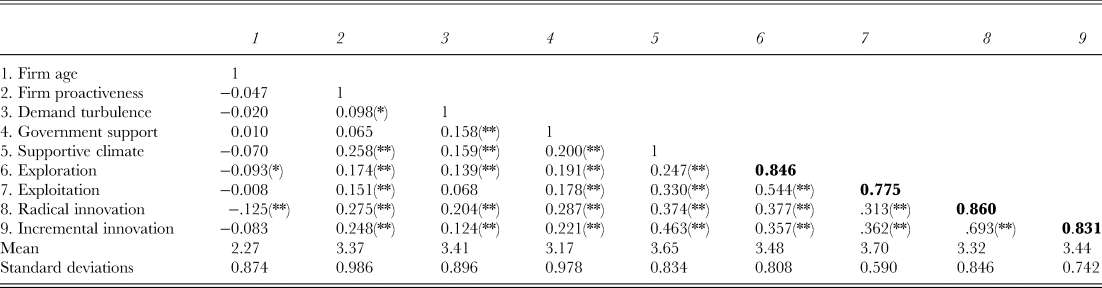
Common method variance (CMV) was also checked. By getting two responses from the same firm and creating the dataset by measuring the independent and control variables in Version A and measuring dependent variables in Version B, we greatly reduced the possibility of CMV (Podsakoff, Mackenzie, Lee, & Podsakoff, Reference Podsakoff, Mackenzie, Lee and Podsakoff2003). We also performed Harman's one-factor test (Podsakoff & Organ, Reference Podsakoff and Organ1986). The result of the rotated component matrix showed no general factor. Hence, we were confident that CMV was unlikely to be a problem in our dataset. Further, a confirmatory factor analysis was also performed to test CMV (Menon, Bharadwaj, & Howell, Reference Menon, Bharadwaj and Howell1996). A measurement model was assessed by linking all variables to a single factor. This model did not fit the data well, suggesting that CMV was unlikely to be a problem here. Table 1 showed the means and standard deviations of key variables and correlations. All the 17 dummies (i.e., size dummies, location dummies, and industry dummies) are omitted from Table 1.
Means, standard deviations, and correlations

Notes: The data on the diagonal (in bold font) is the square root of AVE of the construct.
* Correlation is significant at the 0.05 level.
** Correlation is significant at the 0.01 level.
Scales and Measures
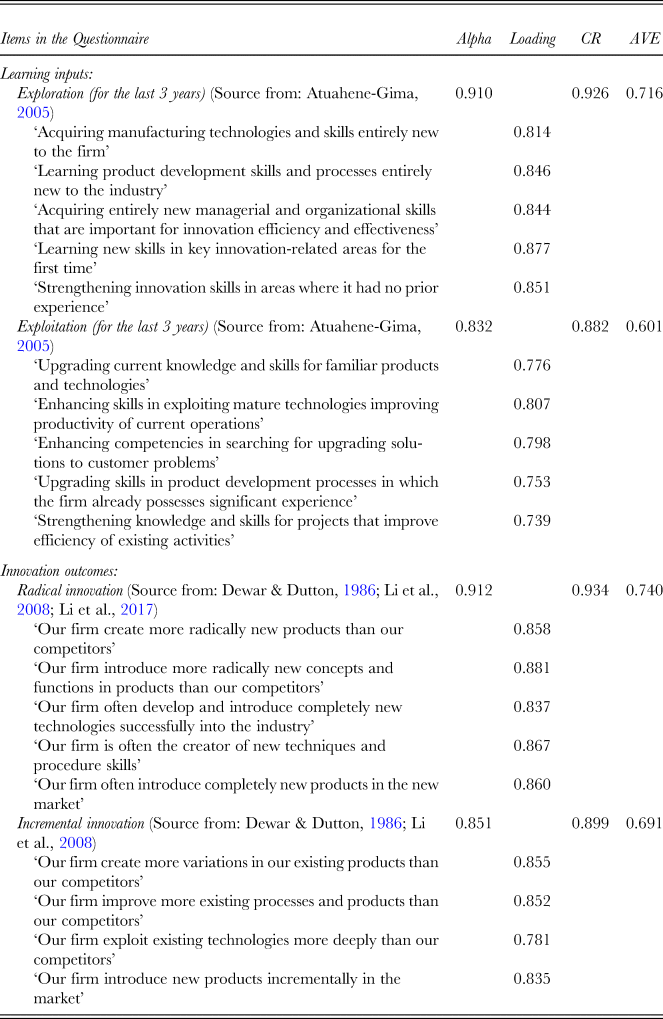
Validated instruments from existing literature were adapted by using a five-point Likert scale, with ‘1’ for ‘strongly disagree’ and ‘5’ for ‘strongly agree’. The detailed information of measures was provided in Table 2.
Items, reliability, and validity analyses

Note: CR refers to composite reliability, and AVE refers to average variance extracted.
Dependent and independent variables. We adapted the available scales to measure radical and incremental innovations, which had been validated in the context of China (Li, Liu, Li, & Wu, Reference Li, Liu, Li and Wu2008; Li, Li, Wang, & Ma, Reference Li, Li, Wang and Ma2017). Specifically, our scale for radical innovation had five items, and our scale for incremental innovation had four items. We asked the respondents to offer their subjective assessment of radical and incremental innovations because the literature indicated that the subjective measures were highly correlated with the objective measures of innovation outcomes, such as patent count and new product count (Song & Parry, Reference Song and Parry1996), and the top managers can more easily judge the outcomes of their innovation via this assessment. We used a five-point Likert scale for these measures.
Similarly, our scales to measure exploration and exploitation were also adapted and validated in the context of China (Atuahene-Gima, Reference Atuahene-Gima2005). Again, we used a five-point Likert scale for both measures. It is worth noting that we purposely adopted the approach to measuring exploration and exploitation as two variables rather than a single variable as a continuum because we wanted to examine not only the additive main effects but also their multiplicative interaction effects on both innovation types (Lavie et al., Reference Lavie, Stettner and Tushman2010).
Control variables. We also added some control variables to the regression model that explain the variance of the firm's radical/incremental innovation. First, we adopted firm age as a control variable, measuring the natural logarithm of the number of years since the firm's birth; firm age is relevant as young and old firms may have different attitudes towards risk and routines as firm life cycle theory proposed. Second, in light of the literature about the impact of external factors on organizational innovation, the environmental factors of demand turbulence and government support were also chosen as control variables, as contingency theory highlighted the impact of the environment to stimulate firm innovation. Demand turbulence was perceived as emerging yet risky opportunities to provoke innovation (Tsai & Yang, Reference Tsai and Yang2013). Government support was perceived as the state policies in support of innovation (Li & Zhang, Reference Li and Zhang2007), which are especially critical in emerging markets, such as China (Liu & White, Reference Liu and White2001). Further, two organizational factors were also added as control variables. On one side, the entrepreneurial orientation literature has established that innovation outcomes are positively related to firm proactiveness (Dess & Lumpkin, Reference Dess and Lumpkin2005). On the other side, innovation supportive climate has been argued to foster employee creativity, individually or as a team, that further improves organizational innovation (Khazanchi, Lewis, & Boyer, Reference Khazanchi, Lewis and Boyer2007). To measure these contextual variables, the respondents were asked to indicate the extent of the following: for instance, ‘predicting changes in customer preference is not easy’; ‘the governments have implemented supportive policies for firm innovation’; ‘our firm tends to take bold actions before our competitors’, and ‘our firm has a good internal climate for supporting innovation behaviors’. Then, province dummies may be included to control for the unobserved effects of subnational variations in market developments and institutions. Hence, we adopted five location dummy variables to control for location dummies. Size dummies are also added. Finally, our sample firms included nine industries, including agriculture, biotechnology, manufacturing, software, among other industries, thus industry dummies are added.
Reliability and Validity Analysis
Reliability measures the inter-item consistency of our constructs, which was assessed using the Cronbach's alpha (Cronbach, Reference Cronbach1951). As reported in Table 2, alpha values of all constructs were well above 0.7. Further, we also calculated composite reliability (CR) to assess the reliability (Bagozzi & Yi, Reference Bagozzi and Yi1990). A CR value greater than 0.70 may indicate the sufficient reliability. As shown in Table 2, all constructs had CRs greater than 0.70.
A validity test was performed via the confirmative factor analysis (CFA) by LISREL 8.0. Convergent validity is the extent to which the items on a scale truly measure the theoretical construct (Fornell & Larcker, Reference Fornell and Larcker1981). As we can see from Table 2, all the loadings of items were well above 0.7. Additionally, the significant t-values for the individual paths also provided strong evidence of convergent validity.
Discriminant validity is the degree to which measures of each latent construct are uniquely enough to be distinguished from other constructs. Therefore, the correlation between each pair of constructs should be less than the square root of AVE for each construct (Fornell & Larcker, Reference Fornell and Larcker1981). As shown in Table 1, none of the correlations between two constructs is higher than the square root of AVE for each construct, providing strong evidence of discriminant validity.
Regression Analysis
We used SPSS 13.0 to do the hierarchical regression analysis. We checked our data for possible violations of normality assumptions, significant outliners, and other problems. We found no significant violations. We mean-centered all the variables to minimize the possible threat of multi-collinearity (Aiken & West, Reference Aiken and West1991). The VIF value was all below the recommended cutoff of 10 (Neter, Wasserman, & Kutner, Reference Neter, Wasserman and Kutner1985).
RESULTS
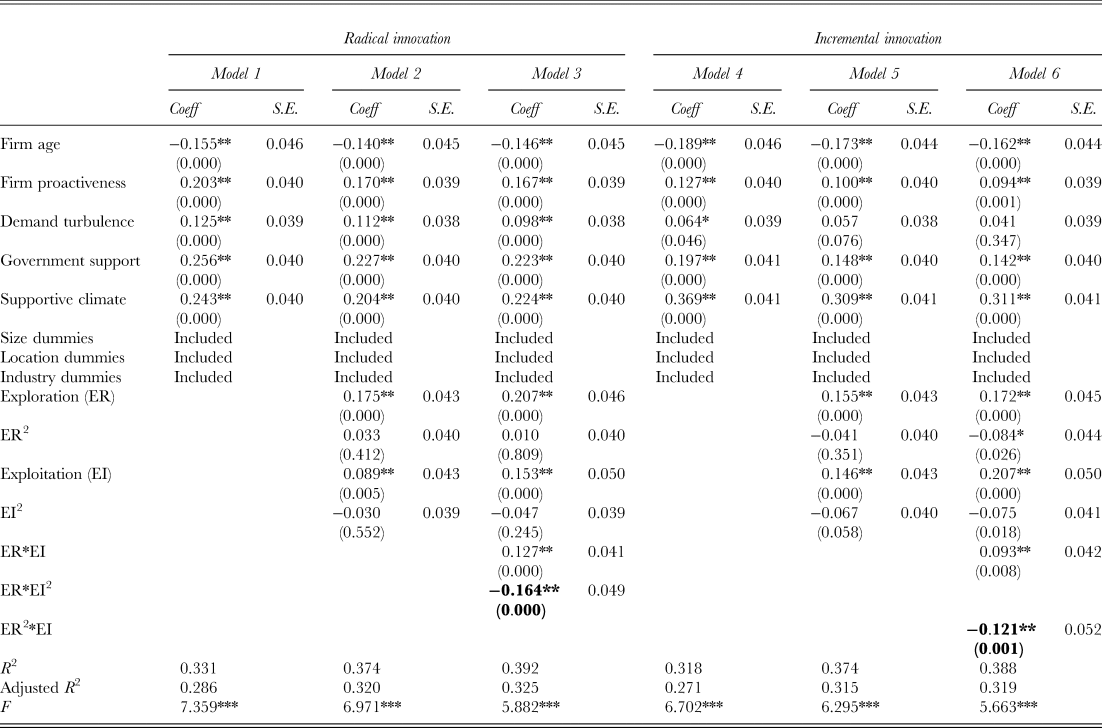
Table 3 reported the results of the regression analysis. The dependent variable was radical innovation for Models 1–3. The overall Chi-Squares for all four models indicated the significant explanatory power. In Model 1, all the control variables were added. In Model 2, findings showed that exploration was positively related to radical innovation (β = 0.175, p < 0.001) as well as the statistically positive effect of exploitation on radical innovation (β = 0.089, p < 0.01). These results implied the positive impact of exploration and exploitation on radical innovation, satisfying the baseline effects of exploration and exploitation. Finally, in Model 3, the finding showed that exploitation moderated the exploration-radical innovation link in an inverted U-shaped pattern (β = 0.127, p < 0.001; β 2 = −0.164, p < 0.001), which strongly supported Hypothesis 1.
Regression model

Note: p-values in parenthesis.
Meanwhile, the dependent variable was incremental innovation for Models 4–6. The overall Chi-Squares for these models indicated the significant explanatory power. In Model 4, the control variables were added. In Model 5, findings showed that exploration was positively related to incremental innovation (β = 0.155, p < 0.001) as well as the statistically positive effect of exploitation on incremental innovation (β = 0.146, p < 0.001). These results implied the positive impact of exploration and exploitation on incremental innovation, satisfying the baseline effects of exploration and exploitation. Finally, in Model 6, the finding showed that exploration moderated the exploitation-incremental innovation link in an inverted U-shaped pattern (β = 0.093, p < 0.01; β 2 = −0.121, p < 0.01), providing a strong support for Hypothesis 2. You may also see Figures 2a and 2b for the support of the two hypotheses.
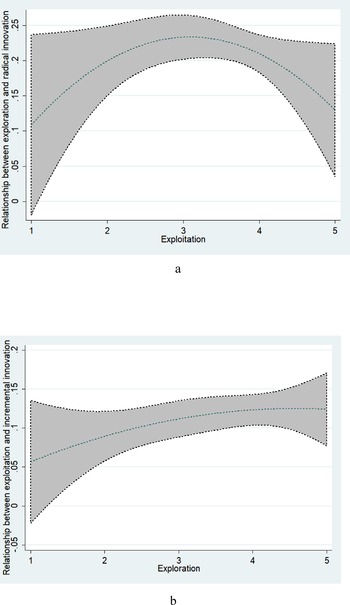
(a) The result of the relationship between exploration and radical innovation across increasing levels of exploitation (with 95% confidence interval) (b) The result of relationship between exploitation and incremental innovation across increasing levels of exploration (with 95% confidence interval)

Figure 2a demonstrates how the relationship between exploration and radical innovation varies across different levels of exploitation. To create this figure, the regression equation predicting radical innovation was examined at different levels of exploitation. The vertical axis of the graph represents values for the standardized regression coefficient for exploration predicting radical innovation, and the horizontal axis represents values for exploitation (after standardization). As shown in the figure, there is an inverted U-shaped relationship between exploration and radical innovation across increasing levels of exploitation. The coefficient is the highest when exploitation is at the intermediate level compared with when exploitation is either too small or too large. These results thus support Hypothesis 1.
Figure 2b illustrates an analogous inverted U-shaped relationship between exploitation and incremental innovation across increasing levels of exploration. The coefficient is the highest when exploration is at the intermediate level compared with when exploration is either too small or too large. The figure, together with the significant quadratic interaction terms, provides empirical support for Hypotheses 2.
Additional Analysis
(1) After rechecking our 508 samples, 2 out of 508 firms focus purely on exploitation, and 1 out of 508 firms focus purely on exploration (and we find that these three firms also report low performance in both two types of innovation). As the percentage (3/508 = 0.0059) is too small, it is hard to judge empirically why these situations take place (based on the low performance of their innovation performance, we can guess that these three companies did not participate in innovation activities and only carried out their routine business). Further, when we delete these 3 samples, our regression results still hold.
(2) Comparison of the innovation performance in young vs. old firms, and small vs. large firms. Empirically, we adopt and perform t-tests and find that younger firms, compared with older firms tend more to engage in both radical innovation (F = 5.732, p < 0.05) and incremental innovation (F = 4.083, p < 0.05). For the relation between firm age and innovation, existing literature showed mixed predictions. While some literature following Schumpeter suggested large firms with sufficient resources and capabilities are more capable of innovation, scholars in the other camp proposed opposite results (Acemoglu & Cao, Reference Acemoglu and Cao2015; Bianchini, Krafft, Quatraro, & Ravix, Reference Bianchini, Krafft, Quatraro and Ravix2015) due to the reasons like less routinization and more flexibility. Thus, our finding echoes the latter camp. Meanwhile, the difference in t-tests of the tendency of small firms and large firms of our samples engaging in radical innovation and incremental innovation are both insignificant.
DISCUSSION
Inspired by the reframed lens from paradox to duality according to the meta-perspective of yin-yang balancing, our duality model of exploration–exploitation interaction can effectively explain why and how the two learning modes are applicable simultaneously to the specific goals of both radical and incremental innovations in novel patterns, especially the interaction effect of exploration–exploitation balance in the inverted U-shaped curvilinear patterns. Our duality model can enrich the original model of learning (Levinthal & March, Reference Levinthal and March1993; March, Reference March1991) and also the subsequent research on ambidexterity (e.g., Lavie et al., Reference Lavie, Stettner and Tushman2010), especially by opening the black box of exploration–exploitation balance so as to shed light on the lingering debates over ambidexterity.
Theoretical Contributions and Practical Implications
This study has made three unique contributions to the body of knowledge in three areas, that is, ambidexterity, innovation, and paradox. First, we contribute to the research on organizational ambidexterity by reframing the prevailing views about a linear link (either positive or negative) between exploration and exploitation into a nonlinear link (the third pattern of inverted U-shaped interaction), echoing the idea of yin-yang balancing mindset (Li, Reference Li2016) and paradox literature (Schad et al., Reference Schad, Lewis, Raisch and Smith2016; Smith & Lewis, Reference Smith and Lewis2011). By testing the complex nonlinear effects of exploitation–exploration interaction on both radical and incremental innovations, this study offers a richer and deeper view concerning the simultaneously complementary and conflicting effects of exploration–exploitation interaction so as to reconcile the mixed findings with new light on the puzzle of ambidexterity (e.g., Lavie et al., Reference Lavie, Stettner and Tushman2010; Tushman et al., Reference Tushman, Smith, Wood, Westerman and O'Reilly2010). In other words, our duality model opens the black box of exploration–exploitation ambidexterity.
Distinctive from the prior linear mindsets, our new duality model provides a more nuanced understanding about a nonlinear exploration–exploitation link at the core of ambidexterity so as to remedy the inherent biases of the two linear camps of organizational ambidexterity with their exclusive focus on either tradeoff or synergy. Our third option with an inverted U-shaped pattern can help reduce current ambiguities about the paradoxical roles of learning (Zacher et al., Reference Zacher, Robinson and Rosing2016). In particular, by revealing the primarily endogenous form of synergy (i.e., the effect of resource complementarity as a counterbalance to offset the driving-out effect) as a positive interaction between exploration and exploitation, our duality model has the potential to integrate the two linear camps of ambidextrous views (e.g., He & Wong, Reference He and Wong2004; Lavie et al., Reference Lavie, Stettner and Tushman2010; Siggelkow & Levinthal, Reference Siggelkow and Levinthal2003) by reframing them into their updated versions to embrace an endogenous interaction for synergy (i.e., resource complementarity) as well as an exogenous intervention via both mechanisms of partial integration and partial separation (i.e., spatial and temporal balances up to a threshold in an inverted U-shaped pattern). Future research on ambidexterity can benefit from the proposed novel nonlinear mindset at the core of our duality model. In particular, this duality model sheds light on the challenge of ‘maintaining an appropriate balance’ between the paradoxical elements as ‘a primary factor in system survival and prosperity’ (March, Reference March1991: 71), even though ‘the precise mix’ as ‘optimal is hard to specify’ (Levinthal & March, Reference Levinthal and March1993: 105). In particular, this has the potential to shed light on the managerial practices in the context of China, reflected in the metaphor of ‘Haier as the sea’ (Li, Zhou, & Zhou, Reference Li, Zhou and Zhou2016; Xing, Reference Xing2016).
Second, we advance innovation research by framing the exploration–exploitation duality for learning mode as a salient antecedent to innovation. Specifically, our study evokes a combined pattern of two unique mechanisms for exploration–exploitation interaction in terms of partial separation and partial integration with their balancing effects on both radical and incremental innovations. Beyond the dominant focus of innovation research on the independent role of exploration or exploitation for radical or incremental innovation (e.g., Atuahene-Gima, Reference Atuahene-Gima2005; Rothaermel, Reference Rothaermel2001), we emphasize the integrative effects of exploitation and exploration on both radical and incremental innovations, especially the mechanisms of partial separation for partial tradeoff and partial integration for partial synergy in a curvilinear pattern. This is a novel approach to managing organizational innovation via the paradoxical interactions between exploitation and exploration as the core input and different innovation types as the core output.
By integrating the ambidexterity literature with the innovation literature, this study seeks the in-depth understanding about how to achieve the best innovation outcomes by establishing a core link between learning mode (i.e., exploration and exploitation) and innovation type (i.e., radical and incremental innovations). First, as learning involves knowledge input, the incompatibility between different learning modes tends to be much weaker than that between different material resources, so the potential for information sharing across the learning modes is higher than that across material resources. Second, this study posits that the varying asymmetrical gap between exploration and exploitation is the underlying force for nonlinear effect, and its threshold from being positive to negative is critical to effective innovation, which extends the research on the complex links between learning mode and innovation type (Lavie et al., Reference Lavie, Stettner and Tushman2010).
Third, this study enriches the current paradox research by demonstrating that any paradox can be better managed as a duality by reframing opposite elements as partially complementary and also partially conflicting in an inverted U-shaped pattern, where both positive and negative effects of paradoxical ambidexterity can be better explained and managed by the mechanisms of partial separation and partial integration in a salient contrast to the traditional mechanism of full separation or full integration. The unique duality model, deriving from the meta-perspective of yin-yang balancing as rooted in the oldest Chinese philosophies (Li, Reference Li2016), lies in its special capability of reframing all paradoxes, such as diversity–unity, centralization–decentralization, stability–change, competition–cooperation, and global–local, into manageable dualities in terms of their effective balances (cf. Smith & Lewis, Reference Smith and Lewis2011; Zacher et al., Reference Zacher, Robinson and Rosing2016). This reframing is made possible by the differentiation between paradox and duality, with the former as a strong form of contradiction requiring tension tolerance and tension reduction (thus the greater need for separation), while the latter as a weak form of contradiction in terms of a manageable balance between tension and harmony (thus both separation and integration in balance for both partial tradeoff and partial synergy, Li, Reference Li2016, Reference Li, Bednarek, Cunha, Schad and Smith2021).
Our duality model strongly suggests that reframing paradox into duality is salient for the deeper understanding about exploration–exploitation interaction as a valuable approach to the study of ambidexterity not only as more holistic in the sense that tension can be healthy but also more dynamic in the sense that we can apply specific mechanisms to tension management. The theme of nonlinear pattern of interaction with a threshold or inflection point deserves an urgent, yet promising, attention in future research (Li, Reference Li2016, Reference Li, Bednarek, Cunha, Schad and Smith2021). This is perhaps one of the most salient issues for the best possible exploitation–exploration balance in particular and all paradoxical balances in general (Papachroni et al., Reference Papachroni, Heracleous and Paroutis2016; Smets et al., Reference Smets, Jarzabkowski, Burke and Spee2015). In a recent review, Schad et al. (Reference Schad, Lewis, Raisch and Smith2016) explicitly explained the underlying distinction between paradox and duality, with the latter more devoted to integration, while the former is more devoted to separation. In this sense, reframing paradox into duality is central to the enrichment and possible integration of diverse management theories. For example, the duality model may help integrate the streams on ambidexterity and dynamic capability, with exploration related to ‘sensing ability’ and exploitation related to ‘seizing ability’ (cf., March, Reference March1991; Teece, Reference Teece2007).
Limitations
Despite the above contributions and implications, this study has following limitations. First, given our purpose about the simultaneous balance in spatial terms, we adopted a cross-sectional design. This design cannot test the balancing mechanism of temporal transitions between exploitation and exploration (e.g., Chen & Katila, Reference Chen, Katila and Smith2008), or the longitudinal effect of tradeoff or synergy (e.g., Lavie et al., Reference Lavie, Stettner and Tushman2010). In addition, this design cannot address the problem of causality which calls for future longitudinal studies. Second, this study had only a single-country design. With this design, this study cannot claim the generalizability of the findings in other contexts. Moreover, future studies may verify the robustness of results using other dependent variables (like the objective measures from patent or new product sources). Relatedly, the ΔR for the independent variables in our model is relatively small, which needs further exploration. Third, this study only focused on the level of a single firm without examining the level of inter-firm alliance, so we cannot directly compare the possible interaction between firm-level learning and inter-firm learning (cf., Rothaermel, Reference Rothaermel2001). Fourth, this study does not focus on the reasons why some firms are more capable of performing paradoxical learning than others, thus possible antecedents to paradoxical learning, such as cognitive flexibility, are not added to the model (Good & Michel, Reference Good and Michel2013). Future research should address the above limitations. Finally, when considering the different impacts of environmental turbulence, the balance of exploration–exploitation may shift more towards exploration in order to enhance external adaptability. Further studies may test such predictions with the new data.
CONCLUSION
There is a broad recognition that the paradox of exploration–exploitation link is one of the most challenging puzzles in the management field (March, Reference March1991; Miron-Spektor et al., Reference Miron-Spektor, Ingram, Keller, Smith and Lewis2018). Despite the diverse attempts to address it as ambidexterity, there is little consensus on how to manage this paradox for its maximum potential. To approach this issue from a novel duality lens rooted in the meta-perspective of yin-yang balancing, this study has reframed the paradox of learning into the duality of learning for the balanced dual goals of partial tradeoff and partial synergy via the balanced dual mechanisms of partial separation and partial integration, which is reflected in a curvilinear pattern. Hence, a novel duality model of exploration–exploitation link has been proposed and also tested, with a special focus on an inverted U-shaped pattern about the complex effects of exploration and exploitation on radical and incremental innovations.
The central theme of this study is that any paradox can be reframed into a duality toward a holistic and dynamic balancing between the opposite elements with partial tradeoff and partial synergy in an inverted U-shaped pattern of interaction. Such a paradoxical interaction is made possible by the specific mechanisms of partial separation to manage partial tradeoff and partial integration to manage partial synergy. Future studies are encouraged to specify the tipping-off or inflection point as the threshold in the curvilinear pattern of exploration–exploitation link to best manage this interactive process, and also specify the necessary and sufficient contexts as the boundary conditions for the optimum balance between exploitation and exploration in particular and all paradoxical opposites in general, not only for the goals of incremental and radical innovations but also for other organizational goals such as financial and non-financial goals as well as short-term and long-term goals.
APPENDIX I
Summary Table of Existing Knowledge About the Exploration–Exploitation Relations

APPENDIX II
Summary of Key Quantitative Studies on the Interaction Between Exploration and Exploitation

DATA AVAILABILITY STATEMENT
A preservation copy of the data, questionnaire and SPSS results file can be accessed via OSF at: https://osf.io/5xp3f/?view_only = f8a35ff897c64605823052525c497538