Introduction
In 2020, an estimated 184 615 new cases of laryngeal cancer were diagnosed worldwide.1 Patients with early laryngeal carcinoma have a good prognosis regardless of treatment modality.Reference Yoo, Lacchetti, Hammond and Gilbert2,Reference Warner, Chudasama, Kelly, Loughran, McKenzie and Wright3 An updated 2014 Cochrane review identified no randomised, controlled trials (RCTs) directly comparing radiotherapy (RT) and endoscopic laser surgery for early laryngeal cancer.Reference Warner, Chudasama, Kelly, Loughran, McKenzie and Wright3 Because of lack of evidence suggesting a preferred treatment with regards to oncological outcomes, decisions in patient management may therefore be directed towards functionality, such as voice outcomes and swallowing for example.
There have been previous systematic reviews comparing the outcomes of RT and endoscopic laser surgery with respect to voice, swallowing and quality of life (QoL) in T1 and T2 laryngeal cancer. The most recent of these was published in 2018 and included evidence up to and including 2016. Guimarães et al.Reference Guimarães, Dedivitis, Matos, Aires and Cernea4 specifically considered voice outcomes only in laryngeal cancer of T1a stage and included studies comparing voice quality using electroacoustic analysis and Voice Handicap Index. Their study found RT to have better outcomes. This study did not comment on the quality of studies and excluded numerous studies that did not use the Voice Handicap Index.
Previously, meta-analysis designed by Greulich et al.Reference Greulich, Parker, Lee, Merati and Misono5 outlined eight retrospective cohort studies that used the Voice Handicap Index assessment; six studies found no difference between groups, and two favoured RT over endoscopic laser surgery. On the other hand, Du et al.Reference Du, Liu, Yu, Li, Li and Wang6 included studies using the Voice Handicap Index 30 and acoustic voice analysis parameters that concluded that endoscopic laser surgery has more advantages than RT in terms of voice quality. The reviews are now dated and limited in content, and with new data published, an updated systematic review of functional and QoL outcomes is required.
Objective
Our objective was to perform a systematic review of the literature comparing functional outcomes with respect to voice character, swallowing outcomes and QoL for endoscopic laser surgery versus RT for early (T1 and T2) stage laryngeal squamous cell carcinoma.
Materials and methods
In order to conduct a review of the literature, a systematic search of the following evidence-based medicine databases was performed: Cochrane Database of Systematic Reviews, PubMed and Web of Science.
The search terms were designed by authors KB and SJ and were as follows: (1) neoplasm OR cancer* OR malignan* OR carcinoma OR tumour OR tumor OR dysplasia, (2) laryn* OR vocal cord OR glotti* OR throat OR voicebox OR subglotti* OR supraglotti*, (3) radiotherapy OR irradiat* OR radiation, (4) laser *surgery OR endolaryngeal surgery with laser OR endoscopic surgery with laser, and (5) AND 2 AND 3 AND 4.
No date filters were set, and papers up to April 2021 were screened. Only papers in English were analysed. Titles and abstracts of identified articles were assessed by KB for relevance, and the following inclusion criteria were applied: (1) primary treatment of T1 or T2 squamous carcinoma, (2) a minimum of two cohorts of patients where treatment compared endoscopic laser surgery and RT, and (3) studies that utilised at least one objective or validated measure of QoL, swallowing or voice.
Articles that met the criteria were retrieved and reviewed. Duplicate studies were removed. Studies were then excluded on the following conditions: (1) treatment of T3 or T4 carcinoma, and (2) participants had undergone previous or concurrent treatment (e.g. previous surgery or chemoradiotherapy).
The subsequent studies had their references reviewed to find further potential studies. Author KB reviewed the search results, and SJ and KB assessed the quality of evidence. Where there was any disagreement between authors on level of evidence, the first author (KB) had the deciding vote. Both authors contributed to the manuscript.
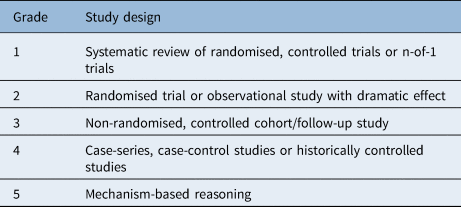
Quality of evidence was assessed by assigning each paper a grade, according to the Oxford Centre for Evidence-Based Medicine System,Reference Howick, Chalmers, Lind, Glasziou, Greenhalgh and Heneghan7 which is summarised in Table 1.
Oxford Centre for Evidence-Based Medicine referring to ‘treatment harms’ 2011

Results
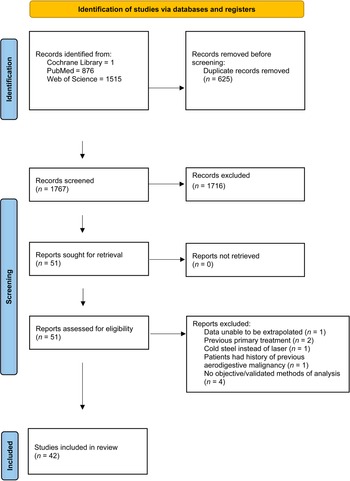
After duplicates were removed, the initial search strategy outlined above yielded 1767 potentially relevant articles. These were reviewed, and those clearly not relevant to this study were removed. Full text copies of those remaining were sourced and included or excluded with reference to the aforementioned criteria. A total of 42 articles were included for final analysis, as shown in Figure 1. This was done in accordance with Preferred Reporting Items for Systematic Reviews and Meta-Analyses guidelines (see Table 1 in the supplementary material, available on The Journal of Laryngology & Otology website).Reference Liberati, Altman, Tetzlaff, Mulrow, Gøtzsche and Ioannidis8
Flow diagram of study inclusion.

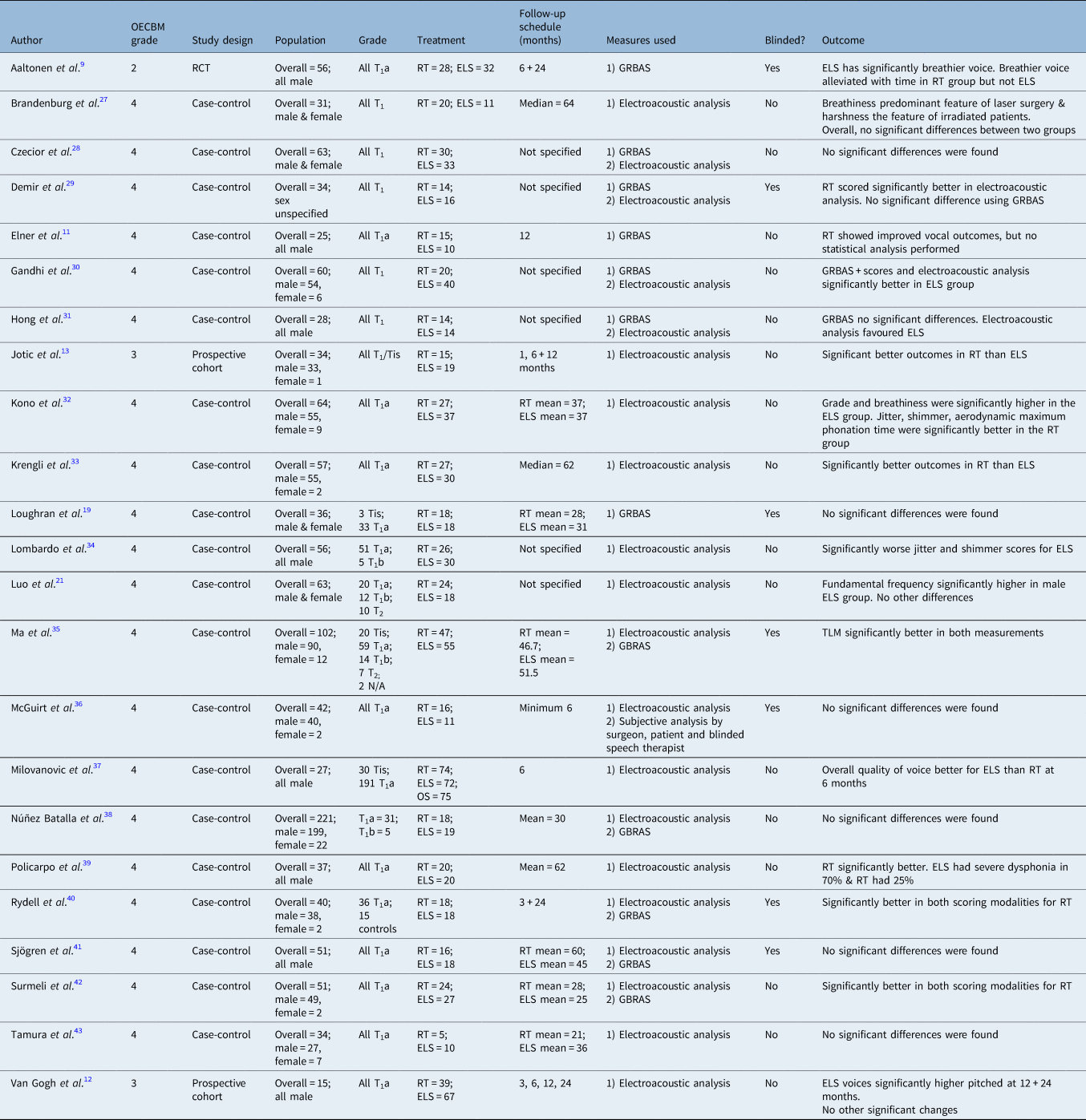
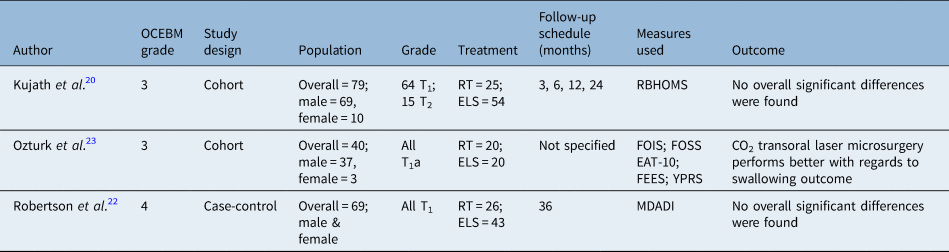
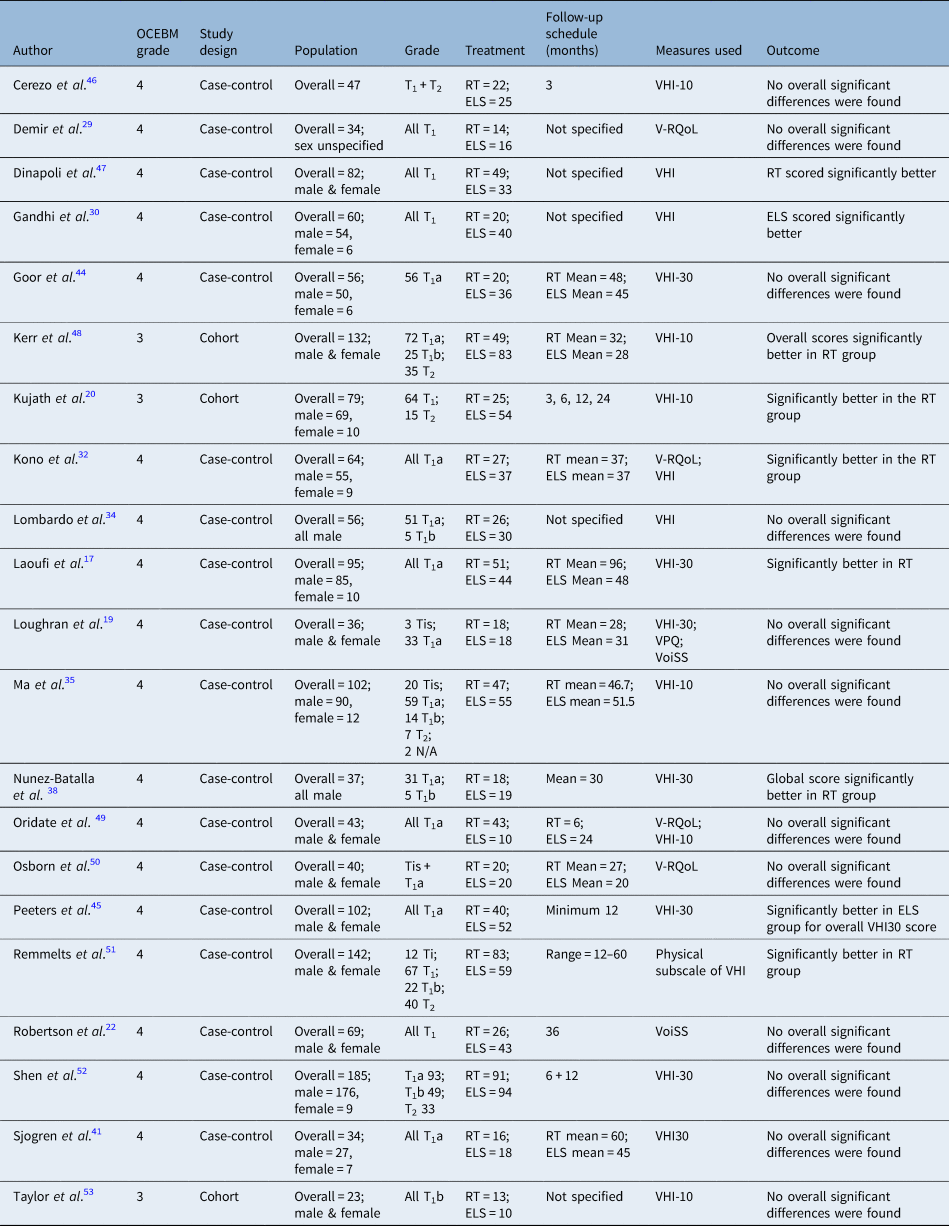
Of the 42 studies included, 23 examined voice outcomes, 3 examined swallowing outcomes and 26 included QoL measures, the summaries of which are shown in Tables 2, 3 and 4, respectively.
Studies reporting voice outcomes

OCEBM = Oxford Centre for Evidence-based Medicine; RCT = randomised, controlled trial; RT = radiotherapy; ELS = endoscopic laser surgery; GRBAS = grade, roughness, breathiness, asthenia, strain scale; Tis = carcinoma in situ; N/A = not available; TLM = transoral laser microsurgery; OS = Open surgery
Patient reported functional outcomes

OCEBM = Oxford Centre for Evidence-based Medicine; Tis = carcinoma in situ; RT = radiotherapy; ELS = endoscopic laser surgery; EORTC QLQ = European Organisation for Research and Treatment of Cancer Quality of Life Questionnaire; H&N = Head and Neck; COOP = World Organization of National Colleges; WONCA = World Organisation of General Practice/Family Physicians; OS = open surgery; ECOG = Eastern Co-operative Oncology Group Performance Status; PSS-HN = Performance Status Scale for Head & Neck Cancer Patients; HADS = Hospital Anxiety and Depression Scale; UoW-QoL = University of Washington Quality of Life; FACT = Functional Assessment of Cancer Therapy
Studies reporting swallowing outcomes

OCEBM = Oxford Centre for Evidence-based Medicine; RBHOMS = Royal Brisbane Hospital Outcomes Measure for Swallowing; FOIS = Functional Oral Intake Scale; FOSS = Functional Outcome Swallowing Scale; EAT-10 = Eating Assessment Tool; FEES = Fibreoptic Endoscopic Evaluation of Swallowing; YPRS = Yale Residue Severity Rating Scale; MDADI = MD Anderson Dysphagia Inventory
Objective voice outcomes
Twenty-three papers reported voice outcomes. Only one study that was identified was an RCT.Reference Aaltonen, Rautiainen, Sellman, Saarilahti, Mäkitie and Rihkanen9 Different studies had varying methods to measure voice outcome, the majority of which used electroacoustic analysis, grade, roughness, breathiness, asthenia, strain scale rating or a combination of both. The grade, roughness, breathiness, asthenia, strain scale (grade is grade of dysphonia and strain is strain voice quality) is a method of assessing dysphonia. Each entity is rated on a four-point scale.Reference Karnell, Melton, Childes, Coleman, Dailey and Hoffman10
Of the 12 studies using the grade, roughness, breathiness, asthenia, strain scale, 6 studies designed the assessment of voice recordings by specialists that were blinded, and 6 did not describe a method of blinding. Five of the studies found no differences in grade, roughness, breathiness, asthenia, strain scale scores comparing the different treatment options, two favoured endoscopic laser surgery and five found RT patients had favourable voice outcomes; however, Elner and FexReference Elner and Fex11 carried out no statistical analysis.
The other main voice outcome measurement modality was electroacoustic analysis. Twenty of the 23 studies used this method, 8 of which also used the grade, roughness, breathiness, asthenia, strain scale. Ten studies found RT to have better outcomes, 6 studies found no overall significant differences between RT and endoscopic laser surgery whereas 4 favoured endoscopic laser surgery. Eighteen of 20 studies were Oxford Centre for Evidence-Based Medicine System grade 4 evidence. Van Gogh et al.Reference van Gogh, Verdonck-De Leeuw, Wedler-Peeters, Langendijk and Mahieu12 and Jotic et al.Reference Jotic, Stankovic, Jesic, Milovanovic, Stojanovic and Djukic13 were Oxford Centre for Evidence-Based Medicine System grade 3 studies and both favoured radiotherapy.
Quality of life outcomes
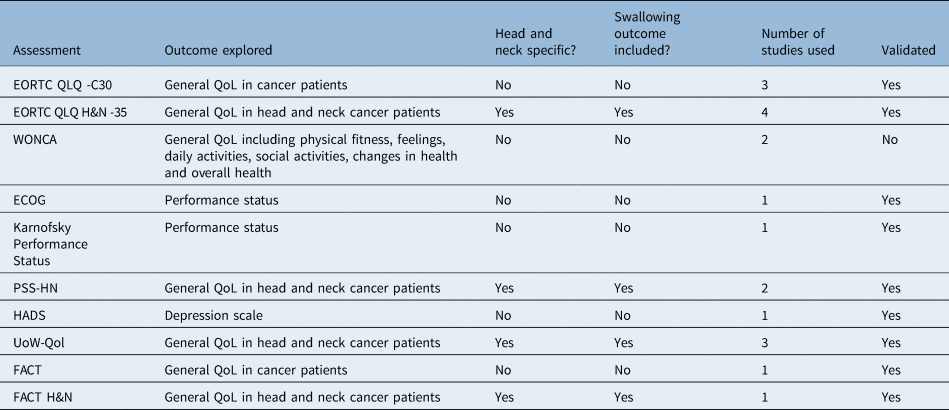
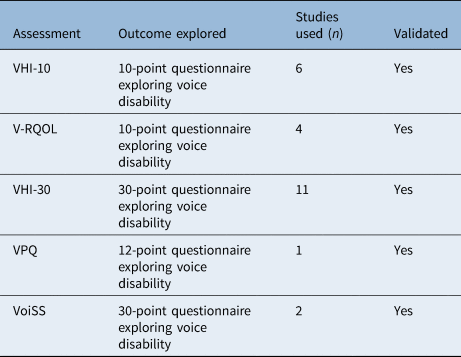
Of the 11 studies measuring general or head and neck specific QoL outcomes, 10 different assessment methods were used as outlined in Table 5. Four of these were head and neck specific, 6 were general QoL questionnaires or performance status scores. The effect of endoscopic laser surgery or RT on voice was also assessed using different patient questionnaires. Swallowing assessment was carried out by a combination of questionnaires and functional assessments. Because of the heterogeneity of methods used, a summary of QoL, voice and swallowing assessments are provided in Tables 6–8.
Patient-reported voice-related outcomes

VHI = Voice; OCEBM = Oxford Centre for Evidence-based Medicine; RT = radiotherapy; ELS = endoscopic laser surgery; VHI = Voice Handicap Index; VoiSS = Voice Symptoms Score; VPQ = Vocal Performance Questionnaire; V-RQoL = Voice-Related Quality of Life
QoL measurements used

EORTC QLQ = European Organisation for Research and Treatment of Cancer Quality of Life Questionnaire; QoL = quality of life; H&N = Head and Neck; WONCA = World Organisation of General Practice/Family Physicians; ECOG = Eastern Co-operative Oncology Group Performance Status; PSS-HN = Performance Status Scale for Head & Neck Cancer Patients; HADS = Hospital Anxiety and Depression Scale; UoW-QoL = University of Washington Quality of Life; FACT = Functional Assessment of Cancer Therapy
Voice outcomes used

VHI = Voice Handicap Index; V-RQoL = Voice-Related Quality of Life; VPQ = Vocal Performance Questionnaire; VoiSS = Voice Symptoms Score
Swallowing assessments used

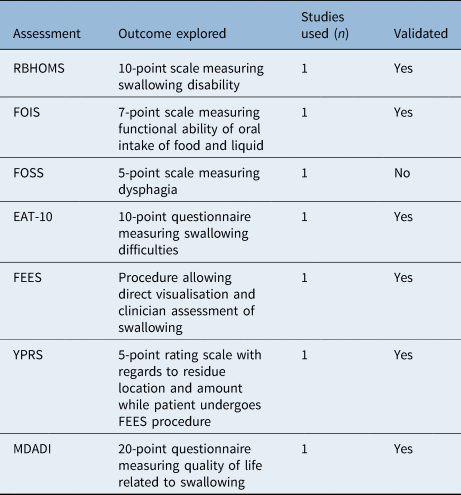
RBHOMS = Royal Brisbane Hospital Outcomes Measure for Swallowing; FOIS = Functional Oral Intake Scale; FOSS = Functional Outcome Swallowing Scale; EAT-10 = Eating Assessment Tool; FEES = Fibreoptic Endoscopic Evaluation of Swallowing; YPRS = Yale Residue Severity Rating Scale; MDADI = MD Anderson Dysphagia Inventory
Eleven included studies reported either general or head and neck specific QoL outcomes, of which 9 found no overall statistically significant differences between the two groups of patients. Bahannan et al.Reference Bahannan, Zábrodsky, Cerny, Cbovanec and Lobynska14 Kucuk et al.Reference Kucuk, Kurnaz and Kutlar15 and Stoeckli et al.Reference Stoeckli, Guidicelli, Schneider, Huber and Schmid16 used both the European Organisation for Research and Treatment of Cancer Quality of Life Questionnaire-30 and European Organisation for Research and Treatment of Cancer Quality of Life Questionnaire Head and Neck-35, whereas Laoufi et al.Reference Laoufi, Mirghani, Janot and Hartl17 used the European Organisation for Research and Treatment of Cancer Quality of Life Questionnaire Head and Neck-35 alone and found no overall difference. Smith et al.,Reference Smith, Johnson, Cognetti, Landsittel, Gooding and Cano18 Loughran et al.,Reference Loughran, Calder, MacGregor, Carding and MacKenzie19 Kujath et al.,Reference Kujath, Kerr, Myers, Bammeke, Lambert and Cooke20 Luo et al.Reference Luo, Fang, Lin, Chang, Liao and Chen21 and Robertson et al.Reference Robertson, Yeo, Sabey, Young and MacKenzie22 additionally used questionnaires not used by other included studies, as outlined in Table 3. They also failed to establish any overall differences between the two treatment regimes. Additionally, of 21 papers that outlined patient-reported voice-related QoL outcomes, 12 found no statistically significant overall scores, 7 favoured RT and 2 found endoscopic laser surgery to have better outcomes.
Swallowing outcomes
The included studies examining swallowing outcomes used a combination of standardised functional studies and patient reported outcome questionnaires as outlined in Table 8. Of the small number of studies shown in Table 4, Ozturk et al. Reference Ozturk, Turhal, Durusuy, Sahin, Akagunduz and Eyigor23 was the only paper identified that focused on comparing long-term swallowing outcomes between the two treatment modalities. This was established by several means and concluded that endoscopic laser surgery is more advantageous regarding swallowing function. Kujath et al. Reference Kujath, Kerr, Myers, Bammeke, Lambert and Cooke20 and Robertson et al. Reference Robertson, Yeo, Sabey, Young and MacKenzie22 using Royal Brisbane Hospital Outcomes Measure for Swallowing and MD Anderson Dysphagia Inventory, respectively, found no difference between treatment modalities. Although the majority of methods used were validated, the Functional Outcome Swallowing Scale is an unvalidated method of swallowing assessment.
Perception of swallow function was incorporated into four of the QoL questionnaires as outlined in Table 6. Luo et al. Reference Luo, Fang, Lin, Chang, Liao and Chen21 and Stoeckli et al. Reference Stoeckli, Guidicelli, Schneider, Huber and Schmid16 stated that patients treated with endoscopic laser surgery have better swallowing outcomes than RT patients, whereas Bahannan et al.,Reference Bahannan, Zábrodsky, Cerny, Cbovanec and Lobynska14 Kucuk et al.,Reference Kucuk, Kurnaz and Kutlar15 Kujath et al.,Reference Kujath, Kerr, Myers, Bammeke, Lambert and Cooke20 Loughran et al.,Reference Loughran, Calder, MacGregor, Carding and MacKenzie19 Robertson et al. Reference Robertson, Yeo, Sabey, Young and MacKenzie22 and Smith et al. Reference Smith, Lockey, Smith and Lockey24 concluded that there were no significant differences.
Discussion
Overall, of 15 papers using voice recording assessment scales (e.g. grade, roughness, breathiness, asthenia, strain scale), 9 found no difference between the two treatment modalities. Because of the nature of perceptual analysis, papers using this method have drawbacks. The included studies have different equipment and varying assessment scales. Additionally, the distance between the patient's mouth and the microphone can differ, and the blinding, training and number of the voice assessors could also affect the results.
Ten of the 20 papers using electroacoustic voice analysis found RT to have better outcomes. Electroacoustic analysis is the most reproducible method of assessment. The measurements of analysis (e.g. jitter, shimmer and noise-to-harmonics ratio) are reliant on the precise determination of fundamental frequency, which can be challenging to evaluate in dysphonia. Moreover, the use of sustained vowel sounds for analysis may not represent functionality or quality of voice during sustained speech. With regards to the practicalities, varying equipment and microphone-mouth distance may also alter results.
Additionally, patient-reported QoL outcomes also showed no overall difference between the treatments. The subjective nature of questionnaires means that potential variability between patients may arise and can be influenced by pre-treatment counselling, individual expectations and occupation. These factors may confer a reduction of sensitivity for more subtle changes.
This systematic review showed a lack of high-quality evidence. The existing literature regarding the treatment of early laryngeal cancer is largely composed of non-randomised data except one RCT. Most studies were retrospective and therefore are more susceptible to information and selection bias. In several studies, patients were allocated to treatment based on the stage of cancer, with more progressive tumours assigned to RT. Furthermore, the histopathological staging process and techniques were not described in several of the included studies; therefore, there is the possibility of staging inaccuracy. Moreover, additional heterogeneity among the studies is present because many included papers lacked details on radiation dose for RT and laser equipment for endoscopic laser surgery. Additionally, many of the studies included had small sample numbers. Low numbers of participants mean there is a reduced chance of detecting a true effect as well as also reducing the possibility that statistically significant results confer a true effect.
Previous agreed standards were set by the proposed evaluation guidelines of the ENT-UK Head and Neck consensus meeting using Voice Symptom Scale with a baseline measurement completed before treatment as well as for assessment at 3, 6 and 12 months post-treatment.Reference Bradley, MacKenzie, Wight, Pracy and Paleri25 The group also agreed that stroboscopy should be used within 3 months and at 12 months following treatment. However, this has not been globally accepted, and it is clear that with the level of methodological heterogeneity there needs to be a standardised approach to evaluating voice, QoL and swallowing outcomes.
The treatment modalities are fundamentally different and consequently there are arguments for both as primary treatments. One aspect to consider is the location of the tumour as the involvement of the anterior commissure is associated with generally worse outcomes. The tumour–node–metastasis staging classificationReference Lydiatt, Patel, O'Sullivan, Brandwein, Ridge and Migliacci26 does not have a category that subcategorises anterior commissure involvement. There is a lack of evidence in regard to the best treatment modality for tumours within this anatomical sub-classification.
Another factor to consider is individual patient needs and the ability to adhere to the treatment regime. This is especially relevant for patients undergoing radiotherapy that have longer hospital stays and require repeated treatment for several weeks, with recurrences unable to be treated with further irradiation. On the other hand, endoscopic laser surgery requires and therefore carries the associated risks of general anaesthesia. Endoscopic laser surgery patients with residual or recurrent disease can also have further resection or have concurrent chemotherapy or RT. Both treatments have different side-effect profiles. Prolonged pain, mucositis and radionecrosis may occur in patients treated with RT, whereas endoscopic laser surgery may cause short-term complications such as bleeding and infection and long-term side effects including local fibrosis. Although beyond the scope of this systematic review, cost utility is increasingly important.
Due to lack of evidence for preferred treatment with regard to oncological outcomes, management may be directed towards functional outcomes Literature regarding the treatment of early laryngeal cancer is largely non-randomised data bar one randomised, controlled trial (RCT) There is no agreed standardised approach to evaluating voice, quality of life and swallowing outcomes Radiotherapy may be best for voice outcomes and endoscopic laser surgery may be best for swallowing outcomes Despite new research published, no treatment is clearly advantageous overall Ideal future research should be composed of RCTs and further prospective studies.
Conclusion
Since the last review was published, eight relevant papers have been published that further compare functional outcomes of RT and endoscopic laser surgery. This is the first review to identify the Ozturk et al. study as a paper that solely focuses on long-term swallowing outcomes.
The lack of high-quality prospective studies that compare the two treatment modalities means that controversy remains regarding which modality is superior. This systematic review aimed to evaluate whether the treatment modalities differed in terms of voice, QoL and swallowing outcomes due to both having comparable oncological effects. With regards to voice outcomes using electroacoustic analysis, RT may be favourable whereas endoscopic laser surgery may produce more favourable swallowing outcomes. However, despite the new research published, no treatment is clearly advantageous overall. We conclude that this is because of a lack of standardised assessment methods and follow-up regime, with most published research comprising low-powered observational studies; indeed there has been only one RCT, which was published in 2014.Reference Aaltonen, Rautiainen, Sellman, Saarilahti, Mäkitie and Rihkanen9 Ideal future research should be composed of RCTs and further prospective studies that use a standardised subjective and objective functional outcome assessment regime to allow valid comparison.
Supplementary material
The supplementary material for this article can be found at https://doi.org/10.1017/S0022215121002887.
Competing interests
None declared