Introduction
Call centers have operated in the big cities of Pakistan – Islamabad, Rawalpindi, Lahore, and Karachi – for some years.Footnote 1 They are a consequence of, and contribute to, globalization. They perform two kinds of operations: receiving calls from abroad in order to provide services to Western customers (incoming), and initiating calls to clients abroad in order to sell them goods and services (outgoing). The right accent is seen by the call center industry as an essential asset for conducting business. Thus, operators have policies and practices that change the local accent to what Western clients are perceived to require. As most clients are located in North America, it is their accent that is the target for most Pakistani call center workers.
This study addresses the call centers of Pakistan located in the capital, Islamabad, and a major cultural center of the country, the city of Lahore. The objective is to describe the language policies and practices of Pakistan’s call centers in relation to language ideologies in Pakistani society in general and in the call centers in particular. Further, the commodification of language among call center workers – the customer services representatives (CSRs) – will be examined in relation to accent. Specific research questions are: What are the language policies and practices that commodify language as linguistic capital in the call centers of Pakistan? How do the CSRs deploy language in order to pass as native speakers of English? Do they succeed in doing so or merely “cross over” to the “other” identities? How are these attempts to pass as natives speakers viewed by other English-using Pakistanis? And how do the CSRs view the use of English by other Pakistanis?
Background: Language and Education in Pakistan
Pakistan is a Muslim majority country with a population of nearly 165 million (Pakistan 2008). The national language is Urdu, while the official one remains English, though the 1973 Constitution (Article 251 (a)) stipulated that it was to be replaced by Urdu within 15 years of the establishment of the Constitution. Urdu is the mother tongue of only the 7.75% of Pakistanis whose parents, or who themselves, are immigrants from India, but it is a very widely used urban second language. The other indigenous mother tongues of the people are Punjabi (44.15%), Pashto (15.42%), Sindhi (14.1%), Siraiki (10.53%), Balochi (3.57%) and “other languages” (4.66%) (Census 2001:107). Among the “others” are at least 55 languages (Rahman Reference Rahman, Saxena and Borin2006:85–92); the Ethnologue lists 72 languages for the country (Gordon 2005).
Education in Pakistan is classifiable with reference to the medium of instruction which, in turn, corresponds with socioeconomic class. English is the medium of instruction in expensive, privately owned, elite schools, cadet colleges, institutional (armed forces, bureaucracy) schools, colleges, and universities. Urdu is the most commonly used medium of instruction in public-sector schools and colleges (mostly for non-science subjects), though Sindhi is used in the Sindhi-speaking parts of Sindh province for the same purposes. The Islamic seminaries (madrasas) also use Urdu for most of their teaching and examinations. The lower middle and working classes attend the vernacular-medium (mostly Urdu-medium) institutions, while the madrasas are attended by either religious families or, more commonly, by very poor and rural students (Rahman Reference Rahman2004).
Theoretical Framework
The political economy of language is defined as the study of the “uneven production, circulation, and distribution of symbolic resources, to ideology, exclusion, legitimation and resistance to linguistic practice as participation in stratified markets, and to the relation of language to other forms of capital”(Gal Reference Gal1989, Heller Reference Heller1989). The most significant factor in this political economy is language ideology, which invests these symbolic resources – such as a language or a variety of it – with the kind of value that produces “a profit of distinction on the occasion of each social exchange” (Bourdieu Reference Bourdieu, Raymond and Adamson1981:55).
This profit can be obtained, at least in theory, if the product is of a certain standard quality. Standardization here refers to “making and enforcing rules for language-use with the intention of reducing optional variation in performance (Milroy & Milroy Reference Milroy and Milroy1998). As globalization demands quality control – “the consistent achievement of a specified, measurable standard” (Cameron 2000:100) – there is great emphasis on using language in a certain way. Call centers, which have been described as “communication factories” by Deborah Cameron, who has given a detailed account of regimentation of speech in the call centers of Britain, have an “enterprise” culture in which there “is a relentless focus on serving the needs of the customer (Cameron 2000:10). Besides the controls exercised by a standard script and other sales strategies, such as a certain voice quality, intonation, polite and deferential language (compared to “women’s language” as described by Lakoff Reference Lakoff1975), and minimal responses, which call center workers in the UK have to employ (Cameron 2000:97–98; also see Cameron Reference Cameron2000a:336), the Pakistani CSR has to deploy a foreign accent too. The commodity that commands exchange value in the call centers of Pakistan that do business with the United States is called a “neutral accent” but, in practice, is a near-native standard American accent. This demands control over accent, among other aspects of the personality in the call centers.
This control over language (accent and much more) is among the new projects for the extension of globalized capitalist market practices over the world. The call centers “where language is at the centre of commodification processes” are sites for this phenomenon (Heller Reference Heller2003:476). The process of value addition to English so as to enhance its worth as linguistic capital (in the sense of Bourdieu Reference Bourdieu, Raymond and Adamson1981:55) involves the substitution of certain phonetic, phonological, and prosodic features of native (American and British) varieties of English for Pakistani ones. This has been described in some detail for the call centers of Bangalore (India) by Claire Cowie (Reference Cowie2007), which provides useful information for this article.
While there are several theoretical approaches to using a language variety other than one’s own – for instance, Bell’s (Reference Bell1984, Reference Bell, Coupland and Jaworski1997) referee versus audience design, Archer’s (Reference Archer1995) theory about social structure bringing about usage which, in turn, changes it, Giles & Powesland’s (Reference Giles and Powesland1975) speech accommodation theory, or Bakhtin’s (Reference Bakhtin1934) stylization versus style – the ones most relevant for the workers of Pakistan’s call centers are the concepts of “crossing” and “passing.”
“Crossing” is defined by Ben Rampton as “the use of a language or variety that, in one way or another, feels anomalously ‘other’” (Rampton Reference Rampton2000:54; also see Rampton 1999). “Passing,” on the other hand, means being taken for an authentic speaker of a certain language or variety which, therefore, does not feel anomalously “other,” like the case of the second language learners reported by Piller (Reference Piller2002). But Piller goes on to conclude that “passing is a temporary performance”; it is “context-specific in that it is typical of first encounters, often service encounters,” and such passing practices “are designed for a particular audience” (Piller Reference Piller2002:200). In short, the borders between “crossing” and “passing” are indeterminate and difficult to demarcate. In gender studies, “passing” is taken as belonging to a gender other than one’s biological sex (Barret Reference Barret, Bucholtz, Liang and Sutton1999, Holland Reference Holland and Powell1999), and there too it has the above limitations. For instance, Todd White’s description of a male-to-female transsexual’s maintaining the “illusion of femininity” and achieving success as a salesperson is a context-specific performance (White Reference White1998).
Thus, when Pakistani CSRs use features of native-speaker English they are indexing “group membership” or “social identity” onto that “other” identity (Ochs Reference Ochs, Stigler, Shweder and Hordt1990). This may be described as stylization, defined as “a community of practice with a distinctive way of speaking [and] is constructed through bricolage, using resources for meaning among which prosodic, paralinguistic and politeness phenomena are especially prominent” (Cameron 2000:88). But does this performance seem natural or affected? These are questions to which we turn later.
In most call centers, however, identity is constantly being created and performed. This happens because the workers have to adhere to a uniform, standardized script supplied by their managers (Cameron 2000:97–98). In India, as in Pakistan, this emergent identity is created not only by the usual processes of scripting but also by synchronicity (working at night, which is day in America) and locational-masking (hiding one’s location) (Mirchandani Reference Mirchandani2004:365–66). Moreover, the better to conceal their identity, the workers use Western pseudonyms (“Bill,” “John,” etc.). This makes Pakistani call center workers different from the other members of the English-using elite(s) in Pakistan, bringing to the fore questions of identity as emergent in telephonic interaction (Benwell & Stokoe Reference Benwell and Stokoe2006:48–86).
These identities are best explained by constructionist theories of identity, according to which “rather than being reflected in discourse, identity is actively, ongoingly, dynamically constituted in discourse” (Benwell & Stokoe Reference Benwell and Stokoe2006:4. emphasis in original; cf. Bucholtz & Hall Reference Bucholtz and Hall2005). The telephonic interactions in the call centers construct and mediate the CSR identity, which is “performed, constructed, enacted or produced, moment-to-moment” (Benwell & Stokoe Reference Benwell and Stokoe2006:49, emphasis in original). In short, it is “an intersubjectively achieved social and cultural phenomenon”(Bucholtz & Hall Reference Bucholtz and Hall2005:607). But what kind of identities are these? This question is best answered by referring to theories of commodification of language, the construction of identities other than one’s own, and, ultimately, the language ideologies on which the policies and practices of the call centers are based.
Method
This study is based on three research methods: observation, interviews, and survey through a questionnaire. I personally visited three call centers in Islamabad (T-hone, I-span, E-surf),Footnote 2 and one, The Group (TG) in Lahore. I also observed workers talking to American and British clients on the phone and taking classes on “accent neutralization” in two major call centers of Islamabad (T-hone and I-span). Distribution of the questionnaires was controlled by the floor managers, which made it impossible to find out how they were distributed and how much time, if any, was given to fill them in. Initially 100 questionnaires were distributed in the call centers of Islamabad, but only 51 were received in usable form. In Lahore, out of 75 only 48 were received. In Islamabad and Lahore questionnaires were filled in within half an hour and returned, but in I-span and E-surf they were returned the next day or, in some cases, several days later. The rate of return in Islamabad was about 50%, while in Lahore it was higher (64%). Initially a pilot survey was carried out in T-hone in which only 24 CSRs filled out the questionnaires, but these have not been used in this paper.
I visited T-hone four times, E-surf three times, and I-span twice during the months of September and October 2007. In November 2007 I visited TG once. Some aspects of the data were rechecked in September 2008, but no new questionnaires were given out. In all visits I tried to engage both trainers and CSRs in conversation in the canteen and elsewhere. My visits lasted between 2 to 6 hours, and each was made with the permission of the call center administrators. I had to wear a tag on which the word “visitor” was written, so that I could only be an observer in the working areas. In the canteen, however, I could sit and chat with anyone who came along without any formal permission. However, in most cases the CSRs had little time to talk to me. I did find some former CSRs elsewhere and had long conversations about the call centers with them. I also invited some accent trainers for dinner and talked to one for a long time while traveling with him from one call center to another in Islamabad. Most importantly, I attended accent training classes in T-hone, although they were held between 12 midnight and 2 am PST (Pakistan Standard Time). A number of workers, managers, and five accent trainers were interviewed. The interviews ranged from being structured (with prepared questions) to being loosely structured. I took notes and went through them later, filling in the context and developing leads. Notes were taken whenever possible, even sometimes during informal conversation. This informal contact with employees of the call centers gave me deeper understanding of their way of life and attitudes toward their job. The questionnaire method alone could not have provided this deeper understanding, which is why this qualitative approach was also used. As this is pioneering work so far as Pakistan is concerned, it may be useful to fill in the gaps in the literature on the call centers of the world. More and better work in the future will surely fill in the remaining gaps and inadequacies of this initial effort.
Profile of Customer Services Representatives (csrs)
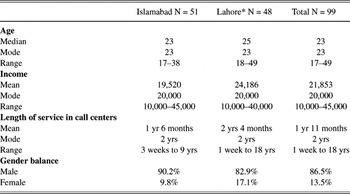
The detailed data on which this brief description of the CSRs is based are given in Appendix 1. Briefly, the CSRs in Pakistan are mostly young men (86.5%) and, though there are slightly more young women in Lahore at the TG (17.1%) as compared to Islamabad (9.8%), the industry is dominated by males. The young men are casually dressed, predominantly in the style of North American streets (jeans, T-shirts, baggy shorts, etc.), but some of the women wear chic Pakistani clothes while others wear jeans. Some of the men also have pierced ears with ornamental objects in them, and some wear long hair. Most, however, do not follow this fashion, nor do most males in the country.
The median age of the CSRs in the database is 23 years and the mode too is 23, though they range between 17 to 49. However, only two individuals out of a total of 99 are close to the higher end of the range. The mean salary of a CSR is PKR (Pakistani rupees) 21,853 (one U.S. dollar equaled approximately Rs. 82 in October 2008).Footnote 3 However, there is a bonus for selling products, which can enhance one’s salary to PKR 100,000 per month. The officers’ pay grade in government service (Grade 17) is PKR 27,115 to 41,915 per month, and the qualifications are higher. Moreover, the CSRs’ job is considered prestigious among young people of this age group, as it implies that they can negotiate the globalized labor market.
The CSRs exhibit a lot of enthusiasm for their job, not only because they earn a higher salary than their peers but also because they perceive themselves as being “smart”: They think they have acquired a native-speaker accent which, in their view, other users of English in Pakistan could not acquire. However, despite being highly motivated, only a few (8%) said they would stay in call centers; but then, even fewer (8.1%) said they would change their career. The other possible answers – “further studies,” “go abroad,” “don’t know,” “mixed,” and “no response” – do not reveal clear intentions; however, conversation with the CSRs suggests that they relate to their work and consider it distinctive but, at the same time, remain under much stress because they have to work at night (even otherwise, the job is stressful; see Cameron 2000:110). Typically, these young people are apolitical; they showed little interest in politics at a time of exceptional political turmoil in Pakistan when this study was being carried out (November 2007–March 2008). It was as if the realities of Pakistan did not touch them in their nocturnal, make-believe existence in America or Europe.
Linguistic Policies and Practices of the Call Centers
The linguistic practices of Pakistani call centers are similar to those of India as reported by Cowie (Reference Cowie2007), especially with reference to the meaning of a “neutral” accent. This accent is the scarce good, the salable commodity, which enables the CSRs to cross linguistic boundaries and, if successfully deployed, even pass as native speakers of English. This accent constructs the emergent identity (Bucholtz & Hall Reference Bucholtz and Hall2005:587–89) that is indexed to the coveted American (or British) identity. Let us, however, begin with a physical description of a typical call center in Pakistan, before we turn to the acquisition of this accent.
Call centers are generally situated in modern, glittering glass-and-metal buildings with avant-garde furniture and ample lighting. The security is tight and access to the CSRs is controlled by managers and other administrative cadres. There are advertisements of trainers claiming to conduct “Accent Neutralization Courses” of a few weeks to three months. Within the hall where the calls are received and made there are notices proclaiming an “English Only Policy.” One such notice in T-hone is as follows:
NO URDU POLICY
Do you Really want to improve your English?
If you do, then you need to stop speaking Urdu!
The only way to learn English (any language) is to force yourself to. speak it all the time. Especially when you feel uncomfortable.
One of the trainers, Abiaz, said that the policy was enforced but also added that it was necessary to do so. He said he was personally responsible for doing so being a trainer. Another person, an administrator called Ghazala, said that agents caught speaking Urdu – or other Pakistani languages – could be fined. However, CSRs were observed speaking Urdu with each other, so the policy was not as stringently imposed as claimed. Two trainers asked about the necessity of such a policy responded as follows:
(1) Abiaz: “English is their greatest asset in this job. We can’t teach it if they keep speaking other languages. We need such a policy. Besides, that English has to be in an accent the Americans can identify with. They won’t do business with someone with poor English or a strong foreign accent.”
Mohammad Wasaq: “Americans would hear back room chat in Urdu and they’d say ‘what’s goin on here?’ We don’t want them to get suspicious that they are dealing with al-Qaeda (laughs).”
In another interview, a trainer called Waseem Waraq said:
(2) “Accent is needed because in the USA they welcome people with their accent. It is a business aid. A person with a strong Pakistani accent doesn’t get business.”
Initially an administrator had told me that the training for both script and accent is of about 50 hours or two weeks. However, CSRs themselves reported varying periods for learning the accent, ranging from one day to a year. In T-hone the course for “accent neutralization” lasts only two days. However, “neutralization” goes on while the CSR is on duty as he or she keeps adjusting to the accent of the workplace and that of the clients.
Learning the features of a native accent of English is connected with intelligibility and not with the possibility that it may be an imposition on those who are economically and politically powerful. According to accent trainers:
(3) “It is a question of intelligibility. Our agents are 90% intelligible while in India they are often in trouble because they are not.”
Only in one small call center, E-surf, the owner, Daniyal Rahman (or Daniel Raymond, as he called himself), claimed that accent was less important than confidence, so he did not bother too much about it (Raymond Reference Raymond2007). He himself did not affect an American or British accent and had about 35 employees. However, Mohammad Wasaq, who happened to accompany me, pointed out that Daniyal was paying less than the big call centers (T-hone and I-span, in this case), and so the CSRs with better accents were unaffordable for him anyway. Thus, he made a virtue of necessity. Moreover, although Daniyal did not allow me to meet any of his CSRs during my four visits to his call center, I managed to find some of them on their way out. All of them had been in other, more prestigious call centers, and those who could possibly “cross” over to the desirable American identity seemed to be fewer than in other places. This, however, is an impression formed in brief meetings with only ten workers.
The Teaching of Accent
Unlike the situation in Bangalore (Cowie Reference Cowie2007:319–21), there are no companies offering accent neutralization courses in Islamabad and Lahore. These services are, however, offered by trainers hired by the larger call centers themselves. Smaller call centers and individuals can attend these courses on payment. Courses teaching the American accent are called “accent neutralization,” as in India (Cowie Reference Cowie2007; Taylor & Bain Reference Taylor and Bain2005:275). This concept was explained on several occasions to me or to others in my presence. The formal explanation given by Abiaz to trainees in a class held from 12 midnight to 2 am at T-hone is as follows:
(4) “We call this class a class in accent neutralization and not one in teaching American accent. What we do is to neutralize the strong Pakistani accent so that it becomes neutral. Like when you use it the other guy wonders: ‘Where is he from? Where is he from? but he isn’t a foreigner!’ So there is no accent; no foreign touch. It still won’t be exact, ditto.”
In another call center in Islamabad, I-span, the trainer, Nadia Khan, said:
(5) “It is not Native American but it will pass as one of theirs. That is a neutral accent.” (Khan Reference Khan2007)
Later, when I pointed out that the segmental and nonsegmental features used to replace (or “neutralize”) the Pakistani accent are from General American English (AmE), and so it is actually a course in the Americanization of accent, the trainer gave no reply.
All trainers used the same concept and explained it in private interviews and conversations with me in the same way. However, when confronted with several facts – phonological theories, course contents given in their own training aids, and the perceptions of the trainees who said they were learning the “American” or “British” accent – they had no answer. Nevertheless, they insisted upon using the same term.
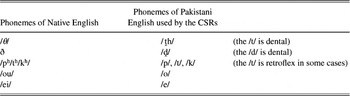
Personal observation of the actual performance of the CSRs on the phone gave me the impression that they could be divided into three categories. First, there were those who can “pass” for speakers of AmE. If they had learned the accent in Pakistan or as adults, then they generally only managed to “cross” over linguistically to the American identity for brief exchanges. However, sustained conversation betrayed their origins – which they took such care to conceal – to an observant native speaker or a trained linguist. The phonemes from Pakistani English given below were found in the speech of those who had learned AmE as adults.
Phonemes of native and Pakistani English varieties

Second, those who managed to “cross” over to the AmE identity for brief, formulaic interactions on the phone used the features in the following list, which they found easier to pick up. Third, those who picked up a few, superficial features of AmE could not even successfully “cross” to the other accent in brief interactions and were either subjected to retraining or eventually removed.
The features of AmE as described by Algeo (Reference Algeo and McArthur1992:39) and Marckwardt Reference Marckwardt and Frank1965 that are picked up easily are:
1. The American accent is mostly rhotic and so is that of Pakistanis. This feature is learned easily in theory, though the AmE /r/ is retroflex while the /r/ in PE is a trill. Although Pakistani languages do have retroflex phonemes, they are pronounced differently. Workers learn this difference with effort.
2. AmE (in contrast to British English) generally has /æ/ instead of /ɑ/ in words like half, dance, bath, etc. Pakistanis learn this easily. Indeed, this is the major distinction a novice manifests when he or she learns American pronunciation.
3. AmE often does not pronounce the /t/ in words like winter, which becomes winner. Pakistanis pick this up quite soon and it too becomes a marker of distinction from speakers of PE for them.
4. In AmE the /ɔ/ in “not” /nɔt/ and other words like it become the unrounded vowel /ɑ/, e.g /nɑt/. The change is not related to age, though, as older speakers tend to be Anglicized and the ones serving in the call centers aspire to Americanization, the latter are seen to manifest it.
5. Secondary stress on the penultimate syllables of words like laboratory is not part of PE (nor of British English) but it is picked up with some instruction.
6. Pronunciations with /sk/ in schedule are very easy to pick up for Pakistanis. As /sk/ and /sh/ are both in the phonetic inventory of Pakistanis this particular feature is easy to learn.
The following are more difficult to pick up according to the trainers, and, indeed, many of the “crossers” did not use them correctly.
a. Sometimes, in cases of hypercorrection, the aspiration in /p, t, k/ is excessive so that they become /ph/, /th/ and /kh/ (not described by Algeo Reference Algeo and McArthur1992: 39 but observed by the author).
b. In AmE /d/ generally occurs in words with a “t” or a “tt” in the spelling (e.g., latter and atom become homophonous with ladder and Adam). This is often confused by Pakistanis. This is associated with the desire to sound like Americans and not with the level of education or age. AmE (unlike British) generally does not have the /j/ glide in words like tune, duke. Thus they sound like /tun/ and /duk/. Pakistanis do not pick this up unless taught.
d. In AmE the /t/ of words like “beaten” becomes glottal and the /n/ becomes schwa + n.. This is not picked up easily by Pakistanis, but they try to elide the /t/ altogether, producing a diphthong /i:e/. followed by /n/.
e. The velarized /l/ of AmE is not picked up by Pakistanis initially, as PE has a clear /l/ even at the end of words, but acrolectal speakers use the dark /l/ (for PE see Rahman Reference Rahman1990:26).
f. Pakistani speakers are unable to distinguish between /v/ and /w/ (as described in Rahman Reference Rahman1990:28).
The trainers said that it was easier for Pakistanis to pick up the American accent rather than the British one because Urdu has the vowels /ɑ/ in ball but not /ɔ/ as in the British pronunciation of ball /bɔll/. They also said that among the first features of AmE to be picked up was the /æ/ vowel in words like bath and that this distinguished even the beginner CSR from the speakers of PE (and RP) who use /ɑ/. Also, pronunciations like /sk/ in schedule were picked up almost immediately. They were often unaware of what they themselves or the CSRs had not picked up. Instead, they uncritically insisted only upon the similarities of their “neutral accent” to a general AmE accent.
Another myth about accent, widely prevalent in the call centers, is that the Indian pronunciation of English is much more “Indian” than that of Pakistan. It takes much more time to be neutralized, it is claimed, so that Pakistani CSRs have an edge over their Indian counterparts. When I asked them whether they had any idea about the first language of the Indian speaker in general – which could be Tamil, Telugu, Malayalam, Bengali, Gujrati, Marhatti, Punjabi, or Hindi, to name only a few major languages – they could not answer the question. I also asked them whether the English of those with Hindi as a mother tongue was very similar to that of those with Urdu in the same position, but, again, the question evoked confused and unsure responses.
The class on accent that I attended in T-hone began at midnight. There were eight trainees, all from the call center itself, and the teacher was Abiaz. He began the class with Howdy guys and the trainees grunted or said howdy. The trainees switched on their computers and put on their earphones. The course was described as follows on the computer screen:
(6) SOUND AMERICAN
Call one.
http://accent.touchstone.com.pk
1. Intonation
2. Word connections
3. American pronunciation
4. Video Lessons
5. Call script practice
6. Fluency
The trainer then asked the class whether accent could be changed. The general consensus was that it could not be completely changed if one started learning it as an adult. However, the trainer said it could be learned “almost fully.” He added that “this is what a learner should believe, even if it is not true, if one wants to learn it. Otherwise you won’t be motivated.”
The students then explained their reasons for having joined this class. All of them considered the American accent not only good for upward social mobility (“job,” “business,” as they put it) but also intrinsically superior to the Pakistani accent. In fact, the notion of Pakistani English was something of a joke and a stigma that had to be removed.
After this the concept of “neutral accent” was explained as discussed above, and the exercise started. The students were made to repeat the exercise and given instructions how to sound the retroflex /r/ and use /æ/ for /a/ (i.e. /hæf/ not /haf/ for half.
The importance of using a “neutral” accent was emphasized again and again with reference to the attitudes of Americans: “Will the Americans like to buy from a person who sounds different from them?” The trainees agreed they would not, but nobody said this could be racism nor did anyone point to the power differential between the Western client and the Asian CSR. The body language of the trainer as well as of the trainees was similar to that shown in Bollywood or American TV dramas. And, contrary to Pakistani norms of behavior, nobody addressed the trainer as “sir,” though they did use “sir” for their would-be clients in the USA.
Biographical Glimpses of the Lives of Accent Trainers
Besides the questionnaire given in Appendix 1, the results of which are given in Appendix 2a & b, the perceptions of the CSRs about language policy and practices in the call centers were obtained by in-depth interviews of two trainers, Abiaz and Mohammad Wasaq, who had been CSRs to begin with, and brief interviews of other trainers.
Abiaz went to a government, Urdu-medium school and had very little exposure to English. He is a Pashto speaker but retains almost no trace of his mother tongue in his present variety of English as far as I could discover. He went through the local school and university system, culminating in earning a master’s degree in English literature. However, accent was not taught to him at any level. He claims to have been internally motivated to pick up “correct” English. Thus, he listened to the BBC to pick up the British accent and then watched innumerable American films and other TV programs. This took him two to three years, during which he served as a teacher of English in a cadet college. In 2004 he joined the TG call center in Lahore (3000 employees in 2005, reported by Siddiqui Reference Siddiqui2005:2) and became a trainer of accent – the first to be selected who had not lived in the USA for years. He is now reputed to be one of the best trainers of accent in T-hone and is said to speak with near-native fluency by John Smith, his American manager.
Mohammad Wasaq, on the other hand, went to the USA as a boy of 15 and spent his youth there, returning to Pakistan in 2004. His main reason for working in the call centers is that he finds the atmosphere there – the pseudonyms, the accent, the clothes, the body language – like “home” (i.e., America). He says he finds it “relaxed like the States” and believes that Pakistani jobs have “too much politics and” (with a shrug of the shoulders) “I don’t dig them.” He trains the CSRs in knowledge of the product, not in accent, but, of course, the accent is always an issue.
Yet another trainer, Wasim Waraq, lived in America for 20 years. He teaches both English and Spanish. The latter is meant to interact with Spanish-speaking Americans who use that language in the USA. He acquired his skills in both languages while working in America. During our interview, he kept switching accents from acrolectal Pakistani to near-native American.
Yet another trainer, Nadia Khan of I-span, learned the accent in Pakistan from a Canadian trainer. She prides herself on her English skills and claims that one of her trainers has never been abroad. The other trainer’s certification comes from Anne Cooke, who produces training CDs. She offers accent neutralization courses of four days followed by a course in product training lasting ten days. Then there is an on-floor evaluation of 30 days, so that the whole process takes 40 days or more (Khan Reference Khan2007).
One thing common to all the trainers is their pride in the accent they have acquired. As Ingrid Piller noted, “Personal motivation, choice and agency seem to be more crucial factors in ultimate attainment,” and, further, one can learn a second language with native-like competence even as an adult learner (Piller Reference Piller2002:201). Some of these young people have shown tremendous personal motivation and appear to have achieved remarkable success in learning their target language variety.
Linguistic Crossing and Passing
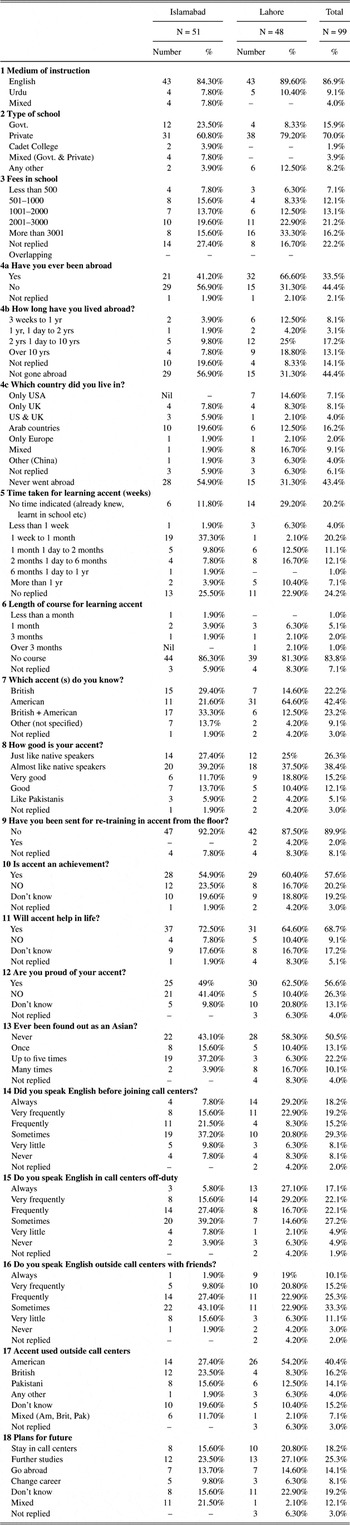
Besides the data from conversations, interviews, and observation, the following data from questionnaires (Appendix 2a & b) are useful for understanding the language ideology and perception of identity of Pakistani CSRs. First, most of them are fluent speakers of English, having been educated in English-medium schools (86.9%) and/or having lived abroad (53.5%) for two years or more predominantly in English-speaking countries. Even those who have lived in Arab countries (16.2%) also studied in English-medium schools there, presumably coming in contact with English-speaking teachers and peers. As most of these young people were exposed to English before their experience in the call centers, they spoke English frequently (52.6%) before joining them. They also claim to speak English when off duty in the call center (61.3%) – something which the present author can corroborate by experience – and also with friends outside the call centers (50.6%). That is probably the reason why 20.2% said they already knew the target accent or learned it in school. Most of them (83.8%) did not take a course in accent training but learned it in a short time, either after a brief training of a few days or on the job itself. The accent most commonly claimed to be used was American (42.4%), though 23.3 % respondents said they also knew the British accent. Only 22.2% claimed to speak only in the British accent. While only 26.3% claimed they spoke “just like native speakers,” most (38.4%) said they spoke “almost like native speakers.”
This would suggest that a little more than one-quarter (26.3 %) of the CSRs claim to be “passing” rather than merely “crossing” to the “other” identity. Such an assertion has been made by Ingrid Piller for 27 out of 73 (37%) second-language users of English and German, who said “that they were passing for native speakers in some contexts” (Piller Reference Piller2002:179). Such cases are different from most of the examples of “crossing” available in the literature. More typical cases of crossing, let us remember, are of an upper-middle-class New York City white teenager who employs some features of African American Vernacular English (AAVE) in order to identify with the Black youth subculture he seeks out (Cutler Reference Cutler1999); impromptu use of German among adolescents in a multilingual school in inner London (Rampton Reference Rampton1999b); or a white boy in a California high school who uses AAVE for much the same reasons as the New Yorker (Bucholtz Reference Bucholtz1999). In such cases the target identity indexed with a certain kind of stylization of speech remains elusive and one remains inauthentic. However, the case of Delilah, a 23-year-old white female who makes consistent use of many distinctive linguistic features associated with AAVE, is more complex (Sweetland Reference Sweetland2002:514). In her case, her association with African Americans “lends her an air of authenticity that an adolescent code-crosser imitating ‘Yo! MTV Raps’ cannot begin to claim” (Sweetland Reference Sweetland2002:531). The case of Texan women who act out a Southern belle identity is also complicated, as they are not using “languages or varieties that are clearly felt to ‘belong’ to others” (Johnstone Reference Johnstone1999:514). In short, both Delilah and the Texan women can pass for African Americans or Southern belles in particular contexts in certain interactions. Likewise, CSRs and trainers who have had long exposure to American English can also pass for Americans in certain contexts. This is not to say, however, that their claim that they speak “just like native speakers” (26.3%) is to be considered true for all contexts and for all kinds of interactions.
Coming now to the 38.4% who think they speak “almost like native speakers,” they appear to be able to cross for brief telephone exchanges as speakers of American English. The remaining 35.3% make no claim even to this lower level of attainment. Such people should have been sent for retraining in accent from the floor, but 89.9% claimed that this had never happened to them. However, only about 50.5% claimed that their clients had never found out they were Asians. Of course, not every American or British client tells the CSR that they know their interlocutor is Asian, so that the number of CSRs who do not authentically cross can be quite high. This is supported by the fact that at the anecdotal level stories of “being caught” or “found out” were common and seemed to be a matter of great concern for the CSRs. Moreover, although the management did not reveal the exact figures, many CSRs are removed if clients complain about their inadequate language skills.
Part of the language ideology of the CSRs and trainers is to be immensely proud of their accent (56.6%). It is not only for the pragmatic reason that it would help them in life (though 68.7% said it would). It is something that sets them apart from other Pakistanis who, in their view, speak inauthentic English. A corollary of this pride is that 40.4% claim to use the American accent and 16.2% the British accent outside the call centers. There is no way to verify these claims, but the fact that they are made suggests what a high value is given to native-speaker accents in the call centers of Pakistan.
Language Ideology and Discrimination
As work on language ideologies makes clear, it is with reference to them that we evaluate and pass judgments upon the series of sounds that is human speech (Schieffelin, Woolard & Kroskrity Reference Schieffelin, Woolard and Kroskrity1998, Woolard & Schieffelin Reference Woolard and Schieffelin1994). If language ideology is defined as “sets of beliefs about language articulated by users as a rationalization or justification of perceived language structure and use” (Silverstein Reference Silverstein, Clyne, Hanks and Hofbauer1979:193), then the relevant belief in this context is that Pakistan’s languages are arranged in a hierarchical order.
In this hierarchical scale English is at the top as the language of empowerment (through employment), followed by Urdu, with the mother tongue (if it is other than Urdu) coming last (Mansoor Reference Mansoor2005:266–67). If the mother tongue happens to be Punjabi – otherwise the language of the dominant majority – there is more culture shame over it than if it is Sindhi, Pashto, Balochi, or Brahvi (Mansoor Reference Mansoor1993:187–90).
However, even English itself is differentially invested with linguistic capital. Among the older age group (50+) it is British Standard English pronunciation (RP) that is most valued. Pakistani speakers of English actually speak what Baumgardner (Reference Baumgardner1987) calls “Pakistani English” (PE), and which is described in more detail in Rahman (Reference Rahman1990). This variety of non-native English is further subdivided into acrolectal, mesolectal, and basilectal PE. The acrolect is also called the Educated Pakistani English accent and reflects grammatically correct written standard English. The mesolectal subvariety follows many of the rules of Pakistan’s languages but is intelligible to British-educated speakers, while the basilect is barely comprehensible to native speakers of British or American English (Rahman Reference Rahman1990:16). Discrimination of the type reported by Lippi-Green Reference Lippi-Green1997 for the United States is part of this ideology of the hierarchization of languages, styles, and accent. While the upholders of the autonomy of non-native varieties of English aspire to create pride in them, there is culture shame about Pakistani English – including the very term itself – in Pakistan. However, while educated Pakistanis accept the acrolect as a prestigious norm, they are contemptuous toward the other subvarieties of PE. As for the American pronunciation, its prestige has increased since dish and later cable TV providing American channels came into the country in the early 1990s. However, this prestige is still restricted to younger people (up to those in their thirties) and still has not replaced the prestige of RP among older people. Indeed, to them, the American accent appears to be affected and somehow false, whereas their own (though it too is learned and cannot be “perfect”) is seen as sophisticated. This situation is similar to that in India, where “the older generation of phonetics trainers (over 30) negatively evaluated American ascents and positively evaluated British accents” (Cowie Reference Cowie2007:323).
While the language ideology of the call centers privileges the “American accent,” except for a few informed CSRs and trainers who have lived for a long time in the USA, it is not fully appreciated that there are several varieties of American English (Lippi-Green Reference Lippi-Green1997:31-40). The trainers actually claim to use “international English” in a “neutral” accent. However, “you sound like an American” is considered a great compliment. The privileging of native speakers goes to the extent of relieving them of any role in actual communication. However, according to Clark’s cognitive model of the communicative act, “the heavier burden usually falls on the listener, since she is in the best position to assess her own comprehension” (Clark & Wilkes-Gibbs Reference Clark and Wilkes-Gibbs1986:34). Listeners will understand accented speech better “when they are motivated, socially and psychologically, to do so” (Lippi-Green Reference Lippi-Green1997:70). But the call center workers of Pakistan feel that the native-speaker client need not make any such collaborative effort. Even when reporting incidents of hostility from customers, they explain it away with reference to the time of the call or dissatisfaction with the product. With reference to CSRs who were removed from the service because of their accent, it was always called “weird,” “strange,” or “Pakistani” by their former colleagues or managers.
This ideology of the superiority of the native speaker makes call center workers evaluate the English of other Pakistani speakers of English negatively. “Your friend has a Ph.D. from a famous American university, sir, and yet he did not learn the right accent. How did his students understand him?” Abiaz once asked me about an academic who had been with us for dinner.
“But you don’t need an American accent to lecture in an American university,” I told him. He shook his head skeptically and went on to tell me how he had sat up listening to American programs late at night.
This contempt for the Pakistani accent of English, even in the case of highly educated (acrolectal) speakers, is evident in the fact that only 5.1% of them claimed that they spoke “like Pakistanis,” whereas only 50.5% claimed that they had never been found out to be Asians. As mentioned earlier, even this claim is probably exaggerated, so the number of workers – as I can testify – who obviously speak like English-educated Pakistanis most of the time is certainly more than the claimed 5.1%. Those who claim to use the Pakistani accent outside the call centers are only 14.1% but this too is much lower than what one would expect. Indeed, even if we add those who claim to use the native-speaker (American and British) accents outside the call centers, the figure we get is 43.4%. The remaining 56.6% includes not only the claimed 14.1% “Pakistani accent” but also “don’t knows” (15.2%); “mixed” accents (7.1%), unspecified “others” (4%), and those who did not reply (3%). One would speculate that more than 50% of the CSRs actually use the accent they are more comfortable with (i.e., the educated “Pakistani accent”) outside the call centers. Not reporting this, or possibly not even noticing this, is part of the language ideology that stigmatizes the Pakistani accent of English.
As in the cases of other language ideologies, this particular one subordinates the CSRs themselves and discriminates those who remain inauthentic in their speech and ultimately lose their jobs. If the call center workers were a powerful collectivity, then it would probably discriminate against the other speakers of PE, but being few and powerless, they express their disapproval of others within their own group.
The speakers of PE, as mentioned earlier, are not a homogeneous group. The highly Westernized elite, which is trained in English in expensive, English-medium, elite schools and colleges, are the descendants of the British-trained Anglicized elite who were nicknamed the “Brown Sahibs” (Vittachi Reference Vittachi1987). They regarded RP as the “correct” linguistic norm but actually used educated Indian English (the acrolect). In Naseer Ahmad Farooqi’s novels about Pakistan in the 1950s, descendants of this elite sometimes abbreviate their names to sound like English names, drink alcohol, play at billiards in the club, and recite English poetry (Farooqi 1968:9). The language ideology of this elite, and others who are less fluent in English but occupy high positions in society, values English but finds its native accents, including RP, alienating. However, the prestige of RP lingers on so that it is still acknowledged as being “correct” though it is PE that indexes the Pakistani elite identity, and not RP. But when it comes to the use of the American accent by a Pakistani, the reaction is negative unless the speaker was born and brought up in the United States, in which case the accent is considered natural for him or her.
It should also be mentioned that this linguistic “crossing,” however convincing it may be in certain contexts, is also seen as the art of the “imposter, the spy” since it involves hiding a person’s true identity and assuming a “fake” one. As Piller says: “Like any other deceit, it is negatively evaluated: to be a ‘language cheat’ is as morally wrong as putting credentials you do not have on your CV” (Piller Reference Piller2002:198).
If the performance is seen as linguistic crossing, then it is discriminated against just as some Black communities criticize Whites “who try to sound too ghetto” (Sweetland Reference Sweetland2002:532). “They have phony accents,” complained one government official upon being introduced to a CSR. “While I cannot employ a chap with a pendu (village yokel) Punjabi accent, it would hardly be wise to take in somebody who is posing to be an American all the time either.” The young CSR was employed eventually because his competitors, to his good luck, fell in the pendu category.
Now here is a story of another young man who was not so lucky. His would-be employer, a senior air force officer administering an institution for the teaching of English, said to me:
(7) “I can’t believe it. And he hasn’t even been abroad. When he spoke on the phone I thought it was a Pakistani born and bred in America and I almost promised him the job. But I am having second thoughts now. Look, what kind of person would change his name and pose to be an American only for a job? And he would have to speak straight in this place. We don’t want this fancy accent.”
The young man was eventually rejected.
English in the Call Centers Versus English in Pakistani Society
Both the Anglicized British Indian elite and the workers in present-day call centers accommodated their language to empower themselves in certain situations: the former to become functionaries of the colonial state, and the latter to take advantage of a new kind of lucrative employment offered by globalization. However, the colonial Anglicized elite had more agency. Even when subordinated by colonial British rulers they held important positions in the elite Indian Civil Service (ICS) and the officer corps of the military. They believed they were working for the progress of their people, a belief which the Pakistani bureaucracy and military inherited. The call center workers, on the other hand, have very little agency. Their speech (Cameron 2000:98), emotion (Hochschild 2003), and even citizenship (Poster Reference Poster2007:276) are managed, reducing their agency in the workplace. Some of these practices have been resisted in India (Taylor & Bain Reference Taylor and Bain2005:273) and the UK (Cameron 2000:112), but I could not confirm any resistance in Pakistan. Outside the workplace, whereas the English-using elite has agency in running the country, the call center workers have none at all. Even socially they are forced to participate only occasionally, and then for limited periods, in community and family activities, because they work at night and are too tired by day.
Moreover, however much the Pakistani elite may regard RP as a norm in theory, in practice there is no pressure upon them to actually use it. The call center workers, on the other hand, are constrained to practice what Bell calls the initiative style shift, the essence of which is “Referee Design” “by which the linguistic features associated with a group can be used to refer to or identify with that group” (Bell Reference Bell1999:525). In their case, as in the case of the crossers mentioned earlier, there is “the apparently ever-present risk that this constructed self will be rejected as ‘inauthentic’ – that the crosser will be rejected as, in Cutler’s words, ‘a “wannabe”’ by peers of both ‘own’ and ‘other’ group” (Hill Reference Hill1999:552). The Pakistani users of English, while not necessarily confident about their written and spoken skills in English, do not lay claim to another identity and, therefore, do not suffer from these fears of rejection.
Conclusion
The language ideology of Pakistan hierarchizes languages and accents used in the country. English spoken in an educated Pakistani accent is the most prestigious. Next is Urdu, followed by the indigenous mother tongues of the people. In the call centers of the country the Pakistani accents of English are stigmatized as workers aspire to native (mostly American) English accents. Such an accent is a highly salable commodity and is produced by adding some linguistic features of the target accent to the local Pakistani accent in a process called “accent neutralization.” The workers acquire this with varying degrees of proficiency and create identities based upon it as well as on their cultural knowledge of America (or Britain) to act out or create an identity enabling them to pass for native speakers of English. This performance often succeeds only in enabling them to cross over to the desired identity for brief interactions, though in some cases they appear to pass as the speakers of the target language for longer durations in certain contexts. However, this accent also alienates them from the English-using Pakistani elite and, if known to have been acquired, is seen as “fake,” “phony,” or “put on.” On the other hand, the call center workers consider their acquired accent not only a business necessity but also “normal,” thus implying the deficiency of all other accents and, hence, the desirability of changing them. Accent, then, is the site of an ongoing struggle for the construction of new, globalized identities in the call centers of Pakistan. This new identity belongs to the corporate sector and is alienated from the Pakistani culture around it. The call centers, then, can be seen as new sites for the extension of globalized capitalist market practices and the ideology which underlies them in the world.
Appendix 1: Questionnaire for Workers in Call Centers
Please do not give your name. This information will be used only for academic research and for no other purpose.
Age Income Male/Female
Length of service in call centers
1. What was the medium of instruction in your school?
(a) English (b) Urdu (c) Sindhi (d) Any other (Specify)
2. What type of School did you attend?
(a) Government school (b) Private school (c) Cadet College (d) Any other (Specify).
3. If you attended a private school, what were the monthly tuition fees?
(a) Less than Rs. 500 per month. (b) Between 501 to 1000 per month. (c) 1001 to 2000 per month. (d) 2001 to 3000 per month. (e) More than 3001 per month.
4. (4a) Have you ever been to any foreign countries before having joined the call center. (4b) If so, which one? (4c) and for how long?
5. How long did you take to learn the accent you use in your job? Please give in months or weeks?
6. Did you a do a course to learn this accent? How long was it?
7. Which of the following accents do you know?
(a) British (b) American (c) Any other (specify)
8. Do you think you sound (a) just like native speakers of that accent (i.e. Americans, British etc) (b) almost but not like native speakers (c) very good (d) good (e) like Pakistani speakers of English.
9. Have you been sent for accent training from the floor? If so, how many times?
10. Do you think at is a great achievement to have learned the accent you have now?
(a) Yes (b) No (c) don’t know
11. Do you think your new accent will help you in life?
(a) yes (b) No (c) don’t know.
12. Are you proud of your accent?
(a) yes (b) No (c) don’t know
13. How many times have you been asked by some caller whether you are an Asian?
14. Did you speak English with friends before joining the call center?
a. Always b. Very frequently c. Frequently d. Sometimes e. Very little f. Never
15. Do you speak English with friends in the call center off-duty?
a. Always b. Very frequently c. Frequently d. Sometimes e. Very little f. Never
16. Do you speak English with friends outside the call center?
a. Always b. Very frequently c. Frequently d. Sometimes e. Very little f. Never
17. Which accent do you use outside the call center?
a. American b. British c. Pakistani d. Any other (specify) e. don’t know
18. What are your plans for the future?
a. I will stay in the call center.
b. I will study further.
c. I will go abroad.
d. I will choose some other career (specify)
e. don’t know.
Profile of Respondents (csrs) * Two respondents from the Lahore sample did not give their age. The above calculations are from 97 for the whole data and 46 from Lahore. Answers to the Questionnaire