Introduction
During the release of parasitoids in a biological control programme, it is expected that females rapidly find and oviposit in the target host, in the target plant or fruit. How fast the biological control agent can locate its host and oviposit is one factor that can affect the insect efficiency in pest management (Kroder & Messing, Reference Kroder and Messing2010). The longer time the parasitoids take to locate their host, the higher is the risk that they will be attacked by predators and be affected by other biotic and abiotic factors. Energy investment will also increase with a longer location time. Insect host location is an innate behaviour but also a behaviour that can change by learning (Raine & Chittka, Reference Raine and Chittka2008; Wei et al., Reference Wei, Tang, Wang, Yang, Cao, Lu, Liu and Liu2013). Learning is defined as a modification of behaviour based on past experience. If the learned behaviour is a result of previous experience associating a stimulus with a reward or a punishment, it is defined as associative learning. Parasitoids can learn to associate host-related odours (Ngumbi et al., Reference Ngumbi, Jordan and Fadamiro2012; Canale et al., Reference Canale, Geri and Benelli2014) and visual cues (Segura et al., Reference Segura, Viscarret, Carabajal Paladino, Ovruski and Cladera2007; Lucchetta et al., Reference Lucchetta, Bernstein, Théry, Lazzari and Desouhant2008; Desouhant et al., Reference Desouhant, Navel, Foubert, Fischbein, Théry and Bernstein2010), with their hosts. Individuals that can learn which environmental stimuli are associated with mates and food may have a fitness advantage over those that cannot and therefore should be favoured by natural selection (Dukas & Duan, Reference Dukas and Duan2000).
Associative learning is previously documented for various Braconidae parasitoids (Müller et al., Reference Müller, Collatz, Wieland and Steidle2006; Ngumbi et al., Reference Ngumbi, Jordan and Fadamiro2012) and for Braconidae wasps that develop in Tephritidae fruit fly species (Lewis & Takasu, Reference Lewis and Takasu1990; Seino & Kainoh, Reference Seino and Kainoh2008; Giunti et al., Reference Giunti, Benelli, Flamini, Michaud and Canale2016). Parasitoids preference for odour cues that orient them to host patches may change with the associative learning (Giunti et al., Reference Giunti, Canale, Messing, Donati, Stefanini, Michaud and Benelli2015). Inexperienced wasps respond innately to stimuli that are derived from their hosts or that indicate appropriate hosts (Turlings et al., Reference Turlings, Wäckers, Vet, Lewis Joseph, Tumlinson, Papaj and Lewis1993). A positive oviposition experience by Cotesia marginiventris Cresson (Hymenoptera: Braconidae) on a preferred host causes additionally an increased attraction, due to the positive association generated of plant volatiles and the reward, given as host presence (Harris et al., Reference Harris, Ruberson, Meagher and Tumlinson2012). Experience of non-infested host fruit can subsequently reduce parasitoid acceptance during later encounter with the same host substrate, even if the latter is infested (Thiel & Hoffmeister, Reference Thiel and Hoffmeister2009). Experience of parasitation that gives a positive association with accompanying cues might enhance the host location capacity subsequently, thus laboratory studies have demonstrated that learning of host-associated sensorial cues reduce the time of decision and enhance the host location efficiency (Papaj & Vet, Reference Papaj and Vet1990; Canale et al., Reference Canale, Geri and Benelli2014; Giunti et al., Reference Giunti, Canale, Messing, Donati, Stefanini, Michaud and Benelli2015). Researchers have proposed that from an applied perspective, odours could be used to train mass-reared parasitoids prior to release, to potentially improve their efficacy in the field, i.e. by allowing the parasitoids to associate a good oviposition site with a sensorial cue that are emitted from the target fruit fly and host fruit (García-Medel et al., Reference García-Medel, Sivinski, Díaz-Fleischer, Ramirez-Romero and Aluja2007; Benelli & Canale, Reference Benelli and Canale2012). A priori host exposition stimulates host discrimination and enhances fruit fly parasitism (Gonçalves et al., Reference Gonçalves, Manoukis and Nava2017). However, a learned preference in laboratory does not always translate into a change in parasitization preferences in semi-field, as observed for the parasitoid Cotesia glomerata L. (Hymenoptera: Braconidae) (De Rijk et al., Reference De Rijk, Cegarra Sánchez, Smid, Engel, Vet and Poelman2018).
Fopius arisanus Sonan (Hymenoptera: Braconidae) is an egg-pupal koïnobiont endoparasitoid able to attack and survive in at least 20 Tephritidae species from the genera Bactrocera, Ceratitis, Anastrepha (Quimio & Walter, Reference Quimio and Walter2001; Rousse et al., Reference Rousse, Gourdon and Quilici2006), and possibly also Euphranta and Philophylla (Chinajariyawong et al., Reference Chinajariyawong, Clarke, Jirasurat, Kritsaneepiboon, Lahey, Vijaysegaran and Waiter2000). Successful introductions of F. arisanus into Hawaii and French Polynesia demonstrate that this parasitoid is an efficient biological control agent, causing a high level of parasitized egg, which result in a reduction of populations of, e.g. Bactrocera dorsalis Hendel and Ceratitis capitata Wiedemann (Quimio & Walter, Reference Quimio and Walter2001; Vargas et al., Reference Vargas, Leblanc, Putoa and Eitam2007, Reference Vargas, Piñero, Mau, Jang, Klungness, McInnis, Harris, McQuate, Bautista and Wong2010). Releases of this Asian parasitoid have additionally been conducted in Guatemala (Rendon et al., Reference Rendon, Sivinski, Holler, Bloem, Lopez, Martinez and Aluja2006), Kenya (Ekesi et al., Reference Ekesi, De Meyer, Mohamed, Virgilio and Borgemeister2016), Benin (Gnanvossou et al., Reference Gnanvossou, Hanna, Bokonon-Ganta, Ekesi, Mohamed, Ekesi, Mohamed and DeMeyer2016), Senegal (Ndiaye et al., Reference Ndiaye, Ndiaye, Djiba, Ba, Vaughan, Rey and Vayssieres2015) and Australia (Carmichael et al., Reference Carmichael, Wharton and Clarke2005) with different results. Augmentative release of Braconidae parasitoid species from the subfamily Opiinae occurs frequently and is hence a relatively established management method of Tephritidae pest species (Sivinski et al., Reference Sivinski, Calkins, Baranowski, Harris, Brambila, Diaz, Burns, Holler and Dodson1996; Montoya et al., Reference Montoya, Liedo, Benrey, Cancino, Barrera, Sivinski and Aluja2000; Vargas et al., Reference Vargas, Long, Miller, Delate, Jackson, Uchida, Bautista and Harris2004; Aluja et al., Reference Aluja, Sivinski, Ovruski, Guillén, López, Cancino, Torres-Anaya, Gallegos-Chan and Ruíz2009)
The host location behaviour by F. arisanus is guided by olfactory cues from the host fruit (Altuzar et al., Reference Altuzar, Montoya and Rojas2004) and from Tephritidae eggs (Rousse et al., Reference Rousse, Chiroleu, Veslot and Quilici2007; Quilici & Rousse, Reference Quilici and Rousse2012). Semiochemicals emitted from fruit fly-infested fruits are additionally stimulating the searching behaviour of parasitoids that parasitize the larval stage of the flies (Ero & Clarke, Reference Ero and Clarke2012; Sivinski & Aluja, Reference Sivinski and Aluja2012). Specific compounds emitted as fruits are infested and fruit fly parasitoids are able to differentiate odour from infested and non-infested fruits (Carrasco et al., Reference Carrasco, Montoya, Cruz-Lopez and Rojas2005). The combination of odours from both fruit and fruit fly, as in infested fruits, is preferred by F. arisanus over non-infested fruits (Liquido, Reference Liquido1991; Altuzar et al., Reference Altuzar, Montoya and Rojas2004; Rousse et al., Reference Rousse, Chiroleu, Veslot and Quilici2007).
By using different fruits infested with fruit fly species eggs, we investigated to which extend the wasp F. arisanus developed a preference for an odour after training and if association learning ability is related to the different combinations. By comparing the innate behavioural odour response with the response of parasitoids that has previous experience of the same odour, we examined F. arisanus associative learning capacity. We investigated the ability of mated female F. arisanus to associate cues of the fruit fly species Zeugodacus cucurbitae Coquillett, B. dorsalis, Ceratitis cosyra Walker and C. capitata (Diptera: Tephritidae), with the fruits papaya Carica papaya L. (Caricaceae), tomato Solanum lycopersicum L. (Solanaceae) and banana Musa sp, Diekmann, (Musaceae). We conducted parasitoid preferences assays in a Y-tube olfactometer to examine the effects of association learning experience and to investigate if the capacity to learn depended on the fruit fly species and/or the fruit combination.
Materials and methods
Parasitoid F. arisanus
An initial population of F. arisanus started in 2008 at the International Institute of Tropical Agriculture station in Benin (IITA-Benin), with 1000 individuals (70% females) provided by the International Centre of Insect Physiology and Ecology (icipe), Kenya. Fopius arisanus were released in Benin and specimens recovered from the field (300 individuals, 86% females), in 2010, gave rise to a new colony, from which we obtained female F. arisanus used in the bioassays in this study. The climate chamber was kept at 25 ± 2 °C and RH 75 ± 5% with a photoperiod of 10 L:14 D. Parasitoids were reared with B. dorsalis as a host and papaya as the main larvae food substrate. Fruit fly infestation of papaya sections were done in transparent Plexiglas cages (20 × 20 × 20 cm) during 4 h with 50 couples of mature B. dorsalis. The infested papaya sections were thereafter introduced to cohorts of 50 couples of 7–15 days old F. arisanus, allowing parasitization during 48 h. After incubation of the papaya for 10 days, pupae were placed in nylon mesh-covered (100 µm gauge) containers, which permitted the emerging parasitoids to leave but hindered the fruit fly species leaving. The adult wasps were thereafter kept in cages (20 × 20 × 20 cm) that were placed near windows to provide natural sunlight every day (10 am to 16 pm) as male F. arisanus require bright light to initiate mating (Hagen, Reference Hagen1953; Ramadan et al., Reference Ramadan, Wong and Beardsley1992; Sime et al., Reference Sime, Daane, Wang, Johnson and Messing2008). Pure honey and water were provided ad libitum. Mature, mated 7–11 days old female parasitoids were used for the experiments.
Tephritidae species
Tephritidae species B. dorsalis, Z. cucurbitae, C. capitata and C. cosyra were reared under laboratory conditions with 25 ± 2 °C, 75 ± 5% RH and 12 L:12 D photoperiod. Bactrocera dorsalis, C. capitata and C. cosyra larvae were reared on papaya and Z. cucurbitae were provided with zucchini Cucurbita pepo L. (Cucurbitaceae). Whole fruits, grown at the IITA station, were introduced into the rearing cages during 48 h and then incubated for 10–15 days. Pupae were collected and transferred to cages (40 × 40 × 50 cm), where emerged male and female adults were kept together. Flies were provided with water and a mixture of a dry diet of red sugar and enzymatic-hydrolysed yeast (CAS: 100684-36-4, Affymetrix, Santa Clara, CA, USA) at a ratio of 3:1, respectively, ad libitum.
Fruit material
Papaya C. papaya L. (Caricaceae), var. Solo, and tomato S. lycopersicum L. (Solanaceae), var. hybrid Thorgal F1 Mill, were cultivated within IITA-Benin station. Banana Musa sp, Diekmann (Musaceae), were bought from the local market. Fruits with a similar size were used, hence the bigger fruits were chopped into comparable sizes, approximately 100 g fruit−1. Ripe fruits were used, evaluated by ocular observations of colour, where <¾of the papaya were yellow, <¾ of tomato red and the whole banana yellow.
Bioassays
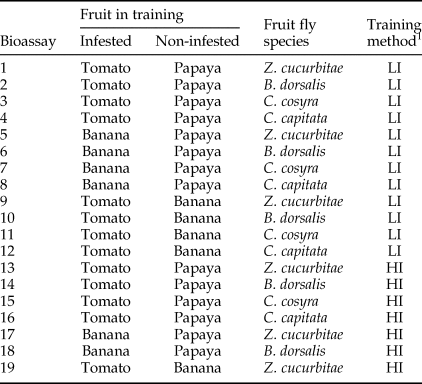
Each bioassay consisted of three parts; training of parasitoids, two-choice test and post-olfactometer observation. Nineteen bioassays were conducted; each one testing F. arisanus response to one combination of two fruits infested with different fruit fly species (table 1). By using two training methods, with different levels of interaction (low interaction (LI) and high interaction (HI), see below) with the host fruit fly species, we assessed whether the level of interaction had an effect on the learning ability (table 1). Comparisons between naïve and trained insects allowed us to assess the effect of the learning experience.
Fruit and Tephritidae fruit fly species used in bioassay during the training and in the two-choice olfactometer test.

1 Low-interaction level (LI), high-interaction (oviposition) level (HI).
Fruits were infested naturally by the fruit fly species, both for the training session and for the choice assays. One fruit was introduced per cage (15 × 15 × 15 cm) together with 30–50 fruit fly females of the respective fruit fly. Infestations of fruits by Z. cucurbitae and B. dorsalis were completed during 1 h and C. capitata and C. cosyra were allowed to oviposit during 2 h. Observations were thereafter made with a stereomicroscope (WILD M3R, Heerbrugg, Switzerland, 40× magnifications) to confirm the presence of at least 30 fruit fly eggs per fruit. All experiments were conducted in a room with uniform lighting to avoid phototaxis. Environmental conditions were 25 ± 2 °C and 75 ± 5% RH.
Training procedure
One-half of the parasitoid cohort was trained one time before the bioassays, while the second half was kept naïve. The training consisted of exposing the wasps simultaneously to one infested fruit and to one non-infested fruit. During the training method named low-interaction level (LI), parasitoids were introduced into a small cage (15 × 15 × 15 cm) during h. A total of approximately 60 parasitoids, in groups of 15, were trained per bioassay. The parasitoids were able to touch the fruits, palp, probe and oviposit in the fruit fly eggs. For the first 15 m in the cage, the parasitoids were observed and their behavioural activities were recorded. In the training method named high-interaction level (HI), parasitoids were introduced into a small cage (15 × 15 × 15 cm). A total of approximately 50 parasitoids were trained per bioassay, in groups of five. Each parasitoid that was observed ovipositing was removed from the cage. The parasitoids were considered trained only if it had adopted oviposition behaviour, i.e. when the parasitoid drilled its ovipositor in the cluster of eggs, had its antennae raised, and stayed motionless for at least 25 s. The training was performed between 10.00 and 12.00 am. The interval between the training and the testing phase was 1–4 h. Hence, all the parasitoids in the high-interaction level oviposited in the fruit fly eggs, while parasitoids in the low-interaction level were in contact with the fruits for 1 h but did not for sure oviposit.
Two-choice assays
The naïve and the trained parasitoids were compared in two-choice assays to measure the effect of learning. The treatments in each bioassay (1–19) consisted of two fruits infested with the respective fruit fly species (table 1). We investigated the olfactory response of the parasitoids towards volatiles of infested fruits in an olfactometer. The system consisted of a compressor (KNF Neuberger, D-79112, N-type 035, 230 V, 1.7 A, Bj 10/1997, Pmax 4.0, IP 44 Kw 0.23, 50 Hz), which generated the air stream through the olfactometer. The air was first pushed through an activated charcoal filter and thereafter through a bottle of water to clean and humidify the air. The air then was divided and passed through two glass bottles containing two different odour sources. In each bottle, one infested fruit was placed. Odours from the bottles were then led into each glass arm in the Y-tube olfactometer (3 cm diameter). The airflow was 4L min−1 per arm.
Trained and naïve female F. arisanus were individually, alternately and gently transferred into the opening of the olfactometer. The wasps were observed during 5 min or were discarded as non-choice insect if they did not make a choice within 5 min. Time of activation, time of choice and the odour source chosen were recorded. The olfactometer arms were swapped and cleaned after every ten females tested (five trained and five naïve females). The olfactometer bioassays were performed between 13.00 and 16.00 pm. For each bioassay, 80–90 female F. arisanus were tested individually; 40–45 trained and 40–45 naïve.
Post-olfactometer observation
Directly finishing the two-choice assay, parasitoid (the once that had made a choice) were taken for an additional behavioural test. The same two fruits used in the olfactometer test were infested (4 h a priori) with the corresponding fruit fly species (same species used in the previous olfactometer assay) and placed in cubic cages (15 × 15 × 15 cm). Batches of five parasitoids, either trained or naïve females, were introduced in each cage. The parasitoids behavioural activities such as contact with the fruit, probing and ovipositing were observed for 15 min per cage. Parasitoids were collectively observed and number of time each behavioural activity was performed was recorded. Thereafter, the fruits were left with the parasitoids for 24 h and then placed into incubation as described by Ayelo et al. (Reference Ayelo, Sinzogan, Bokonon-Ganta and Karlsson2017).
Data analysis
For each two-choice assay, a likelihood χ2 was done to compare the frequency of choice of a given odour cue by trained and naïve parasitoid females. If the number of responding wasps were <5 for one treatment, Yates correction was used. The activation time and the time spent for each chosen cue were tested with a generalized linear model (glm) with a γ distribution, with inverse link function. The observed behavioural activities after olfactometer were tested both with a glm with Poisson distribution and with a likelihood χ2-test. The parasitoid emergence from each fruit was tested using a glm with Poisson distribution, with log link function. The probability among trained wasps of making a positive association with the odour of the infested host and fruit presented during the training was estimated using a three-step algorithm. A binary success probability test of random samples of the real observations was made primarily for all treatments. Thereafter the first step was replicated with new observations created by bootstrap (B = 9999), and a new random vector was considered, indicating if P < 0.05. Bootstrap created new observations based on the real observed values and proportions test with continuity correction then done with the cloned data. All tests were done with R v.3.2.2 (R Development Core Team, 2009).
Results
Choice of fruit by naïve and trained parasitoids
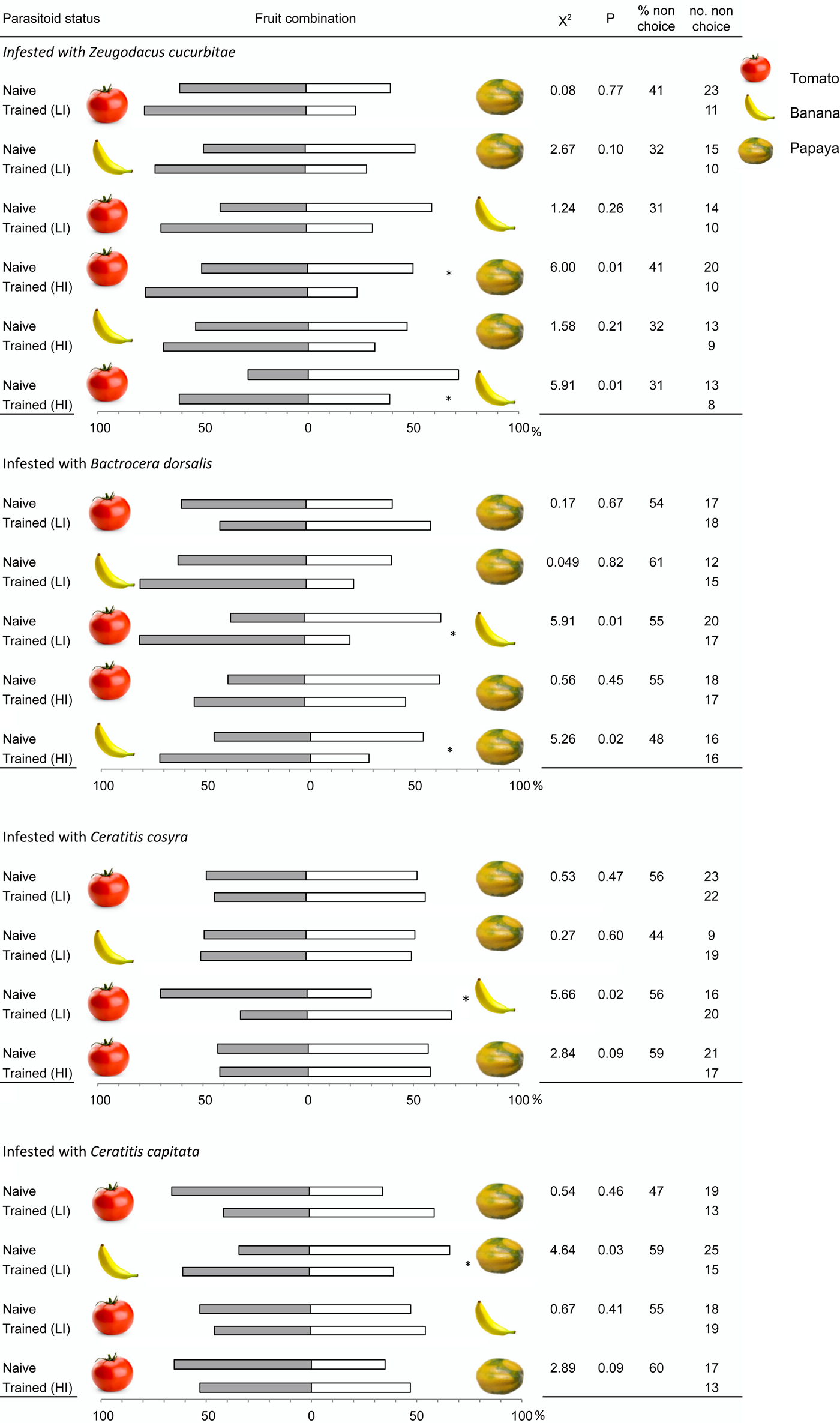
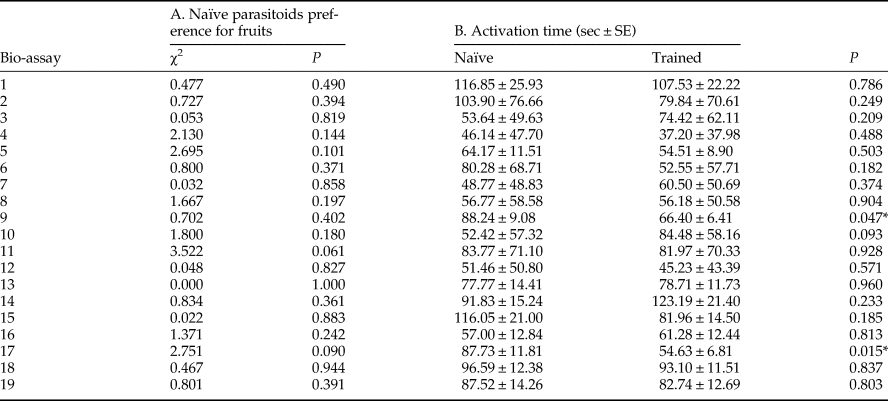
Naïve and trained parasitoids made overall a different choice of fruit, between fruit infested in the training and the non-infested control (χ2 = 7.5187, df = 1, P = 0.0061), even if the numerical difference was small (55.9 and 44.1 for the trained and 50.1 vs. 50.0 for naïve). The trained wasps chose the fruit infested in the training more than the control fruit (χ2 = 7.6640, df = 1, P = 0.0056), while there was no difference between naïve choices of fruit (χ2 = 0.0010, df = 1, P = 0.9750). The difference between naïve and trained parasitoids was detected in six olfactometer assays, while no difference was found in 13 cases (fig. 1). In the occasions where the choice for fruit differed between naïve and trained parasitoids, the trained preferred the fruit that had been infested during the training for all combination, except when C. cosyra infested the fruits (fig. 1). In both bioassays with LI, and HI-trained parasitoids, we observed cases where the choice of fruit differed between naïve and trained parasitoids. However, overall comparisons showed that the choice of fruit differed between naïve and HI-trained parasitoids (χ2 = 12.285, df = 1, P = 0.0005), while there was no difference in choice between naïve F. arisanus and the LI-trained parasitoids (χ2 = 0.595, df = 1, P = 0.4403). Naïve parasitoids did not have a preference for banana, papaya or tomato (χ2 = 1.795, df = 2, P = 0.4076) and no difference between fruit choice was observed in any of the two-choice assays (table 2).
Choice of infested fruits in two-choice olfactometer, comparison of naïve and trained Fopus arisanus. HI = high-interaction and LI = low-interaction training, grey bars = fruit infested during training, white bars = fruits not infested during training, *choice between naïve and trained differed (χ2 test).

Olfactometer results. (A) Naïve parasitoids preference for fruits and (B) activation time in olfactometer assays by naïve and trained Fopius arisanus females.

* activation time for naïve and trained differed.
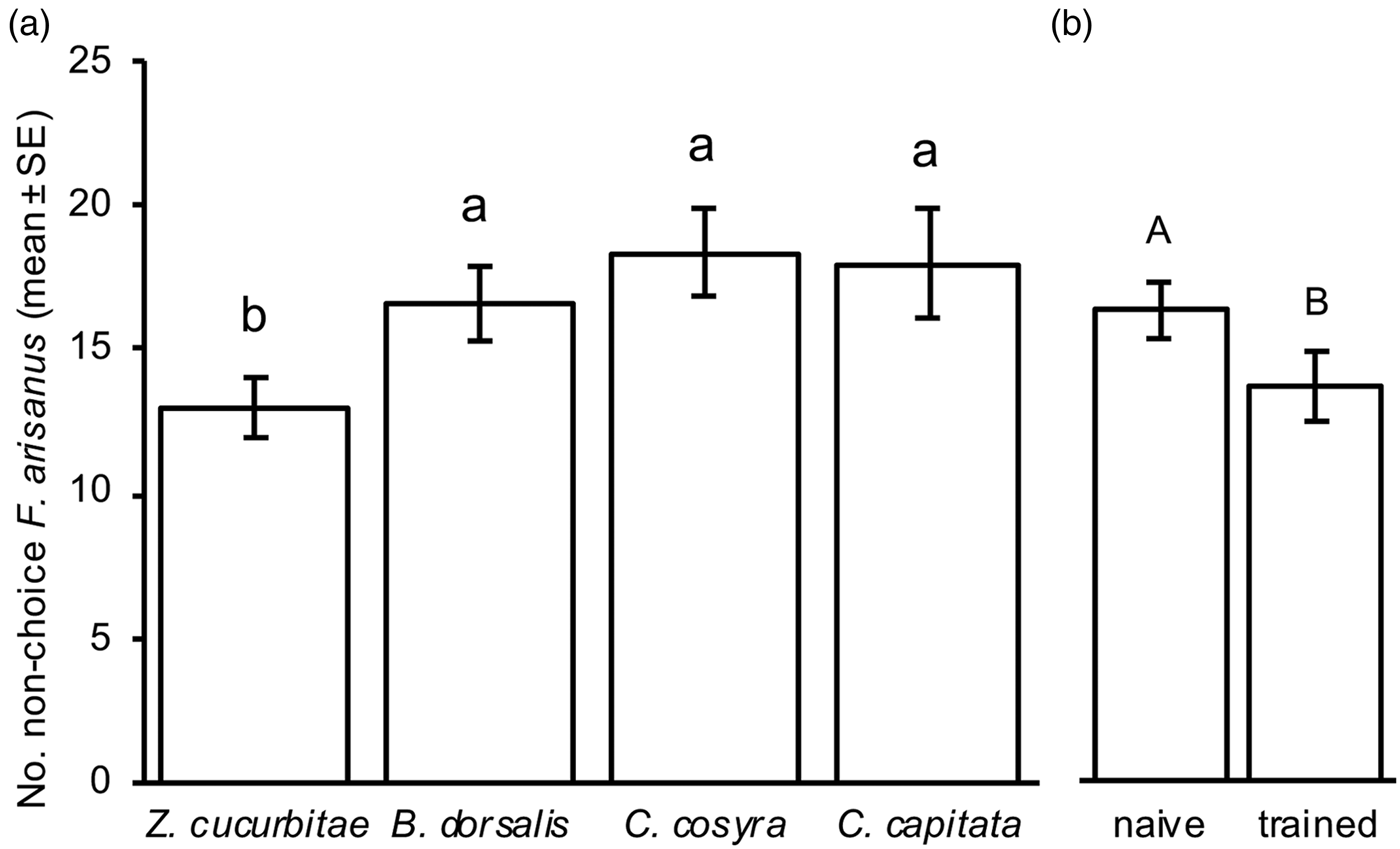
The number of parasitoids that did not make a choice was higher for naïve than for trained F. arisanus (glm, 17.33 ± 0.98, 14.53 ± 0.92 naïve and trained, respectively, bioassay−1, z = 2.072, P = 0.0383). When fruits were infested with Z. cucurbitae, the number of parasitoids that did not make a choice in the olfactometer was lower than when infested with the other fruit fly species (fig. 2).
Number of non-choice Fopus arisanus per bioassay in relation to (a) infesting fruit fly and (b) parasitoid status; naïve or trained (glm).

Activation time and time spent by F. arisanus in each olfactometer arm
The activation time (time taken to respond to odour compound in the olfactometer) was lower for trained than naïve parasitoids, i.e. the trained F. arisanus were faster to get activated and move in the two bioassays when fruits were infested with Z. cucurbitae (table 2). Other bioassays did not result in a difference in activation time between the parasitoid groups and there was no overall difference between activation time for naïve and trained F. arisanus (glm 76.47 ± 3.08, 71.56 ± 2.77 s (±SE) for naïve and trained parasitoids respectively, t = 1.187, P = 0.235).
The time spent in each olfactometer arm did only differ between naïve and trained parasitoids in very few bioassays, while in most assays there were no differences in time spent between the two treatments. Trained wasps spent more time in the presence of tomato odour than banana when the fruits were infested by C. cosyra (glm, 275 ± 80, 145 ± 108 s ( ± SE), respectively, P = 0.05). Fopius arisanus spent shorter time with tomato than papaya when infested by C. capitata (glm, 169 ± 91 and 243 ± 84 s ( ± SE), respectively, P = 0.026) and shorter time with tomato than papaya when infested with B. dorsalis (glm, 91 ± 97, 197 ± 95 s ( ± SE) for naïve and trained parasitoids, respectively, P = 0.022).
Post-olfactometer observations
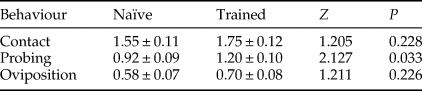
Fopius arisanus post-olfactometer behavioural activity oviposition did not differ between naïve and trained parasitoids, while probing and contact was higher for trained parasitoids than for naïve wasps (table 3).
Activity (contact, probing and ovipositing) by naïve and trained Fopus arisanus during post-olfactometer test (glm, mean ± SE F. arisanus/cage).

Probability of positive association
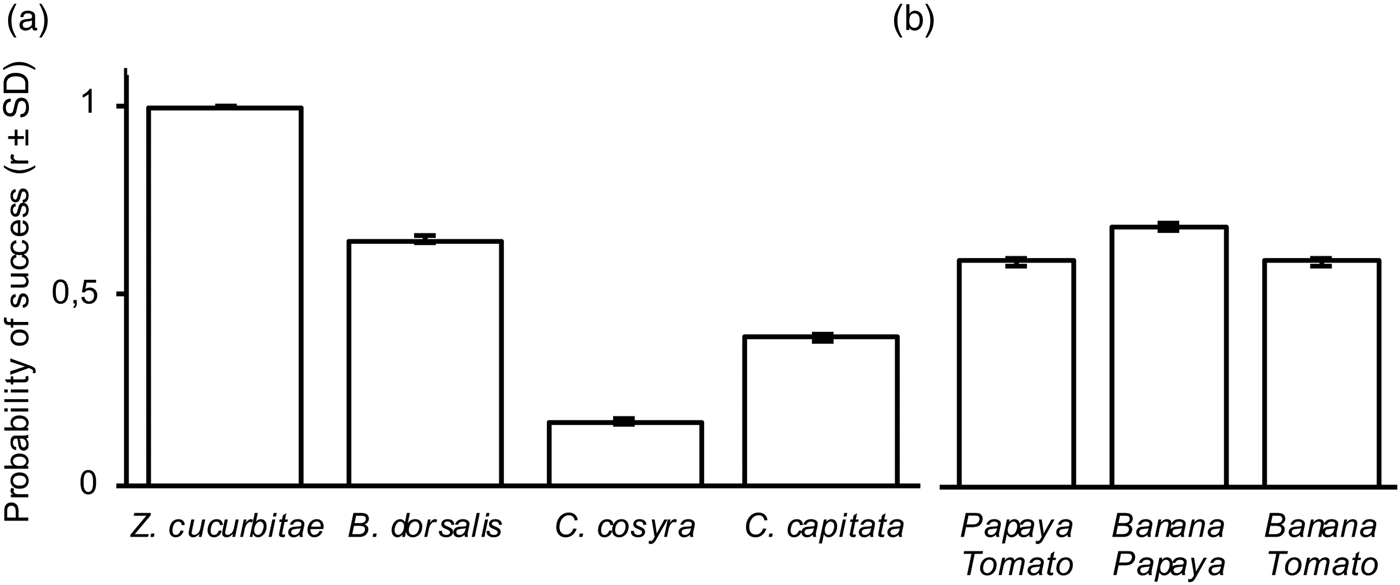
We calculated the probability to learn, i.e. to respond positively to odours of host-infested fruits, with which previous experience was made. This probability of success was dependant on the tritrophic levels interaction as it depended strongly on the infesting fruit fly species and also slightly on the three fruit combinations tested (fig. 3). When fruits were infested with Ceratitis, the chance of learning (making a positive association) was lower than 50% and parasitoids had highest chance to make a positive association of fruit and fruit fly odours in the presence of Z. cucurbitae, followed by B. dorsalis, C. capitata and least with C. cosyra (fig. 3).
Probability of success by Fopus arisanus to make a positive association in relation to (a) fruit fly and (b) fruit combination (bootstrap, B = 9999).

Parasitoid emergence
The parasitoid F. arisanus emerged only from fruits infested with B. dorsalis while no emergence of the parasitoid was recorded from Z. cucurbitae, C. capitata and C. cosyra-infested fruits. With the exception of emergence of C. cosyra from tomato, all flies emerged from all fruits. The emergence of F. arisanus in relation to total emergence of fruit flies and parasitoids was on average 23%, which did not differ between fruits (glm, z = 0.1291, P = 0.1962). It is however imperative to recognize that we observed F. arisanus emerging from tomato in a very low number of cases. The number of F. arisanus emerging was positively correlated to the number of fruit flies (B. dorsalis) emerging from the same fruits (R = 0.69).
Discussion
A difference between naïve and experienced F. arisanus in their response to odours was considered a result of the association of odours generated while in contact with the fruit fly eggs in the fruit. Based on that supposition, we observed a high number of parasitoids that were not affected by the associative learning activity they were confronted with, as few assays showed odour-response differences. A modest associative learning was observed for the egg parasitoid F. arisanus in general. The trained wasps were in a limited number of assays performing a positive chemotaxis towards odours of infested fruit in which they had previous experience. In yet fewer assays, trained female F. arisanus displayed a negative chemotaxis towards the odour related to their previous experience. The learning ability was nevertheless closely related to Tephritidae species.
The few positive odour associations created by F. arisanus were observed in assays with experience of Z. cucurbitae-infested tomato, B. dorsalis-infested tomato, B. dorsalis-infested banana and after experience of C. capitata-infested banana. Previous studies showed that F. arisanus have an ability to associate host with fruit types after experience (Dukas & Duan, Reference Dukas and Duan2000), nonetheless we observed a limit to which F. arisanus can learn to prefer host flies and fruits, possibly linked to the combination of fruit fly species and fruit. Positive associations can be generated with a brief exposure to sugar reward in combination with an odour, as observed for Psyttalia concolor Szépligeti (Hymenoptera: Braconidae), which afterward preferred odours associated with the reward (Canale et al., Reference Canale, Geri and Benelli2014). In our study, presence of fruit fly eggs was given as reward and we found that the capacity by F. arisanus to react positively to odours associated with a host could be partly related to the parasitoid performance in the different fruit fly species eggs (Segura et al., Reference Segura, Nussenbaum, Viscarret, Devescovi, Bachmann, Corley, Ovruski and Cladera2016). Bactrocera dorsalis is a more optimal host for F. arisanus than Ceratitis spp. yet F. arisanus develop in C. cosyra and C. capitata (Mohamed et al., Reference Mohamed, Ekesi and Hanna2010; Ayelo et al., Reference Ayelo, Sinzogan, Bokonon-Ganta and Karlsson2017). Fopius arisanus rarely emerge from Z. cucurbitae (Harris & Bautista, Reference Harris and Bautista1996; Bautista et al., Reference Bautista, Harris, Vargas and Jang2004; Rousse et al., Reference Rousse, Gourdon and Quilici2006). Positive associations after experience with B. dorsalis were hence expected and marginal learning was observed after experience with B. dorsalis in which F. arisanus develop well. The calculated probability to learn was accordingly highest with B. dorsalis. Positive learning probability was <50% in Ceratitis species, which are comparably less preferred hosts than B. dorsalis (Mohamed et al., Reference Mohamed, Ekesi and Hanna2010; Ayelo et al., Reference Ayelo, Sinzogan, Bokonon-Ganta and Karlsson2017), and produce less offspring (Harris & Bautista, Reference Harris and Bautista1996; Harris et al., Reference Harris, Bautista, Vargas and Jang2007).
We observed some cases where the associations made with the fruit fly eggs were negative, hence avoidance behavioural response was observed towards the odour of the infested fruit after training. Negative association was obtained when C. cosyra eggs were infesting tomato and it was observed as a preference for banana by the experienced F. arisanus, as opposed to attraction towards tomato by naïve wasps. This implicated that a negative association was formed with experience of the C. cosyra eggs in tomato and the wasp acted upon this with repulsion. Fruits infested by C. cosyra generated a negative association and emergence of F. arisanus was null. As the combination of fruit and host is important in parasitoid choice of oviposition site (Harris & Bautista, Reference Harris and Bautista1996), the sub-optimal fruit for C. cosyra was probably part of the reason why the unrewarding stimulus caused avoidance. The development of the fruit flies, in which parasitoid develop, is affected by the quality of the substrate, in which the host is found. Hence, the capability of F. arisanus to survive differs between fruits, in relation to fruit fly species. Zeugodacus cucurbitae is known to survive in Musa spp., tomato and papaya (Mcquate et al., Reference Mcquate, Liquido and Nakamichi2017), B. dorsalis survive in banana, tomato and papaya (Liquido et al., Reference Liquido, McQuate, Kurashima, Hanlin, Birnbaum and Marnell2015), C. capitata in seed banana Musa balbisiana (Colla) (Musaceae), tomato and papaya (Liquido et al., Reference Liquido, Cunningham and Nakagawa1990), while C. cosyra is not known to survive in banana, yet emerge occasionally from tomato (Kambura, Reference Kambura2016) and develop in papaya (Steck, Reference Steck2015). Thus, among the species of Tephritidae fruit flies used in our study, some combinations are sub-optimal hosts for F. arisanus yet positive association creation and learning capacity was not straightforwardly linked to performance in host and host fruit.
Learned avoidance behaviour in response to an odour source, i.e. negative associative learning, is documented for other Braconidae wasps (Takasu & Lewis, Reference Takasu and Lewis1996), and perhaps it is more pronounced in specialist Braconidae wasps than in generalist (Steidle & Van Loon, Reference Steidle and Van Loon2003). Low-quality reward such as oviposition in a non-host species might cease the response to previously attractive odours (Takasu & Lewis, Reference Takasu and Lewis2003). Danger in form of an electric shock can cause the parasitoid P. concolor, to respond by avoidance to an innately attractive Tephritidae-host-induced odour (Benelli et al., Reference Benelli, Stefanini, Giunti, Geri, Messing and Canale2014). Unsuccessful host-foraging experiences and oviposition in sub-optimal host species do however not always cause aversive odour association (Costa et al., Reference Costa, Ricard, Davison and Turlings2010; Harris et al., Reference Harris, Ruberson, Meagher and Tumlinson2012), hence oviposition experience by Diachasmimorpha kraussii (Fullaway) (Hymenoptera: Braconidae) in non-host (Drosophila melanogaster, Diptera: Drosophilidae) infested host fruit do not increase the ability to discriminate between host (Bactrocera tryoni (Froggatt), Diptera: Tephritidae) and non-host-related odours (Masry et al., Reference Masry, Clarke and Cunningham2018). While this disability to reduce attraction after unrewarded and/or non-host oviposition might be related to a lack of experience to the non-host during evolution (Costa et al., Reference Costa, Ricard, Davison and Turlings2010), perhaps it is also related to the genetic relatedness between host and non-host species. Bactrocera dorsalis and Z. cucurbitae belonged until recently to the same genus (De Meyer et al., Reference De Meyer, Delatte, Mwatawala, Quilici, Vayssieres and Virgilio2015), yet does F. arisanus parasitism in the latter not allow survival (Nishida & Haramoto, Reference Nishida and Haramoto1953; Vargas et al., Reference Vargas, Leblanc, Harris and Manoukis2012).
The method of giving mass-reared biological control agents pre-release experience of a suitable oviposition site, in association with a host sensorial cue, is proposed to enhance parasitoid location to find the target fruit and fruit fly species. This is to ensure an efficient and rapid host location during the release phase and to ideally improve their efficacy in the field (García-Medel et al., Reference García-Medel, Sivinski, Díaz-Fleischer, Ramirez-Romero and Aluja2007; Benelli & Canale, Reference Benelli and Canale2012). The method is proposed based on the insects’ capacity to increase the ability to discriminate between host and non-host odours after experience (Giunti et al., Reference Giunti, Canale, Messing, Donati, Stefanini, Michaud and Benelli2015; Masry et al., Reference Masry, Clarke and Cunningham2018) and to increase the number of parasitized host eggs, resulting in a higher number of parasitoid offspring (Dukas & Duan, Reference Dukas and Duan2000). Associative learning could also result in a reduction of host location searching time (Dukas, Reference Dukas2008). Correspondingly, can learnt odours related to danger cause fruit fly parasitoids to spend more time with the control than in the presence of ethyl-octanoate and decanal associated with the threat (Benelli et al., Reference Benelli, Stefanini, Giunti, Geri, Messing and Canale2014). However, we found only in two occasions did the trained F. arisanus responded earlier to the fruit odours than naïve wasps. This is more in line with previous research by Ngumbi et al. (Reference Ngumbi, Jordan and Fadamiro2012) and Canale et al. (Reference Canale, Geri and Benelli2014), where time reduction of host finding was not, or only rarely, obtained by experienced wasps, compared with naïve even if learning of infestation-induced volatile compounds was attained. It is also possible to change an innate behaviour, and increase host parasitism for a novel host (Li & Lui, Reference Li and Lui2003; Wei et al., Reference Wei, Tang, Wang, Yang, Cao, Lu, Liu and Liu2013). Perhaps could pre-release experience also reduce attraction to non-target hosts, before the release of the parasitoid in the field to, e.g. reduce attraction to species that acts as sinks, where the parasitoid parasitizes but where no viable progeny develops.
Previous experience with infested fruits increased responsiveness for F. arisanus, since trained were more active to respond (less non-responders) to the fruits odours than the naïve. Oviposition experience (high interaction) furthermore changed the fruit preference, since overall fruit choice differed slightly between experienced F. arisanus and naïve parasitoids, while experience in the low interaction method did not result in an overall difference in fruit choice compared with the naïve parasitoids. In the high-interaction level, all females oviposited in the fruit fly eggs, while in the low-interaction level, the females were in contact with the fruits for 1 h but did not with certainly oviposit. For P. concolor, only 20 s of interaction with odour and a sugar reward can be sufficient for a positive association (Canale et al., Reference Canale, Geri and Benelli2014), while repeated exposure of odours and sugar reward might be needed to learn to respond to odours associated with their hosts (Ngumbi et al., Reference Ngumbi, Jordan and Fadamiro2012), and yet subsequent training might increase effective location of the target host (Minoli et al., Reference Minoli, Kauer, Colson, Party, Renou, Anderson, Gadenne, Marion-Poll and Anton2012). To create F. arisanus preference of an associated odour, it might hence be needed to ensure oviposition in perceived suitable host and host fruit, for the parasitoid learning to become favourable in a biological control setup. Our study has enlightened restrictions in odour learning and showed that the learning capacity of F. arisanus might be limited to certain fruit fly species and fruit combinations and interaction level, as the results show that among different combinations of egg and fruit species, there are different behavioural effects of the associations created. We are yet to understand to what extent F. arisanus is able to recognize the species of fruit flies and what are the criteria for the parasitoid to accept or reject fruit fly eggs. Further studies about the extent to which laboratory results can be translated into the field are needed, as the learning and change in preference obtained in laboratory assays might not always translate in preference change in the field (De Rijk et al., Reference De Rijk, Cegarra Sánchez, Smid, Engel, Vet and Poelman2018). The development of mass-rearing methods to enhance searching behaviour in biological control agents is of interest, e.g. to elucidate the cues used to associate and orient towards the target host, to increase efficiently during the critical first time after release.
Acknowledgements
This research was funded by The Swedish Research Council for Environment, Agricultural Science and Spatial Planning (Formas) through the project grant 229-2013-1978 to MFK. We thank Mr Cyrille Akponon for technical assistance, Mrs Carine Songbé rearing the parasitoid and Dr Bonaventure Omondi Aman and two anonymous reviewers for corrections of an earlier version of the manuscript.