1. Introduction
Preaspiration is a phonological process that is active in several Nordic languages—namely, in the majority of Faroese and Icelandic varieties, and in some dialectal varieties of Swedish and Norwegian—but also in other unrelated languages (Steriade Reference Steriade1997, Silverman Reference Silverman2003, Miller et al. Reference Miller, Elzinga and McLaughlin2005, Stevens & Hajek Reference Stevens, Hajek, Trouvain and William2007, Gordeeva & Scobbie Reference Gordeeva, Scobbie, Fuchs, Toda and Marzena2010, Iosad et al. Reference Iosad, Ramsammy and Honeybone2015, Iosad 2020). Preaspirated segments are preceded by a glottal frication noise ([hC]), which is usually heard after the oral burst of postaspirated stops. In the Nordic family, this phenomenon that affects fortis stops is mostly known through Icelandic, Faroese’s closest sister language (Kingston Reference Kingston, Kingston and Mary1990, Pind Reference Pind1995, Ringen Reference Ringen1999, Keer Reference Keer and Thorhallsdóttir2000, Helgason Reference Helgason2002, Hansson Reference Hansson2003, Hoole & Bombien Reference Hoole, Bombien, Fuchs, Mooshammer and Żygis2010, Árnason Reference Árnason2011, Heimisdóttir Reference Heimisdóttir2014). Faroese preaspiration is described as less prominent than the Icelandic one, the aspiration noise duration being shorter in Faroese than in Icelandic (Pétursson Reference Pétursson1972, Hansson Reference Hansson2003, Árnason Reference Árnason2011:215, Thráinsson et al. Reference Thráinsson, Petersen, Jacobsen and Hansen2012:47). The exact measurements are presented below in table 1 from Thráinsson et al. Reference Thráinsson, Petersen, Jacobsen and Hansen2012:47. In Faroese, the duration of preaspiration is shorter than the duration of the closure of the following consonant even when it is a singleton. In Icelandic, by contrast, the duration of preaspiration is close to the duration of a simple stop, making it acoustically comparable to a full-fledged segment.
Duration of preaspiration in Faroese and Icelandic.

This difference in duration leads to a different notation in each language: While in Icelandic preaspiration is transcribed as a full-fledged glottal fricative ([hC]), in Faroese it is noted as a feature of the stop, an aspiration reflex ([ʰC]) (Hansson Reference Hansson2003:50, 64).Footnote 1 In some studies, Faroese preaspiration has even been disregarded in the transcriptions.Footnote 2
Besides the phonetic difference between Icelandic and Faroese preaspiration, the two realizations also vary with respect to the contexts that trigger them. While all the preaspiration triggering contexts that are active in Icelandic are also active in Faroese (gemination and most /fortis+sonorant/ clusters), Faroese includes two additional environments where preaspiration can occur: intervocalic and word-final singletons.
This paper focuses on Faroese preaspiration and aims at providing phonological representations of the phenomenon.Footnote 3 More specifically, I look at the intervocalic context, which is a good indicator of how preaspiration is triggered in Faroese and its precise conditions. In doing so, I show that all the triggering contexts that are commonly described can be reduced to a single condition that is related to the preceding vowel. After identifying the trigger for preaspiration, I propose representations of the affected stops. My hypothesis being based on an interaction between a stop and the preceding vowel, I also provide representations for both consonants and vowels in order to illustrate the mechanism at play.
This paper is organized as follows. In section 2, I first introduce the Faroese stops and their behavior with regards to aspiration. I then focus on the contexts where preaspiration is triggered. I contrast these contexts with the inhibiting contexts in order to identify the required conditions for the mechanism to apply. In section 3, I discuss the framework I use to represent segments. In section 4, I illustrate the internal layout of Faroese stops. Preaspiration, although it affects consonants, is closely linked to the identity of the flanking nuclei. Consequently, in section 5, I introduce the representations I use for vowels. Finally, in section 6, I illustrate the preaspiration mechanism using examples where the phenomenon is triggered, but also where it is inhibited. In doing so, I show the possible interactions between the onsets and the preceding nuclei.
2. Faroese Preaspiration
As previously mentioned, preaspiration affects fortis stops only. In this section, I present the obstruents of Faroese with particular attention to their behavior with respect to aspiration.
2.1. Post- and Preaspiration of Obstruents
Faroese has two series of stops: fortis stops /p, t, k/ and lenis stops /b, d, ɡ/. Like other Germanic languages, the contrast between the two series is based on aspiration—not on voicing (Iverson & Salmons Reference Iverson and Salmons1995, Beckman et al. Reference Beckman, Jessen and Ringen2013). Fortis stops are lexically aspirated [pʰ, tʰ, kʰ], while lenis stops are not (Árnason Reference Árnason2011:99, 118; Thráinsson et al. Reference Thráinsson, Petersen, Jacobsen and Hansen2012:43). In most dialects of Faroese, voicing is not part of the phonological representation of stops. Thus, the symbols [b, d, ɡ] used in this paper for lenis stops do not refer to voiced consonants, but to lexically unaspirated stops.Footnote 4
Acoustically postaspiration corresponds to a glottal frication noise that occurs during and after the sudden air release in the articulation of a stop. From a phonetic perspective, aspiration results from a VOICE ONSET TIME delay—vocal folds’ vibrations start after the oral burst, while articulators are already in position for the following vowel’s articulation. By contrast, preaspiration corresponds to a glottal frication noise that intervenes before the positioning of the articulators and the silence, characterizing stops.Footnote 5
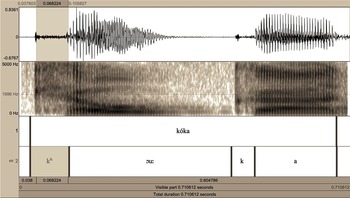
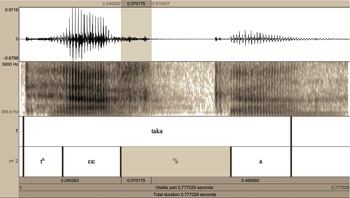
Both types of aspiration are illustrated below: Figure 1 shows the spectrogram of the word kóka ‘boil.INF’ pronounced by a native speaker of Faroese, where the first /k/ is postaspirated.Footnote 6 The release phase of the stop is followed by a continuous and diffuse noise. In figure 2, representing the word taka ‘take.INF’ pronounced by the same speaker, /k/ is preaspirated. A diffuse noise is produced before the silent phase of the stop.
Faroese postaspiration.

Faroese preaspiration.

In Faroese, preaspiration affects fortis consonants, which have several contextual allophones. In most Faroese dialectal varieties, fortis stops are postaspirated word-initially or morpheme-initially in the case of compounds, as illustrated in 1. Postaspirated stops can be followed by either a vowel or a consonant.

Outside the initial context and the preaspirating environments— which is described below—fortis stops are unaspirated.Footnote 8 This is what the data in 2 show. Note that when included in a cluster with /s/, even in word-initial position, fortis consonants are deaspirated.

Faroese preaspiration is usually described as occurring in the following contexts (Árnason Reference Árnason2011, Thráinsson et al. Reference Thráinsson, Petersen, Jacobsen and Hansen2012, Adams & Petersen Reference Adams and Petersen2014): First, when fortis stops are geminated, they surface as long and preaspirated, as shown in 3.

Second, fortis stops are preaspirated when followed by a sonorant, thereby forming a /fortis+sonorant/ cluster, as in 4. Only noninitial clusters are considered as preaspiration is unattested word-initially.Footnote 10

Third, preaspiration also occurs when intervocalic stops are preceded by a mid or low vowel, as the data in 5 show. The spectrographic evidence of intervocalic preaspiration is shown in figure 2. It should also be added that the same distribution is observed when singleton fortis stops are word-final, as in 6.Footnote 11


However, when intervocalic or final fortis stops precede a high vowel ([iː, ɛiː, aiː, ɔiː, ʊiː, uː, œuː, ʉuː]), they surface as unaspirated, as shown in 7 below.Footnote 12

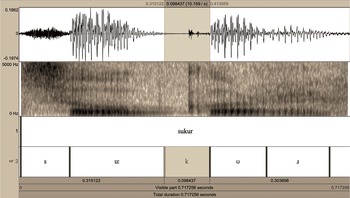
The absence of preaspiration after a high vowel is illustrated in figure 3, where /t/ is preceded by a long /u/ (that is, [uː]).
Absence of preaspiration after high vowels.

As can be seen in sukur ‘sugar.NOM.SG’, the fortis stop is preceded by a phase of silence with no glottal frication noise between the vowel and the release phase.Footnote 13 The absence of preaspiration was also visible in figure 1, where the second /k/ in kóka is preceded by a long diphthong ending in a high gesture: [ɔuː].
Vocalic length is positional in Faroese: A vowel surfaces as long if it is stressed and followed by at most one consonant.Footnote 14 If one of these conditions is not met, the vowel surfaces as short. The data in 8 and 9 show the distribution of length according to the right-hand environment. The words in 8 and 9 are from the same paradigm (except the examples for /u/), and they all are derived from a monosyllabic root ending in a consonant. If the root is followed by a morpheme starting with a vowel, as in 8, then the stressed vowel in the stem surfaces as long. If the same root is followed by a morpheme starting with a consonant, as in 9, then the stressed vowel in the root surfaces as short. This is true for monophthongs and diphthongs. Note that length is accompanied by tenseness for monophthongs.Footnote 15 This is, however, not relevant to the present matter. When short, diphthongs may undergo some quality change, as illustrated by the last two lines. The data in 8 and 9 do not represent the Faroese vocalic system in its entirety. The Faroese vocalic inventory is further elaborated in section 5.


Given the rule of vocalic length distribution, vowels are always expected to be short before a cluster, even when they are stressed. However, note the examples in 10, where some /fortis+liquid/ clusters do not inhibit vocalic length (/kr, kl, pr, pl, tr/). These clusters are possible onsets—they can be found word-initially and may therefore be considered as internal onsets (following the Maximal Onset Principle; Hjelmslev Reference Hjelmslev, Blancquaert and Pée1938, Kurylowicz Reference Kurylowicz1948, Lowenstamm Reference Lowenstamm1981, Selkirk Reference Selkirk, Moortgat, Van der Hulst and Hoestra1981).

Consequently, it would be more accurate to state that vowels are long when they are stressed and in open syllables. In an internal closed syllable, stressed vowels surface as short (Árnason Reference Árnason2011, Thráinsson et al. Reference Thráinsson, Petersen, Jacobsen and Hansen2012).Footnote 16 Note that in all of the examples in 10, except glitra in 10i, the fortis stops are preaspirated, as mentioned in the second condition (i.e. preaspiration when followed by a sonorant).
2.2. Toward a Unified Analysis of Preaspiration
In accordance with the triggering context mentioned in the third condition above, high vowels inhibit preaspiration on the following singleton fortis stop (see data in 7). In those specific examples, the vowels that precede the fortis stops are always long, according to the length distribution constraint given in 8 and 9. However, in 3 and 4, I presented examples of preaspirated stops after a short high vowel: drykkur [ˈdrɪʰkːʊɹ] ‘drink.NOM.SG’, ikki [ˈɪʰt͡ ʃːɪ] ‘not’, rytma [ˈɹɪʰtma] ‘rhythm.NOM.SG’. In these examples, the vocalic shortness is explained by the rule of length distribution, as illustrated in 8 and 9. Accordingly, it can be concluded that high vowels are not blocking preaspiration per se; it rather depends on their length. By contrast, mid and low vowels are compatible with preaspiration regardless of their quantity, as shown in the various examples in 3–6.
The second condition above states that fortis consonants preaspirate when they are included in a cluster with a sonorant in a postvocalic position. I later introduced examples showing that some /fortis+liquid/ clusters do not prevent vocalic length on their right (see 10). As shown earlier, regardless of the vocalic length, most examples in 10 contain preaspirated stops. Interestingly, the post-long high vowel fortis stop [t] is not preaspirated in glitra [ˈɡliːtra] even though that stop is included in a cluster with a sonorant. This specific example resembles the data given in 7 for intervocalic fortis stops, although in glitra, the fortis stop is neither intervocalic nor final.
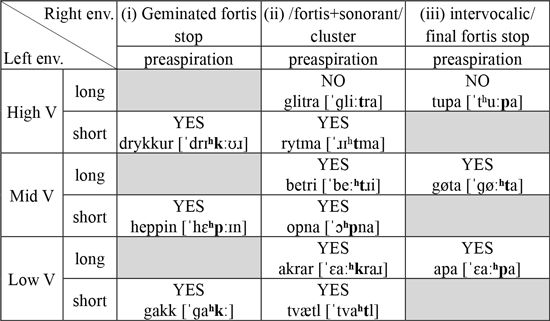
The following table summarizes the distribution of preaspiration based on the right-hand environment of the fortis stop (whether it is intervocalic/final, geminated, or included in a cluster) and based on the left-hand environment, that is, the quality and the quantity of the preceding vowel. Each configuration is illustrated with an example. Grey cells indicate that the configuration is not possible given the principles of vocalic length I cited earlier.
The distribution of preaspiration in Faroese.

As can be seen from table 2, the main parameter that needs to be considered with regards to the triggering or inhibition of preaspiration is the quality and quantity of the vowel to the left. In other words, all triggering contexts given in 3–6 for preaspiration can be reduced to two principles:

The right-hand context is relevant in that it defines the vocalic quantity on the left, but it does not seem to be the main and only criterion. Examples such as glitra [ˈɡliːtra] show fortis stops included in a /fortis+sonorant/ cluster that are not preaspirated, precisely because they are preceded by a long high vowel. In other words, although preaspiration is a consonantal phenomenon, the distribution of its triggering contexts given in 11 indicates that nuclei play a role in it.
Following this observation, I propose to analyze preaspiration as the result of an interaction between the fortis consonant and the preceding nucleus. More precisely, preaspiration involves spreading of the consonant toward the preceding vowel, if the vowel has enough space in its structure to host it. Given that preaspiration occurs without any additional morphological material, it leads to the hypothesis that segments may not only have melody but also space in their internal layout. The only vowels that do not have available space are the high vowels, but only when they are long. In order to test this hypothesis, I introduce the theoretical framework in which this analysis is couched. This is what the next section is dedicated to.
3. Government Phonology 2.0: Previous Work
The hypothesis that segments contain melody and space has been proposed in GOVERNMENT PHONOLOGY 2.0 (henceforth GP2) by Pöchtrager (Reference Pöchtrager2006). Adding space in a segment means providing it with an internal structure, with layers. While making the internal representation of segments more complex allows one to explain length-related phenomena, it also allows us to revise the number of primes required to qualify consonants and vowels. As I show in this section, some properties traditionally associated with melodic primes—aspiration, voicing, occlusion—can be analyzed as structural effects.
One of the main motivations for GP2 is the vocalic extra lengthening observed in several languages, including English.Footnote 17 The phenomenon consists of the lengthening of lexically short nuclei. Correspondingly, lexically long nuclei may surface as extra long. The only condition for this lengthening to happen is that the nucleus must be followed by a lenis stop. A fortis consonant inhibits the lengthening. The following data used to illustrate this are more specifically from New York English, henceforth NYE (Pöchtrager Reference Pöchtrager2006). For instance, the words rip and rib contain the same nucleus: a lexically short high vowel. However, in NYE, the former surfaces as [rɪp], while the later is realized as [rɪːb]. The words loop ∼ lube also have the same nucleus: a lexically long high vowel. In NYE they are respectively realized as [luːp] ∼ [luːːb]. The only difference between these two pairs is the quality of the coda: a fortis versus a lenis stop.Footnote 18
Regarding the melodic content of segments, classical Element frameworks make use of |H| to characterize aspirated segments (Kaye et al. Reference Kaye, Lowenstamm and Vergnaud1990, Harris Reference Harris1994, Backley Reference Backley2011, Árnason Reference Árnason2011). In an aspiration-based language, such as English or Faroese, the stops pair /p/ ∼ /b/ would be represented as |H U ʔ h| ∼ |U ʔ h|, where |H| is responsible for the aspiration, |U| for the labial/round articulation, |ʔ| for the occlusion, and |h| for continuous noise. In this view, the link between the content of a stop and the NYE extra lengthening seems quite opaque. Elements refer to melodic content, while lengthening refers to structural properties that are independent of the content.Footnote 19 Accordingly, Pöchtrager (Reference Pöchtrager2006) proposes analyzing aspiration not as a melodic property but as a structural configuration: Aspiration derives from an underlying/phonological lengthening of stops, not from their melodic content. Fortis stops, being phonologically long, do not allow the preceding nucleus to lengthen, as the targeted position for length is already occupied.Footnote 20 Regarding the origin of the position, since extra lengthening takes place without the addition of any new morphological material, it implies that the position targeted for lengthening is already lexically present. More precisely, it is part of the stop itself. Consequently, stops contain several positions lexically, and the number of positions they use to express their content is what distinguishes fortis from lenis consonants. Based on this, NYE extra lengthening can be illustrated as follows:

In 12a, /p/ is represented by two positions (x, the complement, and xO, the head), under the label O’.Footnote 21 The melodic content responsible for the labial articulation of /p/ is linked to both positions available in the onset. The lenis stop /b/ is structurally identical to /p/, as both belong to the same natural class. In 12b, however, the melody |U| is linked to only one position, leaving the second position of the stop available for the preceding segment. The preceding nucleus, represented as N in 12, is associated with the melody |I|, which yields an unrounded high vowel. While the nucleus only has its own lexical position available in 12a, it can spread toward the empty x onset position in 12b, hence the extra lengthening. Consequently, the phenomenon is not lexically motivated but results from a sort of compensatory lengthening. In other words, it is possible to explain how aspiration can interfere with vocalic length if one assumes that aspiration results from a specific structural configuration and not from melodic primes.Footnote 22 Accordingly, the use of the element |H| is rendered obsolete.
The same logic can be applied to occlusion, traditionally represented as |ʔ|. Following Jensen (Reference Jensen1994), stops are structurally more complex than their fricative counterparts. In Pulaar, he observes that in the singular/plural alternation in [waːndu] ‘monkey’ ∼ [baːɗi] ‘monkeys’, [fɛrlo] ‘hill’ ∼ [pɛrle] ‘hills’, [saːre] ‘town’ ∼ [caʔe] ‘towns’, the initial fricative from the singular undergoes fortition and surfaces as an obstruent in the plural form. One could assume that the melodic prime |ʔ| responsible for occlusion—as in classical Element Theory—is brought to the representation as the plural marker. In a nonsegmental approach, Jensen (Reference Jensen1994) proposes an alternative solution: The plural marker adds empty morphological material, and the reconfiguration of the initial fricative/approximant yields a stop. In other words, the plural form has an initial empty domain, thereby giving the fricative the opportunity to spread to its left. Phonetically, this spreading corresponds to a strengthening of the fricative, which now occupies two domains. This proposal reconnects with the autosegmental principle, which allows any melodic element to appear in any position, without having to formulate a constraint that forbids consonantal elements—such as |ʔ|—to sit in a nuclear position.Footnote 23 It was already widely accepted that, if I| sits in an N or an O position, it yields /i/ or /j/, respectively—the vocalic or consonantal status of the segment is determined by the position, not by the content. With this proposal, Jensen extends the same idea to the major laryngeal classes: Stopness, which is restricted to consonants, should also be encapsulated in the syllabic position, not in the melody.
In GP2, this idea translates into the complexity of the stops’ structures. As illustrated in 12, stops already contain several positions in order to encode aspiration. Consequently, in order to represent occlusion with structure, new layers have to be introduced into the stops’ representation, so that both aspiration and occlusion can be represented in the same segment. This is illustrated in 13.

In 13a, fricatives are provided with two positions in their structure: x and xO, under the label O’. The number of positions that the consonant makes use of to express its content determines if the fricative is a fortis or a lenis consonant (as explained with respect to 12). Contrastingly, in 13b, stops contain one more layer, which encodes stopness. Segmental structures are represented in a recursive fashion: The head of the fricative in 13a, that is, xO, takes a first complement, x1, and projects a higher level, O’. Similarly, the head of the stop in 13b—xO—takes a first complement, x1, and projects a higher level, O’. Then the head’s projection in 13b takes another complement, x2, and projects even higher, O”. Once again, the number of positions that a stop uses to express its content determines if it is a fortis or a lenis obstruent.
Sections 4 and 5 below are dedicated to the representations of Faroese obstruents and vowels, respectively, according to the generalizations that have been made in GP2. More concretely, I explain the melodic elements that I use in the Faroese segments.
4. The Structure of Obstruents
The representations I use for the Faroese stops are based on Pöchtrager’s (2006) model, which eliminates some melodic primes such as |H| for aspiration and |ʔ| for occlusion. This implies that i) stops are structurally more complex than fricatives, and ii) fortis consonants are phonologically longer than lenis consonants. Consequently, the two labial stops /p/ ∼ /b/ have the same internal layout—that is, two tiers—and the same melodic content: |U|. The only difference is the number of positions they use to express this content. In 14, I give the structure of the labial stops.

In accordance with what was presented in section 3, the fortis stop (here in 14a), which lexically contains aspiration, needs two positions to interpret its content. The melodic prime |U|, which is responsible for the rounded/labial articulation, is directly associated with the head of the structure, xO. The link between melody and position is usually achieved through association lines, as in 12. However, such a representation can be problematic once recursive structures and multi-position segments have been introduced. Consequently, the connection between melody and skeletal positions—which are now directly encoded within the consonantal structures—may have to be slightly adapted. Placing the melody directly into the head position is equivalent to linking |U| to xO in 12. In 14, the content can be further associated with several other timing slots (or x’s) through a form of spreading, called MELODIC-COMMAND (or m-command, here represented by the arrows).Footnote 24 In 14, the targeted position is the highest complement, x2.Footnote 25 Consequently, the melody is interpreted in two positions: the head xO and the complement x2.Footnote 26 In 14b, the lenis stop uses only one position to express its content: the head xO.
The representation in 14b can also be used for deaspirated fortis stops. As seen in section 2.1, fortis consonants often undergo deaspiration, which means that they lose the aspiration that is lexically present in them. The only difference between a lenis stop and a deaspirated fortis stop is that the former never had m-command in its structure, while the latter used to have it but lost it.
Regarding the alveolar stops /t/ ∼ /d/, their structural configuration is identical to what has been presented above. In 15, both stops contain two layers, and the fortis stop contains an m-command relation in order to associate the melodic content to two different positions (the head and the highest complement). The melody associated with the head, however, is different: Coronals contain the element |I|, which is responsible for the high articulation.Footnote 27

The same representations hold for velar stops, shown here in 16. In order to represent velarity with elements, I use both |I| and |U| at the same time.

In the same line of thinking as GP2, which aims at reducing the number of primes, I am not in favor of introducing “new” primes to encapsulate velarity (|v| or |@|; Harris Reference Harris1994, Harris & Lindsey Reference Harris, Lindsey, Durand and Katamba1995, Árnason Reference Árnason2011) or coronality (|R|; Harris Reference Harris1994). I instead use the |I, U| elements to the maximum, that is, |I, U, IU|, in order to represent coronals, labials, and velars, respectively.
The use of |I| for coronals can be found in Backley Reference Backley2011 and echoes Clements & Hume Reference Clements, Hume, John, Riggle and Alan1995, Hume Reference Hume1996. These studies point out the connection between coronals and anterior vowels across several languages. If /t, d, s/ frequently behave like palatals (which are unanimously represented as |I| segments) and easily interact with front vowels during phonological processes, they must share some common property. Backley (Reference Backley2011) distinguishes palatals from coronals based on the head status of |I|: Coronals have a nonheaded |I|, while palatals have a headed |I|. This proposal is also congruent with the acoustic features from Jakobson et al. Reference Jakobson, Fant and Halle1952: The authors use [-grave] (or [acute]) to characterize high vowels, palatals, and coronals (palatals and coronals are then distinguished based on the features [compact/diffuse]). Acoustically, the [-grave] or [acute] feature is characterized by a predominance of the higher part of the spectrum, that is, a concentration of energy at higher frequencies, which is also what |I| encapsulates. Given that Faroese does not have lexical palatals, I can reserve the use of |I| for coronals and keep emptiness for consonants with no oral articulation.
The use of |U| in velars can be found in Scheer Reference Scheer1999, Tifrit Reference Tifrit2012, and is also motivated in Backley Reference Backley2011. It is based on the observation that velars and labials share acoustic properties (a concentration of energy in the lower part of the spectrum, which corresponds to the [grave] feature for Jakobson et al. Reference Jakobson, Fant and Halle1952, or |U|). Contra Backley Reference Backley2011, I do not distinguish labials from velars based on the head status of |U|, but I instead use the conjunction of |I| and |U|. This approach predicts that velars and coronals are expected to behave alike. Palatalization, which is now inactive in Faroese, targeted velars specifically, making them sensitive to |I| (kenna [ˈ͡tʃʰɛnːa] ‘know.INF’, kirkja [ˈ͡tʃʰɪɹ̥ ͡tʃa]’ church.NOM.SG’, genta [ˈd͡ ʒɛn̥ta] ‘girl.NOM.SG’ versus kona [ˈkʰoːna] ‘woman.NOM.SG’, kallaði [ˈkʰadlajɪ] ‘call.IND.PST.SG’, gulur [ˈɡuːlʊɹ] ‘yellow.NOM.M.SG’). Palatality may originate from front vowels, but also the glide /j/, traditionally considered the consonantal expression of |I| (tekja [ˈtʰeːʰtʃa] ‘roof.NOM.SG’, kjallari [͡tʃʰatlaɹɪ] ‘cellar.NOM.SG’, kjálki [ˈ͡tʃʰɔʎ̥t͡ʃɪ] ‘jaw.NOM.SG’, gjørt [d͡ ʒœːɻ̥ ʈ] ‘do.PTCP’). Interestingly, Faroese coronals underwent the same process in contact with /j/, yielding the same palatal affricates in most varieties. While the Suðuroy variant maintains the sequences /coronal+j/ as such, the remaining dialects have [͡tʃ, d͡ ʒ]: tjóvur [ˈtjɔuːvʊɹ] ‘thief.NOM.SG.NOM.SG’, tjørn [ˈtjøtn] ‘pond.NOM.SG’, djarvur [ˈdjaɹvʊɹ] ‘brave.NOM.M.SG’ in the southernmost island versus [ˈ͡tʃʰœuːwʊɹ, ˈ͡tʃʰœdn, ˈd͡ ʒaɹvʊɹ] everywhere else.Footnote 28 Labials, by contrast, do not exhibit any particular behavior in regards to |I|. Having presented and motivated the representations used for Faroese stops, I now turn to the vocalic structures.
5. The Structure of Vowels
Vowels are represented here in the same way as consonants, that is, with recursive branching structures. The properties encoded in these structures are, however, different, as aspiration and occlusion are not suitable for vowels. In order to cover the whole Faroese vocalic system, I divide this section into two parts: one for the monophthongs and one for the diphthongs.
5.1. The Faroese Monophthongs
As previously mentioned, each monophthong has a long and a short realization. The long variants appear in open stressed syllables, as in 17. If one of these two requirements is not met, then the short variant surfaces, as in 18. From a phonetic perspective, long and short variants vary in terms of tenseness (long vowels are tense, while their short equivalents are lax). The data in 17 and 18 illustrate all the Faroese monophthongs.


In 19, I give the representations I use for high vowels /i, u/. In terms of elements, these segments consist of only one melodic prime: |I| or |U|. Nevertheless, these vowels also contain several positions: a head and a complement. In 19a, the head, xN, is associated with the melody |I|. xN|I| takes only one complement and projects a higher level, N’. Similarly, in 19b, the nuclear head bears the melody |U| and takes one complement. The results are respectively [ɪ] and [ʊ].Footnote 29

The complement position, the unannotated node, can be used by the vocalic head in order to express length. The figures in 20 show that the only complement situated in the structure of high vowels can be m-commanded by the head (as shown by the arrows). In doing so, the vowels now use two positions each to express their content: the head xN and the complement x. The corollary is that long high vowels do not display any available space in their structure, while short high vowels do.

Regarding low and mid vowels, classical elements frameworks use |A| along with |I/U| for their content (Harris Reference Harris1994, Backley Reference Backley2011). This makes the property corresponding to |A|—aperture—comparable to the other melodic primes, |I| and |U|. However, it should be noted that while melodic propagations of |I| or |U| are common across languages, the spreading of |A| is rarer.Footnote 30 Schane (Reference Schane, Anderson and Ewen1984) also pointed out that the prime |A| is different, in the sense that it is the only one that can be reduplicated within a segmental expression.Footnote 31 Similarly, Pöchtrager (Reference Pöchtrager2018) discusses the legitimacy of |A| in the element inventory and proposes to analyze it—like aspiration—as a structural configuration. More precisely, the property encapsulated by |A|—openness—could be represented with (an) empty layer(s). The more a vowel is open, the more empty layers it projects. This type of representation allows accommodating the rareness of |A| spreading and the possible duplication of the openness property within a segment. As an example, the vowel /a/ is represented in GP2 with an empty structure (here in 21b). That is a structure devoid of melodic content but not of layers. Just like other vowels, empty vowels do contain a head and one or more complements. By comparison, in 21a I give the structure of schwa, which is, by definition, also an empty vowel.

This structure for schwa represents the simplest vocalic configuration (structurally speaking), which is congruent with the fact that schwa is a default vowel. This means that schwa cannot be qualified by any property other than aperture—or openness. If /a/ is also characterized solely by aperture, it needs to be distinguished from schwa: It is represented similarly to schwa but with an extra empty layer, as in 21b. If one posits that openness is now characterized by empty structure, /a/ can be considered to be a more open version of schwa. Accordingly, vowels that consist of a mixture of |I, U| plus the element |A|—mid vowels such as /e, o/—are now represented with a more complex structure. More specifically, they contain (an) empty layer(s).Footnote 32
In 22, the vowel /e/ contains two layers: In the first layer, the head, xN, is associated with the element |I|. This head takes a first complement and projects a higher level, N’. Then the head’s projection takes a second complement, x2, and projects once more. The highest projection is empty: It is not associated with any content. This specific part of the structure corresponds to the openness property, previously represented as |A|. The more open a vowel is, the more empty layers it contains.Footnote 33 This is congruent with the fact that /e/ is considered to be a complex vowel: In Element Theory, it is complex because it contains several primes; in GP2, it is complex because its structure contains two layers.

The same applies to the mid vowels /o, ø/, illustrated in 23 and 24, respectively. In order to represent /o/, I use the element |U| and a double-tiered structure. The vowel /ø/ is represented with both the element |IU| and a two-layered structure.


Note that when mid vowels are long (as in 22a, 23a, and 24a), two potential targets can be m-commanded by the head to express length: x1 or x2. If x2 were targeted by vocalic lengthening, then the structure would not offer any available position for the following onset to spread, and it would be in the same configuration as in 20 (that is, after a long high vowel). However, as seen in section 2.2, only long high vowels inhibit preaspiration. Consequently, the only way to account for the triggering of preaspiration before long mid vowels is to state that the target node for vocalic length is the lowest complement, x1.Footnote 34 In the following sections, I illustrate the diphthongs of Faroese and propose the structures for these vowels.
5.2. The Faroese Diphthongs
As mentioned earlier, diphthongs also have a long and a short variant. The data in 25 and 26 are presented in the same manner as the monophthongs in 17 and 18: The examples in 25 show that when stressed and in open syllables, diphthongs are realized as long. However, when the suffix following the root vowel starts with a consonant, creating a closed syllable, the diphthong surfaces as short, as in 26.


While diphthongs do not undergo a tenseness/laxness change when becoming short, several remarks can be made:
(i) The majority of the diphthongs have a second high gesture (/i/ or /u/)—the diphthongs in 25g,h have a low secondary gesture.
(ii) Some diphthongs become monophthongs when they are short, as in 25d–h.
(iii) The other diphthongs—/ʊi, ɔi, ai/ in 25a–c—remain diphthongs in their short version.
(iv) Among the diphthongs that are monophthongs in their short version, the majority—/ɔu, ʉu, ɛi, ɔa/—lose their second gesture, with only /ɛa/ losing its first gesture.
(v) The diphthong /ɔu/ has two long variants and two short variants that are freely distributed. Most speakers produce [ɔuː] when the diphthong is long and [œ] when it is short (especially in Tórshavn, the capital). The other configurations ([œuː]/[ɔ], [œuː]/[œ], [ɔuː]/[ɔ]) are also attested.Footnote 35
In order to represent diphthongs in GP2, I propose to use a nuclear structure that reunites two segmental structures comparable to the monophthongs presented earlier (see 19–24). The canonical representation is given in 27. The structure projected by N1 can host two vocalic structures, one as a head, one as a complement.

Every Faroese diphthong contains a first articulatory gesture, which corresponds to a lax monophthong (that is, the short version of monophthongs as presented in 17–18). Consequently, in the position noted as α in 27, one finds the structure equivalent to a short monophthong (either N’ or N” depending on the aperture of the first part). Regarding the second position in the diphthong (see position β in 27), I propose that it can be occupied by a vocalic structure (N’ or N” for the same reason as previously stated) or by a glide (that is, a consonantal head xO, without any structure; Pöchtrager Reference Pöchtrager2006:91). The division into two types of diphthongs—some that have purely vocalic gestures and some that are a mix of vocalic and semivocalic gestures—is based on the behavior illustrated in 25–26. The diphthongs that have a semivocalic articulation in β correspond to those that lose their high gesture when becoming short: /ɛi, ɔu, ʉu/ (which can also be transcribed with an offglide as [ɛjː, ɔwː ʉwː]).Footnote 36 These vowels correspond to the classical definition of true (falling) diphthongs (Miret Reference Miret1998). In contrast, diphthongs that maintain a complex articulation when short (/ɔi, ʊi, ai/) correspond to structures where both α and β are occupied by vocalic structures. This distinction allows one to account for the loss versus retention of material in the short version: (Off)glides are not strong enough to subsist in a weak nuclear position, which is an unstressed position.
The structures of the two types of diphthongs are given in 28–29 and 30–31. In 28–29, the diphthongs consisting of two nuclear parts are presented. The diagrams in 28 show the long version of the diphthongs (stressed in open syllables), and the diagrams in 29 show their short version (unstressed or in closed syllables).


The structures in 28–29 are equivalent to the canonical figure illustrated in 27. However, this time α and β are occupied by vocalic structures. In /ɔi/, the first part of the diphthong (α, see the solid frame) hosts the structure responsible for the realization [ɔ], that is, a head associated with the melody |U| and an extra empty layer that encapsulates openness. The second position inside the diphthong (β, see the dotted frame) hosts the structure interpreted as [i]. Since the diphthong is represented here in its long form, the head of the second articulatory gesture triggers m-command of an unannotated node, which causes its phonetic length. The same goes for /ai/ and /ʊi/, where the α position is occupied, respectively, by [a] (an empty two-layered structure) and [ʉ] (a high central rounded vowel which corresponds to the structure of a high vowel containing |I| and |U| simultaneously). In their short version (in 29), the diphthongs lose their m-command. However, both parts are maintained in the interpretation—only the length is lost.
Although the representations in 28 and 29 make use of two vocalic structures that also exist as monophthongs in the system, these configurations should be distinguished from hiatus. While diphthongs consist of two vocalic structures reunited under a higher nucleus (N1 in 28– 29), hiatus would yield two different vowels independent from each other. In Faroese, sequences of tautosyllabic vowels—especially when /i/ or /u/ are involved—never surface as such. A glide, or approximant more generally, always appears in the middle (VjV, VwV, or VʋV). This phenomenon is known as GLIDE INSERTION (see Kitto & De Lacy Reference Kitto, De Lacy, Smallwood and Kitto1999, Staroverov Reference Staroverov2014). In diphthongs, by contrast, no segment ever surfaces between the two gestures, and they count, phonologically, as one vowel.Footnote 37
In the rest of this section, I focus on the diphthongs containing a semivocalic gesture in the second part of their interpretation. As previously mentioned, I attribute the weakness of the second gesture—the tendency to drop in unstressed position—to a semivocalic status. The representations are given in 30 and 31 of the long and the short variant, respectively. The general structure of this type of diphthong resembles the representations given in 29: The main nuclear projection (N1) reunites the structure responsible for the first articulatory gesture (the tense monophthong in α; see the solid frame) and the structure responsible for the second articulatory gesture (in β; see the dotted frame). This time, however, the second gesture is occupied not by a nucleus but by a glide. In terms of consonantal strength, glides are below fricatives, which are below stops.Footnote 38 Consequently, glides are expected to be even less complex (in terms of structure) than fricatives. Being less complex than a one-layer structure would imply not projecting at all. Glides are hence represented by a consonantal head (xO), which is associated with melody but does not take any complement and, accordingly, does not project a higher level. The melody associated with glides’ heads can be |I| for [j], as in [ɛjː], or |U| for [w], as in [ɔwː, ʉwː]. Since the semivocalic reflex in [ɔwː, ʉwː, ɛjː] does not display any available space in order to express length—it is only a head and does not have an x position available in its own domain—I propose to consider that the m-command emanating from xO|I/U| reaches the closest unannotated position. This would be the higher unannotated position of the first gesture (x2 in α). As mentioned above, the diagrams in 30 and 31 show the diphthongs containing a semivocalic secondary gesture. In 30, there is a long version (stressed in open syllables), whereas in 31, there is a short version (unstressed or in closed syllables).


In the short version of these diphthongs (here in 31), the position represented by β drops completely. Consequently, the m-command that emanated from xO is no longer active. The result is a short lax vowel, corresponding to the structure in α.Footnote 39
The two remaining diphthongs that need to be addressed (/ɛa, ɔa/) are quite ambiguous: On the one hand, they seem to consist of two fully vocalic articulations (that is, no on- or offglide); on the other hand, they lose one of their articulatory gestures when becoming short, just as the semivocalic diphthongs /ɔu, ʉu, ɛi/. Not only do they monophthongize in a weak position, but the loss can affect the first part of the diphthong (/ɛa/ [a]) or the second part (/ɔa/ [ɔ]). Furthermore, they are the only diphthongs that end in a low gesture.Footnote 40 Even though the motivation and formalization of the behavior of these two specific diphthongs regarding length/ shortness need to be investigated further, I propose the representations in 32 and 33. The diagrams in 32 show the long versions of the diphthongs /ɛa, ɔa/ (stressed in open syllables), whereas the diagrams in 33 show their short versions (unstressed or in closed syllables).


In 32–33, the first articulation gesture of /ɛa/ corresponds to the short vowel [ɛ], whose structure was exemplified in 22b. As an anterior mid vowel, it has a two-layered structure, and the melody |I| is associated with the head. The structure responsible for the articulation of [a], that is, an empty two-layered structure, finds itself under the same dominating node, N’1. In /ɔa/, the configuration is similar to /ɛa/ in the sense that the first part of the diphthong is a mid vowel (/o/, here with the melody |U| associated with the head), and the second part of the diphthong corresponds to [a]. Since both diphthongs are represented here in their long form, an m-command relationship is present in their structure; more specifically, in the part corresponding to [a]. Thus, the empty head uses a second position, x3, in order to express its emptiness. In the short versions of the diphthongs in 33, one of the positions is suppressed. In /ɛa/, the first gesture drops. Additionally, the m-command that emanates from the head of [a] is also lost. In /ɔa/, the second gesture drops and, consequently, the m-command responsible for length also disappears.
Although diphthongs, as compared to monophthongs, receive a slightly different phonological representation (both articulations are gathered under the same dominating node, the main head’s projection, which counts as one nucleus), the behavior of diphthongs in the preaspiration process is identical to monophthongs. Diphthongs that end in a high gesture are compatible with preaspiration only when they are short. When they are long, the vocalic structure in the second gesture does not offer space for the following onset to spread. The next section is dedicated to the illustration of the preaspiration mechanism. More specifically, it describes how onsets interact with nuclei and how preaspiration is triggered or blocked.
6. Segmental Interactions
In the preceding sections, the following generalizations have been established
(i) Mid vowels allow preaspiration on their right, regardless of their length.
(ii) High vowels inhibit preaspiration on their right when they are long, but not when they are short.
(iii) Although aspiration is often described as a melodic event (presence or absence of |H|), it more likely results from an underlying lengthening.
Following this last point, if postaspiration results from lengthening, it should also be possible to analyze preaspiration as such. This is what the next section illustrates.
6.1. The General Preaspiration Mechanism
As previously illustrated, postaspirated stops contain an m-command relation between their own head and one of their complement positions (as in 14a, 15a, 16a). I propose analyzing preaspiration as the spreading from an onset’s head toward the preceding nucleus position. In other words, both aspirated and preaspirated stops are phonologically long because they use extra position(s) to express their content. The difference lies in the number and the origin of the extra position: While aspirated segments lengthen within their own structure, preaspirated segments further lengthen outside their structure. This is illustrated in 34.

The representation in 34a corresponds to a labial postaspirated fortis stop, that is, a two-layered structure, where the head xO|U| m-commands the highest complement of its structure. The representation in 34b corresponds to a labial fortis stop that is longer than a postaspirated one: It m-commands its highest complement, x2, and also a position inside the preceding nucleus’ structure. Phonetically, this results in preaspiration. This representation makes preaspirated segments more complex than postaspirated segments since aspirated fortis stops occupy two positions, while preaspirated fortis stops occupy three positions.Footnote 41 These representations are congruent with their distribution across languages: Preaspirated stops are rather rare, while postaspirated stops are common. This analysis may also explain why preaspirated stops are unattested word-initially in Faroese. The spreading of stops outside their own structure also allows one to account for the preaspiration data given in section 2.1.
A similar analysis has been proposed in Sigurjónsdóttir Reference Sigurjónsdóttir1990 for Icelandic preaspiration, where only geminate fortis stops and fortis stops followed by /l, m, n/ are preaspirated. She argues that the laryngeal features of the fortis stop occupies one of the timing slots of the preceding vowel. Consequently, she claims that vowels that precede geminates and /fortis stop + l, m, n/ clusters are virtually long, but that they lose space in favor of the following onset. The following figure represents the preaspiration of /pp, tt, kk/.
Icelandic preaspiration.

Postaspirated stops, by contrast, spread their laryngeal features toward the following vowel. However, in this scenario the following vowel is underlyingly short (that is, it occupies one single V slot). This accounts for the fact that Icelandic preaspiration duration is close to a singleton and is thus considered a full-fledged [h], while Icelandic postaspiration is similar to the Faroese one and is considered as a reflex [ʰ]. In other words, Icelandic preaspiration is the expression of the fortis stop laryngeal properties onto its own separate syllabic slot, while postaspiration has to share the slot with the following vowel. This analysis is similar to the Contour Model proposed in Carvalho Reference Carvalho2002, Reference Carvalho2008, Reference Carvalho, Bendjaballah, Lahrouchi, Lampitelli and Faust2014, in the sense that aspiration is seen as a spreading of the consonant laryngeal activity toward a vocalic slot (see note 22).
In the next two sections, I illustrate the interaction between stops and the preceding vowels using the segmental representations explicated previously in GP2. I first look at cases where preaspiration is triggered, and then I illustrate cases where preaspiration is inhibited.
6.2. The Triggering of Preaspiration
In order to illustrate the preaspiration mechanism and the onset/nucleus interaction that I posit, I use the example gøta [ˈɡøːʰta] in figure 5. In this specific example, the affected fortis consonant is a singleton and it follows a mid vowel. Given that the vowel /ø/ is stressed and followed by only one consonant, it surfaces as long.
Representation of gøta [ˈɡøːʰta] ‘street.NOM.SG’.

Each syllable is supported by a nucleus, and each syllable can contain consonants. In GP2 terms, it means that each nucleus projects as much as needed to express its own content; plus, it projects even more in order to host the neighboring consonant(s). The example in figure 5 has two syllables, each containing an onset. The first nucleus is the vowel /ø/, labeled as N”1. The head of the vowel, xN1|IU|, takes a complement, x1, and projects a higher level, N’1. The head’s projection takes a second complement, x2, and projects higher, to N”1. At this point, the structure corresponds solely to the vowel [øː]. The next projection, N”’1, allows N”1 to host the next nucleus of the chain, N”2. The fourth projection of xN1, N””1, is where the onset is inserted, here the lenis stop [ɡ]. The second syllable of the word, /ta/, has a similar representation. The second nucleus of the word, /a/, projects sufficiently to host its own content (up to N”2). Given that this syllable has an onset, xN2 needs to project more in order to host /t/. In other words, each syllable starts from a vowel. If the syllable contains an onset, then it is hosted by its own nucleus.Footnote 42 If the syllable is followed by another syllable, then the second syllable is hosted by the first one. Regarding the preaspiration mechanism, the vowel, although it is long, contains an available position in its structure due to aperture: x2. This unannotated node is not m-commanded by its head and is thus lexically free from any melody or relationship with its head. The following onset has the space to spread toward this node. Following what I proposed in 24b, the fortis stop /t/ occupying three positions (xO2|I|, x8 and x2) surfaces as a preaspirated stop.
The same applies to apa [ˈɛaːʰpa] ‘ape.NOM.SG’—illustrated in figure 6—where the intervocalic fortis stop follows a long diphthong ending in a low gesture, /ɛa/. In this case, the first syllable consists solely of a nucleus. Accordingly, the vowel /ɛa/ does not host any consonant in its structure— however, the next syllable, /pa/, does.
Representation of apa [ˈɛaːʰpa] ‘ape.NOM.SG’

In a similar manner to what is shown in figure 5, the fortis stop has enough available space to spread toward the diphthong /ɛa/. More precisely, the onset can lengthen to x4. Consequently, the stop occupies three timing positions and surfaces as a preaspirated segment. I now turn to cases where preaspiration is not triggered.
6.3. The Inhibition of Preaspiration
In my first example illustrating the inhibition of preaspiration, tupa [ˈtʰuːpa] ‘tube.NOM.SG’, the fortis stop is preceded by a long high vowel (see figure 7). The vowel /u/ is long because it is stressed and followed by only one consonant (that is, an open syllable). Vocalic length is expressed through the m-command from the nuclear head toward an unannotated node; thus, xN1|U| occupies x1. Consequently, the only complement present in [uː] is required by its own head and is not available for another segment to spread to.
Representation of tupa [ˈtʰuːpa] ‘tube.NOM.SG’.

The question that may arise at this point is this: Why does the onset not occupy at least its highest complement position (x7), even though m-command cannot further spread to x1? According to the representations given in 34, this would result in postaspiration. This outcome is observed in Faroese, but not in all dialects. I mentioned in note 8 the possibility of having intervocalic stops sporadically postaspirated in some areas of the hard speech variety. The sporadic intervocalic postaspiration data from hard speech dialects that illustrate this point are presented in 35.Footnote 43

Consequently, in the absence of available space in the preceding nucleus, nothing formally prevents the fortis stop from m-commanding its highest complement and to surface as postapirated. However, this seems to be parameterized, as internal postaspiration is limited to some hard speech dialects.
The same applies to the next example—ótu [ˈɔuːtʊ] ‘eat.IND.PST.PL’ in figure 8—where the fortis stop is preceded by the long diphthong [ɔuː]. Once again, the only complement position present in the second part of the vowel is already used by its head for length. Consequently, the following onset cannot spread toward x3. It is, however, not formally excluded that the onset may m-command its own complement in x6, as previously explained. This would result, in some hard speech dialects, in the postaspiration of the intervocalic stop.
Representation of ótu [ˈɔuːtʊ] ‘eat.IND.PST.PL’


In cases where high vowels are short (or diphthongs ending in a high gesture are short), as in rytma [ˈɹɪʰtma] or upp [ˈʊʰpː], the only complement position x1 is not m-commanded by the vocalic head. It is thus available for the following onset to spread onto. This is summarized in 36, which shows preaspiration after short high vowels.
7. Conclusion
In this article, I have investigated the preaspiration phenomenon in Faroese. There are three classical contexts that have been shown to trigger preaspiration: fortis gemination, /fortis+sonorant/ clusters, and intervocalic/final fortis singletons, if and only if they are not preceded by a long high vowel. If an intervocalic fortis stop is preceded by a high vowel, preaspiration does not occur. In the example glitra [ˈɡliːtra], the fortis stop is in a triggering context: /fortis+liquid/. However, /t/ does not preaspirate. The common factor in intervocalic fortis singletons following high vowels and the example glitra is the vocalic length. I therefore posit that the main criterion for preaspiration is the quality and the quantity of the preceding vowel. In all the data described in this paper, cases of preaspiration occur after a mid vowel or a short high vowel, regardless of the environment on the right.
This distribution can be explained if one admits that aspiration (post- or pre-) results from an underlying lengthening: Fortis stops are longer than lenis stops. I have accounted for the difference between post- and preaspirated stops through the number and the position of the extra slot(s) that a fortis consonant needs to express its content. Postaspirated stops occupy two positions in their own structure, while preaspirated stops occupy two positions in their structure and spread even further toward the preceding nucleus. This configuration is possible only if the vowel to the left has a structure containing an available slot.
Mid vowels are classically represented with |I, U| + |A|, but it is also possible that the property expressed by |A| is achieved through empty structure. Accordingly, vowels that contain aperture have an empty layer in their structure. This particular layer, which does not bear a melody lexically, is the target of the preaspirating fortis stop. It is thus possible to explain why preaspiration always occurs after a mid or a low vowel, regardless of their quantity. High vowels, by contrast, do not contain as many positions. Since they cannot be characterized by openness, their structures do not contain empty space. As a consequence, when the whole structure of a high vowel is used by its head (to express vocalic length), then the following fortis consonant cannot spread. However, as seen from the data, high vowels allow preaspiration when they are short, which indicates that the complement position they have may be available for the following fortis stop if the vocalic head is not using it.