Introduction
Quinoa (Chenopodium quinoa Willd.) is a pseudocereal native to the Andean region of South America, where it has been cultivated for 5000–7000 years (Vega-Gálvez et al., Reference Vega-Gálvez, Miranda, Vergara, Uribe, Puente and Martínez2010). During recent decades, quinoa's interest among consumers, farmers and researchers has increased because its nutritional properties contain a well-balanced protein fraction, having all essential amino acids, and the ability to grow under diverse environmental stresses, such as drought, salinity and soil degradation (Hinojosa et al., Reference Hinojosa, González, Barrios-Masias, Fuentes and Murphy2018; Vázquez-Luna et al., Reference Vázquez-Luna, Fuentes, Rivadeneyra, Hernández and Díaz-Sobac2019). Currently, Perú is the main supplier, producing more than 42% of the total world exportations, followed by Bolivia and Ecuador (Trade Map, 2020). According to FAOSTAT, from 1990 to 2017, the harvested area in these countries tripled, and it is expected to continue to increase. In addition, quinoa has crossed the continental barrier, and today it is cultivated in more than 100 countries around the world (ODEPA, 2018). Despite its significant increase in production and cultivated area, there are several aspects of this crop still unknown, some of them related to its seed. For instance, the last version of the International Rules for Seed Testing (ISTA, 2020) does not include a standardized protocol for quinoa seed evaluation.
Five ecotypes have been described for quinoa (Fuentes et al., Reference Fuentes, Martinez, Hinrichsen, Jellen and Maughan2009): (1) Inter Andean valleys quinoa (in Colombia, Ecuador and Peru); (2) Highlands quinoa (in Peru and Bolivia); (3) Yungas quinoa (in Bolivian subtropical forest); (4) Salares quinoa in salt flats (in Bolivia, northern Chile and Argentina); and (5) Coastal quinoa, from lowlands or sea level (in central and southern Chile). Two of these ecotypes are cultivated in Chile: salares, in the Andean zone at the north of the country (19°S; 2500–4500 m above sea level (m a.s.l.)), and coastal, in central and southern zone at sea level (34–43°S; <300 m a.s.l.), with an estimated total area of 700 ha that is expected to continue increasing (Madrid et al., Reference Madrid, Salgado, Verdugo, Olguín, Bilalis and Fuentes2018). While the world's largest quinoa production corresponds to the highlands ecotype, Chile's most produced genotypes belong to the coastal ecotype, so recent studies have focused on the improvement of their productivity and commercial value (Murphy et al., Reference Murphy, Matanguihan, Fuentes, Gómez-Pando, Jellen, Maughan and Jarvis2018). Additionally, genotypes from the coastal ecotype have been used for breeding of new quinoa varieties aimed to be grown in northern hemisphere countries such as the United States, England, France, Denmark and the Netherlands (Bazile et al., Reference Bazile, Martínez and Fuentes2014; Jacobsen, Reference Jacobsen2017; Murphy et al., Reference Murphy, Matanguihan, Fuentes, Gómez-Pando, Jellen, Maughan and Jarvis2018). Because seeds from different ecotypes differ in characteristics such as colour, size and nutritional content (Miranda et al., Reference Miranda, Vega-Gálvez, Martínez, López, Marín, Aranda and Fuentes2013; Zurita-Silva et al., Reference Zurita-Silva, Fuentes, Zamora, Jacobsen and Schwember2014), differences in seed quality attributes would be expected. However, to date, seed quality attributes such as dormancy and germination requirements have not been fully studied in most of the genotypes grown in Chile.
Therefore, the objective of this study was to determine the cardinal temperatures for seed germination in quinoa genotypes from coastal and salares ecotypes cultivated in Chile, to better understand similarities and differences between these ecotypes. Additionally, the presence of a non-deep physiological dormancy (PD) in some of the genotypes was also studied.
Material and methods
Vegetal material
Seed of nine quinoa genotypes, from different macro zones of Chile, were used in the present study (Table 1): two of salares ecotype from northern zone (Colchane, Tarapacá region, 19°16′S, 68°37′O, 3650 m a.s.l.) with the denomination CoR and CoA; five of coastal ecotype from the central zone (Pichilemu, O'Higgins region, 34°23′S, 72°00′O, 27 m a.s.l.), denominated RO1, RO2, RO3, RO4 and RO5; one of coastal ecotype from south zone (Ancud, in Chiloé Island, Los Lagos region, 41°52′S, 73°36′O, 5 m a.s.l.), denominated Chi; and the commercial cultivar ‘Regalona’ (Semillas Baer), cultivated mostly in Biobío (36°46′S, 73°03′O, 119 m a.s.l.) and La Araucanía (38°54′S, 72°40′O, 580 m a.s.l.) regions, denominated Reg. For all the genotypes, seed samples of around 1 kg, from the 2016–17 season (harvested between February and March 2017), were sent in paper bags to the laboratory 1–2 weeks after harvest. Once received, seeds were placed in a desiccator with silica gel for 5 d and then stored at 20°C, in airtight glass jars, until evaluation.
Germination index (GI) of seed from nine Chilean genotypes of quinoa germinated at temperatures from 11 to 42°C

Genotypes CoR and CoA (northern zone) correspond to the salares ecotype, while RO1 to RO5 (central zone), Chi (southern zone) and Reg (cv. ‘Regalona’, southern zone) correspond to the coastal ecotype. In each genotype, bold numbers represent the maximum GI observed and those values that do not have a significant difference with it, according to LSD test (α = 0.05).
a Value from least significant difference test (α = 0.05).
Determination of cardinal temperatures for germination
Germination was evaluated in a thermogradient table at 10 temperatures between 11 and 42°C. Fifty seeds were sown in a glass Petri dish (9 cm diameter) on top of two filter papers (87 g/m2; Munktell Filter, Falun, Sweden) saturated in distilled water. For each genotype, 10 Petri dishes were mounted, one for evaluation at each temperature. The test was repeated four times. Physiological germination (PG) (radicle emergence equal to or higher than 2 mm length) was evaluated at 6, 12, 24 h and then daily until 7 d after sowing. Results were expressed as the percentage of PG at the end of 7 d and a germination index (GI), calculated by the following equation (Contreras et al., Reference Contreras, Bennett and Tay2008):
 $${\rm GI\ } = {\rm \;}\displaystyle{{G_1} \over {N_1}} + \displaystyle{{G_2} \over {N_2}} + \ldots \displaystyle{{G_n} \over {N_n}}$$
where: G 1, G 2 and G n = proportion of seeds germinated in the first count (G 1: germinated seeds first count/total seeds sown), second count (G 2 ) and last count (G n). N 1, N 2 and N n = number of days at the first count (N 1), the second count (N 2) and the last count (N n); considering as 0.25 and 0.5 for the first two counts, 6 and 12 h after sowing, respectively.
The cardinal temperatures were estimated by fitting a polynomial regression to the GI data of each repetition in each genotype. In this way, the values of minimum (T b ) and maximum (T m ) temperature corresponded to the points of intersection of the curve adjusted with the axis ‘X’, while the optimum temperature (T o ) was estimated as the point of inflection of every curve (González et al., Reference González, Buedo, Bruno and Prado2017).
PG and GI were also evaluated at 20°C after 7 and 15 months of storage at 20°C inside airtight glass jars.
Data analysis
The results of the evaluation were analysed with ANOVA and comparison of means using the Infostat program (InfoStat, 2019). When significant differences were observed (P < 0.05), treatments were compared with Fisher's multiple least significant difference test. In the case of germination percentages, before analysis, values were transformed to the arcsin of the square root of the fraction value.
Results
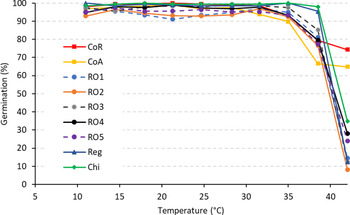
When seed germination was evaluated, all the genotypes presented their maximum germination percentage at temperatures between 11 and 35°C (Fig. 1), which made it impossible to determine cardinal temperatures. However, when the GI were compared, differences in the germination of each genotype at different temperatures and among genotypes at each temperature were observed (Table 1). All genotypes presented maximum GI between 28 and 35°C, indicating that, even though all genotypes reached maximum germination percentages in a broad range of temperatures, the T o of the evaluated quinoa seed would be in this range, which is where the faster germination occurred.
Physiological germination at temperatures between 11 and 42°C of nine quinoa genotypes cultivated in Chile. Genotypes CoR and CoA (northern zone) correspond to the salares ecotype, while RO1 to RO5 (central zone), Chi (southern zone) and Reg (cv. ‘Regalona’, southern zone) correspond to the coastal ecotype. Data for each genotype and temperature are the average of four replicates of 50 seeds each.

Based on the GIs obtained, the cardinal temperatures of each genotype were estimated (Table 2). The values presented in Table 2 correspond to the average of the values obtained from the curve adjusted to the data of each of the four repetitions performed in each genotype. Significant differences were observed between highland and coastal genotypes (Table 2). Seed from highlands genotypes had a T o of 30°C, while seed from coastal genotypes had a T o of 28°C. Additionally, seeds from highlands presented more extreme values for T b and T m.
Cardinal temperatures calculated for quinoa seed germination of nine Chilean genotypes

CoR and CoA (northern zone) correspond to the salares ecotype, while RO1 to RO5 (central zone), Chi (southern zone) and Reg (cv. ‘Regalona’, southern zone) correspond to the coastal ecotype.
a In each column, values with the same letter are not statistically different according to the least significant difference test (α = 0.05).
Values for the seed germination of the nine studied genotypes after 0, 7 and 15 months of storage are presented in Table 3. Note that in this case, evaluation of germination was conducted daily, with a first count after 24 h of imbibition, so maximum value for GI was 1.00, which mean 100% germination in the first count. With the exception of CoA seed, the germination percentage did not change significantly after 15 months of storage. Interestingly, while CoA had a small but significant reduction in germination, most of the coastal genotypes increased their germination percentages, although without statistical significance (Table 3). When GIs were compared, neither genotype from the salares ecotype changed after 7 months of storage, and one of them (CoA) had a significant reduction after 15 months. On the other hand, five of the seven genotypes from the coastal ecotype presented an increase in their GI after 7 months of seed storage, and in two cases, the increase was kept even after 15 months; none of the coastal genotypes had a lower GI after 15 months of storage (Table 3).
Physiological germination percentage and germination index at harvest (0 month) and after 7 and 15 months of storage at 20°C of quinoa seed from nine Chilean genotypes

CoR and CoA (northern zone) correspond to the salares ecotype, while RO1 to RO5 (central zone), Chi (southern zone) and Reg (cv. ‘Regalona’, southern zone) correspond to the coastal ecotype.
a For each variable and genotype, values with different letters have a significant difference according to the least significant difference test (α = 0.05).
Discussion
The nine quinoa genotypes evaluated in this study were able to reach full germination at a broad range of temperatures (Fig. 1), which corresponds with what other studies have reported for this species (González et al., Reference González, Buedo, Bruno and Prado2017; Mamedi et al., Reference Mamedi, Tavakkol Afshari and Oveisi2017). Because the temperature range at which seeds from a species germinate depends on the environmental conditions to which that species has adapted (Côme and Corbineau, Reference Côme, Corbineau, Black, Bewley and Halmer2006; Luna et al., Reference Luna, Pérez, Torres and Moreno2012), our results suggest that coastal ecotype used in Chile would be adapted to grow under a broad range of climatic and ecological conditions, similar to what has been observed in other quinoa ecotypes (González et al., Reference González, Buedo, Bruno and Prado2017; Xiu-shi et al., Reference Xiu-shi, Pei-you, Hui-min and Gui-xing2019).
Even though cardinal temperatures for seed germination depend mainly on the species, for a given seed lot there are several factors that may affect them, such as the environmental conditions for seed production and storage, dormancy status and the method used for determination (Côme and Corbineau, Reference Côme, Corbineau, Black, Bewley and Halmer2006; Bewley et al., Reference Bewley, Hilhorst, Bradford and Nogogaki2013; González et al., Reference González, Buedo, Bruno and Prado2017). Despite all these sources of variation, our results allowed us to distinguish among genotypes from salares and coastal ecotypes, which presented small but significant differences in their cardinal temperatures (Table 2). On the one hand, these results agree with the range of cardinal temperatures that other studies have reported for quinoa (Sigstad and Prado, Reference Sigstad and Prado1999; Boero et al., Reference Boero, González and Prado2000; González et al., Reference González, Buedo, Bruno and Prado2017; Mamedi et al., Reference Mamedi, Tavakkol Afshari and Oveisi2017), supporting that this is a species capable of germinating under a wide range of temperatures, and with optimums within a range from 25 to 30°C, similar to many cultivated species of economic importance (e.g. Avena sativa, Brassica oleracea, Glycine max, Helianthus annuus, Hordeum vulgare and Pisum sativum; Côme and Corbineau, Reference Côme, Corbineau, Black, Bewley and Halmer2006). On the other hand, the significant differences among ecotypes would be explained by the particular environmental range of conditions under which each one of them have evolved, same as other distinctive characteristics such as seed size, episperm colour and variation in inflorescence and floral types (Bhargava et al., Reference Bhargava, Shukla and Ohri2007; Madrid et al., Reference Madrid, Salgado, Verdugo, Olguín, Bilalis and Fuentes2018).
In addition to differences in cardinal temperatures between salares and coastal ecotypes, analysis of GIs obtained at different temperatures also showed that the two genotypes from highlands (CoA and CoR) were consistently faster in their germination than coastal genotypes (Table 1). Among the coastal genotypes, Reg and Chi consistently had the lower GI values, which were not related with a lower germination percentage but with lower germination rates (Fig. 1; Table 1). Ceccato et al. (Reference Ceccato, Bertero and Batlla2011) reported that a quinoa genotype from Chiloe (Chadmo accession) had higher dormancy levels than other quinoa genotypes and suggested that it could be used in quinoa breeding programmes to incorporate tolerance to pre-harvest sprouting. In that study, seed PD was expressed as the after-ripening requirement to reach full germination (Ceccato et al., Reference Ceccato, Bertero and Batlla2011). As a way to study the existence of higher dormancy levels in coastal genotypes compared with those from salares, seed germination (percentage and GI) was evaluated after 0, 7 and 15 months of storage at 20°C. Results show that while genotypes from the salares ecotype maintain or reduce their germination after storage, genotypes from the coastal ecotype tend to maintain their germination percentage and increase GI (Table 3). These results are consistent with the presence of a non-deep PD in seeds of coastal genotypes, which disappear with after-ripening produced during storage (Baskin and Baskin, Reference Baskin and Baskin2004; Finch-Savage and Leubner-Metzger, Reference Finch-Savage and Leubner-Metzger2006).
Differences in dormancy between salares and coastal ecotypes could be a product of the contrasting environments in which these genotypes have evolved. The Colchane area in the north presents a cold desert climate (BWk according to Köppen-Geiger classification), with low humidity and little risk of rain during quinoa seed development and harvest. In the case of coastal genotypes, they are cultivated in areas with a Mediterranean climate to a temperate oceanic climate (Csc to Cfb according to Köppen-Geiger classification), with higher chances of rain towards the harvest, especially in Chiloe. In agreement with conclusions reported by Ceccato et al. (Reference Ceccato, Bertero and Batlla2011), our results suggest that genotypes from the coastal ecotype cultivated in Chile represent a valuable source of PD for introducing pre-harvest sprouting resistance in quinoa breeding programmes.
In conclusion, although salares and coastal quinoa genotypes presented their higher germination in a broad range of temperatures, there was a significant difference in the calculated optimal temperature, which was of 28 and 30°C for coastal and salares ecotypes, respectively. Coastal genotypes, especially Reg and Chi, presented a non-deep PD that may be useful to improve pre-harvest sprouting resistance in quinoa breeding programmes.
Acknowledgements
We thank James Dickson for his contribution in editing this manuscript. This work was supported by institutional funds and by PYT-2016-0079 and PYT-2019-0136 grants from Foundation for Agricultural Innovation (FIA).