There are increasingly urgent calls for humanity to change its ways of living if we are to ensure that current generations are not the last to have a better outlook than their parents (Olshansky et al., Reference Olshansky, Passaro, Hershow, Layden, Carnes, Brody and Ludwig2005). While the fate of the human species is generally perceived as the most topical concern, worsening ecological crises impact all life on Earth, with dire consequences into the future. Humans are faced with the urgent need to recast our ways of living, and education for sustainability across the lifespan, including in early childhood, is seen as one of the most effective means by which societal transformation can occur (Centre for Environment and Sustainability, 2008; UNESCO, 2014). With a view to better understanding how the early childhood education field might contribute to reshaping society, this article reports on a study of the relationship between Queensland early childhood teachers’ understandings of sustainability and education for sustainability (EfS), and how, or whether, they practise EfS. We believe that investigating the knowledge, skills and dispositions of teachers offers directions for maximising the powerful role that they can play in delivering an educational response to sustainability. In the context of this study, we see EfS practices as a broad term that includes not only teachers’ pedagogical practices such as play-based learning and intentional teaching, but also centre policies and environmental management practices such as water conservation and recycling. The research conducted in Australia emerged from a Japanese investigation of a similar topic, with results discussed in light of this earlier work.
The history and evolution of environmental education and education for sustainability involves reshaping understandings of sustainability concepts. Ideas around sustainability are complicated and understood differently by governments, researchers, and the populace, as well as between regions and nations. For example, European countries use Education for Sustainable Development (ESD) in official education and environmental policies. Japan and the United States mainly use Environmental Education (EE) in governmental discourses. Australia and New Zealand have adopted Education for Sustainability (EfS) as common nomenclature.
Similar histories and evolutionary moments have also shaped Early Childhood Education for Sustainability (ECEfS), although this subfield has a much shorter history. The earliest research articles on EE at the early childhood level, for example, were only published in the 1990s, mainly in the United States, although Australian research in EE and EfS is now arguably the strongest of any nation's outputs. Since the beginning of the 21st century, Australian researchers have produced many articles and research papers on EfS (Davis, Reference Davis2009; New South Wales Environmental Protection Agency, 2003). One leading output is the 2014 international publication involving 31 international researchers from nine countries edited by Australian researchers, the world's first research text focused exclusively on ECEfS research (Davis & Elliott, Reference Davis and Elliott2014), to which each of these authors contributed.
As ECEfS research flourishes, it will become easier to undertake meta-analyses of the field because there will be a growing body of work. In earlier articles, for example, suggestions for ways teachers might facilitate nature-based activities in outdoor spaces were the most prevalent focus of early childhood EE/ESD/EfS (Wilson, Reference Wilson1994; Pramling Samuelsson, & Kaga, Reference Pramling Samuelsson and Kaga2008). Elliott, Edwards, Davis, and Cutter-Mackenzie's (Reference Elliot, Edwards, Davis and Cutter-Mackenzie2013) assessment of ‘The Best of Sustainability Education’ — articles and papers published by Early Childhood Australia's research journal Australasian Journal of Early Childhood and its professional magazine Every Child — found this is still largely the case. This focus on nature-based learning illustrates a strong and pervasive thread in ECEfS that Elliott and Davis (Reference Davis2009) identify as contributing to why early childhood education has been so slow to take up EfS — teachers believe they are ‘doing EfS’ in their early childhood centres because they already have a nature orientation to their curriculum work. We argue, however, that such an orientation is not enough to help with addressing current sustainability crises and that a more transformative early education is called for. If one asks the question: Are nature-based activities sufficient or effective for contemporary EfS? — we answer ‘no’. For this paper, we used this general question to formulate our research and to shape our discussion. First, however, as this study emerged from an Australian-Japanese research collaboration, we provide a short description of these different ECEfS contexts.
A Snapshot of ECEE/EfS in Japan
In Japan, nature-based activities in early childhood education have been prescribed in government guidelines since 1926, and included in every national guideline since then (Inoue, Reference Inoue2000, Reference Inoue, Davis and Elliott2014a). To explore the type and frequency of nature-based outdoor activities in early childhood services, the Japanese author of this article conducted a survey of 417 early childhood teachers’ EE practices in 2003. In brief, this study revealed that, on average, children had access to playgrounds for just over 2 hours/day, and half the services had garden beds, wild grasses, fruit trees, and plants with flowers and leaves that children could pick and use while playing. A large majority of services also had small animals that required care. Within the Japanese context, it can be claimed that Japanese early childhood services implement nature-based activities very well and that the long history of national curriculum guidelines and the Japanese tradition of affinity with nature contribute to this positive situation. Additionally, many early childhood teachers support children to efficiently use both natural resources and manufactured materials, because materials conservation is a strongly rooted tradition in Japanese culture. During the 20th century, however, like many Western countries, Japan experienced rapid economic growth, leading to the destruction of natural landscapes and overconsumption of resources; Japan has not yet succeeded in reducing its waste and CO2 emissions, and a number of native species are now endangered. These points illustrate that simply engaging in nature-based activities and teaching about resource conservation have not been sufficient for promoting sustainability in Japan.
These past surveys also revealed that Japanese teachers are not particularly conscious of complex environmental concepts, or of the affordances offered children regarding broader aspects of sustainability such as biodiversity, biocapacity, ecosystems and human-nature relationships when they prepare the pedagogical environment and plan learning activities with children (Inoue & Muto, Reference Inoue and Muto2006, Reference Inoue and Muto2007). Further, while teachers in Japan do provide many nature-based activities and play environments for children, and children are taught to conserve resources, these are mainly implemented for child development purposes, such as enhancing physical development, strengthening social learning, or fostering sensory awareness, rather than for sustainability outcomes (Inoue & Muto, Reference Inoue and Muto2009).
A Snapshot of ECEE/EfS in Australia
In Australia, the first national guidelines for early childhood curriculum, Belonging, Being & Becoming: The Early Years Learning Framework for Australia (EYLF; DEEWR, 2009) gives some emphasis to EfS, while the National Quality Standard (NQS; ACECQA, 2011) has made ‘sustainable practices’ a requirement of accreditation. The EYLF (DEEWR, 2009), for example, supports children to ‘become socially responsible and show respect for the environment’ (Outcome 2, p. 29) and recommends that children learn to understand ‘the interdependence between land, people, plants and animals’, ‘relationships with other living and non-living things’, and ‘the impact of human activity on environments’. The NQS (ACECQA, 2011) makes explicit reference to sustainable practices in Quality Area 3.3: ‘the service takes an active role in caring for its environment and contributes to a sustainable future’.
While the ECEfS field has been slow to develop in Australia relative to other areas of education, nevertheless, as noted earlier, the field is growing rapidly (see Davis, Reference Davis2009; Davis & Elliott, Reference Davis and Elliott2014; Edwards & Cutter-Mackenzie, Reference Edwards and Cutter-Mackenzie2011). One of the characteristics of this recent Australian ECEfS research is that authors emphasise that EfS practices, rather than focusing on traditional, developmentalist ideas of children learning in nature, be framed with reference to newer understandings and representations of children. Instead, young children are viewed as capable, competent human beings, aware of events in the world such as climate change and social injustice, and who can think in quite complex ways about their daily lives. Children, then, should be encouraged to act for sustainability in broader and deeper ways than has previously been recognised (Davis, Reference Davis, Pramling Samuelsson and Kaga2008, Reference Davis2009, Reference Davis, Davis and Elliott2014; Mackey Reference Mackey2012). Cutter-Mackenzie et al.’s (Reference Cutter-Mackenzie, Edwards, Moore and Boyd2014) research reinforces this view, suggesting that outdoor play and traditional outdoor play pedagogies alone are insufficient for supporting children's developing environmental attitudes and dispositions towards sustainability.
There is limited empirical research about ECEfS and Australian teachers’ beliefs and practices, with a recent exception that of Hill et al. (Reference Hill, McCrea, Emery, Nailon, Davis, Dyment and Getenet2014). This survey reported that participants who attended an ECEfS professional development workshop primarily understood sustainability as being about environmental issues rather than viewing sustainability as also having social and economic dimensions. The survey also reported low levels of actual EfS practice and suggested that, like their Japanese counterparts, the understandings of Australian early childhood teachers reflect ideas of EfS as mainly nature-based and about resource conservation. We argue that Australian early childhood teachers, as for those in Japan, might expand their repertoire of practices for sustainability towards more transformative approaches to EfS that encourage participation, problem-solving, critical thinking and ‘making a difference’. A starting point is to explore how early childhood teachers actually construct their ideas about and practices for sustainability under the national curriculum guidelines and standards. To do this, we conducted a survey in Queensland early childhood services in 2012, not long after the EYLF (DEEWR, 2009) and NQS (ACECQA, 2011) had been introduced.
Methods
As described above, contemporary ECEfS practices can be considered to be much broader than traditional nature-based activities such as gardening, caring for animals or outdoor play, and should also include social and economic dimensions. EfS practices should be more holistic and transformative for building a sustainable society based on broader understandings of the Earth's ecosystem and its limits. We argue, therefore, that a broader view of sustainability should prompt educators to create pedagogical environments and plan learning activities that enhance children's awareness of ecosystems, environmental issues, and relationships between humans and nature. EfS experiences should not be segmented, but meaningfully integrated. However, it is difficult to evaluate such holistic approaches because they may appear, on the surface, similar to traditional activities. Qualitative research, therefore, is an appropriate way to explore how educators create pedagogical environments and plan activities with children in holistic ways and how/what children learn about/for sustainability (e.g., Ji & Stuhmcke, Reference Ji, Stuhmcke, Davis and Elliott2014). While case studies are useful, they often tend to describe exemplary practices and do not show to what extent and how EfS is practised in early childhood services more generally. Allied with appropriate quantitative research, insight into what might actually be occurring in a large number of early childhood services and the obstacles that might affect implementation of EfS was the basis of the study reported here, which used a survey with both qualitative and qualitative components.
The survey's purpose was to explore the relationship between understandings of EfS and actual EfS practices of early childhood teachers in Queensland (QLD). The overall research questions were: (1) How do QLD early childhood teachers understand EfS concepts? and (2) How do early childhood teachers practise EfS in QLD early childhood services? In this research, we used some of the questions from the 2003 Japanese survey that had a distinct focus on nature-based learning and environmental management practices (Inoue & Muto, Reference Inoue and Muto2006, Reference Inoue and Muto2007, Reference Inoue and Muto2009). In so doing, we sought to provide a basis for international comparison of approaches to sustainability. However, we added new questions in order to explore more contemporary understandings of EfS, such as holistic and transformative approaches to education that might lead to social change. We also included questions about child participation, which has emerged as a distinguishing characteristic of ECEfS in Australian research literature. The survey questions were translated from Japanese and then reviewed by the Australian researchers for meaning and application to the Australian context. After revisions, we then developed survey questions related to six topics: (1) learning environment and facilities; (2) children's learning activities; (3) teachers’ intentional teaching about sustainability; (4) opportunities for professional development in EfS; (5) conceptual understandings of sustainability and EfS; and (6) centre management practices related to sustainability. All topics required yes/no responses or 7-point Likert scale questions. For topics (1) (5) (6), open-ended questions requiring qualitative responses were also provided. Topics (1) (2) (3) (6) were included in order to reveal how educators intentionally create pedagogical environments and how educators plan activities with children. Topics (4) and (5) were included to provide descriptions of educators’ experiences, understandings and activities in relation to EfS. For each topic, we included questions referring to both traditional nature-focused approaches that have been a feature of early childhood education for a long time (e.g., gardening, animal care, outdoor play, reading books about nature) and sustainability-focused factors (e.g., composting, kitchen gardens, rainwater tanks and reading books about environmental issues).
Participants
Participants were all members of a large Queensland early childhood education provider that has several hundred services, of which 109 (28.9%) responded. Fifty-seven respondents (62.6%) were from community-based services and 19 (20.9%) were from services run by the state government. Seventy-eight respondents (71.6%) were directors, of whom 51 also had a role as teacher in their service. Most respondents had a diploma (28.8%) or bachelor's degree (58.9%). The average length of service as an early childhood teacher was 18.9 years (SD = 12.5).
The Survey and Analysis
In February 2012, we requested that the service provider distribute emails that included the URL of our survey, created via an online survey service (Survey Monkey). The survey was closed in December 2012. During the survey period, reminder emails were sent three times from the administration office of the provider. Because of initial low responses to the electronic survey, we also made hard copies that were handed out by education consultants when they conducted routine professional development network meetings for their teachers. Not all of these meetings were addressing EfS. Data were analysed by descriptive statistics using SPSS software, and relationships examined with the 0.05 level criterion for statistical significance by the Wilcoxon signed-rank test, Fisher's exact test and Spearman's correlation for non-parametric factors. Qualitative comments were analysed using thematic analysis, which included searching for and coding patterns (Denzin & Lincoln, Reference Denzin and Lincoln2005). This survey was approved by Queensland University of Technology's Research Ethics Committee (Approval No. 1200000008).
Results
Learning Environment and Facilities
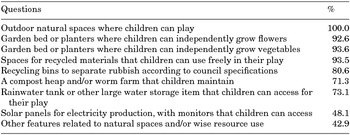
Teachers were asked about their centre's learning environment and facilities. Results are outlined in Table 1. As expected in Australian early childhood services, because of regulatory requirements and what is considered ‘best practice’ for this organisation, all respondents (100%) identified that their service had adequate outdoor natural spaces. Further analysis of the open-ended responses in this category also revealed the following details. Almost all respondents (99.1%) grew and cared for flowering plants (e.g., sunflowers, marigolds), vegetables (e.g., tomatoes, carrots), fruit (e.g., strawberries, passionfruit), herbs (e.g., basil, rosemary), and trees (e.g., bamboo, mulberries). Two thirds of respondents (68.8%) reported that they cared for small animals, identifying a wide range of mammals (e.g., guinea pigs) and birds (e.g., chickens, budgies), and other animals such as reptiles (e.g., turtles, lizards), amphibians (e.g., tadpoles), fish (e.g., goldfish), insects (e.g., silkworms) and others (e.g., hermit crabs, worms).
Kindergarten Learning Environment and Facilities

Children's Learning Activities
The average length of time children used the playgrounds was 129.1 minutes/day (SD = 66.3). The frequency of children's outdoors activities was indicated using a 7-scale rating scheme (rating scale point [RP]: 1 = none, 2 = once/year, 3 = once/6 months, 4 = once/3 months, 5 = once/month, 6 = once/week, 7 = every day). Children played on playground equipment (e.g., swings, slides; average RP 6.5); played traditional and/or physical games outdoors (e.g., running, hide-and-seek, tag; RP 6.9); and played with and/or observed natural materials (e.g., plants, small creatures, sand, stone, water; RP 6.9) almost every day.
Once a week, children engaged in gardening (RP 6.2) and learned about resource use and conservation (e.g., recycling, water saving, energy saving; RP 6.1). However, there were fewer opportunities for children to care for animals (RP 4.4); cook and eat food produced by children (RP 4.4); or make and/or maintain compost (RP 4.4). Children seldom experienced activities such as: participating in environmental activities organised by outside professionals (e.g., environmental education centres, outdoor play specialists; RP 2.8); joining in environmental activities in the community (e.g., clean-up or recycling campaigns; RP 1.8); or field visits in the community to learn about environments (e.g., natural, historical, geographical; RP 1.6).
Teachers’ Intentional Teaching About Sustainability
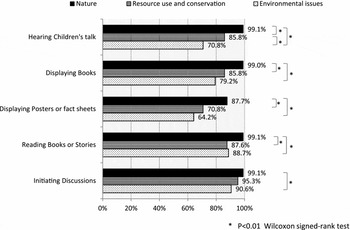
Teachers reported that they used a range of strategies to initiate education for sustainability in their service. These included: taking note of children's conversations; intentionally providing educational resources (displaying books and posters, reading stories) to support sustainability discussions; and initiating discussions about sustainability with children (Figure 1). We then aligned these intentional teaching strategies according to the following three categories: teaching about nature, teaching about resource use and conservation (e.g., recycling, water saving, energy saving), and teaching about environmental issues (e.g. climate change, water pollution, forest destruction). As Figure 1 illustrates, most teachers (87.7–99.1%) taught about nature. However, the percentage of teachers who taught about resource use and conservation (70.8–95.3%) and environmental issues (64.2–90.6%) was significantly lower than those who taught about nature.
Teachers’ intentional teaching about sustainability.

Opportunities for Professional Development in EfS
Teachers reported that they attended several professional development programs and/or workshops broadly related to sustainability, on average, 6.9 (SD = 3.8) times/year. Most experienced practical workshops about teaching and/or learning in the outdoors (72.5%), sustainability (67.0%), and ways to enhance child participation (58.7%). However, these teachers did not report many opportunities to develop in-depth ideas related to sustainability such as an ecological world view, or where they were supported to develop understandings of human-nature relationships and the causes of environmental and sustainability problems (22.9%). Similarly, only small numbers reported professional development focused on resource use and conservation (22.0%), ecosystem and environmental science (15.6%), and wildlife and habitat conservation (11.0%).
Conceptual Understandings of Sustainability and EfS
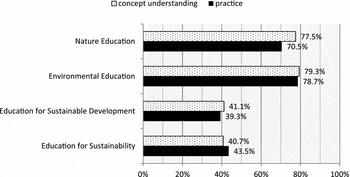
The survey asked Queensland early childhood teachers about the following allied approaches to EfS, often used interchangeably: Nature Education (NE), Environmental Education (EE), Education for Sustainable Development (ESD) and Education for Sustainability (EfS). Figure 2 illustrates the percentage of respondents who identified that they were familiar with these terms and that they practised these forms of education. As expected, NE and EE were well known and were reportedly practised by over 70% of respondents. However, ESD and EfS were known and practised by only around 40% of respondents.
Concept understandings and practices.

We also used open-ended questions to ask respondents to describe what these four forms of education meant. Several respondents who described NE used the words ‘outdoors’, ‘resources’, ‘animals’ and ‘living’, while those who described EE used descriptors such as ‘aware/awareness’, ‘care’, ‘resources’ and ‘recycle’. The words ‘future’ and ‘impact’ were used by a small number of respondents to describe ESD and EfS. Although the term ecosystem is considered an important keyword for ESD/EfS, no respondents used this descriptor. Recognition of the multidimensions of sustainability (social, environmental and economic) is also regarded as significant in defining ESD and EfS; however, only one respondent used these terms.
Centre Management Practices/Policies Related to Sustainability
Around 60% of respondents mentioned that their early childhood centre's philosophy and policy documents included child participation (62.3%) or sustainability (58.7%), while 30% of respondents identified that they had practices/policies relating to matters such as coexistence of humans and nature (36.2%), nature conservation (32.6%), or environmental protection (33.3%). Fifty-one percent stated that they had an environmental management policy (e.g., related to water, energy and chemical use), while 55.3% identified that they had instigated a whole-centre project for improving resource use and materials conservation. We also asked what plans respondents have for improving or enhancing education for sustainability in their centres. Sixty-one respondents gave answers, with 24 respondents (39.3%) providing nature-focused descriptions in open-ended responses (such as ‘green’, ‘garden’, and ‘chicken’) and 37 respondents (60.7%) describing resource use (such as ‘worm farm’, ‘rainwater tank’ and ‘solar panels’). Only two respondents described more holistic approaches: ‘continuing reflective practice with children transformative education approaches aimed at creating positive change’ and ‘to transform not only our service but the local community to be environmental leaders’.
Relationships Between Conceptual Understandings and Practices
The final step of our data analysis was analysing the relationship between teachers’ responses to Topic 5: Conceptual understandings of sustainability and EfS and their practices (Topic 1: Learning environment and facilities, Topic 3: Teachers’ intentional teaching about sustainability, and Topic 6: Centre management practices related to sustainability). First, we divided the responses into two groups, the ‘yes’ group that consisted of those familiar with the concepts NE, EE, ESD or EfS in Topic 5 (shown as dotted bars in Figure 2), and the ‘no’ group, those unfamiliar with these concepts.
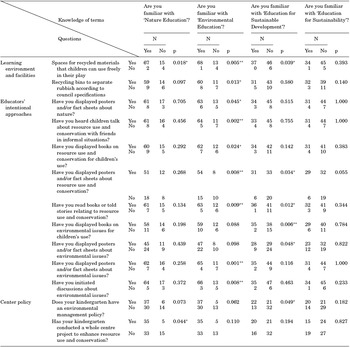
The yes group and the no group were then compared using Fisher's exact test. Questions that showed significant differences between the yes group and the no group are listed in Table 2. The ‘yes’ group who indicated strong understanding of NE reported a statistically significant relationship with having spaces set aside specifically for recycling in the centre and conducting whole-centre projects targeting resource conservation. The yes group who indicated strong understanding of EE reported a statistically significant relationship to a range of strategies such as providing recycling bins to separate rubbish and displaying posters and/or fact sheets about resource use and conservation. The yes group who indicated knowledge of ESD also reported a statistically significant relationship to displaying posters and/or fact sheets about resource use and conservation, displaying books, posters and/or fact sheets about environmental issues, and having an environmental management policy. For those who identified that they knew about EfS, there was no significant relationship between the yes group and the no group, although the yes group reported that they were more likely than the no group to provide a compost heap, care for animals, and display posters/fact sheets about resource use and conservation.
Relationship between concept understandings and teachers' practices

(Fisher's exact test**: P <0.01*: P<0.05)
Discussion
This discussion is organised according to the research questions that framed this study.
Research Question 1: How Do Early Childhood Teachers in Queensland Practise EfS?
The results of this survey suggest that the learning environments and facilities of Queensland early childhood services are structured on a strong tradition of nature-based approaches to teaching and learning that build on this historical foundation of education and care of young children. As expected, teachers who participated in this study reported that children frequently experienced traditional nature-based activities. However, when asked if their pedagogical practices supported learning about environmental issues such as recycling, making compost or water conservation, participants returned relatively low responses to these topics. Another area with relatively low responses was the extent to which children were actively involved in caring for animals, maintaining a composting system, or cooking food produced by the children themselves.
In sum, early childhood teachers in Queensland reported that they practised play-oriented, nature-based environmental education focused more on individual child development outcomes than on children intentionally learning about environmental/sustainability concepts such as ecology and human-nature relationships, or practising active citizenship, seen as foundational for addressing sustainability issues in contemporary society. These results are consistent with those of the surveys conducted in Japan (Inoue & Muto, Reference Inoue and Muto2006, Reference Inoue and Muto2007, Reference Inoue and Muto2009).
Research Question 2: How Do Early Childhood Teachers in Queensland Understand EfS?
In Australia, EE has largely been replaced by EfS in government policies and guidelines, a broader concept that includes not only environmental but the economic and social dimensions of sustainability. ESD, a concept somewhat similar to EfS, was originally introduced at the Rio Earth Summit in 1992, and further profiled in the United Nations Decade for Education for Sustainable Development (DESD, 2005–2014). ESD is mainly used in documents and policies of the United Nations and UNESCO and in Europe. Interestingly, despite the international profile of ESD, this study found that almost 60% of Queensland early childhood teachers were not familiar with either of these terms. This could imply that official governmental and international policies such as the DESD have had little impact or influence in the early childhood education sector.
Our study suggests the need for common terminology around sustainability and EfS (Stevenson, Brody, Dillon, & Wals, Reference Stevenson, Brody, Dillon and Wals2012). There have been several official definitions of EE/ESD/EfS in international documents over the years (e.g., Belgrade Charter, 1976; Tbilisi Declaration, 1978; United Nations Decade of Education for Sustainable Development, 2005–2014; Living Sustainably: The Australian Government's National Action Plan for Education for Sustainability, 2009). However, respondents in this study offered their own unique explanations of these key forms of sustainability education, illustrating lack of familiarity with nationally — and internationally — accepted definitions. If teachers understand EfS in such different ways, we posit that their pedagogical objectives might also be enacted differently and with varied emphasis. Such variety may serve to hinder the progress of EfS into mainstream early childhood pedagogies. We suggest that it is worth encouraging teachers’ deeper understandings of EfS through exploration of the historical and scholarly underpinnings of the field.
Our results also show that respondents who were familiar with the all four terms were more likely to structure their pedagogical environments using strategies such as displaying and reading environmental books, posters and factual information with children, and through developing environmental management policies in their services. This indicates to us that teacher understandings of EfS do influence their practices, to some extent. To illustrate, teachers who were familiar with the term EE, which has been replaced by EfS in Australia, or ESD, which is not officially applied in Australian education, gave some ‘activist’ responses about teaching about environmental and sustainability issues. Teachers who only understood the term EfS did not report using activist practices. We suggest that teachers who were familiar with EE, which had not been recognised in early childhood education, or ESD, which is less common in Australia, may have a deeper and broader concern with sustainability than others, and that this might impact their pedagogical practices for sustainability.
Our study also found that early childhood teachers reported using intentional teaching strategies to promote children's understandings of nature, resource use/conservation, and environmental issues. However, it would appear that the teaching strategies most used focus on books and visual materials such as posters, with some discussion, rather than encouraging deep, contextualised learning of topics (such as recycling, water conservation or habitat protection) through play-based and extended learning experiences, as illustrated in accounts where the Project Approach has been utilised (Ji & Stuhmcke, Reference Ji, Stuhmcke, Davis and Elliott2014). In the 40 years of EE research, it is regularly reported that simply developing knowledge about environmental issues does not lead to behavioural or social change (e.g., Kollmuss & Agyeman, Reference Kollmuss and Agyeman2002). What is important are learning opportunities that actively engage learners in thinking critically about issues and having real-life engagement in problem-solving and enacting solutions to issues (Lang, Reference Lang2007). As called for by Davis (Reference Davis, Davis and Elliott2014), and supported by these findings, we suggest that early childhood teachers should offer young children opportunities to participate actively in play and learning about and for sustainability — and in all the social, economic and environmental perspectives in their everyday lives, and not simply be offered learning through knowledge construction.
Recommendations
To summarise, our survey results suggest that, like their Japanese counterparts, Queensland early childhood teachers engage quite well with traditional nature-based learning activities. However, results also indicate that teachers’ limited understandings of EfS do not lead to the transformational pedagogical practice indicated in the literature as necessary for dealing adequately with contemporary challenges. Even though the EYLF (DEEWR, 2009) and the NQS (ACECQA, 2011) point to the importance of sustainability within early childhood curriculum, these documents alone are not sufficient to support understandings of sustainability and how to practice it effectively.
In relation to professional development, our results identify that although teachers regularly attend seminars and workshops related to environment/sustainability, the focus of such sessions is more on ‘practical’ strategies than on developing teachers’ deep understandings of human-environment interactions and relationships, or more transformational understandings of EfS. One way to change this is to consider the Japanese practice study, a form of professional development aimed at improving teaching (Inoue, Reference Inoue and Davis2014b). Practice study typically involves teachers in a setting deciding on an educational concern — for example, ‘sustainability’. They then plan, implement, document, reflect and discuss the practice study topic under the guidance of experienced teachers and/or EfS researchers/specialists who challenge them to think deeply about underpinning ideas and the impact of their teaching practices. Especially in public kindergartens in Japan, teachers usually prepare a final report about the practice study, and then hold a meeting to report the process to teachers from other kindergartens in the local area. The benefit of this approach is that teachers work collaboratively, engage in critical reflection, and share their enriched teaching practices with colleagues. We also suggest enhancing professional learning by, for example, supporting and strengthening practitioner networks for ECEfS and expanding connections with other relevant organisations that can provide EfS expertise. Additionally, EfS centres of excellence could be profiled so that others can learn from high quality early childhood sustainability education-in-practice, with such centres identified, perhaps, through the NQS (ACECQA, 2011) quality evaluation process.
Considering that in Australia, the EYLF (DEEWR, 2009) and NQS (ACECQA, 2011) do give support to sustainability and EfS, we hope that the quality of EfS improves over time. However, a 2014 Productivity Commission report suggests a watering down of the presence of sustainability in the national curriculum and quality frameworks for the birth to 5 years early education sector in Australia. This unfolding situation further suggests the necessity to deeply embed understandings of sustainability into how early childhood teachers think about and enact EfS such that the vagaries of changing political commitments become less relevant to what actually takes place in early childhood settings. If effective preservice and inservice of early childhood teachers becomes the norm, perhaps teachers will then commit to sustainability because they believe in its importance, rather than in response to governmental policy requirements.
Limitations of the Study and Future Research Possibilities
Our survey was conducted with early childhood teachers from one large service provider in Queensland; the results, therefore, are unlikely to reflect the reality of all Queensland and Australian early childhood teachers. However, this survey is a first step in understanding the status of early childhood EfS in terms of teachers’ beliefs and practices. The fact that the survey was derived from an earlier Japanese survey provides both benefits and limitations. The benefit is that this study builds on previous international research and provides a useful framework for comparative work. One limitation is that the scope of the measure did not include deep explorations of teachers’ views of sustainability and detailed accounts of their pedagogical practices. Widespread influence of the EYLF (DEEWR, 2009) and the NQS (ACECQA, 2011) has only been occurring since 2012, so it is possible that a more consistent application and interpretation of these frameworks may be evident in the future. We would anticipate that educators’ understandings of terms such as EfS and ESD will improve over time as teachers engage more explicitly with these concepts through professional development. We also suggest that the documents themselves require strengthening to ensure that deeper understandings of sustainability and EfS are articulated. Ongoing research will be required to assess whether this is so.
A critique of our survey is that it included a wide range of general topics related to sustainability and early childhood education. For example, in the survey, most teachers answered that they practised traditional, nature-based activities such as gardening, or included outdoor play in their programs. For EfS, however, we believe it is also important to build knowledge of ecological concepts and to critique human-nature relationships — our survey did not adequately address these topics. Also, while many teachers in the study regarded child participation as an important characteristic of EfS — and stated that they considered this in their centre's philosophy — this study did not explore whether teachers actually sought to foster child participation within sustainability-related learning experiences. Future research would be useful to explore whether there is a rhetoric-reality gap between beliefs and practices as has been identified in past EE/EfS research in schools. Moreover, this survey did not explore whether teachers connected their practices and experiences through holistic and transformative ways or what children learned in each activity. Case study research, including in-depth interviews with educators in early childhood settings, is recommended to explore these questions, building on previous work by, for example, Edwards and Cutter-McKenzie (Reference Edwards and Cutter-Mackenzie2011).
Since this study was conducted, allied surveys have been administered in Japan, Sweden and Korea (Ji et al., Reference Ji, Huh, Baik and Chung2015). In the future we hope to compare the results across these international contexts. There is potential for this Queensland research, then, to provide a launching pad for a broader and deeper picture of the relationships between early childhood teachers’ understandings of EfS and their practices across several international contexts.
Acknowledgments
We would like to thank the people and organisations who contributed to this survey, particularly the early childhood teachers of the service provider who gave of their time to participate in the survey, the research and development coordinator who arranged and coordinated the distribution of our survey, and Professor Okjong Ji (Korea), Dr Eva Ärlemalm-Hagsér (Sweden) and Dr Sharon Stuhmcke (Australia), who provided useful comments during the development of the questionnaire. This work was supported by JSPS KAKENHI Grant Number 23501078 and Overseas Research Grant of Osaka Ohtani University, Japan.
Author Biographies
Professor Michiko Inoue is Professor in the School of Early Childhood at Osaka Ohtani University in Japan. She is a leader in environmental education and EfS at the early childhood level in Japan.
Dr Lyndal O'Gorman is Senior Lecturer in the School of Early Childhood at the Queensland University of Technology in Brisbane. Her university teaching and research focus is on the arts and EfS in early childhood and school contexts.
Professor Julie Davis is Professor in the School of Early Childhood, Queensland University of Technology in Brisbane. Her university teaching and research foci are early childhood EfS and embedding EfS into teacher education.