Introduction
In recent decades there have been changes in eating habits and lifestyles, encompassed by the term ‘Nutrition Transition’, linked to improvement in socioeconomic conditions and health (demographic and epidemiological transition), which have contributed to an increase in overweight, obesity and chronic diseases such as cardiovascular disease (CVD) and non-insulin dependent diabetes mellitus (NIDDM) (Popkin, Reference Popkin2006; Delisle, Reference Delisle2010). Dietary modifications associated with Nutrition Transition increase the consumption of foods rich in simple sugars (sweetened beverages, processed food), animal proteins (meat) and saturated fats (meat products, processed food) and decrease the consumption of foods rich in complex carbohydrates (tubers, bread, cereals) and fibre. Nutrition Transition is also associated with a reduction in energy expenditure due to low daily physical activity. However, different transition stages are observed in countries and/or regions, depending on development levels (Popkin, Reference Popkin2006). Migration processes also act on eating habits with an impact on nutrition improvements in quantitative terms, but not necessarily observed in a qualitative way.
One objective way to compare populations’ feeding patterns in different countries or at different times is to use diet quality indices. Among these, the Mediterranean Adequacy Index (MAI) has been used in several studies to determine how much a population or country adheres to the Mediterranean diet (Fidanza et al., Reference Fidanza, Alberti, Lanti and Menotti2004; Bach et al., Reference Bach, Serra-Majem, Carrasco, Roman, Ngo and Bertomeu2006; Balance et al., Reference Balance, Garcia-Lorda, Perez-Rodrigo, Aranceta, Bonet and Salas-Salvado2007; Rodrigues et al., Reference Rodrigues, Caraher, Trichopoulou and De Almeida2007; Da Silva et al., Reference Da Silva, Bach-Faig, Raido Quintana, Buckland, Vaz de Almeida and Serra-Majem2009; Bach-Faig et al., Reference Bach-Faig, Fuentes-Bol, Ramos, Carrasco, Roman and Bertomeu2011). The food consumption pattern that fits with the Mediterranean diet is very interesting from a health perspective because in populations living in the Mediterranean area, the incidence and prevalence of chronic disease are lower than elsewhere, and life expectancies are the highest in the world (Keys, Reference Keys1980; Serra-Majem et al., Reference Serra-Majem, Roman and Estruch2006; Sofi et al., Reference Sofi, Cesari, Abbate, Gensini and Casini2008). Actually, the Mediterranean diet is not unique and there is no accepted definition due to the heterogeneity of diets among countries in the Mediterranean region, and even within a given country. This is due to the existence of different patterns depending on the region, especially between the Mediterranean north and south Basins (Noah & Truswell, Reference Noah and Truswell2001; Karamanos et al., Reference Karamanos, Thanopoulou, Angelico, Assaad-Khalil, Barbato and Del Bem2002). However, several common characteristics have been defined, such as high consumption of vegetable foods (legumes, cereals, fruits and vegetables, nuts and seeds), low consumption of meat and dairy products, olive oil as the main source of fat and moderate wine intake (Willett et al., Reference Willett, Sacks, Trichopoulou, Drescher, Ferro-Luzzi, Helsing and Trichopoulos1995; Trichopoulou, Reference Trichopoulou2004; Serra-Majem et al. Reference Serra-Majem, Trichopoulou, Ngo de la Cruz, Cervera, Garcia Alvarez and La Vecchia2004; Bach-Faig et al., Reference Bach-Faig, Geleva, Carrasco, Ribas-Barba and Serra-Majem2006). The consumption pattern in Morocco is still close to the local traditional Mediterranean diet (Benjelloun, Reference Benjelloun2002). However, nutritional studies of the Moroccan population based on large national surveys of food availability (FAO, 2011) show a change in the food consumption pattern that affects both rural and urban populations (Anzid et al., Reference Anzid, El Hamdani, Baali, Boëtsch, Levy and Montero2009) and different socioeconomic groups (Montero et al., Reference Montero, Anzid, Cherkaoui, Baali and Rodríguez2012), but with a different intensity.
There are few data on the nutritional status of adolescents in Morocco (FAO, 2011) because until recently the main problem in this country was malnutrition, and population studies focused on children under five years and pregnant women. However, adolescence is an important stage in the life cycle in which the growth and development process is completed and ends. A poor diet would have irreversible consequences on this process. Thus, adolescents can also be considered a vulnerable group of the population because they have not yet completed their growth and development, and in terms of eating habits they tend to prioritize immediate gratification and do not take into account the negative consequences of a poor diet long-term. In addition, they are very easily influenced in their behaviours and lifestyles by marketing and the media, both of which are associated with the modernization of Morocco and with the change in lifestyle and food availability in the case of migrants.
Urbanization and globalization are responsible for changes in traditional dietary patterns associated with Nutrition Transition in both developed and developing countries (Popkin, Reference Popkin2002), but migration is also a powerful change factor. Eating is a cultural trait that remains fairly constant among immigrants, with some original cuisine elements being retained in successive generations, but there is no doubt that migrants tend to change their eating habits, copying the behaviours of the countries to which they move (Medina, Reference Medina2002; Ngo & Vidal, Reference Ngo and Vidal2008). Emigrants from developing countries going to developed countries are involved in these changes. Acculturation processes can have a different intensity depending, among other causes, on the migration age and how it occurs, the availability of foods in the destination country, the traditional culture of the origin country, the stay time in the new place and the closer familiar environment (Satia et al., Reference Satia, Patterson, Kristal, Hislop, Yasui and Taylor2001). It has been observed that younger immigrants tend to change their food habits more easily than older immigrants, and this impacts their nutritional status and health (Lee et al., Reference Lee, Sobal and Frongillo1999; Pan et al., Reference Pan, Dixon, Humburg and Huffman1999; Sharma et al., Reference Sharma, Cade, Riste and Cruickshank1999). Most studies have focused on the long-term effects of migration on food habits (Wenkam & Wolff, Reference Wenkam and Wolff1970; Sharma et al., Reference Sharma, Cade, Riste and Cruickshank1999; Montero et al., Reference Montero, Marrodán, Carmenate, Mora, Rodríguez-López and Anzid2010) and few have measured such effects short-term (Wenkam & Wolff, Reference Wenkam and Wolff1970; Pan et al., Reference Pan, Dixon, Humburg and Huffman1999). However, international analyses suggest that even in the short-term, significant changes may occur (Pan et al., Reference Pan, Dixon, Humburg and Huffman1999), with an impact on nutritional status or on growth and development processes (Montero et al., Reference Montero, Marrodán, Carmenate, Mora, Rodríguez-López and Anzid2010).
The aim of this study was to compare the eating habits and quality of diet of Moroccan adolescents living in Ouarzazate (Morocco) and Moroccan adolescents living in Madrid (Spain), to assess whether there are substantial differences in eating patterns between the two samples. The energetic and nutrient content, and quality of food measured by adherence to Mediterranean Adequacy Index (MAI), cholesterol intake (mg/day) and fibre intake (g/day), were used to compare the two sample quality diets.
Methods
The sample consisted of 327 adolescents living in Ouarzazate, a town located on the eastern slopes of the Atlas in Morocco, and 101 living in Madrid (Spain) for an average of 6.01 years (4.18 SD). All adolescents living in Madrid spoke Spanish. Their mean age at migration was 9.38 years (SD=4.36). Their current ages were between 12 and 19 years (mean=16.61 years, SD=1.83). Adolescents living in Madrid came from different coastal and inland regions of Morocco. Nutritional and socioeconomic information was collected in public high schools in the region of Ouarzazate in 2007 and in public high schools in the Autonomous Community of Madrid in 2010 with the informed consent of families or guardians and in accordance with the Helsinki rules developed by the World Medical Association (WMA, 2000). The researchers collected information on eating patterns, asking adolescents who attended classes at these high schools.
Data about diet were collected from both samples. Information on quantity of food consumption was obtained through three-day 24-hour recall surveys. These surveys collected data on the quantity of food consumed by each individual over the course of three days (Fridays/holidays included). Using these data, the average nutritional and energetic compositions of the diet were calculated (energy intake in kcal/day, daily grams of carbohydrates, lipids, proteins, fatty acids, cholesterol and fibre).
The nutritional composition of diets was individually analysed with DIAL® software (Ortega et al., Reference Ortega, López-Sobaler, Andrés, Requejo, Aparicio and Molinero2010), which contains information about energy and nutrients from foods and recipes. The program has the option of incorporating new recipes and can calculate the nutritional composition and amount of energy per serving of these new recipes. Information on ingredients in traditional Moroccan recipes was collected through interviews with Moroccan women, and these recipes were added to the program.
The calculation of the amounts consumed by each individual in cultures where all family members eat in the same central plate is complicated. At the time of completion of the study there were no suitable photographic materials. The amounts consumed by each subject were estimated using a photo book of the SUVIMAX project (SUVIMAX, 2000) containing photos of different dishes with the amounts of each serving. These photos show individual portions, and teenagers were asked to indicate the photo that was closest to the amount they had eaten in the central plate. Pictures of different types of traditional bread of known weight were also used, and adolescents were asked about the portions consumed at each meal. The collecting of information on food consumption was exhaustive, the duration of the interview ranging between 45 and 60 minutes for each individual.
Several diet quality indices were calculated, such as percentage of energy consumed from carbohydrates, proteins and lipids (caloric profile), cholesterol intake (mg/1000 kcal), fibre intake (g/1000 kcal) and MAI (Fidanza et al., Reference Fidanza, Alberti, Lanti and Menotti2004) in order to evaluate how far the adolescent’s diet fitted the traditional Mediterranean diet. The MAI was calculated by dividing the total energy from food groups considered as belonging to the Mediterranean diet (olive oil, cereals, legumes, vegetables, fresh fruits, nuts and fish) by the total energy consumed from foods that are less typical or not typical of this diet (milk, meat, eggs, animal fats and margarine, soft drinks, pastries, cakes and cookies). The index was also calculated leaving out eggs and dairy products (MAI_2), because they were considered to be common to all dietary patterns (Da Silva et al., Reference Da Silva, Bach-Faig, Raido Quintana, Buckland, Vaz de Almeida and Serra-Majem2009).
Information about the maintenance of dietary habits from the country of origin was also collected from the sample living in Madrid. Adolescents were asked about changes in frequency of consumption for several foods when they left Morocco and came to Madrid. The exact question was ‘In Madrid do you eat more, less, or equally often meat, fruits, vegetables, potatoes, legumes, rice, bread, dairy products and industrial pastries than in Morocco?’ They were also asked about the preservation of cultural eating habits, such as eating halal meat, sharing food in one sole central dish, the number of people sharing food and the mother making bread at home.
A Food Frequency Questionnaire (FFQ) for sweetened beverages, industrial pastries, snacks and alcoholic beverages was administered to the study participants.
Adolescents were also asked about their parents’ education and professional occupation. Education level was coded in four categories: illiterate+Koranic school, primary, secondary and university. Father’s profession was coded in four categories: unskilled worker, qualified worker, administrative assistant (or functionary) and qualified professional. Mother’s occupation was coded in five categories: housewife, unskilled worker, qualified worker, administrative assistant and qualified professional. Lineal regression models were performed to analyse the effect of parent’s profession and parent’s education on the adolescent’s quality of diet. For these analyses, father’s and mother’s education were re-coded into illiterate+Koranic and ‘other’; father’s profession was re-coded into unskilled worker and ‘other’ and mother’s profession into housewife and ‘other’.
A database with this information was created and statistically analysed using SPSS® Version 19.0 (SPSS Inc., Chicago, IL, USA). Before applying different statistical tests, the normality, homogeneity of variances and skewness for quantitative variables were checked using the Kolmogorof–Smirnov, Levene and Shapiro Wilks tests. All variables met the conditions of parametric test applicability.
Results
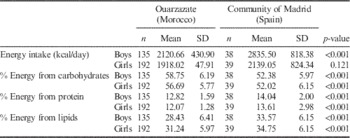
The average daily energy consumption recorded in the sample of adolescents living in Ouarzazate was slightly below the recommendations of the National Research Council, known as the RDA (RDA, 1991), which recommends 2750 and 2200 kcal/day for adolescent boys and girls, respectively (Table 1). In contrast, adolescents living in Madrid met these recommendations (Table 1). The diet energy profile of adolescents from Ouarzazate fitted the recommendations (30–35% of energy from fat, 55–60% from carbohydrates and 10–15% from proteins) (WHO, 2003), while teenagers of Moroccan origin living in Madrid were far from the recommendations, having a high contribution of fat to total energy consumed and less energy from carbohydrates (Table 1). Although energy intake from protein was within the recommended range, this value was significantly higher in the diet of the boys and girls living in the Madrid region (Table 1).
Total daily energy intake and caloric profile of diet of Moroccan adolescents by place of residence and sex
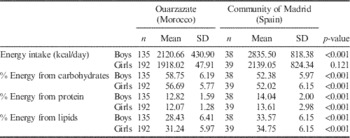
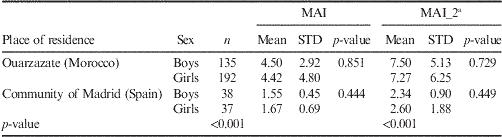
Table 2 summarizes the quality of the adolescents’ diet obtained from the MAI. No significant differences in MAI adherence values were observed between girls and boys, either in Ouarzazate or the Community of Madrid. However, there were significant differences between the MAIs obtained from adolescents living in Ouarzazate and those living in Madrid, with the former presenting a larger value than the latter. This result did not change if the MAI was calculated without eggs and dairy products (MAI_2).
Adherence to the Mediterranean Adequacy Index (MAI) by Moroccan adolescents by place of residence
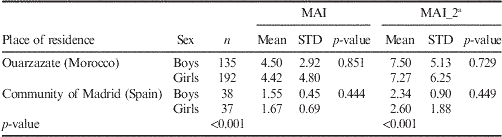
a MAI_2 is the Mediterranean Adequacy Index calculated without eggs and dairy products.
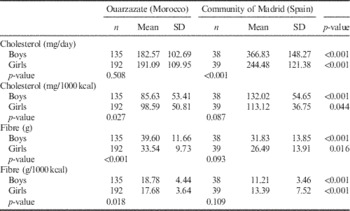
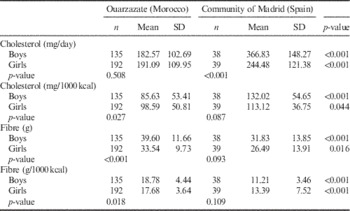
The daily intake of cholesterol, both absolute and relative, was significantly higher in the sample from Madrid, especially in boys (Table 3). Fibre intake (Table 3) fitted the recommendation of the FAO/WHO (WHO, 2003) – more than 30 g/day – but was significantly lower in Madrid. Notwithstanding, fibre intake (in g/1000 kcal), in both sexes, was significantly lower in the Madrid sample. This result is important because a consumption level of 14 g/1000 kcal is considered a protective factor for cardiovascular risk (Anderson et al., Reference Anderson, Baird, Davis, Ferreri, Knudtson and Koraym2009).
Indicators of diet quality of Moroccan adolescents by place of residence and sex
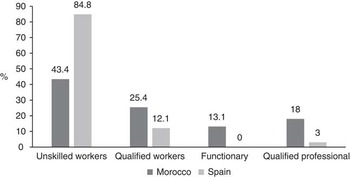
There were no significant differences between the two samples by father’s or mother’s educational level (p=0.284 and p=0.183, respectively). No differences were found by mother’s occupation, with ‘housewife’ being the most frequently reported (90.8% in Morocco and 91.2% in Madrid; p=0.376). However, fathers’ professions were more diverse in Morocco, while in Madrid most were unskilled workers (p<0.001) (Fig. 1).
Description of fathers’ professions for Moroccan adolescents by place of residence (p<0.001).

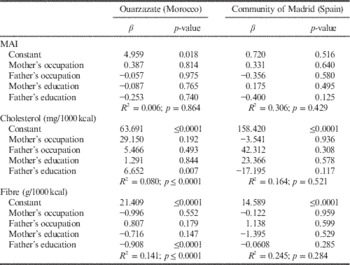
For the Morocco sample the relationship between parent’s educational level and the diet of adolescents has been described previously (Montero et al., Reference Montero, Anzid, Cherkaoui, Baali and Rodríguez2012). Children of more-qualified fathers had a higher consumption of saturated fats, simple sugars and cholesterol (Montero et al., Reference Montero, Anzid, Cherkaoui, Baali and Rodríguez2012). However, parent’s education and profession did not have any effect on MAI in any of the samples studied. In the Madrid sample no effects of father’s and mother’s education and occupation were observed for the other indicators of diet quality considered, i.e. cholesterol and fibre (Table 4). This could be because, despite the differences in level of father’s education, their professions are very similar, with most fathers being unskilled workers, and this could unify the purchasing power of families regardless of the educational level of the head of the household. On the other hand, most of the mothers are housewives, and this can also influence the way they prepare food and maintain Moroccan customs of culinary preparation.
Influence of parents’ occupation and education on quality of diet of Moroccan adolescents by place of residence
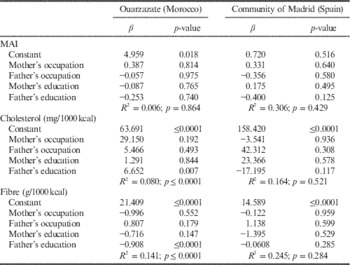
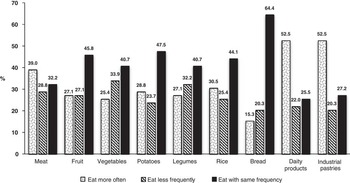
Figure 2 shows the changes in eating patterns associated with migration in the sample of young Moroccans living in Madrid. Most of them ate more frequently meat, dairy and bakery products in Madrid that when they lived in Morocco.
Food frequency consumption of adolescents residing in the Community of Madrid before and after leaving Morocco.

In contrast, most adolescents reported that consumption of fruits, vegetables, potatoes, beans, rice and bread did not change with migration. Interestingly, bread consumption remained the same in more than half of the respondents, being the food that had the lowest variation in consumption with migration.
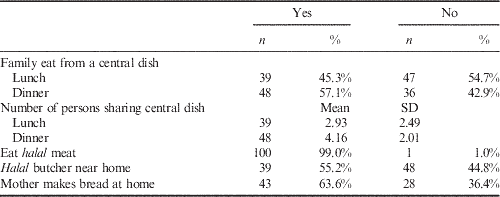
The degree of acculturation or loss of customs from the country of origin is also a key factor in the modification of eating behaviour. Table 5 shows the results regarding maintenance of some Moroccan customs associated with food. The percentage of adolescents who continued to eat with the family from one central dish was quite high, especially at dinner, and the average number of people sharing this meal indicates large families (54% of families had three children or more).
Eating habits of Moroccan adolescents living in the Community of Madrid
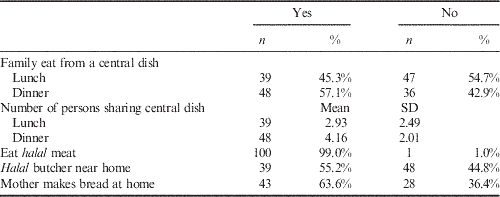
Also, consumption of halal meat is one of the more established and respected religious customs amongst Muslims associated with eating. In the sample of adolescents of Moroccan origin living in Madrid, almost all of them consumed meat slaughtered according to the Muslim ritual, although only half had a halal butcher near their home (Table 5). Finally, it is also noteworthy that in more than half of these families mothers made bread at home.
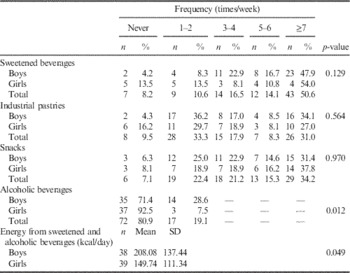
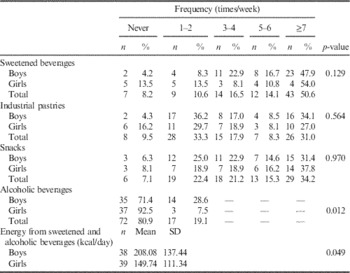
Table 6 shows the frequency (times per week) of unhealthy food consumption and unhealthy habits in young Moroccans living in Madrid. It can be appreciated that there were no significant differences between boys and girls in the consumption of soft drinks, pastries and snacks, but the consumption of alcohol was significantly greater (p=0.012) in males. Half of adolescents regularly consumed soft drinks at least seven times per week, with girls having a higher consumption, since 54% consumed soft drinks more than once a day; however, the difference between sexes was not significant. As for pastries, over 30% of the sample consumed industrial cakes seven or more times a week. Additionally, more than 30% consumed snacks at least once per day. Almost 30% of boys drank alcohol once or twice a week. Both tobacco consumption and energy from the consumption of soft drinks and alcohol were significantly higher in boys.
Consumption frequency (times/week) of unhealthy foods and beverages in Moroccan adolescents living in the Community of Madrid by sex
Discussion
Over the last 40 years Morocco has experienced an enhancement in food availability and in the nutritional status of the population, linked to economic development (FAO, 2011). This change has produced a gradual increase in total energy availability, while maintaining the proportion of nutrients, proteins and lipids, but with an increasing contribution of proteins of animal origin. In this study, the Moroccan sample living in Ouarzazate shows this trend (Montero et al., Reference Montero, Anzid, Cherkaoui, Baali and Rodríguez2012; Mora et al., Reference Mora, Montero, Marrodán, Romero, Carmenate and Rodríguez2012), with a slightly below average energy intake, but the contribution of proteins to total energy fits with WHO recommendations (WHO/FAO/ONU, 2001). The quality of the diet is good and is adjusted to the Mediterranean diet (Da Silva et al., Reference Da Silva, Bach-Faig, Raido Quintana, Buckland, Vaz de Almeida and Serra-Majem2009; Alberti et al., Reference Alberti, Fruttini and Fidanza2009). This situation can be explained because the nutritional transition process in Morocco is in the early and middle stages, which implies the dying-out of nutritional deficits and a reduced consumption of foods with low nutritional interest.
The sample living in Madrid, in contrast, has experienced changes in eating habits. As observed in other immigrant samples in other countries, this study shows higher meat and dairy product consumption, which in quantitative terms could be considered good for adolescents’ growth and health (Montoya et al., Reference Montoya, Torres and Torija2001; Gilbert & Khokhar, Reference Gilbert and Khokhar2008; Wandela et al., Reference Wandela, Råberga, Kumarb and Holmboe-Ottesenb2008). However, these adolescents have acquired new eating behaviours similar to those of Spanish teenagers, such as the consumption of soft drinks, industrial pastries and snacks. This results in a high contribution to their diets of added simple sugars and saturated fats, with even higher values than those detected in the enKid study on the Spanish teenager population (Anzid et al., Reference Anzid, El Hamdani, Baali, Boëtsch, Levy and Montero2009). In spite of the acquisition of these unhealthy habits, the studied sample maintains a reasonable consumption of fruits, vegetables and legumes. This fact has also been confirmed in other immigrants living in the north Mediterranean basin, originating from northern Africa, but it has not been observed in migrant groups of other origins and migrating into other geographical zones (Darmon & Khlat, Reference Darmon and Khlat2001; Gilbert et al., 2008). The reason could be that the above-mentioned foods are frequent and not expensive in Spain due to its climate and geographical characteristics, which are similar to those of Morocco.
The caloric profile, quality and quantity of fats, fibre content and MAI of the adolescents’ diets are better than those observed in France among migrant groups of different origins (Darmon & Khlat, Reference Darmon and Khlat2001). This could be because of the cultural similarities in eating patterns (except for eating pig products), which allow the studied teenagers and their families to keep their traditional ways of eating with lower effort than other migrant groups, such as Latin Americans (MAPA, 2004, 2007). Another element that contributes positively to the upholding of traditional eating habits is family structure type, which favours habits for preparation of food and its consumption. For example, the in-house preparation of bread by mothers, and eating from one central dish, are firmly engrained in Moroccan culture. As observed in other studies (Benjelloun, Reference Benjelloun2002; Wandela et al., Reference Wandela, Råberga, Kumarb and Holmboe-Ottesenb2008), the maintenance of traditional Moroccan costumes in the family environment would contribute to the elevated bread consumption detected in the migrant sample. This habit is linked with traditional Moroccan eating habits, which use bread as an instrument to eat meals from a sole central dish (Benjelloun, Reference Benjelloun2002).
In spite of the maintenance of some traditional healthy patterns, the diet quality of Moroccan teenagers living in Madrid is worse than that of those living in Ouarzazate, and closer to Spanish and other European Union countries’ diets (Moreno et al., Reference Moreno, Sarria and Popkin2002; Schmidhuber & Traill, Reference Schmidhuber and Traill2006).
One of the limitations of this study was the difficulty in accurate measurement of the amounts of food consumed, recurrent in all studies in populations where the custom is to eat from the same plate. However, since the method used in the two groups (those resident in Morocco and those living in Madrid) was the same, the comparison between the two groups can be considered to be valid.
In conclusion, the Moroccan sample living in Ouarzazate had a diet slightly low in calories and with some micronutrient deficiencies (Anzid et al., Reference Anzid, Baali, Vimard, Levy, Cherkaoui and Montero2014), but with a good quality and better adjusted to the Mediterranean diet, showing the described trend for the whole of the country. The migrant teenagers living in Madrid had a higher consumption of calories and proteins, but their diet had a lower quality and lower MAI than that of their peers living in Morocco. However, maintenance of traditional customs slows down the negative effects of acculturation associated with the migratory process. Changes in eating habits associated with migration from the south to the north Mediterranean basin can benefit the migrant group in an immediate way (through greater availability of energy and nutrients, and greater height), if this means not completely losing the eating habits of the country of origin, but later in their life cycle these changes could have negative consequences for their health, contributing to an increased risk of overweight, obesity (Mora et al., Reference Mora, Montero, Marrodán, Romero, Carmenate and Rodríguez2012) and cardiovascular and metabolic problems.
Acknowledgments
This investigation was funded by the Agencia Española de Cooperación Internacional (AECID) through the projects: ‘Transición alimentaria en poblaciones mediterráneas y salud: estudio comparativo de la población marroquí en Marruecos y en España’ (Ref. A/0161317), and ‘Nutrition transition in Morocco. Geographic, socioeconomic and gender variability’ (Ref. C/030659/10). The authors report no declarations of interest.