

1 Latin American Inequality over Five Centuries
Most analysts of the modern Latin American economy carry a pessimistic belief in historical persistence; that is, they believe that Latin America has always had very high levels of income and wealth inequality, suggesting that it will be hard, or even impossible, for modern policy to create a more egalitarian society. The persistence view is based on little or no comparative evidence. Yet, when modern analysts see a more unequal Latin America compared with Asia and the rich post-industrial nations (López and Perry Reference López and Perry2008), they assume that this has always been true. Indeed, some have argued that high inequality appeared very early in the post-conquest Americas, and that it supported rent-seeking and anti-growth institutions that helps explain the disappointing growth performance we observe there even today. This paper argues to the contrary. Compared with the rest of the world, inequality was not high in pre-conquest 1491, nor was it high in the post-conquest decades following 1492. Indeed, it was not even high in the mid-19th century just before Latin America’s belle époque. It only became high thereafter. Historical persistence in Latin American inequality is a myth.
2 Latin America in Context: What Did Pre-Industrial Inequality Look Like the World Round?Footnote 1
We have no evidence documenting inequality for the Inca, Aztec or other indigenous civilizations in the Americas before the arrival of the Iberian conquerorsFootnote 2; but we can guess. Recently, Branko Milanovic, Peter Lindert and myself (2008; hereafter MLW) collected what we call an «ancient inequality» database for twenty-nine places, ranging over two millennia from the Roman empire in the year 14, Byzantium in the year 1000, England in 1290, Tuscany in 1427, Holland in 1732, Old Castille in 1752, France in 1788, Java in 1880 and British India in 1947. The MLW sample includes four Latin American observations: Nueva España 1790, Chile 1865, Brazil 1872 and Peru 1876, although a new Mexican 1844 inequality observation, an 1870 Brazil observation and three 1870 Southern Cone observations can now be added to the Latin American pre-industrial sample. These twenty-nine MLW inequality observations have been constructed mainly from what are called social tables, sources that report average income and income recipients by social classes, but no income variance within them.
Social tables are particularly useful in evaluating ancient societies in which classes were clearly delineated, where the differences in mean incomes between them were substantial, and where mobility between them was trivial. If class (and race) alone determined one’s income, and if income differences between classes were large, while income differences within classes were small (mainly reflecting life-cycle status and luck), then most inequality would be explained by average income differences between classes. One of the most famous social tables was constructed by Gregory King for England and Wales in 1688 (Lindert and Williamson Reference Lindert and Williamson1982). King’s class list was fairly detailed (thirty-one in number), but he did not report inequalities within these social groups, so we cannot identify within-class inequality for 1688 England. Yet, when income variance within class is also available for any pre-industrial country offering social table estimates, the differences between measured inequality are typically very small whether within class variance is included or not. In short, the lion’s share of inequality in pre-industrial societies is and was accounted for by between-class average income differences.
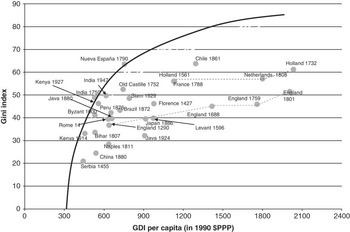
Figure 1 reports what the ancient inequality data look like. The Gini estimates are plotted against income (GDI per capita). The figure also displays what is called the inequality possibility frontier (IPF; solid line), a curve based on the maximum inequality that the elite could have extracted at that income per capita. The maximum is constructed under the assumption that everybody but the elite in such repressive societies would have gotten just the World Bank’s subsistence minimum of $PPP 300Footnote 3. The ratio of the actual inequality to the maximum feasible inequality is called the extraction ratio. In most cases, the calculated pre-industrial Ginis lie pretty close to the IPF. The countries farthest below the IPF curve — with the lowest extraction ratios — are the most advanced pre-industrial economies in northwestern Europe; that is, 1561-1808 Holland, 1788 France and 1688-1801 England.
ANCIENT INEQUALITIES: ESTIMATED GINI COEFFICIENTS AND THE INEQUALITY POSSIBILITY FRONTIER
Note: The solid line IPF is constructed on the assumption that s = $PPP 300 (see text). Source: Milanovic, Lindert and Williamson (Reference Williamson2008, Figure 2).

The IPF allows us to better situate these ancient pre-industrial inequality estimates in a modern context (Milanovic et al. Reference Milanovic, Lindert and Williamson2008, Table 1). Brazil has often been cited as an example of an extremely unequal society, driven by a long history of slavery, racial discrimination and regional dualism. Indeed, Brazil’s Gini in 2002 is comparable to the most unequal pre-industrial societies in our ancient inequality sample. But modern Brazil is more than four times richer than the average ancient society in our sample, so its maximum feasible inequality (92.7) is much higher than our ancient society average (60.6). Thus, modern Brazilian elites have extracted only a little more than 63 per cent of the maximum feasible inequality in Brazil, and its inequality extraction ratio is about the same as what we find among the least exploitative and repressive ancient societies like 1801-1803 England and 1886 Japan. What is true of Brazil, is also true of contemporary Chile, Mexico and Peru. All three have Ginis today well above the world average (Chile 2003 = 54.6, Mexico 2000 = 53.8 and Peru 2002 = 52 vs. the world average = 40.6), but all three have extraction ratios below the least exploitative in our ancient societies’ sample.
Most Latin American societies — at least those that we can document — have higher Ginis today than what they had in the mid-19th century. Indeed, since independence inequality has fallen in only one Latin American republic for which data exist — Chile 1870 = 59.4 to 2003 = 54.6, or down about 8 per cent. But inequality has been on the rise in the other three Latin American republics for which data exist: Mexico 1844 = 51.3 to 2000 = 53.8, up 5 per cent; Brazil 1870 = 54.8 to 2002 = 58.8, up 7 per cent; and Peru 1876 = 42.2 to 2002 = 52, up 23 per cent. But what about extraction rates? As a country becomes richer, and its surplus above subsistence rises, its feasible inequality expands. Consequently, even if recorded inequality is stable, the extraction ratio will fall. It follows that the social consequences of increased inequality may not entail as much relative impoverishment, or as much perceived injustice, as might appear if we only look at the Gini. This logic is particularly compelling for low- and middle-income societies in which increases in income push the maximum feasible inequality up sharply along the steepest part of the IPF curve. The farther a society rises above subsistence, the less will economic development lift its inequality possibilities, and thus the extraction ratio will be driven more and more by the rise in the actual Gini itself. Thus, the inequality extraction ratio has fallen everywhere in Latin America over the past century or two, and in some cases by a lot; it has fallen by 33 per cent in Brazil (from 94 in 1870 to 63.4 in 2002), by 27 per cent in Chile (from 77.3 in 1870 to 56.4 in 2003), by 47 per cent in Mexico (from 105.5 in 1790 to 56.2 in 2000) and by 27 per cent in Peru (from 78.1 in 1876 to 56.7 in 2002). While the rest of this paper will focus on actual or measured inequality, future debates over social justice and economic development will have to struggle with the implications of different trends in actual inequality and extraction ratiosFootnote 4.
3 Fundamentals: Explaining Pre-Industrial Inequality the World Round
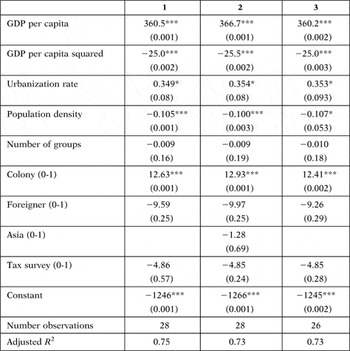
Table 1 attempts to explain differences in pre-industrial inequality. The Kuznets hypothesis posits that inequality tends to follow a bell shape as average real income increases. Although Kuznets formulated his hypothesis explicitly with a view toward industrializing and industrialized economies, one might wonder whether his curve is even more apparent among our pre-industrial economies as well. After all, the secular upswing could be easily explained by increases in per capita income: poor countries do not have much surplus for the elite to extract, but as income rises in pre-industrial economies, so does the surplus and potential inequality. In addition to log average income and its square, Table 1 includes the urbanization rate, population density and colonial status (a dummy variable). The regression also includes a number of controls for country-specific eccentricities in the data: the number of social groups available for calculating the Gini, whether the social table is based on tax data and whether the social table for a colony includes the income of resident colonists. The Kuznets hypothesis predicts a positive coefficient on average income (or its log) and negative coefficient on its square. We also expect higher inequality for the more urbanized countries (Ravallion et al. Reference Ravallion, Chen and Sangraula2007) and for those that are ruled by foreign elites since powerful colonizers are presumed to be able to achieve higher extraction rates than weaker local elites, and since countries with weak local elites but with large surpluses, will attract powerful colonizers to extract it (Acemoglu et al. Reference Acemoglu, Johnson and Robinson2001, Reference Acemoglu, Johnson and Robinson2002).
REGRESSION RESULTS FOR THE GINI COEFFICIENT

Notes: GDP per capita is in natural logs. Coefficients significant at the 10%, 5% and 1% are denoted by three, two and one asterisks, respectively; P-values are given in brackets.
Source: Milanovic et al. (Reference Milanovic, Lindert and Williamson2008, Table 3).
The empirical results confirm all expectations. Both income terms are of the right sign and significant, supporting a pre-industrial Kuznets curve. The sign on the urbanization rate is, as predicted, positive, but since it competes with population density, its statistical significance is somewhat lower. Still, each percentage point increase in the urbanization rate (say, from 10 to 11 per cent) is associated with an increase in the Gini by 0.35 points. Holding everything else constant, colonies had a Gini almost 13 points higher than non-coloniesFootnote 5. Foreigner is a dummy variable that controls for two observations (South Serbia 1455 and Levant 1596) that were colonies but where their ancient inequality surveys did not report the incomes and numbers of colonizers at the top. This is therefore simply another control for data eccentricity, and its negative sign shows that being a colony, but not having colonizers included in the survey, reduces recorded inequality considerably (9-10 points). The number of social groups used in the inequality calculations, or tax census origin of social tables, do not affect the Gini in any significant way. This finding is comforting, because it shows that our estimates of inequality are being driven by fundamentals, not by the way the social tables were constructed by pre-industrial observers.
Population density is negatively associated with inequality. It might have been expected that the introduction of a dummy variable for more densely populated Asia would have caused the effect of density to dissipate. This is not the case, as shown in column 2 of Table 1. The negative impact of population density on inequality seems to be counter-intuitive. After all, conventional theory — which we will explain below — would predict that more population pressure on the land should raise land yields and land rents, lower labor’s marginal product and the wage, thus producing more inequality, not less. Furthermore, this effect should have been all the more powerful in pre-industrial societies in which land and labor drove inequality, not, as in modern societies, human capital and financial wealth. It seems likely that this conventional effect is being offset in the ancient economy data by two forces. First, densely populated agrarian societies also had lower per capita income, so this may have been working against the conventional force (since inequality rises with per capita income). Second, more densely populated agrarian societies must have had higher relative food prices than thinly settled or frontier societies, so that nominal subsistence had to be much higher to purchase the more expensive foodstuffs, lowering measured inequality and the extraction ratioFootnote 6. It seems likely that this force must have been most powerful during the two millennia before the middle of the 19th century since a world market for grains did not yet exist and thus local conditions dictated the relative price of food (Studer Reference Studer2008). This second offset has important implications for comparing inequality in the labor-scarce and resource-abundant Americas with labor-abundant and resource-scarce Europe, and between the densely populated highlands in Mexico and the Andes relative to the resource-abundant Southern Cone. However, it is less clear that it had the same effect within countries over time, since the results in Table 1 rely almost entirely on a cross section, not a time series.
The stylized picture that emerges is this inequality follows contours that are consistent with the Kuznets curve hypothesis, a pre-industrial secular rise to a peak, followed by a fall during the modern economic growth. It follows that most of the pre-industrial Third World had probably reached very high levels of inequality by the early 19th century before what is called the first global trade boom. However, the extraction ratio tends to fall as income increases, even during pre-industrial times. This fact would, of course, invite a European colonist to plunder where the potential surplus was big, but where the local elite had relaxed their extraction rate. We will return to this issue below.
Finally, note that the regression in Table 1 has no «globalization» variable, like terms of trade booms or busts. The reason, of course, is that it confronts pre-industrial history, which, for this sample, is also before the first great globalization boom starting in the early mid-19th century. We will have much more to say about this below.
4 Has Latin America Always Been More Unequal?
Has Latin America always been more unequal than other parts of the world? Stanley Engerman and Kenneth Sokoloff (Reference Engerman and Sokoloff1997; Engerman et al. Reference Engerman, Haber and Sokoloff2000) offered a hypothesis to account for Latin American growth underachievement during the two centuries following its independence. Their thesis begins with the plausible assertion that high levels of income inequality, and thus of political power, favor rich landlords and rent-seekers, and thus the development of institutions which are compatible with rent-seeking but incompatible with economic growth. Their thesis argues further that high levels of Latin American inequality have their roots in the natural resource endowments present when Iberia conquered and colonized the region five centuries ago. Exploitation of the native population and of imported African slaves, as well as their subsequent disenfranchisement, reinforced the development of institutions incompatible with growth. Engerman and Sokoloff (Reference Engerman and Sokoloff1997) had no difficulty in collecting evidence that confirmed high inequality, disenfranchisement and lack of suffrage in Latin America compared with the northern United States. But what about comparisons with the rest of the world, and what about earlier?Footnote 7 Oddly enough, neither the Engerman–Sokoloff team nor its critics have confronted the thesis with inequality evidence for the economic leaders in northwest Europe at comparable pre-industrial stages; this is the comparison that matters, not with industrial United States.
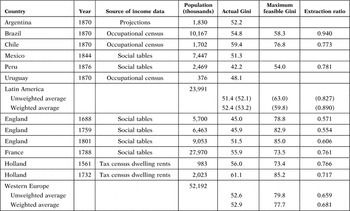
Table 2 presents inequality information for pre-industrial northwest Europe (i.e. before 1800) and for pre-industrial Latin America (i.e. before 1880). For the former, we have observations from 1788 France, 1561 and 1732 Holland and 1688, 1759 and 1801 England and Wales. For the latter, we have six observations: Mexico 1844, Peru 1876 and Argentina, Brazil, Chile and Uruguay 1870. Engerman and Sokoloff coined their hypothesis in terms of actual inequality. According to that criterion, their thesis must be soundly rejected. That is, the (population weighted) average Latin American Gini (52.4) was no higher than that of northwest Europe (52.9). Furthermore, the comparative inequality implications emerging for these social tables have been confirmed recently by Rafael Dobado Gonzáles and Hector Garcia using an inequality proxy — Maddison’s real GDP per capita relative to their unskilled grain wage; according to their data, Mexico, Bolivia and Colombia all had less inequality in 1820 than did the Netherlands, the United Kingdom and France, or even Portugal and Spain (Dobado Gonzáles and Garcia Reference Dobado Gonzáles and Garcia2009, Figure 18).
INEQUALITY IN PRE-INDUSTRIAL LATIN AMERICA AND WESTERN EUROPE COMPARED

Sources: All western European observations and Peru are from Milanovic et al. (Reference Milanovic, Lindert and Williamson2008). The Mexican (1844) actual Gini is based on a social table for the state of Querétaro constructed by Amilcar Challu.
The Brazil and Southern Cone observations are from Bértola et al. (Reference Bértola, Castelnovo, Rodríguez Weber and Willebald2010, Table 4). The weighted averages use population. The Latin American averages in parentheses use only the three available observations.
It is not true that pre-industrial Latin America was more unequal than pre-industrial northwest EuropeFootnote 8. Thus, if inequality encouraged rent-seeking and discouraged growth in Latin America, it must have done so just as powerfully in northwest Europe where the industrial revolution first started! Since we know that high inequality was consistent with industrial revolutions occurring in northwest Europe, it is unclear why it should be inconsistent with them in Latin America somewhat later. However, Latin America was poorer than northwest Europe, and poorer societies have a smaller surplus for the elite to extract. Thus, maximum feasible inequality was considerably lower and extraction rates were considerably higher in Latin America than in northwest Europe (0.89 vs. 0.68, Table 2). While measured inequality does not support the Engerman–Sokoloff thesis, the extraction rate does. The Engerman–Sokoloff team, their followers and their critics all need to decide which of these inequality indicators matters for their hypothesis and why. To the extent that political power determines the extraction ratio, then Daron Acemoglu and James Robinson (2006) may be quite right in stressing political inequality rather than just economic inequality.
5 Broad Sweep: Reconstructing Latin American Inequality Trends since 1491
5.1 Initial conditions: what was Latin American inequality like in 1491?
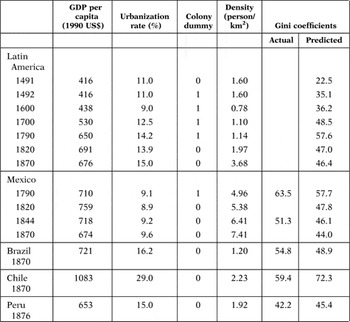
Table 3 uses the Gini regression equation 1 in Table 1, and estimates of the dependent variables also reported in Table 3 to predict Ginis for Latin America in 1491 before the arrival of the Iberians, shortly after the conquest (call it 1492), in 1600, 1700, 1790, 1820 and 1870. Table 3 also predicts Ginis for Mexico in 1820, 1844 and 1870. In addition, the table reports predictions for five Latin American cases where we also have actual inequality estimates; that is, Nueva España 1790, Mexico 1844, Brazil 1870, Chile 1870 and Peru 1876. While the correlation between actual and predicted inequality for those five cases is hardly perfect, it is positive and highly significant (R 2 = 0.47), a comforting result. Indeed, the only big deviant of predicted inequality from actual is 1870 Chile, where relatively high urbanization and GDP per capita drive up the predicted Gini. Without the Chilean observation, R 2 is 0.82.
DATA USED FOR THE GINI PREDICTIONS AND THE GINIS

Sources and notes:
GDP per capita: Maddison (Reference Maddison2008), except Peru 1876 from Milanovic et al. (Reference Milanovic, Lindert and Williamson2008, Table 1). For Latin America, Mexico and Brazil, 1790 is linearly interpolated between 1700 and 1820. For Chile 1790, the Mexican growth rate from 1790 to 1820 is assumed.
Population: Maddison (Reference Maddison2008). Missing years linearly interpolated.
Urbanization: Bairoch (1993, pp. 388-389, 423) and Sánchez-Albornoz (1974, pp. 30-32, 77). Latin American 1820 interpolated. Mexico 1820 and 1870 derived by assuming per cent fall from 1790 to 1820 and rise from 1820 to 1870, the same as for Latin America.
Land area: Milanovic et al. (Reference Milanovic, Lindert and Williamson2008, Table 1).
Colony dummy: While Chile gained independence in 1818, the others did so shortly after 1820: Brazil in 1822, Mexico in 1821, Peru in 1821, and a few even later. Yet, the colony dummy is still set equal to zero in 1820 for Latin America and all four regions in the table.
Actual Gini: See text.
Predicted Gini: Data above are inserted into estimated regression, column 1, Table 1.
Table 3 implies that the Gini coefficient in Latin America before the arrival of the Iberians was 22.5, which would have made it the society with the lowest inequality in the pre-industrial world (Figure 1), and Aztec archeological evidence would seem to confirm itFootnote 9. China in 1880 had a Gini of 24.5, very close to pre-conquest Latin America. Dutch colonial Java had a Gini in 1880 of 39.7, a figure which would have been 27.1 without the Dutch colonists (according to the MLW regression, 39.7−12.6 = 27.1). Thus, Table 3 implies that pre-conquest Latin America had modest levels of inequality much like all the other poor pre-industrial societies that had escaped from being colonized.
5.1.1 Extracting the surplus: what was the colonial impact like after 1492?
Given what we know about ancient pre-industrial economies the world around, and assuming that Iberian colonists were no better or worse at extracting surplus than were the other colonizers in the ancient inequality sample (England, Holland and the Ottoman Turks), the answer to this question is quite simple. Colonies had higher Gini coefficients by 12-13 percentage points (Table 1), so the Latin American Gini coefficient might have drifted up from 22.5 in 1491 to something like 35 in the post-1492 decades. Perhaps it was in fact a bit lower or a bit higher, but inequality clearly must have increased by about half during the first decades after the Iberian conquest.
Not only did the Iberian elite replace the indigenous elite, but, if they were anything like the English, the Dutch and the Turks, the Iberians must have been able (or willing) to raise the extraction rate in their favor by a lot. In his recent magisterial survey of colonial Mexico, Richard Salvucci reminds us how the Spaniards used «elements of compulsion, coercion and force … especially in labor markets» and notes that «the free market was not the Spaniards’ ally, at least to the extent that it would reward scarcity, for the factor that the Spaniards came to own, land, was abundant» (Salvucci forthcoming, pp. 4 and 6).
6 Inequality Stability? The Likely Impact of the 16th Century Demographic Disaster
As is well known, European disease caused immense demographic damage to the indigenous population over the century following Columbus’s first voyage, due to soaring mortality rates. Massimo Livi-Bacci (Reference Livi-Bacci2006) thinks that it shrank by more than 90 per cent by the early 17th century, and the recent surveys by Carlos Assadourian (Reference Assadourian2006) and Linda Newson (Reference Newson2006) agree with him. In fact, some have argued that the pre-Iberian empires were in Malthusian crisis and thus would have undergone a population collapse without the Iberian colonization. In any case, Angus Maddison thinks that the shrinking was a bit smaller, and Table 3 uses Maddison to take the lower bound. The Atlantic slave trade tried to substitute African slaves for decimated indigenous populations but their addition was far smaller than the subtraction caused by European disease, except for the Caribbean and Brazilian coast (Assadourian Reference Assadourian2006, p. 276; Newson Reference Newson2006, p. 152). Furthermore, the African slaves arrived in significant numbers only after a long lag. Moreover, not many were transported to the once densely populated highlands where three-quarters of the indigenous population lived in 1492 (Newson Reference Newson2006, Table 5.1), but rather to the sugar-rich tropics. Of course, the demographic collapse raised the per capita income of the indigenous survivors who resettled on the best lands (Bates et al. Reference Bates, Coatsworth and Williamson2007, pp. 919-920)Footnote 10.
It is useful to elaborate the last point: the demographic disaster in Latin America must have contributed to higher (but unknown) GDP per capita and average labor productivity, higher marginal productivity of labor and lower marginal productivity of land, suggesting that the wage–rent ratio (w/r) went up and that inequality went down. The economics can be made a little more precise. Assume that only land (R) and labor (L) mattered in the early colonial economy, and that technology (A) was unchanged across the 16th century. If we also assume constant returns to scale, then it follows that:

,

.
The marginal product of labor and land are, respectively,

so,

Thus, w/r rises with the land–labor ratio, and the elasticity relating the two is (under these assumptions) always 1.
The elasticity of GDP per capita to the land–labor ratio is α. Table 3 reports that population density fell by 51 per cent between 1500 and 1600 (from 1.60 to 0.78 persons per km2)Footnote 11, implying that the land–labor ratio rose about 103 per cent (from 0.63 to 1.28 km2 per person). If α = 0.5, then GDP per capita might have increased by about 52 per cent over the century. John Coatsworth (Reference Coatsworth2008, p. 548) is in agreement: «As European disease and abuse decimated indigenous populations … per capita output rose … Additional gains in productivity occurred when those who survived found work, resettled or were «congregated» on the most productive lands». And what went up, then went down. As the indigenous population slowly recovered between 1600 and 1700, the land–labor ratio fell about 29 per cent, implying that GDP per capita might have decreased by almost 15 per cent, at least in the Latin American interior. Coatsworth (Reference Coatsworth2008, p. 548) thinks that the fall was even bigger in Mexico. Of course, things were different in the sugar-based plantation islands of the Caribbean.
According to the simple economics above, the percentage rise in the wage-–rent ratio across the 16th century would have been about the same as the percentage fall in the labor–land ratioFootnote 12. If population fell by Livi–Bacci’s 90 per cent (from an index of 100 to 10), then the land–labor ratio rose by a factor of 10 (from an index of 10 to 100)Footnote 13, which implies that w/r rose by a factor of 10 as well. Based instead on Maddison’s population estimates, Table 3 implies that the land–labor ratio more than doubled.
This analysis makes two assumptions that historians of the period would challenge vigorously. First, we have assumed perfect competition which is, of course, completely inconsistent with our knowledge that Iberian colonists introduced coercive and repressive devices so that labor’s greater scarcity was not fully rewarded. In more formal terms, the Iberians used slavery, haciendas, mita, encomienda and other institutions to push the wage below labor’s marginal product (Assadourian Reference Assadourian2006, pp. 293-314; Coatsworth Reference Coatsworth2008; Bértola et al. Reference Bértola, Castelnovo, Rodríguez Weber and Willebald2010, pp. 6-8). Indeed, had
«the Spaniards … been constrained to bid for [their] services, one would have expected the real rewards to the indigenous population to have soared. There is nothing mysterious about this: it is called supply and demand. And supply and demand was clearly on the side of the Indians [and their complements]» (Salvucci forthcoming, p. 16).
The logical response of the Spaniards was to control labor markets (Salvucci forthcoming, pp. 16-17). Almost four decades ago, Shane Hunt (Reference Hunt1972) wrote an impressive (but unpublished) paper describing the evolution of the colonial institutions that extracted the surplus. While Hunt’s Domar-like analysis shows how these coercive institutions kept the wage down during the 16th century demographic disaster, his economic analysis shows clearly that hacienda profitability and implicit rents must have fallen, raising the implicit w/r.
Still, the demographically induced rise in the w/r must have been considerably less than 100 per cent. But, even if it was only 10 or 20 per cent, it implies pronounced downward pressure on inequality across the 16th century. Furthermore, it seems likely that land concentration also diminished as labor got scarcer (and the munifundios per family got bigger and/or land use per hacienda got smaller), so there are other reasons to believe that exogenous demographic trends put strong downward pressure on inequality across the 16th century. On the other hand, improved productivity in extracting minerals from the mines as well as any general improvement in economy-wide productivity (e.g. a rise in A) might have pushed inequality in the opposite direction, upwards.
The second assumption that specialists might well want to challenge is that the available land stock remained unchanged in response to the demographic collapse. Since the pre-Iberian empires had developed intensive agriculture with irrigation and other infrastructure, and since that infrastructure decayed in the absence of a large collective labor input to maintain it (Assadourian Reference Assadourian2006, pp. 278-293), the effective stock of land may have diminished, implying a smaller rise in the land–labor ratio. Still, the stock of animals soared across the 16th century, easily offsetting any fall in the land stockFootnote 14.
What was the net effect of the demographic disaster on income distribution? Quantitative evidence is non-existent, but there is some qualitative evidence supporting a rise in the relative economic position of labor: Indians fled their communities and coerced labor in large numbers took up employment in Spanish towns, estates or as forasteros in other Indian communities where living standards were much higher, and employers increasingly offered workers marginal land on which to grow subsistence crops (Newson Reference Newson2006, pp. 175-177). Furthermore, some time ago, Sherburne Borah and Woodrow Cook (Reference Borah and Cook1958, p. 39) argued that real wages of unskilled labor did indeed rise across the 16th century. Until future research can test what seems to be a plausible working hypothesis of increased labor scarcity, Table 3 uses it to predict that after the first decades of colonization, there was very little additional change in Latin American inequality up to 1600. Indeed, inequality may even have fallen.
7 Inequality Rise: What Did Latin American Inequality Look Like in 1790?
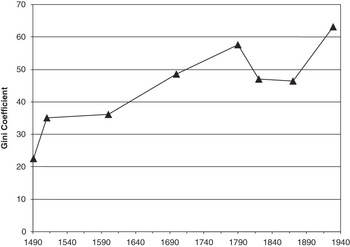
Over the two centuries between 1600 and 1820, a number of fundamentals were at work in Latin America which would have served to raise inequality and extraction ratios. First and foremost, populations partially recovered their 16th century losses. Interpolating 1790 from Maddison’s (Reference Maddison2008) estimates for 1700 and 1820 yields a rise in population from 8.6 million in 1600 to 12.5 million in 1790. Thus, population density rose from about 0.78 to 1.14, and land–labor ratio fell by about 31 per cent. Second, GDP per capita rose from 438 to 650, or almost by half, and urbanization rose from 9 to 14.2 per cent, or by more than half. These forces imply that the Gini might have risen from 36.2 to 57.6, which, according to the Table 3 predictions, implies that over the three centuries after 1491, Latin American inequality reached its peak in the late colonial decades just before independence.
8 Revolution, Independence and Lost Decades
While revolution, independence and the «lost decades» that followed up to about 1870 (Bates et al. Reference Bates, Coatsworth and Williamson2007) were very complicated times, and while there must have been many forces at work influencing inequality, the ancient inequality regression predicts that the Gini probably dropped from 57.6 in 1790 to 46.4 in 1870. The biggest force contributing to the fall was, of course, independence and de-colonization since the five «lost decades» between the 1820s and the 1870 yielded very little GDP per capita growthFootnote 15 or urbanization. Mexico repeats the Latin American (predicted) trends, its Gini falling from 57.7 to 44 between 1790 and 1870, and, once again, by far the biggest fall being between 1790 and 1820, from 57.7 to 47.8. Ongoing research by Amilcar Challu reports a social table for 1844 Querétaro yielding a Gini of 51.3Footnote 16, which implies that most of the fall between 1790 and 1870 had taken place by the 1840s.
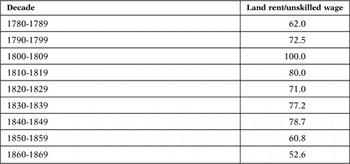
Recent archival work by Leticia Arroyo Abad (Reference Arroyo Abad2008, Figure 1) confirms this prediction of falling inequality after independence. She uses data on wage rates and land rents to infer inequality trends. When her rent–wage ratios for Argentina, Mexico and Venezuela are weighted by 1850 populations, the resulting Latin American rent–wage ratio falls by 11 per cent between 1820 and 1850, and for Mexico alone the fall is 12 per cent. Furthermore, the Arroyo Abad Mexican rent–wage ratio trends and the Mexican Gini coefficients coming from the social tables in Table 3 are closely reproduced by the Amilcar Challu rent–wage series for central Mexico 1780-1869 reported in Table 4. Challu’s inequality index rises by 38 per cent from the 1780s to the 1800s, falls by 29 per cent from the 1800s to the 1820s and then continues a slow downward drift during the «lost decades» up to the 1860s. To summarize, the Arroyo Abad index falls by 4 per cent per decade between 1820 and 1850, the Challu index falls by 5.2 per cent per decade between 1820 and 1869, and our Gini in Table 3 falls by almost 2 per cent per decade between 1820 and 1870.
AN INEQUALITY PROXY FOR CENTRAL MEXICO: HACIENDA LAND RENTS PER HECTARE RELATIVE TO CITY UNSKILLED WAGES 1780-1869

Sources and notes: Land rents are constructed from data taken from personal correspondence with Amilcar Challu, who collected the central Mexican hacienda data from secondary sources. Land rent is assumed to trend like land values since documents suggest that land rents were stable at 5% of land values at least through the 1830s. Unskilled urban wages are taken from Dobado Gonzáles et al. (Reference Dobado Gonzáles, Gómez Galvarriato and Williamson2008, Table A1, p. 46), and are for Mexico City. The decade wage average 1860-1869 is for 1860 only.
What this analysis ignores is the boom in the Latin American terms of trade towards the end of the «lost decades» in the 1860s. While 1870 is the usual date taken for the start of the belle époque, in fact the region’s terms of trade soared over the previous decade. Indeed, over the 15 years 1859-1874, the region’s terms of trade rose 24 per cent (Williamson Reference Williamson2008). While the poor growth performance during the lost decades would have put the lid on inequality rises, the terms of trade boom across the 1860s must have lifted that lid. How much, we do not yet know, but Latin American inequality must have begun to rise a decade or two before the start of the belle époque.
9 Creating Modern Inequality during the Belle Époque Globalization Boom
Latin America faced a rising terms of trade throughout the late 19th century, as commodity prices boomed. Since it was a primary product exporter, land and mineral rents were driven up relative to wages. This happened everywhere around the poor periphery (Williamson Reference Williamson2002, Reference Williamson2008; Coatsworth Reference Coatsworth2008, pp. 567-568), but it was especially dramatic in Latin America partly because the region was able to expand its export sectors so effectively, thus to become very large shares in GDP (Williamson Reference Williamsonforthcoming, Table 4.1). Since land and mineral resources were held by those at the top, inequality rose as well. Not too long ago, the only data we had to judge the magnitude of these inequality trends were proxies, like the land rent to unskilled wage ratio or the GDP per worker to unskilled wage ratio (Williamson Reference Williamson1999, Reference Williamson2002). Thus, when the rent–wage ratio for Argentina, Mexico, Uruguay and Venezuela (Arroyo Abad Reference Arroyo Abad2008, Figure 1) are weighted by 1890 populations, the Latin American average rises 7.9 per cent per decade 1850-1870 and 6.3 per cent per decade 1870-1900, for a total increase of 37 per cent after 1850. Thus, this rent–wage proxy implies a big inequality surge over the second half of the century. We also have the more comprehensive belle époque inequality evidence for Brazil and the Southern Cone summarized in Table 5. It comes from two sources: first, Ginis calculated from new evidence collected by Luis Bértola and Rodríquez Weber (Reference Bértola and Rodríquez Weber2009, Table 4), and second, what Leandro Prados de la Escosura (Reference Prados de la Escosura2007, Table 12.1) calls his backward projected Pseudo-Ginis (P-Ginis). They tell the same qualitative tale: inequality rose by 23 per cent over the belle époque (the average of the Bértola and Prados’ estimated figures). In fact, the Latin American weighted average in Table 5 misses the heavily populated Mexican and Andean republics. However, Prados de la Escosura also shows that a Mexican inequality proxy — income per worker relative to the unskilled wage ratio — rose by about 2.8 times between the early 1880s and 1920 (Prados de la Escosura Reference Prados de la Escosura2007, Figure 12.1b), suggesting that Mexico followed Brazil and the Southern Cone up a steep inequality slope. Furthermore, the Arroyo Abad rent–wage inequality proxy for Mexico confirms the Prados’s data since the 1870-1900 increase was 27 per cent over the three decades. Assuming, therefore, that Mexican inequality rose more like the Prados’s P-Ginis for all of Latin America than the Bértola Ginis for Brazil and the Southern Cone, it follows that Latin American inequality probably rose by something like 30 per cent over the belle époque. Applying that increase to the 1870 Latin American Gini coefficient in Table 3 would imply that it rose from 46.4 to 60.3, making the Gini in the 1920s the highest that Latin America had recorded since pre-conquest, even higher than the 1790 colonial peak (57.6), and much, much higher than 1600 (36.2), or even 1700 (48.5).
BRAZIL AND SOUTHERN CONE INEQUALITY TRENDS 1870-1920

Sources: Ginis for 1870 and 1920 from Bértola et al. (Reference Bértola, Castelnovo, Rodríguez Weber and Willebald2010, Table 4). Pseudo-Ginis (P-Gini) for 1870 and 1929, from Prados (2007, Table 12.1).
Notes: The region weighted Gini averages use 1900 population as weights. The P-Gini is derived from backward projection (see Prados de la Escosura Reference Prados de la Escosura2007, Table 12.2).
10 Revisionist Hypotheses
Figure 2 plots our inequality predictions from 1491 to 1929. However crude the evidence may seem, it points to several revisionist interpretations of, or hypotheses about, 500 years of Latin American inequality.
LIKELY INEQUALITY TRENDS IN LATIN AMERICA 1491-1929

First, it is simply not true that Latin America has always been unequal. It cannot be stressed enough that this is a comparative statement. Only by comparison with other times and places can statements about Latin American inequality offer any useful meaning. While comparisons with the United States are not uncommon in the recent literature, comparisons with the European (colonial) leaders or with other parts of the poor periphery are rarely, if ever, made. When such comparisons are made (Table 2), income inequality in pre-industrial Latin America is found to have been no higher than northwest Europe. To repeat, it is not true that pre-industrial Latin America (pre-1880) was more unequal than pre-industrial northwest Europe (pre-1800). Thus, if it is thought that inequality encouraged rent-seeking, suppressed private property rights, retarded the development of «good» institutions, and thus discouraged growth in Latin America, it must have done the same in northwest Europe where the industrial revolution first started! In addition, it appears that pre-conquest Latin America had one of the lowest, if not the lowest, level of inequality anywhere in the poor periphery. It also appears that Latin American inequality remained one of the lowest anywhere around the world until the start of the 17th century. It can hardly be said that initial endowments and Iberian colonization made Latin America more unequal than other places.
Second, Latin America was poorer than northwest Europe, and poorer societies have smaller surpluses for the elite to extract. Thus, while inequality was lower, what this paper and Milanovic et al. (Reference Milanovic, Lindert and Williamson2008) call extraction rates (how much of the available surplus was actually extracted by the elite) were considerably higher in Latin America than in northwest Europe. Whether measured inequality or extraction rates are the best indicators of pro-rent-seeking and anti-growth institutions is an issue that needs to be resolved since they offer very different inferences regarding Latin American growth underachievement. Presumably, political inequality had an important influence on the size of the extraction ratio.
Third, Latin American inequality over the five centuries from pre-conquest to the present has exhibited immense variance. Indeed, Latin America exhibited more inequality variance between 1491 and 1929 (Ginis ranging from 22.5 to 60.3) than one can find between Latin America, Europe and East Asia today (51, 34 and 38, respectively: López and Perry Reference López and Perry2008, pp. 2-3). While the historical literature certainly offers strong opinions about potential explanations, we need far more evidence to document them firmly. By replacing less rapacious indigenous elite with more rapacious European elite, the Iberian conquest appears to have raised, initially, inequality by about half. Yet, the 16th century saw very little further rise in inequality, most probably because the demographic disaster produced a powerful downward offset to all other inequality-increasing forces. It looks like the two centuries up to about 1790 or so saw the biggest increase in Latin American inequality, reaching its colonial peak in that year (Gini 57.6; Table 3), or shortly thereafter (Table 4). What are the explanations for the colonial inequality boom? Was it simply driven by increases in GDP per capita and thus in the surplus available for the elite to extract? Or, did the elite learn more effective ways to extract a bigger share of the same surplus? Or was it both? In any case, about half of that huge rise up to 1790 was eroded by three decades of war and independence, followed by five post-independence «lost decades» of economic stagnation. Thus, by 1870 inequality in Latin America was not much different than it was for all pre-industrial societies for which we can get the data. To repeat, while inequality was high in Latin America, as it was poised for its industrial revolution, it was no higher than the average pre-industrial society, nor higher than industrializing Europe.
Fourth, globalization forces during the belle époque pushed Latin American inequality up to historic highs by the 1920s. Although that belle époque inequality boom cannot yet be adequately measured for all of Latin America, it looks like ongoing research will shortly do so (e.g. Bértola Reference Bértola2005; Bértola et al. Reference Bértola, Castelnovo, Rodríguez Weber and Willebald2010). Other primary product exporters underwent similar inequality-enhancing booms over that half century too (Williamson Reference Williamson2002; Reference Williamson2006), but it appears that Latin America had one of the biggest inequality booms, and, even more notable, that the high inequality achieved persisted (and even increased) during the anti-global episode between the 1920s and the 1970s (Prados de la Escosura 2007, Table 12.1). The latter offers a striking contrast with the industrialized world which underwent a great egalitarian leveling across the mid-20th century (Williamson and Lindert Reference Williamson and Lindert1980, pp. 53-62; Atkinson and Piketty Reference Atkinson and Piketty2008; Atkinson et al. Reference Atkinson, Piketty and Saez2009).
The inequality history that makes Latin America distinctive stretches across the 20th century when Europe and its English-speaking offshoots underwent a secular decline in inequality correlated with the rise of the welfare state. Latin America did not share that 20th century decline. Why has 20th century Latin American inequality history been so unique, while everything else about its inequality history from 1491 to the 1920s was so ordinary?