Vesicoureteral reflux is one of the most common urological abnormalities in children and it is an important risk factor for recurrent urinary tract infections and subsequent renal scarring. Reference Mattoo1 The incidence of vesicoureteral reflux is 1.3% in healthy children and 8–50% in children with urinary tract infections. Reference Mattoo, Mathews, Avner, Harman, Niaudet and Yoshikawa2 Also, the incidence of renal scarring has been reported from 36 to 56% in children with urinary tract infections and vesicoureteral reflux. Reference Mattoo1 Renal scarring formation is a multifactorial process, and it is the result of an inflammatory response that includes chemotaxis-phagocytosis, lysosomal enzyme release, tubular ischaemia, and reperfusion injury accompanied by immunological mechanisms. Renal scars are histologically characterised by chronic tubulointerstitial inflammation and fibrotic scarring.
There are two main theories in renal scarring development. First, the natural immune system and inflammatory cells are stimulated by the reflux of infected urine into the kidneys. Second, even if the urine is sterile, it increases intrarenal pressure and causes chronic fibrosis. Consequently, renal parenchymal damage can be caused by congenital (dysplasia) or acquired (after pyelonephritis). Reference Mattoo1–Reference Fillion, Watt and Gupta3 Reflux nephropathy is responsible for 12–21% of all childhood chronic kidney diseases. Reference Mattoo, Mathews, Avner, Harman, Niaudet and Yoshikawa2 In previous studies, different cytokine levels in serum and urine and their relation to vesicoureteral reflux and renal scarring have been investigated. The results explained the potential role of the increase in cytokine levels and inflammation in this process in patients with vesicoureteral reflux and renal scarring. In addition, high cytokine levels are also found in these patients, even in the urinary tract infections-free period suggesting that it may be a sign of chronic inflammation. Reference Gokce, Alpay, Biyikli, Unluguzel, Dede and Topuzoglu4–Reference Sabasiñska, Zoch-Zwierz, Wasilewska and Porowski6
Chronic inflammation is an independent risk factor for subclinical atherosclerosis, which is associated with increased cardiovascular complications. Recent studies have revealed the role of proinflammatory cytokines in the progression of atherosclerosis. Reference Moreira, da Silva, Vieira, Fattah, Lueneberg and Gottschall7,Reference Okazaki, Sakaguchi, Miwa, Furukado, Yamagami and Yagita8 Currently, common carotid artery intima media thickness, epicardial adipose tissue thickness, and periaortic adipose tissue thickness are frequently used as markers for detecting subclinical atherosclerosis. Using these markers, the presence of subclinical atherosclerosis in different chronic diseases of childhood has been demonstrated. Reference Djaberi, Schuijf, van Werkhoven, Nucifora, Jukema and Bax9–Reference de Ferranti, Steinberger and Ameduri12 To date, there are no studies on subclinical atherosclerosis in patients with vesicoureteral reflux and renal scarring.
The aim of the study is to evaluate the possible subclinical atherosclerosis and cardiovascular complications in children with vesicoureteral reflux in pre-adolescents when compared to healthy controls. For this purpose, common carotid artery intima media, epicardial adipose tissue, and periaortic adipose tissue thicknesses were measured in patients with vesicoureteral reflux and healthy controls, and a detailed cardiac examination was performed in all study population with tissue Doppler echocardiography.
Methods
Study population and laboratory analysis
Fifty vesicoureteral reflux patients (36 girls, 14 boys, mean age 10.2 ± 3.5 years) followed in our paediatric nephrology clinic between November 2019 and May 2020 were included in this prospective study. In this patient group, vesicoureteral reflux was resolved either spontaneously or after surgical intervention. All children were evaluated using urinalysis and urine culture. Exclusion criteria were CHD, chronic kidney disease, hypertension, patients with acute/recent (within 3 months) urinary tract infections, proteinuria and bilateral renal scarring, overweight, obesity, other accompanying urological abnormalities, and other chronic diseases.
The control group consisted of 40 healthy children and adolescents (24 girls, 16 boys, mean age 10.5 ± 2.3 years) with no acute or chronic diseases. In addition, none of them were overweight or obese.
The diagnosis of vesicoureteral reflux was made by voiding cystourethrogram and graded according to the international reflux study grading system. Reference Lebowitz, Olbing, Parkkulainen, Smellie and Tamminen-Möbius13 Renal parenchymal scarring was detected by dimercaptosuccinic acid scintigraphy. Reference Imperiale, Olianti and Sestini14,Reference Cain, Di Giovanni, Smeeton and Rosenblum15 The patients were divided into two subgroups as those without renal scarring (group I) and those with renal scarring (group II). Subclinical atherosclerosis and cardiac changes were investigated by analysing common carotid artery intima media, epicardial adipose tissue, periaortic adipose tissue thicknesses, and cardiac parameters as defined below between these groups and the control group.
Body weight and height were measured according to standard protocols. BMI was calculated by dividing weight (in kilograms) by the square of height (in metres). Blood pressure was measured with the oscillometric method from right arm using automatic blood pressure device. The average of three readings was obtained from a sitting position after 5 minutes of rest with appropriate cuff size. Fasting blood samples were taken in the a.m. and enzymatic measurement was performed using an automatic analyser for serum urea, creatinine, glucose, uric acid, total cholesterol, triglycerides, high-density lipoprotein cholesterol, and low-density lipoprotein cholesterol. Glomerular filtration rate was calculated using the modified Schwartz formula. Reference Schwartz, Muñoz and Schneider16 Urine analysis and culture were performed.
Echocardiographic measurements
M-mode echocardiographic measurements
Echocardiographic investigations were performed using Philips Affiniti 50 (Philips Healthcare, Eindhoven, Netherlands) with 2.0–4.0 MHz transducers. Echocardiograms were recorded on a hard disc. All measurements were performed according to the American Society of Echocardiography by the same observer blinded to the patients’ clinical details. Reference Lang, Bierig and Devereux17 The measurements were obtained during three consecutive cardiac cycles, and the average values were computed. Ejection fraction and fractional shortening of the left ventricle, interventricular septum systolic and diastolic thickness, left ventricular end-systolic and end-diastolic dimensions, and left ventricular posterior wall systolic and diastolic thicknesses were measured from M-mode echocardiographic tracings obtained at midchordal levelling the parasternal long-axis view. The left ventricular mass was estimated using the anatomically validated formula of Devereux and Reichek. Reference Devereux and Reichek18 The left ventricular mass index was calculated by dividing the left ventricular mass with the height2.7. Reference Devereux and Reichek18
Pulsed Doppler echocardiographic measurements
Ventricular functions were evaluated using the following pulsed-wave Doppler echocardiographic parameters: early and late mitral/tricuspid diastolic velocities, early velocity/late velocity ratio, and left ventricle/right ventricle ejection times. Standard measurement techniques were used for evaluation. Reference Lang, Bierig and Devereux17 Myocardial performance index (Tei index in tissue Doppler echocardiography) was calculated using the formula, the sum of isovolumetric contraction and relaxation times divided by the ejection time. Reference Tei19
Tissue Doppler echocardiographic measurements
Tissue Doppler velocities were obtained from three locations: the sample volume was positioned on the lateral aspect of each atrioventricular valve annulus and basal portion of interventricular septum. Peak early diastolic myocardial, peak atrial systolic, and peak systolic myocardial velocities and time intervals; isovolumetric contraction time, isovolumetric relaxation time, and contraction time were measured by standard technique. Reference Lang, Bierig and Devereux17 Also, e’/a’ and E/e’ ratios were calculated. The Tei index (myocardial performance index) was calculated as defined above. Reference Tei19
Measurement of epicardial adipose tissue thickness
The epicardial adipose tissue was identified as an echo-free space in the pericardial layers on two-dimensional echocardiography, and its thickness was measured perpendicularly on the free wall of the right ventricle at end diastole from the parasternal long-axis views. Reference Iacobellis and Bianco20 The mean epicardial adipose tissue thickness was calculated from three consecutive measurements.
Measurement of common carotid artery intima-media thickness
Longitudinal images of the common carotid artery were obtained by combined two-dimensional mode and colour Doppler examinations. A longitudinal echocardiographic image of the posterior wall of the carotid artery was displayed as two bright white lines separated by a hypoechogenic space. Reference Touboul, Hennerici and Meairs21 The mean common carotid artery intima media thickness was calculated from the three consecutive measurements of the maximum far wall thickness obtained from 10 mm below the carotid bulb.
Measurements of periaortic adipose tissue thickness
Measurement of perivascular adipose tissue was done with conventional methods from the adventitia layer of the abdominal aorta and the adventitial layer of the aorta adjacent to the form of the measurement of the linear echogenic line. Periaortic adipose tissue could no't be distinguished with echocardiographic and ultrasonographic images in deep tissue. Therefore, it was measured within adventitia. Measurements were taken in the axial plane in the supine position at the L1–2 level (just above the umbilicus), proximal to the iliac bifurcation. Reference Akyürek, Atabek, Eklioglu and Alp11–Reference Akyürek, Atabek, Eklioglu and Alp22 Evaluation was repeated three times and the mean value was calculated.
Statistical analysis
The data were analysed by statistical computer programme SPSS 25.0 (SPSS Inc., Chicago, IL, United States of America). The compatibility of numerical variables to normal distribution was examined by Shapiro–Wilk test. Descriptive findings were presented as number, percentage mean, and standard deviation. Comparisons between groups were made by Chi-square test for categorical variables, and one-way ANOVA if assumptions were provided for numerical variables, otherwise by Kruskal–Wallis and Mann–Whitney U test. In cases that statistical significance was found in the one-way ANOVA test, the post hoc Tukey test was used to identify the group that caused the difference. Where the Kruskal–Wallis test was statistically significant, subgroup analysis was performed using the Mann–Whitney U test. Statistical significance level was accepted as p < 0.05.
Results
Patient characteristics
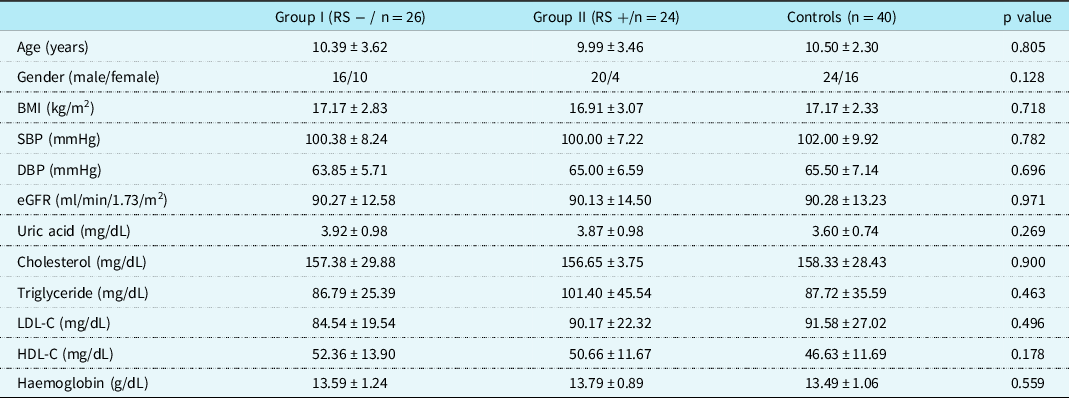
A total of 90 children, including 50 patients and 40 healthy controls, were included in the study. There were 26 patients (16 girls and 10 boys) in group I and 24 patients (20 girls and 4 boys) in group II. There was no statistically significant difference between the patient and control groups in terms of age, gender, body mass index, blood pressure, and biochemical parameters (Table 1).
Demographic and laboratory data of study population.

Data are expressed mean ± SD
BMI = body mass index; DBP = diastolic blood pressure; eGFR = estimated glomerular filtration rate; HDL-C = high-density lipoprotein cholesterol; LDL-C = low-density lipoprotein cholesterol; RS = renal scarring; SBP = systolic blood pressure; SD = standard deviation
M-mode and pulsed Doppler echocardiographic data
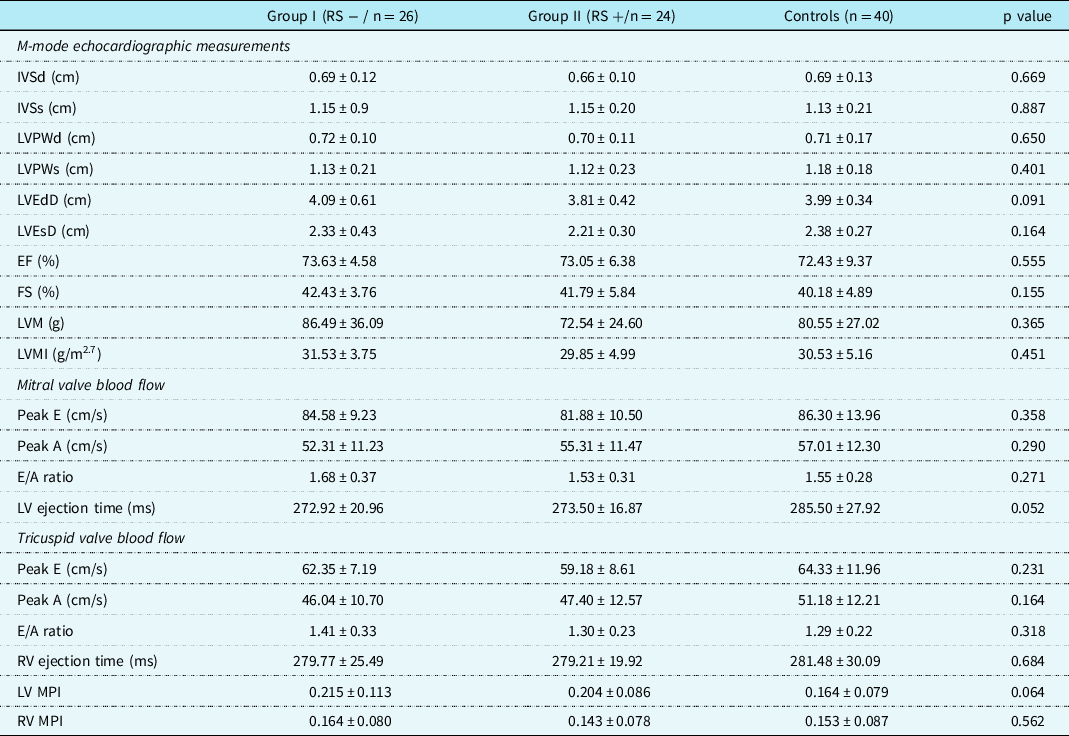
M-mode and pulsed Doppler echocardiographic measurements revealed no statistical difference between the study groups (Table 2). No significant difference in ventricular mass and left ventricular mass index was found between the groups (group I (without renal scarring): 86.49 ± 36.09 g and 31.53 ± 3.75 g/m2.7; group II (with renal scarring): 72.54 ± 24.60 g and 29.85 ± 4.99 g/m2.7; control group: 80.55 ± 27.02 g and 30.53 ± 5.16 g/m2.7; p > 0.05 for all).
M-mode and pulsed Doppler echocardiographic measurements in patients with and without renal scarring and control groups.

A = late mitral/tricuspid diastolic velocity; E = early mitral/tricuspid diastolic velocity; EF = ejection fraction; FS = fractional shortening; IVSd = interventricular septum diastolic thickness; IVSs = interventricular septum systolic thickness; LV = left ventricle; LVEdD = left ventricular end-diastolic dimension; LVEsD = left ventricular end-systolic dimension; LVM = left ventricular mass; LVMI = left ventricular mass index; LVPWd = left ventricular posterior wall diastolic thickness; LVPWs = left ventricular posterior wall systolic thickness; MPI = myocardial performance index; RS = renal scarring; RV = right ventricle
Tissue Doppler echocardiographic data
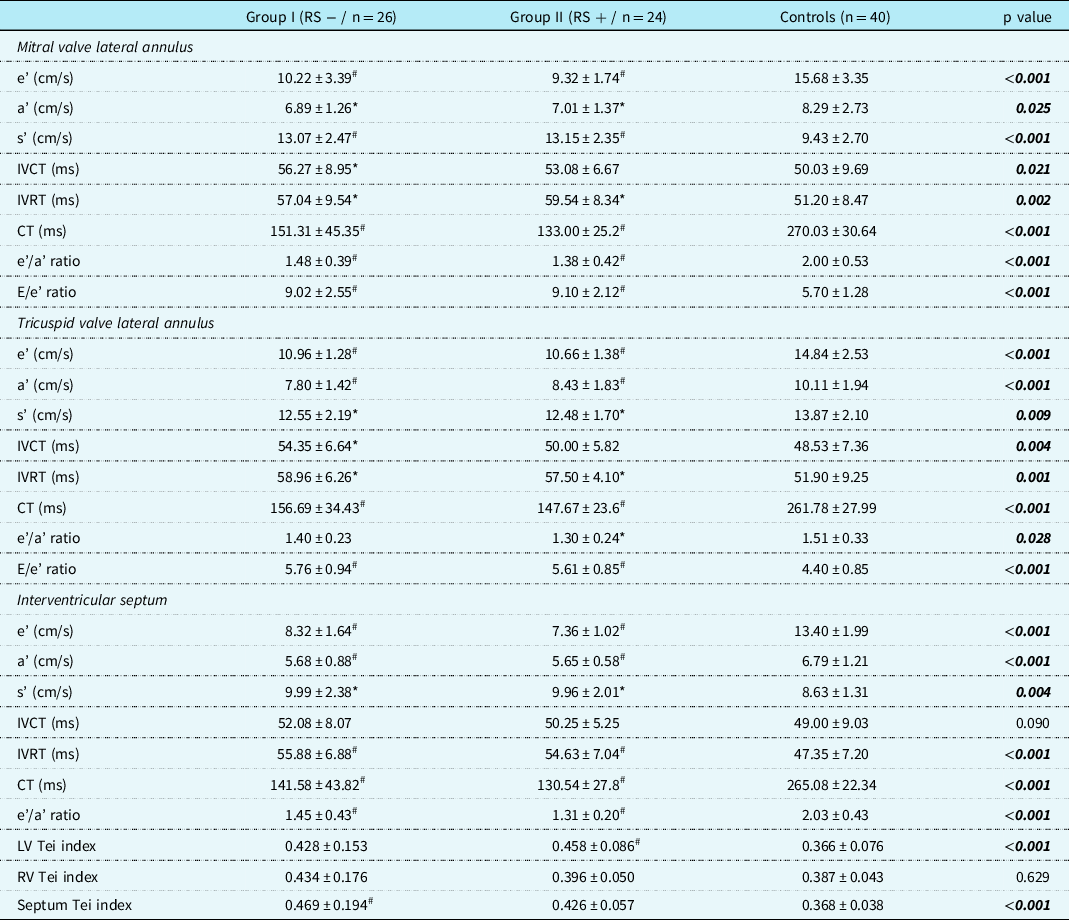
Mitral valve lateral annulus and interventricular septum peak systolic myocardial velocities were significantly higher in groups I (without renal scarring) and II (with renal scarring) (13.07 ± 2.47 and 13.15 ± 2.35, respectively) than the controls (9.43 ± 2.70, p < 0.001). However, tricuspid valve lateral annulus peak systolic myocardial velocity was significantly higher in controls (p = 0.009) (Table 3). Also, peak early diastolic myocardial and peak atrial systolic velocities measured from both Tissue Doppler echocardiographic regions were significantly lower in group I and group II than the control group (p < 0.001 and p = 0.025). On the other hand, peak early diastolic myocardial velocity/peak atrial systolic velocity ratios measured from both echocardiographic regions were significantly lower in group I and group II than the controls (p < 0.001 and p = 0.028). Early diastolic velocity/peak early diastolic velocity ratios calculated from both echocardiographic regions were significantly higher in groups I and II than the control group (for all p < 0.001). Among the time intervals, isovolumetric contraction time and isovolumetric relaxation time measured from both mitral and tricuspid lateral annuluses and isovolumetric relaxation time interval of interventricular septum were higher in study groups than the controls (for all p < 0.05). Adversely, contraction time measured from both Tissue Doppler echocardiographic regions was significantly lower in group I (without renal scarring) and group II (with renal scarring) than the controls (for all p < 0.001).
Measurements of tissue Doppler echocardiographic parameters in patients with and without renal scarring and control groups.

The p values given on the last column (italic) indicate the statistical difference between three groups
a’ = peak atrial systolic myocardial velocities; CT = contraction time; e’ = peak early diastolic myocardial velocities; IVCT = isovolumetric contraction time; IVRT = isovolumetric relaxation time; LV = left ventricle; RS = renal scarring; RV = right ventricle; s’ = peak systolic myocardial velocities
# p < 0.001 versus control
* p < 0.05 versus control
Additionally, Tei indexes of left ventricle, right ventricle, and interventricular septum in study groups were found to be higher than the control group. However, statistical significance was achieved only for septum Tei index of group I (without renal scarring) and left ventricular Tei index of group II (with renal scarring) (for all p < 0.001).
Data of common carotid artery intima media, epicardial adipose tissue, and periaortic adipose tissue thicknesses
Common carotid artery intima media thickness (0.046 ± 0.012 and 0.047 ± 0.010 cm), epicardial adipose tissue thickness (0.436 ± 0.109 and 0.429 ± 0.098 cm), and periaortic adipose tissue thickness (0.149 ± 0.032 and 0.147 ± 0.022 cm) of the study groups were significantly higher than the control group (for all, p < 0.001) (Table 4). However, no statistical difference was observed between group I (without renal scarring) and group II (with renal scarring).
Measurements of cIMT, EFT, and PFT thickness in patients with and without renal scarring and control groups.

The p values given on the last column (italic) indicate the statistical difference between three groups
cIMT = carotid intima-media thickness; EAT = epicardial adipose tissue; PAT = periaortic adipose tissue; RS = renal scarring
* p < 0.001 versus control
Discussion
Renal cortical abnormalities are frequently encountered in children with vesicoureteral reflux, even without a history of urinary tract infections. However, the relationship between vesicoureteral reflux-associated renal damage and urinary tract infections is well-known. Reference Mattoo1 On the other hand; recent studies regarding vesicoureteral reflux and renal scarring show that renal scarring may develop without urinary tract infections. Also, the role of inflammatory cytokines in renal scarring formation has been investigated in many studies. Reference Gokce, Alpay, Biyikli, Unluguzel, Dede and Topuzoglu4,Reference Sabasiñska, Zoch-Zwierz, Wasilewska and Porowski6
Previous studies on children with vesicoureteral reflux revealed increased levels of proinflammatory markers such as interleukin-6, interleukin-8, and transforming growth factor beta-1 in urine or serum. Reference Gokce, Alpay, Biyikli, Unluguzel, Dede and Topuzoglu4,Reference Sabasiñska, Zoch-Zwierz, Wasilewska and Porowski6,Reference Border and Noble23,Reference Morozova, Morozov and Pervouchine24 All these studies show that the inflammation continues in children with vesicoureteral reflux, independent of urinary tract infections and even if vesicoureteral reflux is treated. In our study, common carotid artery intima media, epicardial adipose tissue, and periaortic adipose tissue thicknesses were found to be significantly higher in both scarring and non-scarring patients than in the control group. This finding supports that vesicoureteral reflux alone may cause chronic inflammation even if it does not cause scarring.
Persistent elevation of some proinflammatory markers, such as interleukin-6 and interleukin-8, results in a chronic condition defined as subclinical or low-grade inflammation that plays a key role in the development of cardiovascular disease. Reference Moreira, da Silva, Vieira, Fattah, Lueneberg and Gottschall7,Reference Okazaki, Sakaguchi, Miwa, Furukado, Yamagami and Yagita8,Reference Marchio, Guerra-Ojeda, Vila, Aldasoro, Victor and Mauricio25 In daily practice, common carotid artery intima media thickness is used as a reliable marker in the evaluation of atherosclerotic changes in the early period. In a study evaluating the progression of atherosclerosis, a strong relationship between common carotid artery intima media thickness and interleukin-6 was reported. Reference Okazaki, Sakaguchi, Miwa, Furukado, Yamagami and Yagita8 It has been stated that common carotid artery intima media thickness shows subclinical atherosclerosis in different chronic diseases of childhood. Reference Bakkaloglu, Saygili and Sever10,Reference Järvisalo, Jartti and Näntö-Salonen26 Also, common carotid artery intima media thickness has consistently been related to future cardiovascular disease events in population studies. Reference Bots27 Common carotid artery intima media thickness is significantly related to other markers for cardiovascular disease risk, such as elevated levels of risk factors and presence of atherosclerosis in the coronary arteries. Furthermore, almost all lipid-lowering trials and a large number of blood pressure lowering trials have consistently shown a reduction in progression of common carotid artery intima media thickness. Reference Bots27 In our study, common carotid artery intima media thickness was significantly higher in both renal scarring and non-scarring patient groups when compared to the controls, but no significant difference was found between these two study groups.
On the other hand, body fat distribution is an important cardiovascular risk factor, and fat stores are associated with mortality from all causes. One component of abnormal body fat is the accumulation of adipose tissue around organs and vessels that is called "ectopic fat". Ectopic adipose tissue, unlike subcutaneous adipose tissue, is not a usual place for lipid storage. Epicardial and periaortic adipose tissue also has endocrine functions that can produce inflammatory cytokines and hormones like other adipose tissues. Moreover, they have been lately identified as a powerful risk factor for cardiovascular disease because of their role in the inflammatory process in atherosclerosis. Reference Djaberi, Schuijf, van Werkhoven, Nucifora, Jukema and Bax9,Reference Akyürek, Atabek, Eklioglu and Alp11,Reference Iacobellis and Bianco20,Reference Aeddula, Cheungpasitporn, Thongprayoon and Pathireddy28 It has been reported that epicardial adipose tissue thickness in adult chronic kidney disease is a reliable parameter in evaluating cardiovascular risk and it predicts coronary artery disease. Reference Aeddula, Cheungpasitporn, Thongprayoon and Pathireddy28,Reference Nakanishi, Fukuda and Tanaka29 Also, a recent study showed that epicardial fat volume is a significant univariate predictor of the number of coronary plaques and cardiovascular adverse events in asymptomatic adult patients with diabetes. Reference Venuraju, Lahiri, Jeevarethinam, Rakhit, Shah and Nilsson30 There is a limited number of paediatric studies evaluating epicardial adipose tissue and periaortic adipose tissue thicknesses in obese children with coronary artery disease, increased common carotid artery intima media thickness, and arterial stiffness. Reference Manco, Morandi, Marigliano, Rigotti, Manfredi and Maffeis31 Akyürek et al evaluated the relationship between periaortic adipose tissue thickness and cardiovascular risk in 135 children with type-1 diabetes mellitus. In this study, they reported that there is a positive correlation between periaortic adipose tissue and common carotid artery intima media thicknesses and metabolic risk factors. Reference Akyürek, Atabek, Eklioglu and Alp11 In our study, epicardial adipose tissue and periaortic adipose tissue thickness were found to be significantly higher in both renal scarring and non-scarring patient groups. However, there was no significant difference between renal scarring and non-scarring patient groups.
It is known that E/e’ ratio shows the strongest correlation with left ventricular/right ventricular diastolic filling pressure and left ventricle/right ventricle compliance, Reference Harada, Tamura, Yasuoka and Toyono32,Reference Lopez, Colan and Frommelt33 whereas early diastolic velocity/late diastolic velocity and peak early diastolic myocardial velocity/peak atrial systolic myocardial velocity ratios correlate with relaxation-type dysfunction. Reference Doyon, Haas and Erdem34 Limited data from the children with chronic kidney diseases revealed that left ventricular early diastolic velocity/late diastolic velocity and peak early diastolic myocardial velocity/peak atrial systolic myocardial velocity ratios decrease and early diastolic velocity/peak early diastolic myocardial velocity ratio increases along with the worsening of renal functions from mild–moderate to severe renal failure. Reference Celik, Karakurt, Tabel, Elmas and Yologlu35 On the other hand, Çelik et al reported decreased early diastolic velocity/late diastolic velocity and increased peak early diastolic myocardial velocity/peak atrial systolic myocardial velocity ratios in non-obese-treated hypertensive patients. Reference Celik, Karakurt, Tabel, Elmas and Yologlu35 These studies showed dysfunction of left ventricular relaxation and diastolic filling pressures; however, right ventricular functions were not studied and possibly right ventricular dysfunction was underestimated. In this context, our study revealed that e’/a’ ratios measured from left ventricle, right ventricle, and interventricular septum were significantly lower in renal scarring (+) (group II) and scarring (–) (group I) vesicoureteral reflux patients when compared with healthy controls. Additionally, early diastolic velocity/peak early diastolic myocardial velocity ratios measured from left ventricle and right ventricle were detected to be significantly increased in both patient groups. These findings suggest that left and right ventricle functions and diastolic filling pressures are worsened in children with vesicoureteral reflux regardless of renal scarring formation.
On the other hand, myocardial performance index or Tei index is a good predictor of ventricular systolic functions in children and adults. Reference Tei19 Myocardial performance index measured by pulsed-wave Doppler, M-mode, and tissue Doppler imaging methods is a valuable parameter indicating systolic and diastolic functions. The results from the previously mentioned study showed that left ventricular myocardial performance index was higher in non-obese-treated hypertensive children, but no significance was achieved. Reference Celik, Karakurt, Tabel, Elmas and Yologlu35 However, in our study myocardial performance index values of left and right ventricles in the group without renal scarring were significantly higher than the controls while no statistical significance was shown. Besides, both Tei index values of left ventricle, right ventricle, and interventricular septum were found to be increased in the both study groups than in the controls. Nevertheless, statistical significance was achieved for only left ventricular Tei index of renal scarring (+) (group II) and septum Tei index of renal scarring (−) (group I) groups. By this way, we demonstrated a significant reduction of systolic and diastolic functions of left and right ventricles in children with vesicoureteral reflux regardless of renal scarring formation compared to healthy children.
It is important to consider the limitations pertaining to the methods of this study. The main limitation of our study is that inflammatory cytokines were not studied. Additionally, the duration of illness (vesicoureteral reflux) and associated factors could not be studied. However, serum lipid parameters as well as a detailed echocardiographic assessment was performed.
Our study showed early deterioration of cardiac systolic and diastolic functions in children with vesicoureteral reflux regardless of renal scarring. Also, common carotid artery intima media, epicardial adipose tissue, and periaortic adipose tissue thicknesses, indicating the presence of early subclinical atherosclerosis, were found to be higher in both renal scarring and non-scarring vesicoureteral reflux patients. These results suggest that vesicoureteral reflux alone is an important risk factor for subclinical atherosclerosis, independent of renal scarring, and should be considered in the follow-up of these patients.
Acknowledgements
None declared.
Financial support
This research received no specific grant from any funding agency, commercial, or not-for-profit sectors.
Conflicts of interest
None.
Ethical standards
Ethical clearance was sought and obtained from KTO Karatay University, Medical Faculty Ethical Committee (IRB Number: 419011325-050.99). Patients of the study were asked to provide informed voluntary written consent. Assent was also signed by parents for patients under the age of 18 years to be included in the study.
Author contributions
A.M.E conceptualised and designed the study, carried out the initial analyses, drafted the initial manuscript, and reviewed and revised the manuscript. H.A. designed the data collection instruments, collected data, and reviewed and revised the manuscript. M.İ.D. conceptualised and designed the study, coordinated and supervised data collection, and critically reviewed the manuscript for important intellectual content. All authors approved the final manuscript as submitted and agree to be accountable for all aspects of the work.