Arroyo Pesquero, located in southern Veracruz, Mexico, is best known for the many Olmec masks, thousands of celts, and other stone objects that are attributed to the site. Most of these objects were collected using uncontrolled and undocumented recovery methods and are now in private collections and various museums in Mexico, the United States, and Europe. Almost nothing was known of the archaeology of the site until 2005 when Carl Wendt and Roberto Lunagómez initiated the Proyecto Arqueológico Arroyo Pesquero (PAAP), as part of a larger research program designed to collect regional survey and excavation data from domestic contexts at a range of Olmec sites in that area (Wendt and Lunagómez Reference Wendt and Lunagómez Reyes2011).
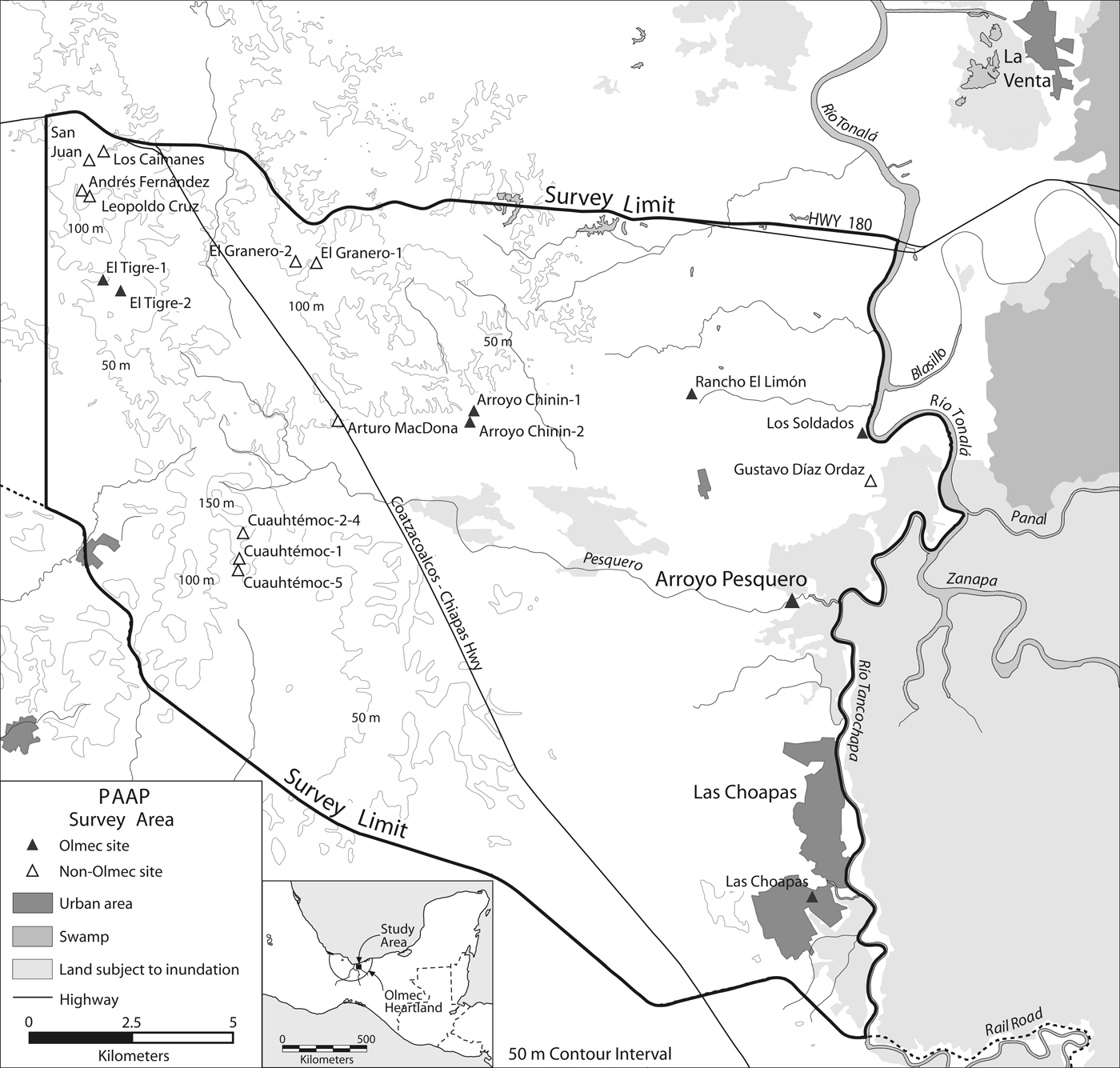
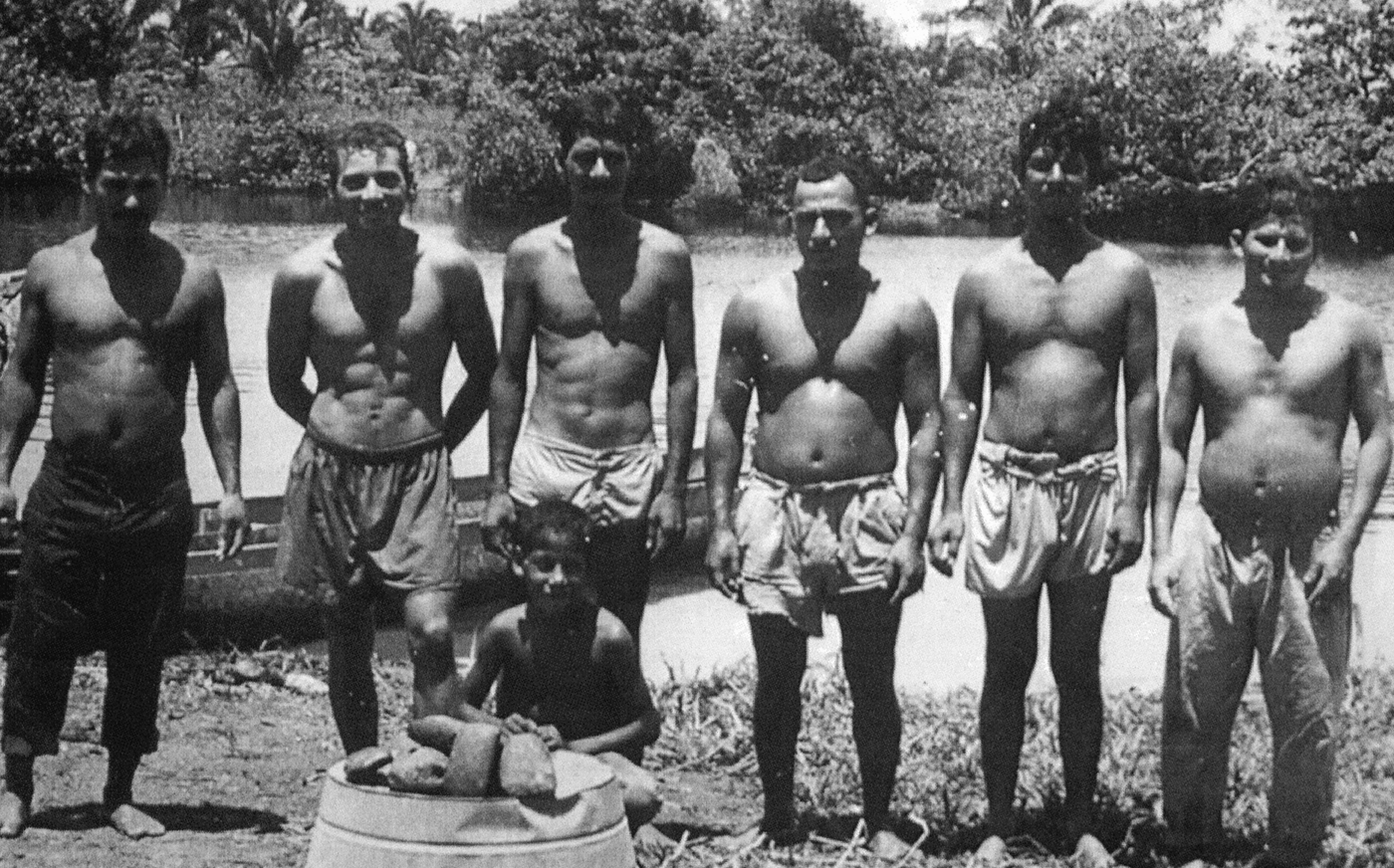
The Arroyo Pesquero, a tributary of the Tancochapa and the Tonala rivers, is situated 16 km from La Venta by air, and 30 km by river. The terrain surrounding the stream consists of extensive grasslands that are inundated for much of the year. The banks of the stream consist of very narrow tree-lined low levees, and access to the area is most feasible by boat. The site was discovered by a local fisherman in 1969 while he was attempting to locate a metal basin from the stream, at the point where a small tributary empties fresh water into the mostly brackish Pesquero (Figure 1). He and other local fishermen would often collect fresh water from this location for drinking and washing clothes in the dry season when most rivers and streams become brackish. A few weeks before his discovery, a friend's son had accidentally dropped a metal basin into the stream when he was collecting fresh water. The boy's father asked our informant and his brother to try to retrieve it, and they decided to dive during the height of the dry season when the water level was at its lowest. When the brothers returned in May 1969, they dove in the spot where the basin was lost and were unable to locate it. They then decided to dive in transects, and systematically covered the stream bed in the area where the boy had lost the basin. Our informant decided to dive once more at the spot where the basin was lost and this time he encountered a hard, smooth object. When he brought it to the surface he saw it was a black colored human mask made of stone. At the end of the day he claims to have retrieved at least seven stone masks from the spot, and coincidentally also the metal basin (Figure 2).
The Arroyo Pesquero region in the eastern Olmec Heartland.

Original discoverers of the Arroyo Pesquero site. This photograph was taken in 1969 shortly after the first masks were discovered. The metal basin in the front of the photo is apparently the one that was lost and later recovered. Note the celts on top of the overturned basin.
Not long after news of the discovery reached archaeologists in Xalapa, Veracruz, Manuel Torres Guzmán (accompanied by Carlos Murguía [see Beverido Perau Reference Beverido Perau1970:80–81]) left to investigate the finds and document the site (Rodríguez Reference Rodríguez and López2009:9). In a brief report, Torres states that he arrived in Las Choapas (the seat of the municipal government) on June 26, 1969, and with the help of municipal authorities and Petróleos Mexicanos (PEMEX) officials tracked down locals in possession of artifacts from Arroyo Pesquero, which included at least three masks, an axe, and an anthropomorphic figurine. The following day Torres commissioned two canoes in order to visit the site and recounted that within roughly an hour divers had extracted about 500 kg of stone. Although it is not made clear in his report, we suspect that Torres acquired the masks, axe, figurine, and possibly some other artifacts and brought them back with him to Xalapa (Torres Reference Torres1969). Alfonso Medellín Zenil's (Reference Medellín Zenil1971:45–49) descriptions of the Arroyo Pesquero artifacts in the Museo de la Universidad de Veracruz lead us to believe that a number of the artifacts attributed to the site are now located at the Museo de Antropología de Xalapa (MAX) are the same artifacts that Torres mentions in his notes. There are six masks attributed to Arroyo Pesquero in the MAX collections (Coe Reference Coe and Trueblood1992:57), two of which were donated by former Veracruz governor Rafael Hernández Ochoa (Acosta Lagunes Reference Acosta Lagunes and Trueblood1992:26). It is likely that at least three of the others were the ones mentioned by Torres in his notes.
When describing the Arroyo Pesquero artifacts in the Museo de la Universidad de Veracruz, Medellín (1971:19) noted that “[t]he muddy river bottom in which these masks were found yielded more than 2,000 crude stone axes, fragments of pyrite mirrors, anthropomorphic figurines with Colossal Head traits, three other functional masks, not stereotyped although hieratic.” We think that this statement is most likely a reference to the near 500 kg of stone mentioned by Torres. In the MAX's storerooms we recently located four unlabeled wooden crates that contained stone very similar in material and form as we found on the Pesquero riverbed in 2012.
Since Torres' brief visit in 1969, Arroyo Pesquero has had many visitors. Locals regularly fish its waters, hunt on its banks, collect sand from its bottom, and, while doing so, they often search for artifacts in the streambed. Locals reported to us that many foreigners have also come to search for artifacts. Many of these looting expeditions evidently have been successful, judging by the number of artifacts in museums and private collections that are attributed to Arroyo Pesquero. Certainly not all the artifacts attributed to the site were actually taken from there, but undoubtedly many were. Some archaeologists and art historians (for example, Kelker and Bruhns Reference Kelker and Bruhns2010:170–172) claim that many of the artifacts attributed to Arroyo Pesquero are either fakes, or were decorated (incised) after they were collected in order to increase their monetary value. While we cannot claim that this has never happened, the argument that the Olmec would only carve jadeite that was pure in color, and that they would not decorate with “scratch” incisions, is not supported by our recent provenienced find.
We know of one other expedition to the Arroyo Pesquero that recovered artifacts from the underwater site. In 1986, with the support of the Veracruz government and then governor Agustín Acosta Lagunes, art dealer and historian George Belcher, and a small team that included his brother, a friend, and archaeologist Manuel Torres Guzmán, mounted a week-long investigation aimed at recovering objects for the new anthropology museum (MAX) in Xalapa, Veracruz (Belcher Reference Belcher2012). With diving gear, a dredge, and a few local guides—some of whom were involved in the 1969 work—the team explored the bottom of the stream. Although never able to get their dredge working, the team did successfully recover scores of pottery sherds in the area downstream of where the masks were discovered. Belcher (Reference Belcher2012) reports that Torres Guzmán took these sherds back to the MAX. Unfortunately, we have not been able to locate these materials to date.
PROYECTO ARQUEOLÓGICO ARROYO PESQUERO
The PAAP was initiated in 2005 with a general regional reconnaissance survey, and in the ensuing seven years of field investigation, we surveyed and excavated at the sites of Arroyo Pesquero (Wendt and Lunagómez Reference Wendt and Lunagómez Reyes2011) and Los Soldados. Most of the work at Arroyo Pesquero was conducted during the 2008 field season (Wendt and Lunagómez Reference Wendt and Lunagómez Reyes2011), however, in 2012 we returned to the site to further explore the streambed, which we were unable to adequately investigate during the first field season at the site.
Between April and May of 2012, members of the PAAP conducted a week-long underwater survey of the streambed to map the topography of the underwater surface and to record the presence and distribution of artifacts. Our original plan was to set up an underwater grid and conduct a systematic, full coverage survey of the streambed. This plan had to be modified because our diving equipment (a hookah system) was held up in customs. We ended up with only five days to survey, so we opted to utilize a transect survey instead. A series of north-south transects were selected in the area that our informants stated was the location of previous finds. Underwater conditions were particularly challenging and included near zero visibility and many obstructions including large logs, smaller debris, partially decomposed leaves, and other vegetation. Nevertheless, we were able to measure subsurface contours by taking soundings by hand using a rope and a plummet along the various transects, and we successfully made a handful of artifact collections. The artifacts that we encountered were resting in shallow depressions on the streambed at depths ranging from 2−3 m from the surface. Artifacts encountered were collected and their exact positions were recorded using sub-meter GPS (Delsescaux Reference Delsescaux2012). The object described herein was discovered in one of these depressions along with other broken stone artifacts. Description of the entire assemblage of artifacts discovered, including a full account of the underwater work, will be forthcoming in a future publication.
DESCRIPTION OF THE KEY ARTIFACT
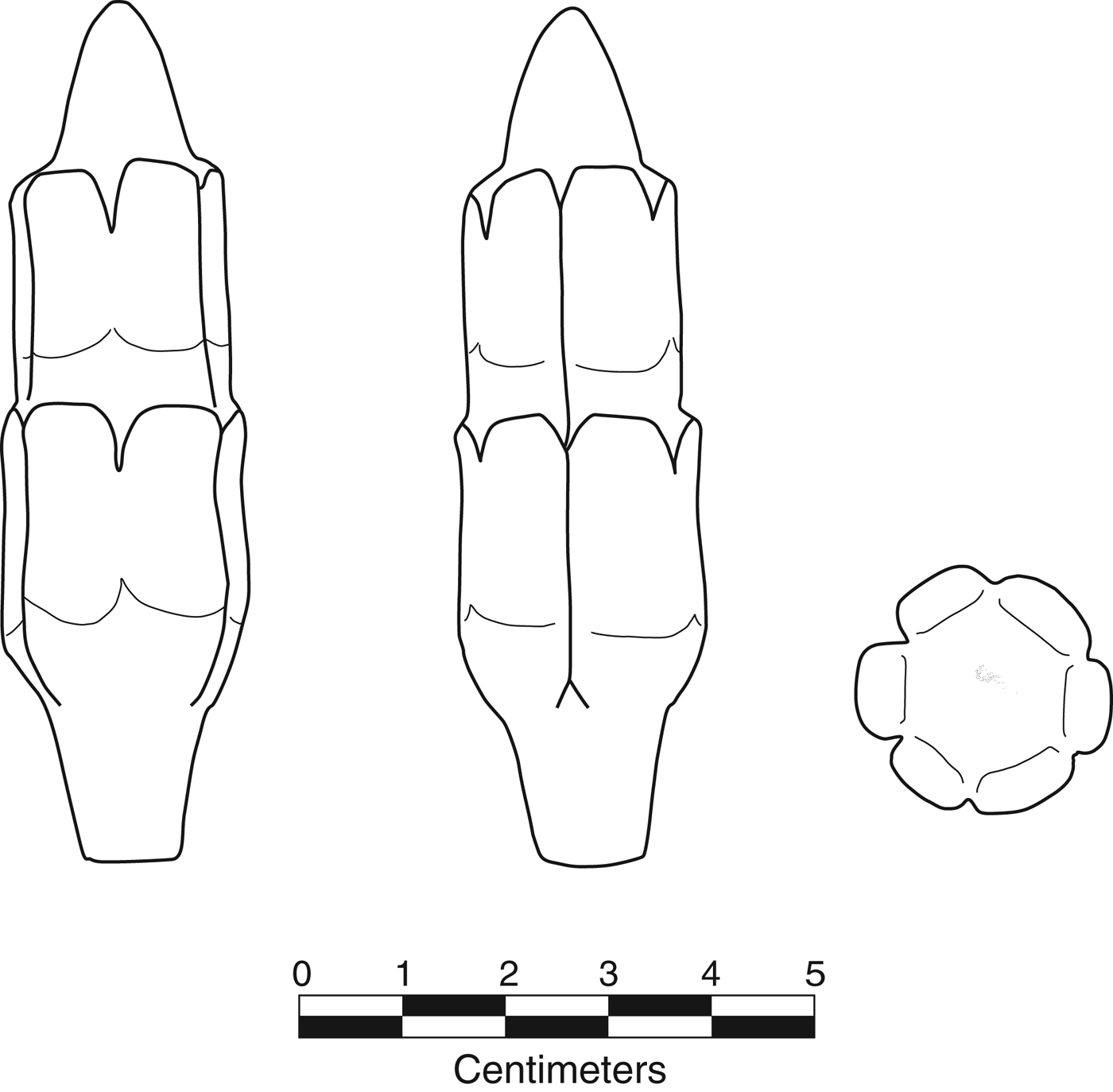
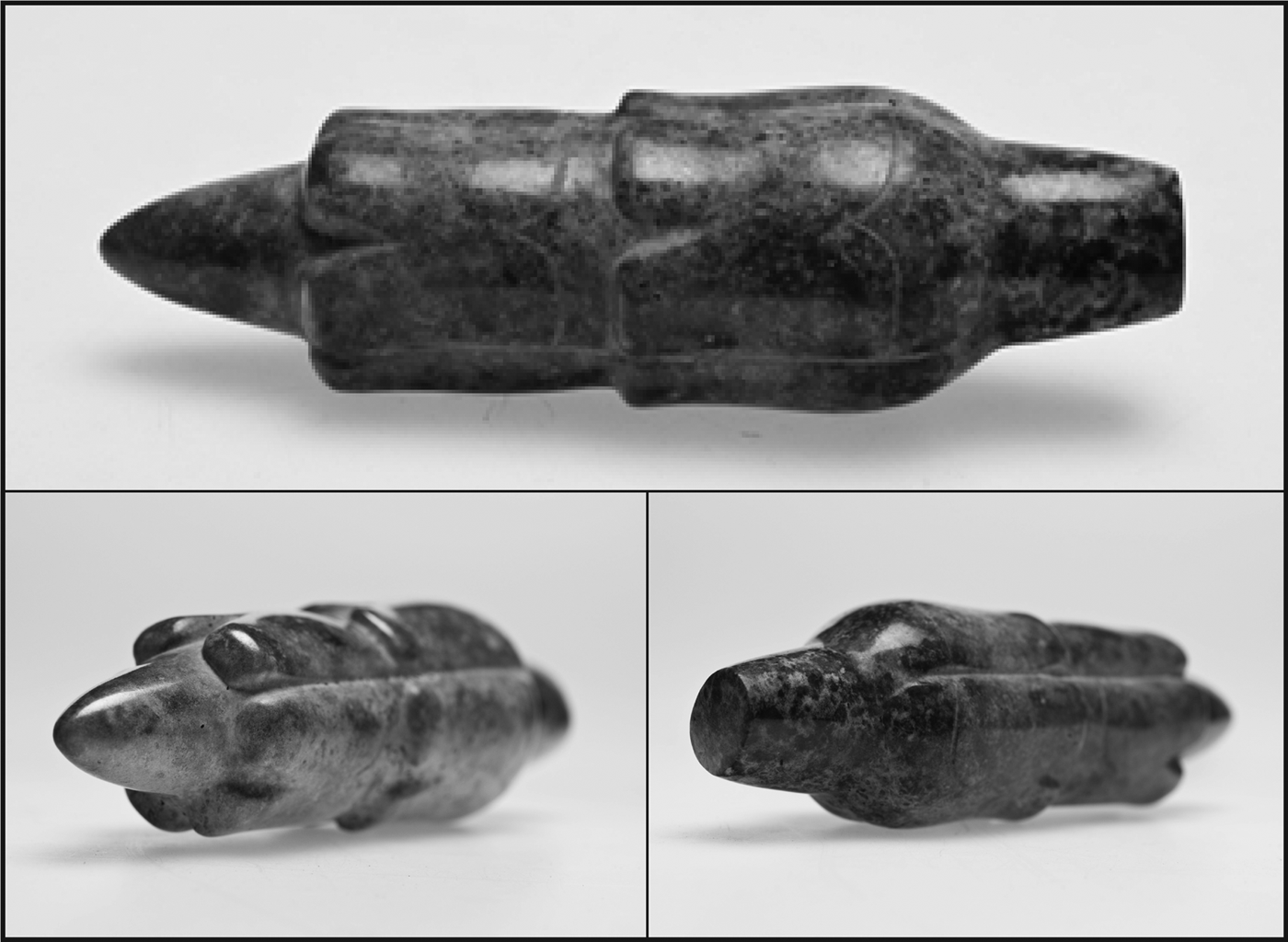
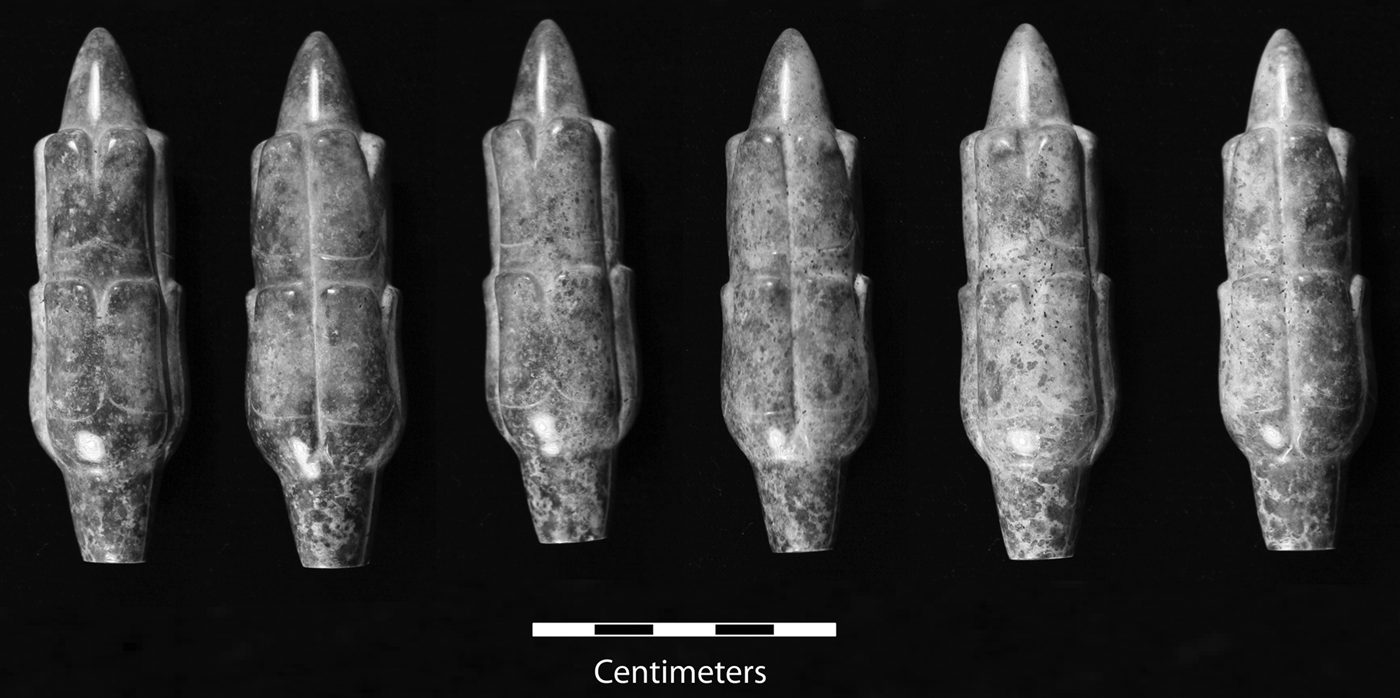
The artifact is a unique object, fashioned from mottled white and brownish orange stone, and finely polished (Figures 3, 4, and 5). The specific gravity of the material is 3.20 (Masson Reference Masson2012), placing it in the category of jadeite. The object stands 8.7 cm high and measures 2.5 cm at its widest point. Similar to many other polished jadeite artifacts attributed to Arroyo Pesquero (see Taube Reference Taube2004:24), this specimen has both highly polished, smoothed relief carved designs, and “scratched” incised lines. At the base it is composed of a cylindrical, tapering element from which arise three sides divided by grooves. Each of the three sides has two rectangular-shaped, stacked elements. The top of each of these rectangular elements has a V-shaped cleft in the center, and at the bottom of each rectangle there is a scalloped-shaped “scratched” incision. The top of the artifact has a tapered, cone-shaped element that appears to be protruding from the top row of clefts and it resembles what Joralemon (Motif 81; Joralemon Reference Joralemon1971:13, 32–33) and others (for example, Taube Reference Taube1996, Reference Taube, Clark and Pye2000, Reference Taube2004) interpret as corn (sometimes presented as banded) emerging from a cleft. The form of this artifact is quite unusual. While cleft rectangles and cones emerging from them are common in Middle Formative Olmec iconography (Joralemon Reference Joralemon1971; Navarrete Reference Navarrete1971, Reference Navarrete1974; Taube Reference Taube1996), this artifact is unusual for the stacking and three dimensional (carved “in-the-round”) presentation.
Line drawing of the artifact by Juan Pírez Morales.
The artifact from different angles. Notice the rounded and polished base of the piece. If it was originally a perforator, after it was broken it would have been smoothed and polished in order to reach this final form.
Rollout of the artifact showing the varying tone of the material.
Sunken V-shaped clefts are one of the most frequently represented and studied motifs in Olmec iconography. Marcus (Reference Marcus, Sharer and Grove1989:172; see also Piña Chan Reference Piña Chan1993:21) has argued that clefts represent the fissures of the earth's surface from which plants, including corn, grow. Taube contends that cleft forms, like those depicted on the back of the seated jadeite figure in the Dumbarton Oaks collection (see Benson Reference Benson1971:Figure 14; Benson and de la Fuente Reference Benson and de la Fuente1996:Catalog No. 52), “probably allude to green, growing maize” (Taube Reference Taube1996:42). Many clefts in Olmec iconography have objects protruding from them, such as simple lines (Benson and de la Fuente Reference Benson and de la Fuente1996:Catalog No. 117), cone shaped elements (Joralemon Reference Joralemon1971:Motif 81), and so-called tripartite elements (Joralemon Reference Joralemon1971:Motif 89). Joralemon (Reference Joralemon1971) and Taube (Reference Taube1996, Reference Taube, Clark and Pye2000, Reference Taube2004) have both argued that all of these protrusions represent corn. In fact, Coe (Reference Coe1968:111) and Joralemon's (Reference Joralemon1971:59–66) “Maize God,” or “God II,” has a split or cleft head often with a cone element (interpreted as an ear of corn) emerging from it (see also Pérez Suárez Reference Pérez Suárez, Noguez and López Austin1997). Taube (Reference Taube2004:28) has suggested that when a cleft head has a “cleft leaf” flanking its cheek (see, for example, Joralemon Reference Joralemon1971:Figure 175), the head itself is meant to represent an ear of corn. And when a cone element is present protruding from the head cleft, he (Taube Reference Taube1996:44, 48, Reference Taube2004:28) interprets the entire face as a mature ear of corn. Cleft rectangles without faces (see Benson and de la Fuente Reference Benson and de la Fuente1996:Catalog Nos. 52 and 116) are often interpreted as sprouting ears of corn (Joralemon Reference Joralemon1996c:267), and jadeite celts themselves are commonly believed to represent green ears of corn (Joralemon Reference Joralemon, Benson and de la Fuente1996d:268; Taube Reference Taube, Clark and Pye2000). Applying Joralemon's (Reference Joralemon and Nicholson1976:37) observation that abbreviated and abstract iconographic information can represent the whole (pars pro toto), Florescano (Reference Florescano2003:11–16) has argued that the Olmec Maize God could be represented by a kernel, an ear of corn, or simply the color of the plant.
In Olmec iconography, scallop-shaped incisions are rarely present at the bottom of cleft rectangles. We know of only three examples. A jadeite object, reportedly from Arroyo Pesquero (Guthrie Reference Guthrie1995:Catalog No. 76; Parsons et al. Reference Parsons, Carlson and Joralemon1988:40–41), depicts an entity emerging from a cleft in a rectangular-shaped element, and exhibits these scallop-shaped engravings near the bottom. It is noteworthy that this object also has a truncated base reminiscent of the cylindrical base on our Arroyo Pesquero find. A second example occurs on the Cascajal block (Rodríguez et al. Reference Rodríguez Martínez, Ortíz Ceballos, Coe, Diehl, Houston, Taube and Calderón2006). One symbol occurs four times (at 2, 24, 38, and 52) on the block (Rodríguez et al. Reference Rodríguez Martínez, Ortíz Ceballos, Coe, Diehl, Houston, Taube and Calderón2006:Figure 4)—an image of a rectangular-shaped object with a cleft on top, scalloping on the lower third, and a truncated “stem” on the bottom. We should mention that Bruhns and Kelker (Reference Bruhns and Kelker2007:1365) misidentify this symbol on the Cascajal Block as being the same symbol that appears on headdress assemblages of various celts (see specifically Benson and de la Fuente Reference Benson and de la Fuente1996:Catalog Nos. 116, 117, 118, and 119). The headdress assemblages to which they refer are missing the important scalloped element. The final example comes from a celt attributed to Arroyo Pesquero now housed at the Cleveland Museum of Art (Benson and de la Fuente Reference Benson and de la Fuente1996:Catalog No. 117). This celt has a profile head with an ear ornament that has “two cleft rectangles with scalloped bases linked by a band” (Joralemon Reference Joralemon1996c:269). It is interesting that all three of these examples containing rectangular elements with clefts and scallops also have “stem” elements present that extend from the rectangle's base. While not a “scallop” in the strict sense, it is worth noting that we know of one—albeit unprovenienced—artifact that depicts stacked “were-jaguar” masks with a head cleft on the top mask, and a scallop-shaped base on the bottom mask (see Joralemon Reference Joralemon1971:Figure 189).
AN INTERPRETATION OF THE ARTIFACT
The interpretation of the artifact is somewhat challenging due to its unique form and particular combination of iconographic elements. If cleft rectangles represent ears of corn as many scholars contend (Joralemon Reference Joralemon1971; Taube Reference Taube1996, Reference Taube, Clark and Pye2000, Reference Taube2004), then this artifact would appear to be depicting six ears of corn, stacked, with a conical ear of corn emerging from the top. We believe such an interpretation is unsatisfactory. Instead, we propose that the cleft rectangles on this artifact represent individual corn kernels, perhaps seed corn (see also Florescano Reference Florescano2003:12–13), rather than an entire ear of corn. The cone-shaped element on top then represents the corn plant as it sprouts form the cleft(s) of seed corn. Another way to look at it is as follows—the artifact is a representation of a husked corn cob. After all, corn plants, and ultimately cobs, do not grow from cobs, they grow from kernels. If our interpretation is accurate, it seems appropriate to reevaluate the motifs that are commonly interpreted as corn plants and ears of corn. Rectangular elements in Olmec iconography might depict corn in various stages of growth (for a similar argument see Taube Reference Taube1996:42). We suggest that rectangular elements with no cleft (see, for example, Benson Reference Benson1971:Figure 14; Benson and de la Fuente Reference Benson and de la Fuente1996:Catalog No. 52), including greenstone celts, represent unripe kernels, unripe ears, or unhusked ears. Rectangular elements with clefts (Benson Reference Benson1971:Figure 11; Benson and de la Fuente Reference Benson and de la Fuente1996:Catalog Nos. 9, 52, and 116) then represents a ripe kernel or seed corn for planting (see Guthrie Reference Guthrie1995:191). When an object is shown emerging from a cleft rectangle, the image represents a sprouting seed or a plant growing (Joralemon Reference Joralemon1971:Motif 81, Figure 88; Riley Reference Riley and Guthrie1995:39; Schele Reference Schele and Guthrie1995:105–106). A ripe ear of corn would then be limited to Joralemon's (Reference Joralemon1971:Figure 80) Motif 93. Our interpretation is similar to Taube's reading of the motifs on the cape of the Dumbarton Oaks figurine discussed in the previous section (Benson and de la Fuente Reference Benson and de la Fuente1996:Catalog No. 52; Benson Reference Benson1971:Figure 14), except that Taube (Reference Taube1996:42) argues the stages are “from jade celt to green, foliated cleft celt and finally to the tasseled cob.” If we are correct, then the head of the so-called Maize God is a corn kernel and not an ear of corn. That said, we contend that a kernel by itself can also represent generic corn, including an ear of corn (in other words, pars pro toto) (see also Florescano Reference Florescano2003).
The overall form of the artifact and its color lead us to believe that it might have functioned as a stone effigy of an ear of corn (see Taube Reference Taube1996, Reference Taube, Clark and Pye2000:307, Reference Taube2004:29, 80–81). The truncated bottom supports the notion that the artifact was a finial that was originally fastened to a wooden staff or scepter (see Parsons et al. Reference Parsons, Carlson and Joralemon1988:40). David Joralemon (personal communication to Wendt, 2013) has suggested that the artifact was the handle of a broken and repurposed perforator that would have originally functioned as a bloodletter. After being deliberately broken, he contends that the butt end of the perforator was refinished at the break point. Objects with iconography identified as scepters, torches, clubs, and bloodletters (compare with Coe Reference Coe, Willey and Wauchope1965:763–765; Grove Reference Grove1987; Joralemon Reference Joralemon1971:Motif 150; Navarrete Reference Navarrete1971; Pohorilenko Reference Pohorilenko, Benson and de la Fuente1996:128; Taube Reference Taube1996) are frequently depicted on Olmec portable art (Benson and de la Fuente Reference Benson and de la Fuente1996:Catalog No. 50; Navarrete Reference Navarrete1974:Figure 16), and as portable objects (see, for example, Benson and de la Fuente Reference Benson and de la Fuente1996:Catalog No. 104; Guthrie Reference Guthrie1995:196). Taube (Reference Taube1996:68) has argued that objects many identify as torches are actually representations of corn ear symbols/emblems, representing ears of corn wrapped in feathers (Taube Reference Taube, Clark and Pye2000:320−325), and Grove (Reference Grove1987) has argued that these so-called ‘torches’ were symbolic bloodletters. What does appear clear is that hand-held bundles, scepters, and perforators are all associated with bloodletting, rulership, and, we suggest, possibly corn. Nevertheless, our interpretation that the artifact depicts an ear of corn is bolstered by its light golden color—the color of some varieties of ripe corn kernels. This interpretation corresponds well with our observation that the cleft rectangles on the artifact represent kernels and not ears of corn.
The idea that the artifact depicts an ear of corn has implications in Olmec studies. We believe this is why golden-colored jadeite was selected instead of bluish-green jadeite, and why the rectangles possess clefts rather than being presented as simple rectangles. Whether a finial of a staff/scepter, a handle of a broken perforator (bloodletter), or simply a portable object representing an ear of corn, the artifact likely symbolized abundance, life force, and authority of the individual who possessed it. The size and shape of the artifact suggests that it may have been carried in a way similar to what is often depicted in Olmec art (see, for example, Navarrete Reference Navarrete1974:Figure 16). Here, torches, staffs, bundles, bloodletters, scepters, etc., are often shown being held in one hand (Benson and de la Fuente Reference Benson and de la Fuente1996:Catalog Nos. 49, 50, 54, 98, and 118), and often by individuals interpreted as being lords or rulers (Benson Reference Benson, Benson and de la Fuente1996:209; Grove Reference Grove1987; Joralemon Reference Joralemon, Benson and de la Fuente1996a:57, Reference Joralemon, Benson and de la Fuente1996b:214, Reference Joralemon, Benson and de la Fuente1996c:269–273; Navarrete Reference Navarrete1971, Reference Navarrete1974:17; Schele Reference Schele and Guthrie1995:106–107). We note that the scepter held in the right arm of the Young LordFootnote 1 (Guthrie Reference Guthrie1995:Catalog No. 193) has a cleft rectangle, or what Schele (Reference Schele and Guthrie1995:107) called the cleft-seed symbol. The fragment of the portable jadeite figure found near Ocozocoautla (Lee Reference Lee, Sharer and Grove1989:Figure 9.8 k; Navarrete Reference Navarrete1971:Figure 1,Footnote 2Reference Navarrete1974:Figure 15) and the Ojoshal “scepter”Footnote 3 (Benson and de la Fuente Reference Benson and de la Fuente1996:Catalog No. 104; Navarrete Reference Navarrete1971:Figure 2, Reference Navarrete1974:Figure 16) appear to have been portable scepters actually carried by Olmec leaders, perhaps as shown on a serpentine figure in the Museo Regional de Antropología Carlos Pellicer Cámara in Villahermosa, Tabasco, Mexico (Navarrete Reference Navarrete1971:Figure 4, Reference Navarrete1974:Figure 16).
Olmec Offerings
The context of the find, as for any archaeological artifact often provides important information for interpretation. Why was this finely worked representation of corn—a symbol of power, rulership, and abundance—deposited into a stream with thousands of other jadeite and serpentine objects? In Mesoamerica, caves, cenotes, springs, and hills and mountains were often seen as sacred and powerful spaces on the landscape, viewed as entrances or nexus points between the underworld, the earth, and the sky, and many groups in Mesoamerica made sacrificial offerings at these locations (Marcus Reference Marcus, Sharer and Grove1989:151–152). Brown (Reference Brown2004:34) has argued that to begin to understand the social meaning surrounding sacrificial offerings and their intended outcome, we must consider the types of materials used, the way the offering was deposited, and the location of the deposit.
One of the best examples of an Olmec sacred offering locale is the site of El Manatí where many intact rubber balls, wooden busts, hundreds of celts, infant bones, and other objects were deposited in a natural spring at the base of a hill (Ortíz Ceballos et al. Reference Ortíz Ceballos, Rodríguez Martínez and Calderón1997). Based on the physical setting, the types of objects recovered (most of high quality and nonlocal manufacture), and their presentation, Rodríguez and Ortíz Ceballos (Reference Rodríguez, Ortíz Ceballos, Stark and Arnold1997:90, 92–93; Ortíz Ceballos and Rodríguez Reference Ortíz Ceballos, Rodríguez, Clark and Pye2000:84) have argued that El Manatí was a sacred place where ancient rituals were performed relating to fertility, mountains, rain, and primordial waters. Another example of Olmec sacrificial offerings is the massive buried offerings to the earth at La Venta (Drucker et al. Reference Drucker, Heizer and Squier1959; Marcus Reference Marcus, Sharer and Grove1989:173). In this case, most materials were nonlocal and still usable, they were laid out over many centuries in a systematic way (see Gillespie Reference Gillespie, Mills and Walker2008; Gillespie and Volk Reference Gillespie and Volk2014), and they were deposited in a restricted, sacred precinct of the site (de la Fuente Reference de la Fuente, Benson and de la Fuente1996:41). Schele (Reference Schele and Guthrie1995:108) has argued that the La Venta Olmec created Pyramid C-1 as replica of a sacred mountain, and Complex A's sunken court represents a primordial sea, under which the Olmec deposited the offerings of serpentine, cashes of celts, and other objects.
As mentioned above, the Arroyo Pesquero cache is located at a point in the stream where freshwater meets with brackish water. Even with stream channel movement, fluctuations in sea level, and various terrain modifications over the last 2,000 years, there exists the possibility that in Olmec times freshwater might have met with saltwater at roughly the same spot in the stream. While having practical importance today as a spot to collect freshwater, in Olmec times the confluence would also have been important for symbolic and cosmological reasons, and an ideal place for a ritual hoard or votive offerings. Like the offerings at El Manatí (Ortíz Ceballos et al. Reference Ortíz Ceballos, Rodríguez Martínez and Calderón1997), we suspect that stone, ceramics, and other perishable objects were deposited in the Arroyo Pesquero as aquatic votive offerings. Offering objects that were symbols of corn (for example, plain celts) and authority at the spot where saltwater and freshwater meet would certainly have been significant in a region where saline, brackish water was abundant and freshwater sources (springs and freshwater streams) were few. Ortíz Ceballos and Rodríguez (Reference Ortíz Ceballos, Rodríguez, Clark and Pye2000:91; see also Rodríguez and Ortíz Ceballos Reference Rodríguez, Ortíz Ceballos, Clark and Pye2000:155) raise a similar point with regard to freshwater. That is, while water was abundant in the El Manatí region, freshwater, so critical to daily life, was relatively scarce in a region of stagnant swamps. It is no wonder that springs and other freshwater sources were sacred places, and sacrificing at them was an important part of Olmec ritual.
Finally, we note that the places where two streams meet to form a larger stream or river are particularly sacred to some Andean societies. In the Andean highlands, river confluences (called tinku) are considered sacred and dangerous (Allen Reference Allen1988:205). Allen (Reference Allen1988:205) states that “[t]inkus are powerful, dangerous places full of liberated and uncontrollable forces. There, amarus (dragonlike serpents) may emerge from the underworld; there, one may be overcome with sleep never to awaken; and there, the brave and lucky may find personal power objects.” It seems plausible that the Olmec could also have had similar ideas about stream confluences, and thus we would not be surprised to find offerings made to spirits at stream/river junctures.
CONCLUSION
The site of Arroyo Pesquero has been enigmatic since it was first reported more than 40 years ago (Beverido Perau Reference Beverido Perau1970:80–81; Medellín Reference Medellín Zenil1971). Some scholars (for example, Benson Reference Benson1971:5) believe that the objects attributed to it were part of a large ceremonial cache, while others (for example, Joralemon Reference Joralemon, Benson and de la Fuente1996a, Reference Joralemon, Benson and de la Fuente1996b) believe that they served a funerary function. What most agree on is that objects recovered from the streambed were deposited there when the meandering Pesquero stream cut through a Middle Formative Olmec site. Results of testing on the riverbank (Wendt and Lunagómez Reference Wendt and Lunagómez Reyes2011) and a recent underwater investigation suggest, however, that the objects recovered from the streambed were deposited as votive offerings, and thus not intended to be recovered at a later time, as would be the case for a ritual hoard. Even though some locals report that there was once mounded architecture in the area, our investigations provided no support for these claims—the area surrounding the Pesquero finds lack surface and subsurface material (Wendt and Lunagómez Reference Wendt and Lunagómez Reyes2011). All of this leads us to the conclusion that Arroyo Pesquero was never an Olmec habitation site.
Having archaeological context, there is no doubt that the object is legitimate and the manufacturing techniques and iconography are Olmec. The artifact also provides evidence to refute the notion that the Olmec would have only used “un-flawed,” solid-colored jadeite (see, for example, Kelker and Bruhns Reference Kelker and Bruhns2010:170–172). The mottling on the artifact we describe here shows that the Olmec did in fact occasionally use so-called blemished jadeite for their carvings, suggesting that the color and “purity” of the stone were not always important or that the carvers intentionally selected (or purposefully manufactured) jadeite of varying hues for particular purposes or effect. It is possible that the Olmec purposefully heated green jadeite to produce the brownish-orange color or simply selected jadeite that was naturally brownish-orange in color because it is the color of some corn kernels. In addition, the incisions on the artifact show that so-called scratching was in fact an engraving technique employed by the Olmec, and that scratched decorations on other artifacts from Arroyo Pesquero were not made by looters, collectors, or others aiming to increase the market value of the objects.
Finally, like many other objects attributed to Arroyo Pesquero, this artifact exhibits corn iconography, yet it is unique in presentation. Many objects from the site are incised with symbols of corn, but the artifact we describe here might depict a corn cob. While it certainly could have once been the handle of a bloodletter, in its current form we argue that it probably would have been attached, as a finial, to a staff and functioned as a symbol of power and authority.
Even though there is much more work to be done at Arroyo Pesquero, our underwater investigation and discovery of artifacts on the streambed helps resolve questions about the site's formation and function, and the little jadeite artifact provides one more example of unique Olmec iconography.
RESUMEN
Durante un reciente reconocimiento subacuático en Arroyo Pesquero, los miembros del Proyecto Arqueológico Arroyo Pesquero (PAAP) 2012 realizaron un hallazgo de una pieza prehispánica extraordinaria e inusual hecha de jadeíta moteada con blanco y marrón. Esta artefacto, que probablemente data del periodo formativo medio, es importante por dos razones: primero, porque el objeto es el primer hallazgo en el sitio durante una investigación arqueológica y por lo tanto tiene procedencia arqueológica, y segundo, por los elementos iconográficos que posee y su forma única en su tipo. Este artículo comienza con un breve recuento sobre la información y trabajos en el sitio de Arroyo Pesquero, incluyendo su descubrimiento, historia de saqueo, y las investigaciones arqueológicas en la zona. Luego, se describe brevemente la presente investigación y el descubrimiento de la pieza. Esto es seguido por una descripción de la pieza—su forma, iconografía, y sus posibles funciones. Concluimos con algunas observaciones sobre la pieza en el contexto del formativo medio en la iconografía olmeca.
Los resultados de nuestra investigación sugieren que los objetos recuperados del sitio de Arroyo Pesquero fueron depositados como ofrendas votivas, y por lo tanto no pretendían ser recuperadas en algún otro momento, fue un sitio ritual y no habitacional. Al igual que muchos otros objetos atribuidos a Arroyo Pesquero, este artefacto exhibe motivos iconográficos de maíz, sin embargo, es único en la forma de representarlos. Las incisiones en otros objetos de procedencia de Arroyo Pesquero que aluden a esta planta no se habían mostrado, como en este caso, en una representación de una mazorca de maíz. Si bien podría haber sido alguna vez el mango de un perforador, en su forma actual sostenemos que, probablemente, habría sido fijado como remate de un cetro y funcionó como símbolo de poder y autoridad. Por último, la jadeíta moteada utilizada para realizar el artefacto demuestra que los olmecas utilizaban, en algunas ocasiones, jadeíta manchada para sus esculturas y las incisiones en la pieza nos muestran que esta técnica de grabado fue en realidad empleada por los olmecas. Este tipo de decoración incisa sobre otros artefactos de Arroyo Pesquero no necesariamente fueron realizadas por los saqueadores, coleccionistas, u otras personas con el objetivo de aumentar el valor de la pieza en el mercado de arte prehispánico.
ACKNOWLEDGMENTS
We extend our gratitude to Matilde García Cerón de Torruco, Luis Arturo Torruco, and the entire Torruco family for their wonderful hospitality and the all the information they provided us with on the history of the Pesquero finds. Thanks also to Arturo for renting us his boat. We are very appreciative of Mariano “Mario” Gallegos for his hospitality. We want to acknowledge Jack Hunter as the member of the PAAP who actually found the artifact during one of his dives. This project would not have been possible without the support and advocacy of Roberto Lunagómez, who also acted as the representative of the Consejo de Arqueología of the Instituto National de Antropología e Historia in charge of overseeing our underwater work. We thank the Consejo de Arqueología for granting permission for the underwater investigations, and INAH Centro Veracruz, the municipal presidents and other municipal officials of Las Choapas and Agua Dulce for their support of the project. Sara Ladrón de Guevara, Director of the MAX, generously provided laboratory and storage space at the MAX. We thank David Joralemon for providing detailed information on the discovery and history of the Arroyo Pesquero site, and for putting Wendt in touch with George Belcher. We are most grateful to George Belcher for sharing the story of his 1986 investigations at the site, his personal photographs, and video recordings. We thank David Grove, Michael Coe, Joyce Marcus, Brenda Bowser, and David Joralemon for providing valuable comments on an earlier draft. Thanks to Juan Pérez Morales for drawing the artifact. Thanks to Mtra. Sofía Larios Leónand of the Instituto de Antropología de la Universidad Veracruzana for granting Bernard access to the Archivo Técnico. Finally we thank the archaeologists and fieldworkers who contributed to the success of the project. All errors are our own.