Travel for religious training, missionary propagation, and devotional pilgrimage has been an integral part of Buddhism since its very inception. Buddhism began as an offshoot of the indigenous Indian śramaṇa tradition of itinerant wanderers (Jaini Reference Jaini and Elder1970), and the religion called its monastics bhikṣu or bhikṣunī, that is, “wandering ascetics” (lit. “beggars”). Initiation into that ascetic life was termed a “going forth” (pravrajita, Kor. ch'ulga 出家) from the indulgent life of a householder; we might today call this a “setting out” on a journey of personal discovery. Right after the start of the Buddha's dispensation in the sixth or fifth century bce, the Buddha formally enjoined his monks to “wander forth for the welfare and weal of the many, out of compassion for the world, for the benefit, welfare, and weal of gods and men.”Footnote 1 This command initiated one of the greatest missionary movements in world religious history—which, with little exaggeration, may be called the first example of globalization—and the travel impulse became an integral part of Buddhism's self-identity. Buddhist propagators, accompanying trading caravans that carried goods across Asia, arrived in China by at least the beginning of the first millennium ce and on the Korean peninsula within another three centuries.
Travel on pilgrimage soon became an integral part of Buddhist practice in India and beyond. In the Pāli recension of the mainstream Buddhist Mahāparinirvāṇasūtra, for example, the Buddha tells his attendant Ānanda that the laity should be encouraged to make pilgrimages to the four sites (mahāsthāna, Kor. sayŏngji 四靈地) most closely associated with the Buddha's career, that is, his birth at the Lumbinī grove near the city of Kapilavastu; his enlightenment at Bodhgayā near Magadha; his first teaching, or “turning of the wheel of the Law” (dharmacakrapravartana), at Ṛṣivadana near Benares; and his final parinirvāṇa at Kuśinagara. Pilgrims who die inspired while making this journey are promised rebirth in heavenly realms. (Still today, Korean Buddhist monks recite a litany of these four places at the beginning of every midday meal, keeping alive in the present the memory of these traditional, and long-neglected, pilgrimage sites.Footnote 2) Pilgrimage was deeply engrained in Buddhist practice by at least the third century bce, after King Aśoka was said to have established 84,000 shrines for the Buddha's relics (śarīra, Kor. sari 舍利) throughout his realm, which became focal points of pilgrimage and cultic practice. This sponsorship led to massive movements of Buddhist pilgrims across the Indian Subcontinent, following what became well-developed pilgrimage routes. Many donor inscriptions from the second and first centuries bce have been discovered at the massive reliquaries of Barhūt and Sāñcī, suggesting that wide-ranging and well-supported pilgrimage networks existed throughout the Subcontinent, networks in which East Asian monks, including Koreans, eventually participated.
Travel Overseas
Korean monks also went forth to propagate their religion, including monks from the early Three Kingdoms. In the fifth century ce, Paekche monks were among the first to introduce Buddhism to the Japanese isles, and monks from the Koguryŏ kingdom were probably the initial propagators of Buddhism in the Silla region of the southeastern Korean peninsula. We have records of at least two Paekche monks who traveled to China to study, and the Samguk sagi 三國史記 (Historical Records of the Three Kingdoms) and the Samguk yusa 三國遺史 (Memorabilia of the Three Kingdoms), respectively, mention seven and eight Silla monks who are said to have studied in China during the sixth and seventh centuries.Footnote 3 Korean monks sojourning in China played active roles in the development of the indigenous schools of Chinese Buddhism as well, as was the case with Wŏnch'ŭk 圓測 (613–95) in the Chinese Yogācāra school, Ŭisang 義湘 (625–702) in the Huayan 華嚴 school, and Musang 無相 (680–756; alt. 584–762) in the nascent Chan or Sŏn 禪 school (Buswell Reference Buswell2005).
The stories surrounding the travels of the eminent Silla scholiasts Wŏnhyo 元曉 (1158–1210) and Ŭisang are emblematic of how deeply engrained travel for study and propagation came to be in Korean Buddhist monasticism. After several years of training in Korea, both monks tried to leave for China in order to study with their counterparts on the mainland. Charged with espionage by guards at the Koguryŏ border and arrested as spies—a role that itinerant monks not infrequently played, in fact—they were imprisoned for several weeks before being repatriated to Silla. (Wonhyo's biography in the Song gaoseng zhuan 宋高僧傳 refers to these events laconically as Wŏnhyo's “discrepant karma.”) On a putative second trip, they intended to travel by sea from Paekche, but ultimately Ŭisang made the trip alone and eventually arrived in China; he studied there for ten years with the early Huayan exegete Zhiyan 智儼 (602–68) and became his successor, before returning to his Silla homeland to help forestall an impending Tang invasion of the peninsula.
Wŏnhyo's own enlightenment experience is said to have occurred while he was on the road with Ŭisang. Taking refuge at night from a severe storm, they discovered at first light that the sanctuary that had sheltered them was actually a tomb littered with skulls. Wŏnhyo is said to have realized from this experience that the mind could turn something offensive into something agreeable and that all things were therefore merely projections of mind. He knew then that he did not need to continue on to China in order to further his training but could live a salutary and productive Buddhist life on the peninsula. As his Chinese biographer, Zanning 贊寧 (919–1001), describes Wŏnhyo's realization, “I learned that because thoughts arise, all types of dharmas arise; but once thoughts cease, a sanctuary and a tomb are not different. Furthermore, the three realms of existence are mind-alone; the myriads of dharmas are mere-representation. Apart from the mind there are no dharmas; it is futile to attempt to seek them elsewhere. I will not continue on to Tang.”Footnote 4 (This story became increasingly embellished over time. According to the most elaborate retelling of the legend, in Juefan Huihong's 覺範慧洪 (1071–1128) Linjian lu 林間錄, when Wŏnhyo took sanctuary that evening, he drank what he thought was sweet water in a gourd, only to discover at daylight that what he had actually quaffed was offal rotting in a skull. There was a predictably gruesome rendition of this story in a television miniseries about Wŏnhyo.) Wŏnhyo subsequently devoted himself to his studies at various venues around Silla until, after a lifetime of scholarship, he “laid down his brush” and left to wander among the common people of the Silla kingdom, teaching them to chant the name “Buddha” while singing and dancing with a gourd that he named Muae 無礙, or “Unconstrained.” As the account of Iryŏn 一然 (1206–89) says,
When he resided at Punhwangsa 芬皇寺 (Fragrant Sovereign Monastery) preparing his Commentary to the Avataṃsakasūtra (Hwaŏmgyŏng so 華嚴經疏), he reached the fourth [roll of the commentary] on the “Ten Transferences Chapter” (Shi huixiang pin 十迴向品) and, having completed it, laid down his brush. … By chance one day, he came upon an actor who was dancing with a large gourd [mask], the appearance of which was bizarre and strange. He made his own religious requisite in the same shape, and ordered that it be named Muae after a [passage in] the Flower Garland Sūtra: “All unconstrained men leave birth and death along a single path.” He then composed a song that circulated throughout the land. He used to take up this gourd and sing and dance his way through thousands of villages and myriads of hamlets, touring while proselytizing in song. He prompted all classes of “mulberry doorposts and jar windows” [the destitute] and even “gibbons and macaques” [youth and country bumpkins] to recognize the name “Buddha,” and recite together the invocation “Homage.” Hyo's proselytizing was great indeed!Footnote 5
Wŏnhyo's biography in the Song gaoseng zhuan describes in more general terms the “unconstrained conduct” (muae haeng 無礙行) in which Wŏnhyo engaged during his domestic travels to propagate Buddhism: Wŏnhyo, Zanning tells us, “plucked the zither in order to enliven the shrines and temples. Sometimes, he dwelt overnight at the village-gate. At other times, he sat in meditation in the mountains and along the streams. He followed the turn of events in any way that he pleased, completely without any fixed regimen.”
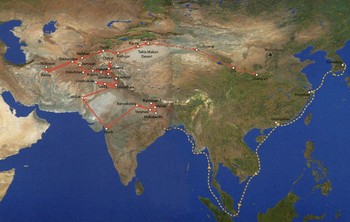
A little more than a generation after Wŏnhyo, we have the first record of Korean monks who undertook the even more arduous pilgrimage to the Buddhist homeland of India. The Unified Silla monk Hyech'o 會超 (ca. 704–80) left a travelogue of his journey, Wang o Ch'ŏnch'ukkuk chŏn 往五天竺國傳 (Memoir of a Pilgrimage to the Five Regions of India), which is one of the few pieces of Korean Buddhist travel literature that has been the object of extensive scholarly study in the West.Footnote 6 After traveling from Korea to China, Hyech'o spent about three years on the mainland before departing in 724 via the southern sea route for India (the Ch'ŏnch'ukkuk of his title) (see figure 1). After landing along India's eastern littoral, he subsequently traveled for another three years or so, visiting many of the Buddhist pilgrimage sites in north-central India, including Bodhgayā and Kuśinagara, before making his way to the south and west of the Subcontinent. Departing from India through the northwest Buddhist strongholds of Kashmir and Gandhāra, he made his way overland back to China via the Silk Roads of the Takla Makan Desert in Inner Asia. After his return, Hyech'o wrote an account of his journey, which is arranged chronologically by the regions and pilgrimage sites that he visited. He describes in rather prosaic fashion the geography and climate, and comments on the economies and agriculture, dress, customs, and religious practices of the regions he visited. Because his account was written at the Tang government's behest, his memoir at times sounds more like a reconnaissance report than a travelogue, showing an inordinate amount of curiosity in the size of local cavalries and the height of ramparts. In describing Kashmir, for example, he notes that “the king possesses three hundred elephants and resides in the mountains. The roads are dangerous and bad. It has not been invaded by any foreign country” (Yang et al. n.d., 46). Or, in his description of Bāmiyān, in present-day Afghanistan, he remarks about its powerful king, whose “cavalry is strong and numerous” (51). Although his account is closely beholden to the similar travelogues of Faxian 法顯 (ca. 399/337–422), Xuanzang 玄奘 (ca. 600–664), and Yijing 義淨 (635–713) written many decades before, Hyech'o's memoir is valuable for offering a detailed contemporary record of the geographic extent of different schools of Buddhism in the regions he visited, as well as the decrepit condition in which he found some of the important Buddhist reliquaries and monasteries. Especially notable in his travelogue is the evidence he provides of the inroads that Arabs and Turks were beginning to make into traditionally Buddhist regions and his testimony that, by the early eighth century, Buddhism had not yet been transplanted to the Tibetan plateau. Hyech'o spent the rest of his life in China, collaborating with the Indian Tantric master Amoghavajra 不空 (Ch. Bukong, 705–74) and perhaps Vajrabodhi 金剛智 (Ch. Jin'gangzhi, 671–741) in translating esoteric Buddhist materials into Chinese, before passing away at the Chinese pilgrimage site of Wutaishan 五臺山 (about which more later). We have contemporary records of seven other Korean monks (and forty-nine Chinese) who traveled to India prior to the middle of the seventh century,Footnote 7 so as grueling as the journey was, apparently many completed it successfully.
Hyech‘o’s travels through India and Inner Asia.

Although travel to India stopped with the demise of Buddhism on the Subcontinent, Korean monks continued to live in China for extended periods through the Koryŏ dynasty. During that time, Ŭich'ŏn 義天 (1055–1101), the fourth son of the Koryŏ king Munjong 文宗 (r. 1047–83), sojourned in Song dynasty China for fourteen months between 1085 and 1087. As a learned scholar-monk, Ŭich'ŏn sought to test his knowledge against the best minds in Chinese Buddhism and was especially eager to study with Jinshui Jingyuan 晉水淨源 (1011–88), the most renowned teacher of Huayan during the Northern Song dynasty. During his travels, Ŭich'ŏn visited with some fifty monks, including leading specialists in the Tiantai 天台, Vinaya, Chan, and Huayan schools. In addition to Jinshui Jingyuan, Ŭich'ŏn also studied Tiantai thought briefly with Cibian Congjian 慈辯從諫 (1035–1109), and met Zhanran Yuanzhao 湛然元照 (1048–1116), a Vinaya specialist in Hangzhou. An inveterate bibliophile, Ŭich'ŏn also collected hundreds of volumes of books during his travels, which he took back to Korea with him, and later dispatched agents all throughout China, Japan, and the Khitan Liao regions of Northeast Asia seeking out other indigenous East Asian writings, which he eventually compiled into his renowned Sokchanggyŏng 續藏經 (Supplement to the [Buddhist] Canon).Footnote 8 The flow of Korean monks into China continued unabated until the Ming dynasty proscription against foreigners traveling to the mainland, a prohibition that started in the seventeenth century.
Travel to Worlds Beyond
Buddhist travel need not, however, be limited to the confines of this physical world. Deeply engrained in Buddhist cosmology is the notion that profound meditative absorption and spiritual insight can offer advanced adepts access to realms of existence that would otherwise be beyond the ken, from the deepest depths of the hells (where East Asian Buddhism claims one of the Buddha's two chief disciples, Mahāmaudgalyāyana, traveled in order to save his mother), to the highest reaches of the heavens (where the Buddha himself traveled to teach his deceased mother Māyā), to all lands in between. Mastery of the four dhyānas (meditative absorptions) of the Realm of Subtle Materiality offers the meditator a tour in the present of the realm of the Brahmā gods, as well as the opportunity for rebirth there in one's succeeding lifetime. The four immaterial dhyānas provide a similar entrée into the increasingly rarified levels of the immaterial heavens, from the sphere of “infinite space” to “infinite consciousness,” “nothing whatsoever,” and, finally, a realm so subtle that it involves “neither perception nor nonperception.” In addition, massive scriptural anthologies offer a virtual Buddhist Pilgrim's Progress of the spiritual journeys of Buddhist adepts, as, for example, in the Avataṃsakasūtra/Buddhāvataṃsakasūtra (and especially its culminating Gaṇḍavyūha chapter), which relates the seeker Sudhana's travels throughout the world to find fifty-three teachers in his quest for enlightenment.
The undersea palace of the Dragon King protector of Buddhism had long been a recurrent object of mythic travel in many Buddhist traditions, but especially in Korea's. The “discovery” of the Mahāyāna scriptures was said to have been a result of the Indian exegete Nāgārjuna's (fl. ca. 150 ce) journey to the Dragon King's palace, where these texts had been stored away for safekeeping until such time as human beings' understanding had matured enough to appreciate them. From that point on, most Buddhists would seek to establish an explicit connection between the Dragon King's palace and themselves as a way of introducing their traditions into broader Buddhist macroculture. Korea was no exception. Paekche and Silla's nautical prowess, and the role these kingdoms played as the virtual Phoenicia of Northeast Asian maritime travel, ensured that Korea's connection to the undersea Dragon King would be especially deep. Indeed, several stories survive in the literature of the journeys that Koreans took to his palace, most during the Chinese Tang and Korean Unified Silla periods.
According to sailors' tales, the western palace of the Dragon King in the West Sea (Yellow Sea) between China and Korea was located under a small island that was five to six days' journey off the coast of Suzhou in Jiangsu Province. The coast was pounded by high waves so that no vessel could approach, but at high tide, the island was inundated so that ships could pass.Footnote 9 There are also stories, though, of an eastern palace of the Dragon King in the East Sea (Sea of Japan), so there were many opportunities to come across this ophidian monarch on sea voyages.
Most of the Korean visitors to the palace were waylaid while aboard their ships and escorted under the sea for an audience with the Dragon King.Footnote 10 The thaumaturge Myŏngnang 明朗 (date unknown), for example, traveled to China in 632 and was escorted to the Dragon King's palace during his voyage home in 635. The Dragon King offered him especially powerful esoteric spells, which later proved instrumental in Silla's survival as a state: Myŏngnang is said to have used the spells to great effect to generate a typhoon that sunk the massive Tang invasion force in 670, the same fleet that Ŭisang had warned about after his repatriation.Footnote 11 During the reign of Sŏngdŏk 聖德 (r. 702–36), Queen Suro visited the Dragon King of the East Sea, who had first appeared to her the day before as an old man (Samguk yusa 2, 974a). We see also continued connections between Korea and the Dragon King in the later story of Poyang 寶壤 (date unknown), who is said to have lived during the tenth century. Poyang was returning to Silla from China when the Dragon King of the West Sea waylaid him and invited him back to his palace. The Dragon King's son, Imok 璃目, accompanied Poyang back to Silla, where they played instrumental roles in the founding of the Koryŏ state (Samguk yusa 4, 1003b–1004a). One of the best-known stories of all, though, is that of a Silla envoy described in the biography of Wŏnhyo who is waylaid while on his way to Tang to find medicine for the Silla queen-consort and escorted under the sea for an audience with the Dragon King. Upon his arrival at the palace, the envoy is told that the queen's illness was simply a pretext to allow the Dragon King to transmit a previously unknown text, the Vajrasamādhisūtra (Kŭmgang sammae kyŏng 金剛三昧經), to Korea, where it was to be edited by the theurgist Taean 大安 (date unknown) and commented upon by the leading Korean scholiast, Wŏnhyo.Footnote 12 The topos of trips to the Dragon King's palace is pervasive as well in Buddhist-influenced vernacular literature written later in the native Korean orthography of han'gŭl. There are, for example, many stories of filial sons who traveled to the Dragon King's palace on their way to China to find medicine for their ailing mothers or returning from an audience with the Dragon King with a wish-fulfilling gem (cintāmaṇi) that could benefit the masses (In Reference In Kwŏn-hwan1972, 23). By demonstrating Korea's many and varied contacts with this palace, peninsular Buddhist civilization was seeking to define itself, at least partially, in terms of mainstream continental beliefs. Indeed, myths are often created as a way of “escaping” geographic or cultural isolation, and this seems an obvious reason for these exuberantly told tales of Korea's connection to this undersea bastion of Buddhist culture (cf. Bascom Reference Bascom and Dundes1965, 290; Jansen Reference Jansen and Dundes1965, 46).
Travel to the Buddhist meccas of India and China, as well as to the mythic undersea bastion of the faith, played a crucial role in connecting Korea to the broader Buddhist cultural sphere. By sojourning in such regions, Koreans were demonstrating their associations with the wider world of Buddhist culture, whether that world be terrestrial, subterranean, or celestial. The Korean pilgrims who left the peninsula for China or India were part of the cultural elite of Korea, and pilgrimage would have served as a sort of cultural insignia, indicating that Korea, too, was now an integral part of pan-Asian Buddhist macroculture. The ability to engage in pilgrimage would have required, first, extensive networks of patronage in order to fund such a journey, and second, a sophisticated knowledge of, and cultural familiarity with, Buddhist cosmology and myth in the case of travel to cosmological realms. Hence, the capability of mounting such journeys would also help validate the achievements and understanding of indigenous Korean Buddhist culture. In a very real sense, because pilgrimage was something that Buddhists in established Buddhist cultures such as India and China did, engaging in pilgrimage would therefore help make Korea an established Buddhist culture. In making these efforts to connect their tradition to the wider Asian tradition of Buddhism, Korean Buddhists were also exhibiting a sense of homogeneous time and space that allowed them to be active participants in a religious tradition whose origins were distant both geographically and temporally from their own. Travel to Buddhist imaginaries, then, also helped break down the spatial and temporal barriers separating Korea from mainstream Buddhism in much the same way as overseas travel.
Bringing the Universal Home: Remapping the Korean Landscape
Simultaneous with their continued travel overseas to major Buddhist sites, Koreans were also bringing those sites home through a wholesale remapping of the domestic landscape. Often, the very same pilgrims who had made the arduous journey overseas were most influential in domesticating the dharma and harnessing the numinous power of its cosmology for their compatriots.
Prior to the introduction of Buddhism to the Korean peninsula, mountains especially, but also certain bodies of water (typically the abodes of autochthonous dragon and snake deities), were considered sacred. In this tendency, Korea was typical of many preliterate societies, which presumed that the natural landscape itself was numinous. With the development of centralized political institutions and the advent of organized religion—which for Korea first meant Buddhism—that telluric landscape had to be decoupled from earlier cults so that the landscape could be remapped with the sacred geography of the newly imported religion. This remapping process imposed new significance on the indigenous landscape, endowing it with the sacred power of Buddhism. As Buddhism was projected onto the local landscape, this “localizing” of the universal sacred geography of Buddhism was simultaneously accompanied by a “delocalization” of the indigenous landscape.Footnote 13 Indeed, the transmission of Buddhist beliefs, practices, and texts to new cultural regions inevitably led to the transplantation of Buddhist cosmology and its imposition to the local geography. Thus, the transition in religious Weltanschauung to the universal religion of Buddhism was accompanied in all Buddhist cultures by comparable shifts in geographic nomenclature (Huber Reference Huber1999, 29–31). At the same time, however, by relocalizing on the peninsula this universalist cosmology of Buddhism, Koreans were also able to establish a separate identity for their own iteration of that tradition, rendering Korea in a real sense independent of the universal.
It is important to note, though, that this relocalizing process was not necessarily static. In Korea, mountains and other sacred sites were successively remapped as those sites were dominated by different religions, or even different schools within the same religion. But because these remappings were not necessarily totalizing, these sites could also become loci of religious contestation, as vestiges of the different overlays survived the latest relocalizing process. For example, in his treatment of religious practice at Kyeryongsan 雞龍山, Je-Hun Ryu (Reference Ryu, Tangherlini and Yea2008) has discussed how the monastery of Tonghaksa 東鶴寺 was converted into a Confucian academy for several centuries during the Chosŏn dynasty before being converted back to a Buddhist monastery; but, even after this last remapping, some of the Confucian overlays were retained—for example, the front gate was called a hongsalmun 紅살門 rather than the typically Buddhist ilchumun 一柱門. Ryu also demonstrates how a marginalized tradition (such as Shamanism) could piggyback on the geographic power and cultural prestige of a dominant tradition (such as Buddhism) as a means of resisting state power and social stigma; indeed, Shamanic shrines located near, or in some cases actually inside, Buddhist monasteries were able to survive, while others located near more traditional sites, such as mountain peaks and ponds, effectively disappeared.Footnote 14 Laurel Kendall similarly documents the ways in which certain Shamanic shrines in the Seoul region benefited from their proximity to Buddhist temples and shrines (Reference Kendall, Tangherlini and Yea2008, 101–20).
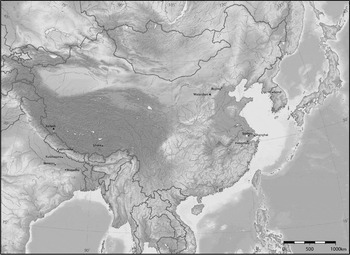
At least by the ninth century, Korea had been thoroughly remapped in terms of Buddhism, with a replication on the peninsula of both the imaginary geography of Buddhist cosmology as well as Indian and Chinese historical landscapes. Because of this Buddhicization of the Korean landscape, relatively few traces of the indigenous pre-Buddhist names remain. The Buddhist sites now ranged from Yŏngch'uksan 靈鷲山 (Mount Gṛdrakūṭa, or Vulture Peak, the site in India where many Mahāyāna sūtras were said to have been preached), to Kŭmgangsan 金剛山 (the Diamond Mountains, from the Avataṃsakasūtra), to Odaesan 五臺山 (the Korean analogue of the Chinese Wutaishan, the abode of the bodhisattva Mañjuśrī) (see figure 2).
Wutaishan and Indian Buddhist sacred sites.

As local geography became universalized, there was less need for the long, dangerous journeys overseas to Buddhist sacred sites. Instead, because these sites were now domesticated, the universal geography of Buddhism was implicit within the indigenous landscape, turning Korea into the Buddha-land itself. This remapping even extended back in time to previous buddhas, whose dispensations were located on Silla territory and commemorated through the establishment of new monasteries. Buddhists discovered near the Silla capital of Kyŏngju the “meditation stone” (yŏnjwasŏk 宴坐石) of Kāśyapa—a buddha of antiquity who gave the current buddha Śākyamuni the prediction of his future buddhahood—and established the major doctrinal center of Hwangnyongsa 皇/黃龍寺 on the site; similar associations can be seen at such important Silla monasteries as Hŭngnyunsa 興輪寺, Punhwangsa 芬皇寺, and so on (McBride Reference McBride2008, chap. 1; Rhi Reference Rhi, Forte and Forte1988, 163–79). Once the decoupling of the local geography from indigenous cults and their preliterate interpretations had occurred, the “relocalization” of Buddhism on that environment enabled Korean Buddhists to travel through the sacred geography of Buddhism from the (relative) comfort of their own locale. The Buddhicization of the landscape thus allowed domestic travel to stand in for pilgrimage to either foreign lands or otherworldly realms. This process was certainly speeded by geopolitical changes in Asia, such as the demise of Buddhism and its pilgrimage networks in India and the Ming dynasty's prohibition against foreigners traveling to the Chinese mainland. Eventually, then, rather than writing only about dangerous journeys to the distant lands of India or China, Koreans were freed to write travel documents concerning trips within their own Korean sacred Buddhist geography.
Mountains as Popular Pilgrimage Sites
A major locus of pilgrimage activity in Korea, as elsewhere across Asia, was the mountains. Mountains were often viewed as the abodes of important sacred beings, such as bodhisattvas, but also as the sites where those beings' most spiritually efficacious activities occurred. As in many preliterate societies, mountains were traditionally viewed as sacred in Korea because they were the home of powerful beings, whom Korean texts claimed could fly freely between them (Samguk yusa 2, 979b6–8). But beyond being simply the abode of divine beings and bodhisattvas, mountains could also function as numinous embodiments of those divinities (Huber Reference Huber1999, 22). The Tibetan pilgrimage cult surrounding Mount Kailash is probably best known in the West, but China and Korea both have sacred mountains that traditionally were conceived of as being similarly powerful. Mountains often served as the climax of travel within the East Asian Confucian tradition, where their height helped the traveler gain a “broad vision” (Ch. daguan, Kor. taegwan 大觀) of the world that would make the petty political interests of their states, or even their empire, pale by comparison (Strassberg Reference Strassberg1994, 20–21). Standing as close to heaven as one could come on earth and located in some of the most isolated of terrestrial regions, mountains were ideal locations for the “liminoid phenomenon” that is pilgrimage (Turner and Turner Reference Turner and Edith Turner1978).
The translation of Indian Buddhist sacred literature into Chinese provided the initial impetus for localizing the Indian Subcontinent's sacred geography in East Asia. With the accompanying Buddhicization of the East Asian landscape, most of the major mountain sites where pilgrimage was performed were given Buddhist names and often came to be associated with the various bodhisattvas of Mahāyāna Buddhism. One of the most interesting tales of the relocalization of a Buddhist cult to Korea involves Chajang 慈藏 (ca. mid-seventh century), an important early figure in the Korean Vinaya and Huayan traditions who “lamented that he had been born on the periphery and hoped to go to the West to witness the Great Propagation [of Buddhism in China]” (Samguk yusa 4, 1005a28). According to the account in the Samguk yusa, during a five- to seven-year sojourn in China between 636/638 and 643, Chajang's first stop was at the major Chinese pilgrimage site of Wutaishan (Five-Terrace Mountain). There, after seven days of supplication before an image of Mañjuśrī that was supposedly cast in heaven at the behest of the king of the gods Indra himself, Chajang had a vision in a dream of the great Bodhisattva of Wisdom. Among various instructions the bodhisattva gave Chajang, Mañjuśrī ordered the monk to go to a mountain in the northeastern part of the Korean peninsula, where he would find a Five-Terrace Mountain with 10,000 Mañjuśrīs in residence. Iryŏn's account of Chajang's vision says,
When he first reached the Middle Kingdom, he went to Mañjuśrī's abode, which was a rock [carving of his image] beside Taihe 太和 pond, where he supplicated for seven days. Out of the blue he dreamed that the Great Saint bestowed on him a four-line gāthā [verse], which he remembered once he awoke. However, because it was all in the Sanskrit language, he was utterly unable to interpret any of it. The next day a monk carrying a brocade robe spangled with gold, the Buddha's begging bowl, and the Buddha's skull-bone [relic] approached near to the Master, and asked, “What is troubling you?” The Master replied, “A gāthā I received in a dream is in Sanskrit pronunciation, so I can't parse the words.” The monk translated it: “‘Karap'ajwarang’ means ‘Comprehend all dharmas.” ‘Tasadagŏya’ means ‘In their own natures are unascertainable.’ ‘Ranggasagarang’ means ‘In this wise comprehend the dharma-nature.’ ‘TalsaNosana’ means ‘And you will instantly see [Vai]rocana.’” He then entrusted to him the robe, etc., that he had brought, saying, “These are the religious requisites of the Founding Master, Lord Śākya[muni]. You should guard and keep them well.” He also said, “In the northeast of your native country, in the vicinity of Myŏngju, is Odaesan. Ten-thousand Mañjuśrīs are constantly in residence there. You should return and visit them.” He finished speaking and disappeared. [After Chajang] had searched everywhere for any sign of his numinous traces, he was about to return to [his home in] the East, when the dragon of Taihe Pond appeared and entreated him to make offerings for seven days. He then told him, “The old monk who transmitted that gāthā to you before was Mañjuśrī himself.” (Samguk yusa 3, 998c; cf. Kim Reference Kim and Sorensen1995, 23–55)
The Chinese Wutaishan became a major pilgrimage center of East Asian Buddhism starting in least the Northern Wei dynasty (424–532), and it eventually became so renowned that it drew monks from across the continent, including South Asia and Tibet. Wutaishan soon came to be recognized as the abode of Mañjuśrī, the Bodhisattva of Wisdom, an identification that prompted Chajang's journey to the mountain. The first translation of the Avataṃsakasūtra (Ch. Huayanjing, Kor. Hwaŏmgyŏng), made in the fifth century, mentioned a Qingliangshan 清涼山 (Pure Clarity Mountain) as the residence of Mañjuśrī; this mountain was supposedly located to the east or northeast of India. Even though the Avataṃsakasūtra does not explicitly state that this Qingliangshan comprised five separate peaks, later texts from the seventh and eighth centuries identified this mythical mountain with Wutaishan (Five-Terrace Mountain) and located it at the site of a mountain in northern Shaansi Province that was then known as Zifushan 紫府山 (Purple Palace Mountain). That name has Daoist overtones, but the mountain seems to have served no major role in Chinese religion before Buddhism relocalized it as Wutaishan. From this point on, Wutaishan cum Qingliangshan continued to be an important center of the Mañjuśrī cult for all of the major traditions of Asian Buddhism.Footnote 15
Upon his return to the Korean peninsula, Chajang traveled to the mountain that Mañjuśrī had identified as Odaesan (Five-Terrace Mountain), where he fashioned a small hut and awaited a vision of the myriad Mañjuśrīs. But after seven days without seeing Mañjuśrī (the Samguk yusa says earlier on that three straight days of fog and haze had obscured any chance of seeing the bodhisattva), Chajang became discouraged and left for Myobŏmsan 妙梵山 (present-day T'aebaeksan 太佰山). One day an old man dropped by to visit, but, annoyed, Chajang sent him on his way. Realizing too late that the old man had actually been a manifestation of Mañjuśrī, Chajang ran after him, but to no avail (Samguk yusa 3, 1000a; 4, 1005c). His belief was restored through the apparition, however, and Chajang's faith inspired subsequent aspirants to travel to Odaesan, where their visionary experiences revealed the presence of massive populations of Buddhist sacred beings on its five separate peaks. These included 10,000 Avalokiteśvaras on the Eastern Terrace; 10,000 Kṣitigarbhas on the Southern Terrace, led by the Eight Great Bodhisattvas; 10,000 Mahāsthāmaprāptas on the Western Terrace, led by the Buddha Amitābha; 500 arhats on the Northern Terrace, led by Śākyamuni Buddha; and 10,000 Mañjuśrīs on the Central Terrace, led by the Dharmakāya Buddha, Vairocana. This Korean remapping of Odaesan served to relocate the universal pantheon of the Avataṃsakasūtra to the specific local site and helped build up Odaesan as a major pilgrimage center dedicated to the cult of Mañjuśrī.Footnote 16
The Korean Buddhist pilgrimage site par excellence has long been the Diamond Mountains (Kŭmgangsan 金岡山), which until its recent closure was drawing thousands of well-heeled tourists (and probably at least a few pilgrims) to the Hyundai-run tourist center in North Korea. The earliest designation for a Kŭmgangsan in Korea was for a sacred mountain located in the originally Silla territory of Yŏngch'ŏn 永川, north of the Kyŏngju 慶州 plain where the Silla capital was sited. This Kŭmgangsan was originally known by its indigenous transcribed name of Hyŏllye 穴禮 and is listed as one of the Three Mountains (samsan 三山) and Five Peaks (o'ak 五岳) that were the objects of cultic worship throughout the Silla period, all of which figure prominently in both the Samguk sagi and Samguk yusa. The Samguk sagi states that the Three Mountains were worshipped during the Great Festival (Taesa 大祀), while the Five Peaks were the ritual object of the Middle Festival (Chungsa 中祀). The Samguk yusa lists Kŭmgangsan as one of the Four Numinous Sites (sayŏngji) of Silla, in this case the northern sacred spot (Rhi Reference Rhi, Forte and Forte1988, 163–65). The Kŭmgangsan site in Kangwŏndo in present-day North Korea became sacralized in connection with the establishment of the Hwaŏm 華嚴 school on the peninsula, where the mountain was said to be the abode of Pŏpki posal 法起菩薩 (Dharmodgata Bodhisattva). The later eighty-roll translation of the Avataṃsakasūtra (often called the Xin, or “New,” Huayanjing 新華嚴經), made between 695 and 699 by Śikṣānanda's translation team (which included the Korean scholiast Wŏnch'ŭk),Footnote 17 includes an early reference in Buddhist literature to a Kŭmgangsan (supposedly located in the middle of the sea) and notes that Dharmodgata Bodhisattva is in residence there (Huayan jing 45, T 279:10.241b). By at least the end of the seventh century, East Asians were already making explicit connections between the Diamond Mountains mentioned in the Avataṃsakasūtra and the Kŭmgangsan of Korea. Minji's 閔漬 (1248–1326) Kŭmgangsan Yujŏmsa sajŏkki 金剛山楡岾寺事蹟記 (Minji 1297/Reference Minji1915, 42) tells us that Ŭisang himself first visited Odaesan before moving on to these Diamond Mountains; there, Dharmodgata Bodhisattva appeared and told him that vast numbers of people could become enlightened at Kŭmgangsan even without practicing, whereas only a few serious religious cultivators would be able to achieve liberation on Odaesan. For all of these reasons, Pŏpki posal is considered to be the patron bodhisattva of Kŭmgangsan. A Hwaŏm monastery was established on Kŭmgangsan at least by the time of P'yohun 表訓 (ca. early eighth century), a disciple of Ŭisang, forever cementing its connections to the sacred geography of the Avataṃsakasūtra. The Diamond Mountains continued to draw monks to its sacred peaks and isolated monasteries at least through the mid-twentieth century, when the Cold War division of the peninsula and its location near the demilitarized zone effectively cut the mountain off from Buddhist pilgrimage networks in Korea.
Modern Buddhist Travelogues
The modern period has continued to see accounts written of Buddhist journeys to the Diamond Mountains and other sacred sites. What little scholarly attention has been paid to Korean Buddhist travel literature has mostly dealt with those few extant examples of Koreans who traveled overseas, either to mainland China or the Indian homeland of Buddhism, or to missionaries who sojourned in Japan while propagating the religion. Much the same phenomenon can been seen in Sinology as well, in which the travels of the Buddhist pilgrims Faxian, Xuanzang, and Yijing to India, as well as others' journeys to the periphery of the empire, have been the object of scores of scholarly monographs and popular treatments, while the far-larger corpus of Chinese domestic travel accounts (youji 遊記) and travel diaries (riji 日記) has been relatively ignored.Footnote 18 This dearth of coverage makes it especially exciting to look at examples of accounts of Korean Buddhist travel to domestic sites, which are written more in the style of traditional Chinese travel narratives (see figure 3). One document that I have translated is a memoir written by Hyangbong 香峰 Sŭnim, an eminent Korean monk of the modern and contemporary period, describing the religious pilgrimages he took during his career, in which the Diamond Mountains and other mountain pilgrimage sites figure prominently. His 1976 memoir, written in vernacular Korean, was published as the introduction to his literary collection Unsu san'go 雲水散稿 (Scattered Jottings of a Wandering Monk).Footnote 19 A renowned poet, calligrapher, and painter, Hyangbong was a monk in the Chogye Order 曹溪宗 who practiced for many decades in the meditation halls of Sŏn 禪 monasteries throughout the Korean peninsula. His memoir is a fascinating look at the itinerant life common to Korean Buddhist monks, an itinerancy in which Buddhist sacred mountains play a ubiquitous role. His collection also includes a series of verses that he wrote at the scenic spots he visited during his 1930 pilgrimage through the Diamond Mountains and vicinity, which illustrates well why Korean Buddhists monks have been attracted to the rugged scenery and splendid isolation of the mountains. This attraction is particularly noticeable in Hyangbong's case, because many of his verses are also accompanied by original watercolor paintings that he made during his peregrinations, many of which are reproduced in his literary collection. Hyangbong's verses, all composed in literary Chinese in traditional belletristic style, convey a sense of the spiritual importance that the Diamond Mountains held for Buddhist monks in traditional Korea.
Korean Buddhist sacred sites.

These domestic travel records have certain affinities with the lyric travel accounts (Ch. youji, Kor. yugi 遊記) and travel diaries (Ch. riji, Kor. ilgi 日記) of traditional Chinese literature (Strassberg Reference Strassberg1994, 4). Rather than the prosaic style of a Hyech'o, clinically describing the climate, geography, and customs of the places he visited, domestic travelogues are written more in the style of traditional Chinese belletristic travel diaries, which offer first-person descriptions of the sites visited. These diaries also typically provide accounts of the traveler's aesthetic response to the site, drawing on the full panoply of classical Chinese and Buddhist literary allusions, which are sometimes written in verse or mixed prose and verse; indeed, Hyangbong's travelogue appends separate verses of his personal aesthetic response to what he is seeing and even one-ups the traditional Chinese authors by including his own watercolor paintings of the sites he visited. Finally, these records not atypically also provide some sense of the traveler's self-cultivation during his journey, a feature that is always prominent, if not predominant, in Buddhist travelogues. Although Buddhist travelogues are more interested in offering an account of practice and religious development than are most of the secular travel writers, there is considerable symbiosis between the two genres.
The Institutionalization of Travel in the Modern Monastic Schedule
Travel has been institutionalized in Korean Buddhist monasticism since at least the seventeenth century and probably long before. The annual schedule followed by monasteries belonging to the Chogye Order, which constitute the overwhelming majority of Korean temples, is still today divided between alternating three-month periods of “binding rule” (kyŏlche 結制) during the summer and winter retreats and “slackened rule” (haeje 解制) during the fall and spring free seasons. During the retreat periods of “binding rule,” monks are required to remain in residence at the monastery where they have given their formal introduction or “room request” (pangbu 房付), which constitutes their official acceptance into the monastic community. Residence requires that they commit as well to a specific monastic position for the duration of the retreat period. During the free seasons of relaxed rule in the spring and fall, however, monks are permitted to travel at will among the monasteries, and travel they do, sometimes with gleeful abandon. Monks call their travels haenggak 行腳 (“itinerancy,” lit. “walking on foot”) or manhaeng 萬行 (lit. “traveling everywhere”), both terms emphasizing the journey of spiritual discovery, not the destination of “pilgrimage” (sullye 巡禮).Footnote 20 Indeed, “traveling everywhere” is exactly how many monks will spend much of their three months' break from rigidly structured practice and meditation. At the major training monasteries, on the first day of the free season, the number of monks in formal residence drops precipitously, as monks depart in droves on the first bus out of the local village to follow their itinerant impulses. All major monasteries have a separate guest quarters (kaeksil 客室) near the kitchen area, where these itinerant monks are allowed to stay for up to three days, before either moving on to their next destination or giving their lodging request and joining that monastic community.Footnote 21 Thus, as has been the case throughout history, travel remains an integral part of what it means to be a Buddhist monk in Korea.