Introduction
Laryngeal squamous cell carcinoma (SCC) is one of the commonest malignant neoplasms of the head and neck. The incidence and mortality of laryngeal SCC vary around the world, and are notably higher in Southeast Asia and Eastern Europe.Reference Jørgensen, Godballe, Hansen and Bastholt1
Despite advances in modern interventions, such as irradiation, endoscopic surgery and open surgery, the five-year survival rate of laryngeal SCC has improved only marginally over the past decades.Reference Sewnaik, Meeuwis, van der Kwast and Kerrebijn2 The recurrence rate is still as high as 45–50 per cent. Following therapy for laryngeal SCC, local recurrence occurs in 5–25 per cent of tumour stage (T) 1 patients, and in 15–50 per cent of T2 patients (with impaired vocal fold mobility).Reference Lefebvre, Coche-Dequéant, Degardin, Kara, Mallet and Ton Van3–Reference Devlin and Langer5
The prognosis of laryngeal SCC patients is influenced by many factors, such as primary site, tumour stage, histological grade and lymph node metastasis. However, these factors are not sufficient to predict the tumour's prognosis. Therefore, recent studies have focused on identifying molecular biomarkers potentially useful for the prediction of laryngeal SCC prognosis.Reference Takes, Baatenburg De Jong, Alles, Meeuwis, Marres and Knegt6
Epidermal growth factor-like domain 7 protein is secreted by vascular endothelial cells, and was first described by Park et al. Reference Parker, Schmidt, Jin, Gray, Beis and Pham7 and Soncin et al. Reference Soncin, Mattot, Lionneton, Spruyt, Lepretre and Begue8 Genes for this protein are located on chromosome 9, the transcripts of which code for a unique, 30 kDa protein which contains a signal peptide and two epidermal growth factor-like modules.Reference Soncin, Mattot, Lionneton, Spruyt, Lepretre and Begue8
High levels of vascular expression of epidermal growth factor-like domain 7 protein are associated with tissue proliferation, for example during embryonic development,Reference Fitch, Campagnolo, Kuhnert and Stuhlmann9 wound healingReference Campagnolo, Leahy, Chitnis, Koschnick, Fitch and Fallon10 and tumour progression. In contrast, expression of the protein is down-regulated in most of the mature vessels of normal adult tissues.Reference Parker, Schmidt, Jin, Gray, Beis and Pham7 Various studies have demonstrated the expression, and clinical significance, of epidermal growth factor-like domain 7 protein in malignant gliomaReference Huang, Li, Zhou, Luo, Li and Yuan11 and hepatocellular carcinoma.Reference Wu, Yang, Li, Ou, Chen and Fan12 However, the expression and prognostic role of epidermal growth factor-like domain 7 protein in human laryngeal SCC has not been investigated.
Therefore, this study aimed to analyse the expression of epidermal growth factor-like domain 7 protein, and its relationship with clinicopathological parameters, in patients with laryngeal SCC.
Materials and methods
Patients and specimens
Tissue samples were obtained from 116 patients with laryngeal SCC who underwent surgery at the department of otolaryngology and head and neck surgery, Second Xiangya Hospital of Central South University of China, between January 2003 and August 2004. All 116 patients met the following inclusion criteria: no history of previous malignancies; primary SCC of the larynx only; and no previous radiotherapy or chemotherapy. All the patients included in our study underwent total or partial laryngectomy and neck dissection (unilateral or bilateral, and functional or radical, based on clinical and surgical findings). Lymph node metastasis was confirmed by post-operative histological examination.
The 116 cases comprised 107 men and nine women, with a median age of 55 years (age range, 32–74 years). Patients' tumour stage was categorised according to the Union International Contre Cancer 2002 tumour-node-metastasis (TNM) staging system, as T1–2 or T3–4. Tumour site was classified as supraglottic (45 cases), glottic (64 cases) or subglottic (seven cases). Tumour histological differentiation was categorised according to the World Health Organization system, as well differentiated (95 cases), moderately differentiated (13 cases) or poorly differentiated (eight cases). Lymph node metastasis was classified as present (66 cases) or absent (50 cases).
Paracarcinoma (paired) nontumour tissue samples were obtained from 33 patients.
Histopathological examination was used to confirm the tumour diagnosis and to assess the paired nontumour tissue samples.
Post-resection follow-up data were obtained for all 116 patients. The mean follow-up time (from completion of treatment to the last otolaryngological examination) was 36.9 months, with a median of 43.2 months (range, 13–60 months). During follow up, all patients underwent clinical and fibre-laryngoscopic examination every three months in the first post-operative year and every six months in the following year.
Immunohistochemical analysis
Paraffin-embedded tissues were sectioned into slices of 4 µm thickness, baked at 60°C overnight, deparaffinised in xylene, and rehydrated through graded ethanol. Tissue slices were incubated for 30 minutes with 3 per cent hydrogen peroxide, to block endogenous peroxidases, and then underwent microwave heat induced antigen retrieval in ethylene diamine triacetic acid (1 mmol/l, pH 8.0) at high power, twice, each time for 7 minutes. After rinsing with phosphate-buffered saline, the tissue slices were incubated with normal goat serum for 30 minutes at 37°C to block nonspecific binding, followed by incubation at 37°C for 30 minutes with mouse anti-human epidermal growth factor-like domain 7 protein monoclonal antibody (1:500 dilution, Abcam, Cambridge, UK), and with goat anti-mouse IgG antibody (1:200 dilution, Sigma, St. Louis, USA) for 30 minutes at 37°C. The streptavidin–biotin–peroxidase complex tertiary system (Zymed, San Francisco, California, USA) was used, according to the manufacturer's instructions, to detect the presence of epidermal growth factor-like domain 7 protein. This protein was visualised by applying 3,3′-diaminobenzidine tetrahydrochloride (Sigma, St. Louis, USA) for 2 minutes and then counterstaining with haematoxylin.
Negative control tissue specimens were similarly analysed for the presence of epidermal growth factor-like domain 7 protein, with the primary antibody replaced by phosphate-buffered saline.
All tissue slides were independently examined by two pathologists who were not informed of any patient's clinical data. Expression levels of epidermal growth factor-like domain 7 protein were assessed by observing the incidence and staining intensity (i.e. colour strength) of immunohistochemically positive cells. The incidence of positive cells was scored as follows: 0 = none or less than 10 per cent; 1 + = 11–25 per cent; 2 + = 26–50 per cent; 3 + = 51–75 per cent; and 4 + = 76–100 per cent. Staining intensity was scored as: 0 = none; 1 + = weak; 2 + = moderate; and 3 + = strong. The two components were multiplied to obtain an overall expression score, as follows: 0 = scores of 0–3; 1 + = scores of 4–6; 2 + = scores of 7–9; and 3 + = scores of 10–12. Expression scores of 0 or 1+ were defined as low protein expression, while scores of 2+ or 3+ were defined as high protein expression. In case of disagreement, slides were reviewed by a third observer until a consensus score was established.
Statistical analysis
Results represent mean ± standard deviation, or median (range). Correlations between epidermal growth factor-like domain 7 protein immunohistochemical expression scores and clinicopathological parameters were analysed using the Mann–Whitney U test.
The relationship between epidermal growth factor-like domain 7 protein expression and overall laryngeal SCC patient survival was assessed using Kaplan–Meier estimates. Differences in survival rate between subgroups were compared using the log-rank test. Cox's proportional hazard model was used to identify factors independently associated with prognosis. In this model, variables were selected in a step-wise fashion, with entry and removal limits of p < 0.05 and p > 0.10, respectively.
All statistical evaluations were performed using the Statistical Package for the Social Sciences version 10.0 software program (SPSS Inc, Chicago, Illinois, USA).
All tests were two-tailed, and a p value of less than 0.05 was considered statistically significant.
Results
Epidermal growth factor-like domain 7 protein expression in laryngeal squamous cell carcinoma
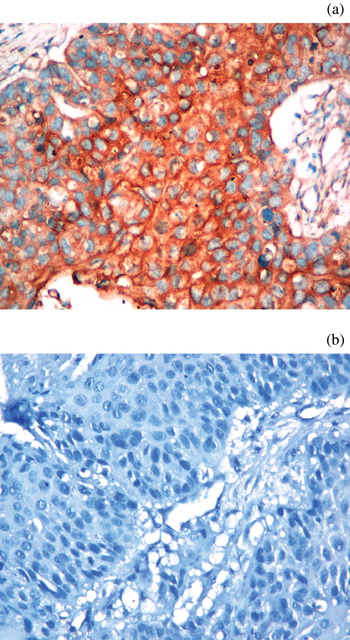
Immunohistochemical staining of epidermal growth factor-like domain 7 protein (indicating protein expression) was stronger in tumour cells, and appeared to localise in the cytoplasm as a diffuse staining with no granules (see Figure 1). Immunohistochemically positive cells were present in 81.03 per cent of the laryngeal SCC patients' samples (94 of 116).
Photomicrographs showing immunohistochemical detection of epidermal growth factor-like domain 7 protein in (a) laryngeal squamous cell carcinoma (showing cytoplasmic immunostaining), and (b) negative control tissue. ( × 400)

Correlation with clinicopathological parameters
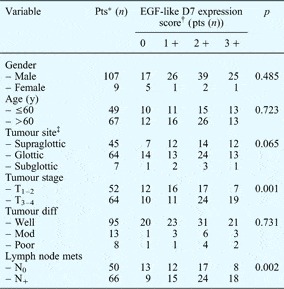
Of the 116 laryngeal SCC samples analysed immunohistochemically, expression scores were 3+ in 26 cases (22.41 per cent), 2+ in 41 cases (35.34 per cent), 1+ in 27 cases (23.28 per cent) and 0 in 22 cases (18.97 per cent). Using the Mann–Whitney U test to assess clinicopathological correlation, we found that epidermal growth factor-like domain 7 protein expression was significantly correlated with tumour stage (p = 0.001) and lymph node metastasis (p = 0.002), but not significantly correlated with gender, age, tumour primary site or tumour histological differentiation (p > 0.05 for all, Table I).
Correlation between EGF-like D7 expression and clinicopathological variables

*Total = 116 laryngeal squamous cell carcinoma patients. †0 or 1 + = low protein expression; 2+ or 3 + = high protein expression. ‡Primary tumour site. EGF-like D7 = epidermal growth factor-like domain 7 protein; pts = patients; y = years; T = tumour stage; diff = histological differentiation; mod = moderate; mets = metastasis; N = lymph node stage
Correlation with survival
Based on epidermal growth factor-like domain 7 protein immunohistochemistry results, the 116 laryngeal SCC patients were divided into 49 patients with low levels of protein expression (i.e. scores of 0 or 1+) and 67 patients with high levels of protein expression (i.e. scores of 2+ or 3+).
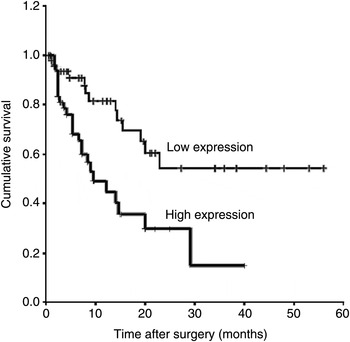
During the follow-up period, 55 patients died within five years of surgery (25 due to local recurrence, 27 due to regional lymph node metastasis and three due to distant metastasis). Of these 55 patients, 40 had epidermal growth factor-like domain 7 protein expression scores of 2+ or 3 + , while 15 had expression scores of 0 or 1+. Using Kaplan–Meier analysis, we found that that increased epidermal growth factor-like domain 7 protein expression levels correlated well with a shorter disease-free period and a lower survival rate (log-rank test, p = 0.007; Figure 2). These results indicate that increased expression of epidermal growth factor-like domain 7 protein may be an indicator of poor prognosis in patients with laryngeal SCC.
Estimated overall survival in 116 cases of laryngeal squamous cell carcinoma, according to epidermal growth factor-like domain 7 protein expression level (Kaplan–Meier method), classified as either low (i.e. immunohistochemical expression score of 0 or 1 +; n = 49) or high (i.e. expression score of 2+ or 3 +; n = 67). Patients with high expression levels had significantly poorer survival than those with low expression levels (p = 0.007; log-rank test).

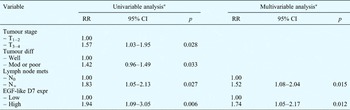
To further investigate the association between epidermal growth factor-like domain 7 protein expression and disease prognosis, univariable and multivariable Cox regression analyses were performed to identify independent prognostic factors. Results showed that disease prognosis was significantly associated with increased epidermal growth factor-like domain 7 protein expression level (relative risk = 1.94, p = 0.006), tumour histological differentiation (relative risk = 1.42, p = 0.033), tumour stage (relative risk = 1.57, p = 0.028) and lymph node metastasis (relative risk = 1.83, p = 0.027) (Table II). However, prognosis was not associated with gender, age or primary tumour site (not shown in Table II). Moreover, multivariable Cox regression analysis indicated that epidermal growth factor-like domain 7 protein expression (relative risk = 1.74, p = 0.012) and lymph node metastasis (relative risk = 1.52, p = 0.015) were both independent prognostic factors for laryngeal SCC.
Association between clinicopathological variables, EGF-like D7 expression and patient prognosis*

* Cox regression analysis. EGF-like D7 = epidermal growth factor-like domain 7 protein; RR = relative risk; CI = confidence interval; T = tumour stage; diff = histological differentiation; mod = moderate; mets = metastasis; N = lymph node stage; expr = expression
Discussion
Angiogenesis is the formation of new vasculature from pre-existing blood vessels, and is essential for the growth and metastasis of malignant tumours.Reference Geiger and Peeper13, Reference Steeg14 New vasculature enables tumour growth by supplying nutrients and oxygen, by removing metabolites, and by releasing growth factors which further promote tumour proliferation, progression and metastasis.Reference Martone, Rosso, Albera, Migliaretti, Fraire and Pignataro15 Increased angiogenesis has been proven to be associated with a poorer prognosis for patients with head and neck tumours.Reference Sauter, Nesbit, Watson, Klein-Szanto, Litwin and Herlyn16–Reference Guidi, Abu-Jawdeh, Berse, Jackman, Tognazzi and Dvorak18
An essential component of angiogenesis is vascular tube formation (tubulogenesis). The latter process involves two phases: (1) the coalescence of endothelial cells to form cords, once they have reached their destination; and (2) the reshaping of these cords into tubes.Reference Hogan and Kolodziej19, Reference Lubarsky and Krasnow20 In zebrafish embryos, the loss of epidermal growth factor-like domain 7 protein prevents vascular tubulogenesis.Reference Parker, Schmidt, Jin, Gray, Beis and Pham7, Reference Fitch, Campagnolo, Kuhnert and Stuhlmann9
Despite clear evidence of a role for epidermal growth factor-like domain 7 protein in angiogenesis, the expression and clinical significance of this protein have not previously been studied in laryngeal SCC.
In the present study, the majority of tumour tissue samples exhibited positive epidermal growth factor-like domain 7 protein staining in the cell cytoplasm, while nontumour tissue samples showed weaker staining. As stated above, epidermal growth factor-like domain 7 protein is secreted by vascular endothelial cells and is involved in tubulogenesis.Reference Parker, Schmidt, Jin, Gray, Beis and Pham7 Endothelial cells within tumour vasculature undergo much more rapid proliferation (i.e. 20 to 2000 times faster) than endothelial cells within normal tissue vasculature.Reference Carmeliet21, Reference Carmeliet22 The increased expression of epidermal growth factor-like domain 7 protein within laryngeal SCC may result in increased vascular tube formation, accelerating tumour growth, proliferation, infiltration and metastasis.
Our study findings indicate a close correlation between increased epidermal growth factor-like domain 7 protein expression and laryngeal SCC stage and lymph node metastasis. This result suggests that this protein may have a potential role in predicting the outcome of laryngeal SCC. This notion is further strengthened by our Kaplan–Meier analysis results: patients with low levels of epidermal growth factor-like domain 7 protein expression generally had a better prognosis than those with higher expression levels. To determine whether epidermal growth factor-like domain 7 protein expression levels could serve as an independent prognostic factor for laryngeal SCC, we fitted this expression level into the Cox regression model, together with other, more conventional clinicopathological parameters.Reference Oosterkamp, de Jong, Van den Ende, Manni, Dehing-Oberije and Kremer23–Reference Johansen, Grau and Overgaard25 Multivariable Cox regression indicated that epidermal growth factor-like domain 7 protein expression and lymph node metastasis were both independent factors for predicting laryngeal SCC prognosis.
• Laryngeal squamous cell carcinoma (SCC) is one of the commonest head and neck malignancies; despite recent treatment advances, the five-year survival rate has scarcely improved
• Epidermal growth factor-like domain 7 protein is important in angiogenesis, and is specifically expressed in laryngeal SCC
• This study found close correlation between expression of this protein and laryngeal SCC tumour stage and lymph node metastasis
• Expression of this protein and lymph node metastasis were both independent prognostic factors for laryngeal SCC
• This protein may be a potential prognostic marker, and anticancer treatment target, for laryngeal SCC
Although the mechanism by which epidermal growth factor-like domain 7 protein expression is increased in laryngeal SCC is still unclear, our data indicate that elevated expression of this protein correlates with poorer prognosis. Thus, this protein may serve as a prognostic marker for laryngeal SCC. Considering the important role of epidermal growth factor-like domain 7 protein in angiogenesis, and its specific expression in laryngeal SCC, we believe that it could potentially represent a future target for anticancer treatment of human laryngeal SCC.
Acknowledgements
We thank Dr Ting Zhang for collecting patient survival data. This study was financially supported by a grant from the National Basic Research Program of China, from 2006 to 2009 (grant number 30371529).