Introduction
Dementia is a debilitating illness that imposes a severe burden on patients and their caregivers, affecting the well-being of both parties (Mohamed et al., Reference Mohamed, Rosenheck, Lyketsos and Schneider2010). Caregivers often suffer from enormous stress (Donaldson et al., Reference Donaldson, Tarrier and Bruns1998) and are at substantial risk for depression (Fuh et al., Reference Fuh, Wang, Liu, Liu and Wang1999). Psychiatric symptoms among caregivers have been correlated with several factors, including an increased utilization of health services (Draper et al., Reference Draper, Poulos, Cole, Poulos and Ehrlich1992) and psychotropic medications (Baumgarten et al., Reference Baumgarten, Battista, Infante-Rivard, Hanley, Becker and Gauthier1992), as well as whether the patient is placed in a nursing home (Gilleard et al., Reference Gilleard, Belford, Gilleard, Whittick and Gledhill1984). The assessment of caregiver burden covers three domains: patient-related factors, caregiver issues, and support from the family or community. Clarifying the relationships among these domains may enable the identification of useful strategies to improve the care of patients with dementia and reduce the burden on caregivers.
In Taiwanese society, up to 95% of patients with dementia are cared for at home by their spouses or adult children, rather than being placed in a nursing home (Huang et al., Reference Huang, Shyu and Chen2008). Chinese children are socially mandated by the tradition of filial piety to care for their disabled elderly adults (Patterson et al., Reference Patterson1998). However, given the increasing industrialization of Taiwanese society, most disabled patients’ adult children must work; moreover, their spouses are often too old to take responsibility for their care. In 2010, Taiwanese families hired more than 174,000 foreign paid caregivers (FPCs) for patients with dementia. Most of these FPCs were from southeastern Asia, including Indonesia, the Philippines, Vietnam, and Thailand. Their presence constitutes a change in the network of informal caregiving and represents an important resource for providing full-time assistance to the families of patients with dementia in Taiwan. A previous study (Rosa et al., Reference Rosa, Ambrogio, Binetti and Zanetti2004) revealed that the presence of FPCs could reduce family caregivers’ objective and subjective burdens. However, FPCs also feel a great burden and are prone to burnout, and thus deserve special attention and training (Rosa et al., Reference Rosa2008).
Patients’ neuropsychiatric symptoms and cognitive function are both important factors associated with caregiver burden (Machnicki et al., Reference Machnicki, Allegri, Dillon, Serrano and Taragano2009; Mohamed et al., Reference Mohamed, Rosenheck, Lyketsos and Schneider2010). However, the influences of these two factors on the burdens of FPCs have not been examined. Educational programs designed for caregivers may improve their knowledge of dementia (Coen et al., Reference Coen, O'Boyle, Coakley and Laulor1999) and reduce caregiver burden (Gitlin et al., Reference Gitlin, Winter, Corcoran, Dennis, Schinfeld and Hauck2003; Teri et al., Reference Teri, McCurry, Logsdon and Gibbons2005; Gallagher-Thompson and Coon, Reference Gallagher-Thompson and Coon2007; Martin-Carrasco et al., Reference Martin-Carrasco2009), but the relationship between these two aspects remains unknown. A recent study (Goncalves-Pereira et al., Reference Goncalves-Pereira, Carmo, Alves da Silva, Papolia, Mateos and Zarit2010) reported knowledge of dementia might not protect against caregiver burden per se. We thus examined the relationship between knowledge of dementia and caregiver burden.
Although two previous studies examined the burdens of family caregivers with or without FPC assistance (Rosa et al., Reference Rosa, Ambrogio, Binetti and Zanetti2004) and those of FPCs (Rosa et al., Reference Rosa2008), respectively, our study is the first to jointly examine caregiver burdens among three groups: FPCs and family caregivers with and without FPC assistance. Our study aimed to: (1) understand the differences in caregiver burden between FPCs and family caregivers in Taiwan; (2) identify the differences in caregiver burden between native family caregivers who did or did not have FPC assistance; and (3) investigate the predictors of caregiver burden in the three caregiver groups (FPCs, family caregivers with FPC assistance, and family caregivers without FPC assistance).
Methods
Participants
We recruited outpatients at the Memory Clinic of Taipei Veterans General Hospital who had been diagnosed with dementia, their family caregivers who did or did not have FPC assistance, and their FPCs. The patients’ diagnoses of dementia were based on the criteria of the Diagnostic and Statistical Manual of Mental Disorders, 4th edition, text revision (American Psychiatric Association, 1994), and diagnoses of Alzheimer's dementia (AD) was based on the criteria of the National Institute of Neurological and Communicative Disorders and Stroke and the Alzheimer's Disease and Related Disorders Association (McKhann et al., Reference McKhann, Drachman, Folstein, Katzman, Price and Stadlan1984). Some patients (n = 225, 46%) enrolled in our study had just received initial diagnoses and others (n = 264, 54%) had been attending the clinic for some time. The patients’ neuropsychiatry symptoms and severity of dementia were evaluated and we used questionnaires to investigate caregivers’ burdens, knowledge of dementia, and mood status. The study protocol was reviewed and approved by the institutional review board of Taipei Veterans General Hospital. Written informed consent was obtained from the patients or their legally authorized representatives, and from family caregivers and FPCs who participated in the evaluation.
Measurements
To evaluate patients’ neuropsychiatric symptoms, caregivers were asked to complete the Neuropsychiatric Inventory (NPI). The Clinical Dementia Rating (CDR) Scale, supplemented by interviews with patients and their family caregivers, was used to assess the severity of dementia. Family caregivers and FPCs completed three questionnaires: the Zarit Burden Interview (ZBI), the Center for Epidemiological Studies–Depression Scale (CES-D), and an item assessing caregivers’ knowledge of dementia (KD).
All questionnaires were translated from English into Chinese and Bahasa Indonesian, as the majority of FPCs in Taiwan are Indonesian citizens and we wished to accommodate their nationality and native language. The standard technique for cross-cultural research was followed, namely translation, back translation, and evaluation by an expert bilingual panel. Filipino caregivers received the original English versions of questionnaires.
Neuropsychiatric Inventory
Patients’ behavioral symptoms were assessed with the NPI, a measure of the frequency and severity of 12 psychiatric symptoms (delusions, hallucinations, agitation, depression, anxiety, euphoria, apathy, disinhibition, irritability, abnormal motor output, appetite, and sleep), during the previous month (Cummings et al., Reference Cummings, Mega, Gray, Rosenberg-Thompson, Carusi and Gornbein1994; Fuh et al., Reference Fuh, Liu, Mega, Wang and Cummings2001). The NPI was administered during structured interviews in which family caregivers were asked screening questions for each behavior and rated the frequency (on a scale of 1–4) and severity (1–3) of each symptom for which they gave a positive response. The NPI symptom score is calculated by multiplying the scores for severity and frequency, yielding a score between 1 and 12 (inclusive) if a symptom is present, and a score of 0 if a symptom is absent.
Clinical Dementia Rating Scale
The CDR Scale is designed to rate dementia severity on a five-point scale, based on the patient's performance in six areas of cognition and daily living (Morris, Reference Morris1993). The CDR was administered during structured interview with patients and their caregivers and the physician rated patient's performance in each area to generate total CDR scores. Total CDR scores range from 0 to 3, as follows: 0 = normal, 0.5 = very mild dementia, 1 = mild dementia, 2 = moderate dementia, and 3 = severe dementia.
Zarit Burden Interview
The ZBI is a self-administered, 22-item instrument that measures caregivers’ perceived burden from providing care. The questionnaire covers areas commonly reported by caregivers as being problematic, such as physical health, psychological well-being, finances, and their relationship with the patient. Responses to each item are structured on a five-point Likert-type scale ranging from 0 (never) to 4 (nearly always), with a total possible score of 0 to 88. Higher scores indicate increased caregiver burden (Zarit et al., Reference Zarit, Reever and Bach-Peterson1980; Ko et al., Reference Ko, Yip, Liu and Huang2008).
Center for Epidemiological Studies–Depression Scale
Caregivers’ depressive symptoms were evaluated using the self-administered CES-D (Radloff, Reference Radloff1977), which was designed to measure depressive symptoms in non-psychiatric participants. Responses to each of the 20 items are structured on a four-point scale according to the frequency of the symptom in the preceding week. Total scores above 16 indicate a high risk for clinical depression. We chose the CES-D because of its relatively high internal consistency (Cronbach's α = 0.87) and predictive validity for diagnosing depression in family caregivers (Bergman-Evans, Reference Bergman-Evans1994).
Caregivers’ Knowledge of Dementia
To assess caregivers’ knowledge of dementia, we used a KD questionnaire adapted from that of Arai et al. (Reference Arai, Arai and Zarit2008). Caregivers were asked to complete this questionnaire independently following the interview. It consisted of 11 items covering three dimensions: general information (four items), symptoms (three items), and biomedical issues including treatment and prognosis (four items). The items used a true/false format, with each correct answer adding to the total score. A higher total score indicates a greater factual knowledge of dementia.
Statistical analyses
Statistical analyses were performed using the SPSS software (version 18.0; IBM Inc., Armonk, NY, USA). Descriptive statistics were expressed as means ± standard deviations for continuous data: if a continuous variable was not normally distributed, the median value was used instead of the mean. Spearman's r coefficients were calculated for simple correlation analysis. We adopted guidelines (Cohen, Reference Cohen1988) for interpreting the strength of a correlation as weak (Spearman's r = 0.10–0.29), moderate (Spearman's r = 0.30–0.49), or strong (Spearman's r = 0.50–1.0). The Wilcoxon signed rank test was used to compare the scores of family caregivers and FPCs. The Mann-Whitney U test was used to assess differences between family caregivers who did and did not have FPC assistance. We used standard multiple linear regression analysis to investigate predictors contributing to caregiver burden. Based on the results of bivariate correlation analysis, we chose four independent variables for inclusion in the linear regression model: NPI, CES-D, and CDR scores, and the duration of care. The statistical significance level was set at p < 0.05.
Results
During the study period, we enrolled 504 patients with dementia. In 447 (88.7%) of these cases, the patient was cared for entirely by family members. In this subgroup, 258 (57.7%) individuals had a diagnosis of probable or possible AD, 85 (18.9%) patients had vascular dementia, and 104 (23.3%) patients had other forms of dementia. The remaining 57 enrolled patients were cared for by family members and FPCs. In this subgroup, only 42 (73.7%) FPCs completed all assessments because of language barriers. Indonesia is a multilingual nation and not all citizens speak Bahasa Indonesian. Thus, the final subgroup consisted of 42 patients: 28 (66.7%) individuals had a diagnosis of probable or possible AD, 11 (26.2%) patients had vascular dementia, and three (7.1%) patients had other forms of dementia.
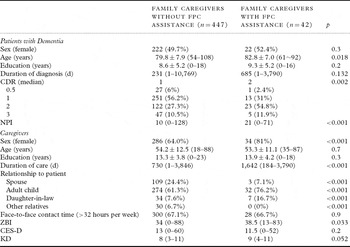
The demographic data and assessments of patients with dementia are shown in Table 1. Patients who were cared for by family members and FPCs were significantly older than those with only family caregivers (82.8 ± 7.0 vs. 79.8 ± 7.9 years; p = 0.018). CDR and NPI scores were significantly higher among patients whose families employed FPCs than among those without FPCs (median CDR score: 2 vs. 1, p = 0.002; median NPI score: 21 vs. 10, p < 0.001).
Demographic characteristics and evaluations of patients with dementia and their caregivers

FPC = foreign paid caregivers; CDR = Clinical Dementia Rating Scale; NPI = Neuropsychiatric Inventory; ZBI = Zarit Burden Interview; CES-D = Center for Epidemiological Studies–Depression Scale; KD = Knowledge of Dementia Questionnaire. Data are presented as n (%), mean ± standard deviation (range), or median (range).
Caregivers’ demographic characteristics and caregiving situations
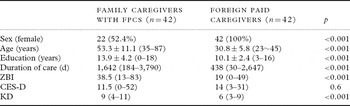
The caregivers’ demographic characteristics and information about the caregiving situations of family caregivers with or without FPC assistance are presented in Table 1. All FPCs were women, with a mean age of 30.8 ± 5.8 (range, 23–45) years. The mean educational level of FPCs was 10.1 ± 2.4 (range, 3–16) years and they took care of the patients 24 hours a day, except on Sundays. Among the 42 FPCs who completed the assessment, five (11.9%) were Filipino and were given the English versions of the questionnaires; the remainder were Indonesian and were given the Bahasa Indonesian versions.
Caregiver burden was greater and duration of care was longer than those among family caregivers with FPC assistance than among those without such assistance (median ZBI score: 38.5 vs. 34, p = 0.033; median duration of care: 1,642 vs. 730 days, p < 0.001). Family caregivers with FPC assistance also tended to have greater knowledge about dementia than those without such assistance, although the difference was not significant (median KD score: 9 vs. 8; p = 0.052).
Table 2 presents the demographic variables and assessments of family caregivers and FPCs taking care of the same patient. Family caregivers with FPC assistance had longer durations of care and significantly higher scores for caregiver burden and knowledge of dementia than did their respective FPCs (median duration of care: 1,642 vs. 438 days, p < 0.001; median ZBI score: 38.5 vs. 19, p < 0.001; median knowledge score: 9 vs. 6, p < 0.001).
Demographic characteristics and evaluations of family caregivers and foreign paid caregivers taking care of the same patients with dementia

FPC = foreign paid caregivers; ZBI = Zarit Burden Interview; CES-D = Center for Epidemiological Studies–Depression Scale; KD = knowledge of dementia questionnaire. Data are presented as n (%), mean ± standard deviation (range), or median (range).
Correlations between caregiver burden and other assessment indices
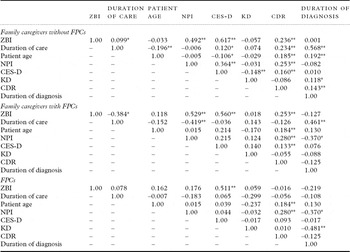
Correlations between caregivers’ burdens, depressive states, and knowledge of dementia and patients’ behavioral symptoms are presented in Table 3. For family caregivers without FPC assistance, ZBI scores showed a strong positive correlation with CES-D scores (Spearman's r = 0.617; p < 0.01), a moderate positive correlation with NPI scores (Spearman's r = 0.492; p < 0.01), and a weak positive correlation with the duration of care (Spearman's r = 0.099; p < 0.05). Similar results were found for the ZBI scores of family caregivers who had FPC assistance, except for a moderate negative correlation with the duration of care (Spearman's r = –0.384; p < 0.05). By contrast, only one strong positive correlation emerged in the FPC group: that between ZBI and CES-D scores (Spearman's r = 0.511; p < 0.01).
Associations of patients’ clinical profiles with assessments of family caregivers with and without foreign paid caregiver assistance and foreign paid caregivers

*p < 0.05; **p < 0.01.
ZBI = Zarit Burden Interview; NPI = Neuropsychiatric Inventory; CES-D = Center for Epidemiological Studies–Depression Scale; KD = knowledge of dementia questionnaire; CDR = Clinical Dementia Rating Scale; FPC = foreign paid caregiver.
We also investigated the correlations between CES-D scores and other measures. For family caregivers without FPC assistance, CES-D scores showed a moderate positive correlation with NPI scores (Spearman's r = 0.364; p < 0.01) and weak negative correlations with KD scores (Spearman's r = –0.148; p < 0.01) and patients’ ages (Spearman's r = –0.106; p < 0.05). No similar findings were noted for family caregivers with FPC assistance. Age and sex of caregivers were not correlated with any assessment measure.
Linear regression analysis
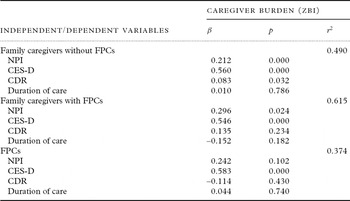
For family caregivers without FPC assistance, factors contributing caregiver burden were CES-D (β = 0.560; p < 0.005), NPI (β = 0.212; p < 0.005), and CDR (β = 0.083; p = 0.032) scores (R2 = 0.490; Table 4). For family caregivers with FPC assistance, CES-D (β = 0.546; p < 0.005) and NPI (β = 0.296; p = 0.024) scores contributed to caregiver burden (R2 = 0.615; Table 4). For FPCs, only CES-D scores (β = 0.583; p < 0.005) contributed to caregiver burden (R2 = 0.428; Table 4).
Multiple linear regression analysis of associations between caregiver burden and other variables

ZBI = Zarit Burden Interview; FPC = foreign paid caregivers; NPI = Neuropsychiatric Inventory; CES-D = Center for Epidemiological Studies–Depression Scale; CDR = Clinical Dementia Rating Scale.
Discussion
The results of our study demonstrated that patients’ neuropsychiatric symptoms were associated with the burden of family caregivers, but not those of FPCs. Family caregivers had greater knowledge of dementia but experienced a greater burden than did FPCs. Caregivers’ mood status was an independent predictor of burden among family caregivers and FPCs. These findings indicate that the sources of burden differ between family caregivers and FPCs.
The presence of behavioral problems in patients had a strong psychological effect on family caregivers and increased their burden, a finding congruent with those of previous studies (Machnicki et al., Reference Machnicki, Allegri, Dillon, Serrano and Taragano2009; Mohamed et al., Reference Mohamed, Rosenheck, Lyketsos and Schneider2010). However, patients’ neuropsychiatric symptoms did not affect FPC burden; thus, the perceptions of FPCs and family caregivers may have differed. A study conducted in Israel (Ayalon, Reference Ayalon2010) demonstrated that family caregivers with greater burdens were more likely to report neuropsychiatric symptoms in care recipients. The same study reported a subjective discrepancy between family members’ and FPCs’ assessments of these symptoms in their patients, suggesting that differences in caregivers’ perceptions of patients’ symptoms lead to differing effects on caregiver burden. A longitudinal study (Mohamed et al., Reference Mohamed, Rosenheck, Lyketsos and Schneider2010) showed that lower levels of behavioral symptoms in patients were associated with lower levels of caregiver burden. Family caregivers, rather than FPCs, may benefit from management of the patient's neuropsychiatric symptoms to reduce the caregiver burden.
Differences between family caregivers’ and FPCs’ perceptions of patients’ neuropsychiatric symptoms may be explained by the process of acculturation, whereby a minority and majority culture fuse together. As immigrants acculturate, they become more individualistic and less familistic (Crist et al., Reference Crist, McEwen, Herrera, Kim, Pasvogel and Hepworth2009). FPCs who travel alone to Taiwan and work in relative isolation from their families may represent an individualistic extreme. For such immigrants, taking care of a demented patient is merely a working obligation, which suggests that patient's severe neuropsychiatric symptoms would not add significantly to the caregiver's burden. Previous studies that have discussed racial differences in burden have often compared individuals of different ethnicities who provide care for kin or non-kin (Crist et al., Reference Crist, McEwen, Herrera, Kim, Pasvogel and Hepworth2009; Siegler et al., Reference Siegler, Brummett, Williams, Haney and Dilworth-Anderson2010). Our study examined a unique relationship in employer–employee dyads characterized by ethnicity differences.
Family caregivers had greater burdens than did FPCs caring for the same patients. The enormous psychological impact on family caregivers of loved ones, compared with FPCs’ greater detachment and different perceptions of the task, might play a role in this difference. The lack of an affective bond and the greater emotional distance between FPCs and patients may explain the insignificant effect of patients’ neuropsychiatric symptoms on FPC burden.
In our study, patients with FPCs were older and had more severe neuropsychiatric symptoms than patients without FPCs. Family caregivers of patients with more severe symptoms, who experienced greater caregiver burden, tended to seek help from FPCs. However, the presence of FPCs did not appear to reduce family caregiver burden. Depression scores were lower but not significantly among family caregivers with FPC assistance than among those without FPCs, despite the former's greater burden and the greater severity of patients’ neuropsychiatric symptoms. By contrast, an Italian study demonstrated lower caregiver burden and depressive symptoms in primary caregivers with FPCs compared to those without (Rosa et al., Reference Rosa, Ambrogio, Binetti and Zanetti2004). The presence of FPCs may have helped family caregivers’ moods, but a large-scale study is needed to confirm this suggestion. The NPI scores of patients with FPCs were negatively correlated with the durations of diagnosis and family caregiving. The burden of family caregivers with FPC assistance was negatively correlated with their duration of care. The presence of FPCs might lessen family caregivers’ perceptions of patients’ behavioral problems over time, further reducing their burden. This topic warrants further investigation.
Knowledge of dementia was not correlated with caregiver burden in our study: this finding is similar to that of a recent Portuguese study (Goncalves-Pereira et al., Reference Goncalves-Pereira, Carmo, Alves da Silva, Papolia, Mateos and Zarit2010). Several aspects of the relationship between knowledge of dementia and caregiver burden need to be considered. KD scores were negatively correlated with CES-D scores among family caregivers without FPC assistance; this finding was congruent with that of a previous study (Graham et al., Reference Graham, Ballard and Sham1997). However, the causality of this association requires further investigation; that is, it remains unclear whether depressed caregivers lack the motivation to improve their knowledge about dementia, or whether an inadequate understanding of the disease leads caregivers to feel depressed. From this perspective, a greater knowledge of dementia associated with a lower level of depression might further reduce caregiver burden. Connell et al. demonstrated racial differences in knowledge about AD, with Caucasians reportedly having greater knowledge and concern about getting the disease relative to African Americans (Connell et al., Reference Connell, Scott Roberts, McLaughlin and Akinleye2009). Such personal concerns may counteract the benefits of comprehending the nature of dementia; another study (Proctor et al., Reference Proctor, Martin and Hewison2002) found that caregivers who knew more about the biomedical aspects of dementia tended to be more anxious, which may have increased their burden. However, it remains unclear whether anxious people seek to acquire more knowledge about dementia, or whether an understanding of the poor prognosis makes caregivers anxious.
Knowledge of dementia was greater among family caregivers than among FPCs, indicating that FPCs received insufficient education and training. Our results showed that FPCs’ knowledge of dementia was negatively correlated with the duration of patient's diagnosis and not associated with the duration of care. Currently, Taiwan lacks training programs designed specifically for FPCs. Although knowledge of dementia was not related to FPCs’ caregiver burden, training programs are acquired to provide them with information about dementia and improve the quality of care (Rosa et al., Reference Rosa2008). FPCs’ burden was strongly correlated with their mood status. As foreigners in a country with an unfamiliar culture and language, FPCs can be expected to feel lonely and lacking in resources. Because caregivers’ mood status is the main correlate of caregiver burden, addressing the depressive symptoms of family caregivers and FPCs may alleviate their burdens.
The current study evaluated caregiver burden and multiple predictors of the caregiving experience among family caregivers and FPCs, factors that have seldom been jointly explored in prior research. This exploration increased our understanding of the correlates of caregiver burden among different populations. However, our study was subject to several limitations. First, although the reliability and validity of the questionnaires used in our study have been confirmed in Taiwan, the validity of the Indonesian version has not been fully examined. Second, our findings remain correlational in nature, given that the study design was cross-sectional and non-experimental. Third, our measurement of patients’ symptoms was based on caregivers’ reports, and caregivers’ ratings might be affected to some extent by their mood status. The FPCs were not asked to rate patients’ neuropsychiatric symptoms, which may have resulted in some bias in the correlational analysis of FPC burden and the severity of patients’ symptoms.
Conclusion
Patients’ neuropsychiatric symptoms and caregivers’ mood status affect caregiver burden. Treatment to improve these symptoms in patients might have the positive effect of reducing the burden on family caregivers, but not that on FPCs. Psychological support to reduce depressive symptoms in caregivers is crucial. We suggest that health professionals in Taiwan provide proper educational programs for caregivers, especially FPCs, to improve their knowledge of dementia.
Conflict of interest
None.
Description of authors’ roles
J.-L. Fuh was involved in acquisition, analysis, and interpretation of data, developing the concept and design of the paper, critical revision of the paper for important intellectual content, and obtaining funding; C.-F. Tsai was involved in developing the concept and design of the paper, acquisition of data, critical revision of the paper for important intellectual content, and obtaining funding; W.-C. Lin was involved in acquisition, analysis, and interpretation of data, and drafted the paper; and S.-J. Wang and J.-P. Hwang critically revised the paper for important intellectual content.
Acknowledgments
The current study was supported by grants from Taipei Veterans General Hospital (V100C-059, VGHUST100-G7-1-3); NSC support for the Centre for Dynamical Biomarkers and Translational Medicine, National Central University, Taiwan (NSC 99-2911-I-008-100); and the Ministry of Education (Aim for the Top University Plan), Taipei, Taiwan.