INTRODUCTION
One of the hallmark features of early grammatical development in English is the inconsistent use of tense/agreement morphemes (Wexler, Reference Wexler, Lightfoot and Hornstein1994). Typical two- and three-year-olds often alternate between sentences such as Daddy running and Daddy's running, or Mommy drive to work and Mommy drives to work. Despite this inconsistency, when young children do produce a tense/agreement morpheme, it is usually correct; productions such as We is running are rare.
Across the preschool years, the proportion of correctly used tense/agreement morphemes gradually increases for most children (Rice & Wexler, Reference Rice and Wexler1996). For children diagnosed with specific language impairment (SLI), however, the period of inconsistency is significantly protracted. Furthermore, throughout the preschool years, these children's levels of correct production of tense/agreement morphemes are not only lower than the levels of their typically developing age-mates, but they are also lower than those of typical children two years younger, even when the groups are similar in mean length of utterance (MLU) (e.g. Hoover, Storkel & Rice, Reference Hoover, Storkel and Rice2012; Leonard, Eyer, Bedore & Grela, Reference Leonard, Eyer, Bedore and Grela1997; Rice & Wexler, Reference Rice and Wexler1996). For children with SLI, it is not unusual for some degree of inconsistency to be evident through the early school years (Marchman, Wulfeck & Ellis Weismer, Reference Marchman, Wulfeck and Ellis Weismer1999; Norbury, Bishop & Briscoe, Reference Norbury, Bishop and Briscoe2001; Rice, Wexler & Hershberger, Reference Rice, Wexler and Hershberger1998) and, in extreme cases, into adolescence and beyond (van der Lely, Reference van der Lely1997).
There have been several attempts to explain tense/agreement inconsistency. The most prominent is the approach taken by Rice, Wexler, and their colleagues (Rice & Wexler, Reference Rice and Wexler1996; Rice, Wexler & Cleave, Reference Rice, Wexler and Cleave1995; Wexler, Reference Wexler, Lightfoot and Hornstein1994). These scholars have proposed that young children treat tense/agreement as optional because a biologically based principle that main clauses must be marked for finiteness has not matured. Thus, a child's failure to use the appropriate tense/agreement form reflects that child's selection of a non-finite verb form instead. For this reason, this period of development is referred to as the ‘optional infinitive stage’ (Wexler, Reference Wexler, Lightfoot and Hornstein1994). The same linguistic principle is assumed to mature even later in children with SLI, causing their protracted period of optional tense/agreement use. When applied to children with SLI, this approach is referred to as the ‘extended optional infinitive account’.
Two key assumptions of the optional infinitive account seem to receive support from the literature. First, the assumption that errors are productions of non-finite (often, infinitive) forms seems supported by findings from languages (e.g. Swedish) that mark non-finite forms with overt infinitive inflections, even though bare stems are permitted in the language (e.g. Hansson, Nettelbladt & Leonard, Reference Hansson, Nettelbladt and Leonard2000). The second assumption that is compatible with the literature is that children understand tense and agreement, but fail to treat these features as obligatory in main clauses. Valian (Reference Valian2006) found that even two-year-old English-speaking children could respond correctly to most comprehension items that required knowledge of the present–past tense distinction.
The observation that tense/agreement morpheme inconsistency constitutes alternation between correct forms and non-finite forms was an important development in the study of both typical language development and SLI. However, the origins of this optional use are far from clear. In the present study, we pursue an alternative source of children's optional tense/agreement use, and extend this pursuit to the study of children with SLI.
Input as a source of non-finite verb use
Several investigative teams have proposed that young typically developing (TD) children's grammatical development is influenced by the input to a greater extent than previously assumed (e.g. Abbot-Smith, Lieven & Tomasello, Reference Abbot-Smith, Lieven and Tomasello2001; Akhtar, Reference Akhtar1999; Kirjavainen, Theakston & Tomasello, Reference Kirjavainen, Theakston and Lieven2009). Croker, Pine, and Gobet (Reference Croker, Pine, Gobet, Taatgen and Aasman2000) put forth the idea that optional infinitives can derive from characteristics of the input, and tested this successfully using a computational model referred to as the Model of Syntactic Acquisition in Children (MOSAIC, discussed more fully below). Theakston, Lieven, and Tomasello (Reference Theakston, Lieven and Tomasello2003) tested this idea experimentally, by asking whether young TD children would be more likely to produce novel verbs in non-finite form (e.g. It mib) if they heard these novel verbs exclusively in questions (e.g. Will it mib?) than if they heard them in inflected form (e.g. Look, it mibs) or in mixed form (e.g. Will it mib? Look, it mibs). In questions, a non-finite verb form follows the subject, which Theakston et al., reasoned could compel children to treat the subject–non-finite verb sequence as a reasonable option in their own utterances. Theakston et al. also presented familiar verbs in the same contexts, but these were not expected to be influenced dramatically by the input, owing to the children's prior history of hearing these verbs in both finite and non-finite contexts.
The results supported the hypothesis; novel verbs were produced largely in the manner in which they were heard, whereas familiar verbs were much less influenced by the presentation condition. The Theakston et al. (Reference Theakston, Lieven and Tomasello2003) study employed one novel verb per presentation condition. Finneran and Leonard (Reference Finneran and Leonard2010) replicated the Theakston et al. findings using an expanded list of sixteen novel verbs.
In a series of studies, Croker, Pine, and Gobet (Reference Croker, Pine, Gobet, Altmann, Cleeremans, Schunn and Gray2001), Freudenthal, Pine, and Gobet (Reference Freudenthal, Pine and Gobet2006), Freudenthal, Pine, Aguado-Orea, and Gobet (Reference Freudenthal, Pine, Aguado-Orea and Gobet2007), and Freudenthal, Pine, and Gobet (Reference Freudenthal, Pine and Gobet2009, Reference Freudenthal, Pine and Gobet2010) refined MOSAIC to more closely simulate optional infinitive use, including output containing pronoun errors in combination with non-finite verbs, as in her walk and him going. The model's learning of each input utterance begins from the right edge of the utterance, with a constraint placed on the model's learning. An utterance-final bias is thereby created, that simulates better learning of the most recently heard elements in a sentence. Development is simulated by gradually relaxing the processing constraint, which enables longer sequences to be learned. Thus, a learning sequence over time could proceed as in home → goes home → she goes home and go → he go → can he go. Given this type of constraint, the degree to which the input contained non-finite verb forms at or near the right edge of the utterance would be a major factor in dictating the degree of non-finite verb use in the model's output.
Along with the strong utterance-final bias, in newer versions, a weaker utterance-initial bias is also built into MOSAIC. This enables the model to account for child utterances in which utterance-medial information is missing. Thus, he go home from Can he go home? can be handled by the strong utterance-final bias, but he go home from He can go home can be explained by a combination of the utterance-final bias and the weaker utterance-initial bias.
When samples of child-directed speech served as input to the model, the output provided a relatively good match with young TD children's use of optional infinitives. These results were especially compelling because the degree of non-finite use produced as output by the model varied depending on whether the child-directed speech samples were from English, Dutch, German, French, or Spanish. For example, Spanish is often characterized as a ‘non-optional infinitive’ language, as young TD children rarely produce errors of this type. The output of the Freudenthal et al. (Reference Freudenthal, Pine, Aguado-Orea and Gobet2007) computational model showed the fewest non-finite forms when Spanish child-directed samples served as input. The simulations across these studies showed that MOSAIC could successfully generate the appropriate cross-linguistic differences, suggesting that differences in the input distribution were responsible for producing these effects.
MOSAIC generates an output that goes beyond rote learning, for the output is not limited to utterances contained in the input. However, lexical effects are expected, given that certain verbs are more likely than others to appear in non-finite form toward the end of the utterance. In the Freudenthal et al. (Reference Freudenthal, Pine and Gobet2010) study, this proved to be the case. For example, specific verbs that frequently appeared in non-finite form toward the end of sentences in the input were more likely to have non-finite forms in the MOSAIC output.
The use of optional infinitives by young TD children has been modeled extremely well by MOSAIC, though, as Freudenthal et al. (Reference Freudenthal, Pine and Gobet2010, p. 650) note, MOSAIC should be seen “not as a realistic model of the language acquisition process itself, but as one of many ways of implementing an utterance-final (and in the current version of the model, utterance-initial) bias in learning”. In the present study, we also examine the role of input in children's use of optional infinitives, adopting many of the assumptions first made explicit by the developers of MOSAIC. However, our focus is on children with SLI – children whose profile differs in important ways from the profile seen in typical development. As noted earlier, children with SLI produce more non-finite forms than younger TD children at the same MLU level, and require longer utterance lengths than TD children before they become consistent in using finite forms. These children's continued use of non-finite forms as their utterance lengths expand has led us to address how children with SLI in the optional infinitive period might be interpreting the input. We begin with a review of SLI work that provides the foundation for our study.
Insensitivity to finiteness dependencies in the input and children with SLI
Leonard and Deevy (Reference Leonard and Deevy2011) conducted an experimental study with the aim of determining if an input-based account could explain the extended period of optional infinitive use seen in children with SLI. They hypothesized that these children would be more likely to produce non-finite subject–verb utterances after hearing input sentences containing a finiteness dependency, that is, sentences in which a non-finite verb in a subject–verb sequence (e.g. the bear eating) is permitted because of the presence of other information earlier in the input sentence (as in We saw the bear eating ).
Leonard and Deevy (Reference Leonard and Deevy2011) tested this idea with a group of preschoolers with SLI who showed inconsistent use of auxiliary is. Input was carefully controlled by adopting the novel verb paradigm developed by Theakston et al. (Reference Theakston, Lieven and Tomasello2003). Children heard novel verbs presented either in an auxiliary frame (e.g. Just now the cat was channing) or in a non-finite frame (e.g. We saw the dog pagging). Following the exposure period for each novel verb, the children were tested on their use of the novel verb in contexts obligating auxiliary is. Test items required the children to use the novel verbs with subjects not previously associated with the novel verbs as well as subjects that had been used with the novel verbs during the exposure period. Along with the children with SLI, a group of age-matched TD children who were at mastery levels in the use of auxiliary is also participated. These TD children were included to ensure that children at this stage of development would refrain from using non-finite versions of the novel verbs even if these verbs had been presented solely in non-finite form during the exposure period.
As expected, the TD children performed at ceiling levels on this task; they used auxiliary is regardless of how the novel verb had been presented during the exposure period. The children with SLI, on the other hand, were much more likely to produce the novel verb in non-finite form if it had been heard in non-finite form and, conversely, to produce auxiliary is if the novel verb had been heard in an auxiliary frame during the exposure period. The children with SLI succeeded in using new subjects with the novel verbs. Thus, although their use or non-use of auxiliaries corresponded to the way in which the novel verbs had been heard, their use of the novel verbs with new subjects showed that this was not a case of rote learning. The study employed a within-subjects design. Therefore, the children's tendency to produce the shorter non-finite utterances such as Minnie Mouse pagging after hearing input such as We saw the dog pagging was not because they could not process a longer sequence. If this were the case, they would not have produced utterances such as Minnie Mouse is channing after hearing Just now the cat was channing.
In a second experiment, Leonard and Deevy (Reference Leonard and Deevy2011) asked whether the input effects seen in the first experiment could reasonably be attributed to a difficulty in the children's understanding of sentences with finiteness dependencies. To explore this question, they compared preschoolers with SLI and younger TD children on a picture-pointing comprehension task involving sentences that contained a non-finite subject–verb subordinate clause, as in The cow sees the horse eating. Although the two groups were matched on their raw scores on a general (standardized) test of sentence comprehension, the TD children showed greater use of auxiliary is in obligatory contexts (M = 81%) than the children with SLI (M = 30%). Leonard and Deevy found that the children with SLI were significantly less accurate on the subordinate clause comprehension task than the TD children and, when in error, were more likely to select a drawing that matched the events reflected in the subordinate clause of the target sentence (e.g. selecting a picture of a horse eating with the cow looking elsewhere rather than at the horse). Of note is the fact that the children's degree of use of auxiliary is was a better indicator of their accuracy in understanding sentences such as The cow sees the horse eating than were their raw scores on the standardized test of sentence comprehension, a more general test of grammatical understanding. This finding suggested that any input effects on these children's use of non-finite utterances may be related to weaknesses with finiteness dependencies in particular.
Although the Leonard and Deevy (Reference Leonard and Deevy2011) work provided useful information about the plausibility of input effects playing a role in tense/agreement inconsistency in children with SLI, several important questions remain – questions that are pursued in the present study. First, the TD children in the novel verb experiment of Leonard and Deevy were the same age as the children with SLI and already at mastery levels in their use of tense/agreement morphology. For the present study, we recruited TD children approximately two years younger than the children with SLI, with equivalent utterance lengths. As noted at the outset of this paper, though still in an optional infinitive stage, such children show greater use of tense/agreement morphemes than do the older children with SLI. The participants in this study replicate this reliable finding in the literature. In this study, we test the prediction that this group difference will be associated with a greater tendency on the part of the children with SLI to use verbs in the manner in which they were heard. That is, as found in the MOSAIC work, we expected the younger TD children to be significantly influenced by the input. Due to the disproportionate difficulty children with SLI have with tense/agreement forms, however, we expected the input effects for these children to be even stronger, presumably because they have special difficulty recognizing the finiteness dependencies within input utterances. The subordinate clause comprehension study conducted by Leonard and Deevy (Reference Leonard and Deevy2011) provided a hint of this difficulty, given that the children's degree of auxiliary is use was a better indicator of their comprehension accuracy on sentences such as The cow sees the horse eating than was their general level of sentence comprehension.
We expected further that the SLI group's weaker command of finiteness dependencies would also lead these children to inappropriately insert tense/agreement forms in contexts requiring non-finite forms, as in We wanna watch the cat ___ . This expectation seems especially plausible given a recent study by Purdy, Leonard, Weber-Fox, and Kaganovich (in press). These investigators found that children with a history of SLI, including inconsistent use of tense/agreement morphology, had a tendency to treat sentences such as We watch the happy girl climbs up the ladder as acceptable, as measured both behaviorally and through electrophysiological measures. These same children were quite sensitive to local agreement errors such as Every night they talks on the phone. Typically developing children, on the other hand, treated both types of sentences as problematic. Their rejection of the first type of sentence indicated that they were sensitive to the breakdown in the finiteness dependency in spite of the local agreement (the happy girl climbs up the ladder) that occurred in the later appearing clause.
Another important component in the present study is our use of a different tense/agreement morpheme than the one used in Leonard and Deevy (Reference Leonard and Deevy2011), and a wider range of input utterances. We examine the children's use of third person singular -s, a morpheme not yet used in novel verb studies of children with SLI, but one that shows an extended period of inconsistent use in the speech of these children. Two different types of frame containing non-finite subject–verb sequences are used, Let's watch the N V (e.g. Let's watch the dog tome), and Does the N V? (e.g. Does the dog mab?). The choice of frames involving both propositional verb complements (Let's watch the N V) and Does interrogatives (Does the N V?) was based on two important factors. First, child productions of non-finite verbs in contexts obligating third person singular -s can appear with either nominative case pronouns (e.g. She run fast) or accusative case pronouns (e.g. Her run fast) in subject position. The frame Does the N V? calls for a pronoun in the nominative case (e.g. Does she run fast?), whereas the frame Let's watch the N V accommodates an accusative case pronoun (e.g. Let's watch her run). Examining the input effects of each type of frame, therefore, seemed to offer a more representative test of the role of input effects on the extended optional infinitive use of children with SLI. A question frame was also selected because questions provide a good test of the breadth of input effects. The non-finite subject–verb sequences in questions are not in subordinate clauses, yet we propose that their propositional nature and separation from the finite form in initial position invite their extraction by children during the optional period of tense/agreement use. Questions also have considerable ecological validity for the proposal; these forms represent approximately 32% of child-directed utterances during this period (Cameron-Faulkner, Lieven & Tomasello, Reference Cameron-Faulkner, Lieven and Tomasello2003). Thus, combined with the other (less frequently occurring) frames containing non-finite subject–verb sequences, there seems to be a sufficient number of instances in the input to serve as a plausible source of children's tense/agreement inconsistency.
As in previous studies, we compare children's treatment of novel verbs with that of familiar verbs. We expect both the SLI and younger TD group to show stronger input effects with novel verbs, as these verbs will have no input history that can interfere with the finite or non-finite exposure conditions to which they are assigned. Finally, we determine whether children with SLI differ from younger TD children in their ability to use subjects with novel verbs that had not been associated with these verbs during the exposure period. We expect no group differences in this ability, given that the problem attributed to children with SLI is a tendency to treat non-finite subject–verb sequences as unconstrained; the problem is not assumed to be one of learning these sequences on a strictly rote basis.
To sum up, the following predictions of an input-based account are tested in the present experimental investigation:
-
1. Both children with SLI and younger TD children will show significant input effects, with greater effects seen for the children with SLI given these children's presumed weaker grasp of finiteness dependencies.
-
2. For verbs heard only with third person singular -s, children with SLI will be especially prone to inappropriately use this inflection when tested on sentences containing finiteness dependencies (e.g. We wanna watch the cat … hides).
-
3. Input effects will be seen for all sentence frame types used as input, suggesting that problems are not limited to any one type of syntactic structure.
-
4. Both groups of children will show greater input effects with novel verbs than with familiar verbs, but even novel verbs will be used by the children in the context of subjects that were never modeled with the verb during the exposure period. The latter finding would suggest that children are not learning the subject–verb sequences as rote forms.
METHOD
Participants
Sixty children served as participants, thirty with SLI and thirty younger typically developing children. The children in the SLI group had been diagnosed with language impairment and were participating in group or individual language intervention programs. They ranged in age from 3;9 to 5;8 (M = 4;8, SD = 6·14 months). Each of these children passed a hearing screening, an oral motor screening, and exhibited no symptoms of disturbance in relating to objects or persons. All thirty children scored above 85 on the Columbia Mental Maturity Scale (CMMS; Burgemeister, Blum & Lorge, Reference Burgemeister, Blum and Lorge1972) (M = 106·93, SD = 9·20). Twenty-eight of the thirty children met our criteria for a language impairment by scoring below the standard score of 87 on the Structured Photographic Expressive Language Test – Preschool 2 (SPELT-P2; Dawson, Eyer & Fonkalsrud, Reference Dawson, Eyer and Fonkalsrud2005), determined by Greenslade, Plante, and Vance (Reference Greenslade, Plante and Vance2009) to be the cut-off point yielding high sensitivity and specificity for this age group. The remaining two children were included in the group on the basis of a score below the 10th percentile on Developmental Sentence Scoring (Lee, Reference Lee1974). The children's MLUs were calculated based on spontaneous speech samples, though this measure was not used as a basis for selecting the children. The mean MLU in morphemes for this group was 4·18 (SD = 0·89). All children in the SLI group showed inconsistency in their use of third person singular -s. In spontaneous speech, these children used this morpheme in 38·10% of obligatory contexts on average (SD = 28·70). On an 18-item sentence completion probe (see below), the children averaged 32·30% use of this inflection (SD = 26·14).
The typically developing group comprised thirty children who from the outset were reaching all developmental milestones, including language, on schedule according to parental report. They ranged in age from 2;5 to 3;1 (M = 2;10, SD = 2·43 months) and were, on average, approximately 22 months younger than the children with SLI. These children passed the same screening tests administered to the SLI group. Given their young ages, the children's non-verbal cognitive functioning was assessed using the Leiter International Performance Scale – Revised (LIPS; Roid & Miller, Reference Roid and Miller1997). Standard scores averaged 120·26 (SD = 9·71). Their expressive language was assessed by means of the expressive subtest of the Reynell Developmental Language Scales (Reynell & Gruber, Reference Reynell and Gruber1990). The children's mean standard score was 109·54 (SD = 10·19). The children's MLUs in morphemes averaged 4·39 (SD = 0·70), and were statistically similar to those of the children with SLI (t(58) = 1·03, p = ·309, d = 0·183). These children, like the children with SLI, were inconsistent in their use of third person singular -s. Mean percentages of use of this morpheme in spontaneous speech and on the 18-item sentence completion probe were 63·37% (SD = 23·66) and 58·07% (SD = 24·89), respectively. Both values were significantly higher than the corresponding values for the children with SLI (t(58) = 3·72, p < ·001, d = 0·965, and t(58) = 3·91, p < ·001, d = 1·010, respectively). This finding corresponds to the literature showing that when preschoolers with SLI and younger typically developing groups show similar MLUs, the children with SLI use third person singular -s with significantly lower percentages in obligatory contexts (e.g. Hoover et al., Reference Hoover, Storkel and Rice2012; Leonard et al., Reference Leonard, Eyer, Bedore and Grela1997; Rice & Wexler, Reference Rice and Wexler1996). As noted in the ‘Introduction’, a major question of the present study was whether these lower percentages on the part of children with SLI are an indication that these children are less aware than the TD children of the types of structural constraint on non-finite subject–verb sequences described throughout the ‘Introduction’. A predicted finding of stronger input effects for the children with SLI would be consistent with this interpretation.
Pre-experimental third person singular -s probes
Prior to their participation in the verb exposure sessions, the children were administered an 18-item probe that assessed their use of third person singular -s. This probe served to document that the children were indeed inconsistent in their use of third person singular -s and that the expected difference between the SLI and younger typically developing groups in degree of third person singular -s use held for these particular children. A sentence completion format was employed, using toy characters and props that were acted out by the experimenter. The child was introduced to a turtle character who was described as shy, often retreating into his shell when some new event was occurring. For this reason, the child needed to help the turtle describe the event. For each of the eighteen items, a new character was introduced to the child and to the turtle. The new character announced what he or she does on a routine basis, demonstrating the action. During the action, the turtle went into his shell and then asked the child to help describe the action by completing his sentence. An example of an item is shown in (1).
-
(1) little mermaid: I love to swim. Do you? I swim all day long (demonstrates).
turtle: Oh-oh, I didn't see. What does Little Mermaid do all day? Little Mermaid …
child: Swims.
A different verb was used for each item. These were: comb, feed, bark, count, slide, swing, take (a nap), swim, rake, hide, call, bite, sweep, wear, play, help, cook, and put on. The children's responses were scored for the presence or absence of the third person singular -s inflection. If the child produced a semantically appropriate substitute (e.g. sleep in place of take a nap), it was treated as a scorable response. If the child provided an unrelated (or no) response, the item was regarded as unscorable. For each child, a percentage of correct use of third person singular -s was computed by dividing the number of correct productions by the number of correct productions plus bare stem productions and multiplying by 100.
Presentation frames
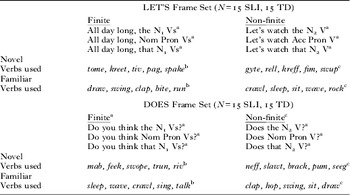
Fifteen children with SLI and fifteen TD children heard five novel verbs and five familiar verbs in the finite frame All day long, the N Vs (e.g. All day long the dog runs) and five other novel verbs and familiar verbs in the frame Let's watch the N V (e.g. Let's watch the cat draw). Hereafter, this pair of presentation frames will be referred to as the LET'S frames. The remaining fifteen children in each group heard five novel verbs and five familiar verbs in the finite frame Do you think the N Vs? (e.g. Do you think the dog hops?) and five other novel and familiar verbs in the frame Does the N V? (e.g. Does the cat talk?). Hereafter, we refer to this pair of presentation frames as the DOES frames. The frames in each of these pairs that contain the non-finite subject–verb sequence (as in Let's watch the cat draw and Does the cat talk?) will be referred to as non-finite frames.
Novel and familiar verbs
Ten novel verbs and ten familiar verbs were used in the LET'S frames. All verbs were monosyllabic CVC or CCVC forms with the exception of the familiar verb draw. The novel verbs were: tome [tom], kreet [krit], tiv [tɪv], pag [pæg], spake [spek], gyte [gaɪt], rell [rεl], kreff [krεf], fim [fɪm], and swup [sw∧p]. The ten familiar verbs were draw, swing, clap, bite, run, crawl, sleep, sit, wave, and rock. For the DOES frames, a different group of ten novel verbs was employed, again in CVC or CCVC form. These were: mab [mæb], feek [fik], swope [swop], trun [tr∧n], riv [rɪv], neff [nεf], slawt [slɔt], brack [bræk], pum [p∧m], and seeg [sig]. The ten familiar verbs were sleep, wave, crawl, sing, talk, clap, hop, swing, sit, and draw. Many of the CVC novel verbs were drawn from the stimuli devised by Jusczyk, Luce, and Charles-Luce (Reference Jusczyk, Luce and Charles-Luce1994).
Several criteria were used to select the novel verbs. Within each frame type (LET'S, DOES) half of the novel verbs were matched with the remaining five novel verbs on length, phonotactic probability, and neighborhood density, employing the values for these measures available from Storkel and Hoover (Reference Storkel and Hoover2010). Specifically, the novel verbs were matched on: (i) the length in number of phonemes of the bare stem form (e.g. [nεf] = 3 phonemes); (ii) the positional frequency of the final phoneme in the stem (e.g. the frequency of [f] in third position); (iii) the summed biphone frequency of the stem (e.g. the frequency of [nε] + [εf]); (iv) the biphone frequency of the final phoneme of the stem followed by the appropriate phonetic form of the third person singular -s inflection (e.g. the biphone frequency of [fs] in neffs); and (v) the neighborhood density of the stem (e.g. for [nεf], the words net, neck, knife, etc.). The same matching was performed for the familiar verbs in each frame type, with the addition of word frequency. This matching was important because the verbs were blocked such that half of these verbs within each frame set were to be heard in a non-finite form and half in a finite form (see below). Therefore, matching on these other factors increased the likelihood that any differences in the children's productions could be attributed to the exposure condition. An additional step was taken by matching the novel verbs and familiar verbs in the same block according to the first five of these characteristics. This matching allowed us to reduce the effects of factors other than familiarity when these two verb types were compared. Matching was accomplished by ensuring that, for each of these characteristics, the means and standard deviations of each grouping of five verbs were statistically indistinguishable from the grouping with which it was to be compared (e.g. the first five novel verbs from the LET'S frame set versus the remaining five novel verbs from the LET'S frame set). Null hypothesis tests comparing novel verbs assigned to the finite versus non-finite condition yielded probabilities ranging from p = ·80 to 1·00 across the matching characteristics. For real verbs, the range was from p = ·47 to 1·00. For novel and real words assigned to the same exposure condition, the p range was from ·36 to 1·00. Finally, comparisons between the verbs used in the LET'S versus the DOES frame, the p range for novel verbs was ·65 to 1·00; for the real verbs the range was ·33 to ·86.
Procedure
One novel verb and one familiar verb were presented to the child during each session. The session began with the child being introduced to two toy characters with movable body parts, allowing them to perform (with the help of the experimenter) a variety of novel actions (e.g. a toy cat scratching its ear with its tail) and familiar actions (e.g. a toy frog clapping). The child was told that sometimes the characters did funny things. At that point, the experimenter made a character perform the novel action assigned for that session. The action was not named as it was first introduced. The child was then told that some of the actions performed by the characters had funny names that should be remembered.
The exposure period began with one character performing the novel action and the other character performing the familiar action. The novel action was performed continuously as the experimenter produced the verb in the assigned frame three times, in a prescribed sequence, with the second use of the frame containing a pronoun form as subject. For the non-finite frame in the DOES set, the following example illustrates the sequence: Does the cat neff? Does she neff? Does that cat neff? The familiar verb was then presented three times, using the other character as the subject, as in Does the frog clap? Does he clap? Does that frog clap? This pattern of three consecutive presentations of the novel verb followed by three consecutive presentations of the familiar verb was repeated eight additional times, for a total of nine sets of three presentations, or twenty-seven total exposures for each novel verb and familiar verb. During the final two sets of three presentations, the child was encouraged to make the character perform the relevant action, as the experimenter produced the relevant frames. This step was employed in the hope that it might promote the child's recall of the verb–action association. Note that each novel verb and familiar verb was presented in only one type of frame (finite or non-finite). In the examples used here, the two verbs were heard only in the non-finite frame from the DOES set.
We opted to use a relatively large number of exposures (27) for each word for two reasons. First, we wanted to ensure that each word was heard several times with a pronoun subject (as in Does she neff?) as well as with a noun subject, given that some of our non-finite sequences employed nominative case pronoun subjects (he, she) and others employed accusative case subjects (him, her). Second, we wanted to avoid the interpretation that any input effects observed in the study were restricted to potentially transient processes, such as fast mapping.
The remaining nine sessions, each held on a different day, proceeded in the same way, with a different novel verb and familiar verb used in each session. The type of exposure was blocked, such that, for half of the children, the first five sessions employed non-finite presentation frames and the next five sessions employed finite presentation frames. For the remaining children, the opposite order was employed. Within this blocking, two different random orders were created, so that a verb did not always appear in the same order in the block. Table 1 provides a summary of the procedure used in the exposure period.
The frames, novel verbs, and familiar verbs used during the exposure period

notes: a This sequence of three was repeated eight times for a total of 27 (3 × 9) presentations; b half of the children assigned to this frame set heard these novel and familiar verbs in finite form; the other half heard them in non-finite form; c half of the children assigned to this frame set heard these novel and familiar verbs in non-finite form; the other half heard them in finite form. N = noun, V = verb, Nom Pron = nominative pronoun; Acc Pron = accusative pronoun.
Post-exposure probes
In each session, immediately following the twenty-seven presentations of the novel verb and the twenty-seven presentations of the familiar verb, the children's use of these two verbs was assessed in a context obligating use of third person singular -s and in a context requiring a non-finite form of the verb. The two verbs would have been heard only in one of these contexts during the exposure period. The order of the probe items requiring use of the verbs in a third person singular -s or non-finite context was counterbalanced across the children such that the third person singular -s probe items were presented first for half the children. Three items were used to test each verb in third person singular -s contexts and three items were employed to assess the verb in non-finite contexts. A sentence completion format was used for each item; the experimenter made the character perform the action and provided a sentence for the child to complete with the appropriate verb. For the third person singular -s probe items, the carrier phrase Every day the N ___ was employed (e.g. Every day the cat ___). For the non-finite probe items, the carrier phrase was We wanna watch the N ___ (e.g. We wanna watch the cat ___). This type of structure was selected for the non-finite probe items because it involved a finiteness dependency expected to be difficult for children with SLI. Such a structure could lead the children to mistakenly use a verb inflected with third person singular -s to show agreement with the local subject (as in We wanna watch the cat … mibs). In fact, we regarded the presence of such errors of tense and agreement over-marking in non-finite contexts as essential evidence that the underlying basis for optional tense and agreement marking is children's failure to fully appreciate that the use of non-finite forms is restricted to their placement within broader structures with properties that call for their use.
For both the third person singular -s items and the non-finite items, the first of the three items used the same character as during the exposure period (e.g. the cat ‘neffing’ and the frog clapping). For the remaining two items of each type, two different characters served as the subject of the action (e.g. a dog ‘neffing’, a mouse ‘neffing’, a bear clapping, and a horse clapping). These characters had never been associated with the action during the exposure period. These items allowed us to determine whether the child's use of the verbs in the probe items extended beyond the particular word sequences (e.g. cat neff; frog clap) in which the verbs had been heard. Table 2 provides a summary of the probe administrations.
Carrier phrases used in the post-exposure probes

notes: a All children received the finite probe items, regardless of exposure condition; b all children received the non-finite probe items, regardless of exposure condition. N = noun.
In summary, each session employed a different novel verb and familiar verb. Both were heard in only one type of frame (e.g. a non-finite frame from the DOES set) twenty-seven times, divided into nine sequences of three presentations. Following the twenty-seven presentations of each verb, probe items were administered – three that assessed each verb in a third person singular -s context, and three that assessed each verb in a non-finite context. Two of the three items required the child to use the verb with a subject that had not been previously associated with the verb.
The remaining nine sessions followed the same format with a different novel verb and familiar verb. Across the ten sessions, five novel verbs and five familiar verbs were heard only in a finite frame and five novel verbs and five familiar verbs were heard only in a non-finite frame. Half of the children heard novel and familiar verbs from the DOES set; the remaining children heard novel and familiar verbs from the LET'S set. To avoid any verb-specific effects, each verb was presented in a finite frame for half the children and in a non-finite frame for the remaining children.
Scoring
The children's responses to the post-exposure probe items were scored without access to the type of frame (finite or non-finite) in which the verb appeared during the exposure period. Audio files of the probe item presentations at the end of each session were extracted and sent electronically to a different research site, where the children's responses were transcribed without knowledge of the exposure condition to which the verbs were assigned.
To promote uniformity in the scoring of the children's productions of the verbs, a scoring system was developed that allowed for non-adult-like pronunciations of the verbs. A verb production was considered an attempt at the appropriate verb if the production contained no more than one phoneme error that deviated from known developmental errors. More than one developmental error in a production was allowed. For example, for the novel verb neff [nεf], the productions [nεp] and [dεp] were both scored as attempts at neff, as they were considered to contain either a single developmental error ([p] for [f] or ‘stopping’ as in [nεp]) or two developmental errors (e.g. ‘stopping’ and [d] for [n] or ‘denasalization’ as in [dεp]). The productions [nif] and [nip] were also considered to be attempts at neff; [nif] was judged to be scorable as only one error ([i] in place of [ε]) was regarded as non-developmental, and [nip] was allowed because it contained only one non-developmental error ([i] for [ε]) and an error that was regarded as developmental in nature (‘stopping’). On the other hand, productions such as [gεb] and [gif] were treated as non-attempts, as each was regarded as containing more than one non-developmental error. Productions were also scored as non-attempts if, after these allowances, the production corresponded to a real verb that was a plausible description of the novel action. For example, if a novel action such as a cat scratching its ear with its tail were described by the child with the production [w∧b], it would be assumed to be an attempt at the word rub and not included as a scorable production. Also excluded were instances in which the child's production matched a novel verb used in a previous session. Finally, productions were considered as attempts at the third person singular -s form of the verb if [s] or [z] appeared at the end of any production otherwise considered as an attempt at the appropriate verb. However, consonant cluster reduction was allowed. For example, productions such as [nεs] and [dεs] (along with [nεps] and [dεps]) were treated as attempts at neffs.
For the finite probe items, correct responses were productions of the appropriate verb with a third person singular -s inflection. For each child, a percentage of use of third person singular -s was calculated by dividing the number of correct productions by the number of correct productions plus the number of bare stem productions of the verb, and multiplying this value by 100. Separate calculations were made for the novel verbs and the familiar verbs. Scoring of the non-finite probe items was conducted in the same way, with the important exception that correct responses were productions of the appropriate verb in bare stem form and incorrect responses were productions of the third person singular -s inflection.
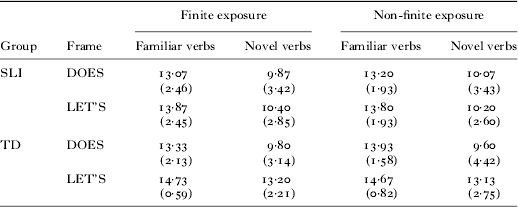
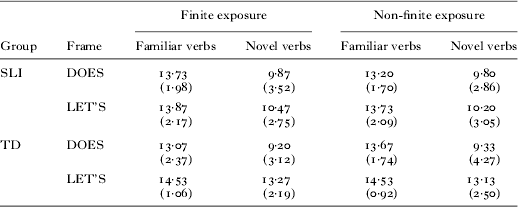
Tables 3 and 4 provide the number of scorable responses for each participant group, divided by type of exposure, sentence frame, and verb familiarity. As can be seen from the tables, the SLI and TD groups were very similar in this regard.
Mean number of scorable responses (and standard deviations) on the finite probes as a function of Exposure Condition, Sentence Frame, Familiarity of Verb, and Participant Group (the maximum is 15 scorable responses)
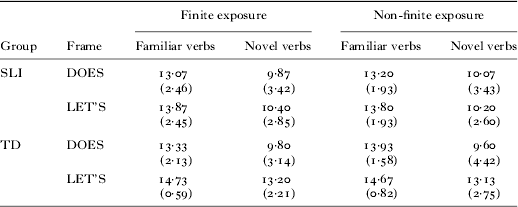
Mean number of scorable responses (and standard deviations) on the non-finite probes as a function of Exposure Condition, Sentence Frame, Familiarity of Verb, and Participant Group (the maximum is 15 scorable responses)

Reliability
Recordings of two randomly selected exposure sessions for each of the sixty children (20% of the data) were transcribed and scored independently by a trained judge. With six post-exposure probe items for novel verbs and six post-exposure probe items for familiar verbs in each exposure session, this amounted to a total of 1,440 probe item responses that were examined for reliability. Two measures of inter-judge reliability were calculated. The first was the percentage of agreement between the original and independent judge on whether a child's response was scorable, following the criteria discussed in the preceding section. The second was the percentage of agreement between the two judges on whether a child's scorable response was accurately produced. For the children with SLI, there was 99% agreement in judging responses as scorable for novel verbs and 99% agreement for familiar verbs. For the TD group, the corresponding agreement values were 97% and 99%. For response accuracy, agreement for novel verbs and familiar verbs for the children with SLI was 96% and 97%, respectively; for the TD group, agreement was 97% and 99%, respectively.
RESULTS
Finite verb probes
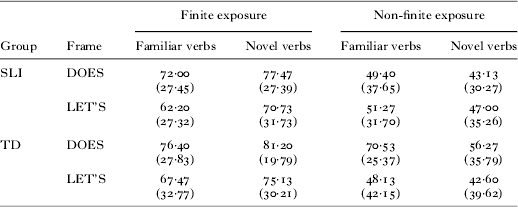
A summary of the children's accuracy on the finite verb probes appears in Table 5. For these probes, correct responses were productions of verbs with the third person singular -s inflection; errors were productions of non-finite (bare) stem forms. The children's productions on the finite verb probes were examined by means of a mixed model analysis of variance (ANOVA) with participant group (SLI, TD) and sentence frame (LET'S, DOES) as between-subjects factors, and exposure condition (finite, non-finite) and verb familiarity (familiar, novel) as within-subjects factors. Arc-sine transformations were applied to the percentage correct data to meet ANOVA assumptions. A highly significant main effect was seen for exposure condition (F(1,56) = 49·32, p < ·001, η 2 p = ·468). Verbs heard exclusively in finite form (M = 72·83, SD = 28·04) were more likely to be produced correctly on the finite verb probes than verbs heard exclusively in non-finite form (M = 51·04, SD = 35·08). Main effects were non-significant for participant group (F(1,56) = 0·87, p = ·355, η 2 p = ·011), sentence frame (F(1,56) = 1·08, p = ·302, η 2 p = ·019), and verb familiarity (F(1,56) = 0·18, p = ·674, η 2 p = ·003).
Mean percentages correct (and standard deviations) on the finite probes as a function of Exposure Condition, Sentence Frame, Familiarity of Verb, and Participant Group; correct responses required use of the third person singular -s inflection on the verb

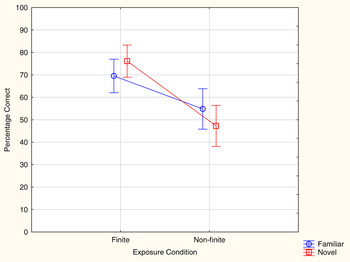
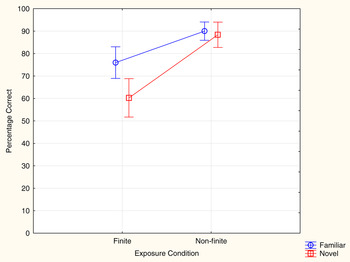
A significant exposure condition x verb familiarity interaction was observed (F(1,56) = 7·31, p = ·009, η 2 p = ·116). Least significant difference testing at the ·05 level indicated that familiar verbs heard in finite form (M = 69·52, SD = 28·68) were more accurate than familiar verbs heard in non-finite form (M = 54·83, SD = 35·13, d = 0·458); similarly, novel verbs were more accurate when heard in finite form (M = 76·13, SD = 27·22) than in non-finite form (M = 47·25, SD = 34·92, d = 0·922). However, as can be seen from the effect sizes, the differences associated with exposure condition were much larger for novel verbs. In addition, accuracy was greater for novel verbs heard in finite form than for familiar verbs presented in finite form (d = 0·236). Figure 1 provides an illustration of this interaction. None of the other ten interactions proved significant (Fs(1,56) ⩽ 2·10, ps ⩾ ·152, η 2 ps = ⩽ ·038).
The children's accuracy in the use of third person singular -s on the post-exposure finite verb probe items as a function of verb familiarity and exposure condition. Values are means; error bars reflect 95% confidence intervals.

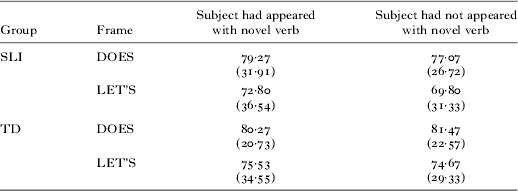
To determine the degree to which the children's productions of the novel verb forms might have been dependent on the particular words appearing with them during the exposure period, we compared the children's accuracy on probe items that employed the same subject as had been used with the novel verb during the exposure period and the accuracy on those items that employed a subject that had never been associated with the novel verb. The results are summarized in Table 6. As can be seen, both the SLI and TD groups were just as likely to produce third person singular -s correctly when the novel verb followed a subject that it had never been associated with in the exposures than when the novel verb followed a subject that had been used with it during the exposure period. This was true for both the DOES and the LET'S presentation frames. For the SLI group that heard verbs in the DOES frame, five children produced a higher proportion of accurate third person singular -s inflections on the finite probes if the subject had been heard with the novel verb, three children produced a higher proportion of accurate inflections if the subject had not been heard with the novel verb, and for seven children accuracy levels were identical in the two cases. For the children with SLI who heard verbs in the LET's frame, similar results were obtained, with the numbers of children being five, four, and six, respectively. The TD group also showed no differences as a function of the type of subject preceding the novel verb. For TD children who heard verbs in the DOES frame, three had a higher proportion of accurate responses if the subject had been heard with the novel verb, four children showed the opposite pattern, and eight exhibited the same level of accuracy for the two subject types. The corresponding numbers for children who heard novel verbs in the LET'S frame were seven, three, and five, respectively.
Mean percentages correct (and standard deviations) on the finite probes as a function of whether the subject had appeared with the novel verb during the exposure period; correct responses required use of the third person singular -s inflection on the verb

Non-finite verb probes
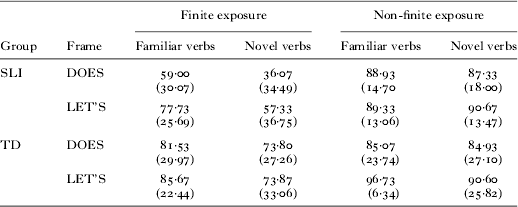
A summary of the children's accuracy on the non-finite probes appears in Table 7. Recall that accurate responses on these probes were productions of non-finite forms rather than finite forms. Errors were instances in which the children inappropriately produced the verb with the -s inflection. Again, a mixed model ANOVA was performed, with arc-sine transformations of the percentage correct data. A main effect for participant group was found (F(1,56) = 6·83, p = ·011, η 2 p = ·109). The TD children (M = 84·03, SD = 25·89) were more accurate than the children with SLI (M = 73·30, SD = 30·81). Familiar verbs (M = 83·00, SD = 33·16) also proved to be more accurately produced than novel verbs (M = 74·33, SD = 32·60) (F(1,56) = 7·66, p = ·008, η 2 p = ·120). Exposure condition was highly significant (F(1,56) = 50·46, p < ·001, η 2 p = ·474), with verbs heard in non-finite form (M = 89·20, SD = 18·80) produced more accurately on these non-finite probes than were verbs heard only in finite form (M = 68·13, SD = 33·16). The main effect for sentence frame did not achieve significance (F(1,56) = 2·90, p = ·094, η 2 p = ·050).
Mean percentages correct (and standard deviations) on the non-finite probes as a function of Exposure Condition, Sentence Frame, Familiarity of Verb, and Participant Group; correct responses required no inflection on the verb; errors involved over-use of the third person singular -s inflection on the verb

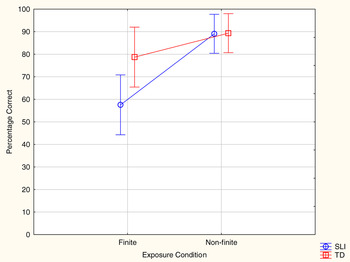
Three of the eleven interactions proved significant. One of these was the participant group x exposure condition interaction (F(1,56) = 8·51, p = ·005, η 2 p = ·132). Post-hoc testing indicated that for the TD children, verbs heard in non-finite form (M = 89·33, SD = 22·35) were produced more accurately on the non-finite probes than verbs heard in finite form (M = 78·72, SD = 28·19, d = 0·417). The same proved true for the children with SLI (M = 89·07, SD = 14·60 versus M = 57·53, SD = 34·57, d = 1·189), with a much larger effect size. For verbs heard only in finite form, the TD group was more accurate on the non-finite probes than were the children with SLI (d = 0·672). An illustration of this interaction appears in Figure 2.
The children's accuracy in the use of non-finite forms on the post-exposure non-finite verb probe items as a function of participant group and exposure condition. Values are means; error bars reflect 95% confidence intervals.

The exposure condition x verb familiarity interaction was also significant (F(1,56) = 14·04, p < ·001, η 2 p = ·200). According to post-hoc testing, verbs heard in non-finite form were produced more accurately on the non-finite probes than verbs heard in finite form, whether the verbs were familiar (M = 90·02, SD = 15·91 versus M = 75·98, SD = 28·45, d = 0·609) or novel (M = 88·38, SD = 21·41 versus M = 60·27, SD = 35·82, d = 0·953), though the effect size was much larger for novel verbs. At the same time, for verbs heard only in finite form, familiar verbs were produced more accurately than novel verbs on these non-finite probes (d = 0·486). This interaction is shown in Figure 3. Finally, the participant group x exposure condition x sentence frame interaction was significant (F(1,56) = 4·39, p = ·041, η 2 p = ·073). For the children with SLI, verbs heard in the finite frame Do you think the N Vs? (M = 47·53, SD = 33·86) were less accurately produced on the non-finite probes than verbs heard in the finite frame All day long, the N Vs (M = 67·53, SD = 32·83, d = 0·600). In addition, the differences between the SLI and TD groups (favoring the latter) was greater for the Do you think frame (M = 47·53, SD = 33·86 versus M = 77·67, SD = 28·42, d = 0·964) than for the All day long frame (M = 67·53, SD = 32·82 versus M = 79·77, SD = 28·40, d = 0·399). For the TD group, the type of finite frame had no bearing on accuracy. The remaining eight interactions were non-significant (Fs(1,56) ⩽ 0·42, ps ⩾ ·522, η 2 ps =⩽ ·007).
The children's accuracy in the use of non-finite forms on the post-exposure non-finite verb probe items as a function of verb familiarity and exposure condition. Values are means; error bars reflect 95% confidence intervals.

As can be seen in Figures 2 and 3, the children sometimes produced finite forms in response to non-finite probe items (e.g. We wanna watch the cat … neffs). Such errors were more likely to be produced by the children with SLI, and if the verb had been heard only in finite form. One possible interpretation of this type of error is that the children regarded the verb as an uninflected monomorphemic word. For example, neffs might have been interpreted to be like the verb fix. To evaluate the likelihood of this type of interpretation on the part of the children, we reviewed the children's responses on the finite probes. We reasoned that if the uninflected monomorphemic verb interpretation was operative in the data, we should have seen productions of the type neffses [nεfsəz]) on the finite probes, given that monomorphemic verbs ending in [s] or [z] require the allomorph [əz] (e.g. fixes [fɪksəz]). However, we found no novel verbs produced with the allomorph [əz] in the data from either group of children. It is true that this allomorph is usually acquired later than [s] and [z], and none of our pre-experimental or post-exposure probe items required this allomorph. However, one child with SLI and one TD child who produced forms like neffs in response to post-exposure non-finite probe items were observed to produce bounces (with the allomorph [əz]) instead of hops for one of the post-exposure familiar verb probe items.
Another way of evaluating the uninflected monomorphemic verb interpretation was to compare the children's tendency to produce such errors as a function of whether the consonant cluster created with the addition of third person singular -s corresponded to a legal word-final cluster in monomorphemic words. This was true for six of the twenty novel verbs – those ending in [ks] such as feeks (as in fix), [ps] such as swopes (as in lapse), and [nz] such as truns (as in bronze). The remaining fourteen novel verbs (e.g. tomes, pags, mabs) did not have monomorphemic counterparts ending with the same cluster. If children were treating any of the novel verbs presented in the finite condition as monomorphemic, those novel verbs whose inflected forms ended in [ks], [ps], and [nz] should have been most likely to be produced incorrectly on the non-finite probes (e.g. as feeks instead of feek). However, the data revealed no clear pattern. The children with SLI showed an error rate of 58% (e.g. saying feeks in a non-finite context) for novel verbs with legal monomorphemic contexts and 55% (e.g. saying tomes in a non-finite context) for novel verbs whose resulting clusters do not occur in English monomorphemic words. The corresponding values for the TD children were 30% and 25%, respectively. The cluster most likely to have been heard in monomorphemic words in children's everyday lives was [ks], as words such as box, fox, fix, tax, and fax are quite common. However, novel verbs with other types of clusters (e.g. [ts], [mz]) were just as likely as those with [ks] to be produced inaccurately on the non-finite probes. This was true for both groups of children.
DISCUSSION
In this study, we tested four predictions. We discuss the results for each prediction and their implications in turn.
Did children with SLI and younger TD children show significant input effects? Were these effects stronger in the SLI group?
The children's responses to both the finite and non-finite probes showed strong input effects. Verbs heard in third person singular -s form during the exposure period were more likely to be produced in this form on the finite verb probes than were verbs heard in non-finite form. Likewise, verbs heard in non-finite form during the exposure period were the most likely to be used in non-finite form on the non-finite probes. This proved true for both groups of children.
As predicted, the input effects were stronger for the children with SLI, but only on the non-finite probes. It is not clear to us why the input effects were not significantly larger for the SLI group than for the TD group on the finite probes. However, this outcome seems due to the TD children showing a larger than expected input effect rather than the children with SLI showing a smaller than expected input effect. This was especially striking for novel verbs, where the use of third person singular -s by the TD children was on average 29% higher for novel verbs that they had heard exclusively in finite form than for novel verbs heard only in non-finite form, matching the similarly large difference of 29% seen for the children with SLI.
Were children with SLI especially prone to over-apply third person singular -s when tested on sentences containing finiteness dependencies?
The non-finite probe items required children to complete the sentence We wanna watch the N ___ with the appropriate form of the verb. In these cases, use of third person singular -s represents over-application in the non-finite context. For verbs presented to the children exclusively in third person singular -s form, the children with SLI were more likely than the TD children to make the over-marking error (e.g. We wanna watch the cat hides). We take this finding as strong evidence in support of the idea that children's tense and agreement errors have their basis in difficulties recognizing the larger contexts in which verb forms are used.
Because productions of finite forms in non-finite contexts are infrequent among both TD children and children with SLI, we evaluated other factors that might explain these results. We found no evidence that the children interpreted novel words as monomorphemic forms ending in /s/ or /z/ (comparable to fix), as they also made over-marking errors on familiar verbs. In addition, they never produced forms such as feekses even though some children produced bounces in place of hops. Finally, the over-marking occurred regardless of the phonotactic characteristics of the word.
Given this evidence, it seems most appropriate to regard the children's errors on the non-finite probes as over-applications of the third person singular -s form. We believe the reason for these error forms is related to the children's relative insensitivity to the fact that the finiteness of the verb form is tied to the type of verb used earlier in the sentence. Children who do not understand this relationship might simply supply the verb in the form in which it was heard during the exposure period. Note that in the case of a finite verb, the child's produced form (e.g. hides) would agree with the immediately preceding subject (e.g. cat) in person and number, so there would be no local cue to discourage the children's use of these forms.
Earlier we noted that a recent study by Purdy et al. (in press) lends support to this interpretation. Children with a history of a protracted period of tense/agreement inconsistency exhibited event-related potentials (ERPs) indicating that they were successfully detecting local errors (e.g. Every night they talks on the phone) but were insensitive to such errors as We watch the happy girl climbs up the ladder and He makes the quiet boy talks a little louder. Whereas for TD children the latter type of sentence elicited a very robust P600 – the well-known neural response to a grammatical error – the P600 for the children with a history of SLI was delayed, shorter in duration, and significantly reduced in amplitude. If the children with SLI failed to understand the structural ties between the early appearing verbs (e.g. watch, makes) and the later-appearing verbs in these constructions, the local agreement reflected in sequences such as the happy girl climbs and the quiet boy talks could easily have led them to regard these sentences as unremarkable. Similarly, in the non-finite probe task of the present study, not grasping that the carrier phrase We wanna watch the N … (V) dictates a non-finite verb, the children could easily have supplied a verb form (e.g. sings, mabs) that agreed with the preceding noun in person and number, especially if that verb was strongly associated with the agreement inflection (-s) in the input, as were the novel verbs heard only in the finite exposure condition.
An unexpected finding reported by Redmond and Rice (Reference Redmond and Rice2001) may be explained with this same interpretation. Using a grammaticality judgment task, these investigators found that children with SLI could correctly reject agreement errors in simple sentences but inexplicably accepted sentences such as He made the robot fell into the pool. If the children failed to appreciate that the verb, made, obligates a non-finite complement, the sequence the robot fell into the pool would seem appropriate in this context.
At first blush, it may seem problematic that a principle responsible for children's failure to use a form such as third person singular -s could also be responsible for children's over-use of that same form in non-finite contexts in which the adult grammar prohibits its use. The common principle is that in each case the children do not understand the structural ties between the earlier- and later-appearing verb forms in the sentence, and therefore the later-appearing subject–verb sequence is not constrained. Thus, the girl sing might be viewed as appropriate to extract from We wanna watch the girl sing, and if presented with the carrier phrase We wanna watch the girl … (V), the children might well supply the verb form (sings) that agrees with girl, not knowing that the earlier-appearing information (We wanna watch) requires a non-finite complement.
It is important to point out that the children may also have failed to appreciate the structure reflected in one of the frames used in the finite condition during the exposure period, Do you think the N Vs? We assume that when children acquire third person singular forms from the input, they not only take these forms from simple sentences but also from those such as Do you think the bunny likes carrots? In this instance, extraction of the subject–verb clause does not lead to an error, because Do you think is followed by a finite rather than a non-finite clause. This idea was first pointed out in the development of MOSAIC – that ‘correct’ forms might initially be based on smaller sentence contexts in the input, with no assumption that the children have yet understood the larger context in which the forms appear (Freudenthal et al., Reference Freudenthal, Pine and Gobet2009, p. 12). The children might be unaware that their extraction of the bunny likes carrots might be no different from their extraction of the girl sing from We wanna watch the girl sing.
In fact, we might speculate that the SLI group's incomplete grasp of presentations such as Do you think the frog swopes? contributed to the interaction with sentence frame that we found for the non-finite probes. In this interaction, the children with SLI were more likely to use the third person singular inflection on the non-finite probes if the verbs had been heard in the Do you think the N Vs? frame than if they had been heard in the All day long, the N Vs frame. Hearing the inflected form in a longer sentence with a poorly understood structure (Do you think the N Vs) may have made it more likely that these children would apply the same inflected form to another longer sentence with a poorly understood structure (We wanna watch the N …).
Were input effects seen for all sentence frames?
We observed significant input effects for both types of finite exposure frame and both types of non-finite frame. As just noted, for the children with SLI, one type of finite frame produced greater input effects (a difference of 30% for familiar verbs and 51% for novel verbs) than the other (a difference of 12% for familiar verbs and 33% for novel verbs), but the difference even on the latter was substantial.
The two non-finite frames used during the exposure period in this study served complementary purposes. Whereas both served as a source for extracting a non-finite subject–verb sequence, the pronoun subject forms associated with these two frames were different. With one type of frame, nominative case pronouns were used in one-third of the exposures (e.g. Does she tome?). With the other type of frame, accusative case pronouns were used one-third of the time (e.g. Let's watch her kreff). The fact that we found clear input effects with both types of frame provides support for the idea that non-finite verb productions with either nominative (e.g. She run) or accusative (e.g. Her run) case pronoun subjects could have their roots in the input, as first noted in Croker et al. (Reference Croker, Pine, Gobet, Altmann, Cleeremans, Schunn and Gray2001).
Two alternative input-related accounts. There are alternative input-related proposals for the source for case errors such as her go and him jump. In her ‘input ambiguity’ hypothesis, Pelham (Reference Pelham2011) pointed out that certain pronoun forms, such as you and it, are identical in nominative and accusative case. Furthermore, the pronoun form her is used in genitive as well as accusative case. The identical forms appearing in more than one sentence context might lead children to treat accusative pronouns, such as him, her, me, and them as appropriate to use in other sentences contexts, such as subjects of verbs. Pelham found that case-ambiguous pronouns (such as you and it) were common in child-directed speech in English, whereas they were much less common in German, a language in which children rarely produce pronoun case errors. The input ambiguity proposal is highly plausible, and it is not incompatible with our approach. On the other hand, it requires the assumption that the multi-case pronoun properties of forms such as you and it generalize to different pronouns (such as him, me, them). In the approach adopted here, in contrast, children can directly apply forms such as him and me as subjects (e.g. Him running, Me throw the ball) to their own utterances after hearing them as subjects of non-finite sequences in the input (e.g. We saw him running, Watch me throw the ball).
Another input-related approach is the ‘input informativeness’ approach of Rispoli, Hadley, and their colleagues (Hadley, Rispoli, Fitzgerald & Bahnsen, Reference Hadley, Rispoli, Fitzgerald and Bahnsen2011; Rispoli, Hadley & Holt, Reference Rispoli, Hadley and Holt2012). These investigators adopted the view advanced by Yang and his colleagues (Legate & Yang, Reference Legate and Yang2007; Yang, Reference Yang2002) who proposed that optional infinitives occur in English because young children require a significant amount of exposure to input before the tense parameter is set to [+tense]. The longer duration is attributed to the relative sparseness of overt tense morphemes (e.g. -ed, -s, finite copula, and auxiliary be forms) in English relative to the many instances in which tense is ambiguous (e.g. invariant forms such as hit, imperatives, zero-marked forms such as walk in I walk, you walk, we walk, they walk). A comparative analysis of child-directed speech samples in English, Spanish, and French by Legate and Yang yielded results consistent with this view. The language with the largest proportion of overt tense morphemes in the input (Spanish) was associated with an optional infinitive stage of the shortest duration, whereas the language with the smallest proportion of overt tense morphemes (English) was associated with the longest period of optional infinitives. Hadley et al., asked whether differences in degree of tense morpheme use between speakers of the same language might also relate to children's use of optional infinitives. The answer was in the affirmative; these investigators found faster growth of tense/agreement morpheme use in young children whose parents exhibited high percentages of overt tense morphemes in their child-directed speech.
Although the input informativeness account places importance on the role of input, it assumes that children's acquisition of language is constrained by principles of universal grammar, including the principle of structure dependence. Therefore, because questions such as Does the baby like juice? and Is the kitty eating? have overt tense forms (does, is), these forms are assumed to reinforce a [+tense] parameter setting; the fact that these tense forms are separated from the lexical verbs (like, eating) does not pose a special problem given the children's knowledge of structural relations. In the approach adopted in the present study, in contrast, the separation of utterance-initial auxiliaries and later appearing non-finite subject–verb sequences is assumed to be one of the driving forces behind children's use of non-finite utterances.
Another difference between the approaches revolves around lexical effects. In the framework of Legate and Yang (Reference Legate and Yang2007) adopted by the input informativeness approach, the [+tense] parameter setting depends on the proportion of overt tense forms but there is no basis for expecting lexical effects. In contrast, following MOSAIC, such effects are assumed in our approach, as verbs are likely to differ in the frequency with which they occur as non-finite forms in the input. Freudenthal et al. (Reference Freudenthal, Pine and Gobet2010) tested this assumption by applying MOSAIC to child-directed speech in five different languages, including English. Clear lexical effects were found across languages.
Were input effects stronger for novel verbs than for familiar verbs? Could inflected novel verbs be used in the context of subjects that had never been associated with the verbs during the exposure period?
Probably the most predictable outcome of this study was the finding that novel verbs exerted stronger input effects than familiar verbs. This tendency was first reported by Theakston et al. (Reference Theakston, Lieven and Tomasello2003) for typically developing children, and observed as well by Leonard and Deevy (Reference Leonard and Deevy2011) for children with SLI using a different tense/agreement morpheme and set of sentence frames. The findings from the finite probes are especially compelling. For both groups of children, novel verbs heard in inflected form were more likely to be used accurately on the finite probes than were familiar verbs that were presented in the same condition. Obviously, production practice was not responsible for this difference; the number of opportunities to use finite forms within our experimental context was the same for novel and familiar verbs. In fact, the children probably had multiple opportunities to use the familiar verbs with third person singular -s prior to their participation in the study. Instead, the more accurate use of third person singular -s on novel rather than familiar verbs presented in the finite exposures is likely due to these novel verbs having no history of being heard in an alternative (non-finite) form.
However, we do not view these findings as meaning that each verb-specific pattern of use is independent of the children's broader grammar. Our use of the novel verb paradigm in this study was designed to capitalize on the strong associations formed between lexical items and specific structures, especially if the lexical items uniformly appear in the same structure. However, as in MOSAIC, these strong associations do not constitute isolated pieces of grammar, distinct from other grammatical entries. Two observations are consistent with this interpretation. First, children showed productivity with their ability to use the novel verbs on the probes with subjects that had not been paired with the verbs during the exposure period. Second, although there was a strong statistical effect of using the novel verb on the probes in a manner that matched the way the novel verb had been presented during the exposure period, the children did not always faithfully reproduce the inflected version of the novel verb. There were many instances in which the children produced a bare stem even when the novel verb had been heard only in inflected form. That is, even their novel verb use sometimes showed the optionality that was characteristic of their everyday speech. This suggests that there may be some additional mechanism in operation to account for especially high rates of non-finite verbs in the speech of young English-speaking children. Räsänen, Ambridge, and Pine (Reference Räsänen, Ambridge and Pine2013) presented evidence in support of their proposal that many examples of bare stems in the early language of English-speaking children do not reflect selection of a non-finite verb, but result from the child's default to the most frequent and phonologically least complex form in the input.
Input effects and the SLI profile
The findings of this study are not predictable from the perspective of the extended optional infinitive approach, but in most respects are quite consistent with predictions based on MOSAIC. In particular, children's use of finite or non-finite forms could be traced to the finiteness of the forms in the input. A variety of input structures affected the children's non-finite use, but all shared the property of having a local sequence of a subject followed by a non-finite verb toward the end of the input utterance. Lexical effects were clear, but the children's productions went beyond rote recall. Of course, the present study was an experimental study; therefore, certain details, such as the over-marking errors that we were able to induce through the use of particular exposure and probe combinations, would not be as typical in MOSAIC, given its use of natural speech samples as input.
In this study, we applied an input-based approach to the study of children with SLI. The data for these children showed an even stronger input effect than for the TD children, even though the children were similar in MLU. This finding parallels the results of comparative studies showing that the correspondence between tense/agreement use and MLU in children with SLI is not the same as for TD children.
We suspect that a computational model such as MOSAIC is capable of simulating the SLI profile of a continued high frequency of non-finite verb forms even when longer utterances in the input can be processed. Of course, success in modeling a profile is not the same as explaining why children with SLI show a different profile in the first place. And here we (and, we believe, others) must speculate. We suspect that the protracted use of optional infinitives after length constraints have relaxed is due to a combination of more general syntactic comprehension difficulties and the children's reliance on communicatively functional subject–verb sequences that had their origins in utterance-final portions of input sentences. For years, the syntactic comprehension weaknesses in children with SLI have been documented, even in children presumed to have primarily expressive language deficits (Bishop, Reference Bishop1979, Reference Bishop2013). In production, these children often limit their utterances to simple sentences despite an MLU that permits longer utterances, and once they attempt complex sentences they have more difficulty than younger TD children in using obligatory connectives that specify the relations between clauses (Owen & Leonard, Reference Owen and Leonard2006; Schuele & Dykes, Reference Schuele and Dykes2005; Schuele & Nicholls, Reference Schuele and Nicholls2000; Schuele & Tolbert, Reference Schuele and Tolbert2001).
It seems possible that as children with SLI identify utterance-final subject–verb sequences in the input, they are drawn to the coherence of these sequences as complete propositions (e.g. Watch the dolphin jump; Did the dolphin jump?) and subsequently rely too heavily on these subject–verb propositions in their speech, even importing them into multi-clause sentences once their utterance lengths increase. This may be the reason why their complex utterances can have the appearance of merged propositions, as in Me want that piece go right there (Eyer & Leonard, Reference Eyer and Leonard1995).
For finite subject–verb propositions derived from simple sentences in the input, this reliance would be undetectable until children make attempts at other sentence types, as in Ernie told Elmo picked up the box and Point to the truck knocked Bert over (Owen & Leonard, Reference Owen and Leonard2006; Schuele & Tolbert, Reference Schuele and Tolbert2001). Finite utterances modeled after the input might also be attached to question forms. For example, preschoolers with SLI are more likely than younger MLU-matched TD children to produce wh-questions with auxiliaries that follow rather than precede the subject, as in Where the boys are going? (Leonard, Reference Leonard1995), a finding of some interest considering that these same children are still in the optional infinitive stage. It seems likely that the integrity of the subject–verb proposition – whether finite or non-finite – contributed to the findings noted earlier that these children are insensitive to errors in sentences such as He makes the quiet boy talks a little louder and He made the robot fell into the pool. If children are treating propositions as self-contained units concatenated with other propositions, they would not recognize the finite over-marking in the second (boldfaced) subject–verb proposition in these sentences.
Although we have emphasized children's attraction to subject–verb propositions, we must note that these units are highly compatible with input calculations of utterance-final non-finite verb frequency in models such as MOSAIC. A wide range of structures containing utterance-final non-finite verbs also have subjects immediately preceding these verbs, as in We saw the bear/him eating, Let's make the dog/him sit up, I watched the girl/her draw a picture, Did the girl/she finish her breakfast?, and Is the baby/she crying? Similarly, in other languages modeled successfully by MOSAIC, the degree to which subjects immediately precede non-finite verbs in the input seems to be a relevant factor (see Leonard & Deevy, Reference Leonard and Deevy2011, pp. 269 – 270).
Given that achieving adult-like syntax is a slow process in SLI, with some individuals showing weaknesses even in adulthood, we suspect that resolving difficulties with finiteness dependencies is a piecemeal process, rather than the result of acquiring a single general principle. This seems especially likely considering the diversity of structures involving such dependencies, as shown above. Once children with SLI show evidence of progressing beyond subject–verb propositions in their own speech, it is possible that the input frequency of occurrence of the various structures with finiteness dependencies will be a significant predictor of the order in which the children begin to shed their use of non-adult-like non-finite utterances. The feasibility of this idea can probably be tested through computational models that systematically manipulate the input frequencies of particular structures once the processing constraint is relaxed to permit the inclusion of more distant left-edge material.
Potential application for treatment
If, as we believe, the use of optional infinitives is related to characteristics of the input, treatment for children with SLI might require a change. For example, in addition to activities designed to give children more practice in using tense/agreement morphemes, activities might be designed that help the children learn that non-finite sequences are restricted to particular syntactic structures. Such a shift would place greater emphasis on comprehension than has been the case in most intervention studies focusing on fostering tense/agreement morpheme use (e.g. Leonard, Camarata, Brown & Camarata, Reference Leonard, Camarata, Brown and Camarata2004). Because previous efforts have only met with modest success, a modification of this type, if empirically based, would be well justified.