Antimicrobial stewardship programs (ASPs) promote the optimal choice, dose, duration, and route of antibiotics. 1 Currently, the Centers for Disease Control and Prevention (CDC) recommend that ASPs measure antimicrobial use in days of therapy (DOT) per 1,000 patient days (PD). This metric, however, does not account for the spectrum of activity of antibiotics and, thus, may not account for significant changes in prescribing patterns. In response, several scoring systems to measure antibiotic spectrum have been created and applied to different patient populations.Reference Madaras-Kelly, Jones and Remington 2 – Reference Gerber, Hersh and Kronman 4 For example, when applied to pediatric community-acquired pneumonia, an antibiotic spectrum index (ASI) was able to capture changes in empiric therapy not reflected in DOT per 1,000 PD.Reference Gerber, Hersh and Kronman 4
Almost all very-low-birth-weight (VLBW, <1,500 g) infants in the neonatal intensive care unit (NICU) receive antibiotics.Reference Flannery, Ross and Mukhopadhyay 5 Although at high risk for infection, excess antibiotic exposure in this population has been associated with significant morbidity.Reference Cotten, Taylor and Stoll 6 , Reference Kuppala, Meinzen-Derr and Morrow 7 Antimicrobial stewardship is challenging yet essential in the NICU, and changes in prescribing practices may not be adequately captured with a metric focused solely on the volume of antibiotics exposure. The objective of this study was to apply an ASI to a VLBW population to assess its utility in capturing changes in multiple dimensions of antibiotic use following the implementation of NICU-specific antimicrobial stewardship interventions.
Methods
A retrospective cohort study was conducted to compare antibiotic use for inborn VLBW infants admitted to St Louis Children’s Hospital NICU between January 1 and December 31, 2014, and between January 1 and December 31, 2017. Neonates with major congenital malformations, death, or transfer to another institution in the first 5 days of life were excluded.
Data collection
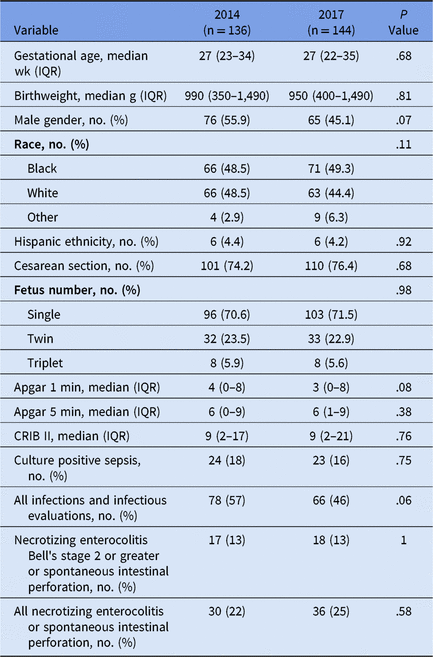
Demographic data were collected for each patient (Table 1). All parenteral or oral antibiotic administration during each patient’s NICU admission was recorded. Every calendar day a patient received 1 antibiotic equaled 1 DOT; 2 different antibiotics received on 1 day equaled 2 DOT.Reference Barlam, Cosgrove and Abbo 8 The ASI for each antibiotic course was calculated using the Gerber et alReference Gerber, Hersh and Kronman 4 scoring system and summed for each patient’s NICU stay. Briefly, the ASI assigns a point for activity against 13 clinically relevant pathogens with an additional point for activity against multidrug-resistant organisms. Antibiotic days (AD) were calculated as each calendar day a patient received any number of antibiotics. Patient days (PD) were recorded as the number of calendar days an infant was admitted to the NICU. The DOT per 1,000 PD and ASI/AD values were calculated for each patient, as well as for each study year. A subgroup analysis was performed based on 4 disease categories common to the NICU: (1) culture proven late onset sepsis (LOS) or meningitis (2) all infections and infectious evaluations resulting in initiation of antibiotics (3) necrotizing enterocolitis (NEC) Bell’s stage ≥2 or spontaneous intestinal perforation (SIP), and (4) NEC all stages or SIP.
Patient Demographics and Clinical Characteristics

Note. IQR, interquartile range; CRIB II, Clinical Risk Index for Babies score.
Antimicrobial stewardship
Our institution implemented a prospective-audit with feedback ASP in August 2016. Specific NICU interventions implemented during this time included (1) changing the empiric LOS regimen from vancomycin and gentamicin to oxacillin and gentamicin and (2) changing the empiric NEC regimen from vancomycin, clindamycin, and gentamicin to ampicillin and gentamicin with the addition of metronidazole for suspected perforation or necrosis and (3) defining standard antibiotic durations for culture-negative sepsis (5 days), Bell’s stage 1 NEC (2–3 days), Bell’s stage 2 NEC (7 days), and Bell’s stage 3 NEC (10 days).
Statistical analysis
Demographic and clinical factors for infants born in 2014 were compared with those born in 2017 using the Mann-Whitney U test and the Fisher exact test for continuous and categorical variables, respectively. Total DOT per 1,000 PD and ASI/AD values for patients born in 2014 were compared to those born in 2017 using an unadjusted Poisson regression analysis. Statistics were performed using SPSS Statistics Grad Pack version 24.0 software (IBM Armonk, NY) and Stata software (StataCorp version 15.1, College Station, TX).
Results
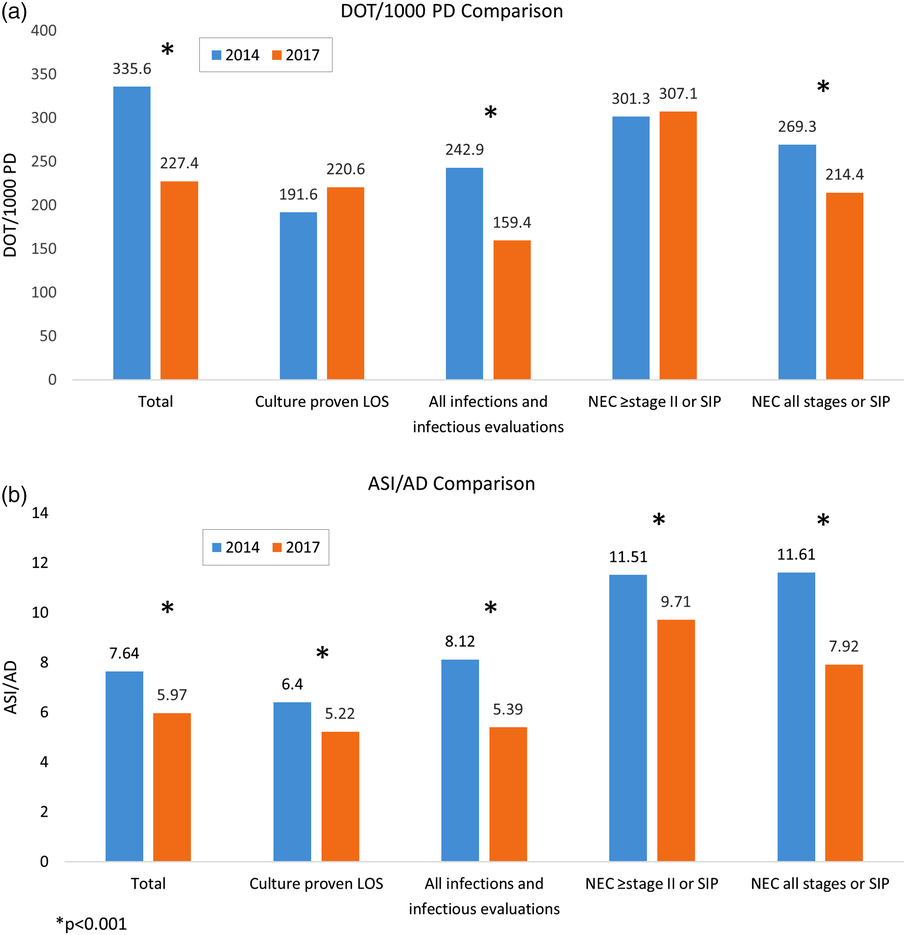
In 2014 and 2017, 136 and 144 infants met our inclusion criteria, respectively. No significant differences in demographics or clinical illness indicators were observed between the 2 study years (Table 1). All of the infants in 2014 were exposed to antibiotics during their NICU admission, while 11.8% of infants in 2017 had no antibiotic exposure during the entire duration of their hospitalization. The total DOT per 1,000 PD was 335.6 in 2014 and 227.4 in 2017, a 32% reduction (P < .001). In addition, the total ASI/AD decreased from 7.63 in 2014 to 5.97 in 2017 (P < .001).
Subgroup analyses demonstrated that infants with culture proven LOS or meningitis, and those with NEC Bell’s stage 2 and above or SIP had no difference in DOT per 1,000 PD between study years, but ASI/AD decreased significantly (P < .001) (Fig. 1). The DOT per 1,000 PD and ASI/AD values both decreased significantly in the LOS and all other infectious evaluations subgroup as well as the NEC of all stages and SIP subgroup (P < .001).
Subgroup analysis by disease state of (A) days of therapy (DOT) per 1,000 patient days (PD) and (B) antibiotic spectrum index per antibiotic day (ASI/AD).

Discussion
In this single-center, retrospective study, we utilized the ASI metric to examine an added dimension of antibiotic exposure following antimicrobial stewardship interventions implemented in the NICU. The significant decrease in the ASI/AD in infants with culture confirmed infection, NEC, or SIP, whereas the DOT per 1,000 PD remained unchanged highlights the importance of the ASI in capturing the impact of antimicrobial stewardship on the spectrum of agents chosen despite similar use as measured by more standard ASP metrics.
Antimicrobial stewardship metrics have historically focused on the quantity of antibiotic used. Although quantity-based metrics reflect some changes in prescribing practice, their inability to capture changes in spectrum has led to development of new metrics. Madaras-Kelly et alReference Madaras-Kelly, Jones and Remington 2 , Reference Madaras-Kelly, Jones and Remington 3 used a Delphi approach to create a spectrum score that was validated to demonstrate de-escalation of antimicrobial treatment in an adult healthcare system, but the scoring system is complex. Stenehjem et alReference Stenehjem, Hersh and Sheng 9 used a system of classifying antibiotics into 5 categories, a simpler approach with less nuance than a spectrum score or index.
The ASI/AD method used in our study is a simple yet detailed and specific method of measuring spectrum of activity of antimicrobial agents. Our study highlights the need for a metric like the ASI/AD to capture important antibiotic use improvements while the quantity of antibiotics might remain unchanged. This metric is likely most important in high-risk groups like VLBW infants among whom broad-spectrum antimicrobial use has been associated with negative consequences.Reference Cotten, Taylor and Stoll 6 , Reference Kuppala, Meinzen-Derr and Morrow 7 , Reference Cotten, McDonald and Stoll 10
Our study has several limitations. First, this study was done at a single institution; it might not be generalizable. Second, a before-and-after study with only 2 time points was performed, limiting our ability to definitively conclude that the ASP was the driving factor in prescribing practice changes. Finally, the ASI/AD metric does not differentiate between appropriate and inappropriate antibiotic use or account for additional risks that might be present in the use of certain antibiotics. For example, the ASI does not account for differences in local microbiologic and antibiotic susceptibility profiles, which may warrant empiric utilization of broader-spectrum antibiotics in individual institutions. Future studies will be required to evaluate effect on microbial resistance patterns or on clinical outcomes in this high-risk population.
In conclusion, our study has demonstrated the utility of the ASI/AD metric in capturing changes in antibiotic use that are not completely documented with the currently used, CDC recommended metric of DOT per 1,000 PD. We propose that the ASI/AD metric should be utilized in addition to DOT per 1,000 PD when evaluating the impact of antimicrobial stewardship interventions.
Financial support
No financial support was provided relevant to this article.
Conflicts of interest
All authors report no conflicts of interest relevant to this article.