Introduction
The links between depression, the personality trait of neuroticism, and cognitive decline are complex, though some research undertaken in the last two decades that has shed light on this area. Late-life depression (LLD) is associated with later cognitive decline and development of dementia, and presence of neuroticism in older depressed patients has been shown to increase risk of cognitive decline and dementia (Manning et al., Reference Manning, Chan and Steffens2017; Terracciano et al., Reference Terracciano2021). While personality has traditionally thought to be stable over time, increasing evidence suggests personality – and neuroticism in particular – may increase with age and as older adults transition across the spectrum of pathological aging (Roberts et al. Reference Roberts, Walton and Viechtbauer2006). For example, Caselli et al., found that an increase in neuroticism preceded the transition from cognitively normal to prodromal Alzheimer’s disease. Considering LLD is a risk factor for Alzheimer’s disease, and baseline neuroticism leads to cognitive decline in LLD, understanding how changes in neuroticism influence cognition in older depressed adults may help identify patients at risk of cognitive decline (Caselli et al., Reference Caselli2018).
Reported neuroticism may be influenced by concurrent depression. Therefore, repeated measures of personality may show decreases in neuroticism among patients whose depression is successfully treated (Renner et al., Reference Renner, Penninx, Peeters, Cuijpers and Huibers2013). In a study of adult patients (mean age 4.19 years) seen in an Affective Disorders Program, the authors found that neuroticism correlated significantly with depression at baseline, and that over 12 weeks of treatment, both depression scores and levels of reported neuroticism decreased, with the change scores between the two measures being highly correlated (Griens et al., Reference Griens, Jonker, Spinhoven and Blom2002). However, while neuroticism may decrease in major depression following treatment, the absolute level of neuroticism in depressed patients who experience remission from depression at 12 weeks remains much higher than nondepressed comparison participants (Bagby et al., Reference Bagby, Joffe, Parker, Kalemba and Harkness1995). Less clear is the extent to which there are differential effects of depression changes on longitudinal measures of neuroticism among patients treated for depression, with some experiencing substantial decrease in levels of reported neuroticism, while others showing stability in reported neuroticism. Even less is known about the relationship between depression severity and neuroticism among older depressed adults.
Thus, examining neuroticism in older adults at two time points in the context of depression treatment may help identify those individuals with a persistent personality trait, as well as others for whom a state of depression may be exerting significant effects on their initial report of neuroticism. With this perspective, examination of the extent of neuroticism change with depression treatment becomes an important variable of interest in predicting cognitive decline. In the present investigation of older depressed adults enrolled in the neurobiology of LLD (NBOLD) study (Steffens et al., Reference Steffens, Manning, Wu, Grady, Fortinsky and Tennen2015), we examined the effect of 1-year change in neuroticism as measured on the NEO-Personality Inventory on 3-year change in global cognitive performance as measured as on the Consortium to Establish a Registry for Alzheimer’s disease (CERAD) cognitive battery. We hypothesized that change in neuroticism would be inversely associated with cognitive change such that older depressed patients with greater change (lowering) in neuroticism score over 1 year would be associated with less cognitive decline over 3 years.
Methods
Subjects
All subjects were enrolled in NBOLD, an NIMH funded study at UConn approved by its Institutional Review Board. After reviewing study information, all subjects provided written, informed consent to participate.
Depressed subjects were recruited from clinic referrals and newspaper advertisements. Inclusion criteria for depressed subjects were aged 60 or above, ability to read and write English, Mini-Mental State Examination (MMSE) score 25 or greater and meeting criteria for major depression, and single episode or recurrent. Study exclusion criteria were current or recent alcohol or drug dependence; conditions associated with brain MRI abnormalities; physical or intellectual disability that may affect completion of self-rating instruments; established clinical diagnosis of dementia; other major DSM Axis 1 psychiatric disorders; and metal or pacemaker in the body or claustrophobia that might preclude MRI. In addition, current treatment with fluoxetine was an exclusion criterion for the depressed group given its long washout period.
The screening and assessment procedures used in NBOLD have been reported previously (Steffens et al., Reference Steffens, Manning, Wu, Grady, Fortinsky and Tennen2015). Briefly, participants were screened for depression using the Center for Epidemiologic Studies Depression scale, using a score of 16 or greater as a cutoff for depression. Upon enrollment and completion of baseline assessments, each participant was paid $100 for their time completing the MRI, cognitive test battery, and experimental computerized measures. The clinical assessment procedures are summarized below.
Baseline assessments
Trained clinical research assistants administered the Duke Depression Evaluation Schedule (DDES) to each participant via computer-assisted data entry. The DDES contains items covering demographic data, social variables, and the Diagnostic Interview Schedule sections for depression, mania, generalized anxiety disorder, somatization symptoms, and alcohol use. A study psychiatrist interviewed each subject to establish a clinical diagnosis of major depression and then administered the Montgomery–Åsberg depression rating scale (MADRS) (Montgomery & Åsberg, Reference Montgomery and Åsberg1979). Each subject completed several self-report measures, including the NEO PI-R (Costa and McCrae, Reference Costa and McCrae1992) as a measure of neuroticism. Within the neuroticism subscale, we also calculated the score for the facet vulnerability to stress.
Treatment protocol
Study psychiatrists followed a treatment protocol that employed both structured and naturalistic components. All depressed subjects were offered open-label treatment with sertraline for 12 weeks. Individuals taking antidepressants at baseline who otherwise met inclusion criteria underwent a study-related 2-week medication washout with weekly telephone contact to assess clinical status and provide in-person assessments as warranted. Those who had prescribers or psychotherapists who did not wish to participate in study-based treatment could continue medication treatment or psychotherapy outside the study.
Neuropsychological assessment
Subjects were administered a standardized cognitive assessment that is comprised of the CERAD neuropsychological battery (Morris et al., Reference Morris1989), a collection of neuropsychological measures with normative standards for the elderly and established utility in longitudinal studies of cognitive impairment. While other cognitive assessments of various domains are also included in NBOLD, the current study focused on the CERAD, a composite measure of cognitive functioning. The CERAD measures include the MMSE; language tasks consisting of category fluency (animal naming) and object naming, constructional praxis and visual memory, requiring copy of four geometric designs, with delayed recall and delayed recognition procedures; and verbal learning and memory, consisting of immediate recall of three learning trials of a 10-item word list, delayed recall of the list, and recognition/discrimination of target words from nontarget foils. The CERAD measures (minus the MMSE) are tallied to create a composite measure of global cognitive functioning (maximum score = 100).
Statistical Analyses
Descriptive statistics were summarized for the total sample. Spearman’s correlation was used to assess the association between two continuous variables, neuroticism and MADRS.
The primary outcome variable was 3-year change in CERAD total score (Year 3 minus baseline), and the predictor variable was 1-year change in neuroticism (Year 1 minus baseline). Multiple linear regression was used controlling for age, 1-year change in MADRS score, education, sex, and race to examine effects of change in neuroticism on change in cognition. All the analyses were performed using SAS 9.4 and significance level of 0.05 was used.
Results
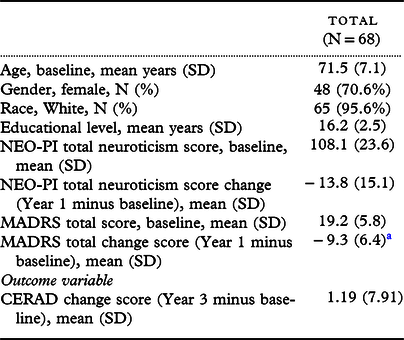
The sample consistent of 68 older depressed subjects with complete 3-year data. Demographic and clinical characteristics of the sample are shown in Table 1. We found that baseline MADRS was associated with baseline total neuroticism score (r (S) = 0.40, P = 0.0006, n = 68), that 1-year MADRS was associated with 1-year total neuroticism score (r (S) = 0.36, P = 0.0027, n = 66), but that the association between 1-year change in MADRS and 1-year change in neuroticism did not reach statistical significance (r (S) = 0.17, P = 0.17, n = 66). Nevertheless, we felt it was important to control for change in MADRS in subsequent analyses in addition to other covariates.
Characteristics of the total sample

MADRS = Montgomery–Åsberg depression rating scale; NEO-PI = NEO personality inventory.
a Two subjects with missing 1-year MADRS score.
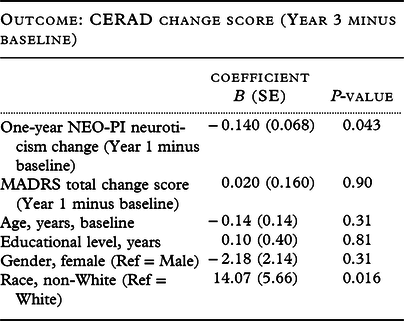
In multivariable linear regression analysis, 1-year change in neuroticism was inversely associated with 3-year change in CERAD total score in models controlling for age, sex, race, education and 1-year change in MADRS score (B = −0.140 [95% CL: −0.275 to −0.004], P = 0.040, see Table 2).
Regression model for predicting 3-year change in CERAD total score from 1-year change in neuroticism

MADRS = Montgomery–Åsberg depression rating scale; NEO-PI = NEO-Personality Inventory; Ref = reference; SE = standard error.
Discussion
The major finding of this study is that 1-year change in total neuroticism as measured on the NEO-PI-R was negatively associated with 3-year change in CERAD total score. The patients with more decline in neuroticism from baseline to Year 1 tended to have less cognitive decline from baseline to Year 3. For example, our model predicts an improvement of 20 (or 15) points on the total neuroticism scale would result in a favorable change of 2.8 (or 2.1) points on CERAD. The partial correlation coefficient between neuroticism change and cognitive change derived from our multiple regression model was 0.26, which represented a near-medium effect size. Our results extend prior studies that found presence of higher neuroticism was associated with greater cognitive decline among older depressed individuals (Manning et al., Reference Manning, Chan and Steffens2017) and with incident dementia in a general population (Terracciano et al., Reference Terracciano2021).
Our finding that patients with less decline in neuroticism over 1-year experienced greater 3-year cognitive decline has several important clinical implications. First, it highlights the role of neuroticism in cognitive outcomes of LLD and impresses on our field the need to identify measures of neuroticism that may be employed during the assessment and management of depression in older adults. Second, our finding of significant improvement in self-reported neuroticism among many older patients receiving treatment for depression indicates that repeated measures of neuroticism may be quite variable in the context of geriatric depression, an observation that challenges the notion of stability of personality, especially over a relatively short period of time. For some older patients, higher neuroticism may simply reflect effects of the state of being depressed (i.e. depression influences responses on neuroticism measures), while in others, concurrent neuroticism may indicate a more enduring personality trait associated with cognitive decline (Yoneda et al., Reference Yoneda2020). Our results support the use of neuroticism measures that can be incorporated into the management of depressed older adults. Neuroticism – particularly stable neuroticism as the current findings reveal – may be an easily identifiable risk factor for early nonresponse to psychotherapy and cognitive decline in older adults (Solomonov et al., Reference Solomonov2021).
The current findings add to the literature that behavioral symptoms (e.g. depression, anxiety, and personality) predict cognitive decline and precede a clinical diagnosis of dementia. In recent years, the term mild behavioral impairment (MBI) has been used to distinguish cognitively normal older adults who report apathy, affective dysregulation, or disinhibited symptoms concerning for a neurodegenerative illness (Ismail et al., Reference Ismail2016). While seemingly distinct constructs, there may be overlap between MBI and neuroticism. For example, in the Caselli et al. (Reference Caselli2018) paper mentioned earlier the authors also found that an increase in neuroticism in prodromal Alzheimer’s disease was also accompanied by an increase in symptoms of depression and anxiety. Changes in anxiety and depression also accompanied persistent changes in neuroticism in a large sample of middle aged adults from the Netherlands Study of Depression and Anxiety (Jeronimus et al., Reference Jeronimus, Ormel, Aleman, Penninx and Riese2013). Considering the present analyses controlled for depression change, it is plausible that the persistence of state anxiety contributes to neuroticism stability in LLD. Future studies will help disentangle the psychological and behavioral constructs overlapping with neuroticism in LLD.
Biological mechanisms that might explain connection between neuroticism and cognitive decline are not clear. Previously, we noted that older depressed individuals high in neuroticism had smaller frontal lobe volumes than depressed subjects low in neuroticism and never-depressed subjects (Joseph et al., Reference Joseph, Wang, Wu, Manning and Steffens2021), and that functional imaging studies implicated the prefrontal cortex in neuroticism among older depressives (Steffens et al., Reference Steffens, Wang, Manning and Pearlson2017). These studies highlight the importance of frontal circuitry in the subgroup of older depressed individuals with comorbid neuroticism. Further studies are needed to understand the complex interactions among neuroticism, depression, and structural and functional frontal lobe changes in the development of cognitive decline. Another mechanism to consider involves the relationships among neuroticism and Alzheimer’s disease pathology. Early studies note that caregiver reports of neuroticism increase in patients following a diagnosis of Alzheimer’s disease (Siegler et al., Reference Siegler, Dawson and Welsh1994). More recent studies found that neuroticism correlated with CSF markers of tau but not amyloid in a cohort of adults with autosomal dominant Alzheimer’s mutations (Aschenbrenner et al., Reference Aschenbrenner2020). Mutation carriers also exhibit higher levels of neuroticism compared to nonmutation carriers. Moreover, in this study, neuroticism remained stable in mutation carriers as time to dementia onset increased, whereas neuroticism appeared to decrease in noncarriers over time. Together, these findings suggest Alzheimer’s disease progression may influence neuroticism change. Finally, chronic exposure to stress associated with neuroticism and depression has detrimental effects on brain function. Prior research linking depression and stress to hippocampal volume loss (Zannas et al., Reference Zannas2013) supports future investigations of neuroticism, hippocampal measures, and cognitive change.
This study has several limitations that should be noted. While few studies in LLD report 3-year cognitive data, our sample size of 68 is still relatively small and may limit the number of covariates we can include in our modeling. Our current cohort was predominantly white, so our findings may not generalize to other groups of older adults. Finally, with our 3-year follow-up period, we are unlikely to be able to detect sufficient numbers of individuals whose cognitive decline has led to diagnosable dementia. Future studies with larger, more diverse samples followed over longer periods will allow us to include other potential confounding factors, to extend our findings in the elderly more broadly and include both cognitive change and development of dementia.
Acknowledgements
This study was supported by grants R01 MH108578 and P30 AG067988 from the U.S. National Institutes of Health.
Conflict of interest
None.
Description of authors’ roles
D. Steffens designed the study and wrote the paper. K. Manning conducted the study and assisted in writing the paper. R. Wu and J. Grady conducted statistical analyses for the paper.