Introduction
The HIV/AIDS prevalence in Ghana can still best be described as a generalized epidemic (UNAIDS, 2011). Currently, the median HIV prevalence in Ghana stands at 2.1%, with sexual transmission accounting for over 80% of all infections (Ghana AIDS Commission, 2012). Obviously, the epidemic in Ghana is being fuelled by sexual risk-taking behaviours, as noted in many parts of sub-Sahara Africa. Experts unanimously agree that one of the most effective ways of preventing sexual transmission is through protective sexual intercourse (condom use), particularly during casual encounters (Coast, Reference Coast2007; Asante & Doku, Reference Asante and Doku2010).
Ghana has over the years embarked on various educational and positive sexual behavioural change campaigns aimed at promoting safer sexual practices, especially protective sexual intercourse (Anarfi, Reference Anarfi, Agyei-Mensah, Casterline and Agyeman2005). Although such campaigns have yielded some gains, unprotected casual sex is still very common in Ghana (Bosompra, Reference Bosompra2001; Anarfi, Reference Anarfi, Agyei-Mensah, Casterline and Agyeman2005; Ghana AIDS Commission, 2012). For instance, while 23% of females and 42% of males aged 15–49 engage in high-risk (non-marital or non-cohabiting) sex, 75% and 55% respectively of such encounters occur without protection (Ghana Statistical Service et al., 2009). This therefore calls for the need to understand the factors that predispose individuals to engage in unprotected casual sex, in order to inform the design of future behavioural interventions aimed at promoting healthy sexual behaviours. This study assessed the socio-demographic, economic and spatial factors associated with unprotected sex in Ghana, particularly casual heterosexual sexual encounters. Given the imminent potential for the future spread of the HIV epidemic through unprotected casual heterosexual sex, this study is timely and appropriate in suggesting measures to consolidate and speed up the declining trend of HIV prevalence in Ghana.
Conceptual framework
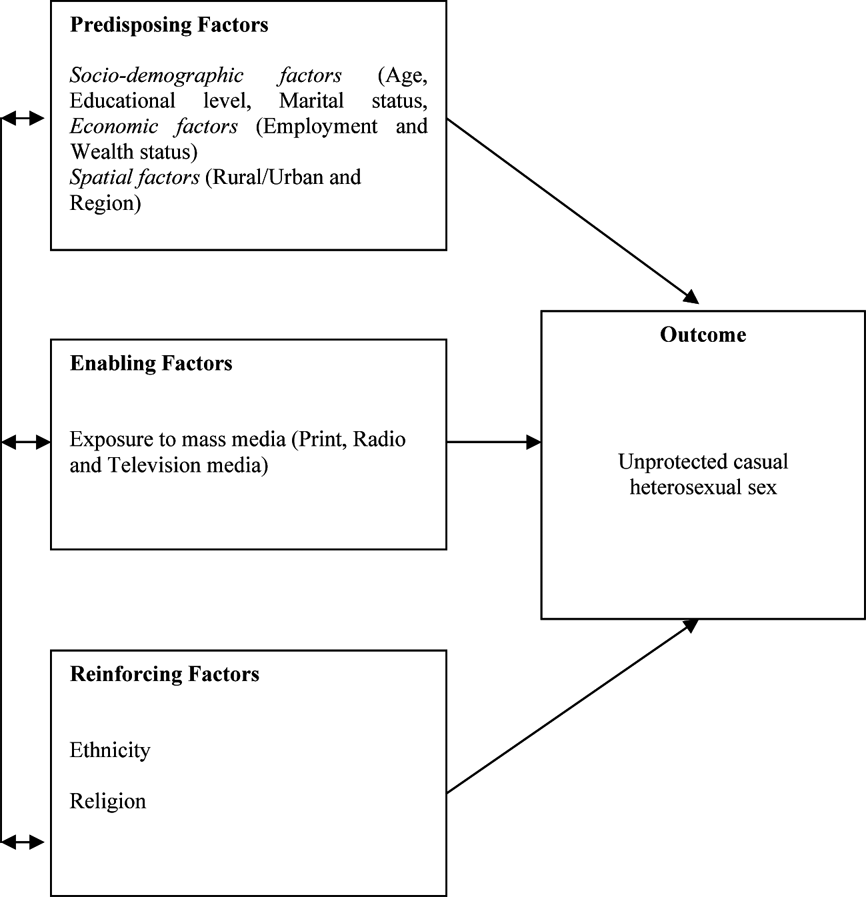
A number of theories and models, each with their peculiar core principles and perspectives, have been applied in the study of sex-related behaviour. While most of such theories and models focus on psychosocial factors such as beliefs, attitudes, risk perceptions, self-efficacy and intentions, others concentrate on social norms, relationships and gender imbalances. Providing a guiding force for this study is the PRECEDE model, which was first published in 1974 (Green & Krueter, Reference Green and Kreuter1999) for health promotion programme planning. The PRECEDE model integrates constructs from Andersen's behavioural model, health education, behavioural change and maintenance principles, culturally sensitive strategies, social action and social learning theory (Green & Krueter, Reference Green and Kreuter1999). The model considers individual psychological processes such as attitudes and beliefs, the social environment as well as structural and environmental concerns, which are important in studying behaviour. This paper adapts the fourth phase of the PRECEDE model, which identifies three categories of factors that play key roles in health-related behaviour: (a) predisposing factors, (b) enabling factors, and (c) reinforcing factors (see Fig. 1).
Conceptual framework.

According to the PRECEDE model, predisposing factors are those forces that either increase or decrease the likelihood of an individual or group to take action. The key consideration in understanding predisposing factors is the extent to which behaviour can be predicted. Enabling factors include both new personal skills and available resources needed to perform a behaviour. The key consideration for these factors and health behaviour is the extent to which their absence will prevent an action from happening. Reinforcing factors are the people and community attitudes that support or make difficult the adoption of healthy behaviours or fostering healthy environmental conditions. Understanding their importance is determined by the extent to which their absence would mean a loss of support for current actions of an individual or group. As illustrated in Fig. 1, understanding these three categories of factors that influence behaviour allows for the identification of priorities and provides a basis for where to focus interventions. This model is a behaviour and problem-oriented model that can assist in creating positive health outcomes.
In this paper, the conceptual framework identifies unprotected casual heterosexual sex as the outcome variable and treats background factors as explanatory variables. The conceptual framework shows the possible associations between a range of background factors organized as predisposing, enabling and reinforcing factors and the outcome variable. The framework assumes that the predisposing factors may be influenced by one's exposure to mass media such as newspapers or magazines, radio and television. These are classified as enabling factors that may influence background factors that predispose an individual to engage in unprotected casual heterosexual sex. It is again assumed in the conceptual framework that the predisposing factors may further be reinforced by community-level factors such as ethnicity and religion. Ethnicity may influence unprotected casual heterosexual sex through cultural beliefs and practices.
Methods
Data and source
The study draws on data from the 2008 Ghana Demographic and Health Survey (GDHS), which has measures on sexual behaviour (see http://www.measuredhs.com/Data/). The 2008 GDHS was designed as a follow-on to the 1988, 1993, 1998 and 2003 surveys. The 2008 GDHS is a large nationally representative dataset collected by the Ghana Statistical Service and Macro, and it forms part of the Global Demographic and Health Survey (DHS) programme. The 2008 GDHS utilized a two-staged stratified sampling procedure. The first stage involved selecting clusters using systematic sampling with probability proportional to size. This was based on an updated master sampling frame constructed from the 2000 Population and Housing Census to produce separate estimates for key indicators for each of the ten regions in Ghana. The second stage involved the systematic sampling of 30 of the households listed in each cluster.
Each household selected for the 2008 GDHS survey was eligible for interview with the Household Questionnaire. A total of 11,778 eligible households were interviewed with the Household Questionnaire. In half of the households selected for the survey, all eligible women aged 15–49 and all eligible men aged 15–59 were interviewed with the Women's and Men's Questionnaires, respectively. A total of 4916 women aged 15–49 and 4568 men aged 15–59 from 6141 households were interviewed over a 3-month period, from early September to late November 2008. The analysis in this paper is based on 752 women and 995 men who reported having engaged in unprotected casual heterosexual sex in their sexual encounter preceding the survey.
Definition of variables
The dependent variable (unprotected casual heterosexual sex) was derived from information on whether a condom was used in the last sexual intercourse. Respondents whose last sexual intercourse was with a married or cohabiting partner were excluded. The last sexual encounter preceding the survey is useful for capturing the most recent behaviour and minimizes recall errors. Respondents were coded ‘1’ if they reported their last sexual intercourse with a non-marital, non-cohabiting partner was without a condom, and ‘0’ if otherwise. Thus, 995 men and 752 women qualified to be included in the analysis of unprotected casual sex.
As informed by the conceptual framework, pertinent factors that may influence unprotected casual heterosexual sex were conceptualized as independent variables and organized as predisposing, enabling and reinforcing factors. Age, educational level, marital status, rural–urban residence, region of residence, employment status and wealth status were considered as predisposing factors to unprotected casual heterosexual sex. Exposure to mass media (print, radio and television) was considered as an enabling factor, while ethnicity and religion were the factors considered in the analysis as reinforcing factors of unprotected casual heterosexual sex.
Age was grouped using 10-year intervals: 15–24, 25–34, 35–44 and 45+ for both sexes. Four categories were created for level of education: no education, primary, middle/Junior Secondary School (JSS) and secondary/higher education. Place of residence was categorized into rural or urban. For region of residence, all ten administrative regions of Ghana were included in the analysis. Three categories were created for marital status: never married, married/cohabiting and divorced/widowed/separated. To reflect the religious landscape of Ghana, group membership was used to categorize religion into: Catholic, Protestant (Anglican, Methodist and Presbyterian), Charismatic (Pentecostal churches), Other Christians (spiritual churches), Muslim, Traditional and No religion.
The wealth quintile approach developed by the GDHS was adopted in categorizing wealth status into poorest, poorer, middle, rich and richest. Employment was put into two categories: employed and unemployed. Exposure to mass media was broken into print media (newspaper or magazine), radio media and television media. Ethnicity was categorized into Akan, Ga/Adangbe, Ewe, Mole-Dagbani and ‘Others’ (minor groups, e.g. Guan, Gruma). These independent variables are considered important in influencing the unprotected casual heterosexual sex of individuals, by acting as either risk or protective factors.
Analytical techniques
Statisticians advise that complex survey designs, such as that of the 2008 GDHS, should be accounted for in data analysis in order to obtain unbiased point estimates and accurate confidence intervals (Korn & Graubard, Reference Korn and Graubard1995; Eltinge et al., Reference Eltinge, Parsons and Jang1997). As the 2008 GDHS sampling used complex methods rather than simple random sampling, the statistical software STATA version 11.0 was used for all analyses. STATA was used because it has a feature for estimating accurate standard errors (StataCorp, 2001). The GDHS weights were applied in all analyses to adjust for differences in probability of selection and to adjust for non-response in order to produce a proper representation (National Institute of Statisics & ORC Macro, 2004).
The initial analysis involved using proportions to describe the sample and background characteristics associated with unprotected casual heterosexual sex. In order to examine the nature and strength of association between the independent variables and the dependent variable (unprotected casual heterosexual sex), it was necessary to control for the confounding effects of other factors using multivariate analyses. Binary logistic regression was used since the dependent variable was constructed to be a binary outcome. With the conceptual framework as a guide, a sequential approach was adopted with the running of three models in succession, starting with a model with just predisposing factors. Age, educational level, marital status, rural–urban residence, region of residence, employment status and wealth status were included in Model 1.
In Model 2, enabling factors (print, radio and television media) were tailored in to assess their influence on the predisposing factors. Then, in Model 3, ethnicity and religion were fitted in as reinforcing factors for the assessment of their effect on the predisposing and enabling factors. Using the results of the final model, each of the factors associated with unprotected casual heterosexual sex was then assessed. The Hosmer–Lemeshow goodness-of-fit test was used to assess the fitness of the data for each model.
As with most population-based surveys, self-reports of sensitive questions bearing on sexuality such as unprotected casual heterosexual sex could be biased. Some researchers argue that such biases could occur through women under-stating and men over-stating their levels of risky sexual behaviours (Family Health International, 1999; Reid, Reference Reid1999; Zaba et al., Reference Zaba, Pisani, Slaymaker and Boerma2004). To mitigate distortion of the results as a result of reporting biases, separate analyses were conducted for men and women. Thus although the comparison of the level of unprotected casual heterosexual sex between men and women may be distorted, the associations between unprotected casual heterosexual sex with other variables may be preserved.
Results
Background characteristics
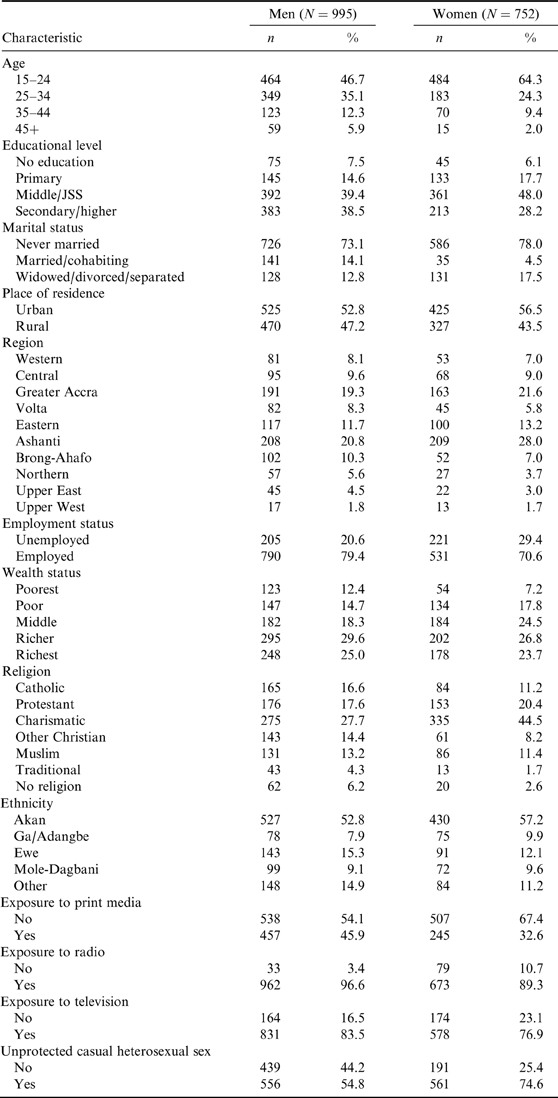
The mean age of the sample was 27.0 and 24.0 years for men and women respectively. As shown in Table 1, a greater proportion of men (47%) and women (64%) were in under 25 years age group. Thereafter, the proportions of respondents generally decreased with age, reflecting the age structure of the Ghanaian population. The analysis revealed that most respondents had middle/JSS education, with a greater proportion being women (48%) compared with men (39%). The majority of respondents (73% men and 78% women) were never married. The distribution by urban–rural residence showed that about 53% of men and 57% of women were urban residents. In terms of region, a greater proportion of respondents were from the Ashanti Region (20% and 28% for men and women respectively). This was followed by Greater Accra with 19% men and 21% women. The Upper West Region had the lowest proportion of respondents, with a similar proportion (about 2%) of men and women.
Background characteristics of respondents reporting unprotected casual heterosexual sex at last encounter (weighted), Ghana 2008
About four out of every five men (79%) were employed, while seven out of every ten women (70%) were employed. More than half (55%) of the men fell within the two highest wealth quintiles, while a higher proportion of women were in the richer (about 27%) category. The sample was predominantly Christian (77% men and 85% women), with charismatic Christians forming the majority (28% men and 45% women). More than half of the men (53%) and women (57%) were Akans, followed by the Ewe (15% men and 12% women).
In terms of media exposure, a greater proportion of the respondents were exposed to the radio, followed by television and the print media. In addition, men had higher exposure to all three forms of mass media (radio, 97%; television, 84%; print, 46%) than women (radio, 89%; television, 77%; print, 33%). About 75% of women compared with 55% of men reported having engaged in unprotected casual heterosexual sex in their last sexual encounter preceding the survey.
Unprotected casual heterosexual sex and background characteristics
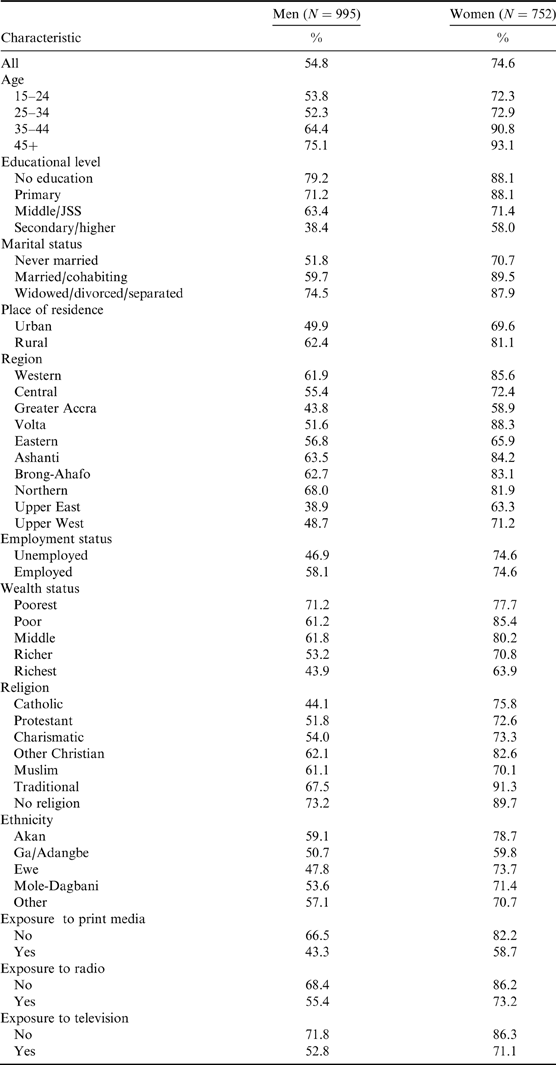
Generally, the level of unprotected casual heterosexual sex appeared to be high (see Table 2). A greater proportion of women (75%) than men (55%) had unprotected casual heterosexual sex. Unprotected casual heterosexual sex appeared to increase with age and at the same time occurred more among respondents older than 44 years (75% for men and 93% for women). The results indicate that unprotected casual heterosexual sex decreased with increasing level of education for both men and women. A greater proportion of men (79%) with no education had unprotected casual heterosexual sex, while for women those with no education and primary education had equal but highest proportions (88%).
Proportions of respondents reporting unprotected casual heterosexual sex at last encounter by background characteristics (weighted), Ghana 2008
% indicates proportion in each category computed separately for men and women.
A greater proportion of widowed/divorced/separated men (75%) engaged in unprotected casual heterosexual sex, and an even greater proportion was reported by married/cohabiting women (90%). Higher proportions of unprotected casual heterosexual sex were reported in rural areas compared with urban settings for both men (62%) and women (81%). Unprotected casual heterosexual sex was highest for men (68%) in the Northern Region, but highest for women (88%) in the Volta Region. The lowest proportion of unprotected casual heterosexual sex for men was in the Upper East Region (39%), whereas for women it was in the Greater Accra Region (59%).
Employed men (58%) were more associated with unprotected casual heterosexual sex compared with unemployed men (47%). Meanwhile, about three-quarters (75%) of women reported unprotected casual heterosexual sex irrespective of their employment status. Unprotected casual heterosexual sex decreased with increasing wealth status for both men and women. Being in the poorest wealth quintile was more associated with having unprotected casual heterosexual sex, with rates of 71% for men compared with 78% for women.
Whereas more men (73%) who belonged to no religious group engaged in unprotected casual heterosexual sex, more women (91%) belonging to Traditional religion did so. Belonging to the Akan ethnicity was more associated with having unprotected casual heterosexual sex, with 59% for men, compared with 79% for women. In as much as lack of exposure to mass media (print, radio and television) was generally associated with having unprotected casual heterosexual sex, lack of exposure to television (72%) was more associated with unprotected casual heterosexual sex for men. For women, lack of exposure to radio and television were similarly (about 80%) more associated with having unprotected casual heterosexual sex.
Multivariate logistic regression results
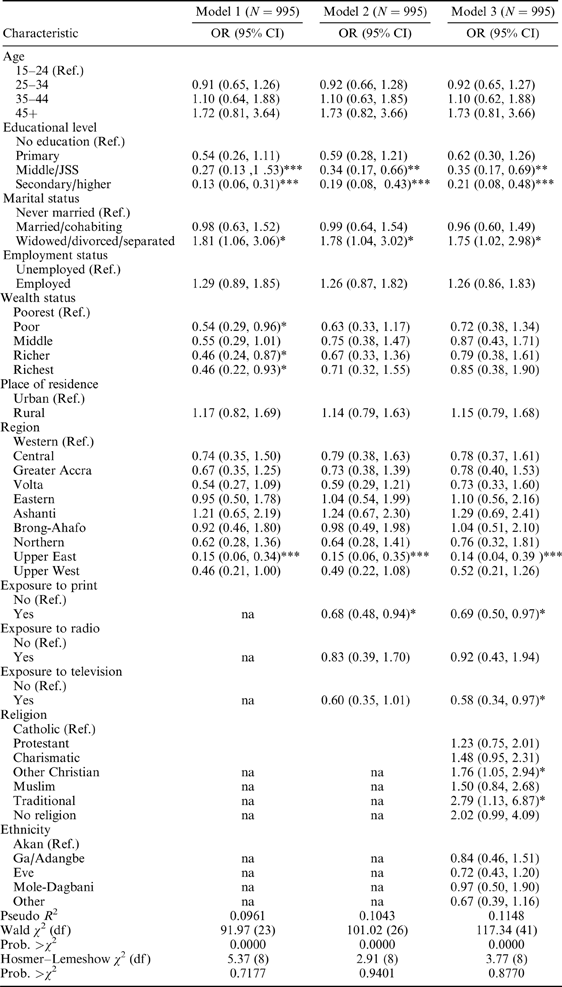
Tables 3 and 4 show the results of the logistic regression models fitted to examine the association between selected socio-demographic, economic and spatial factors and unprotected casual heterosexual sex, while controlling for the confounding effects of other mediators. As guided by the conceptual framework, three logistic regression models were run separately for men and women. The odds of engaging in unprotected casual heterosexual sex are presented.
Results of logistic regression on unprotected casual heterosexual sex among men in Ghana, 2008
OR=odds ratios; Ref.=reference category; na=not applicable.
*p<0.05; **p<0.01; ***p<0.001.
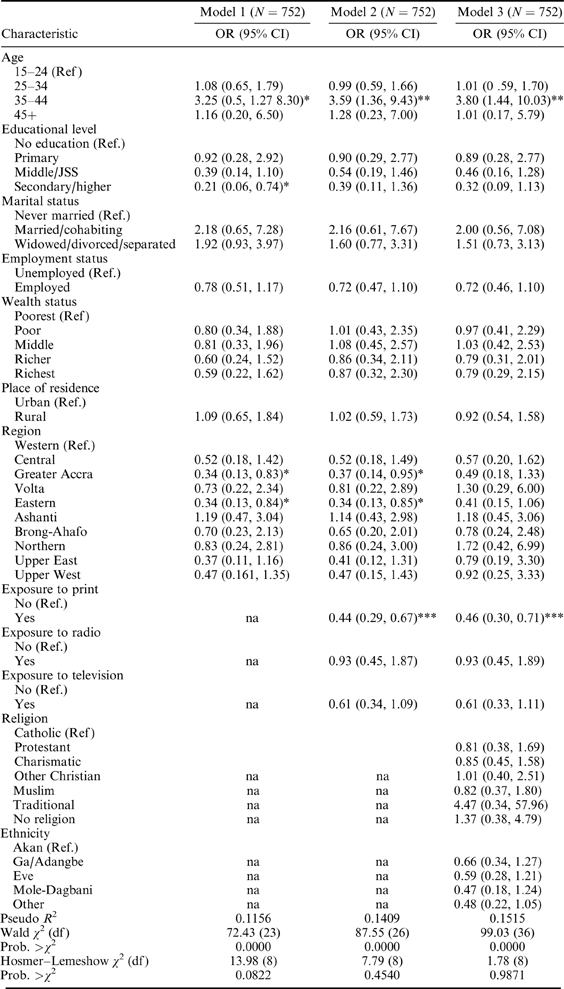
Results of logistic regression on unprotected casual heterosexual sex among women in Ghana, 2008
OR=odds ratio; Ref.=reference category; na=not applicable.
*p<0.05; **p<0.01; ***p<0.001.
In Model 1, which featured predisposing factors, the pseudo-R 2 values for men and women were 0.0961 and 0.1156 respectively, and this improved steadily with each succeeding model. The odds of men having unprotected casual heterosexual sex were positive and significant for widowed/divorced/separated men, but rather negative and significant for men with middle/JSS or secondary/higher education, those in the poor, richer and richest wealth quintiles and those living in the Upper East Region. For women, however, except for those aged 35–44 years, the odds were negative, but significant, for those with secondary/higher education and those living in the Greater Accra and Eastern Regions. In the Model 1, widowed/divorced/separated men were approximately twice (OR=1.8, p=0.028) more likely than never married men to engage in unprotected casual heterosexual sex. The odds of men engaging in unprotected casual heterosexual sex were, however, lower as level of education increased (OR=0.27, p<0.001, for middle/JSS and 0.13, p<0.001, for secondary/higher). Though no discernible pattern was observed for men in terms of wealth status, those in the poor (OR=0.54, p=0.037), richer (OR=0.46, p=0.017) and richest (OR=0.46, p=0.031) wealth quintiles had significantly lower odds of engaging in unprotected casual heterosexual sex compared with those in the poorest category. Compared with the Western Region, men in the Upper East Region were less likely (0.15, p<0.001) to engage in unprotected casual heterosexual sex. In Model 1 for women, those aged 35–44 years were more than three times (OR=3.25, p=0.014) more likely to engage in unprotected casual heterosexual sex, with reference to their counterparts aged 15–24 years. The odds of engaging in unprotected casual heterosexual sex were lower for women with secondary/higher education (OR=0.21, p=0.016) than those with no education. With reference to Western Region, women in Greater Accra (OR=0.34, p=0.020) and Eastern Regions (OR=0.34, p=0.004) had significant lower odds of engaging in unprotected casual heterosexual sex.
With the inclusion of enabling factors (exposure to mass media) in Model 2, the association between widowed/divorced/separated men (OR=1.78, p=0.033) and unprotected casual heterosexual sex weakened, but remained significant. The association between education (OR=0.34, p=0.002 for middle/JSS; 0.19, p<0.001 for secondary/higher) and unprotected casual heterosexual sex remained negative. In contrast, education (secondary/higher) was no longer a significant predictor of unprotected casual heterosexual sex for women. This indicates that education (secondary/higher) does not independently predict unprotected casual heterosexual sex for women in Ghana. The odds of having unprotected casual heterosexual sex rather increased (OR=3.59, p=0.009) for women aged 35–44 with the inclusion of the mass media variables in Model 2. The wealth status categories (poor, richer and richest), which were significant for men, became statistically insignificant with the inclusion of the enabling factors (mass media). Except for the slight decrease in the odds for Greater Accra for women, Model 2 was not different from Model 1 in terms of regional predictors of unprotected casual heterosexual sex for both men and women. Mass media exposure was negatively associated with unprotected casual heterosexual sex for both men and women. However, only exposure to print media was significant for both men (0.68, p=0.020) and women (0.44, p<0.001).
When reinforcing factors (religion and ethnicity) were fitted in Model 3, Greater Accra and Eastern Regions, which were significantly associated with unprotected casual heterosexual sex for women in the previous models, became statistically insignificant. Religion and ethnicity may thus have confounding effects on the association between women in the two regions (Greater Accra and Eastern) and unprotected casual heterosexual sex. The strength of association between unprotected casual heterosexual sex and women aged 35–44 (OR=3.80, p=0.007) further increased in Model 3. The odds of engaging in unprotected casual heterosexual sex remained significantly lower for women with exposure to print media (OR=0.46, p<0.001). The pattern in the final model for men was similar to the previous model (Model 2). However, television exposure, which hitherto was not significant, became significantly less associated (OR=0.58, p=0.041) with men engaging in unprotected casual heterosexual sex. The results continued to show significantly higher probabilities of unprotected casual heterosexual sex among widowed/divorced/separated men (OR=1.75, p=0.040), and otherwise among men with middle/JSS (OR=0.35, p=0.003) and secondary/higher education (OR=0.21, p<0.001). Among the reinforcing factors (religion and ethnicity), Other Christian men (OR=1.76, p=0.030) and men who practise Traditional religion (OR=2.79, p=0.025) turned out to have significantly higher odds of engaging in unprotected casual heterosexual sex than Catholic men. The Hosmer–Lemeshow goodness-of-fit test produced a p-value greater than 0.05 for each model for both men and women, indicating the fitness of the data for assessing unprotected casual heterosexual sex for each model.
Discussion
The study sought to assess the socio-demographic, economic and spatial factors influencing unprotected casual heterosexual sex among Ghanaian men and women. The study assumed that background socio-demographic, economic and spatial factors may predispose individuals to unprotected casual heterosexual sex. It further assumed that such predisposing factors may be enabled by exposure to mass media and may further be reinforced by socio-cultural factors such as ethnicity and religion. The results indicate a different combination of socio-demographic, economic and spatial factors significantly influencing unprotected casual heterosexual sex, with disparities between men and women.
Sexual psychological models suggest that as a function of their ‘biological clock’, women from their mid-thirties to mid-forties go through psychological shifts expressed by an increased desire and willingness to engage in sexual activity and a greater likelihood of consenting to engage in casual sexual intercourse (Easton et al., Reference Easton, Confer, Goetz and Buss2010). Perhaps this explains the high probabilities of unprotected casual heterosexual sex found among women aged 35–44 in this current study. Though this finding is contrary to much of the literature, which associates sexual risk-taking with younger individuals (see Karim et al., Reference Karim, Magnani, Morgan and Bond2003; Abbey et al., Reference Abbey, Parkhill, Buck and Saenz2007), it is consistent with Lammers et al. (Reference Lammers, Van Wijnbergen and Willebrands2011). This is one research area that needs to be explored further. That notwithstanding, Mill (Reference Mill2001) noted that gender norms in Ghana that encourage women to be passive about sex often constrain the ability of women to negotiate for protective sexual intercourse. Such negative gender norms also limit the access of Ghanaian women, more than men, to key productive resources such as education, income and employment, thereby significantly reducing their leverage in negotiating protective sex with their sexual partners, even when they deem it necessary (Mill, Reference Mill2001; Ghana Statistical Service et al., 2009). As Chin (Reference Chin1999) suggests, the sexual health of such women often depends on their sexual partners.
The present study shows high and significant probabilities of unprotected casual heterosexual sex for formally married men (widowed/divorced/separated). Awusabo-Asare and Annim (Reference Awusabo-Asare and Annim2008) similarly observed sexual risk-taking to be more associated with being widowed or divorced or being separated in Ghana. Marriage is sometimes considered to be protective against sexually transmitted infections by providing checks and balances on an individual's sexual behaviour (Akwara et al., Reference Akwara, Madise and Hinde2003). However, marriage dissolution as a result of death of a spouse or divorce may create new freedoms away from marital obligations. Thus the absence of a regular partner may precipitate sexual networking with social and economic dimensions (Awusabo-Asare & Annim, Reference Awusabo-Asare and Annim2008). Those widowed, divorced and separated may therefore be connected in a web of sexual relations with increased risk for sexually transmitted infections, including HIV, through unprotected sex. The influence of marriage dissolution on sexual risk-taking needs to be further researched to enhance understanding and intervention.
A review of behaviour change models suggests that an individual's level of education and awareness of an effective method of preventing infections are key in the adoption of protective sexual measures (Bandura, Reference Bandura, Norman, Abraham and Conner1994; Rosenstock et al., Reference Rosenstock, Strecher, Becker, DiClemente and Peterson1994). In that light, and consistent with other studies (see Pranitha & Cleland, Reference Pranitha and Cleland2005; De Walque, Reference De Walque2007), the results indicate significant and lower probabilities of unprotected casual heterosexual sex among men with middle/JSS and secondary/higher education after controlling for the effect of other factors. This finding is supported by the GDHS, which reports that more men than women with middle/JSS and secondary/higher education agree that people can reduce the risk of getting HIV/AIDS by using condoms every time they have sexual intercourse (Ghana Statistical Service et al., 2009). Generally, people with higher education are more likely to be in a position to access health-related information that promotes healthy life choices such as protective sexual intercourse (Kenkel, Reference Kenkel1991). Education is also seen as an investment towards being well off or attaining a higher socioeconomic status in the future. According to Becker (2003), such an investment raises the value of staying alive, thereby providing enough incentive for educated individuals to protect their health by using protection during casual heterosexual sex.
The positive sexual behavioural campaigns undertaken in Ghana over the years seem to have yielded some gains at the regional level. The general picture from this study shows lower probabilities (with a few exceptions) of unprotected casual heterosexual sex on a regional basis for both men and women. However, only men residing in the Upper East had significant lower probabilities of engaging in unprotected casual heterosexual sex. This finding challenges the view that poverty is the driving force behind sexual risk-taking such as unprotected casual heterosexual sex (Fenton, Reference Fenton2004), considering that the Upper East is the most deprived region in Ghana. However, this could be attributed to the massive research-based HIV/AIDS campaigns embarked on over the years by the Navrongo Health Research Centre (one of three INDEPTH sites in Ghana) located in that region. Complementing this possibility is the high (90%) knowledge of condom use in that region, as reported in 2008 GDHS (Ghana Statistical Service et al., 2009).
Mass media exposure proved, in this study, to be less associated with unprotected casual heterosexual sex for both men and women. In particular, exposure to print media was significant for both sexes while television was only significant for men. Considered to be a reliable channel for disseminating information, mass media have been used over the years in Ghana to inform and legitimize measures to reduce HIV-related risk behaviours (Hornik & McAnany, Reference Hornik and McAnany2001; McCombie et al., Reference McCombie, Hornik, Anarfi and Hornik2002). The significance of print and television exposure could possibly mean that these two mediums provide more educative information about the consequences of unprotected casual sex in Ghana. However, print media exposure could be linked to education, since exposure to print media depends largely on the ability to read educative information about the dangers of unprotected casual sex. On the other hand, the audio-visual nature of television could render it equally useful. According to Bessinger et al. (Reference Bessinger, Katende and Gupta2004), targeting the press may be a useful means of reshaping community attitudes and influencing behaviour change towards STI and HIV/AIDS prevention.
Religion in Africa is viewed as a pervasive and important part of social interaction that can influence sexual risk-taking behaviours positively or negatively through doctrinal teachings, beliefs and values (Kagimu et al., Reference Kagimu, Marum, Wabwire-Mangen, Nakyanjo, Walakira and Hogle1998). With this role of religion well manifested in Ghana (Gyimah et al., Reference Gyimah, Tenkorang, Takyi, Fosu and Adjei2010), this current study found a higher and significant likelihood of unprotected casual heterosexual sex among Other Christian men, as well as men who belong to Traditional religions. Religious teachings that discourage condom use, oppose sex education, and give spiritual interpretations to the spread of sexually transmitted infections could possibly undermine efforts to adopt protective sexual behaviours (Smith, Reference Smith2003; Heike, Reference Heike2007). In addition, religion is often intertwined with believe systems about sex, reproduction and gender roles, which could potentially stand in the way of adopting protective sexual behaviours, even when disease risks are understood (Arnaldo, Reference Arnaldo2004).
This study used data from the 2008 Ghana Demographic Health Survey, which is a nationally representative data set. However, some limitations need to be acknowledged. First, as with most population-based surveys on sexual behaviour, self-reports of sensitive questions such as unprotected casual heterosexual sex could be biased by the wish to provide culturally and socially desirable responses (Zaba et al., Reference Zaba, Pisani, Slaymaker and Boerma2004). However, since great care was taken to assure respondents of confidentiality and privacy of the information collected, such problems may have been minimized. Secondly, being a cross-sectional survey, the study was only able to highlight associations between unprotected casual heterosexual sex and selected background factors. However, the results give no indication about the causality in the relationship between explanatory variables and the dependent variable considered. Despite these limitations, the study is important because it provides information on the prevalence of unprotected casual heterosexual sex in Ghana. It also provides information on the factors that are associated with unprotected casual heterosexual sex, which is important for HIV prevention strategies.
Conclusion
Unprotected casual heterosexual sex among Ghanaian men and women is high. There are both protective and risk factors associated with unprotected casual heterosexual sex. However, there are significant differences in the socio-demographic, economic and spatial factors that predispose individuals to unprotected casual heterosexual sex. The positive effects of formal education and mass media on sexual risk-taking of individuals and groups cannot be overemphasized. In order to reduce the incidence of unprotected casual heterosexual sex, there is the need for behavioural change campaigns to take into consideration the multiplicity of factors that determine unprotected casual heterosexual sex. These messages should be appealing and acceptable to the intended audiences.