Introduction
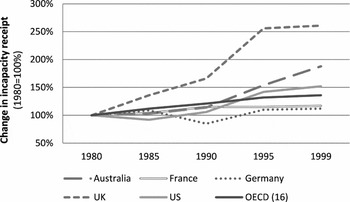
Incapacity benefits – cash payments to working-age people on the grounds that their ill-health or disability limit their ability to workFootnote 2 – are one of the most striking puzzles within the twenty-first century welfare state. Across the OECD in 2007, 6 per cent of the working-age population received incapacity benefits, with incapacity claims being greater than unemployment claims in several countries (OECD, 2010a: 59). In many countries – particularly those in the English-speaking world – there have been rises in incapacity claims since the 1980s (there were rises 1980–1999 for eighteen of the twenty countries in OECD, 2003: 61).
Yet, prima facie, there is an expectation that incapacity rates should be low and declining, due to a combination of health improvements and less physically demanding work. For example, in the OECD's influential report Transforming Disability Into Ability (OECD, 2003: 9), they note that incapacity levels and trends ‘seem counterintuitive when one considers that the health status of the working-age population has been improving over time’, a point echoed more recently using mortality data in a large comparative project by the National Bureau of Economic Research (Wise, Reference Wise2012). The then UK Prime Minister John Major summed this up more bluntly: ‘it beggars belief that so many people have suddenly become invalids, especially at a time when the health of the population has improved’ (quoted in Anyadike-Danes and McVicar, Reference Anyadike-Danes and McVicar2008: 17).
Academic explanations for this puzzle are primarily focused on two factors: social policy and hidden unemployment. First, as the OECD put it, ‘all policy actors and concerned persons agree that more people with disabilities are able to work. That many of these people do not is more down to policy failure and policy choice than anything else’ (OECD, 2003:169, emphasis added); the nature of this policy failure is discussed below. Secondly, many incapacity claimants are seen to be the ‘hidden unemployed’ (Houston and Lindsay, Reference Houston and Lindsay2010) – that is, in a full employment economy they would be absorbed into the labour force, and this is therefore a problem of labour market mismatch rather than health.
This paper focuses on a further explanation that has rarely been tested: that there has been a genuine rise in incapacity because work has become more difficult for people with health problems. This may intuitively seem unlikely, but there has been an ongoing debate among sociologists of work as to whether employment has deteriorated across multiple dimensions, and many countries have seen measurable changes in job characteristics that may be problematic for those with health problems (see below). This paper tests the likely impact of this on incapacity claims by combining data on the extent of changing work with evidence on the empirical relationship of these changing job characteristics to incapacity claims. Relatively few studies have previously investigated the latter relationship; the present study extends these through more careful attention to causality and by being almost the first study from outside of the Nordic countries (see below).
The focus here is on a single case study, the UK, which can be considered a ‘most likely’ case. Not only was the rise in incapacity claims between 1980 and 1999 greater than in any other OECD country bar Korea (OECD, 2003: 61), but the UK has seen a sharp rise in high-demands, low-control jobs. If working conditions are part of the explanation for rising incapacity anywhere, then they are likely to have played a role in the UK. However, working conditions have not been considered within UK reviews of rising incapacity (e.g., McVicar, Reference McVicar2008), and even on the few occasions where working conditions are mentioned, no direct evidence is provided (Whitehead et al., Reference Whitehead, Clayton, Holland, Drever, Barr and Gosling2009: 8, 36).
The structure of the paper is as follows. First, existing explanations for the increase in incapacity claims are considered, alongside research about changing working conditions and their implications for incapacity. The methods and data sources are then described, before the results are presented. Finally, these results are summarised together with their implications for policy.
Policy failure and hidden unemployment
Probably the most influential international reports on disability benefits are the widely cited reports by the OECD (2003, 2010b, 2012). These see the rise in incapacity claims as due to ‘policy failure’ (as above) – by which they mean a mixture of incentivising incapacity, a lack of adequate medical assessment, poor rehabilitation systems and a passive rather than activating system. Similar arguments have been advanced elsewhere (e.g., Autor Reference Autor2011; Kemp et al., Reference Kemp, Sunden and Tauritz2006: 15). However, some countries – including the UK – have seen continuing high levels of incapacity despite following OECD-approved policies, and this has begun to convince the OECD that broader factors must be considered (e.g., OECD, 2012: 17 and below).
The other dominant explanation for rising incapacity is most fully developed in the UK, although it is referred to in several other countries (Bratsberg et al., Reference Bratsberg, Fevang and Røed2010; Koning and Van Vuuren, Reference Koning and Van Vuuren2007), and overlaps with wider accounts of labour market disadvantage in which disabled people are but one part of a larger ‘Precariat’ who suffer from their undesirability to potential employers (Standing, Reference Standing2011: 86–87). Theories of hidden unemployment start by observing that there is much ‘hidden sickness’ in a full employment economy – that is, people with health problems who are nonetheless in work (Beatty et al., Reference Beatty, Fothergill and Macmillan2000). Without full employment, some people with health problems who would have been working are no longer working, either because they are the first to lose their jobs, or because after redundancy they are pushed to the back of the ‘queue for jobs’. While these people therefore have ‘genuine’ health problems, they are the hidden unemployed because if labour demand was high, their health would not interfere with their ability to get a job.
This theory is now widely accepted as an account of the UK (Houston and Lindsay, Reference Houston and Lindsay2010; McVicar, Reference McVicar2008), primarily due to the spatial patterning of incapacity; the highest levels of incapacity receipt are in areas with the weakest labour markets, and econometric analyses highlight the link of local labour demand to incapacity levels. Nevertheless, even in the UK labour demand does not fully explain rising incapacity. Beatty and Fothergill's (Reference Beatty and Fothergill2005) crude estimates – ignoring genuine spatial patterning in ill-health (McVicar, Reference McVicar2009) – still suggest that the majority of claimants are not the hidden unemployed. As Kemp et al. put it (2006: 161), ‘while disguised unemployment may be an important factor, it is unlikely that it is the only driver of the growth, and continued high level, of [incapacity] benefit claims’.
The role of working conditions
There is therefore space for complementary explanations of the growth in incapacity: the hypothesis here is that deteriorating working conditions are one such explanation. For this to be the case: (i) there must have been a deterioration in certain working conditions; and (ii) these working conditions must have a causal impact on incapacity claims.
Causal impacts
Three working conditions seem likely to be critical for disabled people: demands (being forced to work hard), control (decision-making freedom) and physicality (the physical demands of the job). It is easy to see why high demands and physicality might make it harder for people with health problems to stay in work: control is also important as it allows workers to fit their health problems around their work without limiting productivity or taking absences (Johansson and Lundberg, Reference Johansson and Lundberg2004).
These factors have been the subject of extensive research; Karasek's demands/control model has been the most widely used model of job stress in occupational health research, arguing that ‘job strain’ – the combination of low control and high demands – is particularly damaging. The usual summary of this literature is that there is strong evidence for a causal effect of job strain on mental and physical ill-health, although systematic meta-analyses find consistent results only for mental (Stansfeld and Candy, Reference Stansfeld and Candy2006) rather than physical (Kivimäki et al., Reference Kivimäki, Virtanen, Elovainio, Kouvonen, Vaananen and Vahtera2006: 436) ill-health.
Here, however, the focus is on their effect on incapacity receipt rather than ill-health – and while there is strong evidence that physicality matters for incapacity receipt (e.g., Krause et al., Reference Krause, Lynch, Kaplan, Cohen, Goldberg and Salonen1997), there is less evidence on demands/control. Of fourteen available English-language studies (Alavinia et al., Reference Alavinia, de Boer, van Duivenbooden, Frings-Dresen and Burdorf2009; Blekesaune and Solem, Reference Blekesaune and Solem2005; Borsch-Supan and Roth, Reference Borsch-Supan and Roth2010; Christensen et al., Reference Christensen, Feveile, Labriola and Lund2008; Claussen and Dalgard, Reference Claussen and Dalgard2009; Friis et al., Reference Friis, Ekholm and Hundrup2008; Hagen et al., Reference Hagen, Tambs and Bjerkedal2002; Haukenes et al., Reference Haukenes, Mykletun, Knudsen, Hansen and Maeland2011; Krause et al., Reference Krause, Lynch, Kaplan, Cohen, Goldberg and Salonen1997; Krokstad et al., Reference Krokstad, Johnsen and Westin2002; Laine et al., Reference Laine, Gimeno, Virtanen, Oksanen, Vahtera and Elovainio2009; Lund et al., Reference Lund, Iversen and Poulsen2001; Stattin and Jarvholm, Reference Stattin and Jarvholm2005; Vahtera et al.), low control often increased the risk of incapacity benefits, but demands generally had little effect. Yet this small collection of studies suffers from several problems; for example, twelve of the fourteen studies are from the Nordic countries where job control is exceptionally high (Chandola, Reference Chandola2010: 51) and where ‘work ability’ has long been high on the policy agenda (see Discussion below), limiting generalisability internationally.
Moreover, many existing studies are of poor quality, using few controls for likely confounders such as socio-economic status (SES) and health. There is also a long-running debate as to whether the type of person that reports low control or high demands is different from people in the same job who report their working conditions more positively. One response has been to use co-workers’ reports rather than self-reports. A recent paper in the American Journal of Epidemiology (Kolstad et al., Reference Kolstad, Hansen, Kærgaard, Thomsen, Kaerlev and Mikkelsen2011) found that the effect of self-reported strain (high demands, low control) on depression was not replicated when using co-workers’ reports, which they interpreted as evidence that the relationship on the individual level was spurious. However, the few studies using this method to look at incapacity benefits still generally found an impact of control, although without enabling a comparison of the size of the effects (Blekesaune and Solem, Reference Blekesaune and Solem2005; Laine et al., Reference Laine, Gimeno, Virtanen, Oksanen, Vahtera and Elovainio2009; Vahtera et al., Reference Vahtera, Laine, Virtanen, Oksanen, Koskinen and Pentti2010). This issue is considered further in the Methods section below.
Trends
It is often believed that jobs have become easier in recent decades, with the ‘knowledge economy’ replacing ever-diminishing physically demanding manual labour (Autor, Reference Autor2011: 25; DWP, 2009: 1). While plausibly true over longer time periods, when looking from the 1990s onwards the evidence undermines this view. Despite falling numbers of manufacturing jobs, workplace physical demands seem to be stable or even show a slight increase (Olsen et al., Reference Olsen, Kalleberg and Nesheim2010: 233–34) – possibly partly because of a general intensification of work (Eurofound, 2009). While job strain has increased 1995–2005 in nearly every OECD country (OECD, 2012: 63), the UK is rare in that job control declined substantially over the 1990s. As a result, in 1992 under 10 per cent of workers were in high-strain jobs, but by 2006 this had risen to over 15 per cent of men and nearly 25 per cent of women (Green, Reference Green2009).
The usual response to these results is to ask: how can this be true? A fuller answer can be found elsewhere (Baumberg, Reference Baumberg, Vickerstaff, Phillipson and Wilkie2011a), but there are two points to be aware of. First, other evidence supports the same picture. There are many case studies where processes of intensification and declining autonomy can be observed (e.g., McCann, Reference McCann, Howcroft and Richardson2009), and workers have been consistent in reporting a rise in the sources of effort pressure (Green, Reference Green2006: 57).
Secondly, ICT allows workers to work harder and allows managers to monitor workers more closely, as well as disproportionately increasing the productivity of harder-working, better-skilled workers (Green, Reference Green2006: 69). Superficially enlightened management techniques such as high performance working often lead to intensification in practice (Landsbergis et al., Reference Landsbergis, Cahill and Schnall1999). The results of new technologies will therefore vary between countries; the British context may be particularly conducive to reduced autonomy given weak regulation and weak unions (Rubery and Grimshaw, Reference Rubery and Grimshaw2001: 176).
What this study adds
This literature review has argued that policy factors and hidden unemployment are likely to partly explain high and rising levels of incapacity claims – but that the role of deteriorating working conditions has not been fully explored.
This is not to say that changes in the nature of work have been entirely ignored. A number of critical sociologists have argued that employment has somehow changed for the worse, with damaging consequences for society (e.g., Sennett, Reference Sennett1998; Standing, Reference Standing2011). Yet the implications for incapacity are unclear, partly due to debates over the empirical validity of these theoretical claims (Conley, Reference Conley2012; Doogan, Reference Doogan2009; Fevre, Reference Fevre2007), and partly because these accounts have simply not been connected to the issues facing disabled people. Some international reviews have gone further than this in drawing attention to the health implications of rising job strain (e.g., Kemp et al., Reference Kemp, Sunden and Tauritz2006: 19,238; OECD, 2012: 64), yet working conditions can be disabling without damaging health – if working conditions deteriorate, then it can be harder for a person with an impairment to stay in work, even if their underlying health is unchanged. This is not a minor distinction; there are few signs of population-level increases in (mental) ill-health symptoms, hence the plausibility of working conditions as a contributory factor to rising incapacity rests on this point.
Few studies have considered this non-health role of changing working conditions. Burkhauser et al.'s (Reference Burkhauser, Goodman, Houtenville, Stapleton and Burkhauser2003) US study looks only at a limited number of job characteristics, ignores within-occupation changes, does not look directly at benefit/employment outcomes and is weak methodologically (a cross-sectional study with few control variables). Whitehead et al.'s (Reference Whitehead, Clayton, Holland, Drever, Barr and Gosling2009: 8, 36) five-country study noted the possible impact of ‘post-industrialisation’ on the increasing disability employment penalty, but provides no direct evidence on how working conditions have changed, or of their link with worklessness. The study that comes closest to testing this hypothesis focuses on Norway (van Der Wel et al., Reference van Der Wel, Dahl and Birkelund2010), and it found little role for changing working conditions – but as we have already noted, the Nordic countries are exceptional in both the nature of work and the policy responses to it.
The present study therefore represents the best test to date of whether working conditions have played a role in rising incapacity, in this ‘most likely’ case.
Methods
Convincing examples of natural experiments that affect only demands/control are hard to find. The conventional alternative way of investigating causality would be to use self-reported data on demands/control, and see if people in high-demands, low-control jobs are more likely to go on to claim incapacity benefits. Reflecting the difficulties of non-experimental studies, though, previous researchers have been concerned that self-reported working conditions are biased even after controlling the confounders available in most surveys (see above).
This study uses a different approach. Instead of using a worker's own reported working conditions, the analysis is based on the reported working conditions of people like them – in the simplest case, this being people in the same occupational group. These data from working conditions come from one survey (the ‘exposure survey’), while the data on benefit claims that tracks people over time come from a separate survey (the ‘outcome survey’). Such an approach is commonly used in occupational health (Schwartz et al., Reference Schwartz, Pieper and Karasek1988), and is not uncommon in sociology more widely (Chan and Goldthorpe, Reference Chan and Goldthorpe2007).
This method is often argued to provide more ‘objective’ measures of working conditions than people's own self-reports (Schwartz et al., Reference Schwartz, Pieper and Karasek1988), and indeed this was the method used by Kolstad et al. (Reference Kolstad, Hansen, Kærgaard, Thomsen, Kaerlev and Mikkelsen2011) above. The price of this is that imputed working conditions have substantial random measurement error, owing to within-occupation differences, sampling error in rare occupations (Schwartz et al., Reference Schwartz, Pieper and Karasek1988) and coding errors for occupation. The consequence of this will be attenuation bias (underestimated coefficients) even in the absence of any confounding; thus it has been argued that the lower-powered imputation-based studies are a strong test of any hypothesis (Schnall et al., Reference Schnall, Landsbergis and Baker1994: 397). As in all observational studies, there is also the possibility of more systematic confounding that can bias the results in either direction, a point returned to below.
Exposure data
Data on working conditions are taken from the 1992 Employment in Britain (EiB) survey and the 1997, 2001 and 2006 Skills Surveys – the same nationally representative high-quality surveys used by Green (Reference Green2009).Footnote 3 Scales were constructed for each of demands, control and physicality to make the analysis more parsimonious, and to reduce random measurement error (see Web Appendix 2 for details).
These scales were then imputed into the British Household Panel Survey 1991–2006 (BHPS). This is the only long-running nationally representative panel survey in Britain, and has been used for previous analyses of incapacity benefit receipt and (other) working conditions (Jones et al., Reference Jones, Rice and Robone2011). While the imputation approach is intuitively simple – taxi drivers’ mean job control in the exposure data is given to all taxi drivers in BHPS – this belies substantial complexity in implementing it. For example, occupations are classified according to the Standard Occupational Classification (SOC), but SOC90 was replaced by SOC 2000 for the 2006 Skills Survey. As the new classification cannot be neatly recoded into SOC90, Weeden's weighting method (Reference Weeden2005) was used to create a consistent occupational coding over time (see Web Appendices 3 and 4). Further methodological decisions are mentioned in the sensitivity analyses below.
Modelling approach
Having created the BHPS dataset with additional imputed variables, the modelling approach is simply to see whether initial working characteristics affect the chances of claiming incapacity benefits in the following year.Footnote 4
The ability to make causal inferences from observational data depends on whether, holding potential confounders constant, there are no relevant differences between people in different types of jobs – ‘relevant’ being anything that relates to both job demands/control/physicality and incapacity benefit receipt (Christenfeld et al., Reference Christenfeld, Sloan, Carroll and Greenland2004). To make this assumption more plausible, six groups of likely confounders are adjusted for (further details are available in Web Appendix 5):
-
• demands/control/physicality (which are correlated with one another);
-
• demographic/administrative (wave, age, gender, ethnicity, marital status, children, region);
-
• socioeconomic status (SES includes education, log net household income, tenure);
-
• health (minor psychiatric morbidity, four categories of activity limitations, past-year hospitalisation and thirteen categories of health problem);
-
• work (industry, sector, temporary job, size of workplace, hours of work, occupational pension); and
-
• partner's characteristics (has partner in household, partner's employment, partner's incapacity benefit receipt).
We potentially observe each person in work sixteen times 1991–2006, and this clustering of observations within people is accounted for using Generalized Estimating Equations (GEE). GEE has several advantages over random effects (RE) models, and is particularly suited to situations where the between-wave correlations are a nuisance term (Cui, Reference Cui2007: 209). However, the results using RE and GEE are effectively identical, and readers can interpret the results here similarly to conventional RE or cluster-robust regression models. All analyses were undertaken using the ‘XTGEE’ command in Stata v11 (Stata code reproducing the results is available from www.benbaumberg.com).
Results
Descriptive statistics
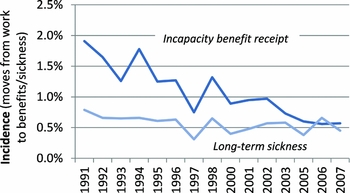
Among those working at the baseline wave, 1.1 per cent claim incapacity benefits in the following year. However, the incidence of yearly transitions to incapacity drops from 1.9 per cent in 1991 to 0.6 per cent in 2006 (see Figure 2). This is probably because overall stability in incapacity benefit claims masks declines in both incapacity on-flows (from work) and off-flows (to work), so that fewer people claim incapacity benefits in any given year. This is supported by the stable prevalence of long-term sickness at the time of interview in BHPS.
Trends in incapacity benefits receipt in selected OECD countries 1980–1999 Source: OECD 2003: 61; OECD(16) refers to the 16 countries with complete data 1980–1999.

Trends in moves from work to incapacity/long-term sickness in BHPS

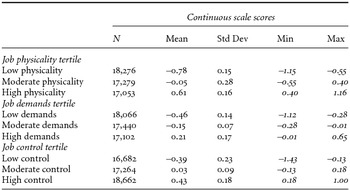
In the original data, the trends in control, demands and physicality are the same as in the literature review (control declined by 0.4 standard deviations (SDs), demands rose by 0.4 SDs, and physicality rose by 0.05 SDs). In the outcome data, the imputed scales are split into tertiles (Table 1); the biggest absolute difference between tertiles is for physicality, and the smallest is for demands.
Descriptive statistics for job demands and control

Notes: Complete case sample, n = 52,608.
As expected, people in the third of lowest-control and highest-physicality jobs have higher levels of incapacity receipt in the following year than people in the highest-control and lowest-physicality jobs (1.4 per cent vs. 0.8 per cent for control, 1.6 per cent vs. 0.6 per cent for physicality). However, it is people in the low-demands – and not the expected high-demands – jobs that have higher levels of incapacity (1.5 per cent vs. 0.7 per cent). This may well reflect the social patterning of different jobs, and it is therefore necessary to look at the associations between these variables after adjusting for likely confounders.
Main results
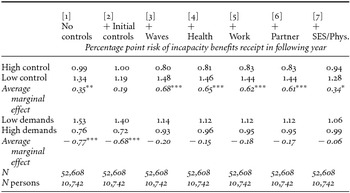
The results of the main models are given in Table 2. (Results are given as Average Marginal Effects (AME), which are the clearest ways of expressing logit models: they show effects as the average percentage point difference in incapacity claims in the following year.) The hypothesis is that falling control and rising demands partially explain rising incapacity. As such, the models below focus on the effects of demands/control; the coefficients for the other covariates for the same models are given in Web Appendix 5.
Regression of incapacity benefits receipt on baseline working conditions

Notes: †p < 0.10 *p < 0.05 **p < 0.01 ***p < 0.001. Each model includes the covariates in the previous models, plus an additional group of covariates. Full details of the covariates are given under ‘modelling approach’ above. The initial controls (model 2) are demographic/administrative variables. SES/Phys (model 7) refers to socioeconomic status + job physicality. Exposure data (on demands/control/physicality) are EiB 1992 and the Skills Surveys 1997/2001/2006; outcome data are BHPS 1991–2007.
Before adding any controls, we again see that it is high control and high – rather than low – demands that are associated with lower chances of claiming incapacity benefits. However, this picture changes when we take account of survey wave, where demands becomes non-significant while the effect of control becomes stronger. In the final model, there are statistically significant effects of high control (0.34 percentage points lower chances of incapacity), but no significant effect of demands.
This therefore partially bears out the original hypothesis: the hypothesised effect of job demands is not apparent, but there is a moderately sized and statistically significant effect of control, even after adjustment for an extensive array of confounders.
If we combine this with the observed decline in job control 1992–2006, the model suggests that one-sixth fewer people in 2006 would move from work to incapacity benefits if job control had not deteriorated since 1992. That is, 0.39 per cent of the sample would move from work to incapacity benefits during the following year, as opposed to the actual 2006 figure of 0.46 per cent (the 95 per cent CI for this estimated effect is 0.02 per cent–0.13 per cent, not taking into account the uncertainty around trends).
A causal effect?
The extent to which this association is evidence of a causal effect depends on a number of assumptions. Some of these are considered in the Discussion below, but it is possible to test others through a variety of sensitivity analyses, of which five are of particular interest.
First, it is possible that there are some relevant unobserved differences between people that are fixed over time – i.e., the sort of person who is in a low-control job may also be the sort of person who is more likely to move onto incapacity benefits, particularly given that those with higher socioeconomic status tend to have high control (as well as greater employment security and higher demands). Such time-invariant factors can be accounted for using the means of all time-varying covariates as additional regressors (a technique associated with Mundlak, Reference Mundlak1978). However, after taking these time-invariant factors into account, the effect of job control is still generally significantFootnote 5 and even increases slightly in size. Interestingly, the null overall effect of job demands is split into opposite effects of permanent (average) demands (high demands reduces the risk of incapacity) and changing demands (increasing demands raises the risk of incapacity). Overall, this provides further support for a causal effect of control, and raises questions about the impact of demands that are returned to below.
Secondly, there may be further time-varying factors that confound the relationship between demands/control and incapacity. It is impossible to control for major occupational group in these analyses, as this would account for a large part of the genuine variation in demands/control, leaving the remaining values largely capturing random noise. While the analyses above control for a greater list of relevant confounders than previous studies,Footnote 6 the robustness of the results was further checked against additional controls that may be associated with occupational class. This includes overall wages, job satisfaction, satisfaction with specific dimensions of work (job security, pay, manager and use of initiative), opportunities for promotion, self-defined class and valuing work. All of these had minimal additional effects on demands/control beyond the controls in Table 2 – the only noticeable change was when controlling for wages, where the effect of control became about 20 per cent smaller and non-significant in some specifications.Footnote 7 This may indicate some unobserved confounding, but in general the effect of job control seems robust to these additional confounders.
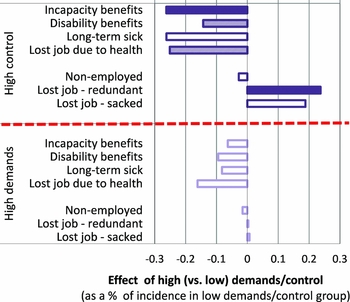
Third, a causal interpretation is further supported if there is evidence of ‘specificity’ – that is, if the apparent effect of control and null effect of demands can be seen on theoretically similar outcomes (e.g., long-term sickness) but not on theoretically different outcomes (e.g., non-employment in general). The results are shown in Figure 3.
Specificity of job demands-control effects to disability-related outcomes Notes: Average incidence of outcomes are 1.1% (incapacity benefits receipt), 2.2% (disability benefits), 0.6% (long-term sickness), 0.9% (lost job due to ill-health), 4.4% (non-employment exc. Incapacity benefits), 3.1% (made redundant) and 0.4% (sacked). Solid bars are significant at the 5% level; bars shaded with hashes are significant at the 10% level; empty bars are not significant. Estimates are based on the same sample and control variables as model 7 in Table 2.

Looking first at control in the upper part of Figure 3, we can see that the results are highly specific to the four health-related outcomes. Only the result for incapacity benefits is significant at the 5 per cent level (disability benefits and health-related job loss being significant at the 10 per cent level, and the rarest and therefore lowest-powered outcome of long-term sickness being p = 0.11) – but the effect size is consistent across three of the four health-related outcomes, and all four contrast markedly to the non-health-related outcomes.Footnote 8 Demands differs markedly; it is not remotely close to significance for any of the seven outcomes (even for the relatively large effect on health-related job loss, p > 0.3). This offers additional support for a causal interpretation for control but not for demands.
Finally, to the extent that these do represent causal effects, they may not be consistent among all groups; a sensitivity analysis therefore tested whether demands/control had different effects by age and gender. There were no significant interactions by gender, but control only had an effect in younger workers, a difference that was marginally significant (p < 0.10)Footnote 9 – a finding considered further below.
Of the large number of other sensitivity analyses, none had a noticeable impact on the results (see Web Appendix 6). These analyses include: (i) imputing working conditions based on different sets of covariates than just occupation and year; (ii) continuous rather than categorical demands/control/physicality; (iii) looking only among workers; (iv) excluding the ‘temporary sick’ at baseline; (v) different estimation techniques (including random effects models); (vi) accounting for the fact that working conditions are observed for occupations rather than individuals; and (vii) accounting for missing data.
Discussion
This paper investigated whether changing working conditions may have contributed to rising incapacity claims internationally, using the most-likely case of Britain (which has not only seen intensification like other countries, but also a noticeable decline in autonomy). Rather than looking at people's self-reported working conditions, which may be subject to individual biases, the study used working conditions reported by people in a particular occupation, merging work surveys into a longitudinal dataset. It then tested whether people in high-demands, low-control jobs were more likely to claim incapacity benefits in the following year, holding constant a large number of sociodemographic and health controls.
The results partially supported the initial hypotheses. Low job control (and high physicality) significantly raised the risk of claiming incapacity benefits in the following year. However, in contrast to the predictions – although fitting the mixed picture from previous studies – there was no effect of job demands on incapacity claims. All of these findings were reasonably robust across a range of different sensitivity analyses, with two exceptions:
-
• The sort of person who is generally in a high-demands job has a lower risk of incapacity, but moving to a more demanding job is associated with a greater risk of incapacity. This may be due to selection effects where the most ambitious/resilient people choose high-demands jobs, while changing demands is a more random process of lifecycle effects and within-occupation change – but other explanations are also possible.
-
• When looking by subgroups, there were some signs that high control only reduced the risk of incapacity claims among younger (<45) workers. This again suggests possible selection and lifecycle influences on the impacts of working conditions.
Further research would be helpful to replicate and develop both findings.
Overall, these models suggest that if job control had not deteriorated between 1992 and 2006, one-sixth fewer people would move from work to incapacity in the following year – although care must be taken in using this estimate. Even in the absence of any confounding – a strong assumption (see below) – these estimates will still be subject to noticeable attenuation biases. (It is possible to eliminate the attenuation bias using technical developments of these models. Further estimates available from the author suggest that one-quarter – rather than one-sixth – fewer people would move to incapacity if job control had not deteriorated.) The focus here is also on the flow from work to incapacity, rather than either the reverse transition from incapacity back to work, or the stock of claimants as a whole. The results are therefore best taken as evidence that changing working conditions played a role in rising incapacity receipt, rather than as a precise quantitative estimate of the extent of that role.
Limitations
As in all social research, causal inference is a challenge. Here we can only treat the associations as causal if we assume that that there is no unobserved confounding – that is, there is nothing outside of the model that causes both demands/control and incapacity receipt. The analysis controls for a larger range of potential confounders than most comparable studies, tests the case for causality in additional analyses and goes beyond self-reported measures of working conditions, all of which make this assumption more plausible.
Yet it is still possible that unobserved confounding remains, both on the individual level (around the health-related – and broader – selection of individuals into changing occupations) and the occupational level (if occupational characteristics are determined by structural factors), and there are two ways in which future research could account for this. First, exogenous sources of variation could be used as instrumental variables (IV) for demands/control/physicality, such as the use of bed overcrowding as an instrument for job demands among nurses (Kivimaki et al., Reference Kivimaki, Vahtera, Kawachi, Ferrie, Oksanen and Joensuu2010). However, IV analyses themselves are beset by problems, both theoretically and practically, and it is difficult to find a convincing instrument for job control. A second alternative would be to model selection into jobs alongside the existing models, allowing us to test whether there are unobserved factors causing both low control and incapacity receipt.
Finally, while demands, control and physicality seem particularly likely to influence fitness-for-work, another priority for future research is to look at other working conditions. For example, ‘light work’ – the expectation that workers scale down to easier work with the same employer as they age – seems to have declined. Yet while this has long been mentioned (Feldman, Reference Feldman1983: 439), it has rarely been studied. A high priority for future research is to fill this gap.
Implications
The best way of dealing with a problem is not necessarily to reverse its cause. Yet, if rising job strain has contributed to the high levels of incapacity benefit receipt since the 1990s – bearing in mind the uncertainties over causal inference mentioned above – then a comprehensive strategy for tackling incapacity should at least consider reducing job strain, and this has generally been absent. For example in the UK, working conditions are not explicitly mentioned in the Prime Minister's Strategy Unit's 2005 report on ‘Improving the Life Chances of Disabled People’ (PMSU, 2005), or in the series of Government Green Papers and White Papers reforming the incapacity benefits system (DWP, 2006, 2008a, 2008b, 2010a), or by the current Coalition Government (DWP, 2010b; Freud, Reference Freud2010).
This is not to suggest that work does not feature in any discussions beyond the UK – the most recent OECD report recommends ‘securing good working conditions which avoid job strain’ as a way of reducing mental health-related incapacity claims (OECD, 2012: 208). Yet, to the extent that the OECD provide any detail at all on how to achieve this, they refer only to better management, protections against dismissal, health and safety policy, and reducing stigma (pp. 65–72); the organisation of work itself is taken as a given. The same logic can be seen in a British Academy-commissioned review by Chandola (Reference Chandola2010) on workplace stress, which provides an excellent overview of the field, and again explicitly draws attention to rising job strain. However, the concluding recommendations focus entirely on the individual and organisational levels, omitting any discussion of the macro-level determinants of working conditions.
The problems with this can be seen when we look at the ‘reasonable accommodations’ that are required within anti-discrimination legislation in America and the EU. There is strong evidence that accommodations help disabled people continue working (Franche et al., Reference Franche, Cullen, Clarke, Irvin, Sinclair and Frank2005), yet there are practical difficulties in implementing accommodations, particularly as they can induce resentment amongst colleagues (Sainsbury et al., Reference Sainsbury, Irvine, Aston, Wilson, Williams and Sinclair2008: 89). As Foster and Wass (in press) suggest, if the ‘ideal worker’ has to work harder and more rigidly, then what counts as a ‘reasonable’ adjustment may still be insufficient to enable disabled people to continue working. This is not to say that interventions that incentivise employers to recruit and retain disabled people are undesirable or ineffective (see Autor, Reference Autor2011; OECD, 2012), but rather that they only deal with the symptoms of a deeper problem.
Changing the nature of work
Some researchers have called for such a change in the nature of work, including the head of the WHO Commission on the Social Determinants of Health (CSDH), Michael Marmot, whose focus on ‘the causes of the causes’ explicitly traces risk factors back to their structural roots – an approach that links to wider critiques of the contemporary labour market (e.g., Standing, Reference Standing2011; Sennett, Reference Sennett1998). Yet sometimes the resulting macro-level policy recommendations are perceived as being ideological rather than ‘evidence-based’ – despite the considerable evidence assembled to support them – and they often suffer from being vague aspirations rather than detailed policy plans. For example, the CSDH does recommend that we should ‘improve working conditions for all workers’, but the actual path to this is unclear (CSDH, 2009: 82).
So what might such a policy to improve working conditions look like? One place to start is by improving the supply of skills in order to get better-quality, higher-autonomy work – yet there is an increasing consensus that skills supply has little impact unless we also increase the demand for skills (Payne and Keep, Reference Payne and Keep2003: 206). One way of trying to improve skills demand is ‘exhortation’ – that is, the Government's attempt to persuade employers that it would be in their own interest to create better-quality work. Such efforts can be valuable, as seen in Finland's Quality of Working Life initiatives (Maltby, Reference Maltby2011), but they are limited by their lack of attention to the wider forces that make employers act in particular ways; if it makes sense to compete using low-autonomy, high-demands jobs, then this is what employers will do. The better quality of work in the Nordic countries is likely to stem from this combination of good skills supply, exhortation and an institutional platform of unions and labour regulation where good work is a sensible business strategy.
This is obviously an agenda of considerable scope, linked to longstanding debates around industrial policy, skills policy and the quality of work (just on the international stage this can be seen within the European Employment Strategy since 2000, the 2012 OECD Skills Strategy, continued attention from the ILO, etc.). It is not realistic to suggest that incapacity policy will be anything than a small part of a long list of considerations within this. Moreover, there is a certain path dependency which makes wholesale institutional change slow and difficult. Nevertheless, given that high levels of incapacity are likely to be in part a side-effect of decisions about economic policy, it would seem sensible for disability-related social and budgetary impacts to be represented within these broader policy discussions in future.
Reframing the puzzle of incapacity
Perhaps the more significant implication, though, is over how we see the ‘puzzle of incapacity’ with which this paper began. On the assumption that health has improved and jobs have become easier, rising levels of incapacity claims may suggest fraud, policy failure and/or hidden unemployment – in other words, rising levels of incapacity represent anything except a genuine rise in work disability. Discussions of incapacity policy therefore are often framed about the puzzle of rising incapacity in an ever-healthier world (OECD, 2003: 9; Wise, Reference Wise2012) and its ‘unsustainability’ (Autor, Reference Autor2011).
This links to a public debate over disability that is similarly sceptical about the ‘genuineness’ of the disability underlying benefit claims – albeit to varying degrees in different countries. In the UK in 2007, 15 per cent of people thought that the majority of disability benefit claimants were ‘falsely claiming’ (the average view was that 30 per cent were claiming falsely), a view that may have become increasingly widespread following a series of often misleading newspaper articles about the scale of fraudulent disability claims (Baumberg et al., Reference Baumberg, Bell and Gaffney2012). The limited evidence available suggests that similar views may be seen elsewhere – for example, 39–48 per cent of those in Norway, Sweden and Denmark agreed that ‘many of those who report themselves as ill are not really ill’ (Halvorsen, Reference Halvorsen2002: 8).
Yet, to the extent that rising incapacity is caused by rising job strain – bearing in mind the uncertainty in the results in this paper – then this lends support to another story, where people with health problems are excluded from the labour market by jobs that have become ever-more difficult for them. This does not necessarily compete with the hidden unemployment approach; changing working conditions can be seen as causing a particular deterioration of labour demand for disabled people (Baumberg, Reference Baumberg, Vickerstaff, Phillipson and Wilkie2011b). This can also be linked to broader critiques of twenty-first-century work, such as Standing's (Reference Standing2011) account of the Precariat. In combination, this opens up the space for a new narrative around incapacity benefits, which does not focus on the failures of the individual or the benefits system. Instead, it is open to the possibility that high levels of disability in the twenty-first-century are to some degree ‘genuine’, and that policies to reduce incapacity claims should cast their eye on the world of work. In Annie Irvine's wonderful phrase (Reference Irvine2011: 766) that provides the title of this article:
‘Perhaps the key question should not be whether an individual is fit for work, but whether the work is fit for the individual.’
Acknowledgements
Thanks to Annie Irvine (and others at SPRU), Mel Bartley and David Blane (and others at ICLS), one very helpful anonymous reviewer, and in particular to John Hills (and others at CASE) for varying forms of criticism, help and guidance – none of which should be taken to indicate their agreement with the views in this paper. Thanks too to all those involved in participating in, funding, collecting, archiving and supplying the secondary data used here; copyright for the data in most cases remains with the survey funders/coordinators; see the Data Archive for details of each survey.
Supplementary material
For supplementary material referred to in this article, please visit http://dx.doi.org/10.1017/S0047279413000810