Combining Two Seminal Articles
More than twenty-five years ago, Mira Wilkins published a seminal article on “The Neglected Intangible Asset: The Influence of the Trade Mark on the Rise of the Modern Corporation.” In that article Wilkins argued that brands played a critical role in explaining the rise of the multifunctional, multiproduct, multiregional, and multinational firm, and she urged academics to pay attention to these valuable business assets.Footnote 1 Since then, many business historians embraced that challenge, and I am one of them.
The title that I chose for my presidential address, “The Nature of the Firm—and the Eternal Life of the Brand,” combines two seminal articles, “The Neglected Intangible Asset” and “The Nature of the Firm,” published by Ronald Coase in Economica in 1937.Footnote 2 I will use these two articles as the basis to reflect on the impact of the brand on the nature of the firm and its changing boundaries, and also on corporate processes of globalization and deglobalization.Footnote 3 Unlike other forms of intellectual property rights, such as patents and copyrights, which expire after a limited number of years in order to facilitate the diffusion of new knowledge, brands and trademarks have the capacity to have “eternal lives,” securing monopoly power to firms forever.Footnote 4
In my analysis, I will also engage with a topic that has for some time been a concern for many business historians, including former BHC presidents: the dialogue between history and theory.Footnote 5 In recent years, the number of publications suggesting what methodologies we should or should not be using, what disciplines we should be dialoguing with, and what topics we should be addressing have proliferated rapidly.Footnote 6 Today, to engage with this ongoing discussion, I will focus on the dialogue with international business.Footnote 7 This is a discipline in which the famous “historical turn” took place more than fifty years ago, and in which, once again, it was Mira Wilkins from the business history side who initiated that successful dialogue.Footnote 8 Her keynote speech on “Multinationals” was a good proof of that.Footnote 9
Before I start, I would like to make a brief remark about my chosen venue for this presidential address. There is often this notion that if you break traditions and do things in a different way, somehow the dignity of the event or the reverence in which it is held is changed. I decided to follow the spirit of the founding fathers of this association who privileged spontaneity and fellowship to formality. Curiously, that was their argument for naming it “Business History Conference” and not “Business History Association.” Today, I chose this beautiful venue by the beach to create a more spontaneous, informal, and hopefully also intellectually stimulating environment for BHC members.Footnote 10
The Dialogue About the Nature of the Firm Between History and Theory
I have structured my address in three parts. In the first part, I analyze the “Dialogue About the ‘Nature of the Firm’ Between History and Theory.”
Everybody knows about the profound impact Ronald Coase’s Reference Coase1937 article had on scholarship worldwide.Footnote 11 In that article, which was the basis for the work that earned him a Nobel Prize quite a few years later in 1991, Coase argues that the entrepreneur chooses to create a firm rather than trading bilaterally through the market, because that allows the entrepreneur to supersede the price mechanism.Footnote 12
Since Coase, many other scholars have been interested in providing different explanations about the nature of the firm. Edith Penrose was one of those scholars. She developed a theory known as the “Resource-based View of the Firm,” published in 1959. Her argument was that activities are conducted within the firm not because of market failures or because there are costs of transacting through the market, but rather due to firms’ success. Firms may have organizational capabilities, such as superior brands and marketing knowledge, that enable them to organize economic activity more efficiently and impede easy entry to newcomers.Footnote 13
Oliver Williamson, also a Nobel Prize Winner in 2009, was another scholar interested in the nature of the firm. He considered the problem of economic organization to be one of contracting.Footnote 14 He approached the firm as a governance structure and identified particular characteristics of transactions, such as asset specificity, that he considered to create transaction costs when using market mechanisms.Footnote 15
Apart from their interest in the nature and boundaries of the firm, these remarkable scholars also shared other commonalities that are worth highlighting. First, they placed emphasis on the power of intellectual property rights, including brands among other resources, in explaining the nature of the firm. Second, they all considered that history is important in informing theory. Ronald Coase always grounded his theory in both qualitative and quantitative evidence. For instance, to understand how markets operate, he looked at the long history of markets and fairs in medieval England. Also, to challenge prevailing views about the dimensions of public goods, Coase studied the evolution of the British lighthouse system by tracing it back to the sixteenth century.Footnote 16
Edith Penrose went a step further in her use of history, as she combined, in a dynamic way, inductive with deductive analysis.Footnote 17 She actively engaged with historical research, rather than relying on secondary sources.Footnote 18 In fact, the main empirical research that she used to inform her theory was published separately in 1960 in Business History Review, under the title “The Growth of the Firm—A Case Study: The Hercules Powder Company.”Footnote 19
Oliver Williamson, whom I first met at Universidade Católica Portuguesa when I was still a student in Lisbon and whose PhD classes I attended for a term when I was a Fulbright Visiting Scholar at the University of Berkeley, just before starting my own PhD studies at the University of Reading, also draws on history to inform and illustrate his theoretical arguments. In his article on “The Modern Corporation: Origins, Evolution, Attributes,” he explicitly thanks Alfred Chandler in the introduction for his valuable comments, and in his two main books, Markets and Hierarchies and Economic Institutions of Capitalism, he prominently cites Chandler’s work throughout.Footnote 20
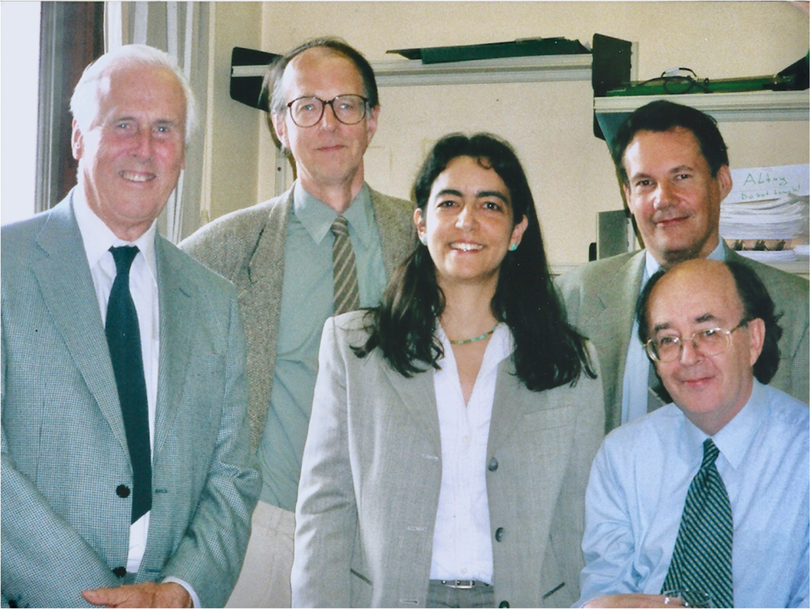
I know, you must all be thinking “Why would someone choose to do a PhD in rainy England, and not apply instead to study in warm California?” Well, my academic interests in international business history were already quite well defined by then. When I went to Berkeley to work with Paul Duguid on eighteenth- and nineteenth-century port wine traders, I had already been accepted as a PhD student at the University of Reading, where I would work with world-renowned scholars in business history and international business.Footnote 21 Figure 1 is a picture of me with my PhD viva committee: John Dunning, Mark Casson, Geoffrey Jones, and Bob Pearce.
My PhD viva with John Dunning, Mark Casson, Geoffrey Jones, and Bob Pearce, University of Reading, May 2002.

At the University of Reading, apart from Geoffrey Jones and his team, which included scholars such as Tony Corley, Peter Scott, Lucy Newton, Matthias Kipping, Andrew Godley, and Peter Miskell, there was also a very prominent group of international business scholars, including John Dunning, Mark Casson, John Cantwell, and Bob Pearce.Footnote 22 Apart from a common interest in the work of Coase on the “Nature of the Firm,” and to some extent Penrose’s and Williamson’s research as well, all these international business scholars also believed in the power of history to help refine theory.Footnote 23 While they drew extensively on historical secondary sources in their work, they also became business historians to some extent. For example, John Dunning’s exquisite analysis of American investment in Britain is grounded in business and economic history and a wealth of historical data.Footnote 24
Mark Casson’s conviction that history can inform theory led him, while head of the department, to headhunt Geoffrey Jones from the London School of Economics in the late 1980s to develop a business history group at the University of Reading. Throughout his career Casson has also conducted original archival research himself and published various articles in business history journals. Some of those articles are collaborations with business historians, of whom I have been one.Footnote 25
When analyzing the different uses that international business scholars make of history, I found distinct patterns that I believe are quite revealing of the different types of dialogues that can exist between business history and other disciplines.
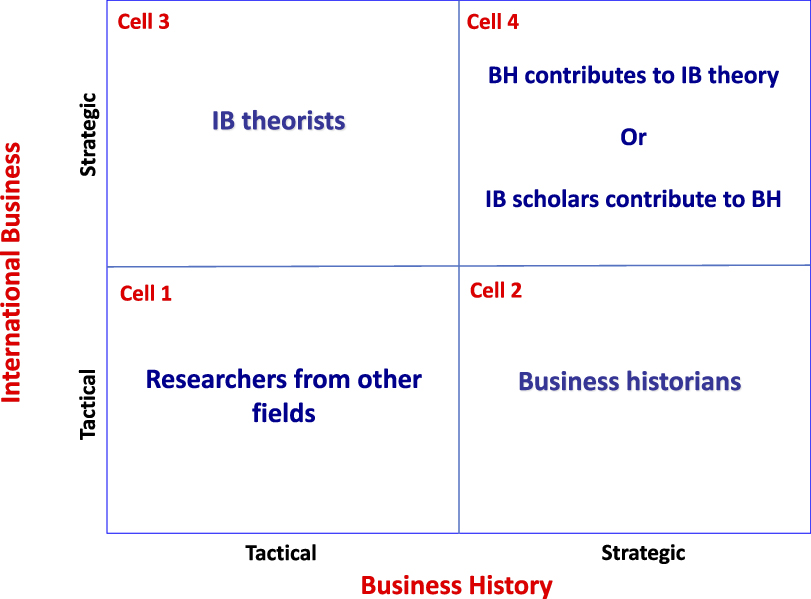
Figure 2 uses international business to analyze four possible types of dialogue with business history. Researchers can have what I call a more “strategic” or “tactical” approach to a discipline. A “tactical” approach means that the scholar draws upon and cites research from another discipline to help structure his or her own arguments but does not necessarily engage with that discipline’s main research questions. A “strategic” approach means that the researcher engages actively with the type of questions and problems of the cognate discipline, while keeping his or her core competencies, which in the case of business history entails relying on in-depth archival research. Throughout a researcher’s career, he or she can be positioned in different cells, depending on the type of research being carried out.
Interdisciplinary dialogue between business history and international business. BH, business history; IB, international business.

In cell 1 the researcher is from another field, for example, strategy, and follows a “tactical” approach toward both disciplines—business history and international business. For example, and to use a familiar name, when writing The Competitive Advantage of Nations, Michael Porter cites Alfred Chandler, as well as John Dunning, among other scholars in business history and in international business, to help ground his arguments and build his theory.Footnote 26
In cell 2 the researcher follows a “strategic” approach with regard to business history and engages with international business to help put forward general propositions and search for synthesis. This approach helps business historians move away from pure history, toward a more generalist business history. Many of us use this type of dialogue with regard to cognate disciplines. Going back to the theories I introduced previously on the resource-based view of the firm and on transaction cost economics, we see several former BHC presidential addresses—such as those by Mira Wilkins, Bill Lazonick, Naomi Lamoreaux, Geoffrey Jones, Patrick Fridenson, and Mary Yeager—drawing on these theories.Footnote 27 But many other business historians engaging with these theories could also be cited.Footnote 28
Cell 3 relates to those cases wherein academics from international business use business history in a “tactical” way to help test models and analyze the dynamic and evolving nature of the firm. An illustration is Jean-François Hennart, who engaged with the historical research on freestanding firms to help refine internalization theory, a key theory in international business.Footnote 29
Finally, in cell 4 academics engage “strategically” with both cognate disciplines. For instance, in a recent article, Geoffrey Jones, Mark Casson, and I used business history research to argue that internalization theory would gain from being extended to take into account the wide diversity of organizational forms used historically by firms operating in international markets.Footnote 30 We also see international business scholars such as Alain Verbeke and Liena Kano recently engaging with historical research to argue that no new theories are required in international business to explain the existence and behavior of multinationals from Latin America and other emerging markets.Footnote 31
Business historians have had a lot to say about the nature of the firm, its changing boundaries, its uniqueness, the role of entrepreneurs who manage the firms and brands, and corporate processes of globalization and deglobalization. There are still great gains in pursuing these questions given the current world environment, characterized as it is by the disintegration of global value chains, institutional voids in different parts of the world, and an increasingly wider variety of unconventional organizational forms created to take advantage of financial, strategic, or legal efficiencies, or a combination of these.
A few months ago, at the Japanese Business History Conference in Kyoto, Takafumi Kurosawa organized a very well attended plenary session on “Situating Business History: Going Beyond National, Disciplinary and Methodological Boundaries.” It was very clear, judging from the questions posed by the audience, that business historians in business schools and economics departments are feeling the pressure to dialogue more with cognate disciplines by engaging with theory and addressing current world problems and also by doing more comparative and international analysis.Footnote 32 I completely agree that this type of approach is conducive to meaningful research, as it facilitates generalizations and synthesis, apart from the fact that it greatly benefits progress in academic careers. However, I also have concerns, particularly with regard to more junior colleagues who, because of these pressures, might end up “disguising” their true identity as business historians, and therefore undermine their core competences.
Business history as a discipline has this great capacity to act as a “hub” where researchers from different social sciences and the humanities can dialogue and collaborate. But that dialogue should always be achieved with business historians showcasing their core competences, which entail doing thorough archival research, acknowledging the uniqueness of the firm and the complexity of the environment, and also doing international and comparative analysis. While discussing the nature of the firm and the context in which it operates, we should also rely on ideological independence, discarding any political ideology and focusing on providing “full truths” about historical reality.Footnote 33 All types of dialogues should be conducive to building the intellectual credibility and global reputation for business history and to making it relevant to other disciplines.
The Eternal Life of the Brand
In the second part of this address, I would like to look at brands and trademarks and illustrate how they can provide new insights into the nature of the firm and also of other economic phenomena, such as corporate processes of globalization and deglobalization.
Again, there is wide research on this topic within different disciplinary contexts, such as management studies in particular, marketing, economics, linguistics, philosophy, sociology, and law.Footnote 34 However, most of that work tends to be ahistorical or uses history in a nonhistorical way.
Because of that, business historians have been particularly successful researching brands and trademarks, as they have been able to provide detailed accounts on the dynamics of competition over very long periods of time. This is in fact one of the areas in which the expertise of business historians has been sought after by the corporate world. Examples of influential commissioned histories focusing on brands include Geoffrey Jones’s Renewing Unilever and Keetie Sluyterman and Bram Bowens’s Brewery, Brand and Family—150 Years of Heineken, in which they portray the trajectories of some of the world’s most famous brands from their origins to global success, including their resilience in periods of adversity.Footnote 35
But business historians have also been producing academic work on brands and analyzing how brands impact the nature of a firm, using a variety of business angles, international contexts, and time periods.Footnote 36 For instance, scholars have looked at the origins of brands and their relationships with the entrepreneurs who created them.Footnote 37 Additionally, business historians looked at how brands help explain the rise of the modern corporation and the dynamics of industries;Footnote 38 how firms build sustainable competitive advantages relying on brands; and also how they have dealt with uncertainty in parts of the world with less sophisticated institutional environments for the protection of intellectual property rights.Footnote 39
In fact, dealing with different types of business risk, institutional risk, and political risk has been a major challenge, threatening the success and the “eternal lives” of brands around the world. Apart from registering trademarks to try to protect their intellectual property, firms have frequently had to use a multitude of avoidance, prevention, mitigation, and also withdrawal strategies.Footnote 40 For instance, during the first half of the twentieth century, Coca-Cola and L’Óreal had great difficulties in operating in South American markets such as Argentina, where legislation relied on the “attributive system,” which enabled local entrepreneurs to appropriate the intellectual property of successful foreign brands (and also of local brands), by simply being the first to register the trademarks, irrespective of any proof of use.Footnote 41
In the early twentieth century, governmental policies in South American countries started favoring import substitution as a way to promote domestic industries. The Argentinian wine industry, for instance, developed in the first place through the imitation of collective and private wine brands from the Old World, as well as through the replication of the production techniques used, by hiring experts and technicians and importing different varieties of grapes from established wine-producing regions.Footnote 42 In these markets, foreign firms that owned successful brands had very limited institutional protection and often chased imitators either individually or in alliances with other competitors also being imitated to negotiate private agreements and stop counterfeiters.Footnote 43 Firms sometimes had to change the types of entrepreneurs managing their brands or their modes of entry into those markets, sometimes relying on alliances with domestic competitors.Footnote 44
Already in the late medieval period Tuscan businesses were forming alliances with other firms in the same industry for the international distribution of their goods. To serve new markets, the new partners often created new brands (or logos) that combined parts of their firms’ existing logos. However, other firms, such as the collateral branch of the Medici family business, which specialized in the production of woolen textiles and international trade of goods, retained their own brand as the only brand for the goods traded, even when forming alliances with other manufacturers and merchants to serve new markets. Through those alliances they were in fact outsourcing production to their partners and selling the goods under their own brand name. This basically means that they were not only creating very early forms of global brands but were also relying on outsourcing of production, reminding us of multinational strategies, considered to be a recent phenomenon, in which firms like Nike and Gap focus on their core competences such as design, branding, and distribution and outsource the activities that generate less value added.Footnote 45 To prevent business risks associated with possible infringement, firms such as Lever Brothers, when launching new household brands in the late nineteenth century, adopted very innovative branding strategies by focusing on the marketing of a very restricted number of brands such as Sunlight and by fiercely protecting those brands legally. As part of these strategies, they developed trademark cluttering, which is currently a concern of many intellectual property rights offices and is considered to be a recent phenomenon. By creating cluttering, Lever Brothers was basically registering an excessive number of unused or overly broad trademarks, with names, sounds, or symbols related to its original brands, as a means of preventing infringement by competitors through the registration of similar brands.Footnote 46
But brands also help explain other corporate phenomena at the industry and global levels, such as mergers and acquisitions, industry concentration, and “vertical” competition within global supply chains.Footnote 47 For instance, in food and alcoholic drinks chains, we can find various examples of the parties involved fighting to preserve the reputation of the goods they traded by using their brand names on the goods in order to appropriate more value added within the chain.Footnote 48
Brands can also help explain business failure and resilience. Sometimes brands must change ownership to remain successful and become global, as global brands require different entrepreneurial skills. In that process, the firms that created and nurtured those brands often end up either refocusing their activities on other brands and businesses or they decline and end up not surviving.Footnote 49 In periods of war and crisis, brands have often become a threat to the survival of the firms that owned them, sometimes being withdrawn from markets, at other times being disguised as a way for firms and their brands and management to stay alive and avoid loss of goodwill, sequestration, and expropriation.Footnote 50
Apart from drawing on firms’ archives, several business historians have also been using trademark registration data, which go back to the second half of the nineteenth century, when trademark law and a registration system first came into place in many parts of the world.Footnote 51 While it is difficult and very time-consuming to gather the data, and also to compare them in a systematic way across countries and over time, that exercise has multiple benefits. It helps refine explanations that usually rely on conventional economic statistics or draw on other sources of intellectual property rights (such as patents or copyrights). For instance, in Brazil it is possible to find a substantial amount of “disguised” foreign direct investment during the late nineteenth century using trademark data, information not accounted for by any foreign direct investment statistics. Many expatriate entrepreneurs set up businesses and registered firms and trademarks as if they were local entrepreneurs. But once we look at the background of those entrepreneurs and the types of brands and firms they created, we see that they were in fact expatriates using foreign technology and marketing and management techniques, as well as international networks for the distribution and sale of their goods, and also often relying on foreign sources to fund their businesses.Footnote 52
Trademark data also offer huge potential benefits for understanding the formation of industries and regional clusters and provide alternative ways of looking at economic development as well as shifts of power and wealth.Footnote 53
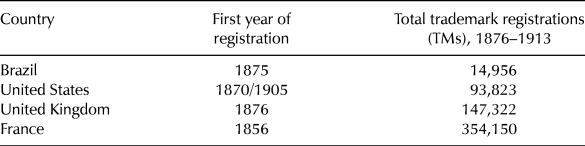
Table 1 shows the total number of registrations from Brazil, the United States, the United Kingdom, and France between 1876 and 1913. In Brazil the figures are substantially lower than in any of the other countries around the same time period, and the trends are very similar if the annual data is weighted by GDP per capita or by population. If we look at the number of foreign trademark registrations per country, we obtain a similar picture. For example, in Portugal, in 1885, one of the first years of registration, the percentage of foreign registrations corresponds to about 66 percent of the total trademarks; whereas in countries such as the United States, this number is substantially lower, only corresponding to around 2.15 percent around the same time. In Brazil and Portugal, two less advanced economies at that time, which relied on the production and trade of nonbranded raw materials, these trademark registration figures (both for domestic and foreign registrations) indicate the presence of less innovative capabilities with regard marketing and branding by local entrepreneurs and an openness to foreign trade and investment. The lower propensity for these countries to protect intellectual property is also indicative of a certain lack of awareness by entrepreneurs about the advantages associated with the protection of intellectual property rights and, to some extent, a lack of trust on the effectiveness of local institutions in enforcing the law.Footnote 54
Trademark registration patterns for selected countries, 1876–1913

Source: Lopes, Guimarães, and Saraiva, “The ‘Disguised’ Foreign Investor,” 1177.
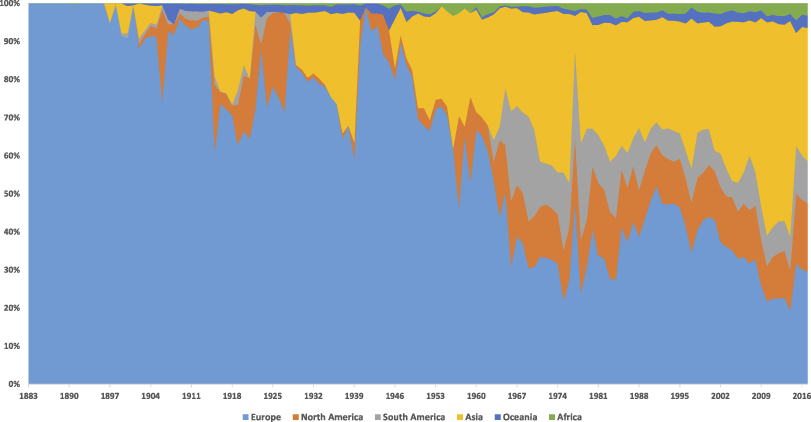
Figure 3 provides an overall evolution of the relative significance of trademark registrations by continent for the period from 1883 up to 2017. It draws on trademark data from the World Intellectual Property Organization, and includes 181 markets. It shows that there has been a shift in the proportion of registrations from developed countries, particularly from Europe, to emerging markets in Asia such as China and India and also to Latin American markets, in particular Brazil.Footnote 55
Significance of trademark registrations by continent, 1883–2017 (amounts stated in percent).
Source: Based on data from the World Intellectual Property Organization historical statistics database, Total Registrations (direct via the Madrid System; (https://www3.wipo.int/ipstats/pmhindex.htm?tab=madrid). A special thanks to Thomas and Sophie da Silva Lopes Johnson for processing the data and designing the graph.

In summary, we have come a long way since the brand and the trademark were considered to be neglected intangible assets by business historians, but there is still a lot of work to be done with regard their impact on the nature of the firm. The capacity of brands to have eternal lives provides a very rich angle for business historians to research long-term evolutionary processes relating to the nature of the firm. In a business environment characterized by the Internet of things, artificial intelligence, and blockchain, global brands have become key facilitators of, and to some extent “synonymous” with, specific economic and social activities: for friends we have Facebook; for auctions we have eBay; for work and home we have Microsoft and Apple; for transportation we have Uber and Lyft; for professional networks we have LinkedIn; for photographs we have Instagram; and for influencing others we have Twitter, just to name the most prominent.Footnote 56 Even when using open innovation and intellectual property landscapes to share resources, know-how, and technology, multinationals are fighting to control their brands across the platforms where they operate and also to protect the intellectual property associated with their trademarks.Footnote 57
Conclusion: The State We Are In
To conclude, the recent phenomena of the spread of populist and nationalist regimes taking positions against major trading blocks and the free movement of people and goods, and the monumental human migration, environmental, and climate change challenges that the earth is facing are all affecting the nature of the firm and corporate processes of globalization and deglobalization. This leads to yet more shifts of power and wealth. Business historians should see these phenomena as a call for the development of their research agendas and for boosting the reputation of the discipline within the social sciences and humanities, and also in the eyes of business and policy makers.
If we engage more in interdisciplinary research, conduct more comparative analyses with an international dimension, and focus more on topics of relevance to business and society, showing, for example, that quite a lot of phenomena believed to be new are not so new after all and that history can provide lessons, we are in no sense diminishing the intellectual rigor of our research. In fact, this helps to enhance the distinctiveness of business history, which as I mentioned before has as its core competence the use of original sources and in-depth archival research.
The interdisciplinary angle of business history was visible at the BHC in Cartagena de Indias, where a large number of scholars from different parts of the world presented very innovative research, as illustrated by the titles of the papers presented during our very busy conference program. But there is another reason why I feel we should be optimistic.
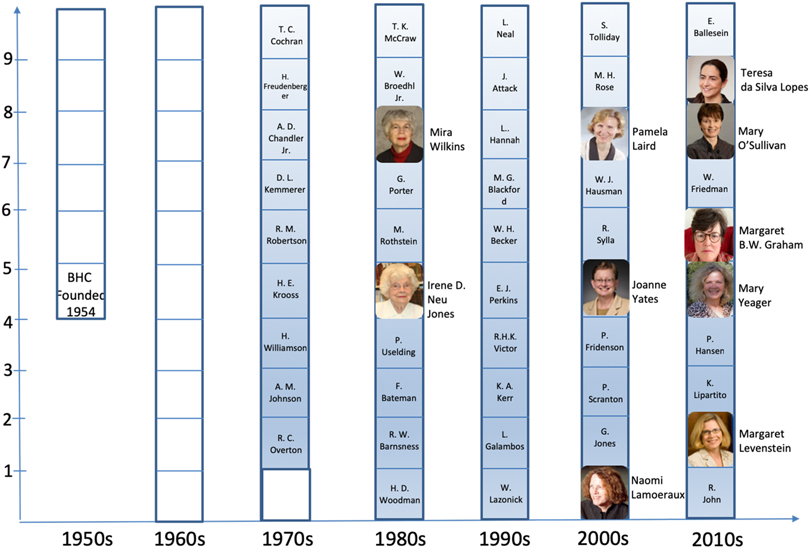
In a world in which women’s rights are constantly being challenged and women need to fight back with movements such as #MeToo, I am very proud to show you Figure 4, which lists the presidents since the foundation of the BHC.
List of presidents of the Business History Conference.
Source: Based on information on the BHC website: https://thebhc.org/officers-past-presidents (accessed March 1, 2019).

While there have always been annual meetings since the BHC was founded in 1954, it was only in 1971 that it became a formal organization and the role of president was created.Footnote 58 Throughout its history, only 20 percent of the BHC presidents were female. However, and this is really enlightening and illustrative of the openness of the BHC, in particular in the past two decades, we see that the number of women has been increasing substantially, with the percentage of female presidents corresponding to 50 percent in the last ten years! This figure is even more impressive when we compare it with the number of female presidents in other associations in the field and in adjacent disciplines in the United States and around the world.Footnote 59
I never considered myself to be a feminist. As Mary Yeager recently pointed out, by adapting Shakespeare’s Twelfth Night (act 2, scene 5) to my case, and I paraphrase: “Some are born feminist, some achieve feminism, and some like you have feminism thrust upon them!.”Footnote 60 And that is totally true!Footnote 61 Life has indeed often put me in situations in which I had to react to and fight against gender inequality. But I should point out that since I first came to this conference, just a few months after I had started my PhD studies in the late 1990s, I have never encountered that problem in the BHC. Over the past twenty years the BHC has always been a very fair and totally equitable association for the discussion of ideas in the field of business history, irrespective of nationality, ethnicity, or gender. It has exposed me to the best research in the field. Here I received comments and advice that greatly shaped my way of thinking. Here I made great friends. And here is where I also experienced a few professional roles as member of the association that greatly enriched my knowledge about the discipline and the management of a professional organization, the last one being the president of the BHC during this past year.
I would like to finish by saying that it has been an enormous honor, humbling experience, and a great privilege to serve this association. I look forward to seeing how it continues to develop from strength to strength in the years to come. Thank you.