On 14 July 1568, William Gerrard and Thomas Offley wrote to Secretary William Cecil attempting to explain why English people were resisting the appeal of England’s first national lottery, held to finance the repair of the nation’s harbors and havens. Warning Cecil that “theare will not followe so good as the queens ma[jes]tie lokethe for, and as all her lovinge subi[ectes] ought to wishe,” they blamed the ineptitude of those local elites charged with promoting the lottery and the fact that the lottery itself was “Straunge to the people of Engl[ande].”Footnote 1 Steps were taken to improve sales, but when the lottery was drawn six months later, barely 10 percent of the 400,000 lots had been sold.
While the Elizabethan lottery has received some attention from historians, these earlier studies saw it as a curious preliminary to the successful series of public lotteries held between the 1690s and the 1820s.Footnote 2 This article will demonstrate the poverty of that assessment, arguing that this first attempt at a public lottery tells us much about the limited ability of early modern governments to implement innovative ways of raising revenue, even when circumstances suggested they would be successful. In the case of the lottery, the new Protestant regime encountered reluctance and resistance, both from those charged with its successful administration and from a public whom they had hoped would participate enthusiastically.Footnote 3 This is especially significant in light of recent work on political culture and state formation in early modern England.
Philip Corrigan and Derek Sayer proposed early modern English state formation as cultural revolution as long ago as 1985, and the past decade has seen a much deeper consideration of “the exercise of political power at the interface of the local and national, and in a way that integrates institutional histories with social and cultural histories,” as Michael Braddick observes in his recent evaluation of new perspectives on state formation in early modern England.Footnote 4 Steve Hindle, in one of the most important books refashioning the subject, argues that rapid changes in economic development after 1550 ensured that the “growth of governance was less a matter of institutional innovation at the centre than of social and cultural development in the localities.”Footnote 5 In deepening and broadening our understanding of what we mean by “the political” and “the state,” these studies have also introduced a new vocabulary, speaking of negotiation, persuasion, and participation more than coercion and enforcement.Footnote 6 Moreover, they place as much emphasis on the daily work of constables, parish officials, and jurors as on that of privy councilors, focus their attention on the household and the vestry as much as on a session of parliament, and elucidate the ways in which individuals shaped their own experiences within structures of authority rather than simply explaining how monarchs and their ministers sought to impose policies.
Three issues central to this recent work on state formation are brought into sharp relief by a closer examination of England’s first state lottery. First, drawing out the linguistic, rhetorical, and visual arguments used by authorities in their attempt to persuade the public to participate in the lottery illuminates cultural assumptions about government and society at a time when state re-formation, not to mention the process of Protestantization, was just beginning. Some of the devices and tropes the authorities thought would be successful may not have brought the desired results, but they were certainly to enjoy added currency in later decades. Second, an analysis of the process whereby the government tried to raise revenue through a lottery demonstrates the tension between formal and informal networks of power and authority and supports the view that power was as much a social relationship as a political one. Tracing how the process developed, from the lottery’s announcement by broadsheet and chart, through the plethora of official proclamations and private letters, to the creation of a new administrative structure, suggests that early modern state formation was hesitant, reactive, and somewhat haphazard. Finally, exploring the reasons for the Elizabethan lottery’s limited success suggests that later developments in state formation need to be carefully situated in their specific contexts in order to capture a fuller sense of the interplay between center and locality, institution and individual, and the political and the social. In the case of the lottery, it seems that distrust of government after a series of damaging coinage debasements was a major factor in the lottery’s failure relative to expectations, while individual concerns about the cost, risk, and perhaps even about the morality of gambling may have also played their part. While this last worry would have convinced only a few ardent Protestants not to buy lots in the late 1560s, it may well help to explain why later Elizabethan and early Stuart governments did not try again, for such views gained considerable potency and agency as England became more fully Protestant. It was only the experience of a much expanded role of the state in everyday life during the middle and later years of the seventeenth century that ensured the success of state lotteries after the Glorious Revolution.Footnote 7
Beginnings
The lottery that was announced on 23 August 1567 was needed to raise £200,000 to repair havens and harbors. To Cecil, the poor condition of England’s ports must have seemed especially urgent, for this was a time of unsettled succession, religious uncertainty, and troubling developments abroad.Footnote 8 Elizabeth remained steadfast in her refusal to marry or settle the succession. By the end of the summer a Protestant regency government was in place in Scotland after the defeat and abdication of the Catholic Mary Queen of Scots, claimant to the English throne, but civil war loomed. Worse, Cecil received intelligence that the Catholic Philip II of Spain was planning an attack on England. Indeed, the Duke of Alba, dispatched to quell the growing rebellion of Dutch Protestants in the Low Countries, arrived in Brussels in the same month the lottery was announced.Footnote 9 The decision to hold a lottery was taken during a time of crisis.
The sum needed for harbor repair was equivalent to a year’s revenue from parliamentary taxation. One might have expected the government to request parliamentary assistance during the session held between 30 September 1566 and 2 January 1567. Indeed, a bill seeking to set up a commission to consider the general problem of inadequate harbors and a second pertaining specifically to a quay in Devon were discussed in that session.Footnote 10 However, a parliamentary solution was problematic. In order to recover from an inherited debt and the costs of waging war with France, the government had successfully obtained parliamentary subsidies in 1559 and 1563 relatively easily. However, the subsidy granted in 1566 caused considerable acrimony in part because peace had been reached with France; the government was demanding subsidies, meant for extraordinary need especially in time of war, in ordinary circumstances.Footnote 11
Since another parliamentary subsidy was out of the question, the government was forced to consider financing harbor repair through the ordinary revenues to which the crown was entitled: exploiting and selling crown lands, raising or farming out customs revenue, securing loans from home and abroad, or calling in the coinage. Yet each of these had been fully exploited earlier to pay for the war with France, so Cecil turned to more novel solutions. One was an entirely new tax to finance the repair of all harbors between Portsmouth and the Thames; he got as far as preparing a draft bill to that effect.Footnote 12 Another was equally unprecedented: a public lottery.
That the secretary would have been receptive to the possibilities of a lottery should come as no surprise. Like his friend and later successor as secretary, Sir Thomas Smith, author of the famous work of political economy, A Discourse of the Commonweal of This Realm of England (1549), Cecil was associated with the “commonwealth” men of the 1540s and 1550s, a time when a myriad of proposals were devised, considered, and debated in light of economic uncertainty and deepening poverty due to rapid population growth and rising prices.Footnote 13 “Throughout his later career,” argues Joan Thirsk, Cecil “upheld the ideals of the Commonwealthmen and was deeply engaged in promoting projects,” many of which took their inspiration from the continent. Was the lottery yet another proposal in what Thirsk considers to be “the constructive phase of projects” between 1540 and 1580?Footnote 14
Smith and the royal financial advisor and merchant adventurer, Sir Thomas Gresham, were well aware that lotteries had been a successful way of raising revenue for public projects on the continent and perhaps both encouraged Cecil’s interest.Footnote 15 Smith had been in the Low Countries in the late-1540s, and given his enormous curiosity in matters economic and monetary, it is unlikely that he would have remained ignorant of lotteries as a source of revenue.Footnote 16 Gresham held the post of royal agent to the Netherlands between 1551 and 1564, and among his contacts was Geerard Gramaye, who had been an advisor for royal lotteries in Sweden and Denmark.Footnote 17 Others also knew that Cecil was open to the idea: six months before the lottery was announced, he noted a lottery associated with George Gilpin and Peter Grimaldi, while the “foreigner” Etienne Perrott came up with proposals to rescue the lottery when the anticipated returns failed to materialize.Footnote 18
There is further evidence that it was the effective use of lotteries in the Low Countries that encouraged Cecil in thinking it would be a viable option. First, in its instructions to local rulers registered in the city of York’s archives, the Privy Council specifically drew attention to a recent lottery in the Low Countries.Footnote 19 Second, the English lottery followed the example of those in the Low Countries by insisting that each purchaser offer a posy—short poems or perhaps a proverb or saying—which would help identify the purchaser along with their name and place of residence. Posies or prozen were first recorded in the Bruges lottery of 1446 and had become a major feature of Flemish and Dutch lotteries; by the end of the sixteenth century they were registered for 85–95 percent of the lots purchased.Footnote 20 Posies had roots in English popular and elite culture as well—being inscribed on fruit trenchers and on rings, written and sometimes published as collections of proverbs and adages, gems of scriptural wisdom or as poems gathered together, like flowers, in a posy—but it was in the Low Countries that they were especially associated with lotteries.Footnote 21 Whatever example Cecil and the government had in mind, and however successful lotteries had been abroad, there is no doubt that the lottery was a novelty in England; there were no tried and true mechanisms upon which to draw. Nor could the young Elizabethan regime build upon the decades of negotiation, persuasion, and coercion that constituted seventeenth-century state formation and that well served those promoting state lotteries from the 1690s onward.
Persuading Participation
The novelty of the lottery was apparent from the very start and pervades the language, tropes, and visual resources the government called into action. Borrowing from the continent, the announcement took the unprecedented form of a black-letter broadsheet listing the prizes and the rules and regulations and authorizing the selling of lots in sixteen cities and towns.Footnote 22 Moreover, rather than choosing the official printers Richard Jugge and John Cawood, the government assigned the broadsheet to Henry Bynneman, a printer who enjoyed the support of Archbishop Matthew Parker, to whom Elizabeth had entrusted the Elizabethan Protestant Settlement. Bynneman’s first sole venture was a 1566 printing of Robert Crowley’s Calvinist Apologie, or Defence of Predestination, followed in 1567 by one of Alexander Nowell’s treatises attacking the English Catholic polemicist Thomas Dorman and translations of Italian and French authors. Stylistically, Bynneman’s work featured elaborate decorative borders, ornaments, and initial letters, which might also explain why he was entrusted with this unique challenge, for, as we shall see, the chart that accompanied the broadsheet had particular illustrative requirements.Footnote 23
The broadsheet declared the purpose of the lottery and announced that the drawing would take place the following June. To encourage quick sales, there were many incentives on offer, including the right to reside for up to seven days at one of the points of sale with immunity from arrest for nonfelonies (a promise that eluded one John Aldaye, who was later scoffed at for claiming wrongful arrest for debt).Footnote 24 As well as three “Welcomes,” additional cash prizes for being one of the first three winners, there were incentives for those who bought large numbers of lots or who enjoyed a run of winning lots. The main enticement was, of course, the chance of winning a prize for an outlay of 10 shillings and the broadsheet listed prizes in cash and goods in great detail; some could even be viewed at the Cheapside house of the queen’s goldsmith. The first prize was £5,000 sterling, comprising £3,000 in money, £700 in plate, and the rest in tapestries and linen cloth. The second through to the eleventh prizes were similarly proportioned, though diminishing in value until there were twelve prizes of £100 each, twenty-four prizes of £50 each, and so on. With 6,000 prizes of 25 shillings, 10,000 of 15 shillings, and not many less of 14 shillings, chances to make a good return on the outlay of 10 shillings was strong. Perhaps the greatest encouragement was the significant promise that the lottery would have no blanks; in other words, each lot was guaranteed to win something, if only the meanest prize of 2 shillings and 6 pence.
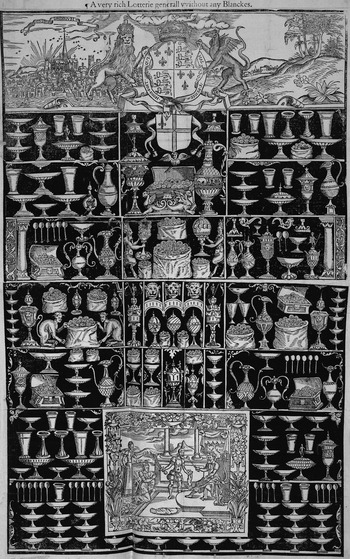
If the form of the broadsheet was as unusual as the choice of printer, even more extraordinary was the pictorial chart or poster that accompanied the broadsheet and which presumably was also the work of Bynneman whose talents were especially suited to its unique visual requirements. Sixty inches long and nineteen inches wide, it was printed in black letter with both ordinary and italic type surrounded by a heavy black border (fig. 1).Footnote 25
The top of the chart drew the viewers’ eyes from left to right, from a sun rising behind the walled city of London, dominated by St. Paul’s cathedral (its recently destroyed spire miraculously restored), to a landscape lush with foliage and blossoming flowers. Prominently placed were the royal arms, with a crowned lion and a winged dragon (the City’s emblem) as supporters, and the City’s arms. Such an explicit reminder of the prosperity and stability of both City and crown was meant to reassure adventurers. Beneath the landscape and heraldry the chart displayed the riches on offer: an Italianate treasure chest decorated with winged serpents, a winged cherub’s head above, a magnificent covered cup and an exquisitely decorated jug, gold and silver dishes, urns, jugs, spoons, cups of varying sizes and shapes, chests, and bags of coin, one of which is held open by a pair of monkeys. In a society where many people would have seen printed images only occasionally, the elaborate lottery chart clearly had an impact; some adventurers even chose posies referencing the prizes on view, declaring their desire to win “the salt,” “the golden cuppe,” and “mony, plate, linen or tapestry.”Footnote 26
In choosing to represent a dazzling array of prizes, the government was following continental practice. Most of the lottery broadsheets and charts from the Low Countries similarly displayed treasures—cups, plate, and coin—but it is the differences between the English chart and such continental examples that require explanation. It was the convention in the Low Countries to give visual priority to
“A very rich lotterie generall, without any blankes, contayning a great number of good prices …” from A booke containing all such proclamations, as were published during the raigne of the late Queene Elizabeth, collected together by the industry of Humfrey Dyson, of the city of London publique notary (London, 1618), fold-out between pp. 121 and 122. Reproduced by permission of the Folger Shakespeare Library.

the beneficiary of the lottery, particularly a hospital or a church. In the Amsterdam lottery of 1558, conducted for the benefit of St. Nicholas Church, the woodcut that surmounted the rules and regulations depicted the church surrounded by building works, blessed by the saint above, with the coats of arms of the Habsburgs and the city on either side, with the prizes shown below. A lively, partly allegorical scene of the Borgaerdenschool in Bruges sits above rows of prizes in the colored wood engraving for its 1574 lottery, while that for Leiden’s hospital in 1598 has graphic images of the ill.Footnote 27
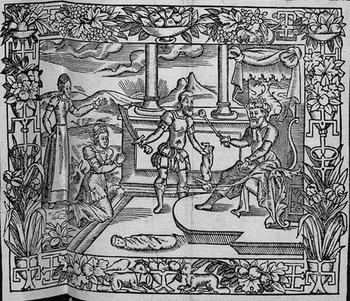
One would have expected, then, that the English chart would feature an image of a harbor or haven. Such a representation would have succinctly justified the lottery and encouraged participation. Clearly, however, the lottery’s novelty was so great that such a straightforward visual argument was considered inadequate; the English lottery chart features a unique image that seems to have required a specially prepared woodcut. Beneath the visual evocation of City and crown, situated amidst the dazzling array of prizes but set apart by a white border and a cornucopia of foliage, fruits, and animals, is a scene depicting King Solomon’s judgment of two women, each claiming to be an infant’s mother (fig. 2).
Enthroned, Solomon’s right arm is raised, holding a scepter; a soldier stands with his sword poised to cleave the child whom he holds upside down. One woman stands gesturing, but the other has fallen to her knees with her hands in supplication.Footnote 28 As all Elizabethans knew, the child would be saved, his true mother revealing herself to the wise ruler by offering to renounce her claim.
In choosing to offer potential buyers an image of the wise King Solomon, the government was appealing to considerable popular enthusiasm for images, ballads, and texts on the subject and also choosing to highlight a key figure in the articulation of the emerging Protestant culture of Elizabethan England. The “Books of Solomon” ran to ten editions from 1537 to 1551, while a “pycture of Saloman the wyse” was among twenty-seven woodcuts listed for sale at the Blackfriar’s shop of the French printer Gyles Godet in 1562–63. Tessa Watt has argued convincingly that Godet carefully selected what images would work for the English market, choosing King Solomon over images of saints and in doing so “bridging the gap between the demands of a public not yet weaned from devotional images and the boundaries of Protestant iconography.” Solomon also featured among the posies in the lottery: from the rather mundane “Salomon was king Davids sonne” to the more personal “I do not desire aboundance to have, but only with Salomon, wisdom I crave.”Footnote 29
“A very rich lotterie generall,” detail. Reproduced by permission of the Folger Shakespeare Library.

The wise Solomon had an important place in Tudor royal iconography and was especially associated with some of the most significant Protestant texts of Elizabethan England. In the prefatory epistle to the Geneva Bible of 1560, readers and listeners encountered words of counsel addressed to Elizabeth: “Wherefore great wisdome, not worldelie, but heavenly is here required, which your grace must earnestly crave of the Lord, as did Salomon, to whome God gave an understanding heart to iudge his people aright, and to discerne betwene good and bad.”Footnote 30 The story of Solomon and the rival mothers, from the first book of Kings, demonstrated Solomon’s wisdom in seeking the ability to judge between good and bad rather than worldly riches, long life, or the death of his enemies. In the year of the lottery’s drawing, 1569, Solomon and Elizabeth were associated in Christian Prayers and Meditations, an important work of piety printed by John Day also known as “Queen Elizabeth’s Prayer Book.”Footnote 31 Day, like Bynneman, enjoyed Parker’s support and was one of the most important printers of Elizabethan England, responsible most famously for John Foxe’s Book of Martyrs.Footnote 32
However powerful the association of the new Protestant Queen of England with the wise and blessed King Solomon, and however popular Solomon was among those seeking verses to read, songs to sing, or pictures to put up on their walls, the choice of Solomon and the two mothers as the central image in a chart advertising a lottery is unique and invites further speculation. Perhaps the government hoped that those reading the broadsheet and viewing the associated chart would conclude that God would bless the wise investor and reward them with riches worthy of a king for, although Solomon did not ask for riches, the scriptures revealed that he certainly enjoyed them. Just as invoking the City’s wealth and prestige was intended to reassure lottery adventurers as to the viability and security of their investment, so Solomon’s prominence in the lottery chart was intended to reassure any who were concerned that winning at the lottery, an outcome that depended more on chance and good luck than on just desserts, enjoyed both royal and divine approval. Perhaps viewers were to be persuaded that God works wonders through humanity and that the most deserving would benefit from his providence.
Moreover, it was Solomon who offered two explicit endorsements of the use of lots in his book of proverbial wisdom. Reading, or hearing, Proverbs 18:18, Elizabethans learned that lots were a useful way to end disputes: “The lot causeth contentions to cease & maketh particion among the mightie.” A reader of this passage in the Geneva Bible enjoyed commentaries explaining that lots were a satisfactory way of resolving hitherto irreconcilable parties. Proverbs 16:33 also provided proof that lots were acceptable, but on the understanding that God determined outcomes: “The lot is cast into the lappe; but the whole disposition thereof is of the Lord.”Footnote 33
It is possible, then, that the prominence of the story of Solomon and the two mothers in the lottery chart was also intended to address misgivings about lotteries as a sinful activity, a form of gambling to which we shall shortly return. It may also have served to remind viewers that the biblical monarch, associated iconographically with both Henry VIII and his daughter Elizabeth, had authorized the use of lots. Furthermore, it visualized both the story told in 1 Kings 3:16–26 and the Geneva Bible’s commentary (“By this example it appeareth that God kept his promes with Salomon in granting him wisdom”).Footnote 34 In short, it reminded godly Protestants that, like Solomon, their new queen was building God’s temple and that they had a part to play by supporting the lottery.
The building of the new temple was a common theme in the development of the new Protestant political culture being shaped during the 1560s, an essential response to what Stephen Alford has called “a politics of emergency.” Articulated particularly by Cecil, it consisted of a radical political narrative that argued England’s relatively weakened state in a hostile world of Catholic conspiracy.Footnote 35 For those promoting the new politics, England was the “beleaguered isle,” and nothing short of the future of Protestantism was at stake, both in England and in the world.Footnote 36 Local communities, in seeking government assistance for harbor repair, did not hesitate to make the argument that well-maintained ports were essential not only for trade but for defense, an argument that sometimes found its way into the preambles of statutes and proclamations.Footnote 37 The trope of the realm’s (and queen’s) safety can be found in preambles, speeches, sermons, letters of advice, and treatises advocating further religious reform or addressing issues such as the queen’s marriage or the succession.
The importance of the Protestant turn in the government’s promotion of the lottery is evident in the circular letter sent by the Privy Council intended to equip local elites with rhetorical strategies to encourage participation. The queen’s subjects were to be reminded that the lottery benefited the entire commonwealth by remedying the dire state of England’s harbors. Appeals to the more recently articulated notions of the commonwealth were now given the added zest of a new political culture, for the council urged local rulers to also emphasize that the lottery was an opportunity to demonstrate loyalty to the queen and fulfill the duty each subject owed her. Indeed, the lottery’s success was a matter of royal honor. Officials were to remind subjects that funds could have been secured through taxes or loans, placing the burden on everyone. Instead, the lottery offered the chance for individual gain while the commonwealth collectively enjoyed the benefits of safer harbors, stronger defenses, improved fishing, and trade. Private gain married with public good was not only a sign of the queen’s wisdom but also of her generosity. Finally, the council suggested that appeals be made to national pride. Surely her subjects would want to “further this her majesties devyse” as enthusiastically as had those of the Spanish king in a recent lottery in the Low Countries, even though it offered “no suche benefyte to them as it is to the subjects here”?Footnote 38
Some individuals found such arguments persuasive enough to frame their choice of posy accordingly, recognizing that the lottery took place during a time of crisis for the new Protestant regime. Three associated the queen with the promise of spring.Footnote 39 Valentine Norton of Sandwich craved the queen’s favor during his lifetime and a heavenly reward after death, while a Chelmsford man insisted “As to my prince I beare faith and love, to have put in my lot, as doth behove.” Some chose to acknowledge the queen’s role in offering them the lottery itself (“I hope to gaine by the Queenes majestie,” “To the prince good will I beare, and put in money to this Affaire”) and others pleaded for her safety and well-being (“Whether I win or lose, God save Queene Elizabeth from hir foes,” “Feare God, Obey the Queene, and serve thy country,” “God save our Queene, we all so pray, and beceech Them that will say nay”). Explicit expressions of anti-Catholicism were rare, but there is no mistaking the sentiments of William St. Leger of Canterbury’s choice: “In God I hope, and a fart for the Pope.”Footnote 40
If the council hoped that by appealing to the subjects’ duty to the queen, her honor, patriotic pride, and the needs of the commonwealth would ensure full participation in the lottery, it was mistaken. A closer examination of the process by which the lottery was administered reveals that any confidence that depended on traditional local elites to sell lots quickly was misplaced. Indeed, only twenty days after 400,000 tickets were offered for sale on 24 August 1567, the Lord Major was forced to issue a proclamation that made explicit the City’s backing of the lottery. Sales had evidently been so poor that the drawing would now be delayed, but no later than Candlemas (2 February) 1569, and those who had purchased lots expecting the draw to take place before 25 June 1568, as promised in the broadsheet, would receive interest on the money they had laid out.Footnote 41 This was the first of several proclamations announcing delays to the drawing, the rest coming from the Privy Council itself. Each sought to reassure what was obviously proving to be a very reluctant public worried, for example, by what would happen to winning lots should the purchaser die before the drawing took place.Footnote 42 In offering explanations for the delays and trying to assuage such doubts, proclamations reveal the problems the early Elizabethan regime faced in pursuing a novel fiscal strategy.
Administering the Lottery
Initially, the government drew on the informal sinews of authority upon which the Tudor state depended. Its limitations were revealed by a proclamation of 3 January 1568 announcing a delay because only some treasurers and collectors were in place on the first day of sale; many had failed to receive their instructions, others had proved to be too busy or ill or had died and replacements had not been found.Footnote 43 We have detailed knowledge of how one lottery treasurer, Sir William More of Loseley, Surrey, drew upon his local standing, his connections, and his social and political credit to promote the lottery. More was an obvious choice to take charge of the lottery in the county. The only surviving son of a remembrancer of the Exchequer during Henry VIII’s reign, More had held an array of local offices: provost marshal, sheriff, justice of the peace, and membership of several commissions. He had been an MP, sitting in five parliamentary sessions for a borough or as knight of the shire. In 1569 he would become deputy lieutenant for Surrey, a position in which he not only organized the militia and levied troops but was responsible for raising voluntary loans, a task that required the same sort of approach he adopted in trying to encourage participation in the lottery as evidenced in his extensive archive.Footnote 44
More’s correspondence reveals that he received frequent badgering letters from officials, including the Privy Council, and on his own part regularly sent letters to his collectors trying to cajole them into action, priming them with examples of success in other localities and sending them books in which to keep proper accounts. Collectors such as George Evelyn of Kingston and William Hammond of Guildford were not finding it easy to sell lots, Hammond hoping that “theye of ye countye doe delyver their mony them selves at London.”Footnote 45 More made notes on how London’s authorities had encouraged participation by making a very public demonstration of buying lots (with the posy “God preserve the cytye of London”).Footnote 46 He knew that in Middlesex parishes and villages people “adventured in Companyes puttyng into ye lottery every Man according to ther abillytye … under one posye in the name of the hole parishe.”Footnote 47 Setting a good example generated a culture of participation that might have been hard to resist given the social structure of early Elizabethan England, but local rulers needed continual prodding from central authority.Footnote 48 It seems that by late spring and early summer it was clear the traditional networks were not working.Footnote 49 What was needed was a new infrastructure that could oversee the process.
By July 1568 John Johnson was in place as Surveyor of the Lottery with a supporting bureaucracy based at “Lottery House” near Goldsmith’s Hall, which became sufficiently established in the public mind for a printer to be able to sell his publications (one of which appropriately enough concerned the sin of covetousness) from his shop “under the Lotterie house.”Footnote 50 Judging from the Surrey correspondence, Johnson took direct steps to ensure success, meeting local leaders in both parishes and hundreds, insisting on proper bookkeeping so that the extra interest promised in the earlier proclamation would be paid, sending out a plethora of paper: copies of proclamations, draft instructions, sets of articles offering advice. To animate and move “the people,” Johnson insisted that the better sort—particularly those holding offices—purchase lots to encourage others and ordered collectors to set up a stall on market day displaying both the chart and broadsheet; with the collectors “in their Eyes” Johnson thought the people would be “provoked” to participate.Footnote 51 Precepts, in the name of More and Johnson, were to be issued to constables instructing them to fulfill their duties, report on their efforts, inform them of any who were negligent, and, more ominously, supply them with the names of defaulters among the “principal men” who would be called to appear before More at a future date.Footnote 52
However persuasive these strategies may have been, indirect and discreet forms of coercion were ever present. The Privy Council letter of 22 July to office holders in Surrey, Sussex, Kent, Hampshire, and the Isle of Wight complained that the lottery was failing because of their “Negligens or by some sinester Disswasions of some not well Disposed persons.” Johnson had been ordered to identify these persons, examine accounts, and take whatever steps he deemed necessary to increase sales, and he certainly did so in Surrey.Footnote 53 On 9 October, Gerrard and Offley told More that “We fynde souche Lacke in youe and some others as is sufficient to Disapoynt the Quenes maiestie.” “Fayle you not heareof as youe tender herin the honor of the Quene’s majestie,” they told him, or you “will answere to the Contrarie at your perill” and their letter does seem to have spurred him into more activity.Footnote 54
In what peril such men would find themselves was left unsaid; imagining the worst was more effective than spelling out the consequences. Failure to perform well would undoubtedly cost in terms of local prestige, influence, power, and authority since the ability to draw on good connections was essential to one’s standing as a member of the local ruling elite. That such nuanced threats secured only limited returns might have been a lesson learned, for thirty years later, when faced with reports that local elites were reluctant to offer loans to the crown, the council was much more direct. Writing to one lord lieutenant, they ordered him to inform elites that failure to cooperate could generate commissions to properly assess their incomes so that they would end up paying their proper share of taxes and no longer according to “such lowe & favourable rates as now are accustomed.”Footnote 55 The vague threats of the 1560s became precise, hard-edged, and more intimidating in the later years of the reign.
Contextualizing Failure
Although the combination of traditional social networks and structures and a new lottery bureaucracy led to more sales, as evidenced in the local records from Beverley, Leicester, London, New Romney, Wells, Winchester, and elsewhere, by the end of 1568 only one-twelfth of the anticipated sales had been realized.Footnote 56 Cecil was forced to accept Perrott’s proposal that the prize list be reduced proportionately, and—even worse—the government would have to renege on its promise that there would be no blanks.Footnote 57 A diminished lottery seems to have provoked no protests or legal challenges, nor, indeed, had the process itself; avoidance and evasion took the form of passive resistance by simply walking past the collector’s booth on market day, ensuring one’s absence when the collector came to call at one’s house or not fulfilling a promise to purchase a lot at another time or in another place. Both the resilience and scale of public resistance requires explanation.
Why did the early Elizabethan government fail to generate enough public interest to realize its financial goals? There are four general contexts that deserve consideration. First, it may be that people simply did not credit the promises being made by the government; there are many indications that there was widespread distrust at the time of the lottery with regards to fiscal strategies, particularly after the legacy of successive recoinages. Second, there was always the likelihood that individuals would resist purchasing a lot simply because they could not afford to do so. Third, lotteries may have run the risk of being considered a form of gambling, an illicit pleasure that was wasteful and therefore something to be avoided at all costs. Finally, it is possible that some, perhaps especially those Calvinists to whom the new Protestant culture was appealing, may have struggled to reconcile the lottery, a game of chance, with God’s providence. While this was not an issue raised directly in connection with the lottery, it was to become an important discussion in later Elizabethan and early Stuart England.
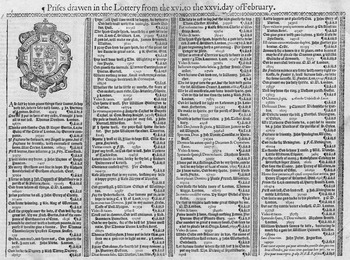
In exploring these contexts, it will be instructive to examine the posies submitted by those who did choose to adventure their money. While collectors’ books, which have yielded so much about lottery participants in the Low Countries, have not survived for the English lottery, two printed prize lists (for the drawings that took
“Prises drawen in the Lottery.” Surrey History Centre, LM 2008, sheet 1. Reproduced by kind permission of the More-Molyneux family and Surrey History Centre.

place between 16 and 26 February and for a period ending 22 March) exist, and they evidence the posies chosen (fig. 3).Footnote 58
Each sheet is divided into four columns separated by a decorative border; in the upper left of the first sheet was set the garter, the crown imperial, and arms emphasizing the “patriotic emblem of protestant Tudor imperialism.”Footnote 59 The lists offer information about the purchaser (name, place of residence, and amount won), but pride of place is given to the posy.Footnote 60 While these posies cannot, of course, provide direct evidence as to why English people failed to buy lots, they do reveal concerns, worries, and tensions that those participating may have shared with their friends and neighbors who chose not to do so.
The lottery was an innovative revenue-raising strategy launched after years of financial uncertainty that generated public distrust. Many contemporaries observed and commented on the dire state of the economy of the time, but it was also widely recognized that the great inflation of prices had been exacerbated by the monetary policies of governments in the 1540s and 1550s, particularly successive debasements of the coinage. Confidence was so low that the reddish discoloration in the new silver coinage caused by increased copper content was a matter for public ridicule, while the debasement of the coinage was featured as a major cause of the economic crisis explored by Smith in his Discourse.Footnote 61
On her accession, and following advice from Gresham, Elizabeth called in the coinage in order to reissue it, but the great recoinage of 1560–61 necessitated a revaluation of the circulating currency according to its debased bullion content. Suddenly a penny was worth only three-quarters of a penny, and few had any reason to believe that what had happened in the past would not recur: they would surrender old coins but not receive their worth in new or, worse, a further debasement was being planned. Indeed, discussions about the devaluation of the coinage provoked panic and protest well into 1566.Footnote 62 Reading through the sequence of proclamations seeking to reassure English people that all was well with the coinage and that the government’s intentions were good, one is struck by how they anticipate later pronouncements providing explanations about the reasons for delaying the drawing of the lottery.Footnote 63 Indeed, while the promotion of the lottery was utterly unique, both in nature and in the way it sought to persuade participation through the broadsheet and chart, the flurry of explanatory proclamations and circuit letters of instruction bear comparison not only with previous issue of recoinage but later attempts to secure compliance over musters, loans, purveyance, and increased subsidies.Footnote 64
While fears that the government intended to debase the coinage further proved unfounded, the great Elizabethan recoinage revealed a level of distrust that would have made any new innovation, such as a lottery, problematic. Indeed, that such distrust was widespread enough to worry the government is shown in its reaction to exaggerated rumors such as all unmarked cattle were going to be seized for the crown or that the queen was going to benefit from new fees to be levied on all christenings and marriages; the council deemed it necessary to issue denials of such “vain and sedicious follies.”Footnote 65
Rumors may have also circulated about the lottery that discouraged participation. Certainly there was anxiety enough for the drawing of the lottery to be rescheduled, advanced by several months to 3 November 1568 in response to purchasers’ demands and “divers other opinions raised among her said people, as it seemeth, by disquiet and curious heads contrary to her majesty’s sincere will and meaning.” Such disquiet would hardly have been calmed by the announcement, on 2 November, of a postponement until 10 January 1569, (allegedly) because treasurers and collectors (like More) had failed to turn in their accounts on time.Footnote 66 Most significantly perhaps is the indication that even some of those buying lots anticipated that there would be blanks despite the government’s published promise to the contrary. Posies such as “If hap and hope in one agree, farewell blank, come lot to me,” “Lord whether thou send a good lot or a blanck, yet so for thy goodness I am bound thee to thanke,” and “Blankes be not good” reveal that not everyone participating believed their lot would earn a prize.Footnote 67
Such pessimism would have been exacerbated by the economic difficulties and social tensions of the 1560s. Revaluation of the coinage seems to have slowed down—but not stopped—inflation, and food prices continued to rise, stimulated by three bad harvests in the first five years of the decade. While historians have certainly seen indications of economic recovery by the time of the lottery, this knowledge was not, of course, necessarily shared by those who had just lived through one of the worst economic crises of the sixteenth century prior to the mid-1590s.Footnote 68 Although More reported to his collectors that parishioners in Middlesex had banded together to participate in the lottery, and several of the posies submitted reflect a collective solution to the costs of a lot (the purchaser being identified as a parish or a group of individuals), there may have been many more who lacked the financial wherewithal or the connections necessary to find others with whom to join.Footnote 69 For others, weighing the chances of winning against life’s necessities, the cost or risk was simply too great, and neither urgings to support queen and country nor the promise that each lot would win a prize could convince them. Indeed, even some of those who did purchase lots submitted posies suggesting that they participated reluctantly: “My mony is put in with a good will, if it chaunce not well, I would I had kept it still.”Footnote 70
The presence of Solomon in the lottery chart and the stress put on loyalty to the queen in Privy Council correspondence may have been intended to overcome religious and ethical concerns about the lottery, particularly among Protestants. It was always possible that the lottery would be seen as a form of gambling, a remnant of a medieval Catholic culture that Protestants were anxious to displace.Footnote 71 Moreover, because it encouraged individuals to contemplate the transformative possibilities a win might enable, participation in the lottery could be seen as encouraging covetousness and thus a violation of the eighth commandment about which a variety of Protestant authors, such as Peter Martyr, had written.
Gambling, illicit gain, and covetousness were all targets of polemical writings from radical Protestants in the decades following Elizabeth’s lottery whose focus was on what they discerned as unlawful games. Philip Stubbes, whose popular book The Anatomie of Abuses was first published in 1583, considered such games to be a form of theft and a mark of the sin of covetousness.Footnote 72 Games of chance invoked the specter of gambling, a sin that wasted the resources God had so lovingly bestowed and was associated with drunkenness and swearing.Footnote 73 Losses incurred resulted in poor health or impoverishment, not only for the individual but for their families and households. Even winning was wrong for it was a way of gaining wealth without work and piety. At first glance, one lottery participant seems to have shared this view, submitting the posy “Fie upon filthy gayne.” On the other hand, his intent may have been ironic or his posy was asserting that the lottery was actually a form of legitimate gain, unlike other games of chance.Footnote 74
The fear that hoping for a win would provoke individuals to invoke God’s name, to try and shape one’s fortune either in anticipation of God’s providence or in an attempt to direct God’s will, was one that occupied later commentators on unlawful games, as England became more Protestant and as a variety of issues from church ales to pastimes and sports troubled the consciences of many. Was there a concern even in the case of the lottery that it encouraged a view contrary to the Geneva Bible’s explanatory commentary on Proverbs 16:33: “So that there is nothing that ought to be attributed to fortune: for all things are determined in the counsel of God which will come to pass”?Footnote 75
The puritan John Northbrooke, curate and preacher in Bristol at the time of the lottery, certainly thought so. Writing a few years later he complained about the “evill custome” of substituting words such as “luck” or “fortune,” be it good or ill, in place of “providence.” Both Dudley Fenner, self-styled “Preacher of the word of God,” and the northern divine, James Balmford, opposed this abuse of God’s providence, arguing that games of hazard were unlawful because they anticipated endings that were solely the prerogative of the divine. As Balmford declared, “we are not to tempt the Almightie by a vaine desire of manifestation of his power and speciall providence.” Thomas Gataker put it succinctly in his 1619 treatise Of the nature and Use of Lots: “Fortune” was simply “God nicknamed.”Footnote 76
In contrast to Balmford, Gataker argued that ordinary lots or games of chance were acceptable if individuals were ready to lose what they “putteth to the hazard” and did so “soberly, seasonably, ingloriously, inoffensively, prudently, and religiously.”Footnote 77 However, players could not expect anything “from God for the directing of the lots in a certain cause” for this would “presume of that which God hath not promised.” Gataker denied that “in every lot is a speciall and mediate Providence of God.” Referencing the mechanisms of a public lottery, he argued that it was “the motion of the vessel” and not the “speciall hand of God” that decided which tickets won. To suggest otherwise was “absurd” for it implied that humans had the power “to make God work immediately at his pleasure.”Footnote 78
While Gataker was primarily concerned with card games and dicing, he was aware of games whose very essence was chance, among them “Lot-sports or Lot-games.” Such were the “Banquet lotteries” of classical times in which gifts were distributed to guests by lottery, “not altogether unlike to our riflings and Loteries, wherein a certain number or so many as will venture their money are admitted to cast dice or draw Lots for some prize or prizes propounded.” While some civil lawyers legitimized them as forms of bargain and sale and so encompassed in contract law, others saw them as a type of unlawful game. Gataker argued that the problem was not the nature of lots but the person—“not from the spring, but from the filthie channel that the streame passeth by”—and his view echoed that of the preeminent puritan writer of Elizabeth’s day, William Perkins.Footnote 79
Although Perkins never considered lotteries per se in his famous work, Cases of Conscience, first published in 1592, we find a relevant and useful argument in his discussion of another popular recreation, animal baiting. Perkins argued that cockfighting and bearbaiting were prohibited activities because in encouraging cruelty between beasts they demonstrated “our rebellion against God, and should rather move us to mourne then to reioyce.” Bullbaiting, on the other hand, had its uses “and therefore it is commanded by civill authoritie; and so have not these.” As Perkins, and later Gataker, argued, this was a case of “ciuill or politick” hazard, “warrantable used in cases of weight and necessitie, with invocation of Gods name.”Footnote 80
Alexandra Walsham has rightly reminded us that belief in providentialism was not limited to zealous Protestants; after all, Catholics and Protestants alike could—and surely did—worry that participating in the lottery was a waste of money or even a form of (illicit) gambling not worth the risk. However, as Walsham also argues, Calvinists faced the added task of explaining providentialism alongside predestination. “The Calvinist doctrine of providence,” she writes, “exerted a powerfully formative influence on puritan piety.”Footnote 81 For some, the lottery may have provoked a crisis of conscience that encouraged prevarication and delay whether as administrators, as the better sort expected to set a good example or simply as purchasers. Even if this does not explain why so many failed to embrace Elizabeth’s lottery of the 1560s, the fact that the debate over lots as unlawful games became more extensive and vociferous in later Elizabethan and Jacobean England might have discouraged later governments from attempting another official state lottery.
Nevertheless, as Gataker’s later analysis argued, qualms about the role of chance and its anticipation of God’s providence in the lottery were not insurmountable. After all, lotteries were successful in the Calvinist Netherlands where the opportunity for personal gain was successfully “harnessed … for godly ends.”Footnote 82 In England this must have been especially true for the godly, attuned to the new politics of emergency in the 1560s, who chose to participate. One committed Calvinist who did so was George Alkington of London. In choosing a posy, he was determined to find words that would express his belief in divine providence and decided to address the Almighty directly: “Thou knewest me ere I was begot, and knowest who I am and shall be, to prosper therefore dispose my lot, that I may the better serve thee.”Footnote 83 While Alkington’s posy is one of the few that speak directly to the relationship between predestination and providence, a large number of the posies submitted demonstrate that many overcame whatever doubts they might have had and seized the opportunity to drive home their belief in God’s providence, emphasizing their Christian duties or even celebrating the new regime.
While there are posies that make specific reference to fortune, even personifying her as in “Laughe Lady Fortune and frowne not,” they are far outnumbered by those insisting on the role of God’s providence in both the queen’s lottery and the lottery of life. Several link fortune with God (“Good Fortune, God send me”) but most simply emphasize God’s providence and do so quite emphatically, as in “The earth is the Lordes, and all that therein is, who so trusteth in him, a good lot can not misse.”Footnote 84 “This little I adventure with a good will, trusting in God my purse for to fill” is one of many variations on the theme “As God will, so be it”; some even took the form of a direct prayer to the almighty: “O lord, give to thy servaunte what it shal please thee.”Footnote 85 Indeed, it was common to insist that chance and providence did not sit well together: “Trust not in chaunce, God will advaunce,” “The lot is put into the pot, but the lord doth guide the lot,” “Fortune is but chaunce from which I flie, and only in Gods gifte wholly trust.” Some chose to attract fortune by denying their belief in it (“The fickle fruit of fortunes floure, it repeth and rotteth in one houre”) while one, “Wisdomme liketh not chaunce,” seems to engage critically with the sentiments behind the inclusion of Solomon’s judgement in the lottery chart. In the posy chosen by Edmund Bocking, one finds another oblique reference to Solomon’s proverb, but in the spirit of the Geneva Bible’s commentary: “The lottes for lucke in lap are cast, but God doth guyde both first and last.”
Other participants seized the opportunity to assert Christian virtues and values (“Imitate Christ, and expel vice, God send me the greatest prise”), to offer scriptural exhortations (“Be meeke in spirit”), or to declare that God had already provided all of life’s necessities (“My Shepherd is the living Lord, nothing therfore I neede”).Footnote 86 Perkins would have been pleased to encounter those posies that promised to help the poor and needy if a prize was won as in Richard Michell of Bodmin’s choice, “Christ the way, the truthe, and the doore, considereth the riche, and forgetteth not the poore.” Richard Proctor of London insisted that the godly would put winnings to a better use than anyone else: “Temporal benefites, to all men God doth sende, but to the godly, well to use them is the ende.”
If those who failed to purchase a lot simply did so because they distrusted what they were being told after years of debasements and months of rumors of further unsavory government demands, because they faced economic difficulties that prevented their participation, or because they had concerns about the lottery as a form of gambling, illicit gain, or even an affront to God, they would have felt vindicated when at long last the drawing of lots began on 11 January 1569 with far more many blanks than prizes, and poorer returns, contrary to what had been promised.Footnote 87 According to the Catholic polemicist, John Leslie, Bishop of Ross, the unfulfilled promise that “no man should leese above two shillings & six pence, and greate numbers should winne large summes” was one of the many lies and abuses Cecil heaped upon the nation.Footnote 88 The author of The Great Frost (almost certainly the prolific London writer Thomas Dekker) anticipated familiarity when his countryman and citizen met to discuss “cold doings” in 1608, the only warmth provided by a private lottery. Both men remembered Elizabeth’s great lottery, the cost and number of tickets, and the dates of the drawing that took place “day and night” for “almost four months.” When Dekker’s citizen recalls “the common burden of that song, when poor prizes were drawn, was ‘Twopence halfpenny,’” he was remembering deep frustration for this was indeed a very poor return on the 10 shillings invested.Footnote 89 Elizabeth’s lottery was not a happy memory.
Conclusion
However successful lotteries had been on the continent, in England they failed to raise the needed funds, and lotteries never become part of the fiscal strategy of later Elizabethan and early Stuart governments. Although the government had constructed its rhetorical and visual arguments carefully, choosing language and images that both drew upon and contributed to the articulation of the emerging Protestant culture of early Elizabethan England, it was unable to overcome resistance and distrust. Perhaps Offley and Gerrard were right in their suspicion that the novelty was too great, but they also understood that established networks of power and authority had failed to persuade purchasers and provide the necessary administrative support.
Of course, it was early days yet in terms of the history of state formation in early modern England. As was suggested earlier, the experience of the lottery may have shaped the strategies of men like More in seeking support and compliance with new demands for soldiers, loans, goods for the royal household, and increased taxes during the “second reign” of Elizabeth, in the very changed experiences of an England at war with Spain.Footnote 90 The lottery—and undoubtedly a myriad of other projects and policies—revealed that new strategies were needed in the endless negotiations that characterized early modern governance. The old and the new that featured during the experiment of the lottery can be detected in the lord lieutenancies where demands for forced loans and other civilian responsibilities were heaped onto what had been initially a military function. It can be seen in the extension in royal commissions until by the early seventeenth century men of quite humble status, and even a few women, were involved in the management of grain supplies, sewers, charities, and, above all, poverty. It may also be evident in the extended use of circuit charges during the 1590s to insist upon better efforts from local justices and again in the issuing of articles of inquiry designed to encourage constables to fulfill their duties and which bear direct comparison to the orders issued by lottery officials three decades earlier.Footnote 91 Besides supporting recent work that emphasizes that early modern state formation is best seen as a negotiation, the early Elizabethan lottery is a striking example of what Steve Hindle has called “the experimental nature of early modern governance.”Footnote 92
If the lottery contributed in some way to later strategies of governance, if not in the more formal structuring of authority then at least perhaps in the experience of individuals, it was not attempted again. Its failure, and memories of that failure, may be sufficient explanation, but it could also be suggested that if Cecil and those promoting the lottery had banked on the appeal of what Paul Griffiths, Adam Fox, and Hindle describe as the “potent brew” of “Protestantism, patriotism and nationalism … stirring pride and focusing loyalties” to legitimize the process and persuade participation, in this particular instance and at this particular time, they were mistaken.Footnote 93 If in later decades other solutions were tried in the inevitable quest for sufficient state revenues (famously, of course, increased levels of parliamentary taxation, greater exploitation of ordinary revenues, royal grants, and the impositions of forced loans and ship money), perhaps anyone contemplating another state lottery would pause because lotteries occupied an awkward space between lawful and unlawful games in the minds of Protestant divines whose voices were increasingly heard as Elizabeth’s reign progressed and as England became a Protestant nation. Private lotteries were not uncommon in later Elizabethan and early Stuart England; indeed some, like the Virginia lotteries, were successful, but no government had the nerve to attempt another state lottery for well over a hundred years.Footnote 94