Filial piety was a fundamental principle of the Qing legal system. However, beginning in the early twentieth century, the meaning of filial piety became more hybridized in legal practice. Yang Shuqin, a forty-two-year-old man in Sichuan, was charged once by his birth father in the 1938 case Yang Changfa v. Yang Shuqin and again by his stepmother in the 1939 case Woman Yang-Wang v. Yang Shuqin for refusing to provide his parents with old-age support and abandoning his unemployed parents. Rather than punishing the unfilial son as Qing magistrates would normally have done, the court pronounced Shuqin innocent.Footnote 1 Under the Qing legal system, Shuqin's confrontation with his parents in court would have been unimaginable. Before the Republican era, elders exercised considerable social and legal superiority over young people.Footnote 2 Had Yang Shuqin's cases occurred under Qing rule, overthrown in 1912, being unfilial would have been a severe allegation. Parents in the Qing dynasty held legal privileges to sanction their children for disobeying or displeasing them, and to have charges brought against a child by parents would have been a disastrous scenario for a junior family member.
During the Republican legal reforms and nation-state building process, the codification of powerful parental authority weakened. The legal system in the Qing dynasty had previously upheld the norms of absolute filial obedience and household-based property ownership but began to show more tolerance toward disobedient children and grandchildren during the Republican era.Footnote 3 Despite this sweeping transformation, local legal practices proved less tolerant. Records from county-level legal archives, including those for Yang Shuqin's case, reveal persistent adherence to elder authority and reinterpretations of filial piety. In most cases, consideration of parental authority in legal documents, including complaints and judgments, continued to haunt local adjudication.
The coexistence of the two ways of interpreting filial piety—one emphasizing parental authority and the other, legal equality—did not demonstrate completely unsuccessful legal reforms or nation-state building. At least in the locality of Jiangjin, during the turbulent decades after the Qing dynasty's overthrow, warfare among warlords, frequent regime changes, and waves of bombing during the Second Sino-Japanese War did not inhibit the number of processed legal cases from increasing. Disputes were resolved, new codes were cited, and legal procedures were gradually formalized, albeit with occasional delays. Thus, the question becomes not about whether the inconsistent interpretations of filial piety in legal practice indicated a failure in nation-state building or legal reforms. Rather, the concern is on how the Republican regime managed to reconcile the seemingly contradictory principles—the notion of parental authority inherited from its Qing predecessor and the imported idea of legal equality—in its hybrid, nonunitary legal system.
This article evaluates the various interpretations of filial piety in local legal practice during the Qing–Republic transition and argues that the meaning of filial piety in the Republican legal system significantly shifted while retaining important continuities. Interaction between legal actors, including plaintiffs, defendants, judges, lawyers, and the broader intellectual community, each with their specific legal knowledge, ultimately resulted in a blending of inherited and imported legal concepts. The availability and variability of legal knowledge were restructured by the synergized transformation of legal institutions, the formation of the Chinese nation-state, and other social processes. As explained later, in using synergization, we emphasize that the two processes—legal reforms and nation-state building—interacted and, in so doing, coproduced forces both external and internal to the legal system. The result was not a complete replacement of the original meaning of filial piety but rather dynamic negotiations among various understandings of filial piety, ultimately leading to the coexistence of its seemingly contradictory interpretations.
Data and Methodology
The basis of this study was an extensive search of the Database of Chinese Judicial Archives Jiangjin Section. We conducted a close reading of 104 legal cases, including legal complaints, depositions, and administrative documents from 1911 to 1949.Footnote 4 Most legal cases we read from the database were civil matters. Although submitted to the criminal court, Yang Shuqin's case, mentioned at the outset of this article, resembled other civil cases involving intergenerational property disputes and was not established to have involved any criminal charges. Accordingly, this paper focuses primarily on civil justice.
Of all disputes that might involve interpreting filial piety, we focus herein on intergenerational property disputes because the transformation of property relations crystallizes important aspects of intergenerational relations within families. For example, individual private property conceptually implies less interference from others—especially elder family members—than does household-owned property. Accordingly, evaluating intergenerational property disputes can reveal divergent interpretations of intergenerational conflicts around the concept of filial piety.
The focal area of the article is Jiangjin county, in southwest China (now a district under the administrative authority of Chongqing). The spread of treaty ports from coastal to inland areas enabled foreign warships, troops, and countless foreign-manufactured goods to enter Jiangjin, which is situated along the Yangtze river. During the May Fourth Movement, students from middle and professional schools established a student union and marched to boycott Japanese goods and oppose Japanese imperialism.Footnote 5 In October 1938, as the Japanese military continued to attack Wuhan, Chiang Kai-shek, the leader of the Kuomintang (KMT), withdrew the party's troops to the southwest hinterland in Chongqing; this followed their initial retreat from Nanjing in late 1937.Footnote 6 The Japanese invasion enhanced the fervent discourse of “saving the nation” in Jiangjin, which had been a popular discourse since the late Qing period.Footnote 7 Continuous military threats, the political base's relocation to regions where the regime rarely had pre-existing control, and the loss of the traditional political and economic base contributed to the KMT desperately seeking to rapidly build state capacity.Footnote 8 Jiangjin is notable for being at the center of all this.
However, while focusing on intergenerational property disputes in Jiangjin, we do recognize that our analysis of filial piety may be limited in its ability to explain practices related to other family laws (such as marriage disputes) in different regions that might also involve the interpretations of filial piety and related legal rules. Nevertheless, Jiangjin has been an important location in modern Chinese history and vividly represents the fundamental and critical nature of the Republican legal reforms in the context of the rise of nationalism and the concurrent accelerated nation-state building process. Hence, examining the rapid legal changes and extensive legal records of Jiangjin county is a valuable research endeavor.
Republican Legal Reforms as an Interactive Process
Scholars have argued that Republican legal reforms revealed continuities in code, custom, and adjudication inherited from the Qing legal system. Some researchers have mainly examined reforms themselves, assessing whether the judicial system underwent significant transformation.Footnote 9 Other researchers have focused on the nation-state building process through the lens of Republican legal reform, regarding legal reform as part of the Republican nation-state building process and focusing on whether the Republican state successfully strengthened its power through the legal reforms.Footnote 10 These two lines of research have yielded valuable insights, but the interactions between the two themes have been largely neglected. The first line of studies, although revealing the nuances within the legal field, have failed to consider how the nation-state building process shaped legal reforms, and the second line of studies have tended to treat legal reforms as an element included in the nation-state building process, leading to a lack of identification of their mutual impacts on each other.
However, legal reforms and nation-state building processes are not inherently mutually exclusive. The sociology of state literature shows that building infrastructure is only one way a state can expand its power and influence, as it could also expand and justify its legitimation through symbolic and despotic power.Footnote 11 Similarly, from the sociology of law literature, we learn that the legal field is shaped not only by political dynamics. As Lauren B. Edelman et al. argue, the legal field is defined as a structured social space that revolves around legal actors, legal institutions, informal practices, and norms regarding the use, nonuse, and circumvention of law, emphasizing the impacts on the legal system from both formal legal apparatuses and society.Footnote 12 As partially revealed in The Trial of Modernity, these two processes dynamically interacted in China, where “the administrative and judicial fields and their respective functions, therefore, overlapped and often conflicted,” undermining reform efforts.Footnote 13 Inspired by these existing studies on legal history and sociology, this study proposes a new framework that evaluates the entanglement between the Republican legal reforms and concurrent nation-state building through examining the continuities and changes in the meanings of filial piety in legal practice.
The same vocabulary or phrase can carry different meanings, which can transform over time. Under various historical situations, filial piety was interpreted and enacted differently by various actors in accordance with the available knowledge and sources they had access to, including popular practices, various legal strategies, legal codes, and successive cultural movements targeting the language of Confucianism (such as the May Fourth Movement and New Culture Movement).Footnote 14 As explained in the following sections, the meaning of filial piety transformed from one integrated principle bridging person, family with state, and morality with legality to many interpretations of state–family, state–person, and intergenerational relations. Such ramifications of filial piety during the Qing–Republic transition were indeed co-produced by legal reforms and nation-state building.
On the basis of our in-depth analysis of the Jiangjin Archives, we introduce two separate processes: the separation between family and state under the nation-state building process and the separation between code and customs under the legal reform. We argue that it is the synergization of these two processes, situated in a given stage of the evolvement of the legal system and nation-state building, that yielded a particular knowledge structure for legal actors to interpret filial piety differently. In the following, we introduce cases from different periods to illustrate how these two separate processes have influenced the changing interpretations of filial piety. We thereafter introduce the synergization process. However, such an arrangement is purely for clarification purposes. We do not mean that the periods during which we select cases to illustrate two separate processes involved no co-making between the two. Rather, we emphasize the synergization as a gradual process of transformation rather than instances of transformative moments. In other words, the synergization process unfolded over time, incrementally, and thus cannot be pinned to specific dates.
Process I: Separating Family from State
The first process introduced here is the separation of the family and state under nation-state building; a case from the early Republic is illustrative. The particular case occurred during a period that featured continuities in law and local adjudicative organizations from the Qing dynasty. According to the gazetteer, shortly after the overthrow of the Qing dynasty, Jiangjin county largely maintained the Qing legal system's practice of having the magistrate oversee both administrative and judicial affairs.Footnote 15 Additionally, the early Republican legal apparatus largely inherited the legal framework of Qing law, with few adjustments.Footnote 16 Despite such significant continuities in the civil legal apparatus, the meaning of filial piety in legal practice was altered. In Jiangjin, a lack of filial piety—once categorized as one of the “ten greatest wrongs” (shi'e) and considered severe and extreme by Qing law—was now treated as a civil matter.Footnote 17 How the head of the local judiciary dealt with charges concerning unfilial children shifted, with one crucial aspect being a lessened concern and weakened legal punishment for disobedient children.
In the 1914 case Woman Zhou-Yang v. Zhou Yugao, the widow Zhou-Yang filed a suit against her adoptive son, Zhou Yugao, with the Jiangjin county government, claiming that Zhou Yugao had assaulted and coerced her (nixiong bimu).Footnote 18 According to the complainant, Zhou Yugao indulged in drugs, squandered the family property, and attempted to strike her with an axe. She thus demanded that the government punish her disobedient unfilial child.Footnote 19 Per Qing law, if parents or grandparents accused their (grand)sons or (grand)daughters-in-law of disobeying them or offering insufficient support, children could be punished by flogging, death, or banishment.Footnote 20 In Qing-era legal practice, similar accusations often resulted in severe punishment of children, which sometimes impelled the children to commit suicide for fear of never returning from exile.Footnote 21
However, in this case, even with explicit allegations of bodily offense, the magistrate, without further investigation, opined that, if the allegation was true, the mother should first turn to the local collective neighborhood organization (jia) and the lineage to resolve the dispute.Footnote 22 A month later, the magistrate traveled to Zhou-Yang's location, ordered Zhou Yugao to be slapped in the face four hundred times, and coordinated with the community leaders to settle the dispute.Footnote 23 Informal institutions like jia or lineages being involved was not uncommon in the Qing legal system. Philip Huang terms this “third-realm justice,” referring to the dispute-resolution process involving interactions between the formal legal system and community mediation.Footnote 24 Informal legal institutions would often become involved at the initial stage, when the magistrate might hear “minor” matters typically seen as distinguishable from severe cases that required more state attention; if the magistrate considered the case too trivial, he would give it to the village leaders to resolve.Footnote 25 Therefore, the fact that Woman Zhou-Yang's complaint about her son's physical assault was treated as a civil matter and first referred to the local jia and the lineage for dispute resolution suggests that, from the magistrate's point of view, a child's offense against their parents was no longer of substantial concern.
Such a legal order also reveals a crucial institutional change in the underlying meaning of filial piety. Before the Qing–Republican transition, the imperial rule, embodied by Confucius's statement “let the ruler be a ruler; the subject, a subject; the father, a father; the son, a son (Junjun chenchen fufu zizi),” linked the parent–child relationship to those of people–magistrate, emperor–subject, and Heaven–emperor (in which the emperor is tianzi, the son of Heaven).Footnote 26 Here, filial piety can be understood as “a top-down chain of delegating parental authority from Heaven,” bridging the gap between filiality and loyalty to the emperor and the gap between personalized morality and imperial state legitimacy.Footnote 27 This hierarchical chain represented an integrated principle of filial piety. As stated in the first chapter of the Canon of Filial Piety, a major Confucian classic, “the beginning of filial piety is serving one's parents; the middle is serving one's ruler; the end is establishing oneself.”Footnote 28 However, the magistrate's opinion revealed that filial piety had become, at that time, more confined to the realm of families, extending less to the state level than during the Qing era. The magistrate not only initially referred the adoptive mother to a local social organization but also imposed less severe punishment on the unfilial son.Footnote 29 In other words, the impact of filial piety diminished.
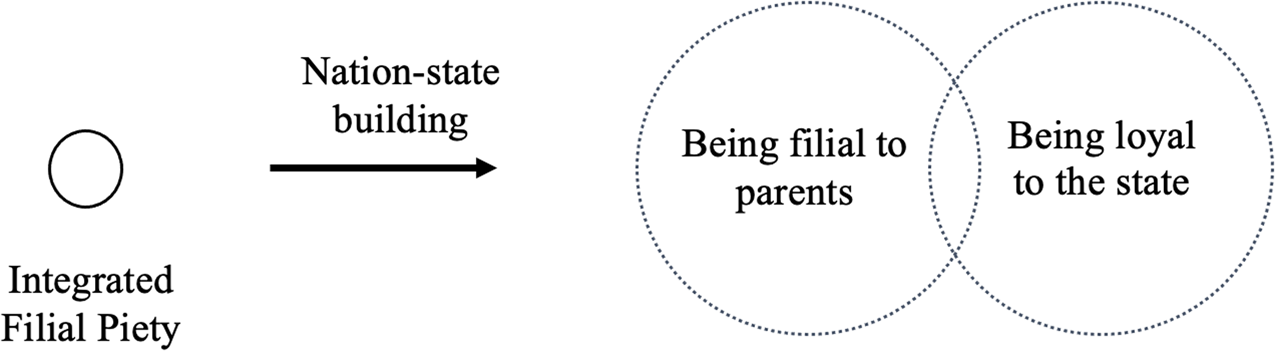
Indeed, through the nation-state building process, the Republican regime redefined its legitimacy, not on the basis of the hierarchical chain of parenthood but rather through acquisition of popular support by promising public prosperity and geopolitical power. According to the 1912 Provisional Constitution, “the sovereignty of the Chinese Republic is vested in the people” and “is exercised by the Advisory Board, the Provisional President, the Cabinet, and the Judiciary,” either elected by citizens or appointed by elected officials.Footnote 30 The constitutions that followed it have continued this redefinition of state legitimacy, also crystallized in the KMT's Three People's Principles. Through these changes, a notion emerged of the Chinese nation-state as being above all citizens and families, representing a departure from the imperial state–family continuum—a gap appeared between the family and state as older alignments began dissolving in Republican China, reshaping the individual's relationship with the state. Submitting to one's parents thus did not necessarily imply submitting to state governance. As a result, a child–subject (zimin) in relation to an emperor–father (junfu) became an individual citizen in relation to the Chinese nation-state. The previously integrated conception of filiality was then divided, as Figure 1 illustrates.
Separation between the state and family behind the recreation of filial piety.

The separation between family and state implied that the magistrate's interpretation of filial piety was hybrid. The specific association of filial piety with the familial sphere still carried some of the meaning underlying the traditional principle of submission to one's parents. Without specific reform to the legal codes, the magistrate remained bound to adhere to the old imperial legal code when making his judgment. This is why he ordered the unfilial son to be slapped in the face four hundred times. Yet, alongside changing political and legal schemes—particularly the ongoing nation-state building process—the punishment for disobedient children was significantly reduced from its levels under the Qing legal system. A lack of filial piety was thus a civil matter, not one of the “ten greatest wrongs.” This shift, in turn, confined the magistrate's interpretation of filial piety to the sphere of family relations, rather than retaining its broader significance as a foundational principle underpinning the entire rule of the state.
Process II: Separating Code from Custom
In the case introduced in the previous section, the transformation of filial piety, with few changes to the code or legal organizational structures, was primarily influenced by the nation-state building process. In this section, we introduce the process of separating code and custom. Beyond the split between family and state, this separation further complicated filial piety's meaning under Republican legal reforms. To illustrate this second separation process, we select Yang Shuqin's case, which occurred during the late 1930s, when the new criminal code, promulgated in 1928 and 1935, and the civil code, promulgated in 1929–1930, were already being implemented. With significant changes in property law, parental authority was undermined, reshaping and complicating the conceptualization of filial piety.
In addition, Yang Shuqin's case was prosecuted under a new judicial system, which was reorganized in 1936. Legal professionals now needed a certificate of legal education or to have passed specialized judiciary exams and acquired professional legal knowledge, including an adequate understanding of constitutional law, organization of the judiciary, procedures, and the new legal codes.Footnote 31 These changes introduced new legal professionals who could interpret the principle of filial piety and execute judgments accordingly, which broadened the gap between what law would accept and what widespread practice outside the legal sphere would recognize.
In Woman Yang-Wang v. Yang Shuqin, Shuqin's stepmother, Woman Yang-Wang, claimed that Shuqin, her unfilial son, had abandoned his parents, driving the stepmother to request increased financial support from Shuqin and his wife. Her complaint emphasized filial piety's sentimental and emotional aspects, which were recognized broadly in popular practice but not in the newly revised legal codes. She justified her request for additional financial support by explaining her meticulous care of Shuqin, including washing his diapers and warmly clothing him as if he were her birth son.Footnote 32 The stepmother also referred to her grown-up stepson as an “abandoner” (yiqi ren), arguing that Shuqin refused to disburse the disputed property (grain rent) to them despite her previous tender care and, even worse, that he intentionally offended the parents, both physically and verbally, who should have been respected appropriately.Footnote 33 Yet, her description of Shuqin as an “abandoner,” a new legal term with a criminal denotation, relied heavily on a conceptualization of integrated filial piety, where sentimental and emotional support are bound up with financial obligations to parents. In the Qing era, both codified law and common practice required that children unconditionally provide parents with old-age support, often in the form of land, meals, grain, or money,Footnote 34 as well as “love and reverence,” as indicated in the Canon of Filial Piety.Footnote 35 Accordingly, what the stepmother demanded from the “abandoner” Shuqin included not only material but also emotional support and humble deference. She intentionally exaggerated the severity of Shuqin's physical assault, perhaps to capture the court's immediate attention. Through this exaggeration, she placed Shuqin's father and herself on the moral high ground, demonizing Shuqin as unfilial and disrespectful. She may have done so partly because she knew how seriously a charge of bodily violence from children against their parents would be taken—potentially warranting the death penalty under Qing law. Her interpretation of filial piety was thus new on the outside but old on the inside. She continued to adopt the rationale underlying filial piety as an integrated principle but cloaked it in the language of the new legal code to bolster her argument.
Shuqin, by contrast, focused on arguing that the properties that his stepmother was claiming were actually his wife's private property (sichan). Shuqin explained that he had been living separately from his parents. Early in 1911, when Shuqin was only fourteen years old, the stepmother had goaded his father to expel him from the family.Footnote 36 What his stepmother claimed to be part of the family property entrusted by his father for Shuqin to manage was, in fact, owned by Shuqin's wife.Footnote 37 By claiming it as his wife's private property, Shuqin hoped to leverage the new legal codes to persuade the court; compared with the old law, the new codes contained a markedly different interpretation of intergenerational dynamics regarding property relations.
For Shuqin and his wife, filiality primarily was a matter of financial and legal bonds, as stipulated by new legal codes. The dependence of parent (child) on child (parent) was limited and did not supersede individual property rights. The 1930 Civil Code clarified the previously ambiguous boundaries between a parent's and children's property.Footnote 38 In particular, marital property law was formalized, transforming family-owned property to individually owned property shared between husbands and wives in nuclear families.Footnote 39 Shared property of married couples can be clearly divided, allowing each spouse to own property individually.Footnote 40 Such an ownership system embodied a parent–children relationship of equality, differing from the unconditional and arbitrary inequality between children and parents, as enshrined in integrated filial piety and stipulated by Qing law. Shuqin's reasoning was thus based on ownership rather than morality and sentiment.
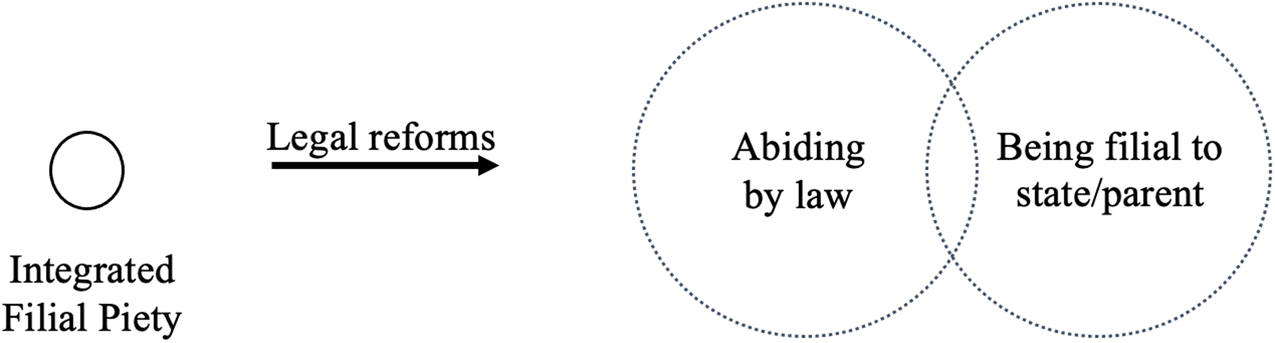
The inconsistency between Yang Shuqin and his stepmother's legal reasoning regarding filial piety reveals notable boundaries between codes and customs, resulting in their different understandings of parent–child property relations. The stepmother's claim points to filial piety's moral and emotional aspect, with rituals and norms legitimizing parental interference in the property. By contrast, Shuqin's claim speaks to individual ownership and the legally defined parent–child relations regarding legal rights and duties. As Figure 2 illustrates, the two were once largely reconciled under integrated filial piety but began to diverge through legal reforms.
Separation between codes and customs behind the recreation of filial piety.

Nonetheless, the parent–child dependence acknowledged by the court judgment represented neither complete compliance with the new code nor the new notion of filial piety but rather a compromise of the two contesting understandings of filial piety. In the final judgment, the judge singled out the legally recognized aspect of filial piety (to support one's vulnerable parents financially), which was different from what the parents took to be the content of filial piety in practice (to respect and take care of one's parents regardless of their financial situations), and thus acknowledged the reasoning provided by Shuqin.Footnote 41 Nevertheless, Shuqin did more than what was stipulated by law. Per the new codes, an individual had the duty to take care of relatives only when they could not financially support themselves; under such circumstances, lineal ascendants by blood (zhixi xueqin zun qinshu) were an exception.Footnote 42 However, Yang Shuqin's stepmother was not qualified because she was not a blood relative of Shuqin. Even so, Shuqin continued to provide financial support for both his stepmother and father, though the judge acknowledged that they were financially stable enough to support themselves.Footnote 43 In other words, while the judgment was primarily based on the new legal codes, it recognized Shuqin's adherence to the tradition of filial piety. He demonstrated this by consistently providing financial support to his stepmother, even though she was excluded from the legally defined parents category under the new codes. The meaning of filial piety in the judgment was thus a hybrid one, as the judge had considered standards of new legal knowledge and existing popular practices. As Figure 2 shows, this dynamic compromise of the two contrasting understandings of filial piety substantially differed from the integrated concept of filial piety.
Subsequently, the ongoing formalization of the Republican legal system further reinforced the separation between codes and customs and incorporated a more clearly defined notion of legal authority. Moreover, as the Second Sino–Japanese War incited a rising tide of nationalism, the separation between codes and customs was further influenced by the gradual separation between the family and the state. The result was a more complicated set of interpretations of filial piety in legal practice.
Synergizing Legal Reforms and Nation-State Building Processes
As discussed, this article historicizes “filial piety” before the Republican era as an integrated principle, connoting the integrated state–family and moral–legal cosmology. Indeed, this conceptualization of filial piety was not always static and consistent, yet the variations in interpretation in the Qing era were distinct from the transformations that were structurally shaped by legal reforms and nation-state building during the Republican era.Footnote 44 As discussed in the context of processes I and II, from the early Republican era, through nation-state building and legal reforms, filial piety was reinterpreted through the state–family separation and code–custom separation.
In this section, we introduce the process of synergization, which was not the same as the process of interaction. The two dimensions could interact with one another, but most importantly, they converged within the same legal space to co-produce forces both external and internal to the legal system to remodel the legal knowledge structure. Synergization altered the sources of knowledge available to legal actors and their interpretations of key legal principles, including filial piety.
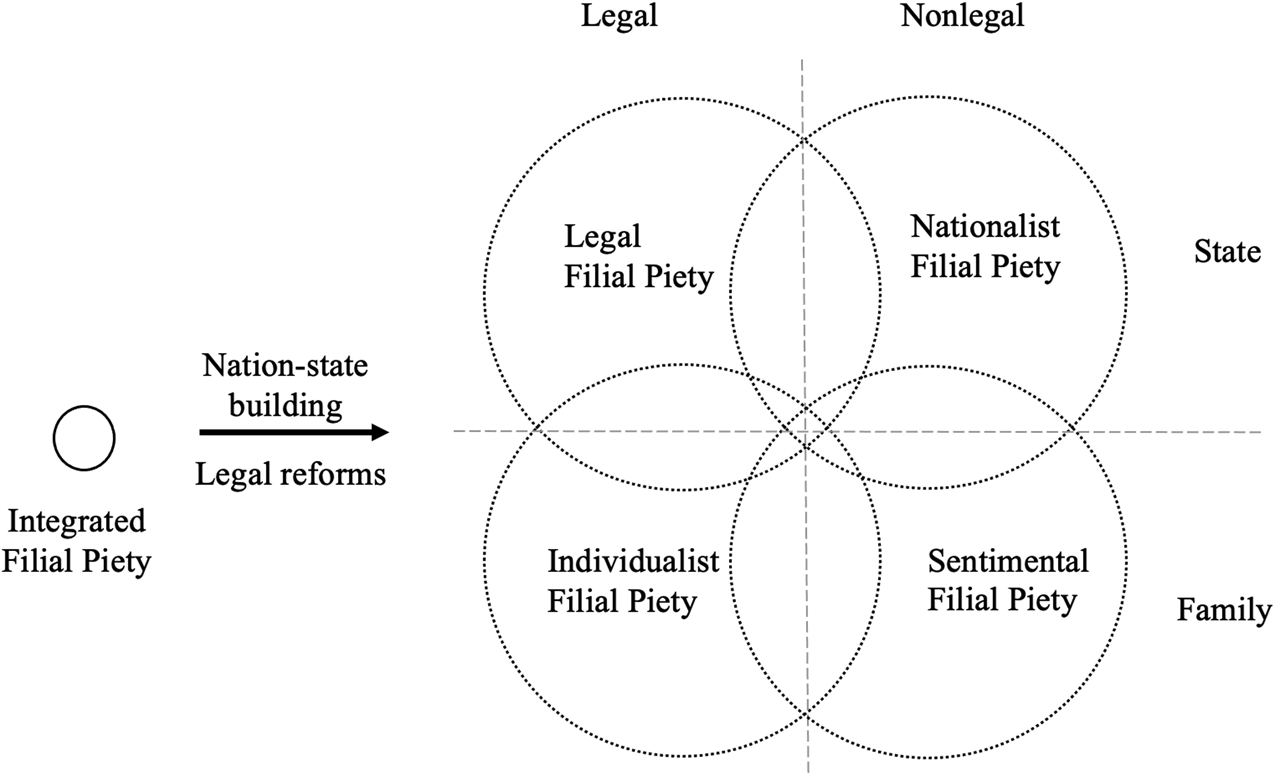
As the legal reforms and nation-state building continued, the two processes were coproduced in legal practices, mutually reinforced one another, and ultimately expanded the meaning of filial piety into four strands. Each strand partially inherited meaning from the previously integrated principle of filial piety but also absorbed the newly imported legal knowledge. We use the term “strands” of meaning instead of “types” or “varieties” to indicate the mutual dependence among the different understandings of filial piety in legal practice; the terms “types” and “varieties” tend to lose the nuanced correspondence of such understandings. These interpretations of filial piety were not wholly separable but often concurrently appeared in the same legal case, woven together to construct the multifaceted—sometimes contrasting—meanings of filial piety. These different strands of interpretation coexisted in the judicial procedure of Jiangjin's local legal practice. The boundaries between them were indefinite, as signified by the dashed lines in the figures.
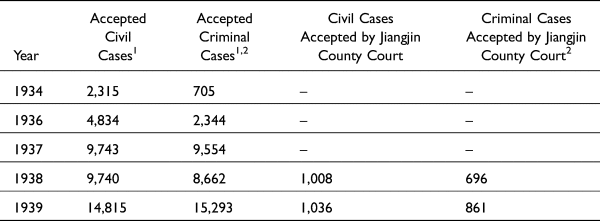
To illustrate this synergization process, we select four cases from the 1940s, a period when the reinforcement of these two separation processes happened most vividly. These cases reveal the synergizing process that enriched and split the once-integrated principle of filial piety. The meaning of filial piety from these four cases was interpreted within the context of the new Chinese nation-state, which was essentially produced by the state–family separation. As discussed, along with the rise of nationalism during the outbreak of the Second Sino–Japanese War, the KMT's political base's relocation to Chongqing promoted intensified state expansion in nearby regions,Footnote 45 reinforcing the centralization of state capacity. Moreover, it contributed to the nation-state building process, transforming the relations between a child–subject (zimin) and the hierarchical chain of parenthood, as in the integrated principle of filial piety, to relations between a person (renmin) and the emerging nation-state. Such newly transformed state–person relations were also concurrently reinforced by law–custom separation, leading to synergization between the two processes. The KMT regime sought to standardize formal legal institutions to demonstrate the independence and capacity of the newly formed Chinese nation-state against extraterritoriality.Footnote 46 In the late 1930s, as in many other counties in Sichuan, Jiangjin established an official independent county court.Footnote 47 According to the judicial statistics shown in Table 1, the number of legal cases accepted by formal courts sharply increased during the 1930s in Sichuan province; in 1939, both the number of accepted civil cases and criminal cases in formal courts saw a significant rise, each exceeding 10,000, which indicated notable quantitative and qualitative improvements in the formal legal system's capacity.
Numbers of Cases (First Instance) Received by Formal Courts in Sichuan Province, 1934–1939

Source: Judicial Administration Statistics Office, “Niandu sifa tongji [Annual Judicial Statistics], 1935, 1938, and 1943,” in Minguo shiqi sifa tongji ziliao huibian [Compilation of Judicial Statistics during the Republican Era], eds. Qi Tian and Hongxia Tang (Beijing: Guojia tushu guan chubanshe, 2013), vol. 16, 236, 428; vol. 18, 379, 564; vol. 19, 339, 417–18, 438.
Notes: There were two categories of civil cases from 1936 to 1939: one was regular, and the other was miscellaneous. The numbers of accepted civil cases and civil cases accepted by Jiangjin county Court in the table indicate regular civil cases only. The source does not clarify whether the number of accepted civil cases in 1934 (2,315) is for regular cases only or both.
1 Cases in these two columns include the county and provincial supreme courts.
2 For criminal cases from 1937 to 1939, private and public prosecution cases were reported separately; the numbers of criminal cases in the three years are sums of accepted private and public prosecution cases.
In Jiangjin county alone, the number of newly accepted civil cases (first instance) grew from 670 to 952 in 1938–1939,Footnote 48 and the number of newly accepted criminal cases (first instance) increased from 507 to 812.Footnote 49 The new legal space—the formal courts—began to thrive. The intertwined nation-state building process and legal reforms facilitated the emergence of new interpretations of filial piety, as evident in the example cases.
Individualist filial piety
One new interpretation of filial piety derived from the synergization process was individualist filial piety, which mainly described the newly defined state–person relation in law. Chen Xianzhao v. Chen-Li Chaoming, a 1940 lawsuit between an adoptive son's birth brother and the adoptive mother, revealed such redefinition of legally defined persons. The adoptive mother, Chen-Li Chaoming, scolded her deceased adoptive son, Chen Xianjie, for “being junior but setting up the will without authorization (nianyou shanli yizhu)” and refused to accept her adoptive son's will, which stipulated to give most of his property, inherited from the male line of Chen-Li Chaoming's husband, to Chen Xianjie's birth brother, Chen Xianzhao.Footnote 50 Chen-Li Chaoming and her late husband had adopted Chen Xianjie as their heir, but the adopted son died at eighteen without marrying or fathering any children.Footnote 51 Similar to Yang Shuqin's stepmother, Chen-Li Chaoming grounded her claim of entitlement to the disputed property on the basis of parental authority, an argument underpinned by integrated filial piety. Conventionally, a son had needed authorization from senior family members for household division.Footnote 52 Authorization to dispose of property transcended gender and empowered fathers and grandfathers as well as mothers and grandmothers to execute their wills over their sons’ wills on the basis of custodial rights under both law and customs reaching back to the Qing era.Footnote 53
However, the stepmother's strategy fell flat. Instead of accepting the stepmother's claim of the son's junior status, the court reframed the son–adoptive-mother relation as being between equal citizens. The court, ignoring the seniority of the stepmother, emphasized that the eighteen-year-old adoptive son Chen Xianjie was not a person with limited capacity (xianzhi xingwei nengli ren) under sixteen years of age and was entitled to establish his own will freely without interference from others.Footnote 54 The court accepted Chen Xianzhao's argument and acknowledged the validity of his will; the stepmother was no longer considered a senior with authority under this legal interpretation.Footnote 55
The separation between code and custom had been fortified through continual legal reforms. By excluding the son from the legal category of “xianzhi xingwei nengli ren,” the court denied the adoptive mother's interpretation of seniority, a socially accepted custom. Similarly, in Woman Chen-Luo v. Chen Shaoxun in 1941, when the stepmother Chen-Luo tried to claim her right to first extract and retain (tiliu) the proportion of land left by her husband before her stepsons, Chen Shaoxun and Chen Shao'ang, the county court opined that “the so-called tiliu was merely an old conventional use to indicate the respectful familial position of the claimant (Woman Chen-Luo) in relation to Chen Shaoxun etc. (the stepsons).” The court further concluded that no such stipulation regarding senior authority was included in the new legal codes.Footnote 56 The court's interpretation of the “old” and invalid senior privileges diverged from the socially acknowledged senior authority that the stepmother claimed. The decision thus highlighted the separation between code and custom.
Apart from redefining legal persons, individualist filial piety also entailed a well-defined legal authority when the separation between state and family continued to increase, which added to the fortified separation between code and norms. When Woman Chen-Luo v. Chen Shaoxun later went to the supreme court, the court further distinguished its scope of authority from that of the executive court (zhixing fayuan).Footnote 57 Such formalization of legal authority went well beyond the changes instituted by the legal reforms described in process II. For instance, in 1936, Bai Zhixiang got in a dispute with his stepmother and tried to resolve it through legal channels, but the local judiciary (the magistrate) declined his petition and suggested that he turn to his kinship group to settle the dispute instead (zi touping zuqi tuowei lishou, wu song qulei).Footnote 58 The blurring of the boundaries of legal jurisdiction in Bai Zhixiang's case exemplified integrated filial piety, which reconciled the state and its legal apparatus with the family under the hierarchical chain of parenthood. While in Chen-Li Chaoming's and Chen-Luo's cases, the individuals were directly linked with the state's formal legal system with limited family interference, and the state's legal apparatus had a more clearly defined scope of power. Accordingly, those cases were also indicative of the separation between family and state. Thus, individualist filial piety, as a co-product of family–state and code–norm separations, revealed the once largely reconciled notion of filial piety being partially transformed into a more clarified notion of a state–person relationship. Notably, it entailed definitions of legal individuals and confined legal power of the state.
Nevertheless, although with changes, such newly transformed interpretation of the state–person relationship continued to embody meaning from the integrated filial piety, as the sons still considered themselves filial because they still provided financial support by reserving a proportion of the property to their stepmothers, following the tradition included in the previously integrated filial piety. However, the new legal authority no longer reinforced such compliance as both sons were legally equal to their parents under the new property law. This equality empowered them in property disputes with their parents, without considering the former parental authority of integrated filial piety. Therefore, the old and new interpretations of filial piety were “contrapuntal” to one another under the new strand of individualist filial piety.Footnote 59
Nationalist filial piety
The once-integrated principle of filial piety also extended to another new notion of state–person relations, namely nationalist filial piety, which centered on political loyalty to the Chinese nation-state. Like individualist filial piety, this interpretation of filial piety was partially a product of family–state separation, particularly driven by the rise of nationalism when facing the Japanese military intrusion and confrontation. The outbreak of the Second Sino–Japanese War provoked a new tide of nationalism that permeated local society in Jiangjin. The continuous local exposure to foreign military power and foreign economic products gradually distinguished the boundary between “foreign” and “national.” A clearer notion of the Chinese nation-state gradually emerged from such interactions with other nation-states, including successive military defeats, the travel of missionaries from borderlands to more inland areas, and the pouring in of goods manufactured by foreign brands.Footnote 60
You Binghui's interpretation of his property donation in You Binghui v. You Fuyuan exemplifies such a newly transformed meaning of the once-integrated filial piety: political loyalty to the newly emerging Chinese nation-state. In 1939, You Binghui was captured and press-ganged into the army as a soldier (lachong yiding).Footnote 61 After returning from service, Binghui learned that his property had been appropriated by the two defendants, likely distant relatives. Before taking legal action, he first sought relief in a kinship meeting. Failing to win his claim, Binghui submitted a complaint to the Jiangjin court, requesting the donation of half of the property he stood to inherit to the nation-state (guojia) to fund defense against the enemy (kangdi).Footnote 62 His request was written in 1941 amid the Second Sino–Japanese War. The donation was likely a strategic tactic to persuade the court. Still, regardless of his intentions, his willingness to give a substantial amount of his private property to the state indicated a new conceptualization of filial piety.
In this version, filial piety expressed national loyalty to an emerging independent Chinese nation-state confronting military intrusion by other nation-states. It featured self-devotion to the Chinese nation-state, an entity Benedict Anderson refers to as “imagined community” that cultivated self-sacrifices to the collective identity. This new conceptualization of devotion to the imagined national identity was also linked to the idea of multiethnicity promoted by Qing rulers.Footnote 63 However, it was distinctive from premodern political loyalty, as it centered on dynastic loyalty and succession and Han ethnicity in its transcendence beyond one single dynasty and ethnicity, emphasizing the sense of Us versus Them (i.e. other nation-states)—particularly the Japanese during the Second Sino–Japanese War when Binghui's case was being heard.Footnote 64
The loyalty expressed to the Chinese nation-state, be it performative or otherwise, was derived from the integrated principle of filial piety and inherited part of its meaning: submission to the state–family continuum. Although the archives do not include more about the story, from the records, Binghui was orphaned at the age of eleven, and his adoptive mother also passed away.Footnote 65 Although he was later adopted by another widow, Woman Shi-Liu, this adoptive mother died of illness when he returned from the army.Footnote 66 Binghui's absence of parents to care for and his donation to the Chinese nation-state revealed the potential replacement of his parents with the state, to whom he gave financial support instead. The parallel positions of state and mother corresponded to filial nationalism, a concept proposed by Vanessa Fong in her study of contemporary Chinese teenagers, referring to a sense of devotion to the state akin to loyalty to one's parents.Footnote 67
As in individualist filial piety, nationalist filial piety also retained other crucial aspects from the integrated principle of filial piety, enabling legal equality to coexist with its inherited meaning. As revealed in the example case, Binghui was filial because his defense of the nation-state complied with the principle of submission to the family–state continuum, an inherited element from the integrated principle of filial piety. However, he was concurrently lawful, as he insisted on his legal right to freely dispose of his private property without unlawful interference or appropriation, exemplifying legal individualism.Footnote 68 His request reveals that the legal principle of individualism had begun to coexist with the inherited principle of integrated filial piety. Under such circumstances, his voluntary defense of the national interest particularized the once-integrated principle of filial piety; the intersection between the Chinese nation-state's rise and individual private property protections enshrined in the new code broadened the principle's meaning.
In summary, the once-integrated principle of filial piety first extended to a newly transformed conceptualization of state–person relations under the rise of the Chinese nation-state. Later, it expanded into additional strands of thought when the nation-state building process synergized with legal reforms. This meaning-making process resonates with Joseph Levenson's contrast between the elements of universalism and particularism in Chinese political ideology. Levenson argues that the Confucian world order—under Heaven (tianxia)—in the late Qing period was essentially a universalist one that united culture and morality, transcending political units and extending to general civilized society. Such a universalist view of the world became a more specific conceptualization of the Chinese state (guo), which thought of itself not as a perfect model of the civilized world but as a unit within it that learned from other nations.Footnote 69 The filial piety principle underwent a similar transformation along with the changing conceptualization of the state. Before the Qing–Republic transition, filial piety reconciled filiality, morality, and legality under the integrated virtue of filial piety. In this sense, the conception of father and children was universalist, extending beyond families to the cosmological order of Heaven and people, linking imperial law to rituals and norms. Later, nation-state building, synergized with legal reforms, transformed and extended the universalist worldview. It became a specific notion of the Chinese nation-state positioned against other nation-states. The virtue of filial piety that had once underpinned the governance of the universalist world became particularized to a specific nation-state. It also became more clearly defined, with specific scopes of law and custom, leading to the differentiation of filial piety into various strands of thought.
Sentimental filial piety and legal filial piety
Individualist and nationalist filial pieties focused more on the transformation of filial piety in state–person relationships. Concurrently, the family–state continuum's gradual disintegration was encouraged by various social activists, business circles, and the Nationalist government, who promoted the idea of reform from large to small families, namely the Western family structure based on husband–wife relations.Footnote 70 The hierarchical chain of parenthood underlying the integrated principle of filial piety thus became more constrained to the individual family sphere, enriching and extending the principle's meaning.
Simultaneously, ongoing legal reforms synergized with the state–family separation, which further extended the meaning of the universalist principle of filial piety into two other types of interpretations. The first was the sentimental filial piety characterized by love and deference to one's parents and recognized by custom in the nonlegal sphere, as exemplified in the 1941 case of Peng Enlin v. Peng Yuzong.Footnote 71 Peng Enlin's father, Peng Xiangting, already had two sons with his first wife. He remarried after his first wife died; with his second wife, he had a daughter, Peng Enlin. According to the daughter and her mother, when Peng Xiangting died, he had not established any will, expecting his well-educated sons to filially take care of their stepmother (xiaoyang). However, his second wife claimed that the two brothers did not attend to her well because she did not receive sufficient financial support from the two brothers, and thus, she requested a redivision of the family property.Footnote 72
Here, the socially recognized submission to and respect for one's parents, crystallized as xiaoyang, seems to share the most similarities with the integrated principle of filial piety. Before the Republican era, both Qing law and Confucian ideology acknowledged the filial duty to care for one's parents as vital. If individuals meticulously cared for their parents under Qing law and customs, they would be both filial and law-abiding. However, xiaoyang, in this case, indicated a different degree of filiality and respect for one's parents compared to the integrated principle of filial piety in the Qing legal system. First, filial piety's separation from state legitimacy significantly decreased the legal severity of being unfilial as a violation of the law. The stepmother's interpretation of filial piety differed from that recognized by Qing law and popular practices, and she could no longer request severe punishment of her stepsons for violating the integrated principle of filial piety. Second, the notion of xiaoyang was no longer a moral–legal principle as it had once been under the Qing legal system. The court did not see it as integrated into legal duties. Both the court and the stepsons regarded the social obligation of xiaoyang as distinct from legal duties.
To respond to the charges, the brothers strategically substituted the notion of filially taking care of one's parents (xiaoyang) with legally caring for one's parents under the new code (fuyang); essentially, they invoked legal filial piety.Footnote 73 Unlike xiaoyang—the moral requirement of filially caring for parents as required by their father and inherited from Qing codes—fuyang highlighted the legal bond between family members, with a duty to care for economically vulnerable relatives.Footnote 74 Instead of interpreting xiaoyang legally, the court, backing the stepsons, acknowledged their understanding of filial piety.Footnote 75 Thus, the court separated the customs of parent–child relations from the legal bonds between family members. The recognized parent–child relations were less involved with love and deference to parents, as required by the principle of xiaoyang, which had also been recognized by the deceased father and popular practices. Fuyang, backed by the court and acknowledged by law, instead pertained to the legally defined, mutual financial responsibility between family members, as embedded in legal duties and rights. The legally defined parent–child dependence underpinning legal filial piety was thus distinct from its previous counterpart in that it focused on legal rights and duties rather than natural and sentimental bonds between parents and children.
Legal filial piety was also distinct because of its emphasis on the mutual financial responsibility between children and parents instead of children's unconditional compliance. However, as with national and individualist filial piety, these two new interpretations continued to retain elements from the integrated principle of filial piety: each emphasized the financial responsibility to care for one's parents. To summarize, Peng brothers were only legally filial to their parents following the standard of fuyang—legal filial piety, and so, the mother could not extract more property from the two brothers through her seniority. Meanwhile, in the stepmother's eyes, they were unfilial, because they showed no deference to her and did not provide sufficient support as required by xiaoyang—sentimental filial piety.
Taken together, the four new strands of filial piety reveal a transformation of the integrated principle of filial piety as one coherent unitary principle into many interpretations of state–person, interpersonal, parent–child, and law–state relations. Such recreations of filial piety were coproduced by the separations of state–family and code–custom. Figure 3 shows the four strands of nationalist filial piety (nationalism and patriotism), individualist filial piety (legally defined state–person relations), sentimental filial piety (submissiveness, care, and respect regarding one's parents), and legal filial piety (legally defined child–parent dependence).
Transformation of the integrated principle of filial piety into four new strands of interpretation for filial piety.

Filial piety and its corresponding parenthood were thus not timeless but rather became structured and transformed by the synergy between legal reforms and nation-state building over time.
In our data pool, among the eighty-five cases that began after the implementation of the 1930 Civil Code, thirty-three exhibit sentimental filial piety, twenty-four discuss legal filial piety, twenty-four concern individualist filial piety, and one demonstrates nationalist filial piety.Footnote 76 Moreover, these numbers reaffirm that synergization was an incremental process. Of the thirty-one cases dating to the 1930s, we see sentimental filial piety in nineteen, legal filial piety in eleven, and individualist filial piety in eight. Notably, sentimental filial piety exhibited more continuities with integrated filial piety during the 1930s in the local Jiangjin legal system. By contrast, the remaining fifty-four cases from the 1940s show a more even distribution of these variants. Examples of sentimental filial piety, legal filial piety, and individual piety occur in fourteen, thirteen, and sixteen cases, respectively, demonstrating a stronger synergization process compared to the 1930s.
Recreating filial piety by drawing upon resources from imported and inherited legal knowledge therefore helps generate a slightly different image of filial piety from that in previous studies. The Republican legal reforms were previously seen as a “thorough transformation,” largely promoting legal equality among parents and children, which the party failed to reconcile with state-sponsored filial piety to cultivate nationalism and patriotism.Footnote 77 However, the continuities of the integrated principle of filial piety embodied in this research reveal that the language used in the Republican era, even if seemingly “modern” and “Western,” did not always contradict the cosmology inherited from the Qing era. The foreign-inspired rule of law and the integrated principle of filial piety recreated legal categories—for example, legal punishment for unfilial behavior, legally defined financial relations between parents and children, senior authority, and private property. Although sometimes abiding by the law meant opposing generational hierarchy, a person could still be legally equal and filial in legal practice.
Drawing upon a post-colonial perspective from Edward Said, it could thus be arbitrary to claim that the new and the old, the Western and the traditional, were contradictory and absolutely separable.Footnote 78 In some cases, courts referred to the funeral obituary and mourning apparel as legal evidence to nullify or prove litigants’ position as legal adoptive sons, showing the persistent entwinement of law and custom.Footnote 79 Filial piety therefore could not have multiplied under the dichotomization of the “Western” model of legal equality and “traditional” parental authority. Instead, intergenerational relations in the Republican era were complicated by the overlapping histories of China and the West and between inherited and imported knowledge structures. The boundaries of these binaries blurred when different sources shared a legal space and interfaced with one another.
This organic hybridity between “Western” and “traditional” legal conceptualizations, which eventually empowered filial piety's particularization, also raises a new line of inquiry to enrich the discussion of legal transplantation. The classic inquiry, primarily concerned with spreading law from a source legal system to a recipient one, often considers legal transplantation as unidirectional, overlooking the mutual interactions between and impacts on both legal systems.Footnote 80 Our finding on the hybridity and particularization of filial piety indicates a more diversified model of legal change for regions like Republican Sichuan. There, we see less of a solitary replacement process of an old conception (integrated filial piety) by new ones as legal transplantation's outcome. Instead, we see a dynamic, serial legal transplantation process where legal actors recreated and particularized the inherited conception in their legal practice by drawing on sources from code, customs, and their specific historical context during the rise of the Chinese nation-state. Republican legal reforms thus exemplified a legal transplantation process of hybridizing and diversifying the old and new legal systems rather than replacing and destroying the old ones.
Conclusion
Before the Republican era, filial piety reconciled filiality to parents with loyalty to the emperor and legality (in the Confucian ideal) under the processes of nation-state building and Republican legal reforms. However, this principle developed into different strands as nation-state building disintegrated the state–family continuum and as legal reforms de-Confucianized the legal system. As indicated in the local legal archives in Jiangjin, the transformation of filial piety crystallized in at least three aspects: legal punishment for unfilial behavior, property distribution with respect to who had the privileges or the power to determine inheritance, and the interpretations of what counted as filial. Over time, punishment for unfilial children gradually decreased in severity. Children obtained more say in property distribution. Love, deference, and financial responsibility within one's family were decoupled from state legitimacy.
The socially accepted concept of filiality also diverged from the legally acknowledged concept of filiality. Informed by new sources of knowledge during the Republican era, the universalist principle of filial piety grew into at least four new interpretations of social and legal relations. The ramifications and recreation of the integrated principle of filial piety were realized in legal practice through negotiations and struggles among those involved. The meaning of filial piety in use depended on the available knowledge during the immediate situation, as structured by legal reforms, nation-state building, and local particularities. Ultimately, the outcome was not one form of filial piety but multiple diverse, sometimes even contradictory, interpretations of filial piety.
The four strands of filial piety provided resources for various actors, including lawyers, legal professionals, litigants, and plaintiffs, to use in actual legal practice. These interpretations interacted in legal practice through competition, negotiation, and compromise. Through such interactions, interpretations of filial piety empowered certain groups while marginalizing others. For example, in practice, local legal interpretations of parent–child relations were often gendered. Although codes and other legal designs canceled the parental authority of mothers, local legal practices continued to reinforce the powerful position of fathers. Women, especially mothers, were marginalized in this transitional moment, revealing the uneven influence and local implementation of legal reforms imposed on various social groups. Nonetheless, despite the patrilineal nature of property relations’ continuity, the transformation during the Qing–Republic transition indicates that the previously integrated notion of filial piety had gradually faded.
Finally, these divergent interpretations of filial piety were recreated from the earlier integrated principle of filial piety, which continued to convey part of its original meaning. The inherited notion of filial piety and the foreign-inspired notions (e.g. the nation-state and the rule of law) had together recreated legal categories used in the examined cases—such as lack of filial piety, legal dependency, senior authority, and private property—making these legal conceptions of filial piety hybrid in nature. Thus, Republican legal apparatuses reconciled the paradox of legal equality and parental authority. Filial piety's historical transformation reveals the lens of knowledge production and transmission as a robust framework for examining the Republican legal system as a dynamic process of legal change, producing liminal knowledge that was neither wholly Confucian nor wholly Western.
Acknowledgments
This article has been presented at the ECNU-UCSD graduate student workshop in November 2021, the Annual Conference of British Association for Chinese Studies (BACS) in September 2021, the Annual Conference of Association for Asian Studies (AAS) in March 2021, and the Midwest Conference on Asian Affairs in October 2019. The authors appreciate the comments from Karl Gerth, Micah Muscolino, Rohit De, Haiguang Wang, Jiaxun Wu, Xi Chen, peers in modern China research colloquium at UC San Diego, and the anonymous reviewers for Law and History Review.
Competing interest
None.