1. INTRODUCTION
English as a lingua franca (ELF) refers to “any use of English among speakers of different first languages for whom English is the communicative medium of choice, and often the only option” (Seidlhofer, Reference Seidlhofer2011, p. 7). In the current world, where more than 70% of English speakers are nonnative speakers (Statista, 2016), ELF users are mostly from the outer and expanding circles (Kachru, Reference Kachru and Kachru1992),Footnote 1 and they use English as a global medium of communication. ELF presents a context of international language learning because English has become a common international language in a variety of settings, such as international education, immigrant communities, global business, international diplomacy and politics, and technology-mediated communication. One example is the spread of English-medium universities that serve as prime academic sites of ELF speakers.Footnote 2 These international universities involve a large number of students, staff members, and instructors of different nationalities who use English as a global lingua franca for academic study and social interactions (Doiz, Lasagabaster, & Sierra, Reference Doiz, Lasagabaster and Sierra2013; Smit & Dafouz, Reference Smit and Dafouz2013; Taguchi, Reference Taguchi2014).
Corresponding to the expansion of ELF speakers, research on ELF use has expanded dramatically in recent years. We have accumulated a critical mass of literature about characteristics of ELF (Jenkins, Reference Jenkins2015; Jenkins, Cogo, & Dewey, Reference Jenkins, Cogo and Dewey2011; Mauranen, Reference Mauranen2012; Seidlhofer, Reference Seidlhofer2011). For example, pronunciation features called lingua franca core (e.g., avoiding consonant deletion at the beginning of a word) have been identified as ELF speakers’ means to communicate intelligibly (Jenkins, Reference Jenkins2000). Grammatical simplification (e.g., omitting the third-person singular –s) happens often in ELF interactions to prioritize efficiency over accuracy (Seidlhofer, Reference Seidlhofer2011). Additive redundancy and lexical innovation are other features of ELF interactions. ELF speakers often overuse a preposition to emphasize the object of a verb (e.g., discuss about) or apply morphological systems in unconventional ways (e.g., bigness) (Mauranen, Reference Mauranen2012). They also use linguistic accommodation and convergence strategies to promote rapport and solidarity (Firth, Reference Firth1996). These findings reiterate creativity and adaptability as the core characteristics of ELF. ELF speakers do not necessarily adhere to the idealized native-speaker norms. They often create their own standards contingent upon their communicative needs and benefits to their interlocutors (Seidlhofer, Reference Seidlhofer2011).
Despite the large amount of literature available in phonology and morpho-syntax, empirical descriptions of ELF pragmatics are underrepresented. Seidlhofer (Reference Seidlhofer2011) acknowledged the lack of literature when she stated that, unlike phonology—which contains a closed set of features for study—analyzing pragmatics is less feasible (p. 218). She called for more research documenting generalizable patterns of ELF pragmatics. Responding to this call, this article reviews common areas of examination in ELF pragmatics with the hope that our review spurs future research in those areas. Based on a synthesis review of empirical studies, we will illustrate key pragmatics issues that have been investigated in ELF research. Based on the synthesis findings, we will discuss how pragmatics might be taught under the lingua franca framework.
2. RESEARCHING PRAGMATICS IN ELF
This section presents a review of research that examined pragmatics-related language use among ELF speakers. Before presenting the review, we will discuss the constructs and definitions of second language (L2) pragmatics, which are relevant in our discussion of ELF pragmatics.
2.1. L2 Pragmatics: Evolving Constructs and Definitions
L2 pragmatics, a branch of second language acquisition, studies L2 learners’ ability to perform communicative acts in context using a target language and how that ability develops over time (Taguchi & Roever, Reference Taguchi and Roever2017). L2 pragmatics also examines how L2 users co-construct meaning and negotiate social practice discursively. A variety of pragmatic dimensions have been analyzed, including speech acts, implicatures, routines, discourse markers, address forms, humor, response tokens, and speech styles. These units of analysis indicate that L2 pragmatics investigates learners’ understanding of the relationship among linguistic form, function, and context of use and how learners perceive and realize the relationship in a social interaction.
The form-function-context relationship is best represented in Thomas's (Reference Thomas1983) classic characterization of pragmatic knowledge involving two interrelated dimensions: pragmalinguistics and sociopragmatics. The former entails knowledge of linguistic forms for performing communicative functions, while the latter involves knowledge of contextual elements and social norms that guide our way of speaking and writing. These two dimensions together help us discern which forms to use in what social contexts. More recently, with the concept of interactional competence (Young, Reference Young and Hinkel2011), the view of pragmatic competence has moved away from a fixed and stable relationship, often taken out of context, among form, function, and context of use. The current view is that the form-function-context relationship changes corresponding to the shifting attitudes, affect, identities, and relations of speakers. In this view, pragmatic competence is understood as the ability to negotiate meaning in a flexible, adaptive manner and to co-construct a communicative act.
Thus the concept of pragmatic competence has evolved over time, shifting from the individualistic and stable view to a more dynamic, agency-oriented view. Moreover, in the current transcultural society, it is important to reconceptualize pragmatic competence in a broader scope of intercultural communication. In the current era, pragmatics often plays a role in an intercultural encounter where users of different first languages (L1s) communicate using their L2s as a common language. As Kecskes (Reference Kecskes2014) contended, in intercultural communication both learners’ L1-based or multicultural experience and their shared experience emerging in interaction affect how they establish mutual norms and understanding. Reconceptualizing pragmatic competence from the intercultural standpoint will help us “go beyond the traditional scope of pragmatic competence focused on how learners perform a communicative act in the L2 and extend the concept to an understanding of how learners successfully participate in intercultural interaction” (Taguchi, Reference Taguchi, Barron, Grundy and Yueguo2017, p. 157).
Our review of ELF pragmatics research is a step in this direction, extending L2 pragmatics to encompass ELF pragmatics. Our goal is to illustrate the scope of investigative foci in ELF pragmatics by surveying common aspects of pragmatics examined in ELF research. Based on this review we will draw a conclusion about what it means to be pragmatically competent in the globalized world.
2.2. Methods of Synthesis Review
Using multiple databases (LLBA, ERIC, Psychology Database), we conducted bibliographic searches to locate studies that examined ELF pragmatics published up to 2017. Using “pragmatics” and “English as a lingua franca” as search terms, we identified 238 studies, which were screened according to the following criteria.
1. The study is a data-driven, empirical study (both quantitative and qualitative) that examines ELF speakers’Footnote 3 pragmatics language use. Studies on issues that are not pragmatics (e.g., accent) were excluded.
2. The study has sufficient information about methods and data.
3. The study is a peer-reviewed, published work and written in English.
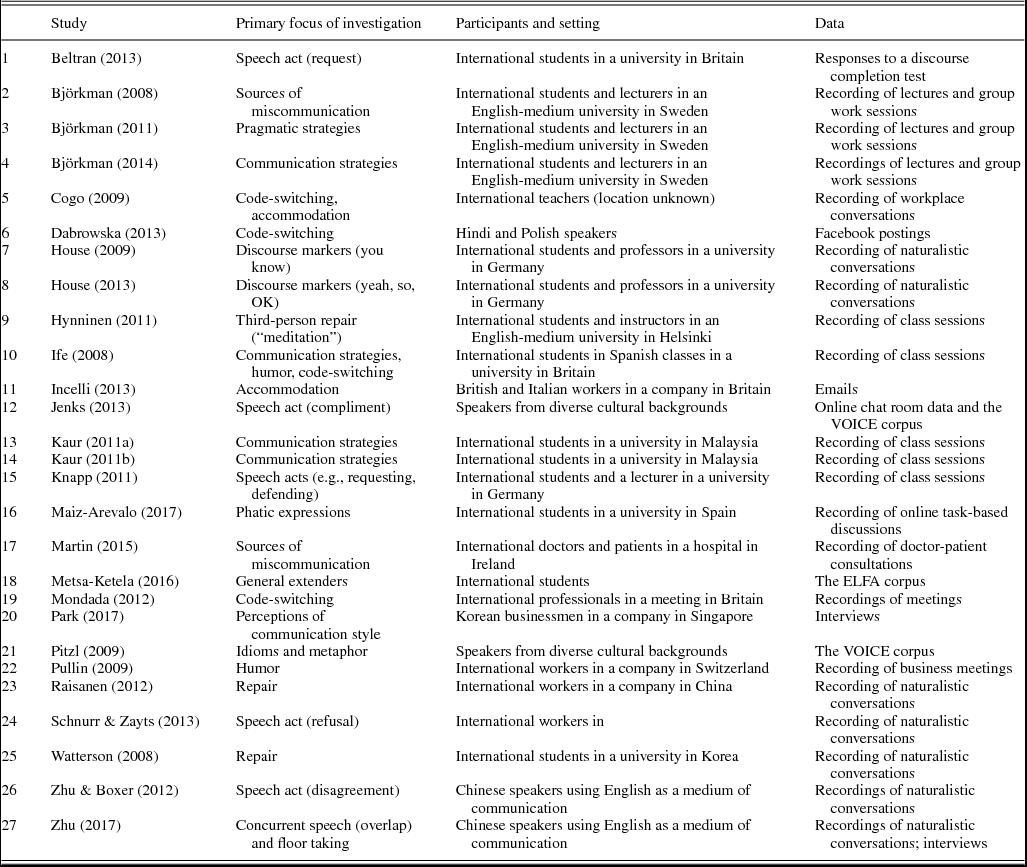
This screening process resulted in 27 primary studies (listed in the Appendix). We proceeded to code each study for participant background, focus of investigation, data collection and analysis methods, and findings (a summary of study features is available for download on IRIS at https://www.iris-database.org/iris/app/home/detail?id=york:934339). After coding the focus of investigation, we grouped the studies according to their investigative similarities. From this process, three main areas of ELF pragmatics research emerged: (a) speech acts as a goal-oriented interactional achievement, (b) strategies for communicative effectiveness, and (c) strategies for accommodation and rapport building. Some studies had more than one pragmatic dimension and thus fall in multiple areas. Hence, the categorization is not completely clear-cut but overlapping. The next section presents findings in these areas.
2.3. Synthesis Findings
2.3.1. Speech Acts as a Goal-Oriented, Interactional Achievement
Among the 27 studies, seven studies examined speech acts, but not all studies analyzed speech acts as an interactional achievement. Beltran (Reference Beltran2013) used a discourse completion test (DCT) to elicit a speech act (request) from international students in a British university and categorized speech act utterances according to strategy type (e.g., imperatives, hinting). The centrality of the native-speaker model is evident in this study; the DCT scenarios were piloted with native English speakers who rated the “real-life authenticity” (p. 120), and ELF speakers’ requests were compared to the baseline native-speaker data for the level of directness. Zhu and Boxer's (Reference Zhu, Boxer, Félix-Brasdefer and Koike2012) study is also similar in that they analyzed disagreement by counting frequencies of direct and indirect strategies.
Other studies departed from using speech acts as individual units of analysis and incorporated a dynamic view of speech acts as negotiated, co-constructed sequences (Jenks, Reference Jenks2013; Knapp, Reference Knapp2011; Schnurr & Zayts, Reference Schnurr and Zayts2013). Consequently, they revealed the ontogenesis of speech act strategies—why certain strategies emerged at a certain point of a conversation, as well as the perlocutionary effect of those strategies, or what interactional outcomes the strategies brought to participants.
Schnurr and Zayts (Reference Schnurr and Zayts2013) analyzed indirect refusals from employees to their supervisors in multicultural workplaces in Hong Kong. They identified a variety of refusal strategies, such as providing explanations or elaborating on alternative solutions. These strategies were contingent on the emergent reactions in the preceding turns and were embedded in a sequential organization. Multiple refusal strategies intersecting in a speech act sequence are an indication that participants coordinated their contributions through turn-taking to achieve a communicative goal.
Jenks's (Reference Jenks2013) study also examined the co-construction of speech acts along with co-construction of “English learner” identity. Jenks analyzed compliment sequences in international chat room data, focusing on compliments about the recipient's English abilities. Compliment providers assessed their interlocutor's English proficiency through compliments, which in the subsequent turn, the interlocutors accepted and further elaborated on, enacting their English learner identity.
Exploring speech acts as an interactional accomplishment is not a new trend. With the surge of interactional pragmatics (Clark, Reference Clark1996) and widespread use of conversation analysis (Sacks, Schegloff, & Jefferson, Reference Sacks, Schegloff and Jefferson1974), speech acts are currently viewed as co-constructed entities in discourse. This trend has also become prominent in L2 pragmatics research; more recent studies have focused on how L2 learners collaboratively construct speech acts turn-by-turn (e.g., Dippold, Reference Dippold2011). However, what is unique in the speech act analysis in ELF is the researchers’ attention to the perlocutionary effect or the outcome of co-constructed acts. For instance, Schnurr and Zayts's (Reference Schnurr and Zayts2013) data showed that because their supervisors were persistent with their requests, the employees canceled their refusal and acknowledged the request with “OK” and “yeah.” The perlocutionary effect of refusals documented in the data indicates the goal-driven nature of ELF talk. Participants are oriented toward the problem at hand with the goal of reaching a mutual solution while negotiating face and power relations.
The studies described here did not discuss the role of L1 cultural influence in the analysis, stating that they found no evidence of participants’ cultural backgrounds affecting their refusals or compliments. The lack of cultural influence could be due to the studies’ focus on the pragmalinguistics aspect of the interaction. An emphasis on the sociopragmatics dimension reveals that culture-specific norms can impact performance of speech acts. For example, Knapp (Reference Knapp2011) described a conflict between a German lecturer and an Indian student in a German university. The student (Ranjit) skipped group-project meetings, and the group complained to the lecturer, who asked Ranjit to explain. Instead of performing the requested speech act, he performed a different one: pleading for another chance to contribute to the group. Due to the Indian value of hierarchy, certain speech acts (e.g., defending) were difficult to perform with someone of higher status. Hence, what the lecturer considered an appropriate speech act in this situation was perceived as otherwise by Ranjit. Park (Reference Park2017) also found the impact of L1 sociopragmatic norms on a speech act. Park interviewed Korean businessmen in multicultural corporations in Singapore and found that, due to the Korean value of modesty, participants avoided bolstering their achievements in front of their supervisors, even though they were aware of the need to do so.
The struggle in deciding whether to adopt expected norms reveals the criticality of sociopragmatics in ELF pragmatics. This tendency contrasts with many L2 pragmatics studies in which the pragmalinguistics of speech acts (e.g., semantic strategies, internal/external modifications) are the primary focus, and sociopragmatics are mainly treated as contextual factors (e.g., power, social distance) that affect the choice of pragmalinguistic forms. However, ELF research considers how the speaker's agency influences one's choice to accept or reject other norms based on their previously learned pragmatic repertoire.
2.3.2. Strategies for Communicative Effectiveness
The previous section discussed how ELF researchers examined the construct of speech acts in an interaction-sensitive manner by specifically attending to perlocution in the sequence, as well as sociopragmatic agency in performing a speech act. This section turns to the area of interactional management in ELF pragmatics research.
A trend found in the studies reviewed here is the researchers’ explicit focus on the functional aspects of ELF discourse for communicative effectiveness. Several studies examined linguistic and discursive devices that promote smooth continuity in ongoing talk. House (Reference House2009, Reference House2013) analyzed the use of discourse markers (e.g., “you know”) in an international university in Germany. Maiz-Arevalo (Reference Maiz-Arevalo2017) focused on phatic expressions in online discussions among graduate students of different nationalities. Metsa-Ketela (Reference Metsa-Ketela2016) analyzed general extenders (vague expressions such as “stuff like that”) for indicating uncertainty, saving face, and organizing discourse. In these studies pragmatics is viewed as a discourse-level tactic that contributes to the facility of interaction. The ability to use discourse markers, phatic expressions, and general extenders enables ELF speakers to communicate and manage interaction efficiently.
Aside from the discourse tactics, communicative effectiveness has been explored from the standpoint of problem-solving strategies. Ten studies examined how ELF speakers use communication strategies to negotiate meaning, support comprehension, and establish common ground. These studies indicate that the study of ELF pragmatics goes beyond the level of pragmalinguistics and sociopragmatics that the traditional interlanguage pragmatics research focuses on. Rather, the primary focus in ELF pragmatics is interactional competence (Young, Reference Young and Hinkel2011)—how speakers construct mutual understanding while coping with problems of miscommunication and nonunderstanding.
Several studies revealed sources of communication difficulties in ELF interactions (Björkman, Reference Björkman2008; Kaur, Reference Kaur2011a; Martin, Reference Martin2015). Martin (Reference Martin2015) analyzed doctor–patient consultations in ELF in an Irish hospital. Data revealed patients’ interactional challenges stemming from their linguistic problems (e.g., lack of vocabulary), unfamiliarity with consultation styles, and differences in cultural assumptions. Kaur (Reference Kaur2011a) analyzed classroom interactions in an English-medium university in Malaysia and found that ambiguity and lack of clarity were major sources of misunderstanding, while linguistic problems (e.g., grammatical errors) were rarely the cause.
Other studies focused on the actual strategies used to preempt or solve communication difficulties. Kaur (Reference Kaur2011b) found that self-repair was a common strategy for improving clarity. ELF speakers often used self-corrections to address linguistic errors, mostly when the errors were perceived as high stakes, which impeded understanding. Björkman (Reference Björkman2008, Reference Björkman2011, Reference Björkman2014) developed the taxonomy of self- and other-initiated repair strategies that promote communicative effectiveness based on ELF data in Sweden. Dabrowska (Reference Dabrowska2013) analyzed code-switching as a compensatory strategy in Facebook postings by Polish and Hindi speakers.
While these studies analyzed repair strategies in isolation, other studies situated repair as a co-constructed interactional achievement. Watterson (Reference Watterson2008) demonstrated how repair is constructed collaboratively via turn-taking among ELF speakers in Seoul. Watterson identified four stages of repair: (a) trigger (cause of nonunderstanding), (b) indicator (indication of nonunderstanding by the listener), (c) response (attempt of repair by the speaker), and (d) reaction (confirmation of a problem being solved). Collaborative repair was also found in Hynninen's (Reference Hynninen2011) study. Using data from an English-medium university in Helsinki, Hynninen revealed instances of “mediation,” or a third-person intervention, where the third person steps in and does repair work by paraphrasing a problematic utterance (e.g., “what he would like to know is . . .”). While many studies conducted linguistic-level analyses, Raisanen (Reference Raisanen2012) addressed multimodal dimensions of repair work. A Finnish engineer and his manager in an international company in China achieved shared understanding by using all semiotic resources available to them, including gestures, gaze, body postures, and artifacts such as paper and pen.
These findings demonstrate that ELF interactions are conceptualized as cooperative and meaning-driven, oriented toward mutual understanding. Mutual understanding is co-constructed and monitored turn-by-turn as participants deploy communication strategies to increase explicitness or to preempt and resolve communication problems. These communication strategies—often called pragmatic strategies by ELF scholars (Björkman, Reference Björkman2011; Cogo & House, Reference Cogo, House, Barron, Gu and Steen2017; Mauranen, Reference Mauranen2006)—have been a prominent area of ELF research. In fact, Björkman (Reference Björkman2011) claimed that pragmatics has guided the direction of ELF research because pragmatics addresses mutual cooperativeness, the main characteristic of ELF interaction. Björkman observed (p. 951):
The work on ELF started with studies in pragmatics, arising from the need to understand how non-native speakers of English communicate with each other. These studies in ELF pragmatics have investigated the critical issue of understanding and the resolution of non-understanding in ELF contexts with reference to pragmatic strategies.
This quote and the primary studies in this synthesis tell us that pragmatics in ELF research extends its focus beyond the notions of politeness and directness or pragmalinguistic and sociopragmatic competence that L2 pragmatics studies have predominantly focused on. ELF pragmatics focuses on how speakers use discourse tactics, conversation moves, and communication strategies to support smooth interaction and joint meaning-making. An effective pragmatic act in ELF is ultimately about interactional effectiveness, rather than proximity to native-speaker norms. Its success can be assessed in terms of whether speakers achieve mutual understanding by using linguistic and interactional resources in a creative, flexible manner. Interactive and interpretive work that ELF speakers engage in using various tactics is at the core of pragmatics in ELF research.
2.3.3. Strategies for Accommodation and Rapport Building
Six studies examined accommodation strategies for solidarity building as a target area of investigation. Accommodation, defined as the way in which speakers adjust their speech to their interlocutors (Giles & Coupland, Reference Giles and Coupland1991), is a common phenomenon in ELF. An early study in this area is Firth's (Reference Firth1996) analysis of phone conversations among international business workers. A critical point of the study is that ELF speakers’ nonstandard forms are resources for achieving mutual intelligibility and rapport. Data showed that, when their interlocutor produced a nonstandard form, ELF speakers did not correct the form. Instead, they purposefully incorporated the marked form into their own utterances, creating synergy with their interlocutors. By letting marked forms pass or adopting the forms in their own speech, ELF speakers displayed alignment and cooperation (Firth, Reference Firth1996). The supposition of normality despite linguistic problems (Firth, Reference Firth1996) was also documented in Incelli's (Reference Incelli2013) study, which analyzed emails among international workers in a British company. Accommodation practice is also found in Pitzl's (Reference Pitzl, Mauranen and Ranta2009) analysis of a corpus of ELF conversations, which revealed ELF speakers’ creative, nonstandard use of idioms (e.g., saying “We should not wake up any dogs” to mean “Let sleeping dogs lie.”). These examples illustrate how nonstandard, invented idioms are accommodated by ELF speakers as a shared discourse repertoire, contributing to their solidarity and in-group membership.
Code-switching is another indicator of accommodation; ELF speakers use it to display their international identities and accommodate to each other's cultural backgrounds. Mondada (Reference Mondada2012) documented an instance of code-switching in a multilingual meeting in France. Mondada described an episode of language shift from a monological (English only) to a bilingual regime (French and English). This shift occurred to facilitate participation of a French speaker who was an expert on the topic, but could not contribute to the discussion fluently in English. This episode illustrates the multiplicity and plasticity of linguistic choices in ELF discourse. ELF speakers adjust their choices in real-time to local constraints and communicative goals. Cogo's (Reference Cogo, Mauranen and Ranta2009) study also revealed the multicultural identity that ELF speakers enact via code-switching. Cogo illustrated a case where two ELF speakers of different L1s (Italian and Japanese) switched to their shared third language (L3; Spanish) in a casual workplace conversation. There was no functional purpose of this code-switching, like compensating for linguistic deficiency. Instead, their creative use of multilingual repertoire was a strategy signaling affiliation with the community of multilingual speakers.
While Mondada's and Cogo's studies documented code-switching from ELF to another language (L1 and L3), Ife (Reference Ife, Soler and Jordà2008) revealed instances of code-switching in the opposite direction—from L3 to ELF. In Spanish classes in a British university, students from different L1s often shifted to their common language, ELF, as aids for learning and communication. This code-switching displayed a range of pragmatic meanings—regret, irony, and humor—indicating that students used ELF as a mutual resource for rapport building. Using conversation data among international workers in Switzerland, Pullin (Reference Pullin, Mauranen and Ranta2009) presented a variety of cases where humor was used to mitigate power, overcome tension, and promote solidarity. Notably, participants’ L1 became a source of humor, illustrating pluralistic linguistic options available in ELF talk.
Rapport building is found in other discourse features, such as floor taking and topic shifting. Zhu's (Reference Zhu2017) analysis of ELF conversations in China demonstrated how an extended overlap leading to a floor transition, which violates ritual organizational structure of turn-taking, actually helped maintain rapport, because the overlap was used to elaborate on the interlocutor's statement. Concurrent speech was co-constructed among ELF speakers based on their shared backgrounds and goal orientations.
2.3.4. Summary: What Is Pragmatic Competence in ELF?
The previous section presented a scope of ELF pragmatics research in three areas: (a) speech act as interactional achievement, (b) strategies for communicative effectiveness, and (c) strategies for accommodation and rapport building. Through a synthesis of 27 studies, pragmatic competence in ELF can be summarized as follows:
• Ability to shape illocutionary force according to the interlocutor's reactions and jointly construct a speech act sequence via turn-taking
• Ability to co-construct mutual norms and standards of what is appropriate and acceptable in a given situation without necessarily adhering to native-speaker norms
• Ability to navigate the communicative demands skillfully by using a variety of communication strategies and discourse devices to achieve mutual understanding
• Ability to display alignment with the interlocutor's linguistic acts and needs, developing shared discourse repertoire for rapport management
These representations of pragmatics in ELF transform our understanding of pragmatics from pragmalinguistics and sociopragmatics knowledge alone to the enactment of the knowledge as speakers seek mutual understanding and common ground in interaction. Pragmatics in ELF is viewed as a joint action rather than an individual work. A successful pragmatic act is not about demonstrating native-like pragmalinguistic and sociolinguistic knowledge. Rather, it is about calibrating and adjusting one's own pragmalinguistic and sociopragmatic resources, as well as other linguistic and semiotic resources, to the interlocutor and context in order to achieve a communicative goal. Pragmatic norms of what is appropriate and acceptable are locally negotiated among speakers based on what is feasible and practical for them in the context of interaction. Pragmatics in ELF is a representation of creativity and adaptation in intercultural communication. The next section explores how some of these dimensions of ELF pragmatics can be taught in various instructional contexts.
3. TEACHING THE PRAGMATICS OF ELF
The question of whose norms should be used for the instruction, assessment, and curriculum or materials development often arises for global English. Implied in this complicated question is the idea that there is no single method applicable to all instructional contexts (Gimenez, Calvo, & El Kadri, Reference Gimenez, Calvo, El Kadri, Bayyurt and Akcan2015; Marlina & Giri, Reference Marlina and Giri2014). This is equally true of pragmatics instruction. Thus far, there is a small body of literature relevant to the teaching of ELF pragmatics (e.g., Baker, Reference Baker, Holmes and Dervin2016; Canagarajah, Kafle, & Matsumoto, Reference Canagarajah, Kafle, Matsumoto and Yiakoumetti2012; House, Reference House, Alsagoff, McKay, Hu and Renandra2012; Murray, Reference Murray2012). Based on this literature, we propose interrelated pedagogical principles for ELF pragmatics, described in this section.
Currently, the most prevalent approach among pedagogically oriented literature is based on native-speaker norms (e.g., Houck & Tatsuki, Reference Houck and Tatsuki2011; Tatsuki & Houck, Reference Tatsuki and Houck2010). One possible reason for this tendency is that an inner-circle native-speaker model is treated as the default and assumed to be the “proper” model due to its status and prestige. This is true in English as a second language (ESL) contexts, where students are often expected to “acculturate” or at least to be aware of how “mainstream” people communicate. This convention also prevails in many English as a foreign language (EFL) contexts (e.g., Ronald, Rinnert, Fordyce, & Knight, Reference Ronald, Rinnert, Fordyce and Knight2012; Tatsuki & Fujimoto, Reference Tatsuki and Fujimoto2016). Another justification for the reliance on inner-circle norms is an explicit awareness-raising approach. Despite acknowledgment of diverse pragmatic norms in global varieties of English, the inner-circle model is often prioritized in awareness-raising instruction due to researchers’ or teachers’ familiarity with native-speaker norms (DeCapua & Dunham, Reference DeCapua and Dunham2007). Still another reason is that the pragmatic features of other English varieties are considered underresearched or relatively unknown to teachers and researchers. In any case, alignment with native-speaker standards is typically viewed as successful L2 learning, and learner language is often assessed by how much it approximates native-speaker norms. However, instruction built exclusively on inner-circle norms is not culturally relevant to L2 learners whose needs involve interacting with other ELF users in global contexts. Departing from the current practice, we propose three pedagogical principles for ELF pragmatics: (a) diversifying the models of pragmatic language use, (b) preparing learners to become ethnographers while cautioning against essentialism, and (c) developing meta-pragmatic awareness and use of strategies for communicative effectiveness. As both local and global needs must be taken into consideration to design a culturally relevant pedagogy (Ladson-Billings, Reference Ladson-Billings1995), our proposals should be regarded as suggestive in nature and are meant to serve as a springboard for further discussion.
3.1. Diversifying the Models of Pragmatic Language Use
This pedagogical principle derives from a common thread running through much of the literature related to ELF pragmatics, that is, to diversify the models of pragmatic uses that learners are exposed to (e.g., Gu, Reference Gu, Alsagoff, McKay, Hu and Renandra2012; Matsuda & Friedrich, Reference Matsuda, Friedrich and Matsuda2012; Murray, Reference Murray2012). The studies reviewed in the previous section, as well as other studies, have uncovered unique features of ELF pragmatics, demonstrating a shift away from native-speaker norms as a single model of pragmatics (see also Taguchi & Roever, Reference Taguchi and Roever2017). In addition to the inner-circle models often used in teaching L2 pragmatics, authentic, evidence-based ELF samples—spoken or written—can be presented to learners so they can analyze how meaning is negotiated in discourse. This approach runs parallel to the teaching of ELF pronunciation, where ideal pedagogy entails exposing learners to various English accents (e.g., Walker, Reference Walker2010). Treating the pragmatics of global English varieties as legitimate can help deconstruct the prevalent linguistic imperialism (Phillipson, Reference Phillipson1992) and dismantle the stigma attached to localized varieties, while promoting linguistic equality and plurilingualism.
In interlanguage pragmatics, divergences from native-speaker norms are typically viewed as manifestations of underdeveloped interlanguage, learner deficiency, or negative L1 transfer. Under our ELF approach, however, divergences from inner-circle models demonstrated by L2 learners are reconceptualized as interactional resources that constitute diversified models in pragmatics-focused instruction. Notably, these diversified norms may serve only as receptive models for comprehension and may not serve as models for production (Wen, Reference Wen2012), unless learners elect to incorporate the localized features into their own expression.
In discussing pedagogy, we take a pragmatic (i.e., practical) approach using research findings from literature broadly relevant to global language uses. ELF researchers may contest that the characterization of norms in global varieties of English—even empirically established norms—reflects a static view of language. However, from the practical point of view of teaching a variety of learners in a range of contexts, learners’ awareness of pragmatic features of ELF varieties can form a foundation of learners’ intercultural and (meta-)pragmatic awareness (see Section 3.3) on which context-dependent, fluid negotiation of meaning can emerge. That is, with knowledge of different expressions of face and politeness in different cultures, learners are better able to flexibly negotiate in ELF contexts by exercising their meta-pragmatic awareness of their own and world cultures (Gu, Patkin, & Kirkpatrick, Reference Gu, Patkin and Kirkpatrick2014). Next we begin with awareness-raising tasks for learners of lower proficiency who have little contact with users of other languages.
The speech act of request is among the most researched areas in pragmatics, and thus the findings can be applied to ELF pragmatics instruction. Beginning-level learners who have little experience with authentic L2 interactions can start building an awareness of different negotiation strategies for requests. For example, learners can analyze request sequences by speakers of Chinese, Indonesian, and Japanese, in which abundant background information is given as facework preceding the actual request (Kirkpatrick, Reference Kirkpatrick and Sharifian2015; Kirkpatrick & Xu, Reference Kirkpatrick and Xu2002). This phase of instruction may be furthered by a fine-grained analysis of different levels of directness in requests, for example, in their own English variety (or varieties), Black South African English (BSAE), and English spoken by Palestinian-Arabic speakers. While conventionally indirect interrogative forms (e.g., would/could you) are common in many languages, BSAE prefers the use of explicit performatives (e.g., I'm asking for . . .), which may be a shared feature of many of the African languages spoken in South Africa (Kasanga, Reference Kasanga2006). In Palestinian-Arabic English, the level of politeness in requests as well as that of indirectness indexed by silence was found to be relatively low (Atawneh & Sridhar, Reference Atawneh and Sridhar1993). Learners can identify these characteristics by comparing samples of requests or statistics shown in the above-mentioned studies and reflecting on or analyzing their own language of requests.
In these awareness-raising activities, learners can be encouraged to relate the ELF pragmatics features to the local cultures that shape linguistic expressions indexing group identity and solidarity. For example, Babai Shishavan and Sharifian (Reference Babai Shishavan and Sharifian2013, p. 811) showed how indirectness in Persian English refusals is associated with their cultural conceptualizations of tă’ărof (ritual politeness) and ru-dar-băyesti (distance-out-of-respect), which manifest as ritualized routines of ostensible refusing invitations and distance or indirectness indexing their deference. Learners can analyze sample data reflecting these cultural conceptualizations. With an awareness that linguistic expressions can vary across contexts, learners can also collect data on Persian English refusals (e.g., online or in research articles) and examine the trustworthiness of the information (see Section 3.2 on the learners-as-ethnographers approach). It is important that at an early stage of instruction, learners become mindful of judgments and stereotypes toward unfamiliar pragmatic norms and begin to appreciate diversity of world cultures, including pragmatic variation. Other possible instructional targets, as recommended by Kirkpatrick (Reference Kirkpatrick and Sharifian2015), include terms of address, greetings, compliments, other speech acts, the level of formality, and rhetorical styles in ELF. Learners can be given language samples or collect data themselves to analyze pragmatic norms and negotiations manifested in ELF interactions. While high-proficiency adult learners may compare and contrast several ELF pragmatics data excerpts in an extended discourse, young or less proficient learners should handle isolated examples or brief interactional samples from a few ELF varieties at a time.
3.2. Preparing Learners to Become Ethnographers While Cautioning Against Essentialism
Several educators have advocated preparing language learners to act like ethnographers (e.g., Roberts, Byram, Barro, Jordan, & Street, Reference Roberts, Byram, Barro, Jordan and Street2001; Swales, Reference Swales1990). This second approach—the learners-as-ethnographers approach—is also applicable to the learning of ELF pragmatics (e.g., Ishihara & Cohen, Reference Ishihara and Cohen2015; Murray, Reference Murray2012) especially for intermediate- to advanced-level adult learners. As participant observers, ethnographers study social practices of the local community and sociocultural norms of behavior shared by the members. As learners analyze their own interactions with others in a community, they can generate, test, and revise their hypotheses about local practices by attending to their interlocutors’ pragmatics. For instance, novice diplomats can observe expert diplomats in their use of oppositional talk and report back to discuss the outcome of their observations (for sample observation prompts, see Ishihara, Reference Ishihara and Friedrich2016).
For this task, insights from the fields of intercultural communication (e.g., Hofstede's [Reference Hofstede2011] cultural dimensions) and nonverbal communication (e.g., chronemics, kinesics, and proxemics) can be useful. Learners are invited to carefully analyze interlocutors’ cultural backgrounds, manifestations of their identities, and social practices they engage in. For example, by observing interlocutors’ dress, body language, use of time and space, process of decision making, and gender-related role enactments, learners can extrapolate about their interlocutors’ subjectivities, cultural affiliations, and verbal or nonverbal practices that index their identities. Awareness of these cues can aid learners in interpreting their interlocutors’ meaning and determining their next course of action in a contextually contingent manner.
Competent ELF speakers are flexible during interaction, as they draw on multiple linguistic resources adaptively and creatively. The learners-as-ethnographers task can help develop such competence. For example, learners can keep a journal of the occurrences of cultural clashes, misunderstanding, or confusion they experienced, and then they can develop these records into case studies. Teachers and learners can collaboratively interpret these critical incident narratives using insights from intercultural communication, examine potential causes of conflicts, and explore effective solutions. These activities can provide learners with opportunities to reflect on their experiences iteratively, which can lead to deeper, multifaceted understanding of those intercultural interactions. Similar activities include ethnographic diaries or field notes followed by teacher-guided observation of ELF interactions (House, Reference House, Alsagoff, McKay, Hu and Renandra2012) and learners’ self-assessment of pragmatic development through journaling (Fujioka, Reference Fujioka, Tatsuki and Fujimoto2016).
A noteworthy caveat for this learners-as-ethnographers approach is the risk of essentialization, a trap that learners should be cautioned against. Just as with culture, pragmatic norms are fluid, multifaceted, and situated in social practice. Furthermore, with globalization, individuals’ subjectivities are becoming more dynamic and diversified with multiple cultural affiliations; changing historical, political, and social relationships; and shifting worldviews. Therefore, learners should be encouraged to avoid stereotyping, othering, or marginalizing cultures, interlocutors, and their subjectivities. As part of ELF pragmatics instruction, learners can discuss the potential risks of overgeneralization in the learners-as-ethnographers approach and actively employ a nonessentialist view of cultures. As in Holliday, Kullman and Hyde (Reference Holliday, Kullman and Hyde2017), through analysis of critical incident narratives learners can study how essentialist ideas, such as stereotyping, othering, prejudice, and marginalization, can creep in to develop an awareness of unequal distribution of power, status, and privilege, as well as of historical and political relationships between different cultural groups (Kramsch, Reference Kramsch2006).
3.3 Developing Meta-Pragmatic Awareness and Use of Strategies for Communicative Effectiveness
The third pedagogical principle includes developing learners’ meta-pragmatic awareness using authentic interactional data of ELF encounters. Meta-pragmatic awareness refers to explicit knowledge about social meaning of a linguistic form in context, as well as awareness of how the form constitutes various dimensions of the context (Kinginger & Farrell, Reference Kinginger and Farrell2004). Meta-pragmatic awareness allows learners to reflect on their understanding of a certain phenomenon and “bring into awareness the particular cultural frames or assumptions which are at work in the interpretive process” (McConachy, Reference McConachy2013, p. 102). The learners-as-ethnographers approach discussed in Section 3.2 can promote meta-pragmatic awareness.
In addition, the features of ELF discourse identified in the literature can also serve as a resource for enhancing meta-pragmatic awareness. While ELF interactions are not monolithic and can demonstrate communicative difficulties (e.g., Kaur, Reference Kaur2011a; Knapp, Reference Knapp2011; Martin, Reference Martin2015; Mortensen, Reference Mortensen2013), ELF interactions are found to be largely supportive, meaning-focused, and oriented toward mutual understanding. For example, using the “let-it-pass” and “making-it-normal” strategies (Firth, Reference Firth1996), ELF users deliberately divert attention from linguistically problematic forms they encounter to sustain the conversation and maintain the appearance of normality. These inclinations for rapport and solidarity are relevant to a great extent of tolerance of ambiguity or infelicities typically found in ELF (Murray, Reference Murray2012). To develop such strategies, learners can be presented with excerpts of transcribed ELF interactions and guided to discover these underlying strategies. Such process of discovery and understanding can also enhance their meta-pragmatic awareness of typical ELF interactions.
In the synthesis review of existing findings (see Section 2.3.2), we discussed strategies for communicative effectiveness from the standpoint of discourse tactics, problem-solving strategies, and communication strategies, which are used to negotiate meaning, support comprehension, and establish common ground. Self- and other-initiated repair often support communicative effectiveness (Björkman, Reference Björkman2008, Reference Björkman2011, Reference Björkman2014) and thus can be taught to L2 learners. Other strategies for communicative effectiveness that may be suitable for instruction include the use of: discourse markers, confirmation checks (e.g., paraphrasing, repetition, and overt question), clarification requests, explicitness strategies (e.g., repetition, simplification, signaling importance, and paraphrasing), and represents (i.e., supporting interlocutors by echoing or mirroring their utterances) (e.g., see Björkman, Reference Björkman2014; House, Reference House2009).
ELF speakers also tend to use less mitigation and more directness, creative language, code-switching, and humor (House, Reference House and Trosborg2010, Reference House, Alsagoff, McKay, Hu and Renandra2012; Mondada, Reference Mondada2012; Pitzl, Reference Pitzl, Mauranen and Ranta2009; Pullin, Reference Pullin, Mauranen and Ranta2009). House (Reference House and Trosborg2010), for instance, uncovered how brief code-switching to a shared language can be used as an inserted sequence while maintaining the smooth flow of the original interaction. House (Reference House, Alsagoff, McKay, Hu and Renandra2012) argued that, because this type of code-switching occurs naturally in interaction, it should be taught to L2 learners, for example, through analysis of recorded and transcribed conversations.
Since communication strategies are not automatically available to all language users (e.g., native, nonnative, or ELF), explicit awareness-raising instruction on communication strategies can be beneficial (Gu, Reference Gu, Alsagoff, McKay, Hu and Renandra2012). However, because the use of communication strategies is highly context-dependent and constrained by the institutional settings and local goals (Björkman, Reference Björkman2014; Wen, Reference Wen2012), it is challenging to identify specific strategies to prioritize in instruction for a particular group of learners. It is also unclear to what extent instruction in this area is facilitative.
3.4 Addendum for ELF Pragmatics Instruction
In addition to the three pedagogical principles for ELF pragmatics, we present two additional musings. First, in order to introduce an ELF paradigm that is apparently distinct from the conventional dominance of inner-circle native-speaker norms (Dewey, Reference Dewey2012), the instruction may well start with an awareness raising of linguistic diversity and plurilingualism in general and the status of ELF in today's globalization, followed by an explicit communication about the instructional objectives. Despite the prevalent native-speaker model, ELF users are entitled to the ownership of their varieties and should be empowered to remain independent of native-speaker norms and judgments, and to maintain negotiation of their subjectivities as part of their linguistic rights (Ates, Eslami, & Wright, Reference Ates, Eslami and Wright2015; Canagarajah et al., Reference Canagarajah, Kafle, Matsumoto and Yiakoumetti2012). This awareness may be achieved by discussing the status of diversified and localized English varieties in the world and the prevalence of lingua franca interactions between nonnative speakers across linguistic and cultural borders, which elucidates the relevance of ELF paradigm to learners’ imminent needs (for sample instructional tasks, see Gimenez et al., Reference Gimenez, Calvo, El Kadri, Bayyurt and Akcan2015; Gu, Reference Gu, Alsagoff, McKay, Hu and Renandra2012).
Second, in an extension of accommodation and rapport-building strategies (see Section 3.3), we would propose ELF pragmatic instruction reflecting a mind-set of “the benefit of the doubt,” or general attitude of empathy, compassion, and respect—constructs borrowed from peace linguistics (Crystal, Reference Crystal1999; Friedrich, Reference Friedrich and Chappelle2013; Gomes de Matos, Reference Gomes de Matos, Coleman, Deutsch and Marcus2014). Crystal (Reference Crystal1999) delineated peace linguistics as transcending the notion of peace (i.e., absence of violence or war) to encompass human rights, linguistic diversity, and plurilingualism. As language can be used to either create solidarity, connection, and dignity, on the one hand, or to incite hostility, hatred, and violence, on the other, ELF users should be mindful of the potential outcome of their language use. Learners can be exposed to models of interactions in which interlocutors’ linguistic rights and dignity are respected. Along with an enhanced meta-pragmatic awareness of consensus-oriented ELF interactions, learners may opt to espouse optimism for compassionate mutual understanding while engaging in the intercultural negotiation of meaning. (For a sample interaction on this attitude, see Sharifian, Reference Sharifian and Jackson2012; for combining this mind-set with pragmatics-focused instruction, see Ishihara, Reference Ishihara2017.)
4. CONCLUSION AND FUTURE DIRECTIONS
In an attempt to illustrate how realities of globalization have challenged conventional ways of researching and teaching L2 pragmatics, this article first presented recent trends in research in ELF pragmatics and then proposed interconnected pedagogical principles. Although this synthesis review was somewhat limited in scope, extracting studies that explicitly used “ELF” as a key term, general trends indicate that pragmatics in ELF has been viewed as communicatively effective and rapport building, as opposed to a strict adherence to native-speaker norms. However, unfortunately, few of the studies reviewed here offer robust pedagogical implications, echoing the sentiments of the teachers who characterized ELF as a “pie-in-the-sky” (Dewey, Reference Dewey2012). In order to narrow this gap, we hope that further research will uncover the complex undertakings of ELF negotiations, which can serve as a foundation for research-based ELF pedagogy.
Future research needs to expand the database of ELF pragmatics features. Aside from the features examined in the studies reviewed here (speech acts in interaction, communication strategies, and rapport-building tactics), we need more studies examining the use of linguistic forms in ELF for negotiation of interpersonal meaning. Researchers can focus on forms that occur frequently using linguistic corpora. Candidate features include address forms, response tokens, hedging, discourse markers, and conversation openings and closings. By analyzing how global English speakers use these forms in interaction with others, researchers can reveal characteristics of ELF interactions, such as flexibility and adaptability, through pragmatics lenses.
Another future direction involves expanding on the study of intercultural pragmatics (Kecskes, Reference Kecskes2014). Intercultural pragmatics focuses on how speakers from different cultures negotiate their prior norms and co-construct new norms unique to their communicative situations. Although several studies revealed clashing L1-based sociopragmatic norms among global English speakers (e.g., Knapp, Reference Knapp2011), such research is still underrepresented in the field. Research is even scarcer when it comes to studies of how speakers in ELF contexts negotiate norms and co-construct mutual standards of what is appropriate in a given situation. Although ELF research focuses more on communication strategies than co-construction of norms, given the fluid and context-dependent nature of norms, we argue that investigation into the process of creating mutual standards is an important area of research. To expand future research in this direction, a qualitative, discursive analysis of ELF interaction is necessary. For example, in a confrontational speech event (e.g., disagreement and complaint) researchers can analyze face-saving strategies, conflict resolution techniques, and semiotic resources used during the process.
ELF researchers, if they do not currently teach language learners themselves, may wish to collaborate with practitioners if they wish to more directly link their research to pedagogical applications. Assessment, in the classroom context in particular, is another area that lags behind. It is argued that global English users’ pragmatic production or behavior should be assessed not based on native-speaker norms but in terms of their effectiveness in interactive discourse (Murray, Reference Murray2012; Seidlhofer, Reference Seidlhofer2011). Future research and pedagogy need to explore concrete strategies through which this principle is translated into instruction, assessment, and teacher preparation in various ELF contexts.
Features of 27 Studies Synthesized in this Article