INTRODUCTION
Coping with cancer has significant psychological implications for patients (Merckaert et al., Reference Merckaert, Libert and Messin2010). Despite medical progress and increases in survivorship rates, the disease may be perceived as life threatening, which may lead to psychological distress and avoidance coping (Haisfield-Wolfe et al., Reference Haisfield-Wolfe, McGuire and Krumm2012; Moser et al., Reference Moser, Arndt and Han2013; Posluszny et al., Reference Posluszny, McFeeley and Hall2004). Radiation treatments may lead to psychological distress, depression, and physical distress (Mackenzie et al., Reference Mackenzie, Carey and Sanson-Fisher2013). In addition, the experience of hospitalization can cause emotional distress due to worries about the future, concern regarding former roles, and sleep disturbances, among others (Taylor, Reference Taylor2006).
The community meeting (CM) is a common therapeutic intervention on psychiatric wards (Johnson, Reference Johnson1997), where staff–patient meetings are held regularly. The aim of these meetings is to share personal issues, manage problems in the ward, relate to interpersonal relationships, and deal with needs of which a participant may be unaware (Kreeger, 1974; Rice, Reference Rice, Alonso and Swiller1993). To the best of our knowledge, this kind of intervention has not been implemented in any other general hospital unit, emphasizing the uniqueness and innovation of the group format.
A rather unique group, based on the CM format, emerged six years ago in our radiotherapy unit. The groups' goals were to strengthen patient coping abilities; prompt open communications among staff, patients, and caregivers; and provide information. Meetings are now held in the unit's lounge once a week for 45 minutes. The group includes the unit's multidisciplinary staff (head physician, head nurse, psychologist, social worker, and spiritual guide), inpatients, and caregivers. The participants are recruited by the staff 15 minutes before each gathering. The group operates as an open group, which means that participants may attend only once or even for part of a meeting, while others may attend regularly during hospitalization. On average, 7–9 patients participate in each meeting (about 40% of inpatients). A third participate with their caregiver. On average, 3–4 caregivers participate without the patients. Participants differ in such aspects as disease type, support level, language, culture, and religion. For example, a curative patient who is preoccupied with discharge to home and return to routine might attend with the family members of a terminally ill patient who is hospitalized for pain control and who are worried about his prognosis.
The meetings are facilitated by the psychologist and head nurse. They are conducted in Hebrew, with breaks for translation to Russian and Arabic when required. Each meeting opens with a general statement, inviting participants to raise any issue that might trouble them. Common issues raised by participants are: (1) logistic issues—the timing of radiation treatment or complaints about food; (2) medical issues—questions regarding the disease, causes, and possible treatments; and (3) emotional issues—how to talk with small children about the disease or how to maintain hope in desperate times. After the meeting, staff members gather to share and discuss the meeting's events (e.g., a patient who expressed emotional difficulty and should be offered individual sessions, a confused patient who was referred for an MRI that revealed brain metastases).
Group participants deal with a significant crisis—a life-threatening disease (Annunziata et al., Reference Annunziata, Muzzatti and Bidoli2010; Boesen et al., Reference Boesen, Karlsen and Christensen2011). They are mostly focused on the “here and now” (Boesen et al., Reference Boesen, Karlsen and Christensen2011) and are occupied with practical/medical issues (Yalom & Leszcz, Reference Yalom and Leszcz2006). In this state, their symbolizing abilities, such as the ability to reflect and acknowledge the metaphoric meaning of the group, are minimal (Bermann & Vienberg, Reference Bermann and Vienberg2000). This requires direct and active guidance with a psychoeducational focus (Boesen et al., Reference Boesen, Karlsen and Christensen2011; SAMHSA, 1999; Yalom & Leszcz, Reference Yalom and Leszcz2006).
Several therapeutic factors can exist within the current group framework (Greenstone & Leviton, Reference Greenstone and Leviton2010; Yalom & Leszcz, Reference Yalom and Leszcz2006):
-
1. Illness perception. During meetings, many issues regarding the disease (medical and emotional) can arise. This can enhance patient knowledge and understanding regarding the illness, strengthen their sense of control and self-efficacy, and ease levels of anxiety related to treatments and hospitalization.
-
2. Relations with the main caregiver. During meetings, issues regarding patient–caregiver communications can be discussed, including difficulties in the current context of dealing with the disease. Meetings can encourage more secure and direct communications with the main caregiver, which may strengthen this source of support.
-
3. Relations with other participants. Meetings encourage interaction between patients, mutual support, and sharing. All of these provide a sense of universality, a gathering of people dealing with similar problems and experiencing a feeling of “togetherness.” This can ease distress, reduce the suffering that results from social stigma and isolation, and provide social support and hope. These effects can occur more easily in a group setting than in individual treatment, particularly when those who have shared the same experiences give personal advice, as opposed to staff members who may be perceived as aloof or distant. In addition, meeting other patients can give rise to feelings of altruism, as it enables patients to help one another. The understanding that they have something to give (e.g., advice, support) contributes to patient self-esteem and well-being, enabling the “patient role” to broaden, and shifting the focus away from their personal problems.
-
4. Relations with unit staff. The meeting enables unmediated time with staff and prompts open communication and sharing.
In contrast to the paper by Eliasov and colleagues (Reference Eliasov, Zalman and Flechter2011), which reviewed the community meeting from a theoretical perspective, the current study aimed to quantitatively estimate its effect, specifically on the four therapeutic factors discussed above. We hypothesized that inpatients would perceive these aspects of the CM as positive. Given the nature of the intervention as part of the unit's routine, it was impossible to conduct a randomized controlled trial. Since various variables can influence the therapeutic factors and cannot be evaluated, the decision was made to evaluate participant perception of the factors in the context of the group (e.g., how patients perceive their relations with staff during the meetings), and the questionnaire was designed accordingly.
PATIENTS AND METHODS
Sample and Intervention
The sample included patients hospitalized in the radiotherapy unit between January of 2011 and June of 2012 who participated in CMs during their hospitalization. A few days before discharge, patients were asked by staff members to complete an anonymous questionnaire, written in their mother tongue (Hebrew/Russian/Arabic). The local ethical committee approved the study.
Measurements
Existing questionnaires relating to the four selected factors were examined but were determined to be unsuitable for the current setting, and it was decided that completing four different questionnaires was too cumbersome for participants. Hence, the staff designed a new questionnaire compatible with the needs of the current study and based on the four theoretical factors. The degree of compatibility between the questionnaire's items and the research variables was evaluated and validated by two senior psychologists.
The questionnaire (see Appendix) included the following sections:
-
1. personal and medical information
-
2. questions evaluating participants' perceptions of the following aspects of the CM (rated on a scale of 1–5):
-
a. relations with staff: questions regarding patients' feelings of confidence and closeness with the staff, staff's willingness to help and listen
-
b. relations with the main caregiver: feelings of confidence and closeness with the main caregiver, ability to communicate and seek help from them
-
c. relations with other participants: feelings of closeness with other participants and perceiving them as a source of support
-
d. illness perception: questions regarding cognitive, emotional, and behavioral aspects of the disease
-
e. general satisfaction.
-
-
3. open questions allowing participants to express their opinion regarding specific contributing or disturbing factors in the CM.
Due to the diverse population in the unit, the questionnaire was translated into Arabic and Russian by the process of “back translation” to ensure as accurate a translation as possible (Shaw & Ahmed, Reference Shaw and Ahmed2004).
Statistical Analysis
Due to a large number of missing values, the theoretical factors of the questionnaire were measured by calculating a Cronbach's alpha value rather than by factor analysis. Correlations between variables were tested by two nonparametric tests, both suitable for the current sample: the Mann–Whitney U and Kruskal–Wallis tests.
RESULTS
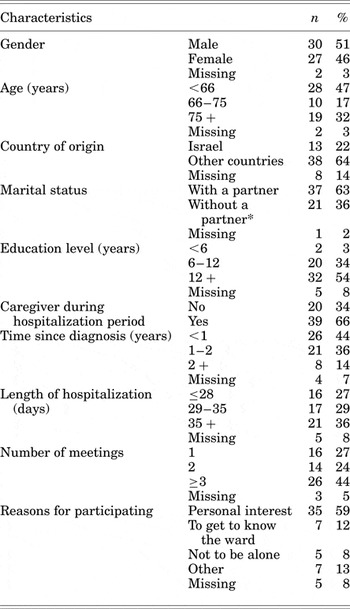
Approximately 720 patients were hospitalized in the radiotherapy unit from January of 2011 to June of 2012, of which 220 participated in CMs. Some 59 patients completed the questionnaire. Table 1 details the demographic and medical characteristics of the sample. The median age of participants was 68. Most were born outside of Israel, were married, and had more than 12 years of education. Some 26 participants were diagnosed during the past year, mostly with breast or colon cancer. Another 38 participants were hospitalized for over a month, and 26 participated in CMs three times or more. The main reason given for participation was personal interest.
Demographic and medical characteristics of participants

*Includes the following categories: single, separated, divorced, widowed.
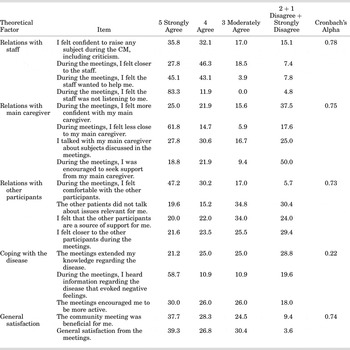
Table 2 details the results of each theoretical factor of the questionnaire. Regarding relations with staff, 68% felt confident to raise any subject during a CM, including criticism (rated 4 or 5), 74% felt closer to the staff, 88% felt the staff wanted to help, and 95% felt that the staff listened to them. Only 42 participants answered the last item, which might be due to its reverse phrasing, which can be misleading, especially considering the heterogeneous population on the unit. The value of Cronbach's alpha for this theoretical subject was 0.78. Statistical analysis revealed that overall perception of this relationship was positive and that none of the demographic or medical factors were significantly correlated to it.
Results of the theoretical factors of the questionnaire (%)

Regarding relations with main caregiver, only patients who had a main caregiver during their hospitalization period (n = 39) answered this section. The caregivers were not necessarily present for the meetings. Some 47% felt more confident with their main caregiver during the meetings, 58% talked with them about subjects discussed in the meetings, and 40% were encouraged to seek their support, while 76% felt less close to their main caregiver. It is highly possible that this item was misunderstood; the reverse phrasing might be the reason for that, so it was not included in the statistical analysis. The value of Cronbach's alpha for this theoretical subject was 0.75. Statistical analysis revealed that none of the factors were significantly correlated to relations with the main caregiver.
Regarding relations with other participants, 77% felt comfortable with the other participants, 35% felt that they talked about relevant issues, 42% felt they were a source of support, and 45% felt closer to them during the meetings. The value of Cronbach's alpha for this theoretical subject was 0.73. Statistical analysis revealed that patients who were born in Israel (n = 13) perceived these relations more positively.
Regarding illness perception, 46% of participants felt that the meetings expanded their knowledge of the disease, and 56% felt they encouraged them to be more active. However, nearly 70% heard information that evoked negative feelings. The value of Cronbach's alpha for this theoretical subject was 0.22. The reasons for this low result will be discussed in the next section.
Participants' general satisfaction with the meetings was relatively high, and most (66%) were satisfied and perceived the meetings as beneficial. The value of Cronbach's alpha for this theoretical subject was 0.74. Statistical analysis revealed that people with a main caregiver and hospitalization duration greater than 28 days perceived the meetings as most beneficial.
Patients' answers on the open questions were subdivided into two main issues: (1) the significance of interactions with the staff—the staff's willingness to help, their attention and support, their openness (e.g., the head physician sharing personal information), and the feeling that the patients were not alone; and (2) sharing and open communication—the importance of talking, sharing, and not keeping things to oneself.
DISCUSSION
The aim of our study was to evaluate patient perception of community meetings held in a radiotherapy unit. The following aspects of the group were evaluated using a questionnaire created specifically for this purpose: relations with staff, relations with main caregiver, relations with other participants, and illness perception.
Participants rated their general satisfaction as high, which reflected the overall contribution of the group. Patients with longer periods of hospitalization were more satisfied. This result can be explained by the sense of belonging and togetherness with the staff and other patients that can consolidate over time. In addition, people who had a main caregiver during their hospitalization were more satisfied with the meetings. Given the importance of this kind of support for patients (Isaksen et al., Reference Isaksen, Thuen and Hanestad2003; Kroenke et al., Reference Kroenke, Kubzansky and Schernhammer2006; Uchino, Reference Uchino2006), it is highly probable that caregivers provide a secure base for patients upon which to form new relationships and better cope with emotions evoked during the meetings.
The most significant and contributing aspect of the meetings, as perceived by the participants, was found to be their relationship with the staff. The overall perception of this issue was highly positive in aspects of feeing close to the staff and perceiving them as willing to help and be attentive. Studies have demonstrated that a positive relationship with staff is related to better medical outcomes (Bankoff et al., Reference Bankoff, McCullough and Pantalone2013; Farin et al., Reference Farin, Gramm and Schmidt2013) and adherence to treatment (Venetis et al., Reference Venetis, Robinson and Turkiewicz2009). In addition, these relationships have a been shown to have a significant impact on a patient's coping ability and well-being (Davidson, Reference Davidson2009; Taylor, Reference Taylor2006). The aspect of listening within this relationship was found to be highly significant for patients as a therapeutic factor and a factor that strengthens the physician–patient relationship (Jagosh et al., Reference Jagosh, Donald Boudreau and Steinert2011).
A relatively high percentage of participants (15%) did not feel confident to raise issues during community meetings. It is possible that doing so in a group setting requires an active approach and a more dominant personality. This begs the question of whether the group format should be reconsidered to be more suitable for other participants (e.g., the staff should raise issues for discussion). On the other hand, the current format encourages people to take a more active role rather than wait for the staff to lead them. Studies have shown that encouraging this role among patients may lead to better care outcomes (Parchman et al., Reference Parchman, Zeber and Palmer2010). In addition, the opportunity to sit together silently, without immediately filling the silence with words and predetermined topics, has great importance. It reflects the ability to stay in the realm of “Being” and not “Doing,” which is highly significant, especially in the medical setting, which is strongly characterized by the latter (Yalom & Leszcz, Reference Yalom and Leszcz2006).
The factor “relations with other participants” was found to be more significant for patients born in Israel. The possible reasons for this may be a higher sense of belonging among native Israelis, cultural differences, or communication difficulties due to the language barrier. Studies have found that relationships with other cancer patients are considered significant due to their ability to provide hope regarding the future, share information, and provide a feeling of being understood and taken care of (Isaksen et al., Reference Isaksen, Thuen and Hanestad2003). Hence, the group setting enables patients to gain emotional support from other patients with similar experiences and is considered an important source of support (Weis, Reference Weis2003).
Despite the initial assumption that the meetings can improve patient–caregiver relations by facilitating communication and sharing, this effect was found to be nonsignificant. It is possible that these relationships consolidated over the years and involved a delicate and intimate dynamic. In the context of the disease, they are a stable coping source for patients (Isaksen et al., Reference Isaksen, Thuen and Hanestad2003); hence, group meetings during hospitalization might not be the appropriate setting to question these interactions.
The factor “illness perception” had a low alpha value. This factor included cognitive, emotional, and behavioral aspects of the disease, which were selected based on staff experience with common content in the meetings. It is possible that participants perceived these contents differently from the staff; for example, they did not focus on the cognitive aspect of the information provided, but on their feeling of being heard and understood.
The group format relates to the multidimensional aspects of patients coping with the disease; it provides medical information, encourages open communication with staff members, aims at strengthening social resources (family members and other inpatients), and provides a secure place for sharing personal issues. The attendance of a multidisciplinary staff also reflects a recognition of patients' diverse needs and the importance of treating them in a holistic manner. This reflects the bio-psychosocial model proposed by Engel (Reference Engel1977), focusing on the patient as an individual with a subjective interpretation, a cultural background, and a social context (Fave et al., Reference Fave, Massimini and Bassi2011)— all relevant aspects of patients' coping and adjustment.
CONCLUSIONS
Despite the methodological limitations, it should be noted that the main significance of the community meeting is the personal and unmediated interaction of patients with staff, an interaction that provides an opportunity for sharing and for building a sense of togetherness. General hospital wards dealing with chronic illnesses should consider introducing such interventions. Future studies with larger samples and structured measures should be conducted in order to better understand the effects of this unique kind of group setting. Future studies could also measure the impact of community meetings on staff and caregivers.
PRACTICE IMPLICATIONS
The community meeting format should be incorporated into hospital wards, as it contributes to patient satisfaction by facilitating attentive and unmediated interaction with staff.
LIMITATIONS
The current study has some limitations. The number of questionnaires from patients who participated in community meetings (n = 59) was not sufficient considering the length of our study. This may have resulted from the timing of questionnaire completion, a few days before discharge, when people were likely preoccupied with different issues. Additionally, patients who did not participate in community meetings were also asked to complete a questionnaire, which included medical and personal information, as well as questions regarding their reasons for not participating. Only 27 patients completed this questionnaire. The possible reasons for this low compliance rate may be the same as those for nonparticipation: patients with a more introverted personality. Regardless, due to the small number of questionnaires, we decided to not include them in the statistical analysis. Finally, patients who perceived an improvement in their relations with the staff may have felt obligated to complete the questionnaire, resulting in a bias that may overestimate the benefits of the intervention.
CONFLICTS OF INTEREST
None of the authors have any conflicts of interest to declare.
APPENDIX: THE STUDY QUESTIONNAIRE
The following questionnaire refers to the community meetings, held weekly in the ward's lounge. Completing the questionnaire will help the staff better understand and address the needs of inpatients.
The questionnaire is anonymous and is used solely for the purposes of the current research.
-
1. Date: ___/___/_____
-
2. Gender: 1. Male 2. Female
-
3. Year of birth: ______________
-
4. Country of birth: _________________________
-
5. Year of immigration to Israel: 1. 2007–2010 2. 2000–2006 3. Before 2000 4. Born in Israel
-
6. Years of education: __________
-
7. Marital status: 1. Single 2. Married 3. Separated 4. Divorced 5. Widow/er
-
8. Number of children: _______________
-
9. Number of children under 18 years of age: ______________
-
10. Type of cancer: 1. Breast 2. Colon 3. Lung 4. Prostate 5. Pancreas 6. Stomach 7. Sarcoma 8. Melanoma 9. Other ________________________
-
11. Date of diagnosis: ___________________
-
12. Duration of current hospitalization: ___________________
-
13. Reason for current hospitalization: 1. Chemotherapy 2. Radiotherapy 3. Chemoradiation 4. Treatment complications; 5. Disease complications 6. Palliative care
-
14. Level of mobility: 1. Mobile 2. Using a walker 3. Using a wheelchair 4. Bedridden
-
15. How many times during the current hospitalization have you participated in the community meeting? ________________
-
16. Why have you participated in the meetings?
1. It interested me 2. To pass the time 3. I felt uncomfortable to refuse the staff's invitation 4. To get familiar with the ward 5. Not to be alone
6. Other ___________________________________
-
17. Did you need translation during the meetings? 1. Yes 2. No
-
18. Do you have a main caregiver? 1. Yes 2. No
-
19. If yes, who?
1. Spouse 2. Child 3. Parent 4. Brother/sister 5. Friend 6. Other ____________
-
20. What is the degree of support?
1. High 2. Moderate 3. Low 4. Other ____________
-
21. Did your caregiver participate in the community meetings? 1. Yes 2. No
-
22. If yes, in how many meetings did s/he participate? ____________
-
23. In how many did s/he participate without you? ____________
Please rate the following statements regarding the community meeting:

-
41. I will recommend that other patients participate in the group: 1. Yes 2. No 3. Not sure
-
42. Please indicate which factors were meaningful to you during the meetings:
_______________________________________________
_______________________________________________
-
43. Please indicate which factors disturbed you during the meetings:
_______________________________________________
_______________________________________________
-
44. Please describe a meaningful moment you experienced during meetings:
_______________________________________________
_______________________________________________
Please make sure you have completed all items.
Thank you for your cooperation!